DIGITAL PHOTOGRAPHY IN DENTISTRY
DR.ANANT AGARWAL, M.D.S III, CPGIDS
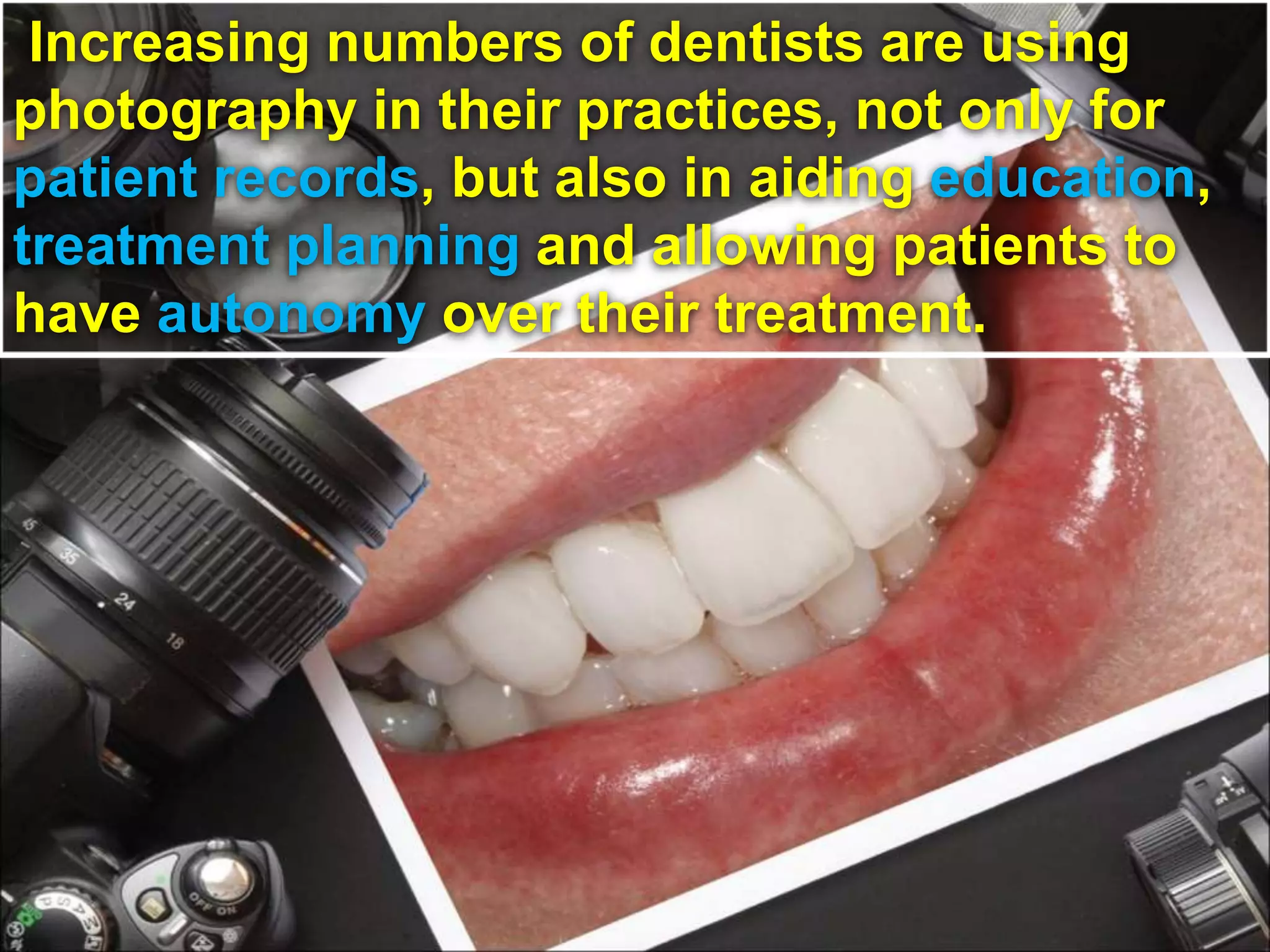
Increasing numbers of dentists are using
photography in their practices, not only for
patient records, but also in aiding education,
treatment planning and allowing patients to
have autonomy over their treatment.

FUNDAMENTALS OF DIGITAL DENTAL
PHOTOGRAPHY
1. An overview.
2. Purposes and uses.
3. Principles of digital photography.
4. Choosing a camera and accessories.
5. Lighting.
6. Camera settings.
7. Extra-oral set-ups.
8. Intra-oral set-ups.
9. Post-image capture processing.
10. Printing, publishing and
presentations.
Part 1: AN
OVERVIEW
Digital dental
photography is
useful for every
discipline of
dentistry, and is
an essential part
of contemporary
practice.
• A usable dental
image should
have correct
colour rendition
and suffi- cient
detail to show
the oral clinical
IMAGE QUALITY VS INTENDED USE
For dental use, the primary factor is deciding which
camera format is suitable for yielding the required
image quality.
Image quality is paramount because every dental
image is a medico-legal record and therefore
accurate documentation is essential.
image quality can be represented on an arbitrary scale
from 0 to 10, with zero representing a poor or
unacceptable quality and ten representing the best
possible image reproduction
All portable camera offer convenience, portability
and accessibility at the expense of poor image
quality, and are unsuitable for documenting a dento-
legal record.
Further up the scale are SINGLE LENS REFLEX
(SLR) and RANGE FINDER cameras, which are
both capable of delivering better image quality.
The
SLRs
semi-
professional
professional
uses.
Based on
film
photography
DIGITAL SLR DSLR
All the features of DSLRs such as lenses, aperture
and shutters are identical as those for conventional
film cameras.
The popularity of SLRs is that they are immune from
parallax, since the viewfinder, lens and image sensor,
or films, all share the same optical axis.
Another advantage of this format is that it offers
immense versatility and unlimited accessories.
•Besides dento-legal documentation,
dental photography has a host of
applications for all dental disciplines.
• Communication with patients,
technicians and specialists is
enhanced with dental imagery and
photography is a vital tool for
educating patients, staff and
colleagues.
• Pictures of treatment carried out at
the practice can be used for compiling
portfolios for marketing, and for
construction of a practice website.
Dental
Documentation
Progress
And
Monitorin
g
Examination,
Diagnosis,
Treatment
Planning
Treatme
nt
Outcom
es
‘It is worth remembering”
‘a picture really is worth more
than a thousand words’, especially if one
has to type them”.
Examination, Diagnosis, Treatment Planning
Ideal method for analysing the pre-operative dental status at a later date
A series of pre-operative images helpful for recording
 baseline of oral health
 firm diagnosis and
 offering treatment options to restore health, function and aesthetics
Progress And Monitoring
For monitoring the progress of pathological
lesions or the stages of prescribed dental
treatment.
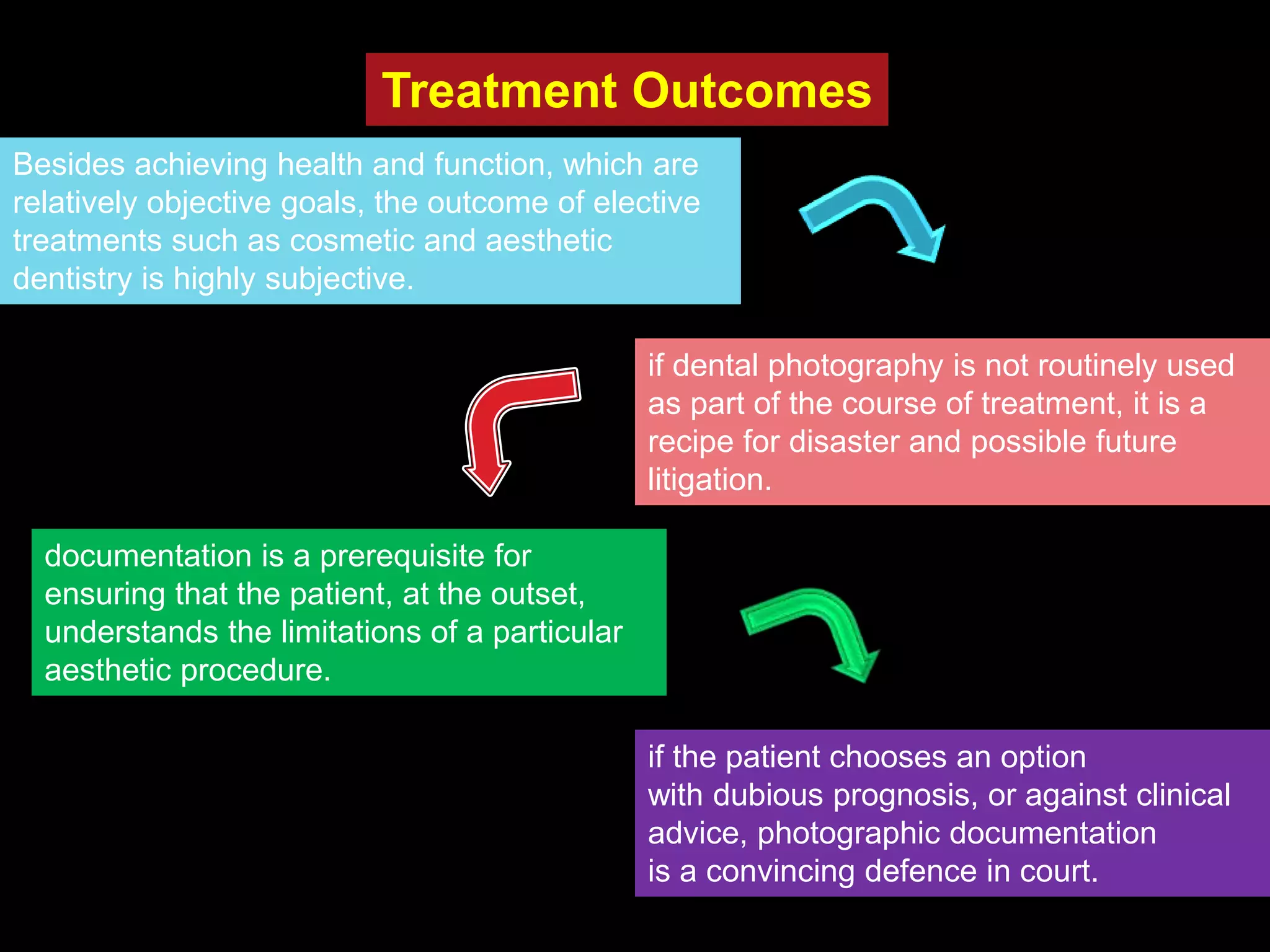
Treatment Outcomes
Besides achieving health and function, which are
relatively objective goals, the outcome of elective
treatments such as cosmetic and aesthetic
dentistry is highly subjective.
if dental photography is not routinely used
as part of the course of treatment, it is a
recipe for disaster and possible future
litigation.
documentation is a prerequisite for
ensuring that the patient, at the outset,
understands the limitations of a particular
aesthetic procedure.
if the patient chooses an option
with dubious prognosis, or against clinical
advice, photographic documentation
is a convincing defence in court.
Communication
Patient
Visual presentation is invaluable so that
The patient can judge the benefits, as
Well as pitfalls of these relatively novel
Treatment options
Staff
Dental education is invaluable for
Staff members to play their roles within
A team and stresses their responsibilities
For effective communication, cross
Infection control and keeping abreast of
Changing ideas and paradigm shifts.
Academic
If A clinician desires to publish
postgraduate
Books or articles, either now or
In the future, meticulous photographic
Documentation is A must.
Specialists
If referral to a specialist is necessary,
either for further treatment or a second
opinion
Dental technician
Photographs can be traced, or marked with
indelible pens to communicate salient
features such as shape, alignment,
characterisations, regions of translucency
or defining features such as mamelons,
banding.
PORTFOLIOS
every treatment carried out at a practice
can be documented and subsequently
used for educating patients, informing them
of the benefits and pitfalls of a given
therapy.
creating a digital portfolio is using presentation software, eg
Microsoft ® PowerPoint™
MARKETING
Before embarking on any form
of advertising it is advisable to consult
the GDC guidelines, and preferably have
items checked by an indemnity
organisation to ensure adherence to ethical
and professional standards.
Internal Marketing External Marketing
Stationery include letterheads,
appointment cards, estimate forms, post-
operative instructions and business cards
customized toothbrushes, ball point pens,
pads, bags or other gift items are another
form of marketing that can incorporate
practice logos.
Internet, advertising in
 telephone directories,
 local newspapers,
 radio and
 television
Part 3: Principles Of Digital
Photography
We live in a digital world,
and recent technological
advances have offered
conveniences and facilities
that were once only stuff of
dreams
• The eyes and digital
sensors share uncanny
similarities, unlike fi lm
photography that is rigid
and inflexible
• Digital photography can
be summarised by the
acronym CPD (capture,
processing and display).
DIGITAL PHOTOGRAPHY VS CONVENTIONAL
PHOTOGRAPHY :
• Instantaneity and convenience
• Flexibility for editing, copying and disseminating images
• Environmentally greener by eliminating toxic dyes and
processing
Chemicals
• Long-term economy by reusing storage media such as
memory cards.
THE SENSORS
TECHNICAL ASPECTS OF DIGITAL
PHOTOGRAPHY
C P D
CAPTURE
PROCESSING
DISPLAY
CAPTURE
Image sensors, the semiconductors are photosensitive units composed of tiny light
detecting units called pixels.
Basically, the image sensor is a collection of silicone photodiodes (pixels) the
intensity of brightness and darkness of an object.
capable of producing a black and white image
To create a colour image appropriate filters
additive primary colours red, green and blue.
sensors
CCD
(charged
coupled device)
Full frame CCDs Interline CCD’s
CMOS
(complementary
metal oxide
semiconductors)
Part 4: Choosing A Camera
•The most convenient, versatile,
easy to use camera for dental
applications is the digital single
lens reflex (DSLR) camera.
•A high quality lens is the key
factor for high resolution images.
• The number of pixels is not an
indication of the image quality, but
only the size of a digital image.
PART 5: LIGHTING
Choosing the appropriate type
of lighting is essential for
obtaining a correctly exposed,
high quality, detailed image.
• The ideal lighting for dental
photography are camera
mounted electronic flashes.
• By using reflectors and
diffusers, light can be modified
for specific c applications, or for
conveying a particular mood or
ambiance.
Dental photography encompasses three
facets of the visual experience, colour,
space and time:
Colour is a three dimensional entity consisting of hue, value
and chroma.
 Space defines depth, transparency, size, shape/form and
texture
Time indicates movement, flicker, sparkle (vitality), fluctuation
and glitter.
CHARACTERISTICS OF LIGHT
The presence and
manipulation of light.
Time
Colo
r
Space
achieved by
VISUAL AND GRAYSCALE
The visual system of the eye is capable of detecting only
wavelengths ranging from 380 nm (violet) to 780 nm (red)
ISAAC NEWTON
Light has no colour
Object’s colour is due to the colours it reflects, not the colours it
absorbs.
photography requires a
continuous
spectrum light source.
natural daylight or tungsten
lamps
electronic flash tubes produce
a discontinuous or linear
spectrum, where colours of the
spectrum do not merge
seamlessly but are distinct entities
known as neutral density, which is
used for calibrating light meters,
assessing exposure and setting
the white balance of a digital
image.
DEPTH OF FIELD
Small depth of fi eld: a wide aperture
opening will result in only a few items
being sharply focused, for example the
red bead in the centre
Large depth of fi eld: a small aperture
opening will result in many items being
sharply focused
PART 6: CAMERA SETTINGS
Depth of field varies inversely with the
aperture opening. A wide-open lens
with
an aperture of f4 has little depth of field
whereas if stopped down to f22,
almost
everything from front to back will be
sharply focused
As close-up
dental photography has a small depth
of
field, it becomes essential to have a
small
aperture opening, say f22, so that as
many
teeth as possible or a large area of soft
tissue is in focus.
Exposure is a combination of two camera settings,
1). The lens aperture and
2). The shutter speed.
Exposure explains how light acts on a photosensitive material, for example a digital
sensor.
The lens aperture, or opening, controls light intensity, while the duration of light is
controlled by the shutter speed.
The aperture size is calibrated in f-stop numbers;
The larger the number, the smaller the lens opening
EXPOSURE
WHITE BALANCE
When a piece of white card is viewed outdoor in daylight it
appears white.
When viewed with indoor tungsten lights, it still appears
white!
The reason for this colour adaptation.
Colour adaptation is the brain’s ability to compensate for
different illumination: because short-term memory
‘remembers’ the card as being white, it therefore appears
white irrespective of the lighting source.
daylight is 6,500 K, while tungsten is 3,500 K.
Incorrect white balance setting at 5,500 K using 3,000 K
illumination, the result is that the paper appears yellow instead
of white.
Correct white balance setting at 5,500 K using
5,500 K illumination, the paper now appears
white
WB (white balance) setting dial on
a digital camera back
• Portrait photography should
aim to capture the patient in a
relaxed state of mind.
• The set-up for portraiture can
utilise natural daylight, compact
or studio flashes.
• Laboratory or bench images of
plaster casts and prostheses are
easily photographed with studio
or compact flashes and a variety
of colored backgrounds.
• The best approach to
achieving unique and interesting
pictures is trial and error.
Experimentation is the key to
creativity
PART 7: EXTRA-ORAL SET-UPS
SPACE The distance between the photographer
(clinician)
and the subject (patient) is termed
the photographic space.
The goal of the clinician is gauging the
patient’s personal space and respecting it
at all times.
This creates a relaxed ambience for both the
operator and subject, yielding photographs that
convey serenity rather than tension.
A simple way
to overcome a potential space barrier is
using long focal length portrait lenses
(greater than 100 mm), which allow the
photographer to ‘virtually’ intrude into the
intimate or personal space, without agitating
the subject.
RELATING
Projection,
Introjection and
Confluence
Photographers relate to a subject in three ways:
According to the Freudian concept of psychological
defense mechanisms, projection is a means to alleviate
personal anxieties.
In an attempt to resolve personal conflicts, an individual
attempts to project his inner feeling onto external entities
such as the environment, people, art, music, etc.
PROJECTION
Many clinicians request a female patient to apply
lurid lipstick to increase the colour contrast
between the lips and teeth. In these
circumstances the red lipstick is the operator’s
projection onto the patient, conveying the
clinician’s sensual emotions
INTROJECTION
Introjection is the opposite of projection,
allowing the subject to reveal their
inner essence and outer presence. In this
situation the subject is conveying their
personality, rather than having the
operator’s personality imposed on them.
A dental example is the classical relaxed smile, with
the incisal plane of the maxillary incisor teeth
parallel to the curvature of the lower lip.
is when, for a fleeting moment, the photographer and
subject unite (mentally) and are in unison with one
another.
This requires patience, dedication, and protracted
perseverance.
CONFL UENCE
Projection is ‘going to the subject’,
Introjection is ‘letting the subject come to you’ and
Confluence is ‘achieving a one-ness’.
To summarise
DENTAL PORTRAITURE SET-UPS
Achieved Using Three Types Of Illumination,
Natural daylight,
Bi-lateral camera mounted flashes (as for
intra-oral images)
 Studio flashes.
Types of pictures required depend on the intended facial assessment.
1. Frontal facial at rest (for assessing persona of patient)
2. Frontal facial during a relaxed smile (for , assessing incisal plane
relationship to the inter-pupillary line)
3. Frontal facial with exaggerated smile (assessing degree of
Maxillary gingival exposure)
4. Profile at rest (for example, orthodontic assessment, lip positions)
5. Profile during a relaxed smile (assessing inclination of maxillary
Incisors)
6. Profile with exaggerated smile
7. Dento-facial images (framing only lips And teeth) with same poses as
for full
Frontal facial pictures
NATURAL DAYLIGHT SET-UP
The set-up is very simple, requiring Few items :
1. Cloth or card as a background, either Black or
colour of choice
2. Card or cloth reflectors, white, silver Or gold
(purchased from photographic Retailer or art card cut
to size (1 m2)
3. Tripod for using slower shutter speeds Or wider
apertures if light is low due to a cloudy day.
BI-LATERAL CAMERA MOUNTED FLASHES SET-UP
Using camera mounted flashes such as ring or bilateral
flashes. The advantages of this set-up are convenience
and expedience, as well as being economical and space
saving.
However, the intensity of ring and bilateral flashes is
usually insufficient for Illuminating the face.
The inventory for a simple studio set-up
consists of the following:
1. Two or three electronic studio fl ashes
2. Flash soft boxes or reflective Umbrellas
3. Light modifying fl ash attachments, for example barn doors,
spot cones, mesh grids
4. Selection of reflectors, for example white, silver and gold
5. Coloured fabrics or cards for backdrops.
STUDIO FL ASH SET-UPS
Studio set-up 1:
Black background,one flash and one
reflector
used for standard portrait images
Disadvantage : Shadow
Studio set-up 2:
Black background, two flashes
Having two bi-lateral studio fl ashes totally eliminates shadows rather than
softening
them as in set-up 1.
Studio set-up 3:
Colored background, two flashes and one reflector
This set-up uses a coloured instead of a black background.
Studio set-up 4:
black background, one flash
For profile images, a single fl ash with a soft box or other
attachment is used as a unidirectional light to illuminate the
face
Studio set-up 5:
coloured background, two
flashes
This is identical to set-up 4, except a coloured background
substitutes the black backdrop.
The arrangement is particularly useful for dento-facial profile
and lateral Images.
DENTAL LABORATORY SET-UPS 1
DENTAL LABORATORY SET-UPS
Include documenting pre-operative casts,
diagnostic wax-up and surgical stent for guiding
implant placement
DENTAL LABORATORY SET-UPS 2
Fibre-optic trans-illumination allows
visualisation of natural enamel
opalescence
DENTAL LABORATORY SET-UPS 3
placing flash in front of model
produces the lighting effect
DENTAL LABORATORY SET-UPS 4
fl ash placed to right side of plaster cast
Ultra-violet illumination
Shows internal fluorescence of the various
porcelain layers within an all-ceramic restoration.
Photographing with uv light is also useful for
checking porosity or fractures within all-ceramic
units, which can be detrimental to the longevity
of the restoration in the oral cavity.
UV illumination allows checking for porosity or
fractures within all-ceramic restorations
Photograph with UV
illumination
of crown on left lateral incisor
(the crown has been
superimposed onto the tooth
preparation)
To be continued…
Thank you
Part 8:-Intra –oral setups
The majority of pictures taken in the dental are intra-
oral, which includes the following:
1. Full arch – frontal and occlusal.
2. Quadrant occlusal, lingual (or palatal) and lateral.
3. Magnification images for detailed analysis of teeth
or soft tissues.
4. Oral mucosa.
5. Enamel texture, cracks and dentine strata.
6. Translucency: incisal and interproximal.
7. Shade analysis for artificial restorations.
Photographic equipment should be wrapped with disposable
cellophane covers
Patient With Bilateral Cheek Retractors
For Photographing The Oral Cavity
A maxillary tooth will
appear longer if the patient’s
chin is pointing downwards
or the camera axis is
superior to the
maxillary arch, but this is a
useful set-up for
photographing mandibular
anterior teeth
A maxillary tooth will
appear shorter if the
patient’s chin is pointing
upwards or the camera
axis is inferior to the
maxillary arch. This is a
useful set-up for
illuminating & capturing
crown margins
CLEARLY VISIBLE CROWN
MARGINS OF THE LEFT LATERAL
INCISOR
PATIENT IS LOOKING DIRECTLY
INTO THE CAMERA THE CROWN MARGINS
OF THE LEFT LATERAL INCISOR ARE NOT
CLEARLY DISCERNIBLE
FULL-ARCH
Frontal View Occlusal view
Use the canines as the point
of focus for ensuring
maximum depth of field.
The point of focus will depend
on the shape of the upper and lower
arches.
Change the point of focus either
anterior or posterior to the canines
if all teeth are not in focus.
Occlusal and lateral views
Full arch frontal set-up
Full maxillary arch occlusal
set-up
Full mandibular arch occlusal set-up
QUADRANT VIEWS: OCCLUSAL,
LINGUALAND BUCCAL
Quadrant buccal set-up
Quadrant lingual set-up
TEXTURE, DENTINE LAYER
AND ENAMEL CRACKS
A silver reflector
is placed on the
contra-lateral
side of the fl ash
to bounce light
back onto the
teeth
Image taken with bilateral flashes showing the
specular reflections that obscure dentine strata
and enamel cracks
The same image as , but photographed with
the set-up described
Dentine strata and enamel cracks
TRANSLUCENCY –
INCISALAND INTERPROXIMAL
SHADE ANALYSIS
SHADE ANALYSIS IS CARRIED
OUT PRE-OPERATIVELY BEFORE
BLEACHING
SHADE ANALYSIS IS CARRIED
OUT PRE-OPERATIVELY AFTER
BLEACHING
POSTERIOR
TEETH
A slight overexposure may be necessary to compensate for light
being reflected off the mirror surface to illuminate the teeth
Conclusions
The rapid rate of innovation in the field of photography often
confounds dental professionals regarding the same. Digital
photography has been gradually adopted, accepted and
standardized by all dental specialties and has become an
important resource. Photographs can be easily obtained using
the correct equipment, proper settings and the most effective
techniques, thereby increasing the chances of obtaining high-
quality images. This article covers the bare minimum that a
dentist needs or rather ought to know before he ventures into
the interesting world of digital clinical photography.
References:
1. Ahmad I. Digital dental photography. Part 4: Choosing a camera and accessories. Br
Dent J 2009; 206: 575-581.
2. Ahmed I. Digital dental photography. Part 6: Camera settings. Br Dent J 2009; 207: 63
69.

Digital Photography in Dentistry

  • 1.
    DIGITAL PHOTOGRAPHY INDENTISTRY DR.ANANT AGARWAL, M.D.S III, CPGIDS
  • 2.
    Increasing numbers ofdentists are using photography in their practices, not only for patient records, but also in aiding education, treatment planning and allowing patients to have autonomy over their treatment.
  • 3.
  • 4.
    FUNDAMENTALS OF DIGITALDENTAL PHOTOGRAPHY 1. An overview. 2. Purposes and uses. 3. Principles of digital photography. 4. Choosing a camera and accessories. 5. Lighting. 6. Camera settings. 7. Extra-oral set-ups. 8. Intra-oral set-ups. 9. Post-image capture processing. 10. Printing, publishing and presentations.
  • 5.
    Part 1: AN OVERVIEW Digitaldental photography is useful for every discipline of dentistry, and is an essential part of contemporary practice. • A usable dental image should have correct colour rendition and suffi- cient detail to show the oral clinical
  • 6.
    IMAGE QUALITY VSINTENDED USE For dental use, the primary factor is deciding which camera format is suitable for yielding the required image quality. Image quality is paramount because every dental image is a medico-legal record and therefore accurate documentation is essential. image quality can be represented on an arbitrary scale from 0 to 10, with zero representing a poor or unacceptable quality and ten representing the best possible image reproduction
  • 8.
    All portable cameraoffer convenience, portability and accessibility at the expense of poor image quality, and are unsuitable for documenting a dento- legal record. Further up the scale are SINGLE LENS REFLEX (SLR) and RANGE FINDER cameras, which are both capable of delivering better image quality.
  • 10.
  • 11.
    All the featuresof DSLRs such as lenses, aperture and shutters are identical as those for conventional film cameras. The popularity of SLRs is that they are immune from parallax, since the viewfinder, lens and image sensor, or films, all share the same optical axis. Another advantage of this format is that it offers immense versatility and unlimited accessories.
  • 12.
    •Besides dento-legal documentation, dentalphotography has a host of applications for all dental disciplines. • Communication with patients, technicians and specialists is enhanced with dental imagery and photography is a vital tool for educating patients, staff and colleagues. • Pictures of treatment carried out at the practice can be used for compiling portfolios for marketing, and for construction of a practice website.
  • 13.
    Dental Documentation Progress And Monitorin g Examination, Diagnosis, Treatment Planning Treatme nt Outcom es ‘It is worthremembering” ‘a picture really is worth more than a thousand words’, especially if one has to type them”.
  • 14.
    Examination, Diagnosis, TreatmentPlanning Ideal method for analysing the pre-operative dental status at a later date A series of pre-operative images helpful for recording  baseline of oral health  firm diagnosis and  offering treatment options to restore health, function and aesthetics
  • 15.
    Progress And Monitoring Formonitoring the progress of pathological lesions or the stages of prescribed dental treatment.
  • 16.
    Treatment Outcomes Besides achievinghealth and function, which are relatively objective goals, the outcome of elective treatments such as cosmetic and aesthetic dentistry is highly subjective. if dental photography is not routinely used as part of the course of treatment, it is a recipe for disaster and possible future litigation. documentation is a prerequisite for ensuring that the patient, at the outset, understands the limitations of a particular aesthetic procedure. if the patient chooses an option with dubious prognosis, or against clinical advice, photographic documentation is a convincing defence in court.
  • 17.
    Communication Patient Visual presentation isinvaluable so that The patient can judge the benefits, as Well as pitfalls of these relatively novel Treatment options Staff Dental education is invaluable for Staff members to play their roles within A team and stresses their responsibilities For effective communication, cross Infection control and keeping abreast of Changing ideas and paradigm shifts. Academic If A clinician desires to publish postgraduate Books or articles, either now or In the future, meticulous photographic Documentation is A must.
  • 18.
    Specialists If referral toa specialist is necessary, either for further treatment or a second opinion Dental technician Photographs can be traced, or marked with indelible pens to communicate salient features such as shape, alignment, characterisations, regions of translucency or defining features such as mamelons, banding. PORTFOLIOS every treatment carried out at a practice can be documented and subsequently used for educating patients, informing them of the benefits and pitfalls of a given therapy. creating a digital portfolio is using presentation software, eg Microsoft ® PowerPoint™
  • 19.
    MARKETING Before embarking onany form of advertising it is advisable to consult the GDC guidelines, and preferably have items checked by an indemnity organisation to ensure adherence to ethical and professional standards. Internal Marketing External Marketing Stationery include letterheads, appointment cards, estimate forms, post- operative instructions and business cards customized toothbrushes, ball point pens, pads, bags or other gift items are another form of marketing that can incorporate practice logos. Internet, advertising in  telephone directories,  local newspapers,  radio and  television
  • 20.
    Part 3: PrinciplesOf Digital Photography We live in a digital world, and recent technological advances have offered conveniences and facilities that were once only stuff of dreams • The eyes and digital sensors share uncanny similarities, unlike fi lm photography that is rigid and inflexible • Digital photography can be summarised by the acronym CPD (capture, processing and display).
  • 21.
    DIGITAL PHOTOGRAPHY VSCONVENTIONAL PHOTOGRAPHY : • Instantaneity and convenience • Flexibility for editing, copying and disseminating images • Environmentally greener by eliminating toxic dyes and processing Chemicals • Long-term economy by reusing storage media such as memory cards.
  • 22.
  • 23.
    TECHNICAL ASPECTS OFDIGITAL PHOTOGRAPHY C P D CAPTURE PROCESSING DISPLAY
  • 24.
    CAPTURE Image sensors, thesemiconductors are photosensitive units composed of tiny light detecting units called pixels. Basically, the image sensor is a collection of silicone photodiodes (pixels) the intensity of brightness and darkness of an object. capable of producing a black and white image To create a colour image appropriate filters additive primary colours red, green and blue.
  • 25.
    sensors CCD (charged coupled device) Full frameCCDs Interline CCD’s CMOS (complementary metal oxide semiconductors)
  • 26.
    Part 4: ChoosingA Camera •The most convenient, versatile, easy to use camera for dental applications is the digital single lens reflex (DSLR) camera. •A high quality lens is the key factor for high resolution images. • The number of pixels is not an indication of the image quality, but only the size of a digital image.
  • 27.
    PART 5: LIGHTING Choosingthe appropriate type of lighting is essential for obtaining a correctly exposed, high quality, detailed image. • The ideal lighting for dental photography are camera mounted electronic flashes. • By using reflectors and diffusers, light can be modified for specific c applications, or for conveying a particular mood or ambiance.
  • 28.
    Dental photography encompassesthree facets of the visual experience, colour, space and time: Colour is a three dimensional entity consisting of hue, value and chroma.  Space defines depth, transparency, size, shape/form and texture Time indicates movement, flicker, sparkle (vitality), fluctuation and glitter.
  • 29.
    CHARACTERISTICS OF LIGHT Thepresence and manipulation of light. Time Colo r Space achieved by
  • 30.
    VISUAL AND GRAYSCALE Thevisual system of the eye is capable of detecting only wavelengths ranging from 380 nm (violet) to 780 nm (red) ISAAC NEWTON Light has no colour Object’s colour is due to the colours it reflects, not the colours it absorbs.
  • 31.
    photography requires a continuous spectrumlight source. natural daylight or tungsten lamps electronic flash tubes produce a discontinuous or linear spectrum, where colours of the spectrum do not merge seamlessly but are distinct entities known as neutral density, which is used for calibrating light meters, assessing exposure and setting the white balance of a digital image.
  • 32.
    DEPTH OF FIELD Smalldepth of fi eld: a wide aperture opening will result in only a few items being sharply focused, for example the red bead in the centre Large depth of fi eld: a small aperture opening will result in many items being sharply focused PART 6: CAMERA SETTINGS
  • 33.
    Depth of fieldvaries inversely with the aperture opening. A wide-open lens with an aperture of f4 has little depth of field whereas if stopped down to f22, almost everything from front to back will be sharply focused As close-up dental photography has a small depth of field, it becomes essential to have a small aperture opening, say f22, so that as many teeth as possible or a large area of soft tissue is in focus.
  • 34.
    Exposure is acombination of two camera settings, 1). The lens aperture and 2). The shutter speed. Exposure explains how light acts on a photosensitive material, for example a digital sensor. The lens aperture, or opening, controls light intensity, while the duration of light is controlled by the shutter speed. The aperture size is calibrated in f-stop numbers; The larger the number, the smaller the lens opening EXPOSURE
  • 35.
    WHITE BALANCE When apiece of white card is viewed outdoor in daylight it appears white. When viewed with indoor tungsten lights, it still appears white! The reason for this colour adaptation. Colour adaptation is the brain’s ability to compensate for different illumination: because short-term memory ‘remembers’ the card as being white, it therefore appears white irrespective of the lighting source. daylight is 6,500 K, while tungsten is 3,500 K. Incorrect white balance setting at 5,500 K using 3,000 K illumination, the result is that the paper appears yellow instead of white. Correct white balance setting at 5,500 K using 5,500 K illumination, the paper now appears white WB (white balance) setting dial on a digital camera back
  • 36.
    • Portrait photographyshould aim to capture the patient in a relaxed state of mind. • The set-up for portraiture can utilise natural daylight, compact or studio flashes. • Laboratory or bench images of plaster casts and prostheses are easily photographed with studio or compact flashes and a variety of colored backgrounds. • The best approach to achieving unique and interesting pictures is trial and error. Experimentation is the key to creativity PART 7: EXTRA-ORAL SET-UPS
  • 37.
    SPACE The distancebetween the photographer (clinician) and the subject (patient) is termed the photographic space. The goal of the clinician is gauging the patient’s personal space and respecting it at all times. This creates a relaxed ambience for both the operator and subject, yielding photographs that convey serenity rather than tension. A simple way to overcome a potential space barrier is using long focal length portrait lenses (greater than 100 mm), which allow the photographer to ‘virtually’ intrude into the intimate or personal space, without agitating the subject.
  • 38.
  • 39.
    According to theFreudian concept of psychological defense mechanisms, projection is a means to alleviate personal anxieties. In an attempt to resolve personal conflicts, an individual attempts to project his inner feeling onto external entities such as the environment, people, art, music, etc. PROJECTION Many clinicians request a female patient to apply lurid lipstick to increase the colour contrast between the lips and teeth. In these circumstances the red lipstick is the operator’s projection onto the patient, conveying the clinician’s sensual emotions
  • 40.
    INTROJECTION Introjection is theopposite of projection, allowing the subject to reveal their inner essence and outer presence. In this situation the subject is conveying their personality, rather than having the operator’s personality imposed on them. A dental example is the classical relaxed smile, with the incisal plane of the maxillary incisor teeth parallel to the curvature of the lower lip.
  • 41.
    is when, fora fleeting moment, the photographer and subject unite (mentally) and are in unison with one another. This requires patience, dedication, and protracted perseverance. CONFL UENCE Projection is ‘going to the subject’, Introjection is ‘letting the subject come to you’ and Confluence is ‘achieving a one-ness’. To summarise
  • 42.
    DENTAL PORTRAITURE SET-UPS AchievedUsing Three Types Of Illumination, Natural daylight, Bi-lateral camera mounted flashes (as for intra-oral images)  Studio flashes.
  • 43.
    Types of picturesrequired depend on the intended facial assessment. 1. Frontal facial at rest (for assessing persona of patient) 2. Frontal facial during a relaxed smile (for , assessing incisal plane relationship to the inter-pupillary line) 3. Frontal facial with exaggerated smile (assessing degree of Maxillary gingival exposure) 4. Profile at rest (for example, orthodontic assessment, lip positions) 5. Profile during a relaxed smile (assessing inclination of maxillary Incisors) 6. Profile with exaggerated smile 7. Dento-facial images (framing only lips And teeth) with same poses as for full Frontal facial pictures
  • 44.
    NATURAL DAYLIGHT SET-UP Theset-up is very simple, requiring Few items : 1. Cloth or card as a background, either Black or colour of choice 2. Card or cloth reflectors, white, silver Or gold (purchased from photographic Retailer or art card cut to size (1 m2) 3. Tripod for using slower shutter speeds Or wider apertures if light is low due to a cloudy day.
  • 45.
    BI-LATERAL CAMERA MOUNTEDFLASHES SET-UP Using camera mounted flashes such as ring or bilateral flashes. The advantages of this set-up are convenience and expedience, as well as being economical and space saving. However, the intensity of ring and bilateral flashes is usually insufficient for Illuminating the face.
  • 46.
    The inventory fora simple studio set-up consists of the following: 1. Two or three electronic studio fl ashes 2. Flash soft boxes or reflective Umbrellas 3. Light modifying fl ash attachments, for example barn doors, spot cones, mesh grids 4. Selection of reflectors, for example white, silver and gold 5. Coloured fabrics or cards for backdrops. STUDIO FL ASH SET-UPS
  • 47.
    Studio set-up 1: Blackbackground,one flash and one reflector used for standard portrait images Disadvantage : Shadow
  • 48.
    Studio set-up 2: Blackbackground, two flashes Having two bi-lateral studio fl ashes totally eliminates shadows rather than softening them as in set-up 1.
  • 49.
    Studio set-up 3: Coloredbackground, two flashes and one reflector This set-up uses a coloured instead of a black background.
  • 50.
    Studio set-up 4: blackbackground, one flash For profile images, a single fl ash with a soft box or other attachment is used as a unidirectional light to illuminate the face
  • 51.
    Studio set-up 5: colouredbackground, two flashes This is identical to set-up 4, except a coloured background substitutes the black backdrop. The arrangement is particularly useful for dento-facial profile and lateral Images.
  • 52.
  • 53.
    DENTAL LABORATORY SET-UPS Includedocumenting pre-operative casts, diagnostic wax-up and surgical stent for guiding implant placement
  • 54.
    DENTAL LABORATORY SET-UPS2 Fibre-optic trans-illumination allows visualisation of natural enamel opalescence
  • 55.
    DENTAL LABORATORY SET-UPS3 placing flash in front of model produces the lighting effect
  • 56.
    DENTAL LABORATORY SET-UPS4 fl ash placed to right side of plaster cast
  • 57.
    Ultra-violet illumination Shows internalfluorescence of the various porcelain layers within an all-ceramic restoration. Photographing with uv light is also useful for checking porosity or fractures within all-ceramic units, which can be detrimental to the longevity of the restoration in the oral cavity. UV illumination allows checking for porosity or fractures within all-ceramic restorations Photograph with UV illumination of crown on left lateral incisor (the crown has been superimposed onto the tooth preparation)
  • 58.
  • 59.
    Part 8:-Intra –oralsetups The majority of pictures taken in the dental are intra- oral, which includes the following: 1. Full arch – frontal and occlusal. 2. Quadrant occlusal, lingual (or palatal) and lateral. 3. Magnification images for detailed analysis of teeth or soft tissues. 4. Oral mucosa. 5. Enamel texture, cracks and dentine strata. 6. Translucency: incisal and interproximal. 7. Shade analysis for artificial restorations.
  • 60.
    Photographic equipment shouldbe wrapped with disposable cellophane covers
  • 61.
    Patient With BilateralCheek Retractors For Photographing The Oral Cavity
  • 62.
    A maxillary toothwill appear longer if the patient’s chin is pointing downwards or the camera axis is superior to the maxillary arch, but this is a useful set-up for photographing mandibular anterior teeth
  • 63.
    A maxillary toothwill appear shorter if the patient’s chin is pointing upwards or the camera axis is inferior to the maxillary arch. This is a useful set-up for illuminating & capturing crown margins CLEARLY VISIBLE CROWN MARGINS OF THE LEFT LATERAL INCISOR PATIENT IS LOOKING DIRECTLY INTO THE CAMERA THE CROWN MARGINS OF THE LEFT LATERAL INCISOR ARE NOT CLEARLY DISCERNIBLE
  • 64.
    FULL-ARCH Frontal View Occlusalview Use the canines as the point of focus for ensuring maximum depth of field. The point of focus will depend on the shape of the upper and lower arches. Change the point of focus either anterior or posterior to the canines if all teeth are not in focus. Occlusal and lateral views
  • 65.
  • 66.
    Full maxillary archocclusal set-up
  • 67.
    Full mandibular archocclusal set-up
  • 68.
  • 69.
  • 70.
  • 71.
    TEXTURE, DENTINE LAYER ANDENAMEL CRACKS A silver reflector is placed on the contra-lateral side of the fl ash to bounce light back onto the teeth Image taken with bilateral flashes showing the specular reflections that obscure dentine strata and enamel cracks The same image as , but photographed with the set-up described Dentine strata and enamel cracks
  • 72.
  • 73.
    SHADE ANALYSIS SHADE ANALYSISIS CARRIED OUT PRE-OPERATIVELY BEFORE BLEACHING SHADE ANALYSIS IS CARRIED OUT PRE-OPERATIVELY AFTER BLEACHING
  • 74.
    POSTERIOR TEETH A slight overexposuremay be necessary to compensate for light being reflected off the mirror surface to illuminate the teeth
  • 76.
    Conclusions The rapid rateof innovation in the field of photography often confounds dental professionals regarding the same. Digital photography has been gradually adopted, accepted and standardized by all dental specialties and has become an important resource. Photographs can be easily obtained using the correct equipment, proper settings and the most effective techniques, thereby increasing the chances of obtaining high- quality images. This article covers the bare minimum that a dentist needs or rather ought to know before he ventures into the interesting world of digital clinical photography.
  • 77.
    References: 1. Ahmad I.Digital dental photography. Part 4: Choosing a camera and accessories. Br Dent J 2009; 206: 575-581. 2. Ahmed I. Digital dental photography. Part 6: Camera settings. Br Dent J 2009; 207: 63 69.

Editor's Notes

  • #18 Fundamental change in an individual's or a society's view of how things work in the world. paradigm shifts
  • #20 General dental council
  • #22 Disseminating means : the act of dispersing or diffusing something
  • #23 Sesor which detect any thing
  • #26 Ffc must be carried out in darkness, that is, after the camera shutter is closed. CCDs have non-light sensitive rows between the pixels which convey the electrical charge simultaneously as the pixels are ‘stimulated’ by the incoming light. CCD, but processing is performed on each pixel rather than being conducted to the end of a line.
  • #29 For example the pink gingival colour indicates health, correct tooth proportion (shape) conveys pleasing aesthetics, and a smile infers a pleasurable moment in time.
  • #31 Where ‘nm’ is a nanometre or one billionth of a meter.
  • #36 K kelvin
  • #42 एक-एक पद को प्रा प्त करना- achieving a one-ness As a general observation, advertising companies ubiquitously use projection images to sell products. A beautiful model is often depicted in proximity to the product, representing an elusive and desirable commodity. Introjection images are family gatherings and holiday snap shots, when people are relaxed with familiar company and surroundings. Lastly, confl uence imagery is usually artistic in nature and the photograph becomes more than mere documentation, having a deeper meaning than that which is literally depicted.