Asian Journal of Applied Science and Technology (AJAST)
Volume 1, Issue 1, Pages 110-113, February 2017
© 2017 AJAST All rights reserved. www.ajast.net
Page | 110
Digital Notice Board in Schools and Colleges by Implementing IoT with Audio
Alert System
C.Anitha1
, M.Aruna2
, S.Elavarasi3
, V.Nandhini4
and D.L.Jayanthi5
1
UG Scholar, Department of ECE, Vivekanandha College of Engineering for Women, India. Email: anitha.aavichu@gmail.com
2
UG Scholar, Department of ECE, Vivekanandha College of Engineering for Women, India. Email: mayavanaruna@gmail.com
3
UG Scholar, Department of ECE, Vivekanandha College of Engineering for Women, India. Email: elavarasisj@gmail.com
4
UG Scholar, Department of ECE, Vivekanandha College of Engineering for Women, India. Email: nandhinidinesh123@gmail.com
5
Assistant Professor, Department of ECE, Vivekanandha College of Engineering for Women, India. Email: jayanthidl@gmail.com
Article Received: 12 February 2017 Article Accepted: 21 February 2017 Article Published: 26 February 2017
1. INTRODUCTION
In this modern world, nowadays everyone needs a comfort
living life. Man has researched different technology for his
need. In today’s world of full of connectedness, people are
becoming habitual to easy access to information. Whether the
information is received through the internet or television,
people want to be informed and up-to-date with the latest
events happening around the world. Wired network
connection such as Ethernet has many drawbacks depending
on the need and type of connection. Now a day’s people like
and prefer wireless connection rather than wired connection
because wireless connection can interact with people easily
and it require less time.
The main objective of this project is to construct an internet
based graphical notice board system using raspberry pi that
display message sent from the user and to design a simple,
easy to install, user friendly system, which can receive and
display notice in a particular manner with respect to date and
time so that the user can easily access or know the latest
notices or messages. Wi-Fi i.e., the wireless technology is
used in this project. The Ethernet cable is used to connect the
Ethernet connector from raspberry-pi to router.
Internet connection must be essential for this project. Updates
are enabled automatically as default and can be disabled later
whenever we want to disable it. This paper is organized as
follows: In first part we discuss the literature survey of various
systems. In the next part we discuss the proposed system,
process flow and then its application. In the last section we
draw a conclusion out of all the discussion followed by a list
of references.
1.1 Internet of Things (IoT)
The Internet of things is the internetworking of smart
devices, buildings, vehicles and other items like embedded
with electronics, software, sensors and network connectivity
that enable these objects to collect and exchange data. The
IoT allows objects to be sensed or controlled remotely across
the existing network architecture. When IoT is augmented
with actuators and sensors, the technology becomes an
example of the more general class of cyber-physical systems.
The Internet of Things (IoT) can be described as connecting
day to day objects like mobile-phones, Internet, TVs, sensors
and actuators to the Internet where the devices are linked
together enabling new forms of communication between
things and people, and between things to things. Building
IoTs has advanced significantly in the recent years, since it
has added a new idea to the world of information and
communication technologies.
1.2. Raspberry Pi
The raspberry pi is a credit card sized computer. It can be
plugged into our TV and a keyboard, and can be used for
many of the things that our average desktop does like
spreadsheets, word document and processing, games and it
also plays high definition video. The raspberry pi is the work
done by the Raspberry foundation, a charitable organization.
UK registered charity (no. 1129409), may 2009. It is
supported by the University of Cambridge Computer
Laboratory and tech firm broadcom. The raspberry pi has a
broadcom BCM 2835 system on a chip (SOC), which
includes an ARM 1176 JZF- S 700MHz processor. It is
originally shipped with 26 Megabytes of RAM, later
ABSTRACT
Notice Board is primary thing in many places like institutions, public utility places i.e., bus stops, railway stations, colleges, malls, etc. But sticking
various notices day to day is a tedious process and also a separate person is required to take care of it daily and manually. This project is about
advanced wireless notice board. The project is built around ARM controller 11 Raspberry-pi which is heart of the system. Display is obtained on
projector or LCD monitor. Wi-Fi is used for Data transmission. At any time we can add or remove or alter the image according to our requirement. At
transmitter authorized PC or mobile is used for sending a notices or messages. At receiving end Wi-Fi is connected to raspberry pi. The raspberry pi
can be dedicated to Ethernet. When an authorized user sends a notice from his system, it is received by the receiver. The message may be a voice note
or image. Wireless communication is a popular technology that allows an electronic device to exchange data wirelessly over a computer network,
including high speed wireless connections and so the data is received from authenticated user. In this paper, we propose a remotely send notice to
Raspberry pi from a web application and also we include speaker to receive a voice message.
Keywords: Web application and server, Raspberry pi card, Ethernet, Speaker and Electronic components.
Asian Journal of Applied Science and Technology (AJAST)
Volume 1, Issue 1, Pages 110-113, February 2017
© 2017 AJAST All rights reserved. www.ajast.net
Page | 111
upgraded to 512 Megabytes. It does not include a built-in hard
disk but uses an SD card for booting and long term storage.
2. LITERATURE SURVEY
In this part, we summarized some existing system papers and
its drawbacks which are given below. GSM based notice
board in this creative technique the user can able to display
the latest information and also the contents of notice can be
changed any time. The concept is to design a SMS based
automatic display board. Even though the information can be
altered or changed it has some drawback which is given in the
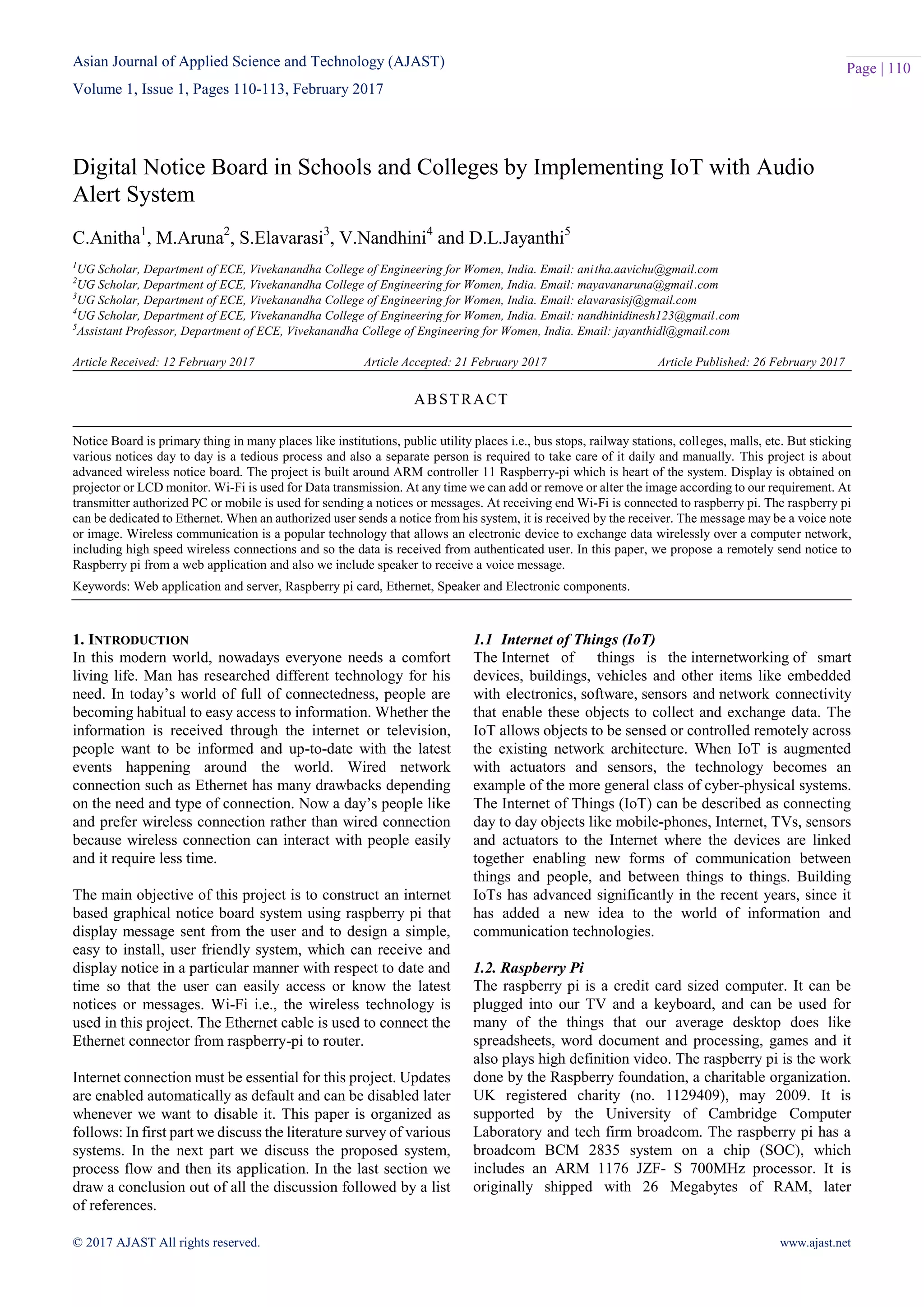
following review table.
Wireless E-Notice board using Wi-Fi and blue tooth
technology, in this paper the authors focusing to display the
desired message of the user through an SMS using Wi-Fi
module and Bluetooth connected to it. Android Phone Speech
Recognition Sensed Notice Board Display in this paper, the
main objective is to convert voice data to text. The text is send
over the microcontroller via blue tooth for displaying on
notice board. It also has many drawbacks to implement.
Wi-Fi provides higher data rates for multimedia access and
audio communication as compared to both zigbee and
Bluetooth which provides lower data transfer rates. It also
covers the area of 100m but the Bluetooth covers only for
10m.
3. PROPOSED SYSTEM OVERVIEW
In our project there are two parts one part is transmitter and
another part is receiver.
3.1 Transmitter
Personal Computer (PC) is used as a transmitter part. Only the
authorized PC is used here.
3.2. Receiver
It consists of following sections.
3.2.1. Wi-Fi Module
Wi-Fi is a high performance and cost effective WLAN USB
module. It connects the Raspberry pi mini cost credit card
sized computer to a Wi-Fi local area network. Wi-Fi is a
technology for Wireless Local Area Networking with devices
based on the IEEE 802.11 standards. It supports data rates up
to 150 Mbps and it covers the area ranges 20 meters.
3.2.2. LCD Monitor
It is used to display the notices or data of any form like text,
images, audio voices and multimedia etc. Wi-Fi will check the
authorization of the user entry and the raspberry pi card will
convert the messages that will be displayed into LCD monitor.
3.2.3. Raspberry pi
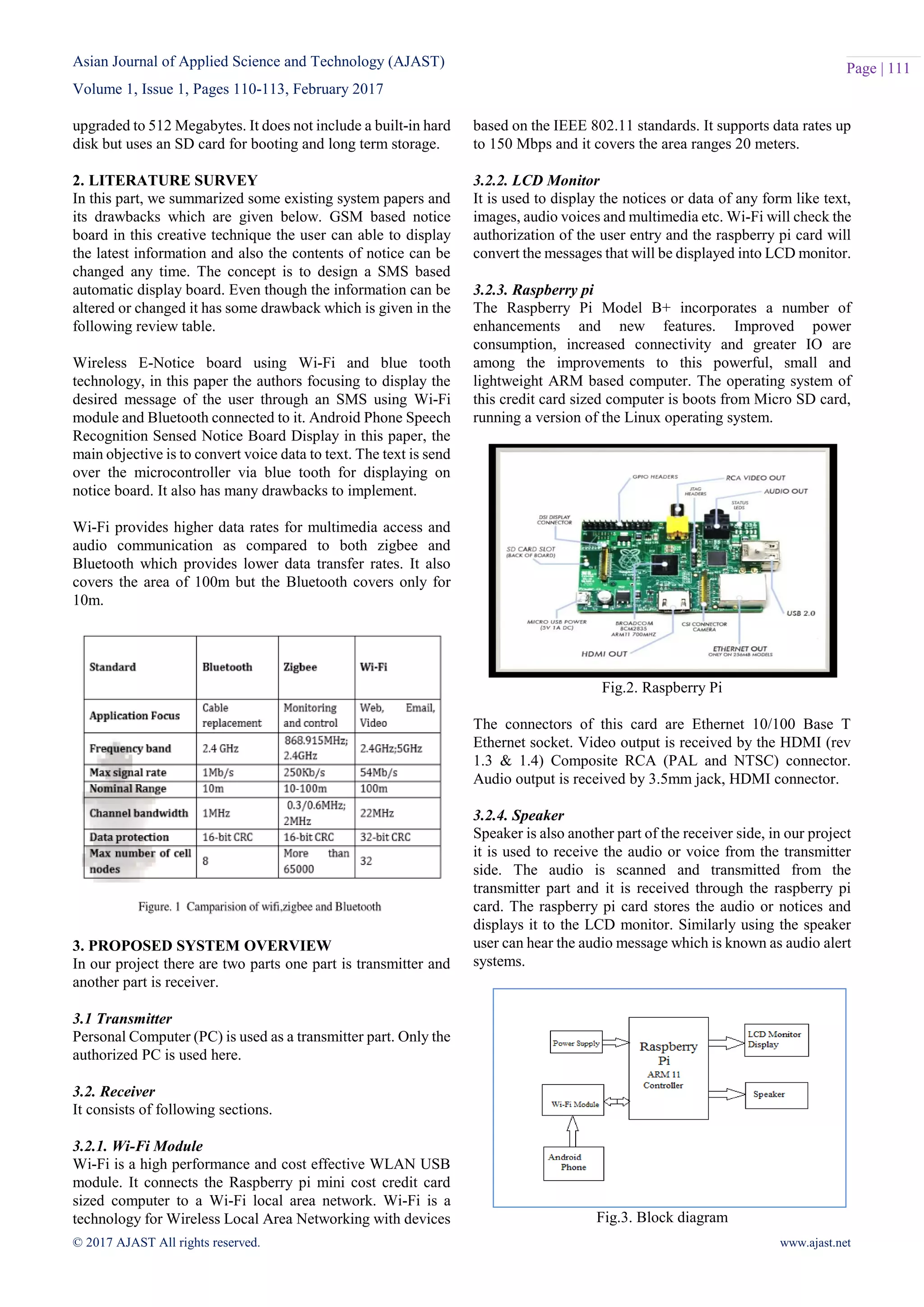
The Raspberry Pi Model B+ incorporates a number of
enhancements and new features. Improved power
consumption, increased connectivity and greater IO are
among the improvements to this powerful, small and
lightweight ARM based computer. The operating system of
this credit card sized computer is boots from Micro SD card,
running a version of the Linux operating system.
Fig.2. Raspberry Pi
The connectors of this card are Ethernet 10/100 Base T
Ethernet socket. Video output is received by the HDMI (rev
1.3 & 1.4) Composite RCA (PAL and NTSC) connector.
Audio output is received by 3.5mm jack, HDMI connector.
3.2.4. Speaker
Speaker is also another part of the receiver side, in our project
it is used to receive the audio or voice from the transmitter
side. The audio is scanned and transmitted from the
transmitter part and it is received through the raspberry pi
card. The raspberry pi card stores the audio or notices and
displays it to the LCD monitor. Similarly using the speaker
user can hear the audio message which is known as audio alert
systems.
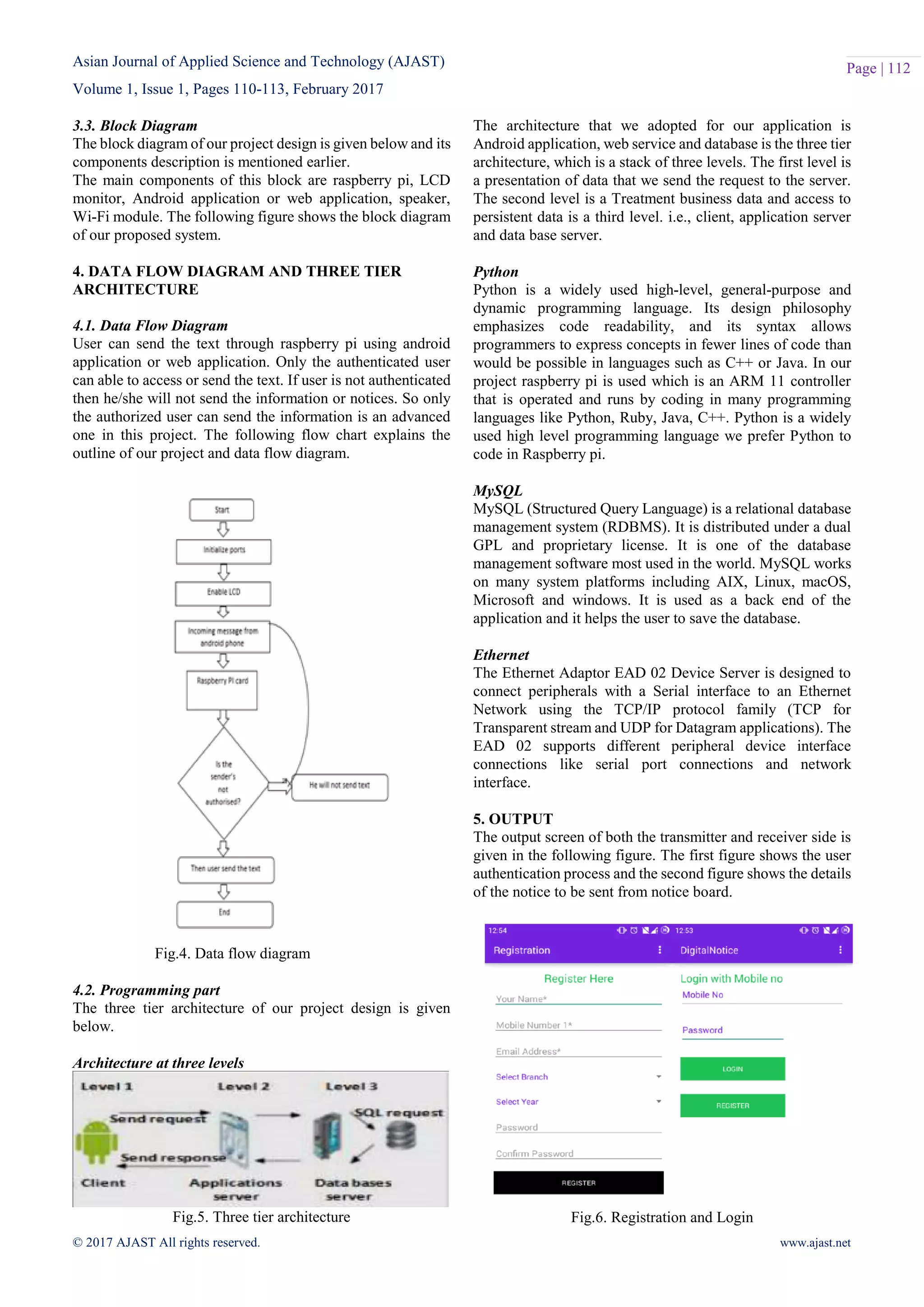
Fig.3. Block diagram
Asian Journal of Applied Science and Technology (AJAST)
Volume 1, Issue 1, Pages 110-113, February 2017
© 2017 AJAST All rights reserved. www.ajast.net
Page | 112
3.3. Block Diagram
The block diagram of our project design is given below and its
components description is mentioned earlier.
The main components of this block are raspberry pi, LCD
monitor, Android application or web application, speaker,
Wi-Fi module. The following figure shows the block diagram
of our proposed system.
4. DATA FLOW DIAGRAM AND THREE TIER
ARCHITECTURE
4.1. Data Flow Diagram
User can send the text through raspberry pi using android
application or web application. Only the authenticated user
can able to access or send the text. If user is not authenticated
then he/she will not send the information or notices. So only
the authorized user can send the information is an advanced
one in this project. The following flow chart explains the
outline of our project and data flow diagram.
Fig.4. Data flow diagram
4.2. Programming part
The three tier architecture of our project design is given
below.
Architecture at three levels
Fig.5. Three tier architecture
The architecture that we adopted for our application is
Android application, web service and database is the three tier
architecture, which is a stack of three levels. The first level is
a presentation of data that we send the request to the server.
The second level is a Treatment business data and access to
persistent data is a third level. i.e., client, application server
and data base server.
Python
Python is a widely used high-level, general-purpose and
dynamic programming language. Its design philosophy
emphasizes code readability, and its syntax allows
programmers to express concepts in fewer lines of code than
would be possible in languages such as C++ or Java. In our
project raspberry pi is used which is an ARM 11 controller
that is operated and runs by coding in many programming
languages like Python, Ruby, Java, C++. Python is a widely
used high level programming language we prefer Python to
code in Raspberry pi.
MySQL
MySQL (Structured Query Language) is a relational database
management system (RDBMS). It is distributed under a dual
GPL and proprietary license. It is one of the database
management software most used in the world. MySQL works
on many system platforms including AIX, Linux, macOS,
Microsoft and windows. It is used as a back end of the
application and it helps the user to save the database.
Ethernet
The Ethernet Adaptor EAD 02 Device Server is designed to
connect peripherals with a Serial interface to an Ethernet
Network using the TCP/IP protocol family (TCP for
Transparent stream and UDP for Datagram applications). The
EAD 02 supports different peripheral device interface
connections like serial port connections and network
interface.
5. OUTPUT
The output screen of both the transmitter and receiver side is
given in the following figure. The first figure shows the user
authentication process and the second figure shows the details
of the notice to be sent from notice board.
Fig.6. Registration and Login
Asian Journal of Applied Science and Technology (AJAST)
Volume 1, Issue 1, Pages 110-113, February 2017
© 2017 AJAST All rights reserved. www.ajast.net
Page | 113
Fig.7. Main interface
6. CONCLUSION
Now the world is moving towards automation, so in this world
if we want to do some changes in the previously used system
we have to use the new techniques. Wireless operation
provides fast transmission over long range communication. It
saves resources and time. Data can be sent from remote
location. User authentication is provided so that unknown
person cannot access this notice board is a secured one.
Previously the notice board using GSM was used in that there
was the limit of messages but in our system Multimedia data
can be stored on chip or on SD card. Text messages and
multimedia data can be seen whenever we want to see is an
advantage of using our project.
REFERENCES
[1] Shraddha.J.Tupe, A.R.Salunke, “Multi-functional smart
display using Raspberry-PI”, Volume 2, Special Issue
(NCRTIT 2015), January 2015.
[2] J.S.Lee, Y.W.Su, and C.C.Shen, “A comparative study of
wireless protocols: Bluetooth, UWB, Zigbee, and Wi-Fi”,
Proceedings of the 33rd Annual Conference of the IEEE
Industrial Electronics Society (IECON), pp.46-51, November
2007.
[3] https://www.raspberrypi.org/help
[4] Li, J., Da-You, L., and Bo, Y., “Smart home research”,
Proceedings of the Third International Conference on
Machine Learning and Cybernetics, vol. 2, pp. 659–663,
Shanghai, 26–29 August 2004.

Digital Notice Board in Schools and Colleges by Implementing IoT with Audio Alert System

  • 1.
    Asian Journal ofApplied Science and Technology (AJAST) Volume 1, Issue 1, Pages 110-113, February 2017 © 2017 AJAST All rights reserved. www.ajast.net Page | 110 Digital Notice Board in Schools and Colleges by Implementing IoT with Audio Alert System C.Anitha1 , M.Aruna2 , S.Elavarasi3 , V.Nandhini4 and D.L.Jayanthi5 1 UG Scholar, Department of ECE, Vivekanandha College of Engineering for Women, India. Email: anitha.aavichu@gmail.com 2 UG Scholar, Department of ECE, Vivekanandha College of Engineering for Women, India. Email: mayavanaruna@gmail.com 3 UG Scholar, Department of ECE, Vivekanandha College of Engineering for Women, India. Email: elavarasisj@gmail.com 4 UG Scholar, Department of ECE, Vivekanandha College of Engineering for Women, India. Email: nandhinidinesh123@gmail.com 5 Assistant Professor, Department of ECE, Vivekanandha College of Engineering for Women, India. Email: jayanthidl@gmail.com Article Received: 12 February 2017 Article Accepted: 21 February 2017 Article Published: 26 February 2017 1. INTRODUCTION In this modern world, nowadays everyone needs a comfort living life. Man has researched different technology for his need. In today’s world of full of connectedness, people are becoming habitual to easy access to information. Whether the information is received through the internet or television, people want to be informed and up-to-date with the latest events happening around the world. Wired network connection such as Ethernet has many drawbacks depending on the need and type of connection. Now a day’s people like and prefer wireless connection rather than wired connection because wireless connection can interact with people easily and it require less time. The main objective of this project is to construct an internet based graphical notice board system using raspberry pi that display message sent from the user and to design a simple, easy to install, user friendly system, which can receive and display notice in a particular manner with respect to date and time so that the user can easily access or know the latest notices or messages. Wi-Fi i.e., the wireless technology is used in this project. The Ethernet cable is used to connect the Ethernet connector from raspberry-pi to router. Internet connection must be essential for this project. Updates are enabled automatically as default and can be disabled later whenever we want to disable it. This paper is organized as follows: In first part we discuss the literature survey of various systems. In the next part we discuss the proposed system, process flow and then its application. In the last section we draw a conclusion out of all the discussion followed by a list of references. 1.1 Internet of Things (IoT) The Internet of things is the internetworking of smart devices, buildings, vehicles and other items like embedded with electronics, software, sensors and network connectivity that enable these objects to collect and exchange data. The IoT allows objects to be sensed or controlled remotely across the existing network architecture. When IoT is augmented with actuators and sensors, the technology becomes an example of the more general class of cyber-physical systems. The Internet of Things (IoT) can be described as connecting day to day objects like mobile-phones, Internet, TVs, sensors and actuators to the Internet where the devices are linked together enabling new forms of communication between things and people, and between things to things. Building IoTs has advanced significantly in the recent years, since it has added a new idea to the world of information and communication technologies. 1.2. Raspberry Pi The raspberry pi is a credit card sized computer. It can be plugged into our TV and a keyboard, and can be used for many of the things that our average desktop does like spreadsheets, word document and processing, games and it also plays high definition video. The raspberry pi is the work done by the Raspberry foundation, a charitable organization. UK registered charity (no. 1129409), may 2009. It is supported by the University of Cambridge Computer Laboratory and tech firm broadcom. The raspberry pi has a broadcom BCM 2835 system on a chip (SOC), which includes an ARM 1176 JZF- S 700MHz processor. It is originally shipped with 26 Megabytes of RAM, later ABSTRACT Notice Board is primary thing in many places like institutions, public utility places i.e., bus stops, railway stations, colleges, malls, etc. But sticking various notices day to day is a tedious process and also a separate person is required to take care of it daily and manually. This project is about advanced wireless notice board. The project is built around ARM controller 11 Raspberry-pi which is heart of the system. Display is obtained on projector or LCD monitor. Wi-Fi is used for Data transmission. At any time we can add or remove or alter the image according to our requirement. At transmitter authorized PC or mobile is used for sending a notices or messages. At receiving end Wi-Fi is connected to raspberry pi. The raspberry pi can be dedicated to Ethernet. When an authorized user sends a notice from his system, it is received by the receiver. The message may be a voice note or image. Wireless communication is a popular technology that allows an electronic device to exchange data wirelessly over a computer network, including high speed wireless connections and so the data is received from authenticated user. In this paper, we propose a remotely send notice to Raspberry pi from a web application and also we include speaker to receive a voice message. Keywords: Web application and server, Raspberry pi card, Ethernet, Speaker and Electronic components.
  • 2.
    Asian Journal ofApplied Science and Technology (AJAST) Volume 1, Issue 1, Pages 110-113, February 2017 © 2017 AJAST All rights reserved. www.ajast.net Page | 111 upgraded to 512 Megabytes. It does not include a built-in hard disk but uses an SD card for booting and long term storage. 2. LITERATURE SURVEY In this part, we summarized some existing system papers and its drawbacks which are given below. GSM based notice board in this creative technique the user can able to display the latest information and also the contents of notice can be changed any time. The concept is to design a SMS based automatic display board. Even though the information can be altered or changed it has some drawback which is given in the following review table. Wireless E-Notice board using Wi-Fi and blue tooth technology, in this paper the authors focusing to display the desired message of the user through an SMS using Wi-Fi module and Bluetooth connected to it. Android Phone Speech Recognition Sensed Notice Board Display in this paper, the main objective is to convert voice data to text. The text is send over the microcontroller via blue tooth for displaying on notice board. It also has many drawbacks to implement. Wi-Fi provides higher data rates for multimedia access and audio communication as compared to both zigbee and Bluetooth which provides lower data transfer rates. It also covers the area of 100m but the Bluetooth covers only for 10m. 3. PROPOSED SYSTEM OVERVIEW In our project there are two parts one part is transmitter and another part is receiver. 3.1 Transmitter Personal Computer (PC) is used as a transmitter part. Only the authorized PC is used here. 3.2. Receiver It consists of following sections. 3.2.1. Wi-Fi Module Wi-Fi is a high performance and cost effective WLAN USB module. It connects the Raspberry pi mini cost credit card sized computer to a Wi-Fi local area network. Wi-Fi is a technology for Wireless Local Area Networking with devices based on the IEEE 802.11 standards. It supports data rates up to 150 Mbps and it covers the area ranges 20 meters. 3.2.2. LCD Monitor It is used to display the notices or data of any form like text, images, audio voices and multimedia etc. Wi-Fi will check the authorization of the user entry and the raspberry pi card will convert the messages that will be displayed into LCD monitor. 3.2.3. Raspberry pi The Raspberry Pi Model B+ incorporates a number of enhancements and new features. Improved power consumption, increased connectivity and greater IO are among the improvements to this powerful, small and lightweight ARM based computer. The operating system of this credit card sized computer is boots from Micro SD card, running a version of the Linux operating system. Fig.2. Raspberry Pi The connectors of this card are Ethernet 10/100 Base T Ethernet socket. Video output is received by the HDMI (rev 1.3 & 1.4) Composite RCA (PAL and NTSC) connector. Audio output is received by 3.5mm jack, HDMI connector. 3.2.4. Speaker Speaker is also another part of the receiver side, in our project it is used to receive the audio or voice from the transmitter side. The audio is scanned and transmitted from the transmitter part and it is received through the raspberry pi card. The raspberry pi card stores the audio or notices and displays it to the LCD monitor. Similarly using the speaker user can hear the audio message which is known as audio alert systems. Fig.3. Block diagram
  • 3.
    Asian Journal ofApplied Science and Technology (AJAST) Volume 1, Issue 1, Pages 110-113, February 2017 © 2017 AJAST All rights reserved. www.ajast.net Page | 112 3.3. Block Diagram The block diagram of our project design is given below and its components description is mentioned earlier. The main components of this block are raspberry pi, LCD monitor, Android application or web application, speaker, Wi-Fi module. The following figure shows the block diagram of our proposed system. 4. DATA FLOW DIAGRAM AND THREE TIER ARCHITECTURE 4.1. Data Flow Diagram User can send the text through raspberry pi using android application or web application. Only the authenticated user can able to access or send the text. If user is not authenticated then he/she will not send the information or notices. So only the authorized user can send the information is an advanced one in this project. The following flow chart explains the outline of our project and data flow diagram. Fig.4. Data flow diagram 4.2. Programming part The three tier architecture of our project design is given below. Architecture at three levels Fig.5. Three tier architecture The architecture that we adopted for our application is Android application, web service and database is the three tier architecture, which is a stack of three levels. The first level is a presentation of data that we send the request to the server. The second level is a Treatment business data and access to persistent data is a third level. i.e., client, application server and data base server. Python Python is a widely used high-level, general-purpose and dynamic programming language. Its design philosophy emphasizes code readability, and its syntax allows programmers to express concepts in fewer lines of code than would be possible in languages such as C++ or Java. In our project raspberry pi is used which is an ARM 11 controller that is operated and runs by coding in many programming languages like Python, Ruby, Java, C++. Python is a widely used high level programming language we prefer Python to code in Raspberry pi. MySQL MySQL (Structured Query Language) is a relational database management system (RDBMS). It is distributed under a dual GPL and proprietary license. It is one of the database management software most used in the world. MySQL works on many system platforms including AIX, Linux, macOS, Microsoft and windows. It is used as a back end of the application and it helps the user to save the database. Ethernet The Ethernet Adaptor EAD 02 Device Server is designed to connect peripherals with a Serial interface to an Ethernet Network using the TCP/IP protocol family (TCP for Transparent stream and UDP for Datagram applications). The EAD 02 supports different peripheral device interface connections like serial port connections and network interface. 5. OUTPUT The output screen of both the transmitter and receiver side is given in the following figure. The first figure shows the user authentication process and the second figure shows the details of the notice to be sent from notice board. Fig.6. Registration and Login
  • 4.
    Asian Journal ofApplied Science and Technology (AJAST) Volume 1, Issue 1, Pages 110-113, February 2017 © 2017 AJAST All rights reserved. www.ajast.net Page | 113 Fig.7. Main interface 6. CONCLUSION Now the world is moving towards automation, so in this world if we want to do some changes in the previously used system we have to use the new techniques. Wireless operation provides fast transmission over long range communication. It saves resources and time. Data can be sent from remote location. User authentication is provided so that unknown person cannot access this notice board is a secured one. Previously the notice board using GSM was used in that there was the limit of messages but in our system Multimedia data can be stored on chip or on SD card. Text messages and multimedia data can be seen whenever we want to see is an advantage of using our project. REFERENCES [1] Shraddha.J.Tupe, A.R.Salunke, “Multi-functional smart display using Raspberry-PI”, Volume 2, Special Issue (NCRTIT 2015), January 2015. [2] J.S.Lee, Y.W.Su, and C.C.Shen, “A comparative study of wireless protocols: Bluetooth, UWB, Zigbee, and Wi-Fi”, Proceedings of the 33rd Annual Conference of the IEEE Industrial Electronics Society (IECON), pp.46-51, November 2007. [3] https://www.raspberrypi.org/help [4] Li, J., Da-You, L., and Bo, Y., “Smart home research”, Proceedings of the Third International Conference on Machine Learning and Cybernetics, vol. 2, pp. 659–663, Shanghai, 26–29 August 2004.