Digital Marketing
Campaign Conversion
Prediction
- Boston Institute Of Analytics
PROJECT CONTENT
• Introduction
• Data Preprocessing
• Exploratory Data
Analysis (EDA)
• Feature Engineering
• Model Selection
• Model Evaluation
INTRODUCTION
• This project aims to enhance campaign effectiveness in the digital marketing sector
by accurately predicting customer conversions.
• By leveraging machine learning, the project seeks to identify potential converters
and optimize marketing strategies.
• The objective is to develop a robust machine learning model that predicts customer
conversions based on various demographic and engagement factors, enabling
improved campaign targeting, increased conversion rates, and maximized return on
advertising spend (ROAS).
Exploratory Data Analysis (EDA)
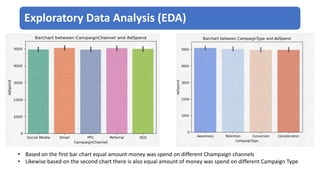
• Based on the first bar chart equal amount money was spend on different Champaign channels
• Likewise based on the second chart there is also equal amount of money was spend on different Campaign Type
EDA
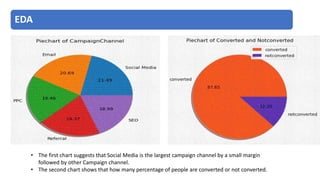
• The first chart suggests that Social Media is the largest campaign channel by a small margin
followed by other Campaign channel.
• The second chart shows that how many percentage of people are converted or not converted.
Feature Engineering
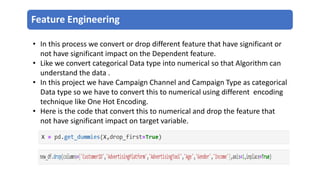
• In this process we convert or drop different feature that have significant or
not have significant impact on the Dependent feature.
• Like we convert categorical Data type into numerical so that Algorithm can
understand the data .
• In this project we have Campaign Channel and Campaign Type as categorical
Data type so we have to convert this to numerical using different encoding
technique like One Hot Encoding.
• Here is the code that convert this to numerical and drop the feature that
not have significant impact on target variable.
Model Selection
• In this process we try different type of model or algorithm that give better
result on the data and give good accuracy.
• There are different type of algorithm, that perform better on categorical
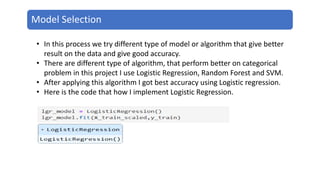
problem in this project I use Logistic Regression, Random Forest and SVM.
• After applying this algorithm I got best accuracy using Logistic regression.
• Here is the code that how I implement Logistic Regression.
Model Evaluation
• In this process we asses the model that whether the model is overfit or
underfit.
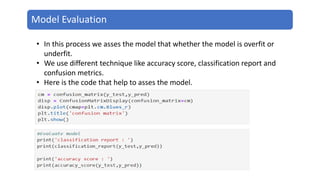
• We use different technique like accuracy score, classification report and
confusion metrics.
• Here is the code that help to asses the model.
Thank You

Digital Marketing Campaign Conversion Prediction.

  • 1.
  • 2.
    PROJECT CONTENT • Introduction •Data Preprocessing • Exploratory Data Analysis (EDA) • Feature Engineering • Model Selection • Model Evaluation
  • 3.
    INTRODUCTION • This projectaims to enhance campaign effectiveness in the digital marketing sector by accurately predicting customer conversions. • By leveraging machine learning, the project seeks to identify potential converters and optimize marketing strategies. • The objective is to develop a robust machine learning model that predicts customer conversions based on various demographic and engagement factors, enabling improved campaign targeting, increased conversion rates, and maximized return on advertising spend (ROAS).
  • 4.
    Exploratory Data Analysis(EDA) • Based on the first bar chart equal amount money was spend on different Champaign channels • Likewise based on the second chart there is also equal amount of money was spend on different Campaign Type
  • 5.
    EDA • The firstchart suggests that Social Media is the largest campaign channel by a small margin followed by other Campaign channel. • The second chart shows that how many percentage of people are converted or not converted.
  • 6.
    Feature Engineering • Inthis process we convert or drop different feature that have significant or not have significant impact on the Dependent feature. • Like we convert categorical Data type into numerical so that Algorithm can understand the data . • In this project we have Campaign Channel and Campaign Type as categorical Data type so we have to convert this to numerical using different encoding technique like One Hot Encoding. • Here is the code that convert this to numerical and drop the feature that not have significant impact on target variable.
  • 7.
    Model Selection • Inthis process we try different type of model or algorithm that give better result on the data and give good accuracy. • There are different type of algorithm, that perform better on categorical problem in this project I use Logistic Regression, Random Forest and SVM. • After applying this algorithm I got best accuracy using Logistic regression. • Here is the code that how I implement Logistic Regression.
  • 8.
    Model Evaluation • Inthis process we asses the model that whether the model is overfit or underfit. • We use different technique like accuracy score, classification report and confusion metrics. • Here is the code that help to asses the model.
  • 9.