Digital Logic Design
Project: 5-32 Bit
Decoder
Groups Member
Muhammad uzair
Muhammad Huzaifa
Hassan raza
Sahil kumar
Muhammad Rizwan
Mujeebullah
Mudasir Mujtaba
Mohsin raza
Qalandar bux
Maqsood ahmed
Overview of the Project
Project Scope
Explore the objectives and
scope of our digital logic
design project focusing on
building advanced
decoders.
Team Collaboration
Discover the effective
collaboration techniques
employed by our team to
ensure successful project
completion.
Project Timeline
Learn about the timeline
and milestones we have set
to achieve our goal.
Introduction to Decoders
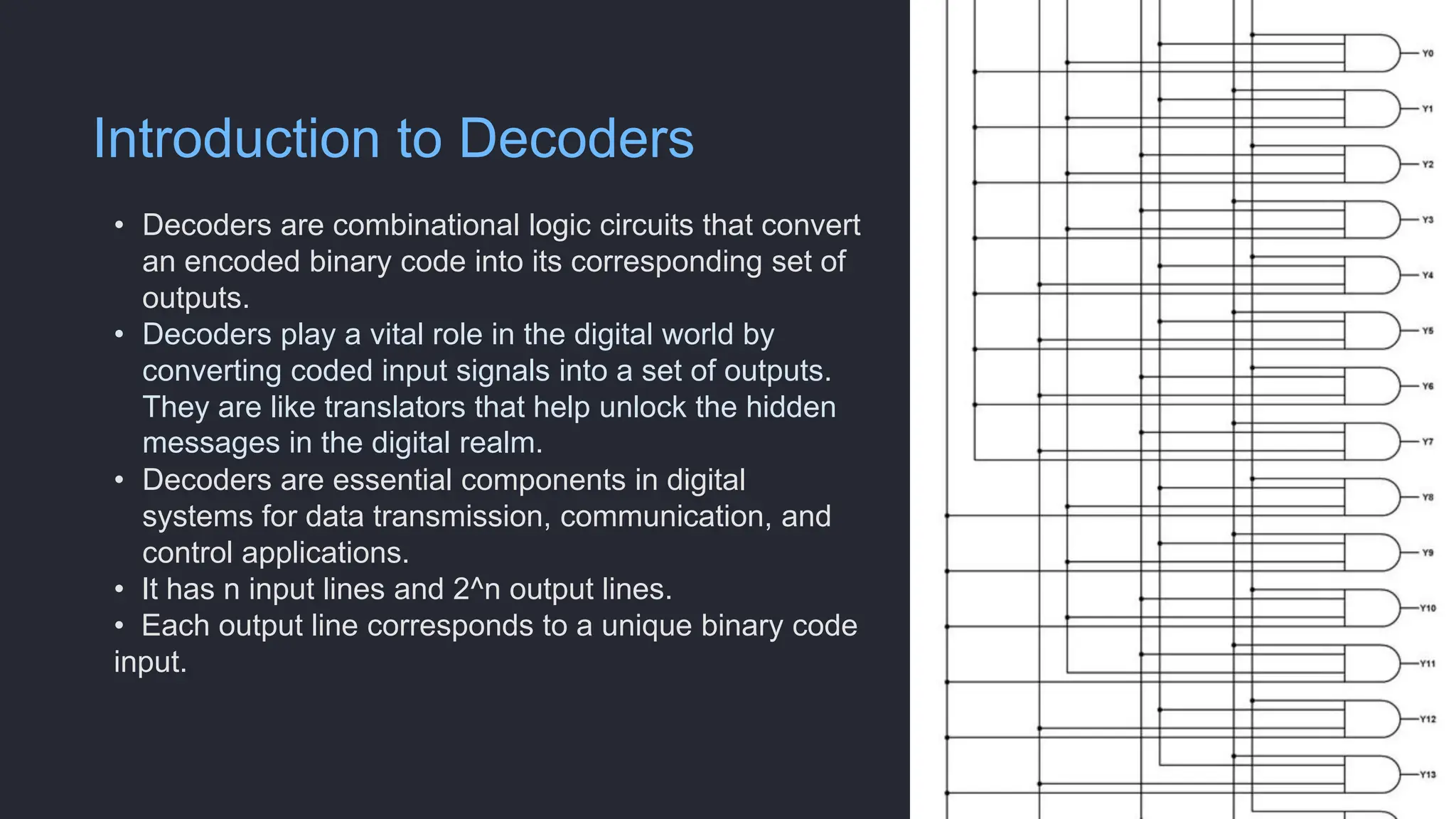
• Decoders are combinational logic circuits that convert
an encoded binary code into its corresponding set of
outputs.
• Decoders play a vital role in the digital world by
converting coded input signals into a set of outputs.
They are like translators that help unlock the hidden
messages in the digital realm.
• Decoders are essential components in digital
systems for data transmission, communication, and
control applications.
• It has n input lines and 2^n output lines.
• Each output line corresponds to a unique binary code
input.
Decoder Functionality
Discover the inner workings of decoders as we delve into their logic and
operation. We will explore how they can decode binary information and
provide corresponds outputs based on specific code configurations.
The hardware and software we used
Our Project Overview
Get ready to be amazed by our impressive 5 to 32-bit decoder project.
We have designed these decoders from scratch, carefully crafting each
circuit to ensure optimal performance and efficiency.
Our Project Overview
To implement a 5-to-32-bit decoder using the 74LS138 ICs, you would need four
74LS138 ICs and one additional 74LS139 IC (2-to-4 decoder). The 74LS138 ICs
would handle the lower 4 bits of the input code, and the 74LS139 IC would
handle the most significant bit (MSB). The outputs of the 74LS139 IC would then
be used to enable the appropriate 74LS138 ICs, ensuring that only one output
line is active at a time.
Here is a step-by-step guide on how to implement a 5-to-32-bit decoder using
the 74LS138 and 74LS139 ICs:
1.Connect the Input Lines: Connect the 5 input lines (A, B, C, D, E) to the
appropriate pins of the 74LS138 ICs and the 74LS139 IC.
2.Connect the Enable Inputs: Connect the outputs of the 74LS139 IC (Q0, Q1) to
the enable inputs (E1, E2) of the corresponding 74LS138 ICs.
3.Connect the Output Lines: Connect the outputs of the 74LS138 ICs (Q0, Q1,
Q2, Q3, Q4, Q5, Q6, Q7) to the corresponding output lines (Q0, Q1, Q2, ...,
Q31).
4.Power and Ground Connections: Connect the VCC pin of each IC to a positive
5V supply and the GND pin to a ground connection.
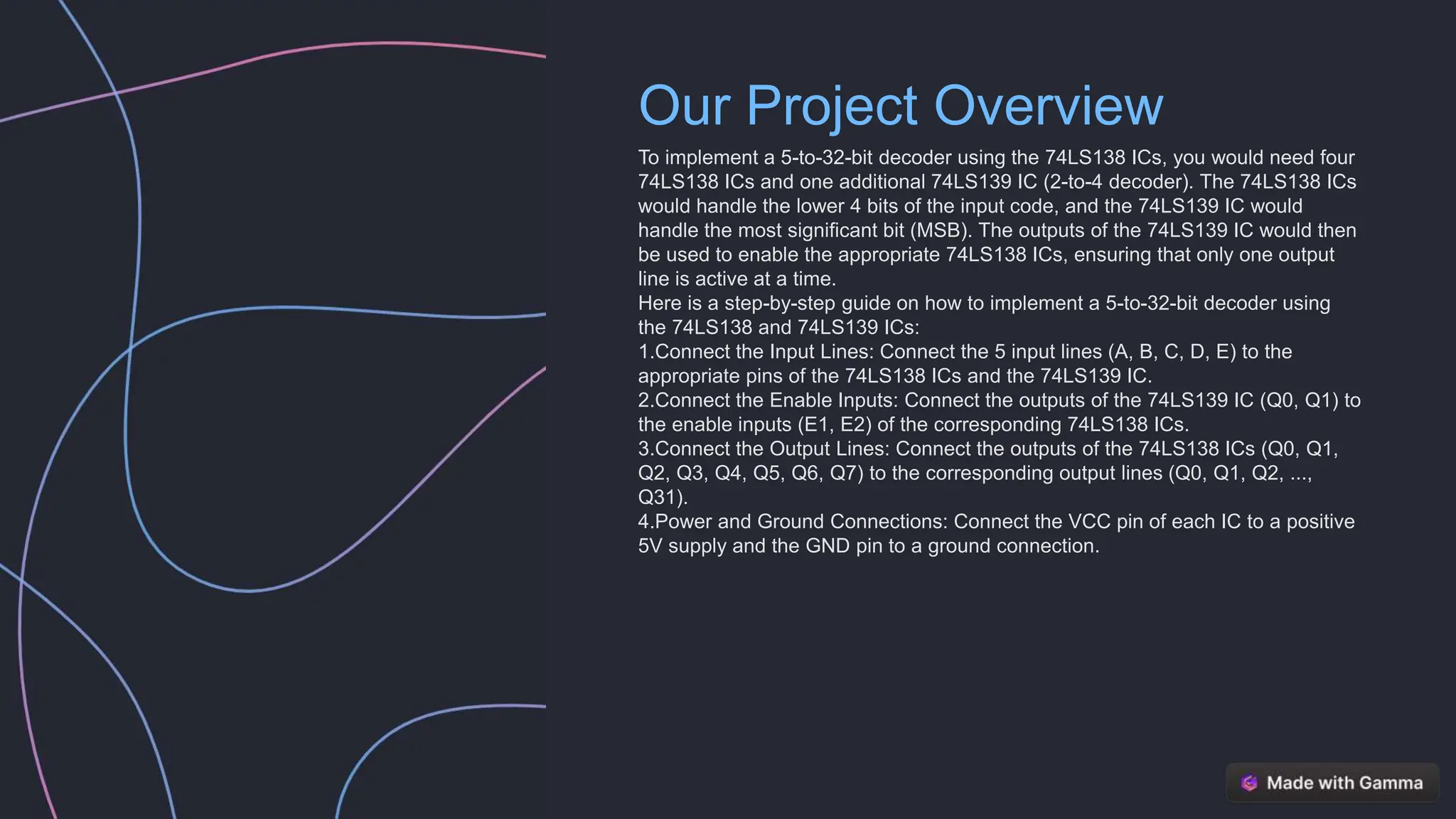
16-bit Decoder Design Details
We will unveil the intricacies of our 16-bit decoder design, revealing the logic behind its operation
and the key components that make it an essential tool in the digital logic landscape.
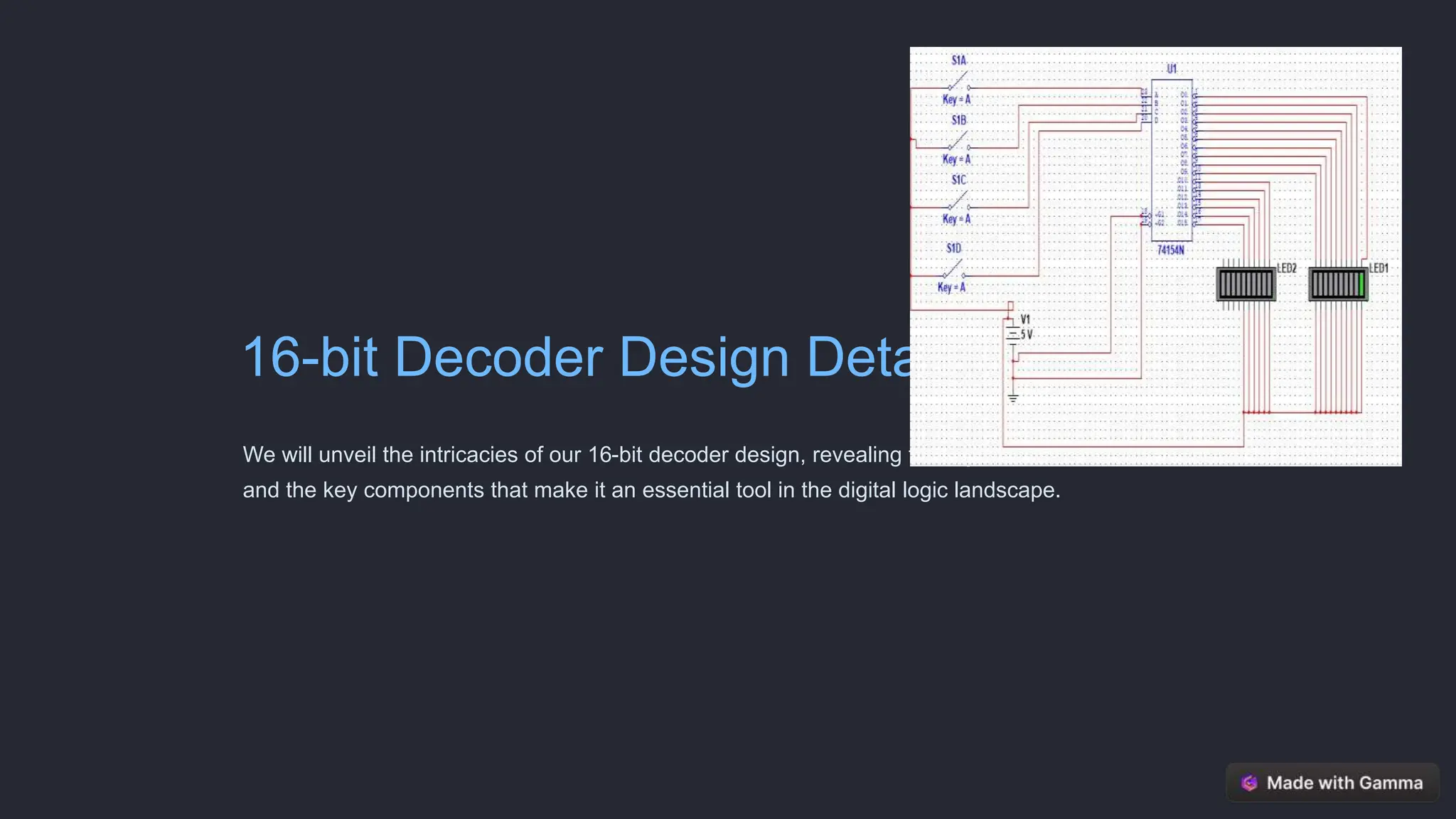
32-bit Decoder Design
Details
Journey deeper into the realm of decoders as we explore the design
intricacies of our cutting-edge 32-bit decoder. Witness the power and
versatility of this advanced circuit in action.
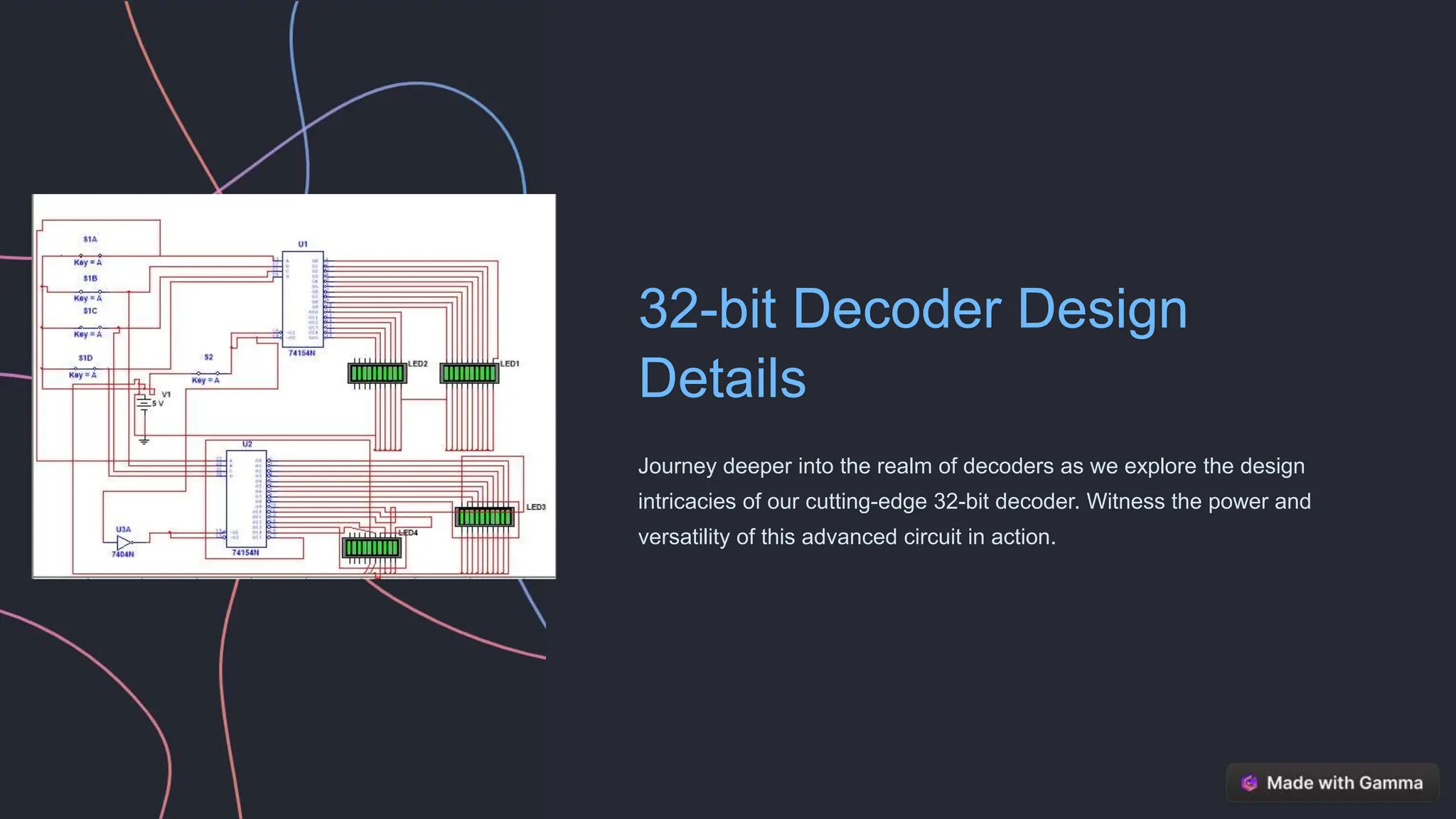
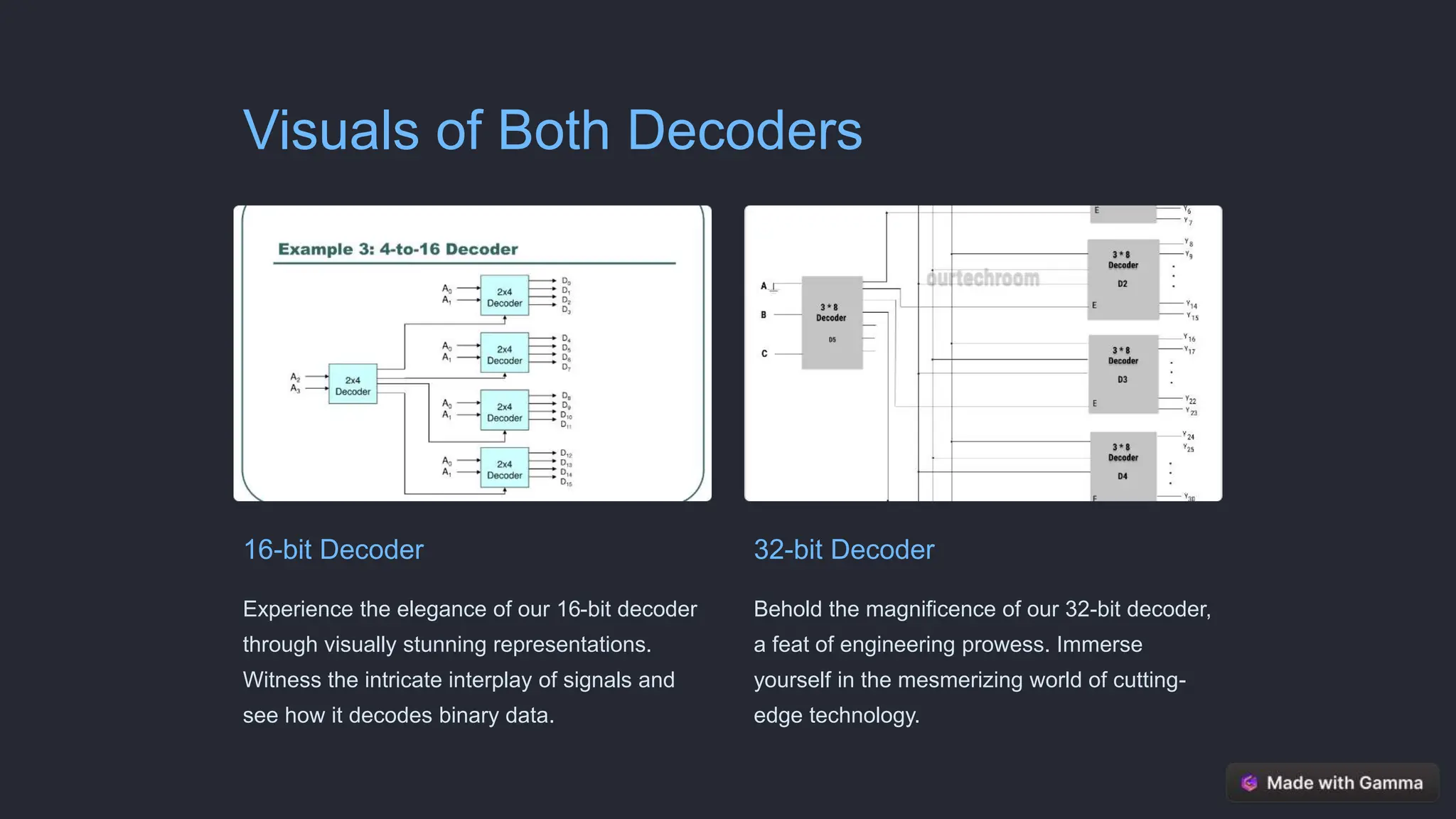
Visuals of Both Decoders
16-bit Decoder
Experience the elegance of our 16-bit decoder
through visually stunning representations.
Witness the intricate interplay of signals and
see how it decodes binary data.
32-bit Decoder
Behold the magnificence of our 32-bit decoder,
a feat of engineering prowess. Immerse
yourself in the mesmerizing world of cutting-
edge technology.
Real-World Applications of Decoders
1 Communications
Systems
Explore how decoders
form an integral part of
communication
systems, enabling
efficient data
transmission and
reception.
2 Computer
Architecture
Discover the crucial
role of decoders in
modern computer
architectures,
facilitating data
processing and
memory access.
3 Digital Image
Processing
Learn about the
application of
decoders in image
processing algorithms,
enabling complex
image transformations
and analysis.
Conclusion and Summary
As our journey through decoders comes to a close, we reflect on the
challenges faced and the knowledge gained. Join us in celebrating the
power and beauty of digital logic design.

Digital-Logic-Design-Project-16-bit-and-32-bit-Decoder.pptx

  • 1.
  • 2.
    Groups Member Muhammad uzair MuhammadHuzaifa Hassan raza Sahil kumar Muhammad Rizwan Mujeebullah Mudasir Mujtaba Mohsin raza Qalandar bux Maqsood ahmed
  • 3.
    Overview of theProject Project Scope Explore the objectives and scope of our digital logic design project focusing on building advanced decoders. Team Collaboration Discover the effective collaboration techniques employed by our team to ensure successful project completion. Project Timeline Learn about the timeline and milestones we have set to achieve our goal.
  • 4.
    Introduction to Decoders •Decoders are combinational logic circuits that convert an encoded binary code into its corresponding set of outputs. • Decoders play a vital role in the digital world by converting coded input signals into a set of outputs. They are like translators that help unlock the hidden messages in the digital realm. • Decoders are essential components in digital systems for data transmission, communication, and control applications. • It has n input lines and 2^n output lines. • Each output line corresponds to a unique binary code input.
  • 5.
    Decoder Functionality Discover theinner workings of decoders as we delve into their logic and operation. We will explore how they can decode binary information and provide corresponds outputs based on specific code configurations.
  • 6.
    The hardware andsoftware we used
  • 7.
    Our Project Overview Getready to be amazed by our impressive 5 to 32-bit decoder project. We have designed these decoders from scratch, carefully crafting each circuit to ensure optimal performance and efficiency.
  • 8.
    Our Project Overview Toimplement a 5-to-32-bit decoder using the 74LS138 ICs, you would need four 74LS138 ICs and one additional 74LS139 IC (2-to-4 decoder). The 74LS138 ICs would handle the lower 4 bits of the input code, and the 74LS139 IC would handle the most significant bit (MSB). The outputs of the 74LS139 IC would then be used to enable the appropriate 74LS138 ICs, ensuring that only one output line is active at a time. Here is a step-by-step guide on how to implement a 5-to-32-bit decoder using the 74LS138 and 74LS139 ICs: 1.Connect the Input Lines: Connect the 5 input lines (A, B, C, D, E) to the appropriate pins of the 74LS138 ICs and the 74LS139 IC. 2.Connect the Enable Inputs: Connect the outputs of the 74LS139 IC (Q0, Q1) to the enable inputs (E1, E2) of the corresponding 74LS138 ICs. 3.Connect the Output Lines: Connect the outputs of the 74LS138 ICs (Q0, Q1, Q2, Q3, Q4, Q5, Q6, Q7) to the corresponding output lines (Q0, Q1, Q2, ..., Q31). 4.Power and Ground Connections: Connect the VCC pin of each IC to a positive 5V supply and the GND pin to a ground connection.
  • 9.
    16-bit Decoder DesignDetails We will unveil the intricacies of our 16-bit decoder design, revealing the logic behind its operation and the key components that make it an essential tool in the digital logic landscape.
  • 10.
    32-bit Decoder Design Details Journeydeeper into the realm of decoders as we explore the design intricacies of our cutting-edge 32-bit decoder. Witness the power and versatility of this advanced circuit in action.
  • 11.
    Visuals of BothDecoders 16-bit Decoder Experience the elegance of our 16-bit decoder through visually stunning representations. Witness the intricate interplay of signals and see how it decodes binary data. 32-bit Decoder Behold the magnificence of our 32-bit decoder, a feat of engineering prowess. Immerse yourself in the mesmerizing world of cutting- edge technology.
  • 12.
    Real-World Applications ofDecoders 1 Communications Systems Explore how decoders form an integral part of communication systems, enabling efficient data transmission and reception. 2 Computer Architecture Discover the crucial role of decoders in modern computer architectures, facilitating data processing and memory access. 3 Digital Image Processing Learn about the application of decoders in image processing algorithms, enabling complex image transformations and analysis.
  • 13.
    Conclusion and Summary Asour journey through decoders comes to a close, we reflect on the challenges faced and the knowledge gained. Join us in celebrating the power and beauty of digital logic design.