Building an Innovation Nation:
Firms Need Stronger Dynamic
Capabilities
David J. Teece
Institute for Business Innovation
Haas School, UC Berkeley
And
Executive Chairman
Berkeley Research Group
dteece@thinkbrg.com
Nikkei Business LIVE: Reimagining Capitalism,
Reconstructing with innovation
October 6, 2021
Copyright David J. Teece
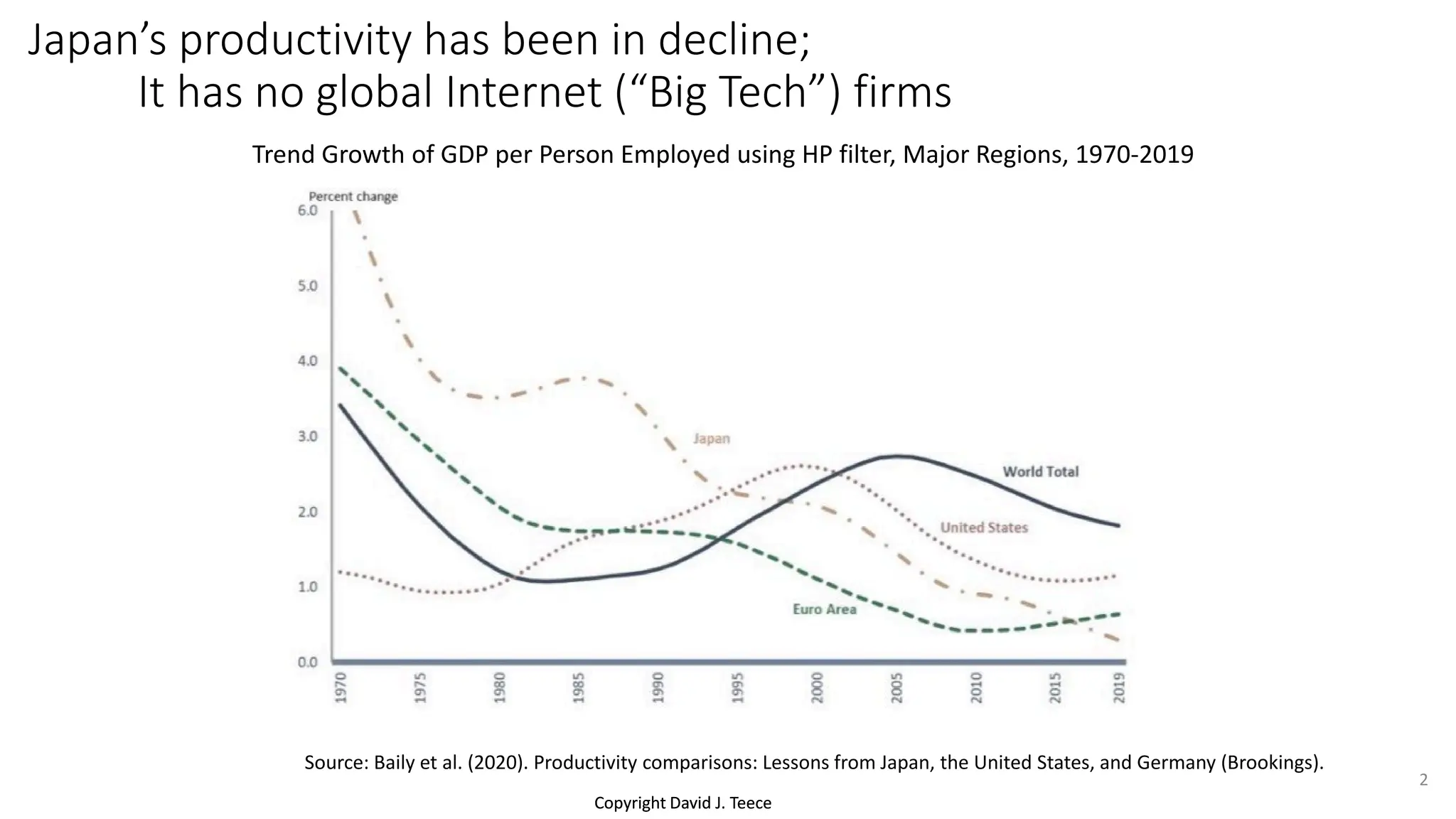
Japan’s productivity has been in decline;
It has no global Internet (“Big Tech”) firms
Trend Growth of GDP per Person Employed using HP filter, Major Regions, 1970-2019
Source: Baily et al. (2020). Productivity comparisons: Lessons from Japan, the United States, and Germany (Brookings).
Copyright David J. Teece
2
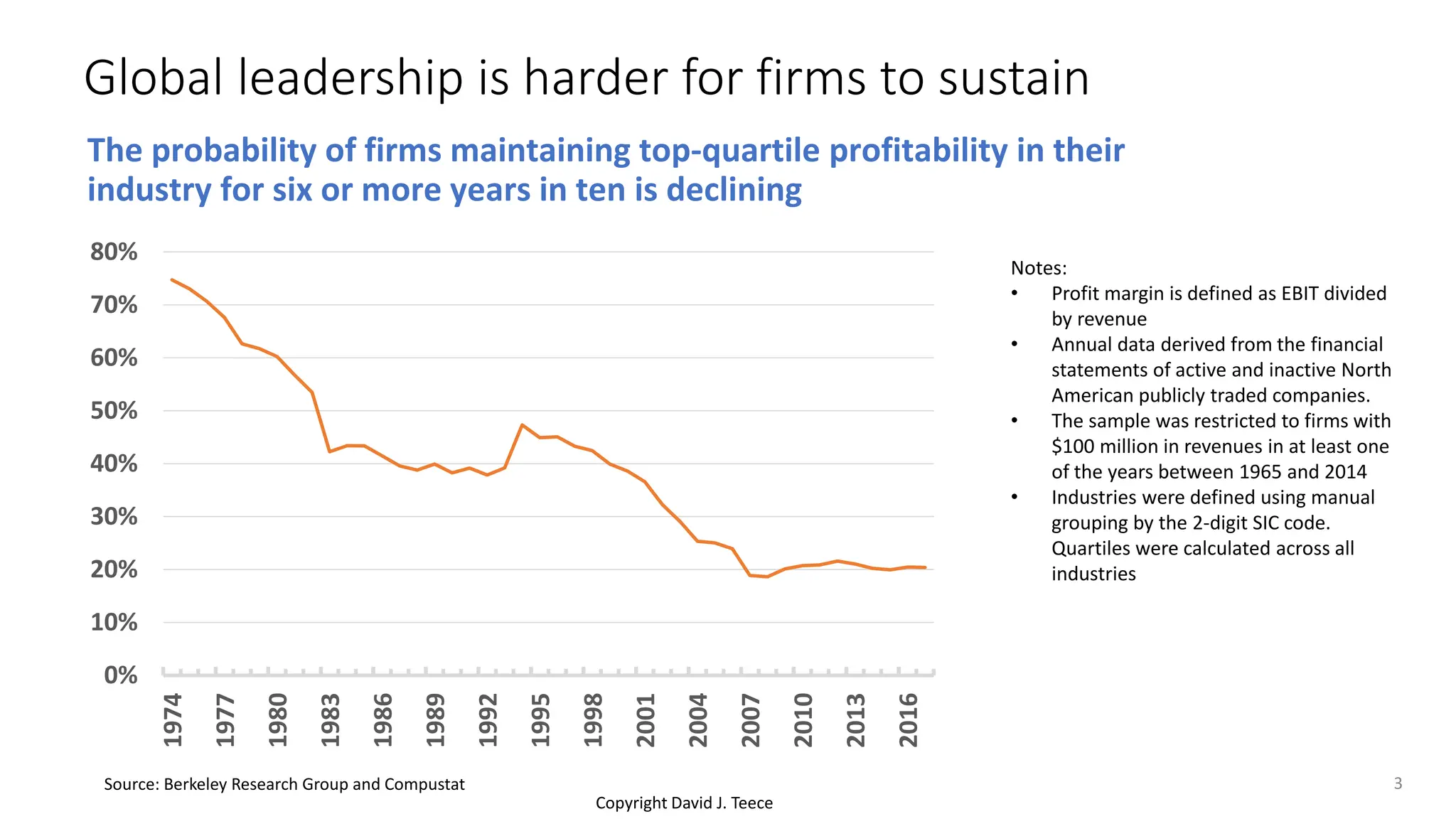
Global leadership is harder for firms to sustain
The probability of firms maintaining top-quartile profitability in their
industry for six or more years in ten is declining
Source: Berkeley Research Group and Compustat 3
Copyright David J. Teece
0%
10%
20%
30%
40%
50%
60%
70%
80%
1974
1977
1980
1983
1986
1989
1992
1995
1998
2001
2004
2007
2010
2013
2016
Notes:
• Profit margin is defined as EBIT divided
by revenue
• Annual data derived from the financial
statements of active and inactive North
American publicly traded companies.
• The sample was restricted to firms with
$100 million in revenues in at least one
of the years between 1965 and 2014
• Industries were defined using manual
grouping by the 2-digit SIC code.
Quartiles were calculated across all
industries
Copyright David J. Teece
Dynamic Capabilities Help Sustain Industry-Leading
Profitability
Basic Definition: “The ability of an organization and its management
to integrate, build, and reconfigure internal and external
competencies to address rapidly changing environments.”*
• They are also critical for dealing with conditions of uncertainty, in
which new rivals and other problems arise without warning
• They are shaped by each firm’s unique heritage, take years to “build”,
and continue to adapt over time
• They are driven by management but require organization-wide
involvement and integration
* - Teece, Pisano and Shuen, Strategic Management Journal, 1997
4
Copyright David J. Teece
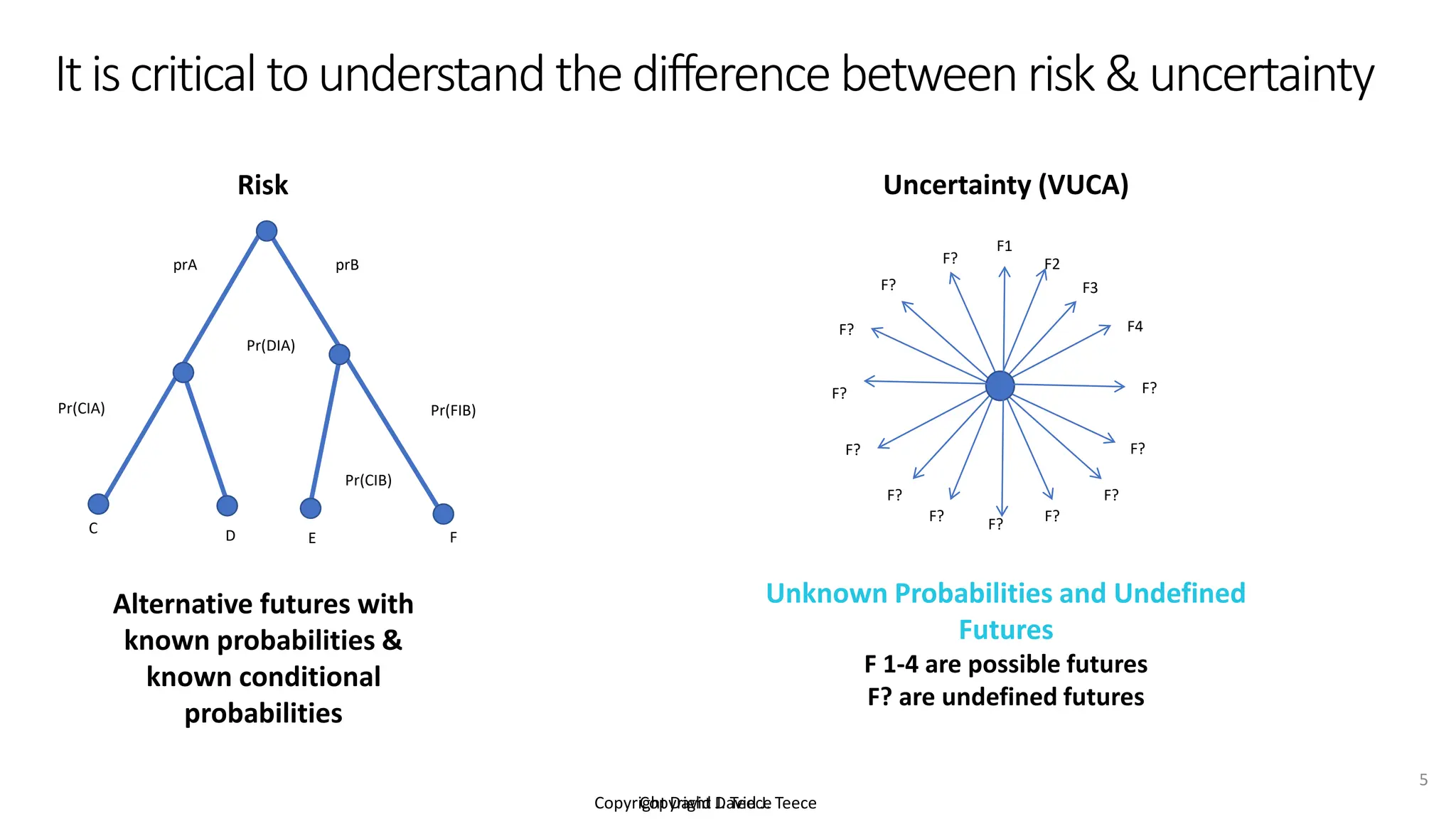
Itiscritical tounderstand thedifference betweenrisk&uncertainty
Pr(DIA)
Pr(CIB)
Risk
C D E F
prB
Pr(FIB)
Pr(CIA)
prA
Alternative futures with
known probabilities &
known conditional
probabilities
F1
F?
F?
F?
F?
F?
F? F?
F2
F3
F4
F?
F?
F?
F?
Uncertainty (VUCA)
Unknown Probabilities and Undefined
Futures
F 1-4 are possible futures
F? are undefined futures
F?
Copyright David J. Teece
5
Copyright David J. Teece
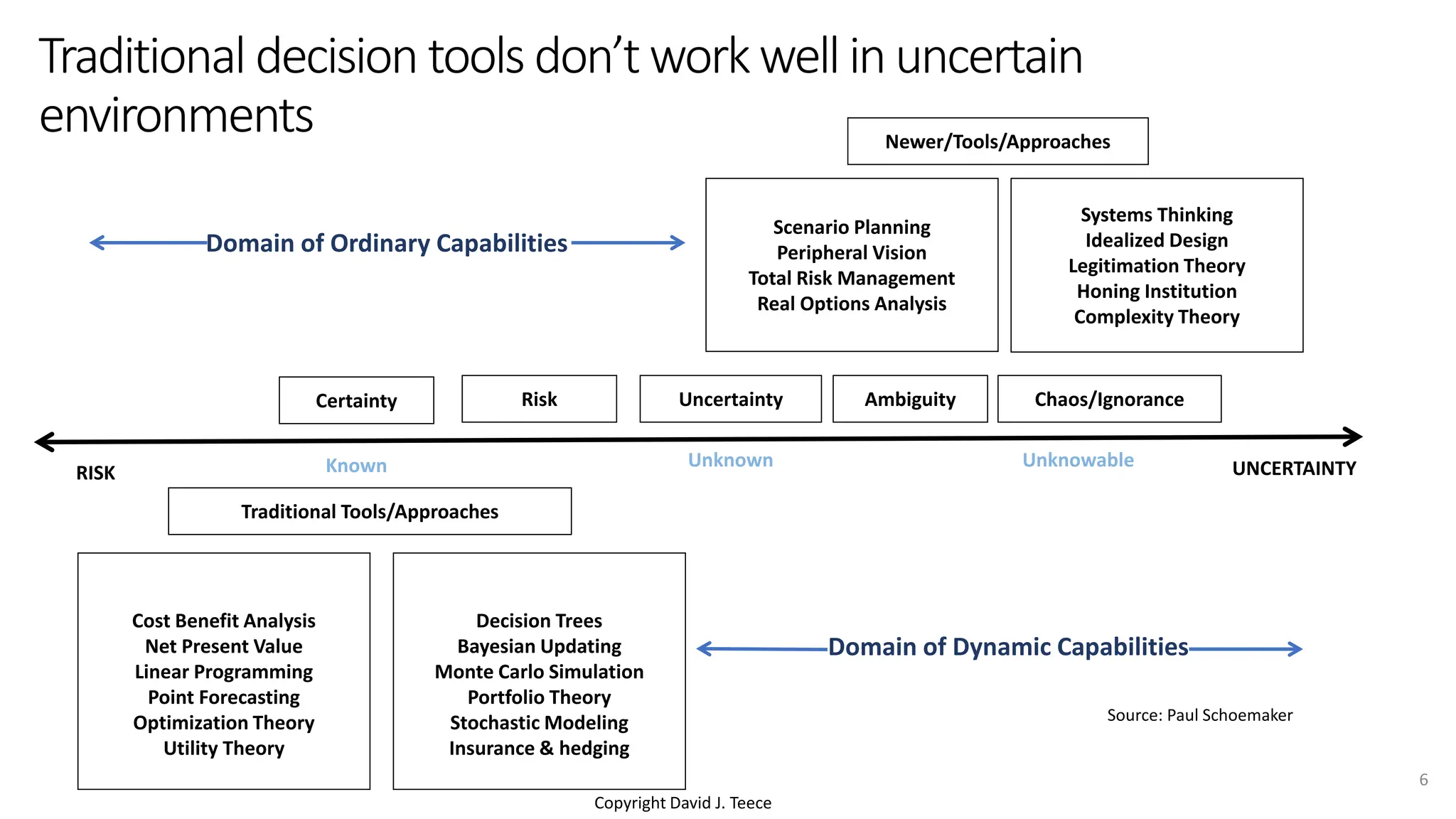
Traditional decision tools don’t workwellinuncertain
environments
Certainty Risk Uncertainty Ambiguity Chaos/Ignorance
Newer/Tools/Approaches
Scenario Planning
Peripheral Vision
Total Risk Management
Real Options Analysis
Systems Thinking
Idealized Design
Legitimation Theory
Honing Institution
Complexity Theory
Cost Benefit Analysis
Net Present Value
Linear Programming
Point Forecasting
Optimization Theory
Utility Theory
Decision Trees
Bayesian Updating
Monte Carlo Simulation
Portfolio Theory
Stochastic Modeling
Insurance & hedging
Known Unknown Unknowable
Traditional Tools/Approaches
Domain of Ordinary Capabilities
Domain of Dynamic Capabilities
RISK UNCERTAINTY
Source: Paul Schoemaker
6
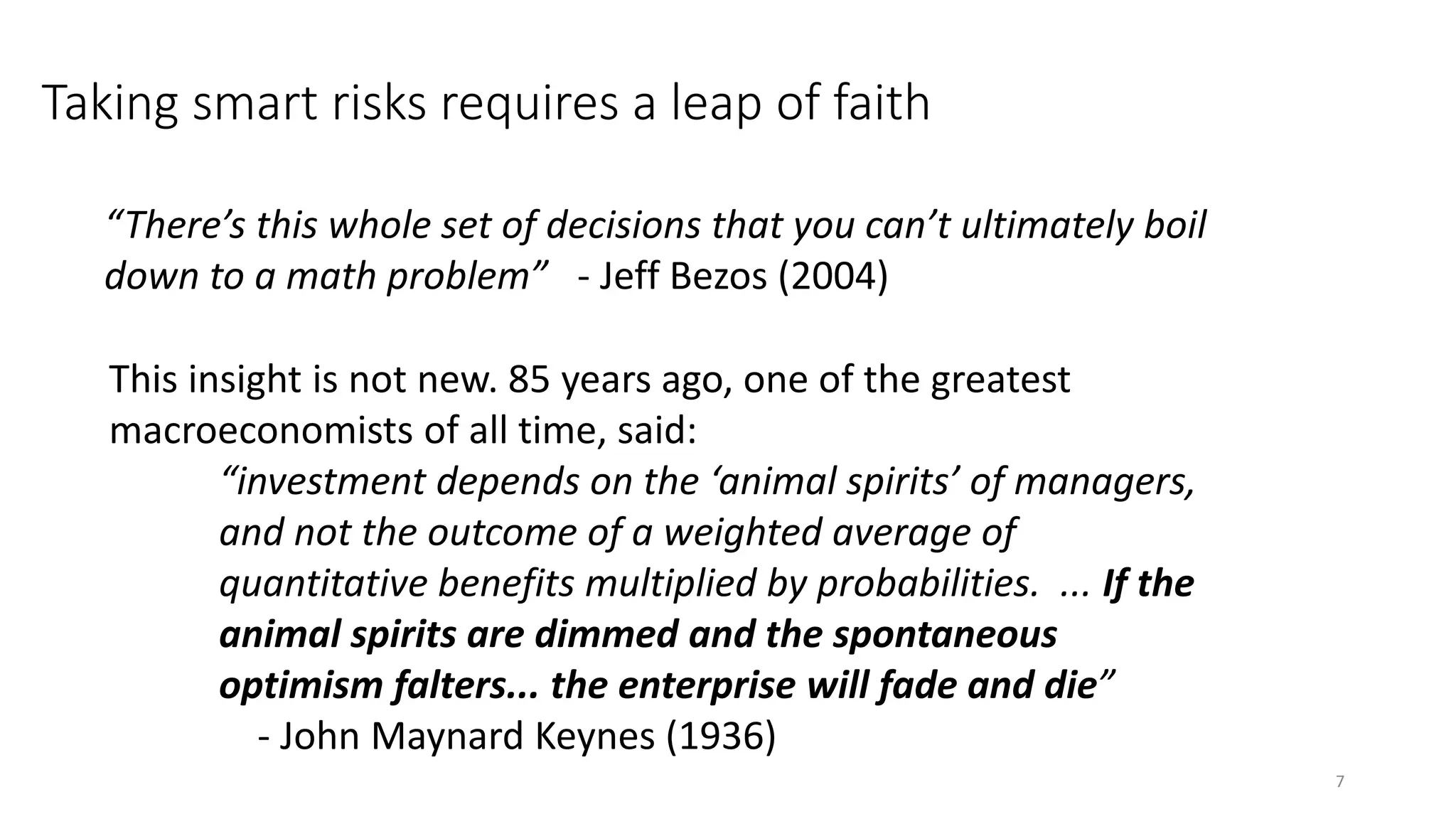
“There’s this whole set of decisions that you can’t ultimately boil
down to a math problem” - Jeff Bezos (2004)
Taking smart risks requires a leap of faith
This insight is not new. 85 years ago, one of the greatest
macroeconomists of all time, said:
“investment depends on the ‘animal spirits’ of managers,
and not the outcome of a weighted average of
quantitative benefits multiplied by probabilities. ... If the
animal spirits are dimmed and the spontaneous
optimism falters... the enterprise will fade and die”
- John Maynard Keynes (1936)
7
Copyright David J. Teece
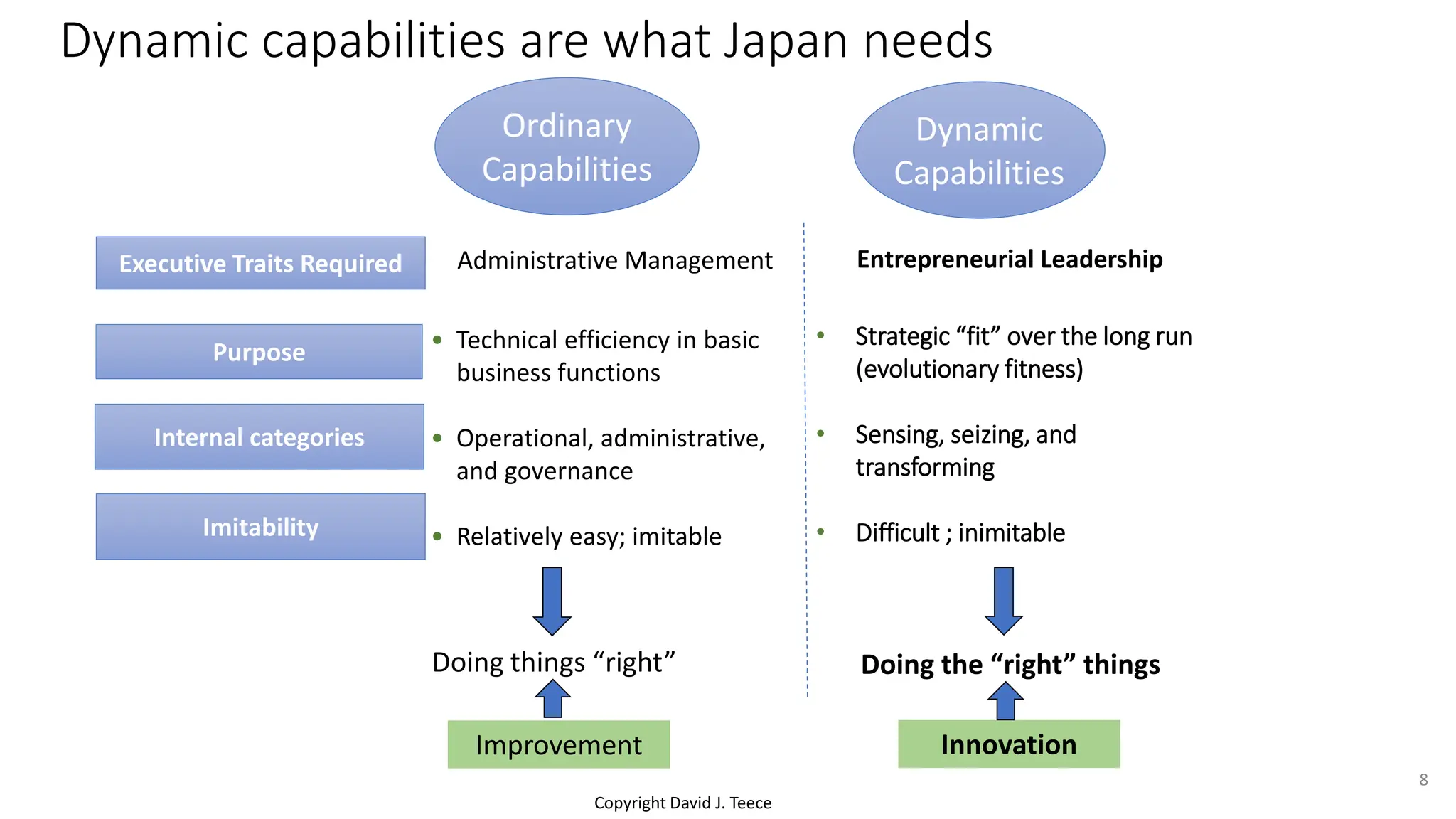
• Strategic “fit” over the long run
(evolutionary fitness)
• Sensing, seizing, and
transforming
• Difficult ; inimitable
• Technical efficiency in basic
business functions
• Operational, administrative,
and governance
• Relatively easy; imitable
Ordinary
Capabilities
Dynamic
Capabilities
Doing things “right” Doing the “right” things
Dynamic capabilities are what Japan needs
Internal categories
Imitability
Purpose
Administrative Management
Improvement Innovation
Executive Traits Required Entrepreneurial Leadership
8
Copyright David J. Teece
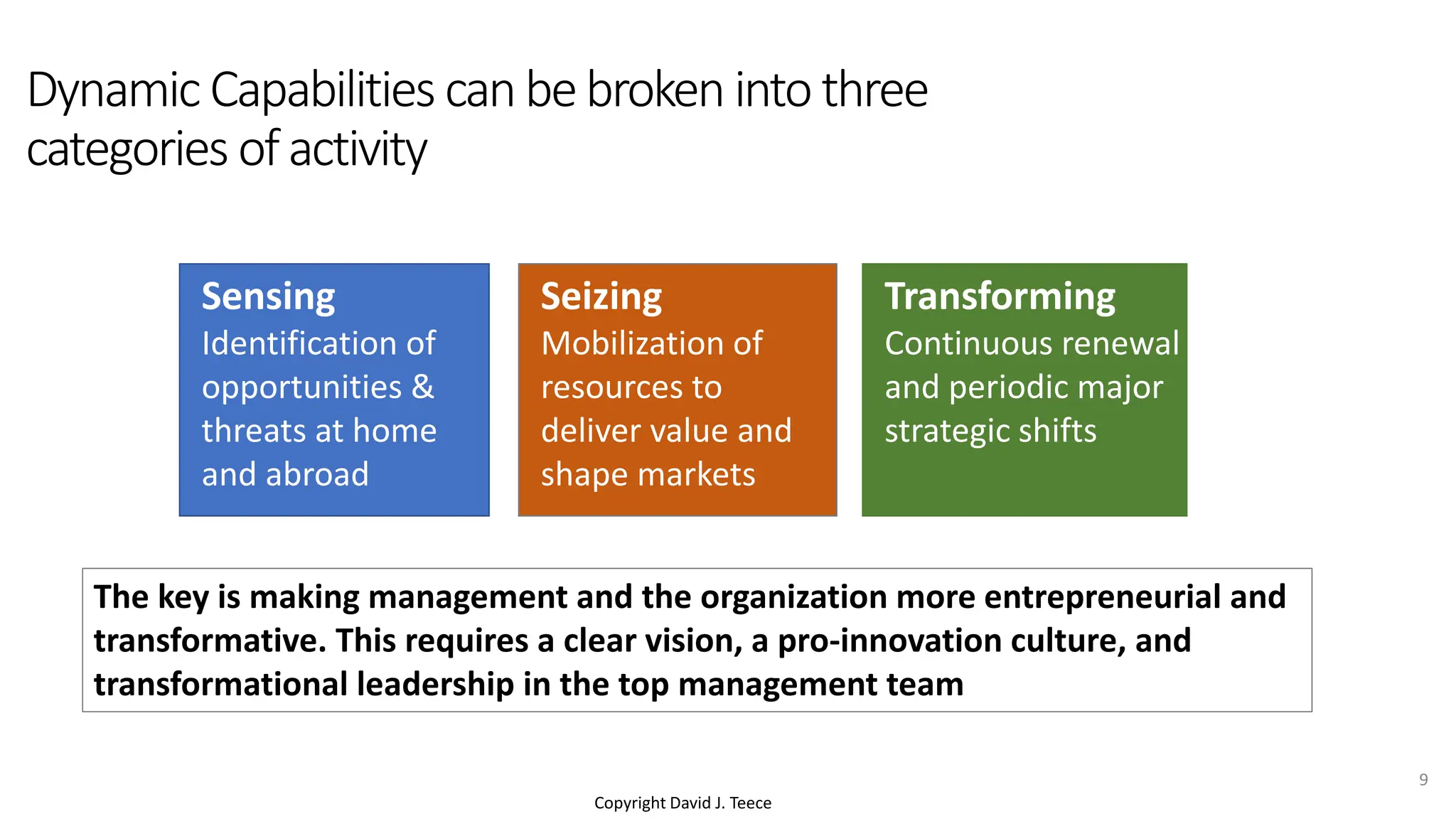
Dynamic Capabilities canbebroken into three
categories ofactivity
Sensing
Identification of
opportunities &
threats at home
and abroad
Transforming
Continuous renewal
and periodic major
strategic shifts
Seizing
Mobilization of
resources to
deliver value and
shape markets
The key is making management and the organization more entrepreneurial and
transformative. This requires a clear vision, a pro-innovation culture, and
transformational leadership in the top management team
9
Copyright David J. Teece
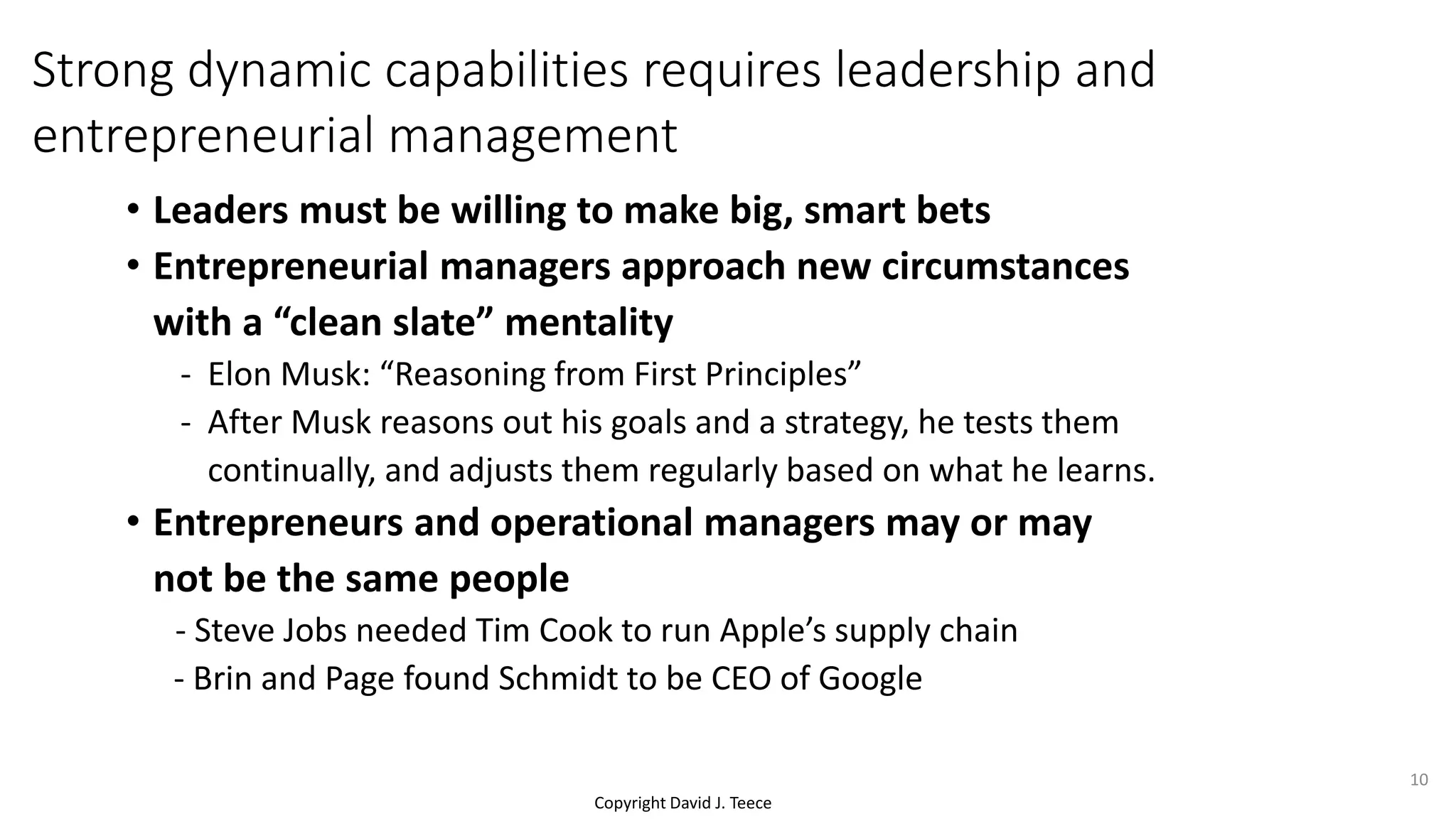
• Leaders must be willing to make big, smart bets
• Entrepreneurial managers approach new circumstances
with a “clean slate” mentality
- Elon Musk: “Reasoning from First Principles”
- After Musk reasons out his goals and a strategy, he tests them
continually, and adjusts them regularly based on what he learns.
• Entrepreneurs and operational managers may or may
not be the same people
- Steve Jobs needed Tim Cook to run Apple’s supply chain
- Brin and Page found Schmidt to be CEO of Google
Strong dynamic capabilities requires leadership and
entrepreneurial management
10
Copyright David J. Teece
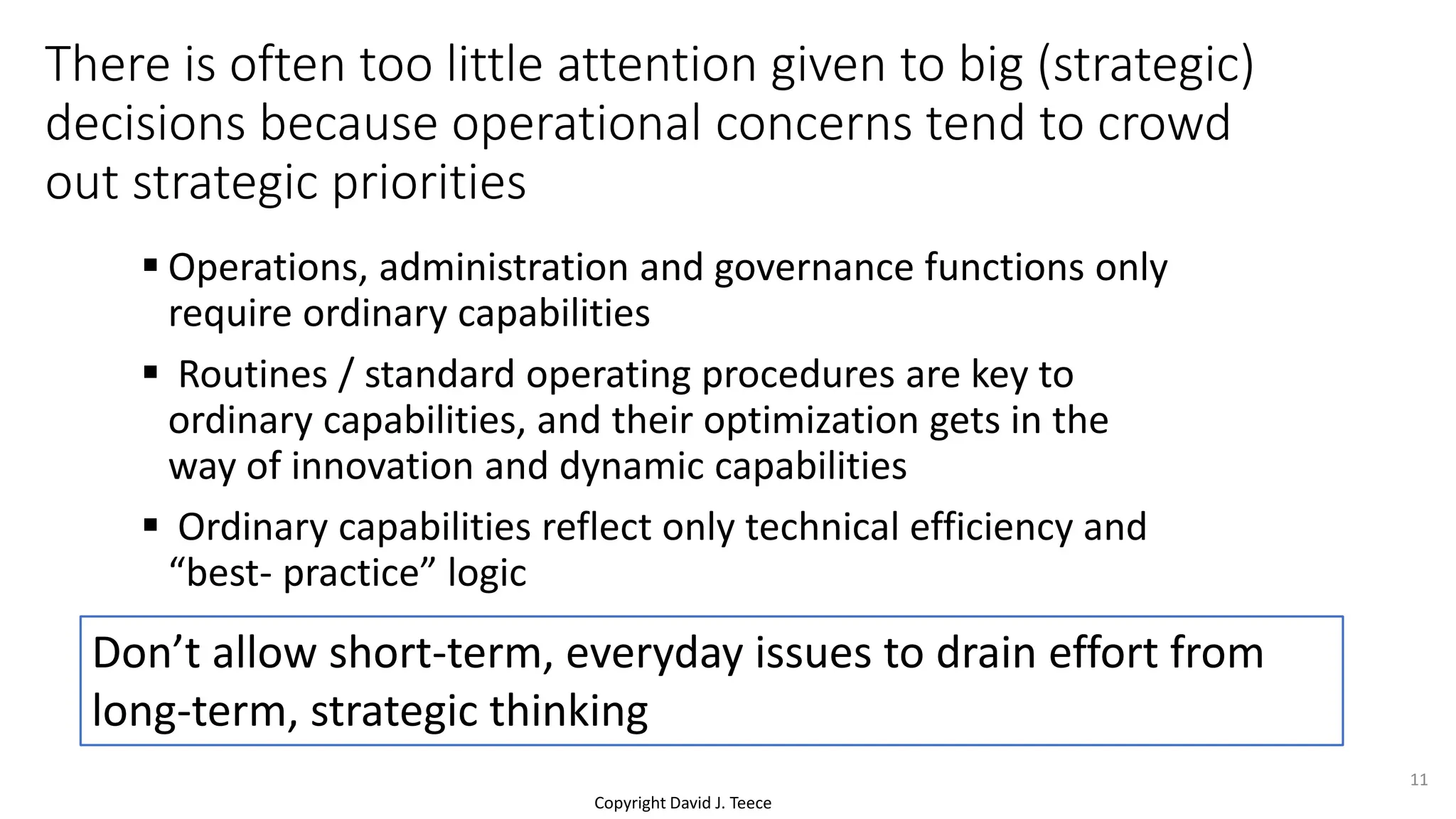
There is often too little attention given to big (strategic)
decisions because operational concerns tend to crowd
out strategic priorities
 Operations, administration and governance functions only
require ordinary capabilities
 Routines / standard operating procedures are key to
ordinary capabilities, and their optimization gets in the
way of innovation and dynamic capabilities
 Ordinary capabilities reflect only technical efficiency and
“best- practice” logic
Don’t allow short-term, everyday issues to drain effort from
long-term, strategic thinking
11
Copyright David J. Teece
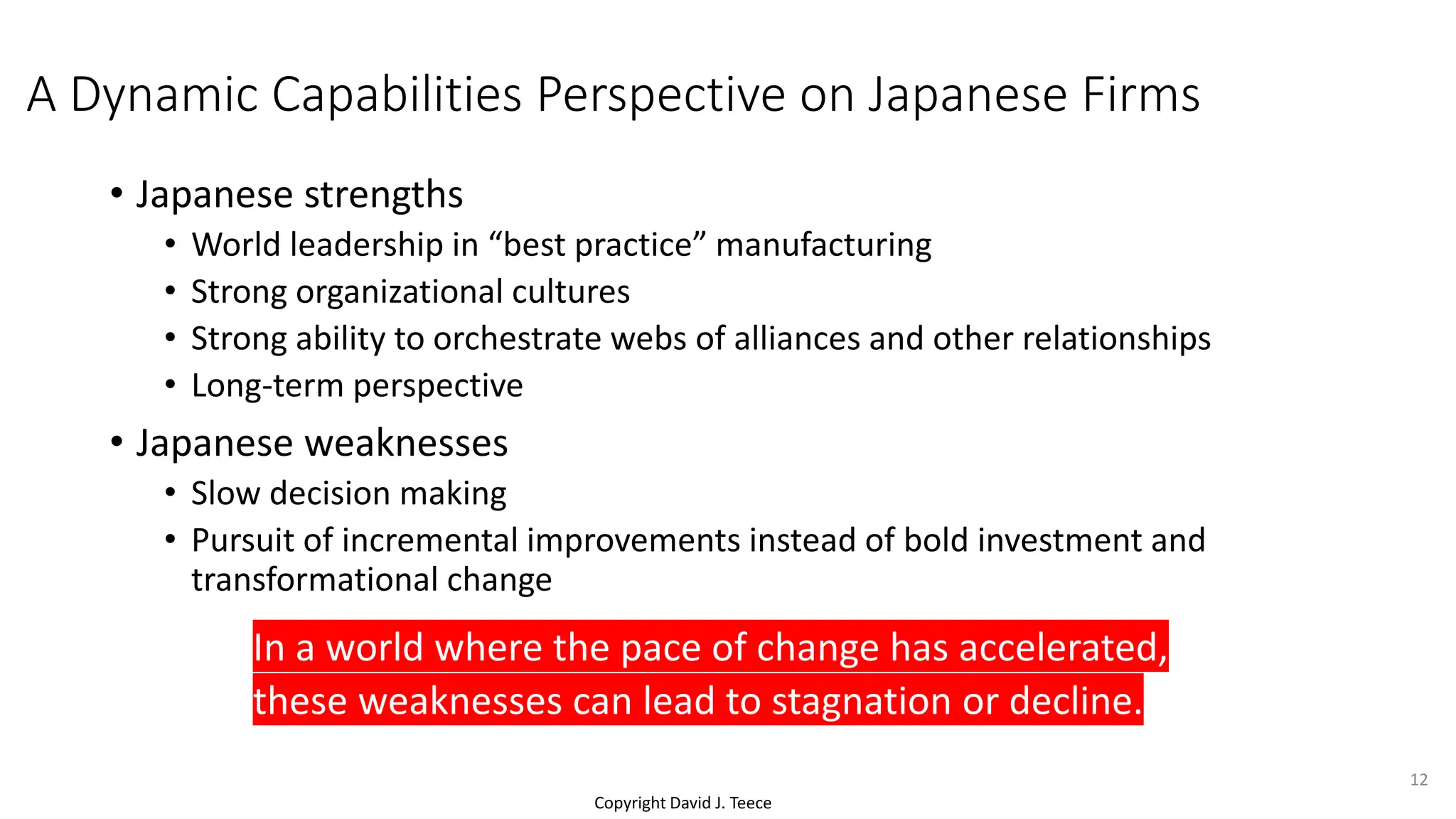
A Dynamic Capabilities Perspective on Japanese Firms
• Japanese strengths
• World leadership in “best practice” manufacturing
• Strong organizational cultures
• Strong ability to orchestrate webs of alliances and other relationships
• Long-term perspective
• Japanese weaknesses
• Slow decision making
• Pursuit of incremental improvements instead of bold investment and
transformational change
In a world where the pace of change has accelerated,
these weaknesses can lead to stagnation or decline.
12
Copyright David J. Teece
A single-minded focus on efficiency today can
weaken the company tomorrow
• “Best practices” cannot ensure competitive advantage
• Rivals can copy them over time
• Once a few firms master the same level of efficiency, profits are driven down
• Cutting “excess” capacity leaves an organization unprepared for
extreme shifts
• Hospital cutbacks left the US and other countries unable to handle the covid
surge
• Just-in-time inventory left auto supply chains unable to handle the jump in
demand from pandemic recovery
13
Copyright David J. Teece
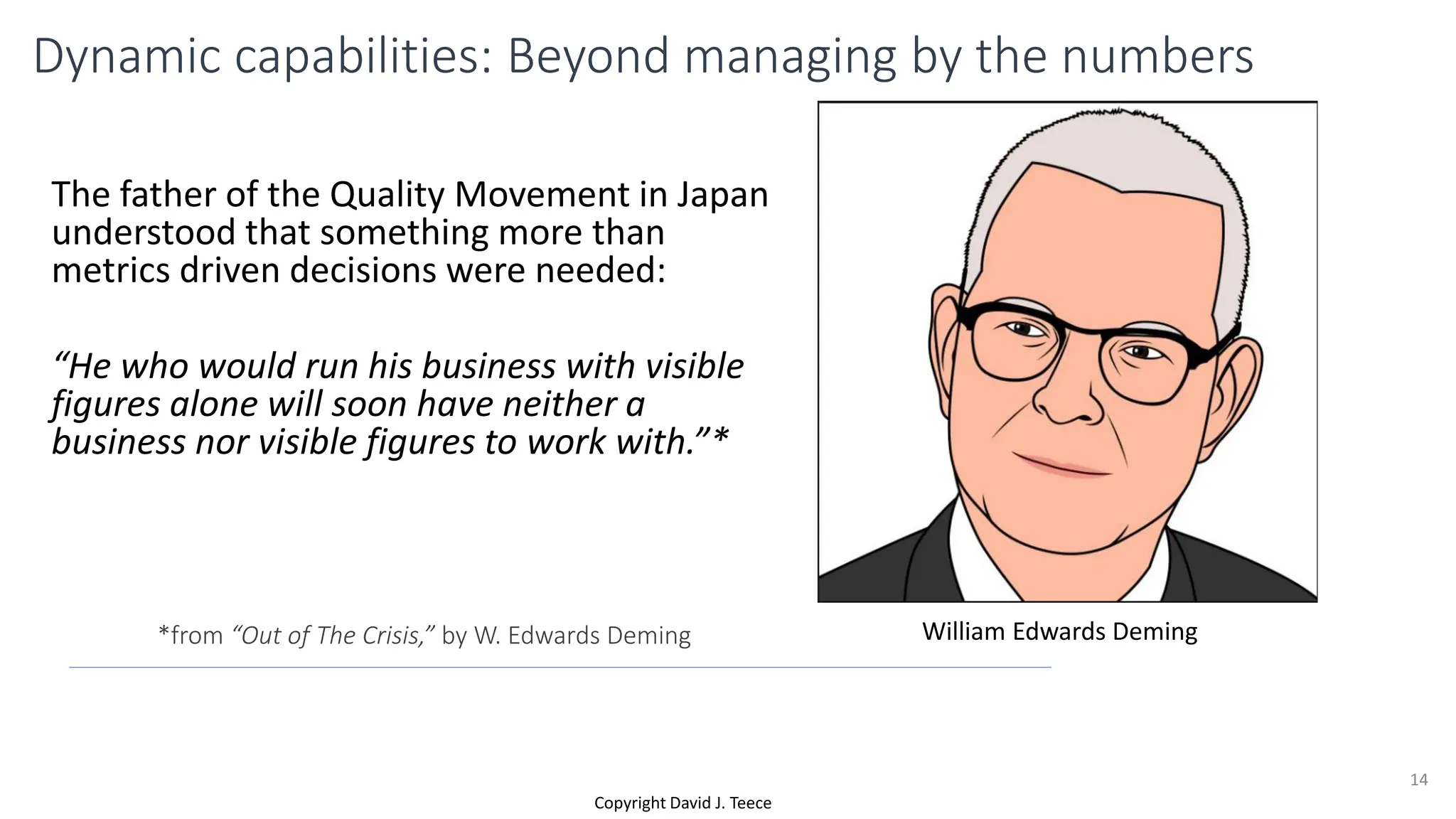
The father of the Quality Movement in Japan
understood that something more than
metrics driven decisions were needed:
“He who would run his business with visible
figures alone will soon have neither a
business nor visible figures to work with.”*
William Edwards Deming
*from “Out of The Crisis,” by W. Edwards Deming
Dynamic capabilities: Beyond managing by the numbers
14
Copyright David J. Teece
Lessons of the samurai
• The feudal system of the samurai survived for centuries
• “It does not matter who is stronger....”
(Miyamato Musashi, 17th Century Samurai warrior-philosopher)
• In the short-term, skill and tactics are sufficient to win battles
• After the Meiji Restoration embraced firearms and other European
ideas, the samurai failed to adapt to a new way of life
• Yesterday’s skills (ordinary capabilities) – no matter how excellent – are not
sufficient to ensure long-term survival
• Strong dynamic capabilities can help maintain an organization’s “fit” in a
changing business environment
15
Copyright David J. Teece
Change coming to the auto industry
• New opportunities are shifting the source of advantage from
hardware to software
• Electric vehicles (e.g., power management)
• Greater use of semiconductors
• Connected cars
• Autonomous vehicles
• Requires developing new capabilities or giving partial control of key
technology to partner(s)
• Japanese companies lost ground in electronics when software became more
important in the 1990s
• A challenging and dangerous transition for incumbents
• Electrification and autonomy are attracting new entrants
16
Copyright David J. Teece
It’s hard for big firms to change
• Sony had a worldwide success with its Walkman
• But it missed the opportunity in digital players
• Toyota built a large success with its hybrid Prius technology
• But it seems to be missing the shift to electrification
• The problem isn’t so much technological, but organizational
• Fear of cannibalizing existing business (e.g., protecting Sony Music rights)
• Inability to embrace new models (e.g., digital music store with rival music
labels)
The challenge for Japanese firms is amplified
because there is not a strong domestic base of
entrepreneurial startups to draw from
17
Copyright David J. Teece
Perfectionism can be the enemy of innovation
• Optimization is about reducing variance and avoiding failure
• Innovation requires a willingness to reward smart risk-taking
• A “smart failure” is a chance to learn and try something different
• America’s (and China’s) startup culture, where nine in ten efforts end
in failure, has led to a sustainable national advantage.
18
Copyright David J. Teece
Smart, timely risk taking is required
• Smart risks are supported by analysis, but involve choices for which
numerical certainty is impossible.
• The market required may not exist yet
• The risk-taking manager develops an understanding of the future
through a process of sensemaking
• In the 1960s, Tom Watson at IBM committed the financial capital and
technical resources to develop and deploy the System/360 mainframe
ecosystem while competitors acted cautiously.
• Speed matters – once the business model has proven successful
• With digital technologies, “You have to race really hard to scale fast—
but the benefit is that you’re achieving escape velocity from the black
hole that is hypercompetition.”
- Reid Hoffman (LinkedIn founder), Masters of Scale (2021)
19
Copyright David J. Teece
Seizing is complex and demands a “bias for action”
• Seizing requires management to orchestrate internal and external
assets (especially big data) to:
• Secure and allocate capital
• Fill capability “gaps”
• Ensure availability of the right employee skills and strategic partnerships
• Develop and license necessary intellectual property
• Reuse customer data
• Failure to seize/act/invest can be fatal
• Xerox PARC and the PC: great sensing but poor seizing
• PARC developed all the elements of what came to be the Mac: the
graphical interface, the mouse, Ethernet, laser printing; but failed to invest
until it was too late.
• Late arrivers can recover: Microsoft missed the Internet; IBM
missed cloud computing; Intel missed mobile
20
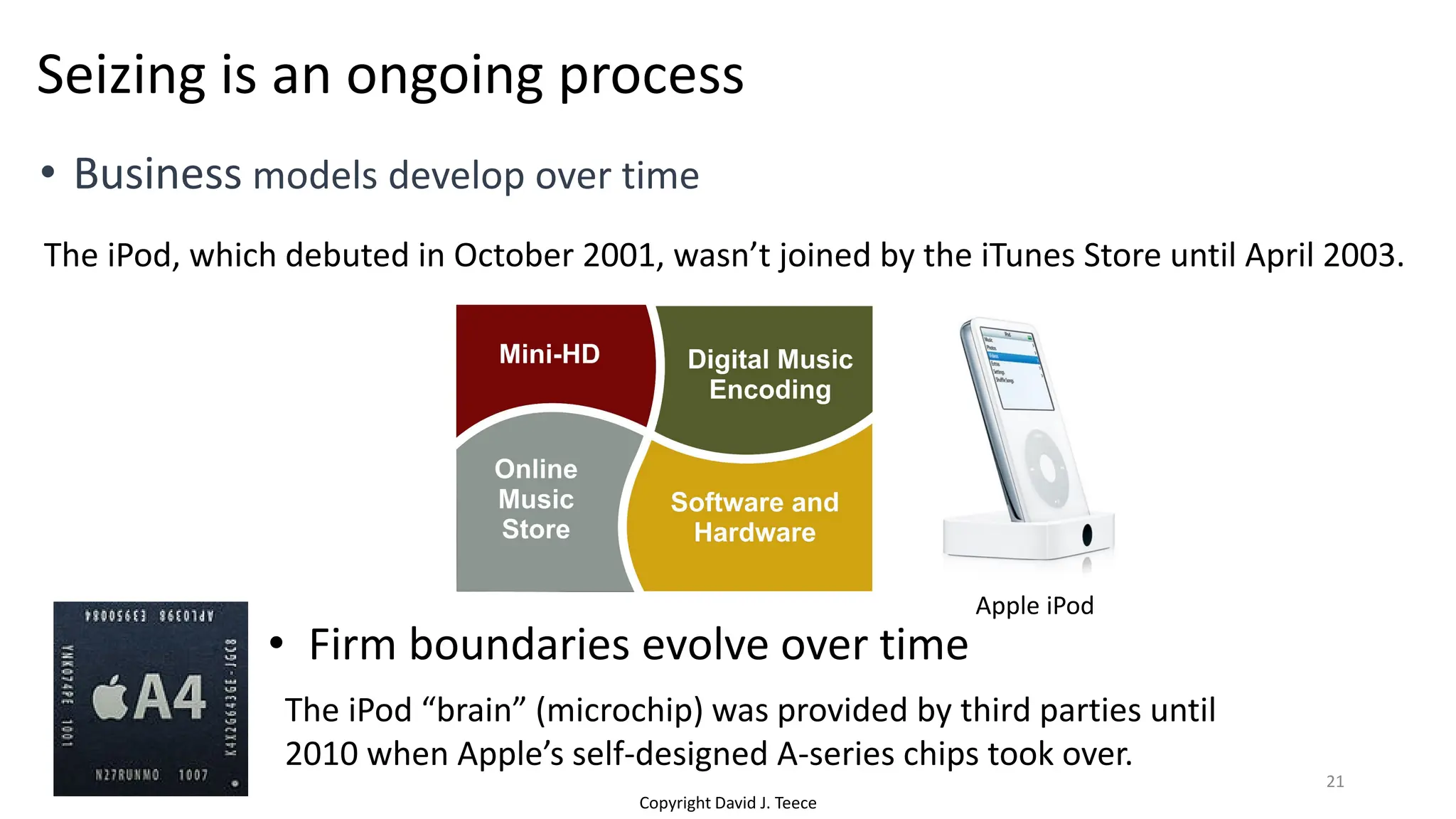
• Business models develop over time
Apple iPod
Copyright David J. Teece
The iPod, which debuted in October 2001, wasn’t joined by the iTunes Store until April 2003.
The iPod “brain” (microchip) was provided by third parties until
2010 when Apple’s self-designed A-series chips took over.
• Firm boundaries evolve over time
Seizing is an ongoing process
21
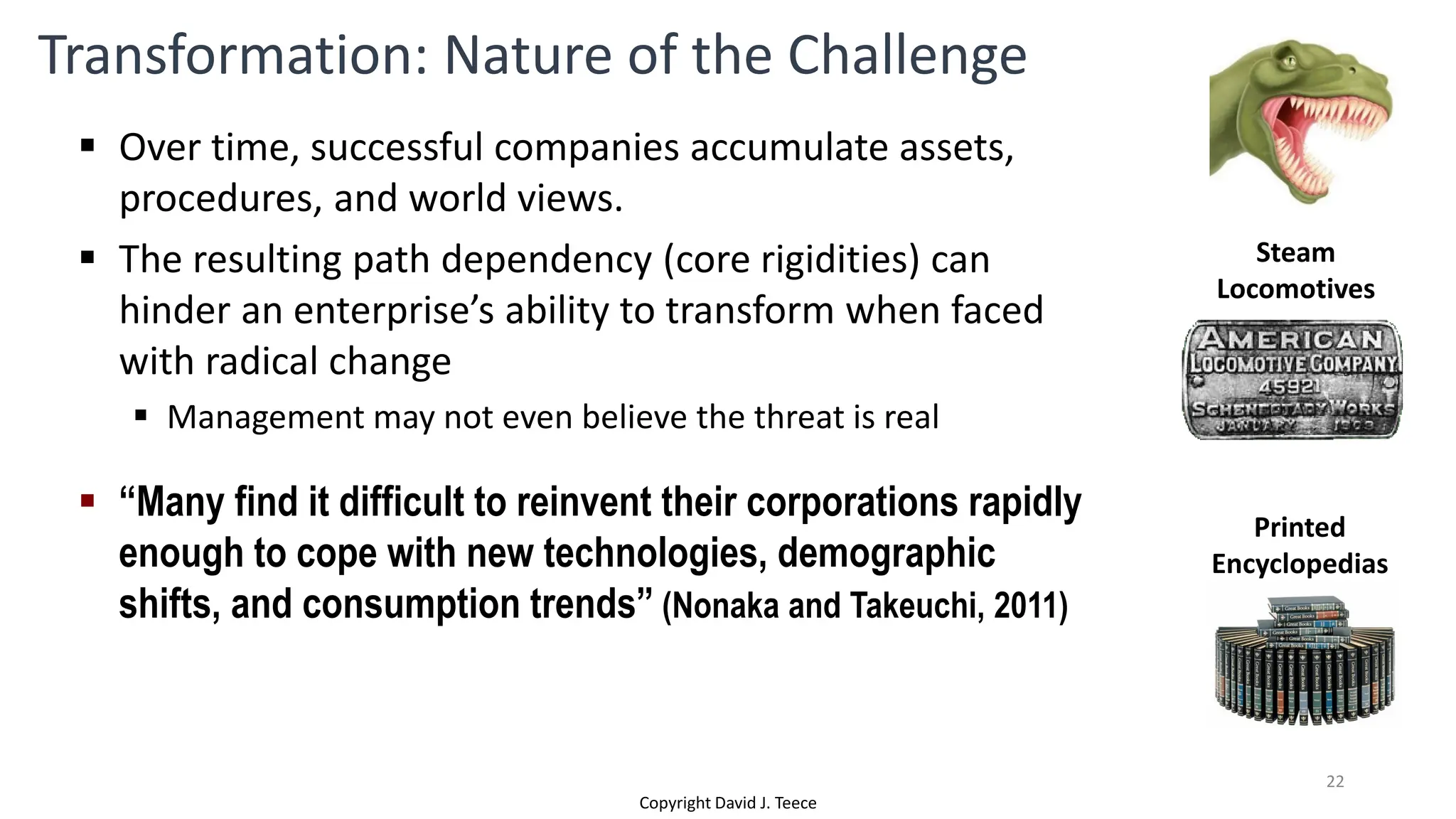
Transformation: Nature of the Challenge
 Over time, successful companies accumulate assets,
procedures, and world views.
 The resulting path dependency (core rigidities) can
hinder an enterprise’s ability to transform when faced
with radical change
 Management may not even believe the threat is real
 “Many find it difficult to reinvent their corporations rapidly
enough to cope with new technologies, demographic
shifts, and consumption trends” (Nonaka and Takeuchi, 2011)
Printed
Encyclopedias
Steam
Locomotives
Copyright David J. Teece
22
“Enduring companies are not really companies that have lasted for
100 years. They’ve changed 25 times or 5 times over that 100
years, and they aren’t the same companies as they were. If they
hadn’t changed, they wouldn’t have survived ... The leadership
that really counts is the leadership that keeps a company
changing in an incremental, continuous fashion. It’s constantly
focusing on the outside, on what’s going on in the marketplace,
what’s changing there, noticing what competitors are doing.”
- Lou Gerstner, the CEO who revived IBM in the 1990s, in a 2014 interview
“Turnaround” efforts are only required when
transformational capabilities have become flabby
23
Copyright David J. Teece
Alignment: A systems perspective is key to success
• Do all the elements of the organization fit together harmoniously?
• Are they innovative, flexible, and prepared to change?
• Do all the elements of the business model work together to generate
sustainable profits?
• Is the top management team looking ahead at how the firm can
change to match its ideas about future market trends?
Nonaka and Takeuchi (2011): The “wise leader” must be able
to see the trees and the forest at the same time
24
• The dynamic capabilities framework is a workable systems approach
Copyright David J. Teece
Sony’s revival showed strong dynamic capabilities
• Missed opportunities in the 1990s: personal computers, flat-panel
TVs, the Internet.
• Howard Stringer, CEO in 2005, tried unsuccessfully to bring back
profits by cutting costs for greater efficiency (ordinary capabilities)
• 2012: Kazuo Hirai became CEO
• Transforming: “One Sony” vision of better integration across the company,
including Sony Pictures in California (example: 2013 Xperia Z smartphone
involved the television, digital camera, and industrial engineering divisions)
• More transforming: divested computers, chemicals, optical disc drive
• Seizing: business model evolving from focus on hardware to content creation,
subscriptions, and licensing of intellectual property
25

Building an Innovation Nation: Firms Need Stronger Dynamic Capabilities

  • 1.
    Building an InnovationNation: Firms Need Stronger Dynamic Capabilities David J. Teece Institute for Business Innovation Haas School, UC Berkeley And Executive Chairman Berkeley Research Group dteece@thinkbrg.com Nikkei Business LIVE: Reimagining Capitalism, Reconstructing with innovation October 6, 2021 Copyright David J. Teece
  • 2.
    Copyright David J.Teece Japan’s productivity has been in decline; It has no global Internet (“Big Tech”) firms Trend Growth of GDP per Person Employed using HP filter, Major Regions, 1970-2019 Source: Baily et al. (2020). Productivity comparisons: Lessons from Japan, the United States, and Germany (Brookings). Copyright David J. Teece 2
  • 3.
    Global leadership isharder for firms to sustain The probability of firms maintaining top-quartile profitability in their industry for six or more years in ten is declining Source: Berkeley Research Group and Compustat 3 Copyright David J. Teece 0% 10% 20% 30% 40% 50% 60% 70% 80% 1974 1977 1980 1983 1986 1989 1992 1995 1998 2001 2004 2007 2010 2013 2016 Notes: • Profit margin is defined as EBIT divided by revenue • Annual data derived from the financial statements of active and inactive North American publicly traded companies. • The sample was restricted to firms with $100 million in revenues in at least one of the years between 1965 and 2014 • Industries were defined using manual grouping by the 2-digit SIC code. Quartiles were calculated across all industries
  • 4.
    Copyright David J.Teece Dynamic Capabilities Help Sustain Industry-Leading Profitability Basic Definition: “The ability of an organization and its management to integrate, build, and reconfigure internal and external competencies to address rapidly changing environments.”* • They are also critical for dealing with conditions of uncertainty, in which new rivals and other problems arise without warning • They are shaped by each firm’s unique heritage, take years to “build”, and continue to adapt over time • They are driven by management but require organization-wide involvement and integration * - Teece, Pisano and Shuen, Strategic Management Journal, 1997 4
  • 5.
    Copyright David J.Teece Itiscritical tounderstand thedifference betweenrisk&uncertainty Pr(DIA) Pr(CIB) Risk C D E F prB Pr(FIB) Pr(CIA) prA Alternative futures with known probabilities & known conditional probabilities F1 F? F? F? F? F? F? F? F2 F3 F4 F? F? F? F? Uncertainty (VUCA) Unknown Probabilities and Undefined Futures F 1-4 are possible futures F? are undefined futures F? Copyright David J. Teece 5
  • 6.
    Copyright David J.Teece Traditional decision tools don’t workwellinuncertain environments Certainty Risk Uncertainty Ambiguity Chaos/Ignorance Newer/Tools/Approaches Scenario Planning Peripheral Vision Total Risk Management Real Options Analysis Systems Thinking Idealized Design Legitimation Theory Honing Institution Complexity Theory Cost Benefit Analysis Net Present Value Linear Programming Point Forecasting Optimization Theory Utility Theory Decision Trees Bayesian Updating Monte Carlo Simulation Portfolio Theory Stochastic Modeling Insurance & hedging Known Unknown Unknowable Traditional Tools/Approaches Domain of Ordinary Capabilities Domain of Dynamic Capabilities RISK UNCERTAINTY Source: Paul Schoemaker 6
  • 7.
    “There’s this wholeset of decisions that you can’t ultimately boil down to a math problem” - Jeff Bezos (2004) Taking smart risks requires a leap of faith This insight is not new. 85 years ago, one of the greatest macroeconomists of all time, said: “investment depends on the ‘animal spirits’ of managers, and not the outcome of a weighted average of quantitative benefits multiplied by probabilities. ... If the animal spirits are dimmed and the spontaneous optimism falters... the enterprise will fade and die” - John Maynard Keynes (1936) 7
  • 8.
    Copyright David J.Teece • Strategic “fit” over the long run (evolutionary fitness) • Sensing, seizing, and transforming • Difficult ; inimitable • Technical efficiency in basic business functions • Operational, administrative, and governance • Relatively easy; imitable Ordinary Capabilities Dynamic Capabilities Doing things “right” Doing the “right” things Dynamic capabilities are what Japan needs Internal categories Imitability Purpose Administrative Management Improvement Innovation Executive Traits Required Entrepreneurial Leadership 8
  • 9.
    Copyright David J.Teece Dynamic Capabilities canbebroken into three categories ofactivity Sensing Identification of opportunities & threats at home and abroad Transforming Continuous renewal and periodic major strategic shifts Seizing Mobilization of resources to deliver value and shape markets The key is making management and the organization more entrepreneurial and transformative. This requires a clear vision, a pro-innovation culture, and transformational leadership in the top management team 9
  • 10.
    Copyright David J.Teece • Leaders must be willing to make big, smart bets • Entrepreneurial managers approach new circumstances with a “clean slate” mentality - Elon Musk: “Reasoning from First Principles” - After Musk reasons out his goals and a strategy, he tests them continually, and adjusts them regularly based on what he learns. • Entrepreneurs and operational managers may or may not be the same people - Steve Jobs needed Tim Cook to run Apple’s supply chain - Brin and Page found Schmidt to be CEO of Google Strong dynamic capabilities requires leadership and entrepreneurial management 10
  • 11.
    Copyright David J.Teece There is often too little attention given to big (strategic) decisions because operational concerns tend to crowd out strategic priorities  Operations, administration and governance functions only require ordinary capabilities  Routines / standard operating procedures are key to ordinary capabilities, and their optimization gets in the way of innovation and dynamic capabilities  Ordinary capabilities reflect only technical efficiency and “best- practice” logic Don’t allow short-term, everyday issues to drain effort from long-term, strategic thinking 11
  • 12.
    Copyright David J.Teece A Dynamic Capabilities Perspective on Japanese Firms • Japanese strengths • World leadership in “best practice” manufacturing • Strong organizational cultures • Strong ability to orchestrate webs of alliances and other relationships • Long-term perspective • Japanese weaknesses • Slow decision making • Pursuit of incremental improvements instead of bold investment and transformational change In a world where the pace of change has accelerated, these weaknesses can lead to stagnation or decline. 12
  • 13.
    Copyright David J.Teece A single-minded focus on efficiency today can weaken the company tomorrow • “Best practices” cannot ensure competitive advantage • Rivals can copy them over time • Once a few firms master the same level of efficiency, profits are driven down • Cutting “excess” capacity leaves an organization unprepared for extreme shifts • Hospital cutbacks left the US and other countries unable to handle the covid surge • Just-in-time inventory left auto supply chains unable to handle the jump in demand from pandemic recovery 13
  • 14.
    Copyright David J.Teece The father of the Quality Movement in Japan understood that something more than metrics driven decisions were needed: “He who would run his business with visible figures alone will soon have neither a business nor visible figures to work with.”* William Edwards Deming *from “Out of The Crisis,” by W. Edwards Deming Dynamic capabilities: Beyond managing by the numbers 14
  • 15.
    Copyright David J.Teece Lessons of the samurai • The feudal system of the samurai survived for centuries • “It does not matter who is stronger....” (Miyamato Musashi, 17th Century Samurai warrior-philosopher) • In the short-term, skill and tactics are sufficient to win battles • After the Meiji Restoration embraced firearms and other European ideas, the samurai failed to adapt to a new way of life • Yesterday’s skills (ordinary capabilities) – no matter how excellent – are not sufficient to ensure long-term survival • Strong dynamic capabilities can help maintain an organization’s “fit” in a changing business environment 15
  • 16.
    Copyright David J.Teece Change coming to the auto industry • New opportunities are shifting the source of advantage from hardware to software • Electric vehicles (e.g., power management) • Greater use of semiconductors • Connected cars • Autonomous vehicles • Requires developing new capabilities or giving partial control of key technology to partner(s) • Japanese companies lost ground in electronics when software became more important in the 1990s • A challenging and dangerous transition for incumbents • Electrification and autonomy are attracting new entrants 16
  • 17.
    Copyright David J.Teece It’s hard for big firms to change • Sony had a worldwide success with its Walkman • But it missed the opportunity in digital players • Toyota built a large success with its hybrid Prius technology • But it seems to be missing the shift to electrification • The problem isn’t so much technological, but organizational • Fear of cannibalizing existing business (e.g., protecting Sony Music rights) • Inability to embrace new models (e.g., digital music store with rival music labels) The challenge for Japanese firms is amplified because there is not a strong domestic base of entrepreneurial startups to draw from 17
  • 18.
    Copyright David J.Teece Perfectionism can be the enemy of innovation • Optimization is about reducing variance and avoiding failure • Innovation requires a willingness to reward smart risk-taking • A “smart failure” is a chance to learn and try something different • America’s (and China’s) startup culture, where nine in ten efforts end in failure, has led to a sustainable national advantage. 18
  • 19.
    Copyright David J.Teece Smart, timely risk taking is required • Smart risks are supported by analysis, but involve choices for which numerical certainty is impossible. • The market required may not exist yet • The risk-taking manager develops an understanding of the future through a process of sensemaking • In the 1960s, Tom Watson at IBM committed the financial capital and technical resources to develop and deploy the System/360 mainframe ecosystem while competitors acted cautiously. • Speed matters – once the business model has proven successful • With digital technologies, “You have to race really hard to scale fast— but the benefit is that you’re achieving escape velocity from the black hole that is hypercompetition.” - Reid Hoffman (LinkedIn founder), Masters of Scale (2021) 19
  • 20.
    Copyright David J.Teece Seizing is complex and demands a “bias for action” • Seizing requires management to orchestrate internal and external assets (especially big data) to: • Secure and allocate capital • Fill capability “gaps” • Ensure availability of the right employee skills and strategic partnerships • Develop and license necessary intellectual property • Reuse customer data • Failure to seize/act/invest can be fatal • Xerox PARC and the PC: great sensing but poor seizing • PARC developed all the elements of what came to be the Mac: the graphical interface, the mouse, Ethernet, laser printing; but failed to invest until it was too late. • Late arrivers can recover: Microsoft missed the Internet; IBM missed cloud computing; Intel missed mobile 20
  • 21.
    • Business modelsdevelop over time Apple iPod Copyright David J. Teece The iPod, which debuted in October 2001, wasn’t joined by the iTunes Store until April 2003. The iPod “brain” (microchip) was provided by third parties until 2010 when Apple’s self-designed A-series chips took over. • Firm boundaries evolve over time Seizing is an ongoing process 21
  • 22.
    Transformation: Nature ofthe Challenge  Over time, successful companies accumulate assets, procedures, and world views.  The resulting path dependency (core rigidities) can hinder an enterprise’s ability to transform when faced with radical change  Management may not even believe the threat is real  “Many find it difficult to reinvent their corporations rapidly enough to cope with new technologies, demographic shifts, and consumption trends” (Nonaka and Takeuchi, 2011) Printed Encyclopedias Steam Locomotives Copyright David J. Teece 22
  • 23.
    “Enduring companies arenot really companies that have lasted for 100 years. They’ve changed 25 times or 5 times over that 100 years, and they aren’t the same companies as they were. If they hadn’t changed, they wouldn’t have survived ... The leadership that really counts is the leadership that keeps a company changing in an incremental, continuous fashion. It’s constantly focusing on the outside, on what’s going on in the marketplace, what’s changing there, noticing what competitors are doing.” - Lou Gerstner, the CEO who revived IBM in the 1990s, in a 2014 interview “Turnaround” efforts are only required when transformational capabilities have become flabby 23
  • 24.
    Copyright David J.Teece Alignment: A systems perspective is key to success • Do all the elements of the organization fit together harmoniously? • Are they innovative, flexible, and prepared to change? • Do all the elements of the business model work together to generate sustainable profits? • Is the top management team looking ahead at how the firm can change to match its ideas about future market trends? Nonaka and Takeuchi (2011): The “wise leader” must be able to see the trees and the forest at the same time 24 • The dynamic capabilities framework is a workable systems approach
  • 25.
    Copyright David J.Teece Sony’s revival showed strong dynamic capabilities • Missed opportunities in the 1990s: personal computers, flat-panel TVs, the Internet. • Howard Stringer, CEO in 2005, tried unsuccessfully to bring back profits by cutting costs for greater efficiency (ordinary capabilities) • 2012: Kazuo Hirai became CEO • Transforming: “One Sony” vision of better integration across the company, including Sony Pictures in California (example: 2013 Xperia Z smartphone involved the television, digital camera, and industrial engineering divisions) • More transforming: divested computers, chemicals, optical disc drive • Seizing: business model evolving from focus on hardware to content creation, subscriptions, and licensing of intellectual property 25