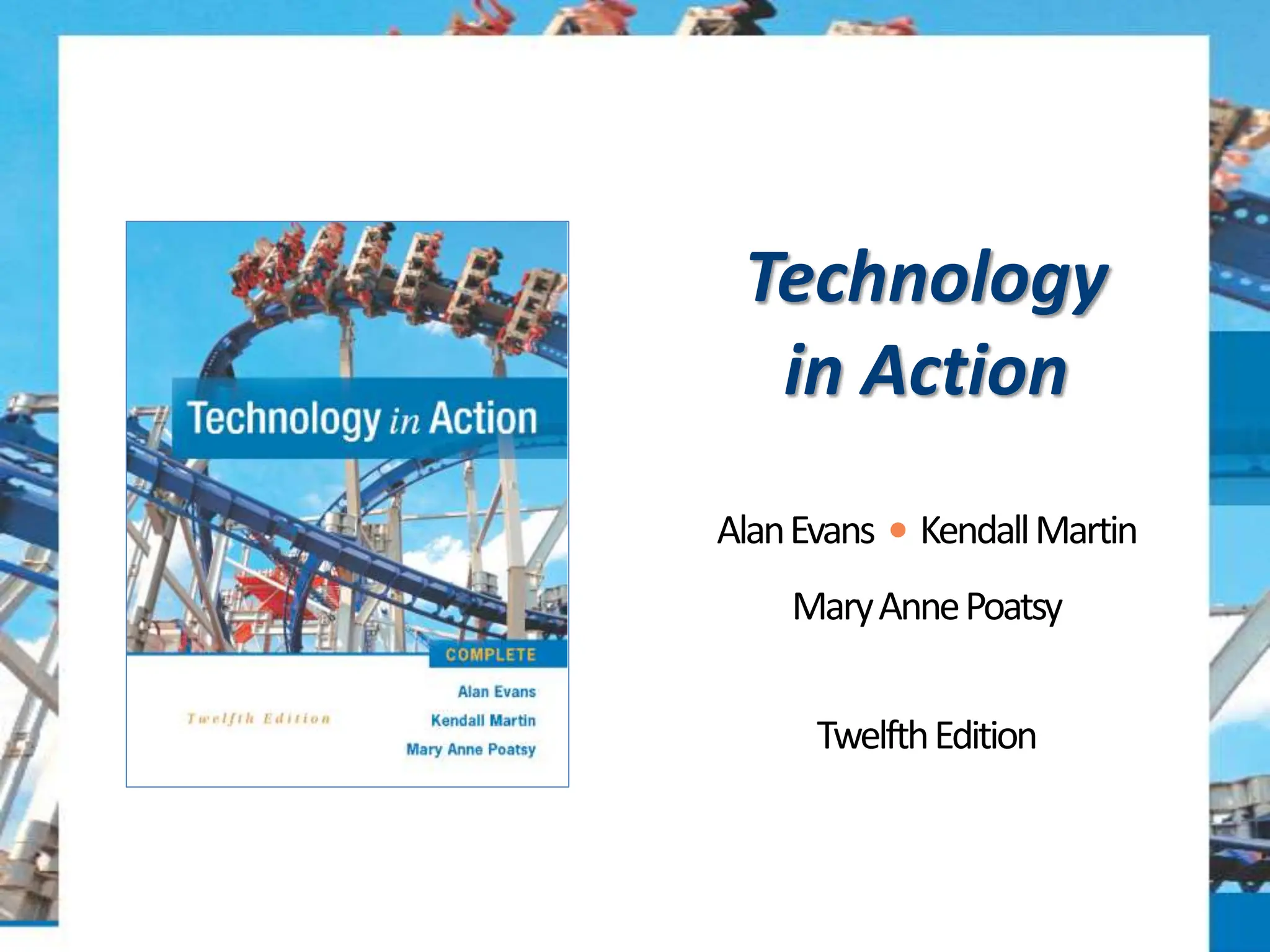
Technology
in Action
AlanEvans • KendallMartin
MaryAnnePoatsy
TwelfthEdition
Technology in Action
Chapter 5
Digital Devices and Media:
Managing a Digital Lifestyle
Mobile Devices
• Digital Convergence
• Telephony: Smartphones and Beyond
• Tablets, Netbooks, and Ultrabooks
Copyright © 2016 Pearson Education, Inc. 8-2
Digital Convergence
Objective
1. How is the trend of digital convergence seen
in the market?
Copyright © 2016 Pearson Education, Inc. 8-3
Telephony:
Smartphones and Beyond
Objectives
2. What hardware and software comprise a
typical smartphone?
3. How do I synchronize information between
my phone and my computer, and how do
mobile Internet data plans work?
4. What do I need to keep my smartphone
secure?
5. How does digital telephony support VoIP
services?
Copyright © 2016 Pearson Education, Inc. 8-4
Tablets, Netbooks,
and Ultrabooks
Objective
6. What distinguishes the performance of
tablets, netbooks, and ultrabooks?
Copyright © 2016 Pearson Education, Inc. 8-5
Digital Convergence
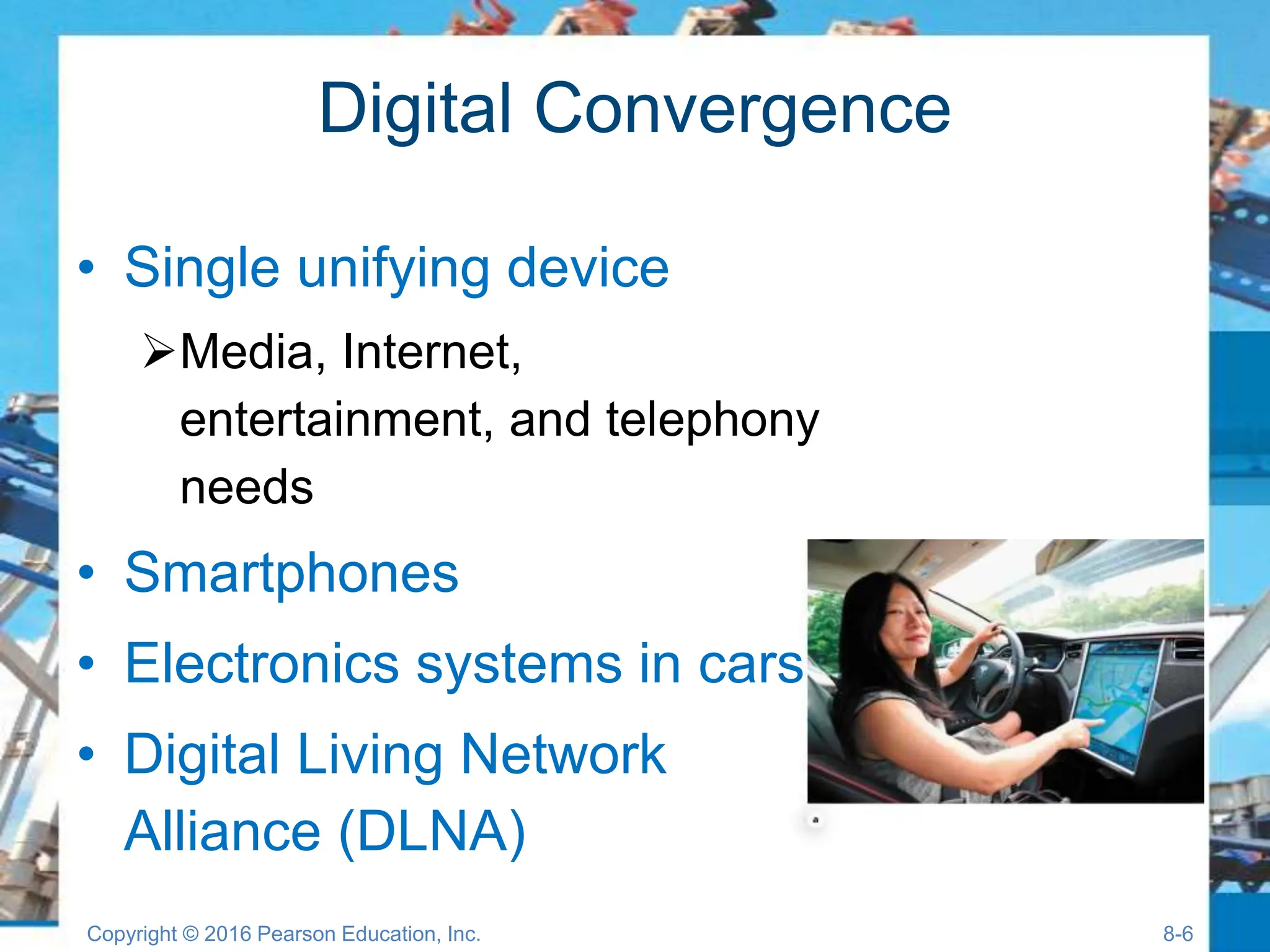
• Single unifying device
Media, Internet,
entertainment, and telephony
needs
• Smartphones
• Electronics systems in cars
• Digital Living Network
Alliance (DLNA)
Copyright © 2016 Pearson Education, Inc. 8-6
Telephony: Smartphones and Beyond
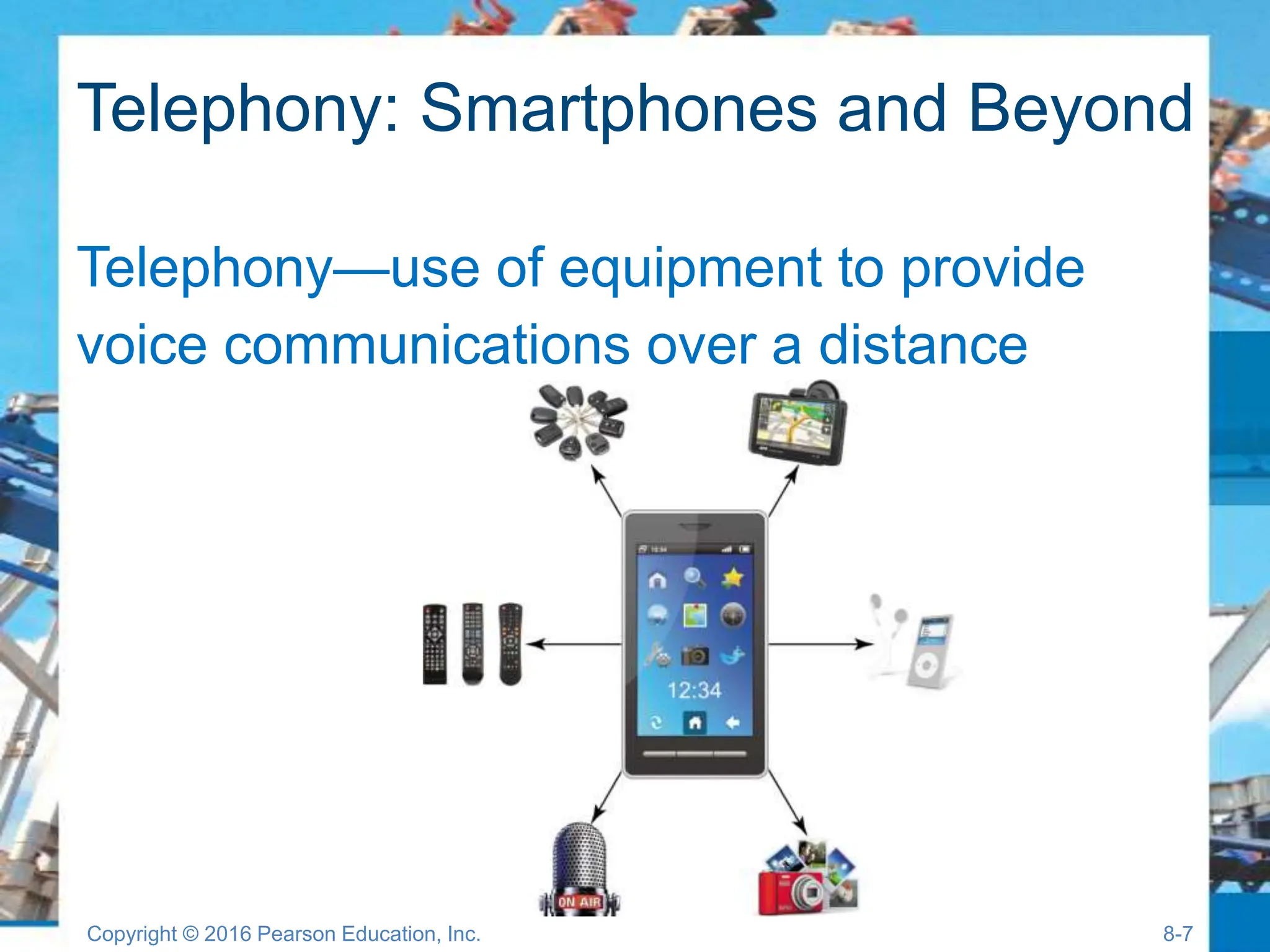
Telephony—use of equipment to provide
voice communications over a distance
Copyright © 2016 Pearson Education, Inc. 8-7
Telephony: Smartphones and Beyond
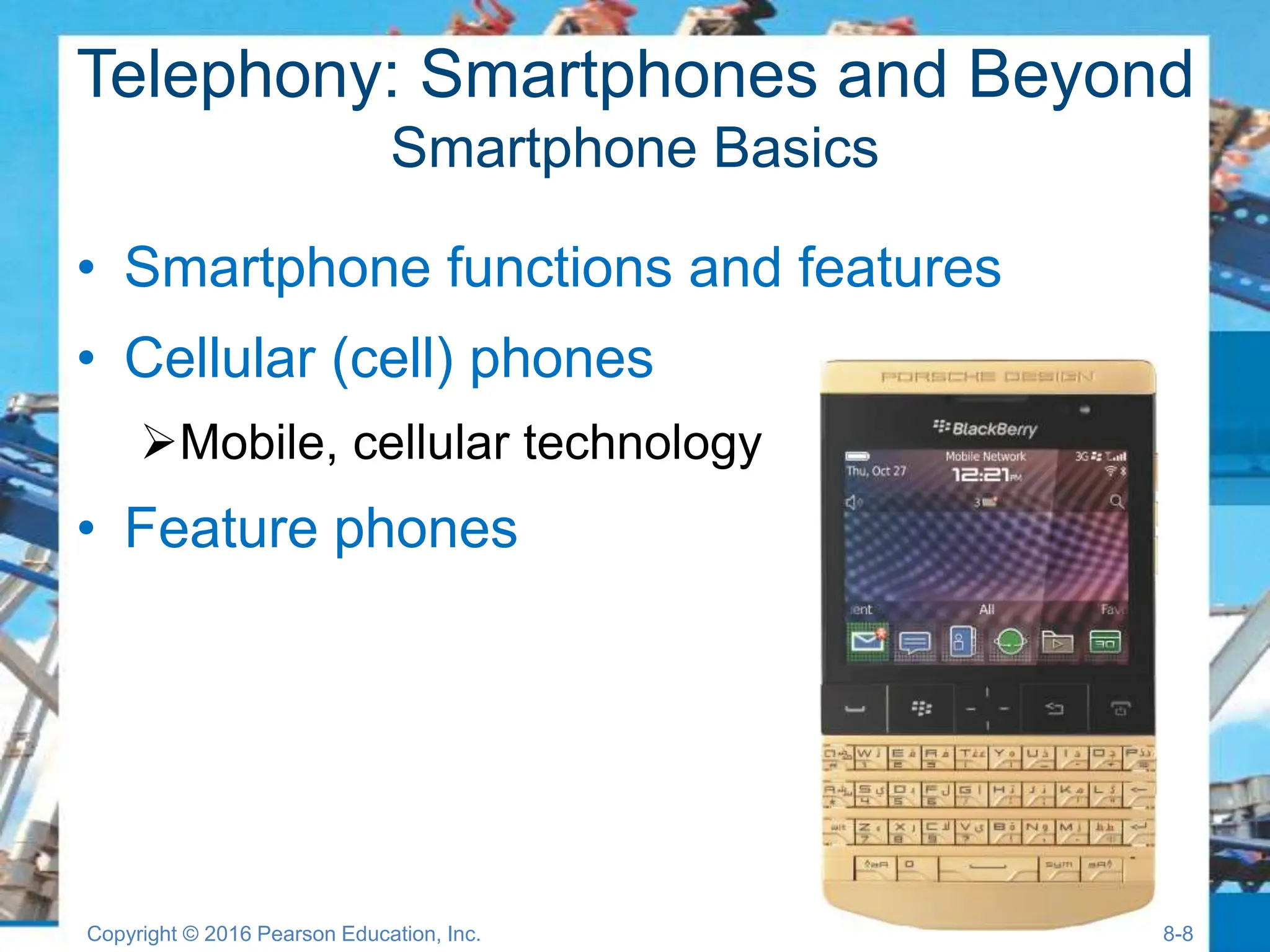
Smartphone Basics
• Smartphone functions and features
• Cellular (cell) phones
Mobile, cellular technology
• Feature phones
Copyright © 2016 Pearson Education, Inc. 8-8
Telephony: Smartphones and Beyond
Smartphone Components
• Memory stores information and programs
• OS—read-only memory (ROM)
• Data is stored in separate internal
memory chips
• Additional memory
• Smartphone operating systems
Copyright © 2016 Pearson Education, Inc. 8-9
Telephony: Smartphones and Beyond
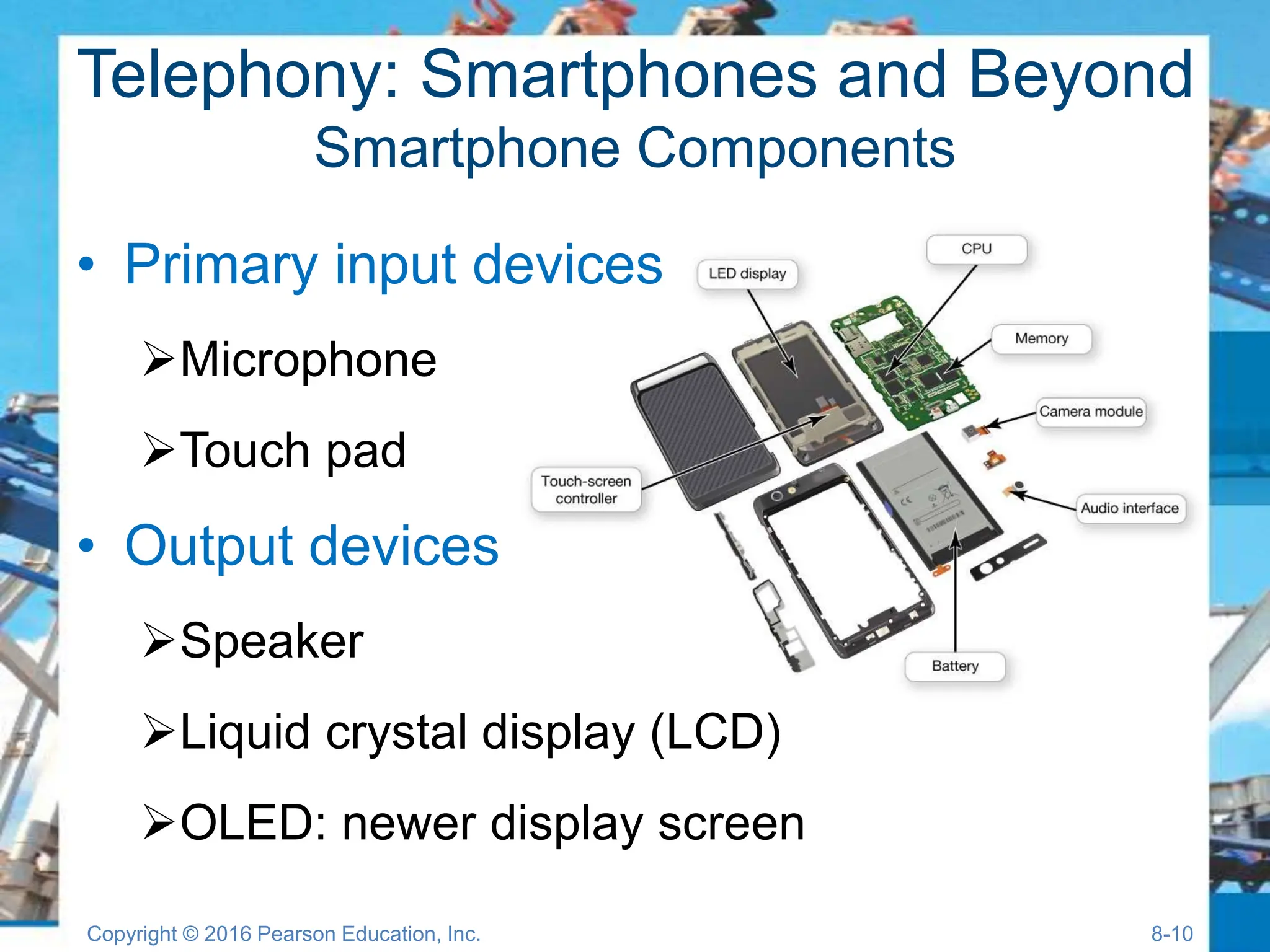
Smartphone Components
• Primary input devices
Microphone
Touch pad
• Output devices
Speaker
Liquid crystal display (LCD)
OLED: newer display screen
Copyright © 2016 Pearson Education, Inc. 8-10
Telephony: Smartphones and Beyond
How Cell Phone Technology Works
• Cellular network
• Base transceiver station
• Mobile switching center
• Digital processing
Copyright © 2016 Pearson Education, Inc. 8-11
Telephony: Smartphones and Beyond
Synchronizing
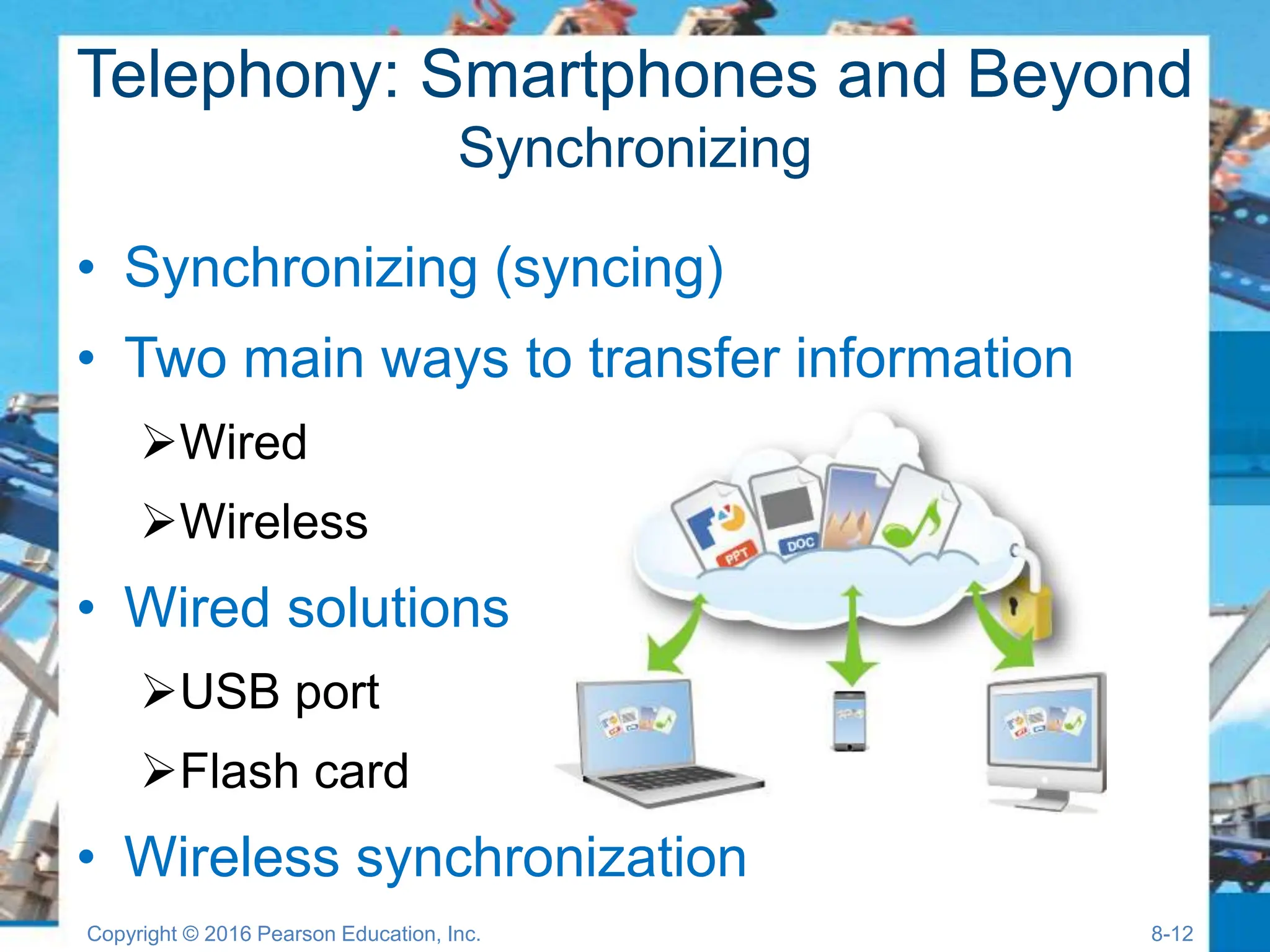
• Synchronizing (syncing)
• Two main ways to transfer information
Wired
Wireless
• Wired solutions
USB port
Flash card
• Wireless synchronization
Copyright © 2016 Pearson Education, Inc. 8-12
Telephony: Smartphones and Beyond
Text Messaging
• Short message service (SMS)
Short text messages
Up to 160 characters
Convenient and quick
Uses cell phone network
• Multimedia message service (MMS)
Copyright © 2016 Pearson Education, Inc. 8-13
Telephony: Smartphones and Beyond
Mobile Internet
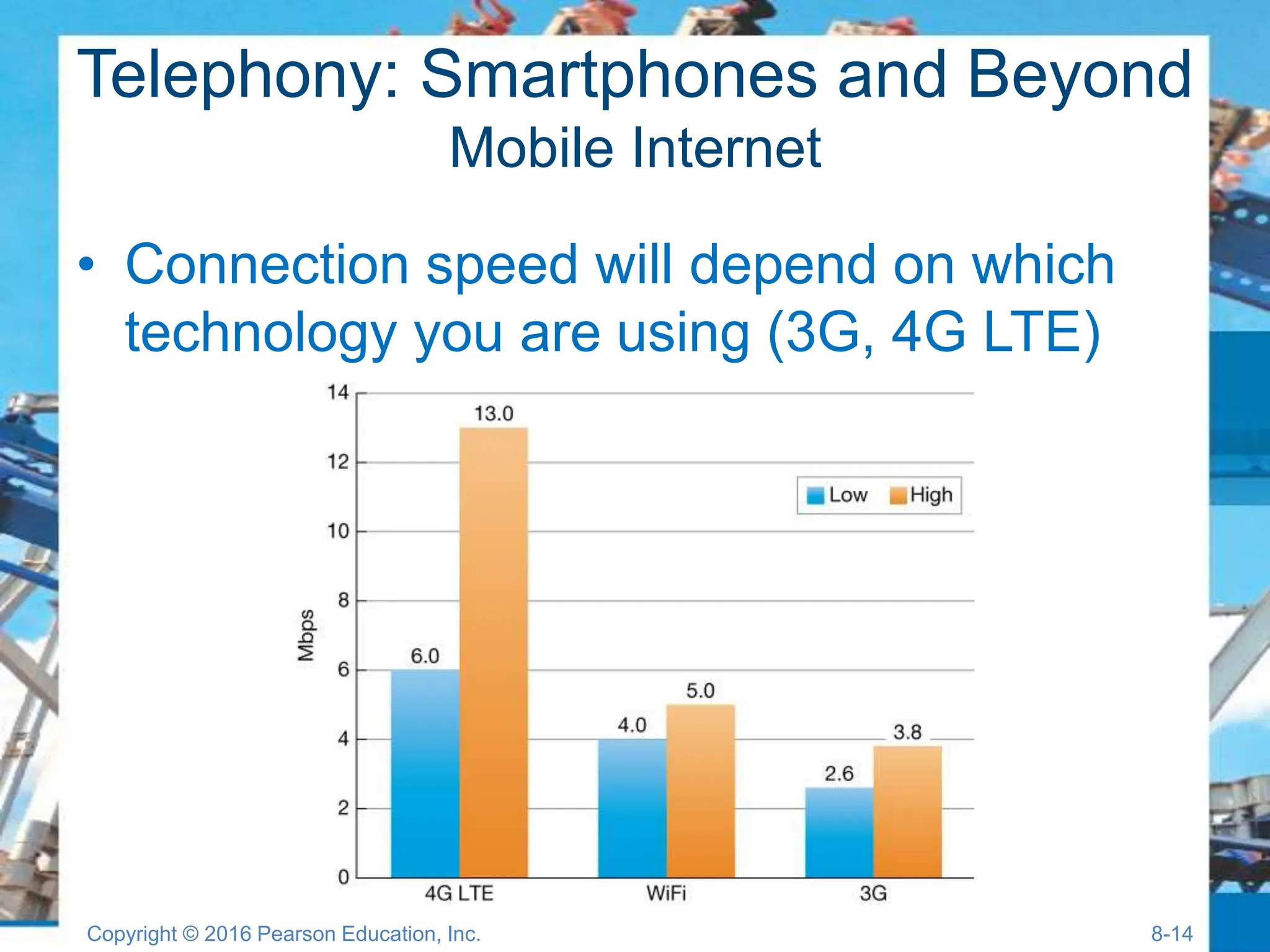
• Connection speed will depend on which
technology you are using (3G, 4G LTE)
Copyright © 2016 Pearson Education, Inc. 8-14
Telephony: Smartphones and Beyond
VoIP
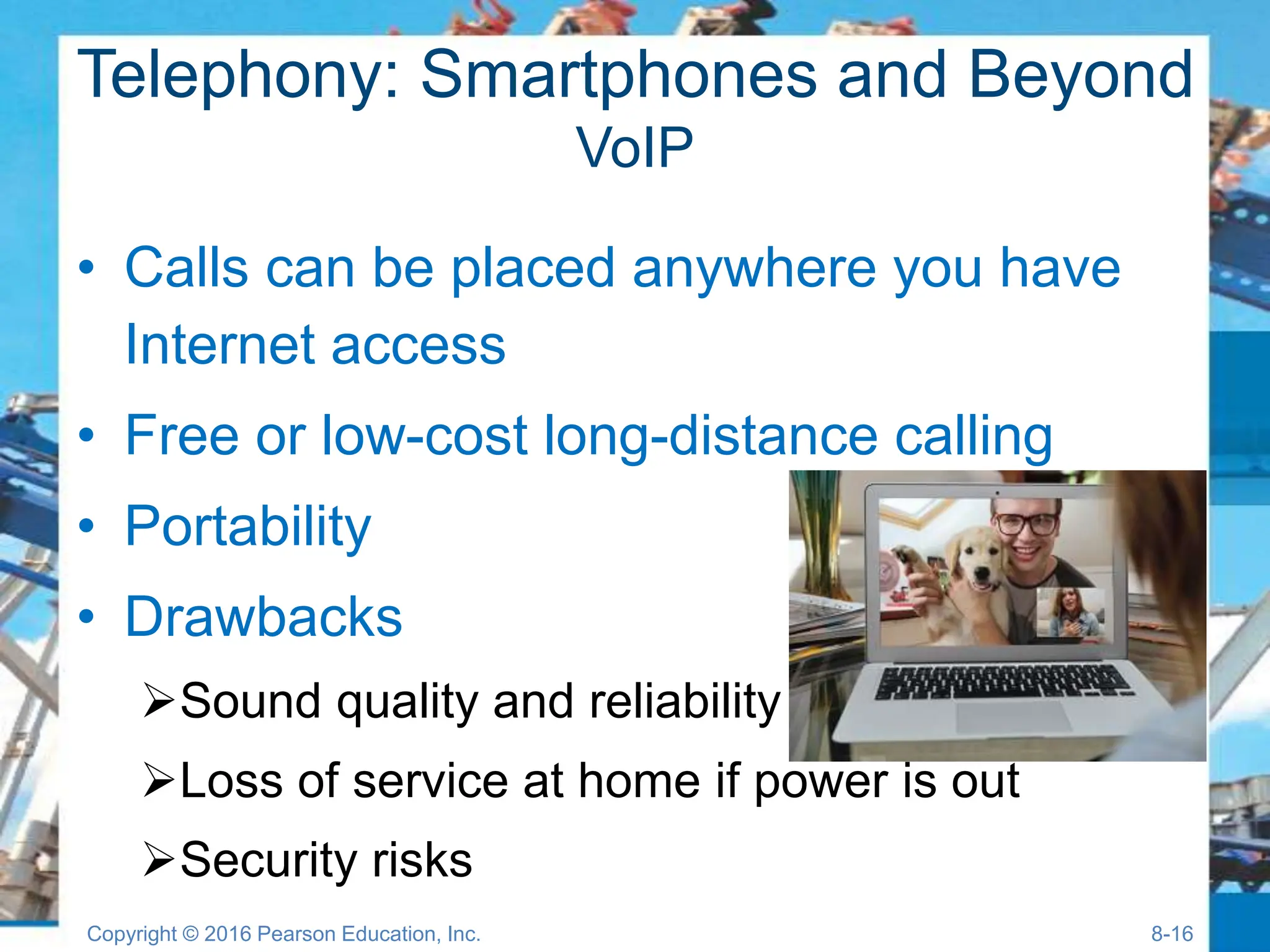
• Digital phone service
• Technology similar to e-mail
• Skype
Copyright © 2016 Pearson Education, Inc. 8-15
Telephony: Smartphones and Beyond
VoIP
• Calls can be placed anywhere you have
Internet access
• Free or low-cost long-distance calling
• Portability
• Drawbacks
Sound quality and reliability
Loss of service at home if power is out
Security risks
Copyright © 2016 Pearson Education, Inc. 8-16
Telephony: Smartphones and Beyond
Smartphone GPS
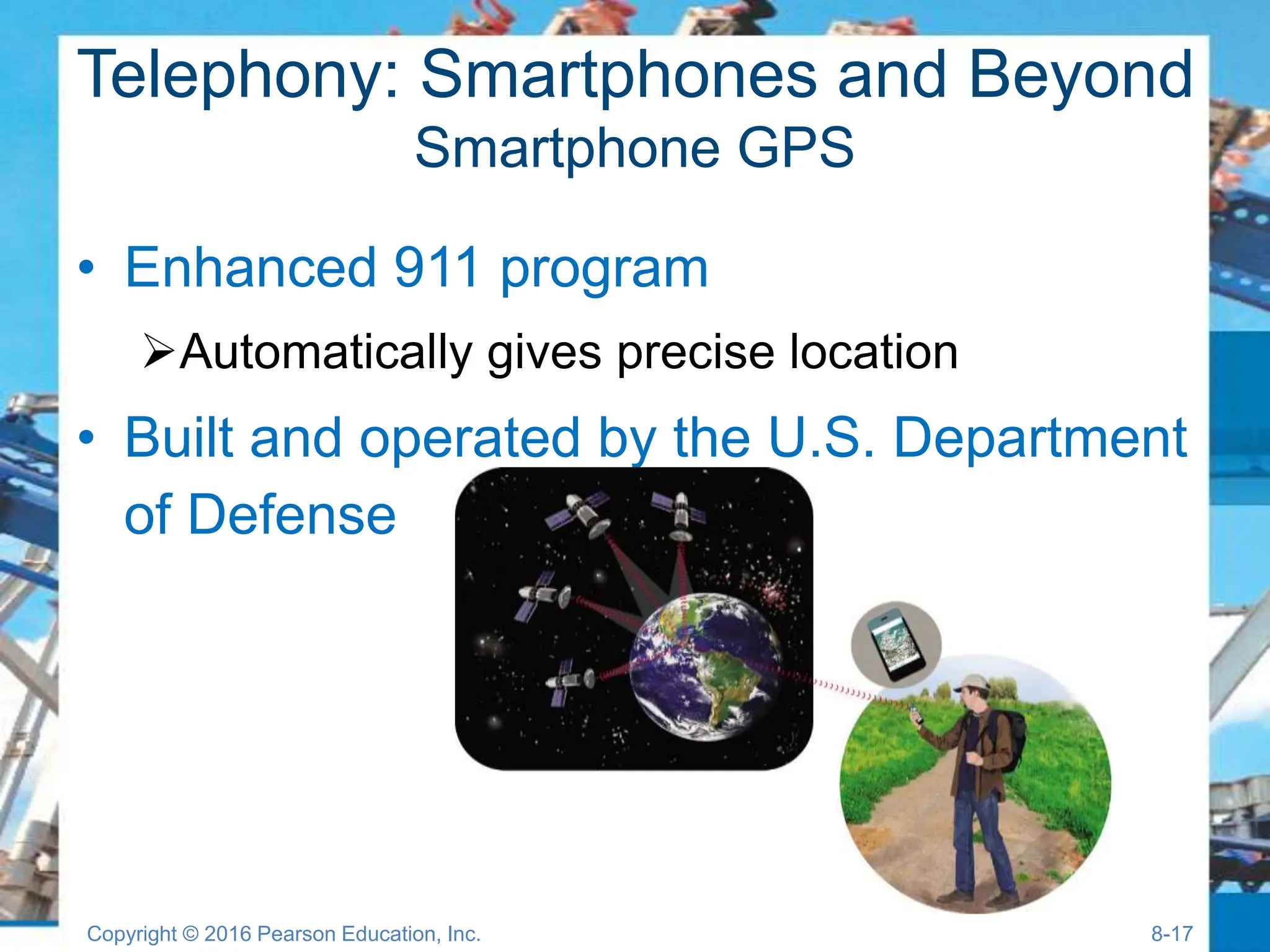
• Enhanced 911 program
Automatically gives precise location
• Built and operated by the U.S. Department
of Defense
Copyright © 2016 Pearson Education, Inc. 8-17
Tablets, Netbooks, Ultrabooks
Tablets
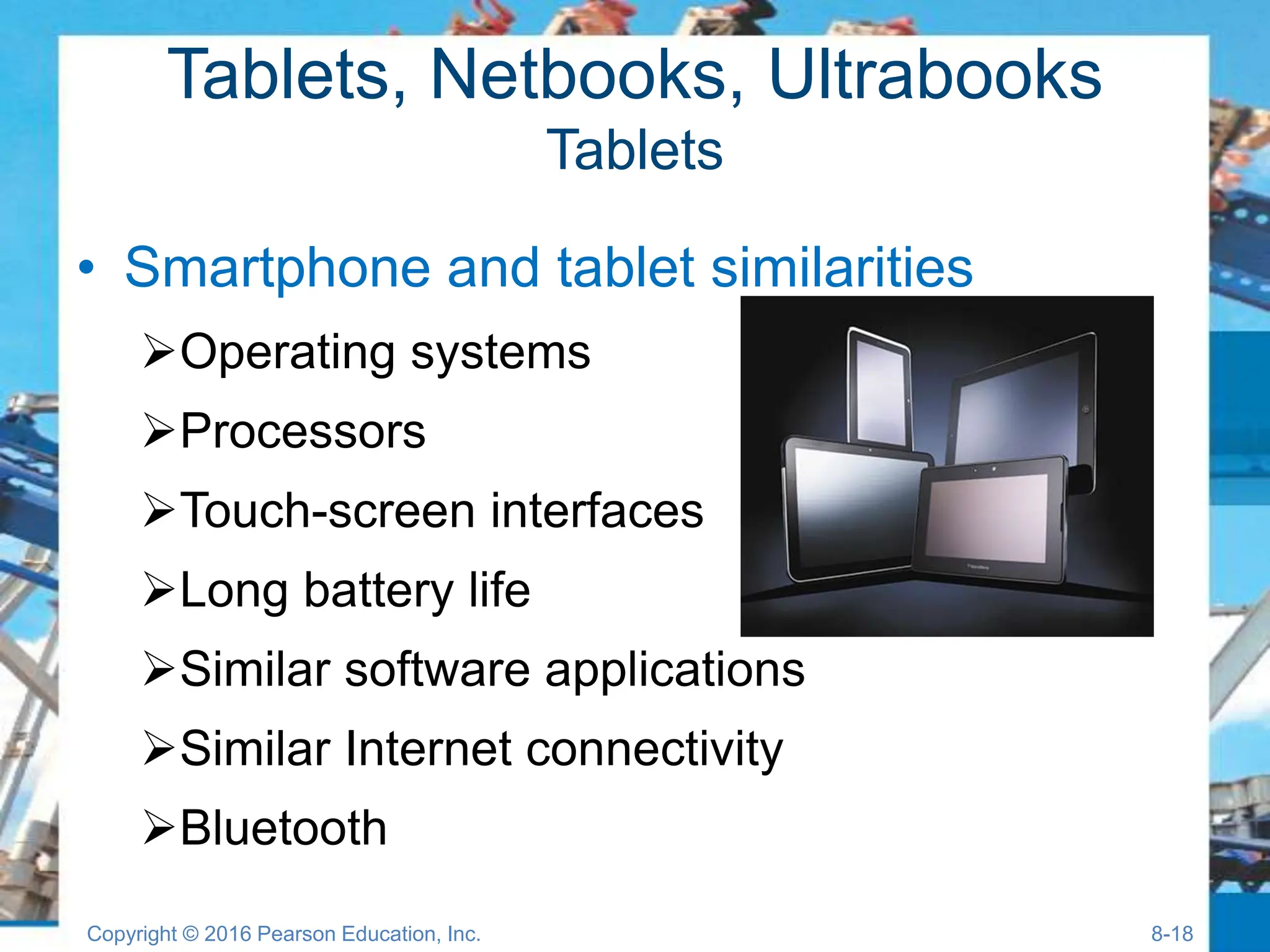
• Smartphone and tablet similarities
Operating systems
Processors
Touch-screen interfaces
Long battery life
Similar software applications
Similar Internet connectivity
Bluetooth
Copyright © 2016 Pearson Education, Inc. 8-18
Tablets, Netbooks, Ultrabooks
Netbooks
• Netbooks
Traditional OS
Keyboard
Weigh 2 pounds or less
Inexpensive compared with tablets and
ultrabooks
Copyright © 2016 Pearson Education, Inc. 8-19
Tablets, Netbooks, Ultrabooks
Ultrabooks
• Ultrabooks
Full-featured computers
Very thin, lightweight computing solution
Don’t have optical drives
Offer SSD drives
Weigh under 3 pounds
Full-size keyboards
13- to 15-inch screens
Copyright © 2016 Pearson Education, Inc. 8-20
Tablets, Netbooks, Ultrabooks
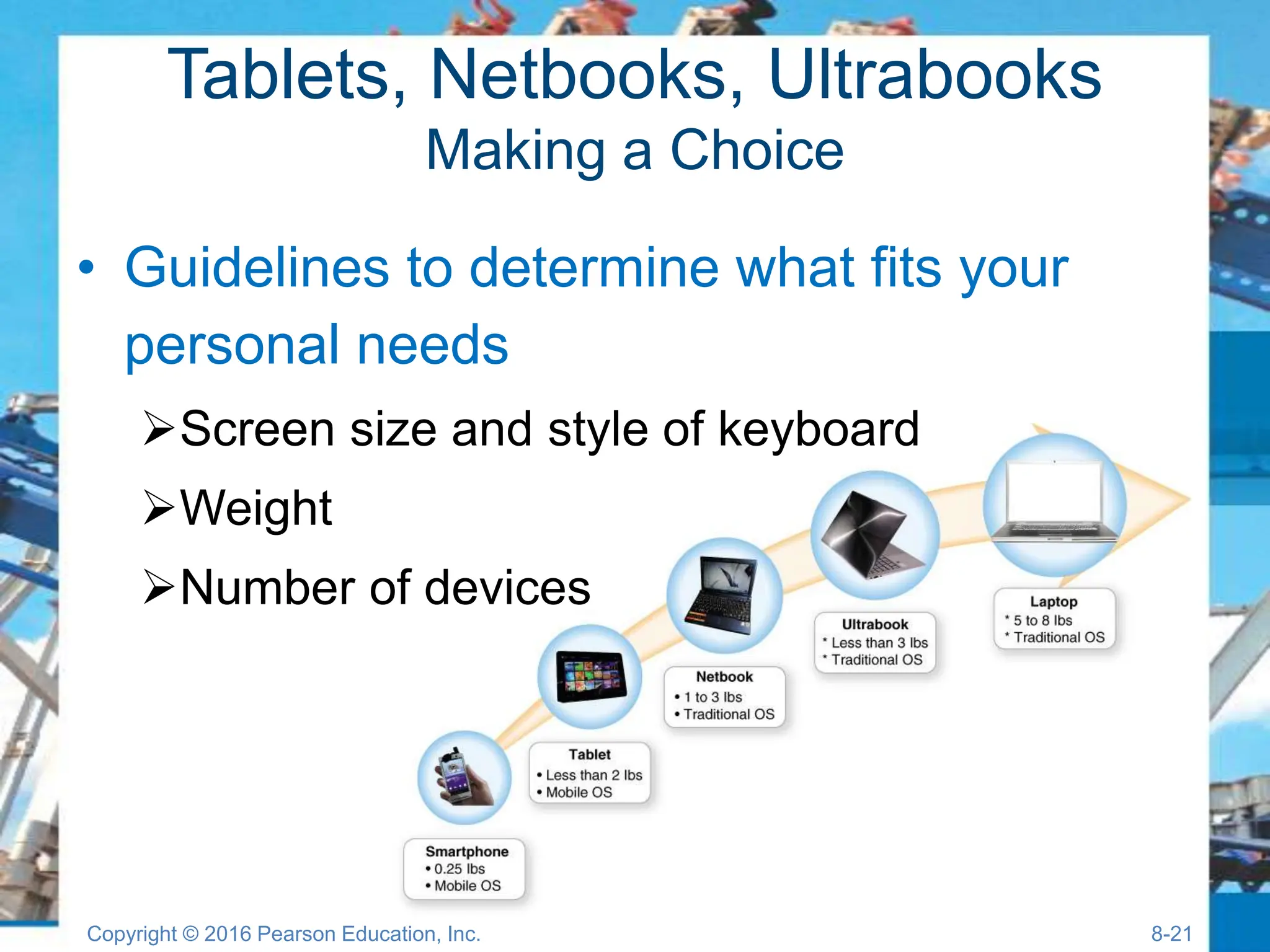
Making a Choice
• Guidelines to determine what fits your
personal needs
Screen size and style of keyboard
Weight
Number of devices
Copyright © 2016 Pearson Education, Inc. 8-21
The Digital Information Age
• Digital Defined
• Digital Media
Copyright © 2016 Pearson Education, Inc. 8-22
Digital Defined
Objective
7. What advantage do digital formats have over
analog signals?
Copyright © 2016 Pearson Education, Inc. 8-23
Digital Media
Objectives
8. How is the digital format changing the way
media is created and distributed?
9. How do I work with digital images and
videos?
Copyright © 2016 Pearson Education, Inc. 8-24
Digital Defined
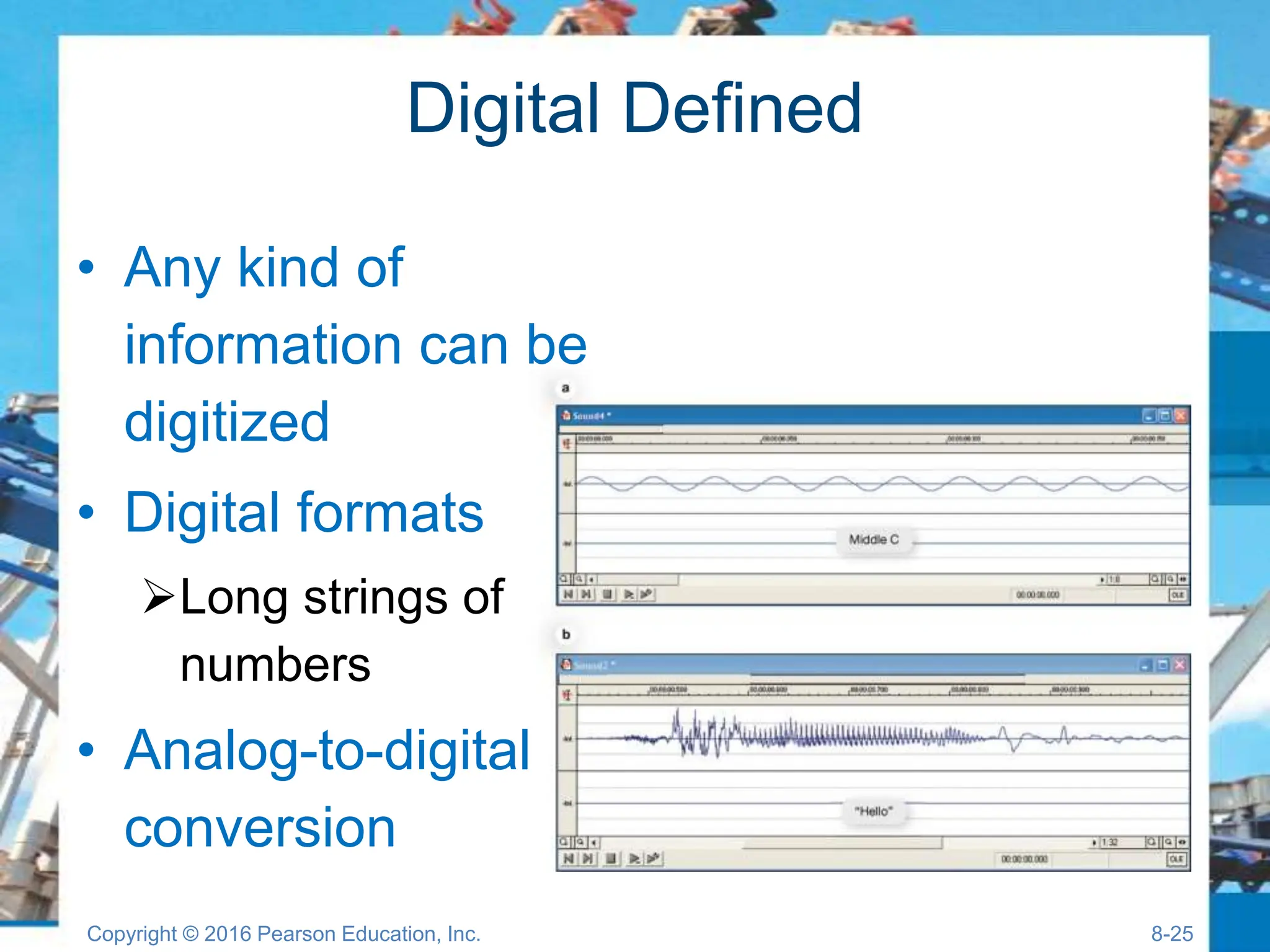
• Any kind of
information can be
digitized
• Digital formats
Long strings of
numbers
• Analog-to-digital
conversion
Copyright © 2016 Pearson Education, Inc. 8-25
Digital Media
Digital Publishing
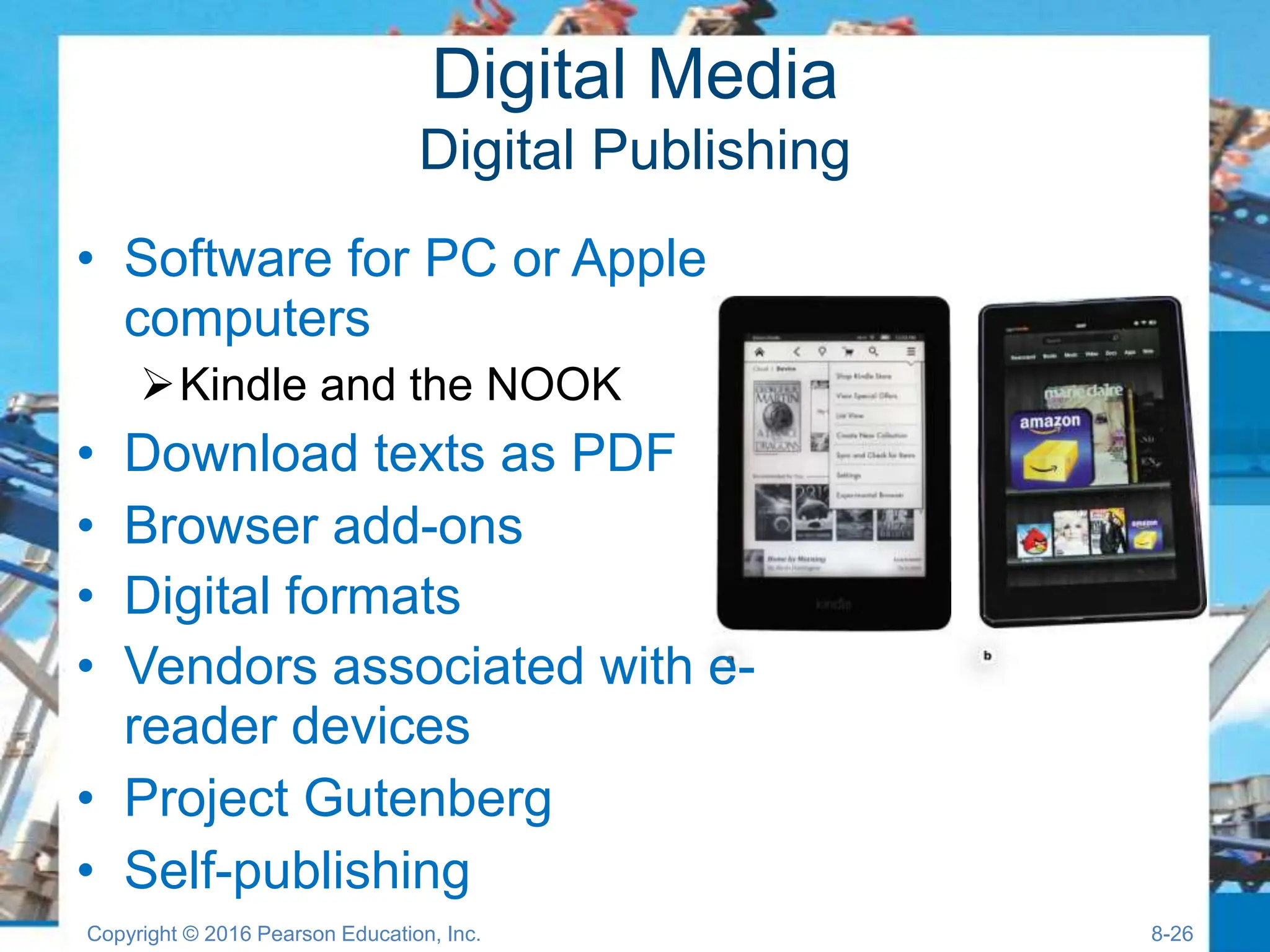
• Software for PC or Apple
computers
Kindle and the NOOK
• Download texts as PDF
• Browser add-ons
• Digital formats
• Vendors associated with e-
reader devices
• Project Gutenberg
• Self-publishing
Copyright © 2016 Pearson Education, Inc. 8-26
Digital Media
Digital Photography
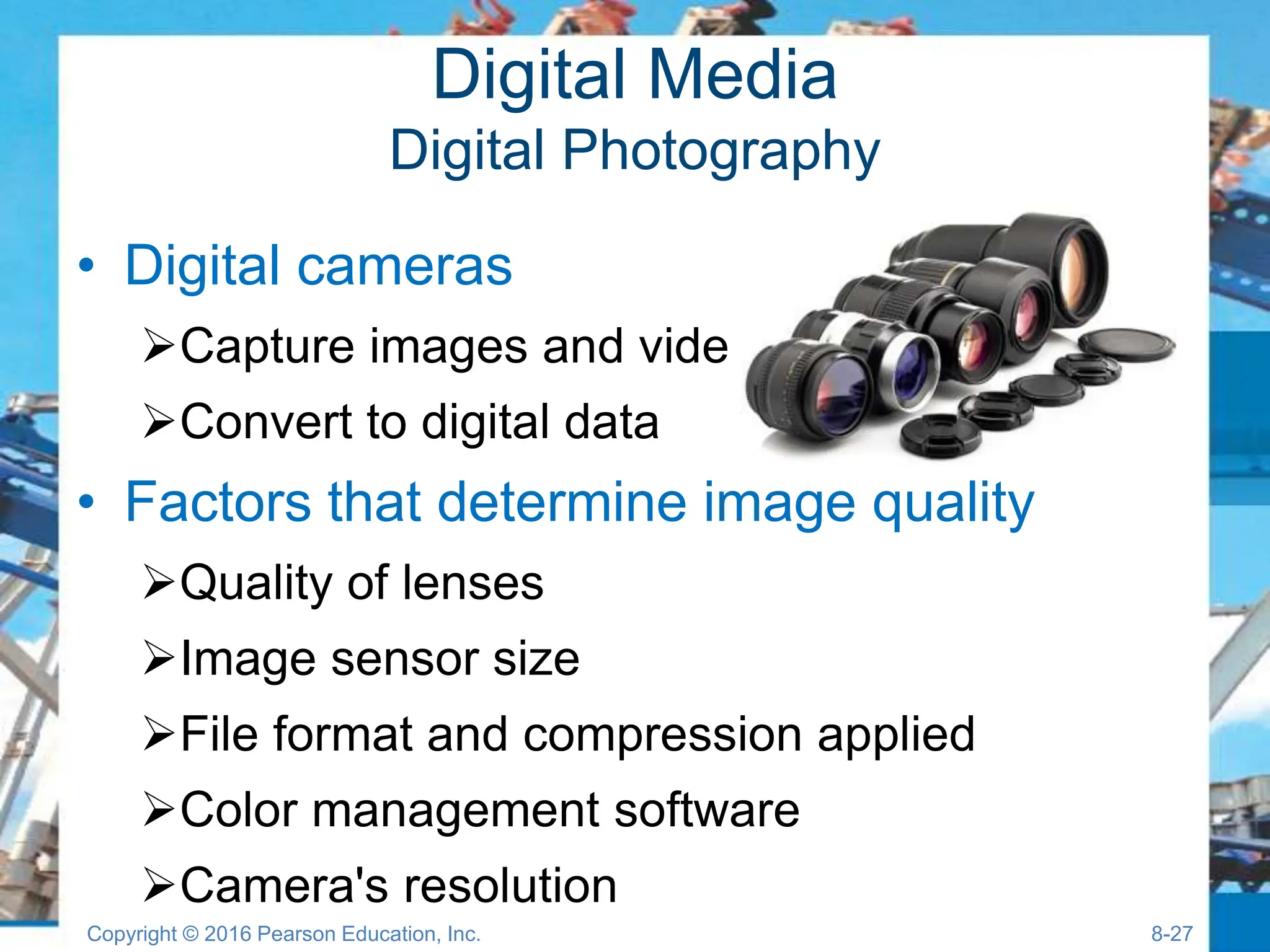
• Digital cameras
Capture images and video
Convert to digital data
• Factors that determine image quality
Quality of lenses
Image sensor size
File format and compression applied
Color management software
Camera's resolution
Copyright © 2016 Pearson Education, Inc. 8-27
Check Your Understanding
1. How is the trend of digital convergence seen
in the market?
2. What hardware and software comprise a
typical smartphone?
3. How do I synchronize information between
my phone and my computer, and how do
mobile Internet data plans work?
4. What do I need to keep my smartphone
secure?
5. How does digital telephony support VoIP
services?
Copyright © 2016 Pearson Education, Inc. 8-28
Check Your Understanding
6. What distinguishes the performance of
tablets, netbooks, and ultrabooks?
7. What advantage do digital formats have
over analog signals?
8. How is the digital format changing the
way media is created and distributed?
9. How do I work with digital images and
video?
Copyright © 2016 Pearson Education, Inc. 8-29
All rights reserved. No part of this publication may be reproduced, stored in a
retrieval system, or transmitted, in any form or by any means, electronic,
mechanical, photocopying, recording, or otherwise, without the prior written
permission of the publisher. Printed in the United States of America.
Copyright © 2016 Pearson Education, Inc.

Digital Devices and Media - Presentation

  • 1.
    Technology in Action AlanEvans •KendallMartin MaryAnnePoatsy TwelfthEdition
  • 2.
    Technology in Action Chapter5 Digital Devices and Media: Managing a Digital Lifestyle
  • 3.
    Mobile Devices • DigitalConvergence • Telephony: Smartphones and Beyond • Tablets, Netbooks, and Ultrabooks Copyright © 2016 Pearson Education, Inc. 8-2
  • 4.
    Digital Convergence Objective 1. Howis the trend of digital convergence seen in the market? Copyright © 2016 Pearson Education, Inc. 8-3
  • 5.
    Telephony: Smartphones and Beyond Objectives 2.What hardware and software comprise a typical smartphone? 3. How do I synchronize information between my phone and my computer, and how do mobile Internet data plans work? 4. What do I need to keep my smartphone secure? 5. How does digital telephony support VoIP services? Copyright © 2016 Pearson Education, Inc. 8-4
  • 6.
    Tablets, Netbooks, and Ultrabooks Objective 6.What distinguishes the performance of tablets, netbooks, and ultrabooks? Copyright © 2016 Pearson Education, Inc. 8-5
  • 7.
    Digital Convergence • Singleunifying device Media, Internet, entertainment, and telephony needs • Smartphones • Electronics systems in cars • Digital Living Network Alliance (DLNA) Copyright © 2016 Pearson Education, Inc. 8-6
  • 8.
    Telephony: Smartphones andBeyond Telephony—use of equipment to provide voice communications over a distance Copyright © 2016 Pearson Education, Inc. 8-7
  • 9.
    Telephony: Smartphones andBeyond Smartphone Basics • Smartphone functions and features • Cellular (cell) phones Mobile, cellular technology • Feature phones Copyright © 2016 Pearson Education, Inc. 8-8
  • 10.
    Telephony: Smartphones andBeyond Smartphone Components • Memory stores information and programs • OS—read-only memory (ROM) • Data is stored in separate internal memory chips • Additional memory • Smartphone operating systems Copyright © 2016 Pearson Education, Inc. 8-9
  • 11.
    Telephony: Smartphones andBeyond Smartphone Components • Primary input devices Microphone Touch pad • Output devices Speaker Liquid crystal display (LCD) OLED: newer display screen Copyright © 2016 Pearson Education, Inc. 8-10
  • 12.
    Telephony: Smartphones andBeyond How Cell Phone Technology Works • Cellular network • Base transceiver station • Mobile switching center • Digital processing Copyright © 2016 Pearson Education, Inc. 8-11
  • 13.
    Telephony: Smartphones andBeyond Synchronizing • Synchronizing (syncing) • Two main ways to transfer information Wired Wireless • Wired solutions USB port Flash card • Wireless synchronization Copyright © 2016 Pearson Education, Inc. 8-12
  • 14.
    Telephony: Smartphones andBeyond Text Messaging • Short message service (SMS) Short text messages Up to 160 characters Convenient and quick Uses cell phone network • Multimedia message service (MMS) Copyright © 2016 Pearson Education, Inc. 8-13
  • 15.
    Telephony: Smartphones andBeyond Mobile Internet • Connection speed will depend on which technology you are using (3G, 4G LTE) Copyright © 2016 Pearson Education, Inc. 8-14
  • 16.
    Telephony: Smartphones andBeyond VoIP • Digital phone service • Technology similar to e-mail • Skype Copyright © 2016 Pearson Education, Inc. 8-15
  • 17.
    Telephony: Smartphones andBeyond VoIP • Calls can be placed anywhere you have Internet access • Free or low-cost long-distance calling • Portability • Drawbacks Sound quality and reliability Loss of service at home if power is out Security risks Copyright © 2016 Pearson Education, Inc. 8-16
  • 18.
    Telephony: Smartphones andBeyond Smartphone GPS • Enhanced 911 program Automatically gives precise location • Built and operated by the U.S. Department of Defense Copyright © 2016 Pearson Education, Inc. 8-17
  • 19.
    Tablets, Netbooks, Ultrabooks Tablets •Smartphone and tablet similarities Operating systems Processors Touch-screen interfaces Long battery life Similar software applications Similar Internet connectivity Bluetooth Copyright © 2016 Pearson Education, Inc. 8-18
  • 20.
    Tablets, Netbooks, Ultrabooks Netbooks •Netbooks Traditional OS Keyboard Weigh 2 pounds or less Inexpensive compared with tablets and ultrabooks Copyright © 2016 Pearson Education, Inc. 8-19
  • 21.
    Tablets, Netbooks, Ultrabooks Ultrabooks •Ultrabooks Full-featured computers Very thin, lightweight computing solution Don’t have optical drives Offer SSD drives Weigh under 3 pounds Full-size keyboards 13- to 15-inch screens Copyright © 2016 Pearson Education, Inc. 8-20
  • 22.
    Tablets, Netbooks, Ultrabooks Makinga Choice • Guidelines to determine what fits your personal needs Screen size and style of keyboard Weight Number of devices Copyright © 2016 Pearson Education, Inc. 8-21
  • 23.
    The Digital InformationAge • Digital Defined • Digital Media Copyright © 2016 Pearson Education, Inc. 8-22
  • 24.
    Digital Defined Objective 7. Whatadvantage do digital formats have over analog signals? Copyright © 2016 Pearson Education, Inc. 8-23
  • 25.
    Digital Media Objectives 8. Howis the digital format changing the way media is created and distributed? 9. How do I work with digital images and videos? Copyright © 2016 Pearson Education, Inc. 8-24
  • 26.
    Digital Defined • Anykind of information can be digitized • Digital formats Long strings of numbers • Analog-to-digital conversion Copyright © 2016 Pearson Education, Inc. 8-25
  • 27.
    Digital Media Digital Publishing •Software for PC or Apple computers Kindle and the NOOK • Download texts as PDF • Browser add-ons • Digital formats • Vendors associated with e- reader devices • Project Gutenberg • Self-publishing Copyright © 2016 Pearson Education, Inc. 8-26
  • 28.
    Digital Media Digital Photography •Digital cameras Capture images and video Convert to digital data • Factors that determine image quality Quality of lenses Image sensor size File format and compression applied Color management software Camera's resolution Copyright © 2016 Pearson Education, Inc. 8-27
  • 29.
    Check Your Understanding 1.How is the trend of digital convergence seen in the market? 2. What hardware and software comprise a typical smartphone? 3. How do I synchronize information between my phone and my computer, and how do mobile Internet data plans work? 4. What do I need to keep my smartphone secure? 5. How does digital telephony support VoIP services? Copyright © 2016 Pearson Education, Inc. 8-28
  • 30.
    Check Your Understanding 6.What distinguishes the performance of tablets, netbooks, and ultrabooks? 7. What advantage do digital formats have over analog signals? 8. How is the digital format changing the way media is created and distributed? 9. How do I work with digital images and video? Copyright © 2016 Pearson Education, Inc. 8-29
  • 31.
    All rights reserved.No part of this publication may be reproduced, stored in a retrieval system, or transmitted, in any form or by any means, electronic, mechanical, photocopying, recording, or otherwise, without the prior written permission of the publisher. Printed in the United States of America. Copyright © 2016 Pearson Education, Inc.