Dr. Sam Lanfranco, Prof. Emeritus & Senior
Scholar
York University, Canada - ISOC Canada -
Chair, NPOC Policy Committee, ICANN
Havana March 16th
2016
La Historia de la computación e Internet
en la región
¿Qué? - ¿Por Qué?
¿Para Quién?
América Latina, el Caribe y Cuba: de Ayer a Mañana
Learning Lessons: Latin America, the
Caribbean, Cuba & The World
1. History: Documents and Celebrates Human Effort
2. Its Purpose: Learn Lessons to Build a Better Tomorrow
1. The Speed of change means
1. A better tomorrow for our children and ourselves
2. Digital History is both young and thin
3. Digital Artifacts are mainly obsolete
2. Global Lessons Learned: use global digital history
3. Ride the Wave: use the right technology in the right context
4. Context: Use less old thinking and more new innovation
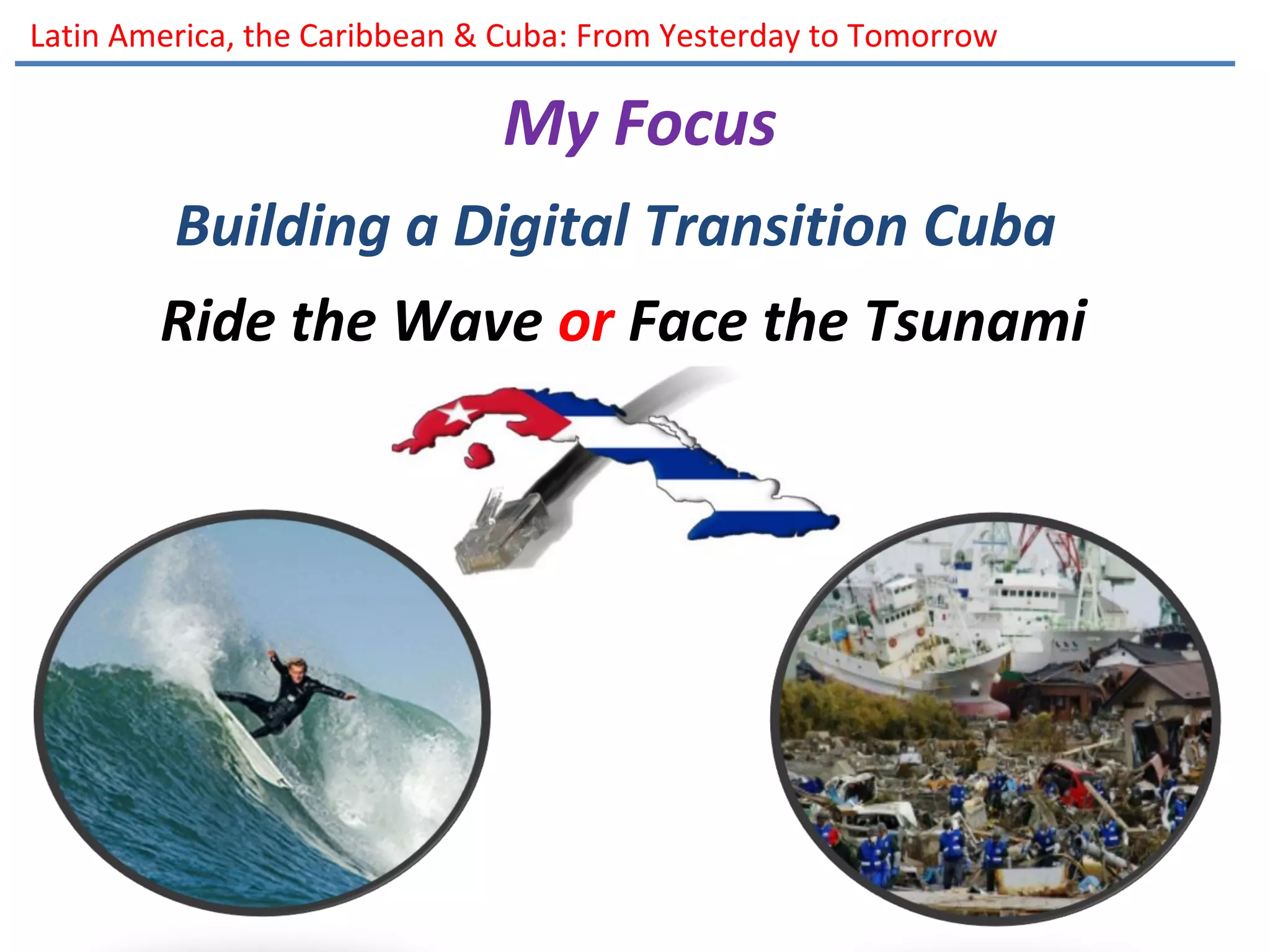
Latin America, the Caribbean & Cuba: From Yesterday to Tomorrow
My Focus
Building a Digital Transition Cuba
Ride the Wave or Face the Tsunami
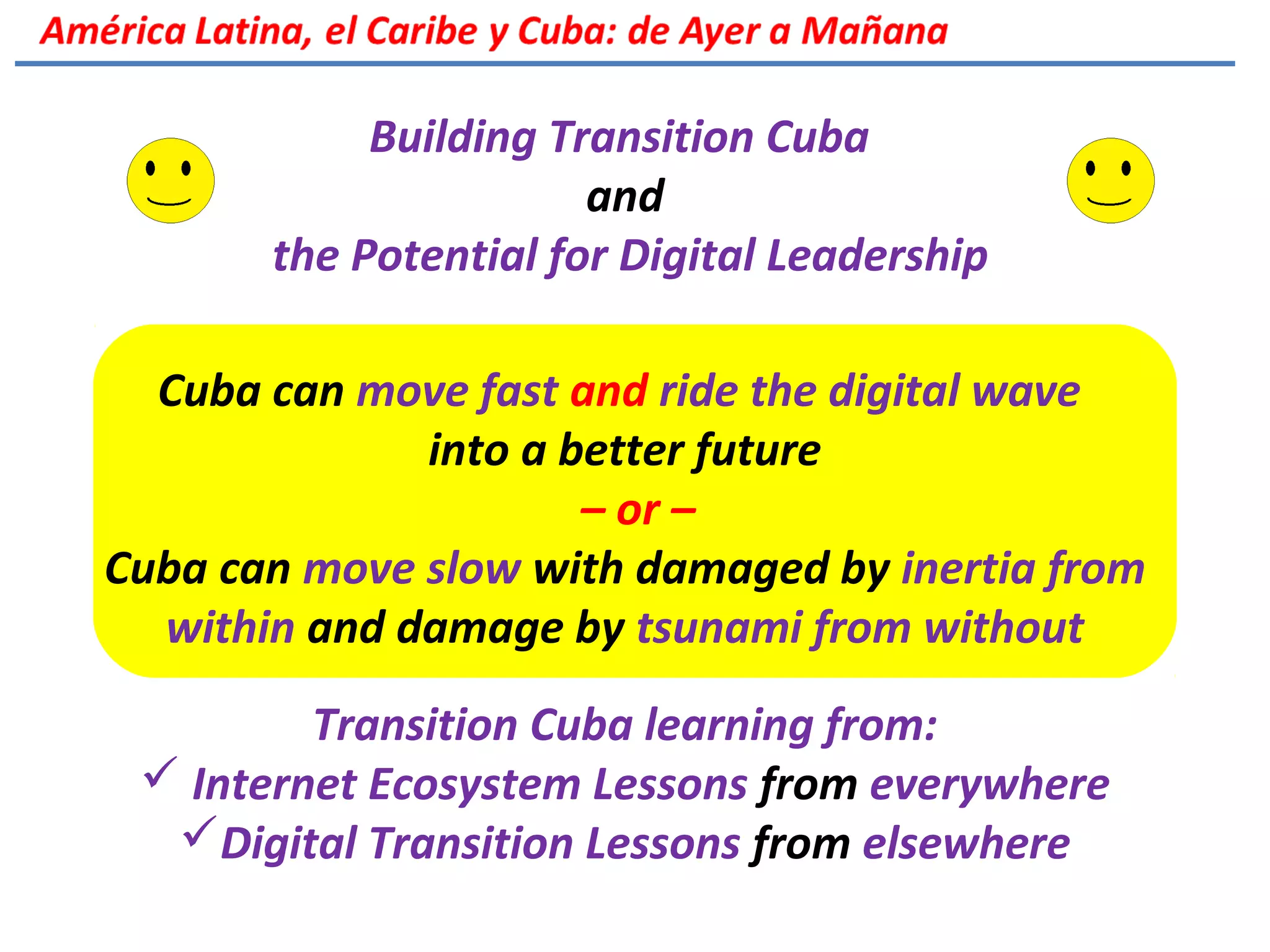
Building Transition Cuba
and
the Potential for Digital Leadership
Cuba can move fast and ride the digital wave
into a better future
– or –
Cuba can move slow with damaged by inertia from
within and damage by tsunami from without
Transition Cuba learning from:
 Internet Ecosystem Lessons from everywhere
Digital Transition Lessons from elsewhere
Fixed-broadband price as
Percentage of Gross Personal Income
Obstacle or Opportunity:
•Technology: Wi-Fi – Wireless – Mesh – Internet of Things – IXPs
•Political Will: Spectrum – Fiber/Towers – Technology – Tariffs/Duties
•Privacy & Security: Personal – Business – State/National
Evidence: Broadband in Cuba
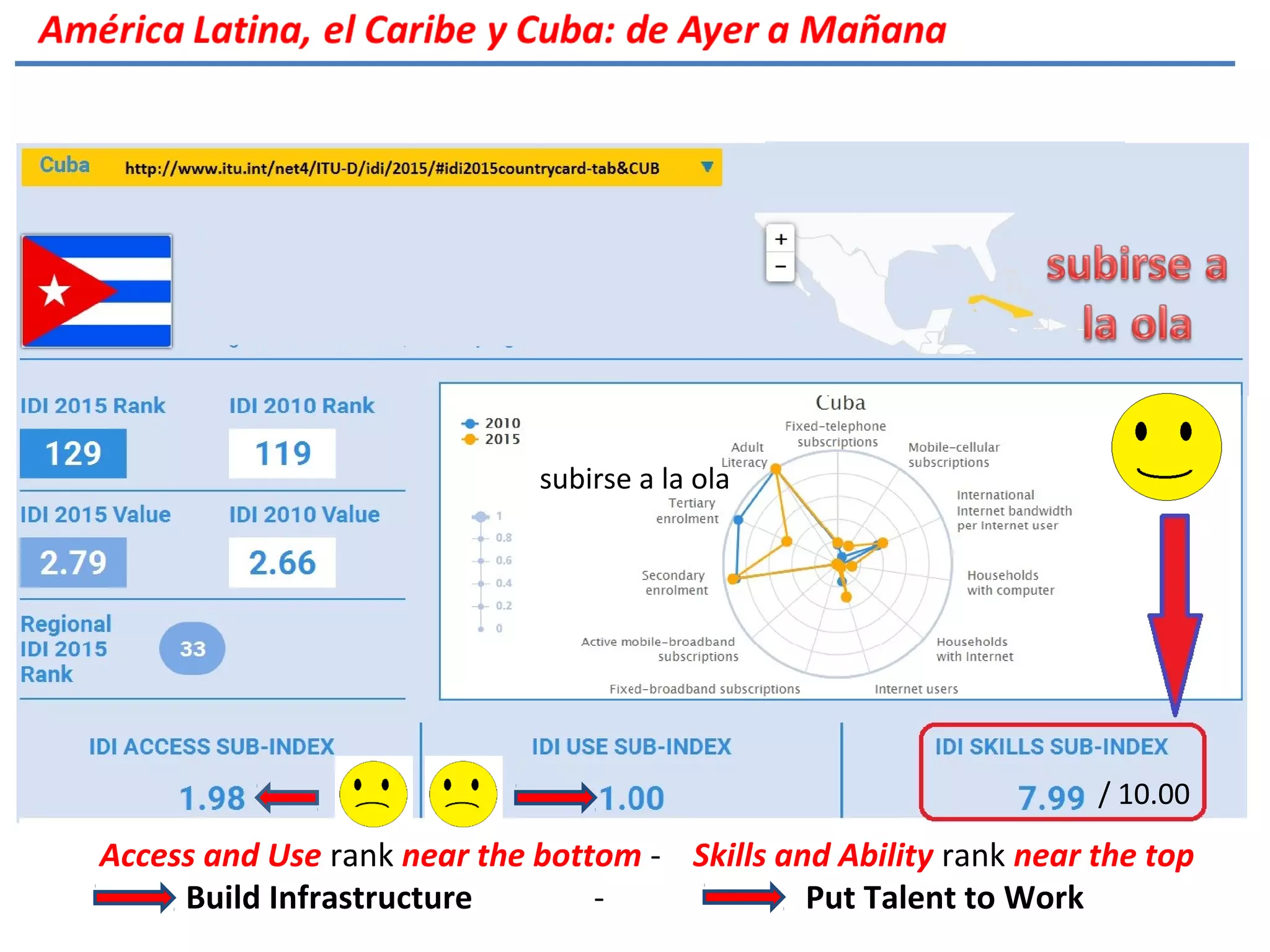
Evidence: Cuba’s ITU ICT Development Index
Obstacle – or - Opportunity
•Technology: Wi-Fi – Wireless – Mesh – Internet of Things – IXPs
•Political Will: Spectrum – Fiber/Towers – Technology – Tariffs/Duties
•Privacy & Security: Personal – Business – State/National
Source: ITU
Access and Use rank near the bottom - Skills and Ability rank near the top
Build Infrastructure - Put Talent to Work
subirse a la ola
/ 10.00
Cuba’s Potential Dynamic Comparative Advantages for Tomorrow?
• Highly Educated Youth
• Education, Research, Technology: sector pockets of strength
• Favorable Natural Ecosystem: for Farming / Solar Energy / Tourism
Obstacles to Development using Cuba’s Dynamic Comparative Advantages
• Slow political will for infrastructure and innovation support
• Slow innovation around ecosystem strengths (Farming/Solar/Tourism)
• Lack of bottom up opportunities in innovative activities
Cuban Opportunity:
Example: MakerSpaces: A Wave or a Tsunami?
Cuban Shared Technology & Skills
Start-up Structures for Cuba [??]
Enterprise Skills and Funding [??]
Initiative Innovation
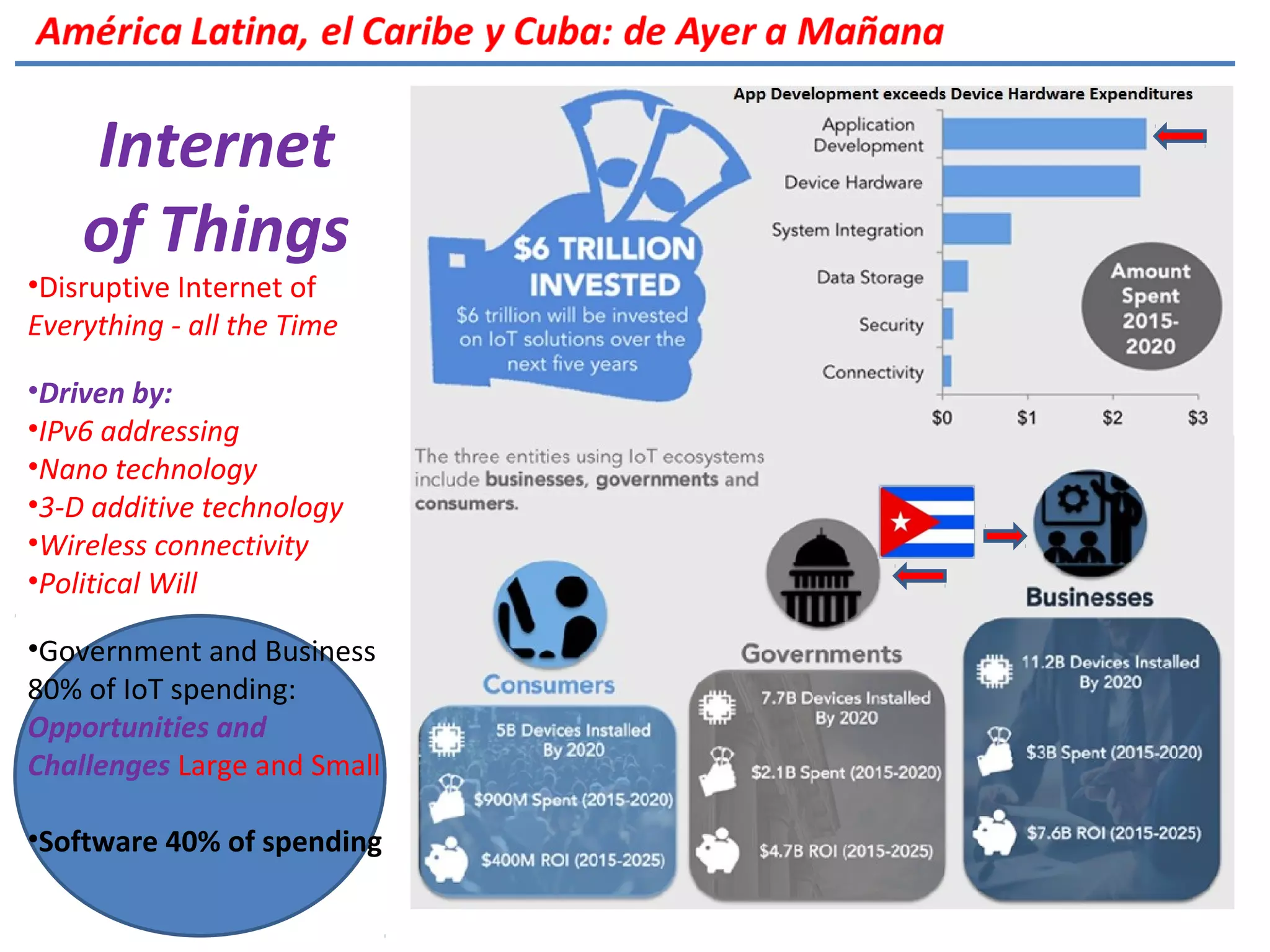
Internet
of Things
•Disruptive Internet of
Everything - all the Time
•Driven by:
•IPv6 addressing
•Nano technology
•3-D additive technology
•Wireless connectivity
•Political Will
•Government and Business
80% of IoT spending:
Opportunities and
Challenges Large and Small
•Software 40% of spending
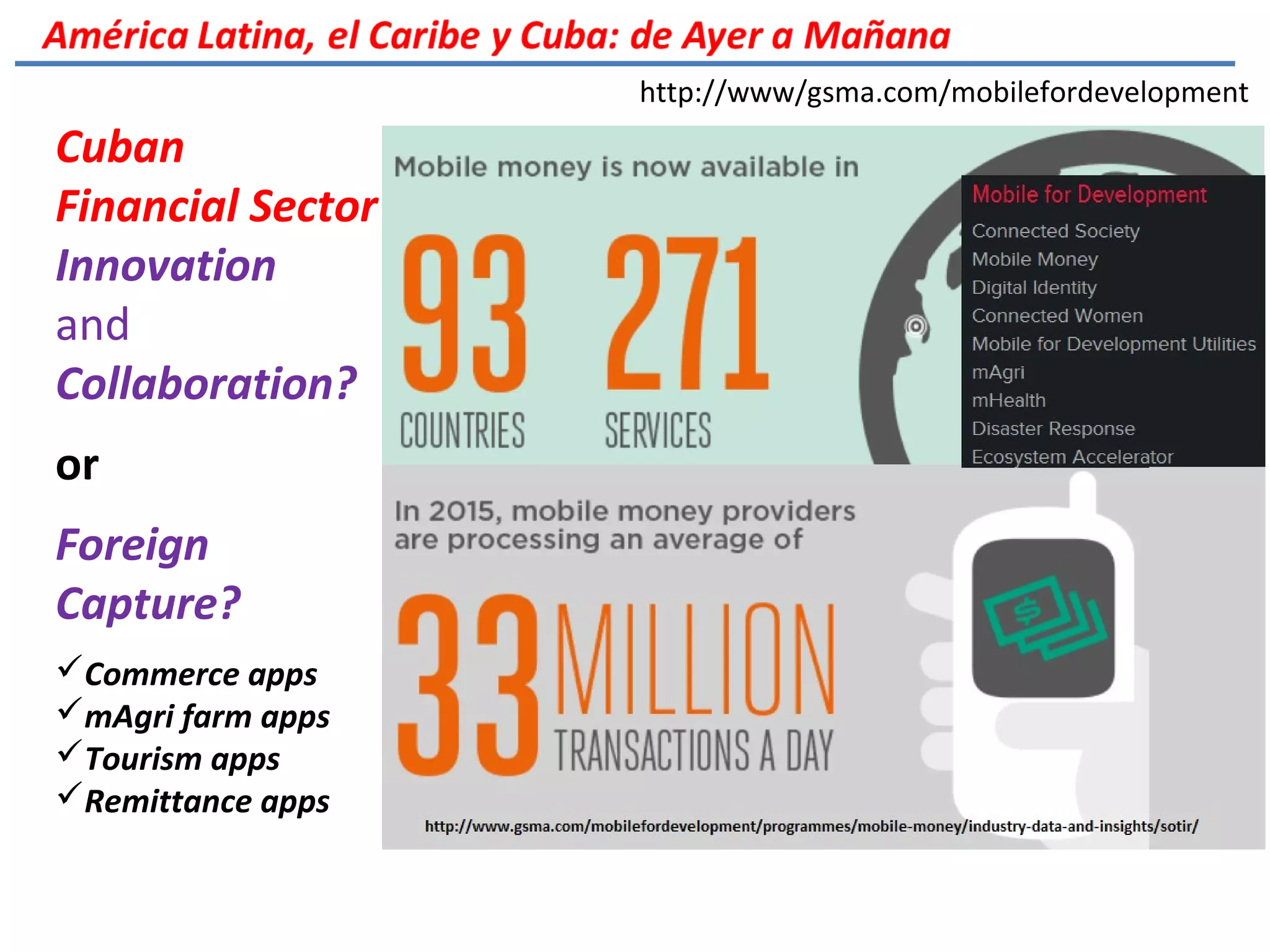
Cuban
Financial Sector
Innovation
and
Collaboration?
or
Foreign
Capture?
Commerce apps
mAgri farm apps
Tourism apps
Remittance apps
http://www/gsma.com/mobilefordevelopment
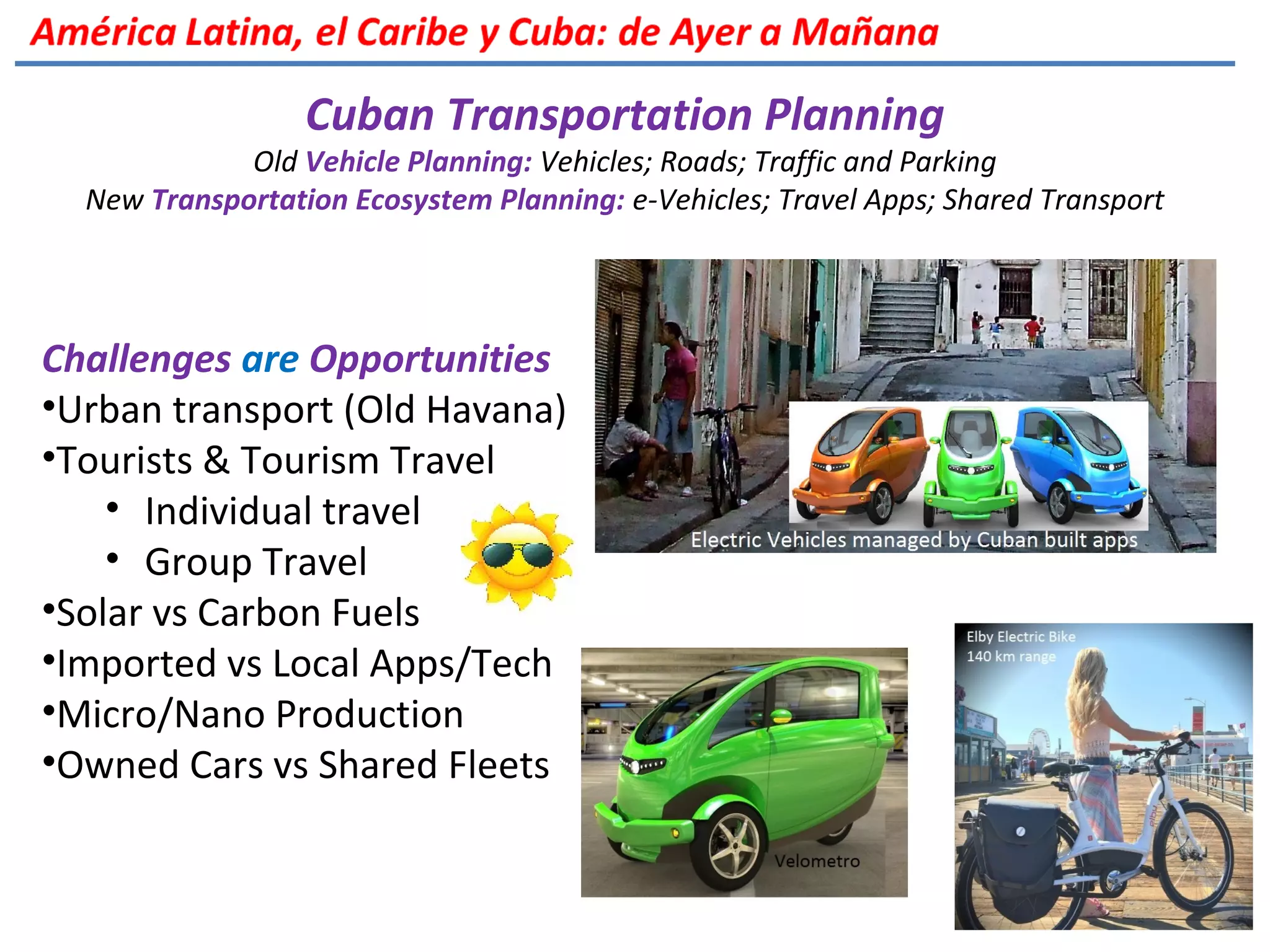
Cuban Transportation Planning
Old Vehicle Planning: Vehicles; Roads; Traffic and Parking
New Transportation Ecosystem Planning: e-Vehicles; Travel Apps; Shared Transport
Challenges are Opportunities
•Urban transport (Old Havana)
•Tourists & Tourism Travel
• Individual travel
• Group Travel
•Solar vs Carbon Fuels
•Imported vs Local Apps/Tech
•Micro/Nano Production
•Owned Cars vs Shared Fleets
Transition Estonia: Rode the Wave
 2000: Declared Internet access to be a human right
 Refused land line phone system & built a digital cell system
 Spread free Wi-Fi and embraced online e-government
 2007: First country with online general election voting
 Today: 95% of Estonians file annual tax returns online
 From no land ownership registry to a digital land registry
 Health records are stored in the digital cloud
 In 8 years all schools were online
 Skype developed in Estonia:
 2005 Skype sale produced pool of venture capital
 Estonia’s capital: home to more than 150 tech companies
 Tech companies are engaged in global partnerships
 Tech represents 15% of Estonia’s GDP., up from zero
 Transition Estonia:
 discarded legacy thinking
 Political will to embrace the Internet
 Embraced innovation potential of it education youth
 Rode wave to transition success.
http://www.economist.com/blogs/economist-explains/2013/07/economist-explains-21
Ride the Wave: Pre-Transition Myanmar
From 0.002% Internet access in 2012 to over 50% access today
 SIM card prices fell from over 2,000.00 $US to less than 2.00 $US
 Imports were restricted to smart phones (low cost Chinese)
 A contract was granted to build 8,000 cell towers by 2018
 The Political Will for policy was in place
 Pubic/Private/Foreign partnerships were encouraged
Transition Challenge to Myanmar’s government, business
community, and civil society
 Engaged in little awareness raising or stakeholder engagement
 Will face major stresses from rapid ICT and Internet access.
 Risks: Swamped by a foreign tsunami or retreating into stagnating
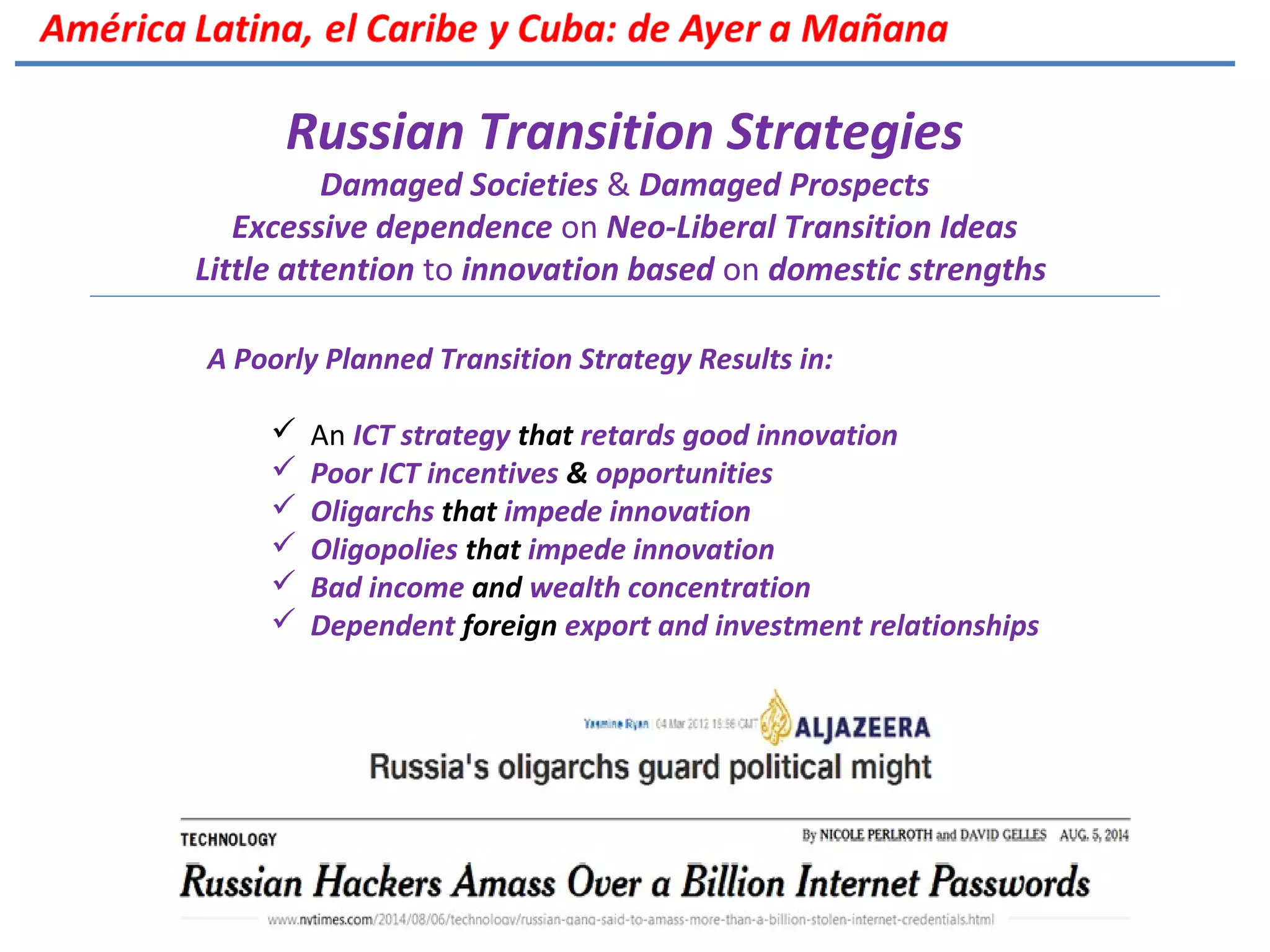
A Poorly Planned Transition Strategy Results in:
 An ICT strategy that retards good innovation
 Poor ICT incentives & opportunities
 Oligarchs that impede innovation
 Oligopolies that impede innovation
 Bad income and wealth concentration
 Dependent foreign export and investment relationships
Russian Transition Strategies
Damaged Societies & Damaged Prospects
Excessive dependence on Neo-Liberal Transition Ideas
Little attention to innovation based on domestic strengths
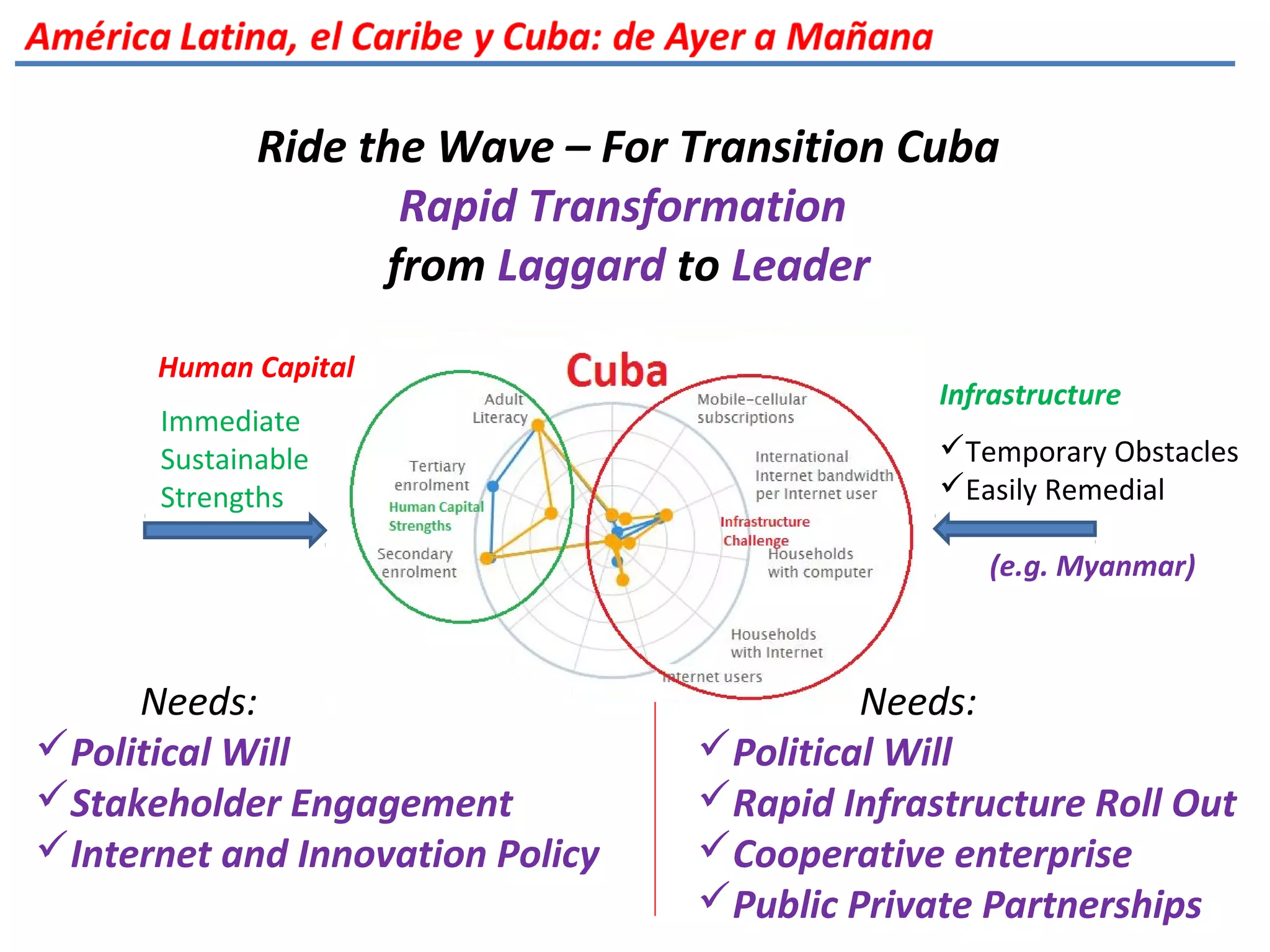
Ride the Wave – For Transition Cuba
Rapid Transformation
from Laggard to Leader
Needs:
Political Will
Stakeholder Engagement
Internet and Innovation Policy
Needs:
Political Will
Rapid Infrastructure Roll Out
Cooperative enterprise
Public Private Partnerships
Immediate
Sustainable
Strengths
Infrastructure
Temporary Obstacles
Easily Remedial
(e.g. Myanmar)
Human Capital
Transition Cuba Agriculture:
Potential Knowledge & Collaboration
Regional and Global:
> IDB & India <
Transition Cuba Agriculture:
Potential Knowledge & Collaboration
> Canada <
Grow Cooperatively to Compete Globally:
Ride the Wave at Home & Harness the Tsunami
Rapid infrastructure roll out
Bottom Up Stakeholder Engagement in Domestic Internet Policy
Broader and Deeper Cuban Engagement in Regional and Global Policy forums
 Multilateral, UN, and non-governmental Internet organizations
 ICANN’s Multistakeholder Governmental Advisory Committee (GAC)
 Engagement with the Internet Society (e.g. IXP efforts)
 Technical participation in the Internet Engineering Task Force (IETF) & IAB
 Business, Academic, Civil Society engagement in ICT for Development
 Stakeholder engagement in the IGF and WSIS activities
Cuban Political Will at all levels: more open processes within Cuba’s values
Start to Ride the Wave
Approach:
Multistakeholder Consultation
for a decade of digital Innovation
Para comentarios, preguntas, críticas,
ideas, ponerse en contacto conmigo por
correo electrónico:
<Lanfran@yorku.ca>
<Sam@Lanfranco.Net>
Adios Ramon
1924 - 2016
Sam Lanfranco
Prince Edward County Ontario
Lanfranco Farm
Se puede hacer

Digital Cuba: Ride the Wave of Face the Tsunami

  • 1.
    Dr. Sam Lanfranco,Prof. Emeritus & Senior Scholar York University, Canada - ISOC Canada - Chair, NPOC Policy Committee, ICANN Havana March 16th 2016 La Historia de la computación e Internet en la región ¿Qué? - ¿Por Qué? ¿Para Quién? América Latina, el Caribe y Cuba: de Ayer a Mañana
  • 2.
    América Latina, elCaribe y Cuba: de Ayer a Mañana Learning Lessons: Latin America, the Caribbean, Cuba & The World 1. History: Documents and Celebrates Human Effort 2. Its Purpose: Learn Lessons to Build a Better Tomorrow 1. The Speed of change means 1. A better tomorrow for our children and ourselves 2. Digital History is both young and thin 3. Digital Artifacts are mainly obsolete 2. Global Lessons Learned: use global digital history 3. Ride the Wave: use the right technology in the right context 4. Context: Use less old thinking and more new innovation
  • 3.
    Latin America, theCaribbean & Cuba: From Yesterday to Tomorrow My Focus Building a Digital Transition Cuba Ride the Wave or Face the Tsunami
  • 4.
    Building Transition Cuba and thePotential for Digital Leadership Cuba can move fast and ride the digital wave into a better future – or – Cuba can move slow with damaged by inertia from within and damage by tsunami from without Transition Cuba learning from:  Internet Ecosystem Lessons from everywhere Digital Transition Lessons from elsewhere
  • 5.
    Fixed-broadband price as Percentageof Gross Personal Income Obstacle or Opportunity: •Technology: Wi-Fi – Wireless – Mesh – Internet of Things – IXPs •Political Will: Spectrum – Fiber/Towers – Technology – Tariffs/Duties •Privacy & Security: Personal – Business – State/National Evidence: Broadband in Cuba
  • 6.
    Evidence: Cuba’s ITUICT Development Index Obstacle – or - Opportunity •Technology: Wi-Fi – Wireless – Mesh – Internet of Things – IXPs •Political Will: Spectrum – Fiber/Towers – Technology – Tariffs/Duties •Privacy & Security: Personal – Business – State/National Source: ITU
  • 7.
    Access and Userank near the bottom - Skills and Ability rank near the top Build Infrastructure - Put Talent to Work subirse a la ola / 10.00
  • 8.
    Cuba’s Potential DynamicComparative Advantages for Tomorrow? • Highly Educated Youth • Education, Research, Technology: sector pockets of strength • Favorable Natural Ecosystem: for Farming / Solar Energy / Tourism Obstacles to Development using Cuba’s Dynamic Comparative Advantages • Slow political will for infrastructure and innovation support • Slow innovation around ecosystem strengths (Farming/Solar/Tourism) • Lack of bottom up opportunities in innovative activities Cuban Opportunity: Example: MakerSpaces: A Wave or a Tsunami? Cuban Shared Technology & Skills Start-up Structures for Cuba [??] Enterprise Skills and Funding [??] Initiative Innovation
  • 9.
    Internet of Things •Disruptive Internetof Everything - all the Time •Driven by: •IPv6 addressing •Nano technology •3-D additive technology •Wireless connectivity •Political Will •Government and Business 80% of IoT spending: Opportunities and Challenges Large and Small •Software 40% of spending
  • 10.
    Cuban Financial Sector Innovation and Collaboration? or Foreign Capture? Commerce apps mAgrifarm apps Tourism apps Remittance apps http://www/gsma.com/mobilefordevelopment
  • 11.
    Cuban Transportation Planning OldVehicle Planning: Vehicles; Roads; Traffic and Parking New Transportation Ecosystem Planning: e-Vehicles; Travel Apps; Shared Transport Challenges are Opportunities •Urban transport (Old Havana) •Tourists & Tourism Travel • Individual travel • Group Travel •Solar vs Carbon Fuels •Imported vs Local Apps/Tech •Micro/Nano Production •Owned Cars vs Shared Fleets
  • 12.
    Transition Estonia: Rodethe Wave  2000: Declared Internet access to be a human right  Refused land line phone system & built a digital cell system  Spread free Wi-Fi and embraced online e-government  2007: First country with online general election voting  Today: 95% of Estonians file annual tax returns online  From no land ownership registry to a digital land registry  Health records are stored in the digital cloud  In 8 years all schools were online  Skype developed in Estonia:  2005 Skype sale produced pool of venture capital  Estonia’s capital: home to more than 150 tech companies  Tech companies are engaged in global partnerships  Tech represents 15% of Estonia’s GDP., up from zero  Transition Estonia:  discarded legacy thinking  Political will to embrace the Internet  Embraced innovation potential of it education youth  Rode wave to transition success. http://www.economist.com/blogs/economist-explains/2013/07/economist-explains-21
  • 13.
    Ride the Wave:Pre-Transition Myanmar From 0.002% Internet access in 2012 to over 50% access today  SIM card prices fell from over 2,000.00 $US to less than 2.00 $US  Imports were restricted to smart phones (low cost Chinese)  A contract was granted to build 8,000 cell towers by 2018  The Political Will for policy was in place  Pubic/Private/Foreign partnerships were encouraged Transition Challenge to Myanmar’s government, business community, and civil society  Engaged in little awareness raising or stakeholder engagement  Will face major stresses from rapid ICT and Internet access.  Risks: Swamped by a foreign tsunami or retreating into stagnating
  • 14.
    A Poorly PlannedTransition Strategy Results in:  An ICT strategy that retards good innovation  Poor ICT incentives & opportunities  Oligarchs that impede innovation  Oligopolies that impede innovation  Bad income and wealth concentration  Dependent foreign export and investment relationships Russian Transition Strategies Damaged Societies & Damaged Prospects Excessive dependence on Neo-Liberal Transition Ideas Little attention to innovation based on domestic strengths
  • 15.
    Ride the Wave– For Transition Cuba Rapid Transformation from Laggard to Leader Needs: Political Will Stakeholder Engagement Internet and Innovation Policy Needs: Political Will Rapid Infrastructure Roll Out Cooperative enterprise Public Private Partnerships Immediate Sustainable Strengths Infrastructure Temporary Obstacles Easily Remedial (e.g. Myanmar) Human Capital
  • 16.
    Transition Cuba Agriculture: PotentialKnowledge & Collaboration Regional and Global: > IDB & India <
  • 17.
    Transition Cuba Agriculture: PotentialKnowledge & Collaboration > Canada < Grow Cooperatively to Compete Globally:
  • 18.
    Ride the Waveat Home & Harness the Tsunami Rapid infrastructure roll out Bottom Up Stakeholder Engagement in Domestic Internet Policy Broader and Deeper Cuban Engagement in Regional and Global Policy forums  Multilateral, UN, and non-governmental Internet organizations  ICANN’s Multistakeholder Governmental Advisory Committee (GAC)  Engagement with the Internet Society (e.g. IXP efforts)  Technical participation in the Internet Engineering Task Force (IETF) & IAB  Business, Academic, Civil Society engagement in ICT for Development  Stakeholder engagement in the IGF and WSIS activities Cuban Political Will at all levels: more open processes within Cuba’s values
  • 19.
    Start to Ridethe Wave Approach: Multistakeholder Consultation for a decade of digital Innovation
  • 20.
    Para comentarios, preguntas,críticas, ideas, ponerse en contacto conmigo por correo electrónico: <Lanfran@yorku.ca> <Sam@Lanfranco.Net> Adios Ramon 1924 - 2016 Sam Lanfranco Prince Edward County Ontario Lanfranco Farm Se puede hacer