
Rencontre Recherche > Innovation + Construction
Chambre des Métiers, Luxembourg
26 février 2019
DIGITAL BUILT ENVIRONMENT MANAGEMENT
Sylvain KUBICKI
Luxembourg Institute of Science and Technology
1. Key challenges the EU Construction industry is
facing today
2. Overview of LIST projects
3. Beyond BIM: a research and innovation trajectory
4. Conclusion
SUMMARY
2
1. Key challenges in the EU
Construction industry
3
4
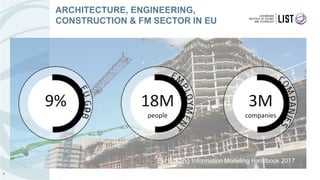
ARCHITECTURE, ENGINEERING,
CONSTRUCTION & FM SECTOR IN EU
9% 18M
people
3M
companies
EU Building Information Modeling Handbook 2017
5
ARCHITECTURE, ENGINEERING,
CONSTRUCTION & FM SECTOR IN EU
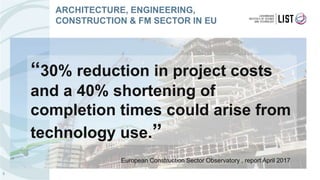
“30% reduction in project costs
and a 40% shortening of
completion times could arise from
technology use.”
European Construction Sector Observatory , report April 2017
“ […] the construction process should be viewed as a
high priority challenge, to be addressed by the TIR
roadmap using BIM tools to expedite high-quality
planning, construction, operation, refurbishment
and disaggregation and reuse.”
Extract from the Third Industrial Revolution report, Rifkin, 2016
6
STRATEGY STUDY – THIRD INDUSTRIAL
REVOLUTION LUXEMBOURG 2016
http://www.digitalbuilding.lu
p. 145
7
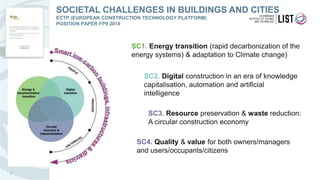
SOCIETAL CHALLENGES IN BUILDINGS AND CITIES
ECTP (EUROPEAN CONSTRUCTION TECHNOLOGY PLATFORM)
POSITION PAPER FP9 2018
SC4. Quality & value for both owners/managers
and users/occupants/citizens
SC1. Energy transition (rapid decarbonization of the
energy systems) & adaptation to Climate change)
SC2. Digital construction in an era of knowledge
capitalisation, automation and artificial
intelligence
SC3. Resource preservation & waste reduction:
A circular construction economy
8
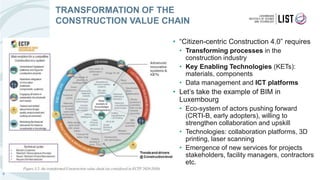
TRANSFORMATION OF THE
CONSTRUCTION VALUE CHAIN
• “Citizen-centric Construction 4.0” requires
• Transforming processes in the
construction industry
• Key Enabling Technologies (KETs):
materials, components
• Data management and ICT platforms
• Let’s take the example of BIM in
Luxembourg
• Eco-system of actors pushing forward
(CRTI-B, early adopters), willing to
strengthen collaboration and upskill
• Technologies: collaboration platforms, 3D
printing, laser scanning
• Emergence of new services for projects
stakeholders, facility managers, contractors
etc.
2. Overview of LIST projects
9
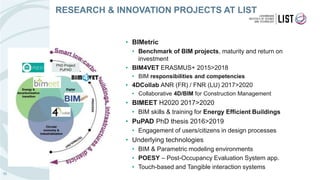
• BIMetric
• Benchmark of BIM projects, maturity and return on
investment
• BIM4VET ERASMUS+ 2015>2018
• BIM responsibilities and competencies
• 4DCollab ANR (FR) / FNR (LU) 2017>2020
• Collaborative 4D/BIM for Construction Management
• BIMEET H2020 2017>2020
• BIM skills & training for Energy Efficient Buildings
• PuPAD PhD thesis 2016>2019
• Engagement of users/citizens in design processes
• Underlying technologies
• BIM & Parametric modeling environments
• POESY – Post-Occupancy Evaluation System app.
• Touch-based and Tangible interaction systems
10
RESEARCH & INNOVATION PROJECTS AT LIST
PhD Project
PuPAD
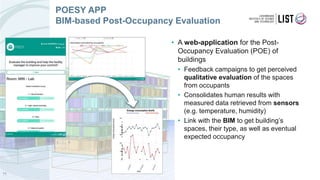
• A web-application for the Post-
Occupancy Evaluation (POE) of
buildings
• Feedback campaigns to get perceived
qualitative evaluation of the spaces
from occupants
• Consolidates human results with
measured data retrieved from sensors
(e.g. temperature, humidity)
• Link with the BIM to get building’s
spaces, their type, as well as eventual
expected occupancy
11
POESY APP
BIM-based Post-Occupancy Evaluation
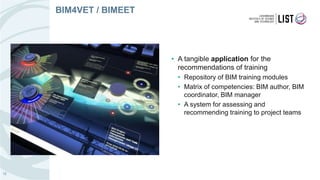
• A tangible application for the
recommendations of training
• Repository of BIM training modules
• Matrix of competencies: BIM author, BIM
coordinator, BIM manager
• A system for assessing and
recommending training to project teams
12
BIM4VET / BIMEET
3. Going Beyond
13
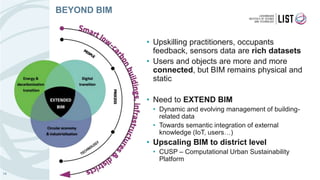
• Upskilling practitioners, occupants
feedback, sensors data are rich datasets
• Users and objects are more and more
connected, but BIM remains physical and
static
• Need to EXTEND BIM
• Dynamic and evolving management of building-
related data
• Towards semantic integration of external
knowledge (IoT, users…)
• Upscaling BIM to district level
• CUSP – Computational Urban Sustainability
Platform
14
BEYOND BIM
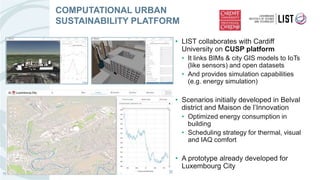
• LIST collaborates with Cardiff
University on CUSP platform
• It links BIMs & city GIS models to IoTs
(like sensors) and open datasets
• And provides simulation capabilities
(e.g. energy simulation)
• Scenarios initially developed in Belval
district and Maison de l’Innovation
• Optimized energy consumption in
building
• Scheduling strategy for thermal, visual
and IAQ comfort
• A prototype already developed for
Luxembourg City
COMPUTATIONAL URBAN
SUSTAINABILITY PLATFORM
15
4. Conclusion
16
• Call for interest: case studies in Luxembourg
• Intelligent, energy-efficient buildings
• Positive Energy Blocks
• Construction BIM and digital twins
• Instruments available: H2020, FNR (Bridges)
• A strong European collaboration established
• Policy makers, academics, research institutes
• In a nutshell
• LIST develops BIM-based technology bricks
• To improve building occupants’ experience, well being
• And citizen engagement
17
BEYOND BIM, A TRAJECTORY
Rencontre Recherche > Innovation + Construction
Chambre des Métiers, Luxembourg
26 février 2019
Sylvain KUBICKI
sylvain.kubicki@list.lu
@SKubicki
THANK YOU FOR YOUR
ATTENTION
18

Digital Built Environment Management

  • 1.
    Rencontre Recherche >Innovation + Construction Chambre des Métiers, Luxembourg 26 février 2019 DIGITAL BUILT ENVIRONMENT MANAGEMENT Sylvain KUBICKI Luxembourg Institute of Science and Technology
  • 2.
    1. Key challengesthe EU Construction industry is facing today 2. Overview of LIST projects 3. Beyond BIM: a research and innovation trajectory 4. Conclusion SUMMARY 2
  • 3.
    1. Key challengesin the EU Construction industry 3
  • 4.
    4 ARCHITECTURE, ENGINEERING, CONSTRUCTION &FM SECTOR IN EU 9% 18M people 3M companies EU Building Information Modeling Handbook 2017
  • 5.
    5 ARCHITECTURE, ENGINEERING, CONSTRUCTION &FM SECTOR IN EU “30% reduction in project costs and a 40% shortening of completion times could arise from technology use.” European Construction Sector Observatory , report April 2017
  • 6.
    “ […] theconstruction process should be viewed as a high priority challenge, to be addressed by the TIR roadmap using BIM tools to expedite high-quality planning, construction, operation, refurbishment and disaggregation and reuse.” Extract from the Third Industrial Revolution report, Rifkin, 2016 6 STRATEGY STUDY – THIRD INDUSTRIAL REVOLUTION LUXEMBOURG 2016 http://www.digitalbuilding.lu p. 145
  • 7.
    7 SOCIETAL CHALLENGES INBUILDINGS AND CITIES ECTP (EUROPEAN CONSTRUCTION TECHNOLOGY PLATFORM) POSITION PAPER FP9 2018 SC4. Quality & value for both owners/managers and users/occupants/citizens SC1. Energy transition (rapid decarbonization of the energy systems) & adaptation to Climate change) SC2. Digital construction in an era of knowledge capitalisation, automation and artificial intelligence SC3. Resource preservation & waste reduction: A circular construction economy
  • 8.
    8 TRANSFORMATION OF THE CONSTRUCTIONVALUE CHAIN • “Citizen-centric Construction 4.0” requires • Transforming processes in the construction industry • Key Enabling Technologies (KETs): materials, components • Data management and ICT platforms • Let’s take the example of BIM in Luxembourg • Eco-system of actors pushing forward (CRTI-B, early adopters), willing to strengthen collaboration and upskill • Technologies: collaboration platforms, 3D printing, laser scanning • Emergence of new services for projects stakeholders, facility managers, contractors etc.
  • 9.
    2. Overview ofLIST projects 9
  • 10.
    • BIMetric • Benchmarkof BIM projects, maturity and return on investment • BIM4VET ERASMUS+ 2015>2018 • BIM responsibilities and competencies • 4DCollab ANR (FR) / FNR (LU) 2017>2020 • Collaborative 4D/BIM for Construction Management • BIMEET H2020 2017>2020 • BIM skills & training for Energy Efficient Buildings • PuPAD PhD thesis 2016>2019 • Engagement of users/citizens in design processes • Underlying technologies • BIM & Parametric modeling environments • POESY – Post-Occupancy Evaluation System app. • Touch-based and Tangible interaction systems 10 RESEARCH & INNOVATION PROJECTS AT LIST PhD Project PuPAD
  • 11.
    • A web-applicationfor the Post- Occupancy Evaluation (POE) of buildings • Feedback campaigns to get perceived qualitative evaluation of the spaces from occupants • Consolidates human results with measured data retrieved from sensors (e.g. temperature, humidity) • Link with the BIM to get building’s spaces, their type, as well as eventual expected occupancy 11 POESY APP BIM-based Post-Occupancy Evaluation
  • 12.
    • A tangibleapplication for the recommendations of training • Repository of BIM training modules • Matrix of competencies: BIM author, BIM coordinator, BIM manager • A system for assessing and recommending training to project teams 12 BIM4VET / BIMEET
  • 13.
  • 14.
    • Upskilling practitioners,occupants feedback, sensors data are rich datasets • Users and objects are more and more connected, but BIM remains physical and static • Need to EXTEND BIM • Dynamic and evolving management of building- related data • Towards semantic integration of external knowledge (IoT, users…) • Upscaling BIM to district level • CUSP – Computational Urban Sustainability Platform 14 BEYOND BIM
  • 15.
    • LIST collaborateswith Cardiff University on CUSP platform • It links BIMs & city GIS models to IoTs (like sensors) and open datasets • And provides simulation capabilities (e.g. energy simulation) • Scenarios initially developed in Belval district and Maison de l’Innovation • Optimized energy consumption in building • Scheduling strategy for thermal, visual and IAQ comfort • A prototype already developed for Luxembourg City COMPUTATIONAL URBAN SUSTAINABILITY PLATFORM 15
  • 16.
  • 17.
    • Call forinterest: case studies in Luxembourg • Intelligent, energy-efficient buildings • Positive Energy Blocks • Construction BIM and digital twins • Instruments available: H2020, FNR (Bridges) • A strong European collaboration established • Policy makers, academics, research institutes • In a nutshell • LIST develops BIM-based technology bricks • To improve building occupants’ experience, well being • And citizen engagement 17 BEYOND BIM, A TRAJECTORY
  • 18.
    Rencontre Recherche >Innovation + Construction Chambre des Métiers, Luxembourg 26 février 2019 Sylvain KUBICKI sylvain.kubicki@list.lu @SKubicki THANK YOU FOR YOUR ATTENTION 18

Editor's Notes

  • #5 Gross Domestic Product 9%
  • #6 Gross Domestic Product 9%