Recognising informal elearning
with digital badging: evidence
for a sustainable business
model
Patrina Law, Head of Free Learning
The Open University
Patrina.Law@open.ac.uk
@HigherEdPatrina
www.slideshare.net/patrinalaw
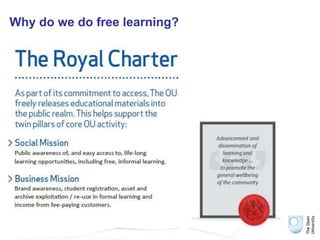
Why do we do free learning?
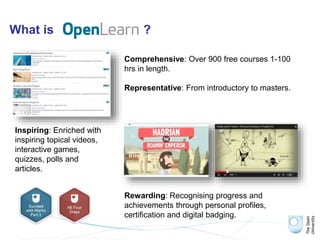
What is ?
Comprehensive: Over 900 free courses 1-100
hrs in length.
Representative: From introductory to masters.
Inspiring: Enriched with
inspiring topical videos,
interactive games,
quizzes, polls and
articles.
Rewarding: Recognising progress and
achievements through personal profiles,
certification and digital badging.
4
Our commitment to ‘open’
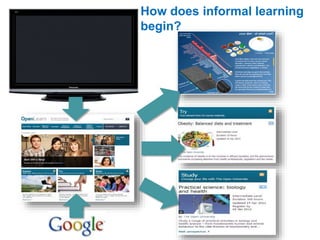
How does informal learning
begin?
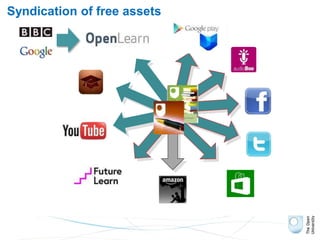
Syndication of free assets
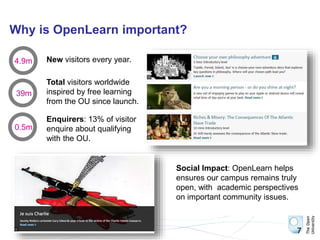
Why is OpenLearn important?
7
Enquirers: 13% of visitor
enquire about qualifying
with the OU.
39m
Total visitors worldwide
inspired by free learning
from the OU since launch.
4.9m New visitors every year.
Social Impact: OpenLearn helps
ensures our campus remains truly
open, with academic perspectives
on important community issues.
0.5m
Our research: who are our informal learners?
Research projects in 2013, 2014 and 2015:
• Demographic profiling of learners, students and teachers
• Understanding how the content serves learners’ needs
• Examining how free educational content is influences the
progression to formal study
• Understanding learners’ challenges and successes
• Discovering what learners want and how this is changing
• Evaluating the impact of the ‘recognition’ for informal learning
9
What do our surveys tell us?
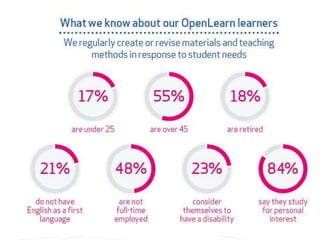
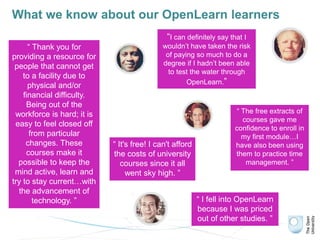
What we know about our OpenLearn learners
“I can definitely say that I
wouldn’t have taken the risk
of paying so much to do a
degree if I hadn’t been able
to test the water through
OpenLearn.”
“ The free extracts of
courses gave me
confidence to enroll in
my first module…I
have also been using
them to practice time
management. ”
“ It's free! I can't afford
the costs of university
courses since it all
went sky high. ”
“ I fell into OpenLearn
because I was priced
out of other studies. ”
“ Thank you for
providing a resource for
people that cannot get
to a facility due to
physical and/or
financial difficulty.
Being out of the
workforce is hard; it is
easy to feel closed off
from particular
changes. These
courses make it
possible to keep the
mind active, learn and
try to stay current…with
the advancement of
technology. ”
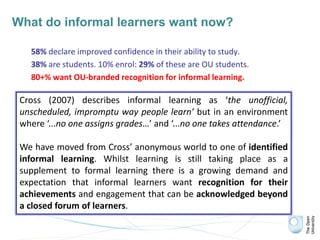
What do informal learners want now?
58% declare improved confidence in their ability to study.
38% are students. 10% enrol: 29% of these are OU students.
80+% want OU-branded recognition for informal learning.
Cross (2007) describes informal learning as ‘the unofficial,
unscheduled, impromptu way people learn’ but in an environment
where ‘...no one assigns grades…’ and ‘...no one takes attendance.’
We have moved from Cross’ anonymous world to one of identified
informal learning. Whilst learning is still taking place as a
supplement to formal learning there is a growing demand and
expectation that informal learners want recognition for their
achievements and engagement that can be acknowledged beyond
a closed forum of learners.
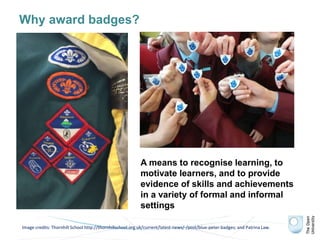
Why award badges?
Image credits: Thornhill School http://thornhillschool.org.uk/current/latest-news/-/post/blue-peter-badges; and Patrina Law.
A means to recognise learning, to
motivate learners, and to provide
evidence of skills and achievements
in a variety of formal and informal
settings
Digital badges in HE
Research tells us that they are used:
1. by educators in MOOCs to reward and motivate
learners to participate in a group.
2. by learners to let others know of their mastery
usually in closed, online, tutored environments.
3. by universities as a method of encouraging first
year students to complete.
Awarding of a badge can often be a manual activity.
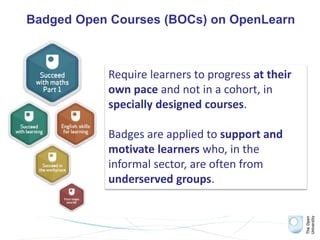
Badged Open Courses (BOCs) on OpenLearn
Require learners to progress at their
own pace and not in a cohort, in
specially designed courses.
Badges are applied to support and
motivate learners who, in the
informal sector, are often from
underserved groups.
Engaging with learners – informal and formal
Launched in 2015, Badged Open Courses:
1. Give informal learners the recognition they’ve requested.
2. Give prospective students the skills to be prepared for
undergraduate study.
3. Give our current students a means of developing and
displaying skills relevant to career progression.
 Created using repurposed module content or via current
module production
 Cheaper to produce than our MOOCs
 No tutoring overhead
 Badging infrastructure interoperable with open standards
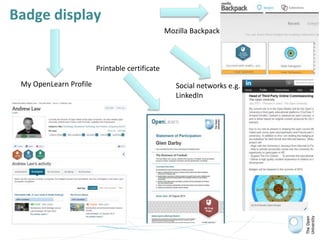
Badge display
Mozilla Backpack
My OpenLearn Profile Social networks e.g.
LinkedIn
Printable certificate
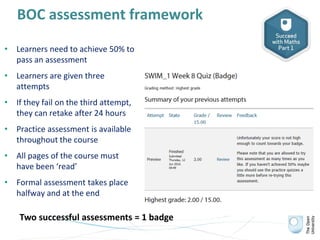
BOC assessment framework
• Learners need to achieve 50% to
pass an assessment
• Learners are given three
attempts
• If they fail on the third attempt,
they can retake after 24 hours
• Practice assessment is available
throughout the course
• All pages of the course must
have been ‘read’
• Formal assessment takes place
halfway and at the end
Two successful assessments = 1 badge
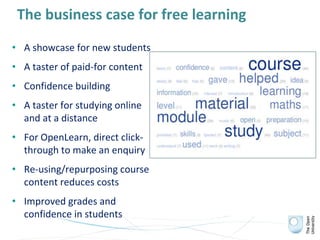
The business case for free learning
• A showcase for new students
• A taster of paid-for content
• Confidence building
• A taster for studying online
and at a distance
• For OpenLearn, direct click-
through to make an enquiry
• Re-using/repurposing course
content reduces costs
• Improved grades and
confidence in students
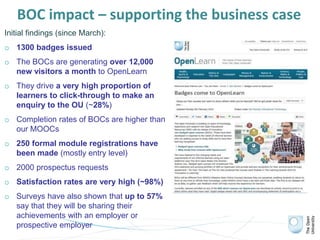
BOC impact – supporting the business case
Initial findings (since March):
o 1300 badges issued
o The BOCs are generating over 12,000
new visitors a month to OpenLearn
o They drive a very high proportion of
learners to click-through to make an
enquiry to the OU (~28%)
o Completion rates of BOCs are higher than
our MOOCs
o 250 formal module registrations have
been made (mostly entry level)
o 2000 prospectus requests
o Satisfaction rates are very high (~98%)
o Surveys have also shown that up to 57%
say that they will be sharing their
achievements with an employer or
prospective employer
BOC impact – qualitative data analysis
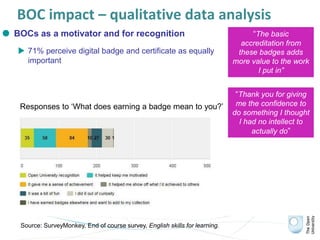
 BOCs as a motivator and for recognition
 71% perceive digital badge and certificate as equally
important
Responses to ‘What does earning a badge mean to you?’
Source: SurveyMonkey. End of course survey, English skills for learning.
“The basic
accreditation from
these badges adds
more value to the work
I put in”
“Thank you for giving
me the confidence to
do something I thought
I had no intellect to
actually do”
BOC impact – qualitative data analysis
 BOCs supporting professional development
 39-57% will show badge to employer
 BOCs as preparedness and driver for study
 Promising demographic for undergraduate recruitment in terms of age
(younger than OpenLearn overall) and existing qualifications: 7-17%
hold undergraduate degree compared to 26% on OpenLearn
(MOOCs >70%)
 Reasons for studying: Professional development (84%), personal
interest (78%), preparation for study (54%)
 58% had not taken online course before
“a good talking point
and something to
include on my CV”
“Refreshed my maths
skills and going on to do
the open learn English
course, will be applying to
do an access course in
March”
BOC impact – qualitative data analysis
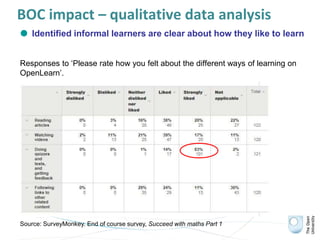
 Identified informal learners are clear about how they like to learn
Responses to ‘Please rate how you felt about the different ways of learning on
OpenLearn’.
Source: SurveyMonkey. End of course survey, Succeed with maths Part 1
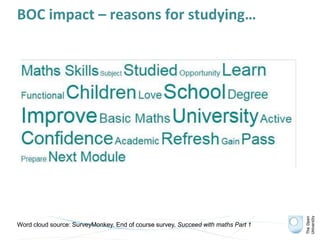
BOC impact – reasons for studying…
Word cloud source: SurveyMonkey. End of course survey, Succeed with maths Part 1
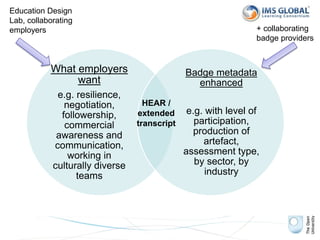
What employers
want
e.g. resilience,
negotiation,
followership,
commercial
awareness and
communication,
working in
culturally diverse
teams
Badge metadata
enhanced
e.g. with level of
participation,
production of
artefact,
assessment type,
by sector, by
industry
HEAR /
extended
transcript
Education Design
Lab, collaborating
employers + collaborating
badge providers
Next steps
1. Platform enables rapid feedback for interoperable
innovation with the VLE (Moodle)
2. Continue to experiment in the open with digital
credentialising and ‘volunteer’ social support
3. Extending curriculum to new postgraduates, plus subject-
specific clusters, employability, workplace skills
4. Delivery of BOCs to offender learners (UK and Australia)
5. Working with Centre for Recording Achievement for the
UK to recognise Digital Badging in HE.
6. OU BOCs on OU Student Record and HEAR.
@HigherEdPatrina
www.slideshare.net/patrinalaw

Digital badging at the OU

  • 1.
    Recognising informal elearning withdigital badging: evidence for a sustainable business model Patrina Law, Head of Free Learning The Open University Patrina.Law@open.ac.uk @HigherEdPatrina www.slideshare.net/patrinalaw
  • 2.
    Why do wedo free learning?
  • 3.
    What is ? Comprehensive:Over 900 free courses 1-100 hrs in length. Representative: From introductory to masters. Inspiring: Enriched with inspiring topical videos, interactive games, quizzes, polls and articles. Rewarding: Recognising progress and achievements through personal profiles, certification and digital badging.
  • 4.
  • 5.
    How does informallearning begin?
  • 6.
  • 7.
    Why is OpenLearnimportant? 7 Enquirers: 13% of visitor enquire about qualifying with the OU. 39m Total visitors worldwide inspired by free learning from the OU since launch. 4.9m New visitors every year. Social Impact: OpenLearn helps ensures our campus remains truly open, with academic perspectives on important community issues. 0.5m
  • 8.
    Our research: whoare our informal learners? Research projects in 2013, 2014 and 2015: • Demographic profiling of learners, students and teachers • Understanding how the content serves learners’ needs • Examining how free educational content is influences the progression to formal study • Understanding learners’ challenges and successes • Discovering what learners want and how this is changing • Evaluating the impact of the ‘recognition’ for informal learning
  • 9.
    9 What do oursurveys tell us?
  • 10.
    What we knowabout our OpenLearn learners “I can definitely say that I wouldn’t have taken the risk of paying so much to do a degree if I hadn’t been able to test the water through OpenLearn.” “ The free extracts of courses gave me confidence to enroll in my first module…I have also been using them to practice time management. ” “ It's free! I can't afford the costs of university courses since it all went sky high. ” “ I fell into OpenLearn because I was priced out of other studies. ” “ Thank you for providing a resource for people that cannot get to a facility due to physical and/or financial difficulty. Being out of the workforce is hard; it is easy to feel closed off from particular changes. These courses make it possible to keep the mind active, learn and try to stay current…with the advancement of technology. ”
  • 11.
    What do informallearners want now? 58% declare improved confidence in their ability to study. 38% are students. 10% enrol: 29% of these are OU students. 80+% want OU-branded recognition for informal learning. Cross (2007) describes informal learning as ‘the unofficial, unscheduled, impromptu way people learn’ but in an environment where ‘...no one assigns grades…’ and ‘...no one takes attendance.’ We have moved from Cross’ anonymous world to one of identified informal learning. Whilst learning is still taking place as a supplement to formal learning there is a growing demand and expectation that informal learners want recognition for their achievements and engagement that can be acknowledged beyond a closed forum of learners.
  • 12.
    Why award badges? Imagecredits: Thornhill School http://thornhillschool.org.uk/current/latest-news/-/post/blue-peter-badges; and Patrina Law. A means to recognise learning, to motivate learners, and to provide evidence of skills and achievements in a variety of formal and informal settings
  • 13.
    Digital badges inHE Research tells us that they are used: 1. by educators in MOOCs to reward and motivate learners to participate in a group. 2. by learners to let others know of their mastery usually in closed, online, tutored environments. 3. by universities as a method of encouraging first year students to complete. Awarding of a badge can often be a manual activity.
  • 14.
    Badged Open Courses(BOCs) on OpenLearn Require learners to progress at their own pace and not in a cohort, in specially designed courses. Badges are applied to support and motivate learners who, in the informal sector, are often from underserved groups.
  • 15.
    Engaging with learners– informal and formal Launched in 2015, Badged Open Courses: 1. Give informal learners the recognition they’ve requested. 2. Give prospective students the skills to be prepared for undergraduate study. 3. Give our current students a means of developing and displaying skills relevant to career progression.  Created using repurposed module content or via current module production  Cheaper to produce than our MOOCs  No tutoring overhead  Badging infrastructure interoperable with open standards
  • 16.
    Badge display Mozilla Backpack MyOpenLearn Profile Social networks e.g. LinkedIn Printable certificate
  • 17.
    BOC assessment framework •Learners need to achieve 50% to pass an assessment • Learners are given three attempts • If they fail on the third attempt, they can retake after 24 hours • Practice assessment is available throughout the course • All pages of the course must have been ‘read’ • Formal assessment takes place halfway and at the end Two successful assessments = 1 badge
  • 18.
    The business casefor free learning • A showcase for new students • A taster of paid-for content • Confidence building • A taster for studying online and at a distance • For OpenLearn, direct click- through to make an enquiry • Re-using/repurposing course content reduces costs • Improved grades and confidence in students
  • 19.
    BOC impact –supporting the business case Initial findings (since March): o 1300 badges issued o The BOCs are generating over 12,000 new visitors a month to OpenLearn o They drive a very high proportion of learners to click-through to make an enquiry to the OU (~28%) o Completion rates of BOCs are higher than our MOOCs o 250 formal module registrations have been made (mostly entry level) o 2000 prospectus requests o Satisfaction rates are very high (~98%) o Surveys have also shown that up to 57% say that they will be sharing their achievements with an employer or prospective employer
  • 20.
    BOC impact –qualitative data analysis  BOCs as a motivator and for recognition  71% perceive digital badge and certificate as equally important Responses to ‘What does earning a badge mean to you?’ Source: SurveyMonkey. End of course survey, English skills for learning. “The basic accreditation from these badges adds more value to the work I put in” “Thank you for giving me the confidence to do something I thought I had no intellect to actually do”
  • 21.
    BOC impact –qualitative data analysis  BOCs supporting professional development  39-57% will show badge to employer  BOCs as preparedness and driver for study  Promising demographic for undergraduate recruitment in terms of age (younger than OpenLearn overall) and existing qualifications: 7-17% hold undergraduate degree compared to 26% on OpenLearn (MOOCs >70%)  Reasons for studying: Professional development (84%), personal interest (78%), preparation for study (54%)  58% had not taken online course before “a good talking point and something to include on my CV” “Refreshed my maths skills and going on to do the open learn English course, will be applying to do an access course in March”
  • 22.
    BOC impact –qualitative data analysis  Identified informal learners are clear about how they like to learn Responses to ‘Please rate how you felt about the different ways of learning on OpenLearn’. Source: SurveyMonkey. End of course survey, Succeed with maths Part 1
  • 23.
    BOC impact –reasons for studying… Word cloud source: SurveyMonkey. End of course survey, Succeed with maths Part 1
  • 24.
    What employers want e.g. resilience, negotiation, followership, commercial awarenessand communication, working in culturally diverse teams Badge metadata enhanced e.g. with level of participation, production of artefact, assessment type, by sector, by industry HEAR / extended transcript Education Design Lab, collaborating employers + collaborating badge providers
  • 25.
    Next steps 1. Platformenables rapid feedback for interoperable innovation with the VLE (Moodle) 2. Continue to experiment in the open with digital credentialising and ‘volunteer’ social support 3. Extending curriculum to new postgraduates, plus subject- specific clusters, employability, workplace skills 4. Delivery of BOCs to offender learners (UK and Australia) 5. Working with Centre for Recording Achievement for the UK to recognise Digital Badging in HE. 6. OU BOCs on OU Student Record and HEAR. @HigherEdPatrina www.slideshare.net/patrinalaw

Editor's Notes

  • #3 Patrina
  • #4 Patrina
  • #5 Patrina
  • #6 Informal learning often starts with broadcast [Click ON the video on the TV - The video on the TV will play while you talk – turn the volume down if too much ] We make about 25 SERIES with the BBC each year About 250 million ‘views’ of our programmes in the UK (people watch more than one) Academic involved in programme making [Click away form the TV graphic to get next step in animation] All programmes have a call to action – points at open learn – more than 10K hours of content and about 5.5m visitors each year – OpenLearn is THE home of our informal learning It contains light items, perhaps only requiring 5 or ten minutes study – including videos games, interactives (click ON this item to be taken through the page on OpenLearn if you are online) It contains examples of units (whole) from our courses (nearly all are covered at all levels) [‘Try’ – click ON this item to be taken to the unit related to the previous light interactive] And every page contains a link to the opportunities to study formally with the OU - more than 10% of those visiting OpenLearn make this journey to enquiry about formal study And where possible we syndicate our content onto other channels like YouTube and iTunesU .. And now some of our courses on FutureLearn Although much of this comes from TV - increasingly traffic comes form natural search (Google) – because we have so much content in the open.
  • #7 We think syndication is important – getting the same content onto multiple channels – helps us reach more and different people We will build on this this year from these three initial channels to many more BUT critically ONLY openlearn will really allow us a degree of control over how our materials are shown, deliver on brand impression, and be optimised for offering next steps to OU
  • #8  Why is it important … Scale
  • #10 Leigh-Anne