Digital culture
An emerging value system & set of expectations
expressed in the activities of news and online
information media makers & users
An expression of individualization, post nationalism
and globalization
Does not imply that eventually we‟ll all be online, but
assumes that the way humans and machines interact
in an increasingly digitized society leads to an
emerging „digital culture‟
Indymedia in Digital
Culture
It‟s a form of user-generated participatory content or
“we media”

Loosely organized and developed around
practices/ideals of open publishing and collaborative
nonlinear storytelling (such as in weblogs)

Serves as a platform for the production/dissemination
of news and information
Principal Components Of
Digital Culture
Values/Practices the multitude need in order to
have the freedom to make an identity and
participate in identity politics

Expressed and reproduced via blogging/open
publishing etc and doesn‟t necessarily constitute
to digital culture as a whole but the preferred
values that go along with it
Principal Components
 cont.
Information Culture- the convergence of media
contents/forms, national/cultural traditions,
characters/sensibilities, a mixing of culture and
computers

Remediation- the mix/remix of old and new media

Bricolage- the highly personalized, continuous
assembly/disassembly of reality
Digital Media relies on participation:

1. We‟re active agents in the process of media making (we
   become participants)

2. We doubt/modify reality (we engage in remediation)

3. We assemble our own particular versions of this reality
   (we become bricoleurs)

• Digital Culture isn‟t defined just by convergence of
  devices, we reproduce it via our perceptions of reality
Participation
 “Hypersociability”- social consists of networked
 individualism, “enhancing the capacity of individuals
 to rebuild structures of sociability from the bottom
 up.”

 News has now evolved into a
 collaborate, participatory activity. Online Peer to
 Peer news is considered more reliable and preferred
 compared to more traditional business to consumer
 news

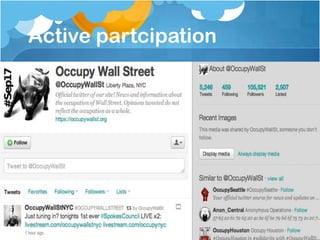
 More and more people have the tools to
 create, circulate, archive content (via
Active partcipation
So to put that in context…
 How are social movements (such as the Occupy
 Wall Street movement and the Middle East
 Uprising via social media) prime examples of
 participatory culture in media? (Via twitter etc)
Participation cont.
People are more willing to voice their concerns and
claim their place in society (and have the available
tools) but usually only do so if they feel their personal
interests are at stake
Do-it-yourself culture, people are claiming the right to
be heard rather than spoken to which is the case in
traditional media
We see this in Web 2.0, which has gone from a one way
flow to a two way flow
Why is participation relevant to the spread of digital
media?
Remediation
 Immersed in the system while at the same time
 attributing legitimacy/credibility to a self
 definition of working against/outside of the
 system as well from within

 How webloggers tend to do what they do in
 distantiation from what journalists do, while at
 the same time remediating some of journalism‟s
 peculiar strategies, techniques and content
Bricolage
 Incorporates practices and notions like
 borrowing, hybridity, mixture and plagiarism
 Such as content cocreation, “Wiki” based software
 and Peer2Peer networks
 In journalism, seen in „shovelware‟ or the
 repurposing or windowing of content across
 different sites to reach potential audiences.
 Journalists reuse and redistribute content originall
 produced by other media
In Conclusion
 Digital Culture is created, reproduced, sustained
 and recognized via social systems like politics,
 economy etc.

 It fosters community but can be fueled by
 isolation. We can „feel‟ connected to everyone in
 the system without actually going anywhere

Digicompresentation

  • 2.
    Digital culture An emergingvalue system & set of expectations expressed in the activities of news and online information media makers & users An expression of individualization, post nationalism and globalization Does not imply that eventually we‟ll all be online, but assumes that the way humans and machines interact in an increasingly digitized society leads to an emerging „digital culture‟
  • 3.
    Indymedia in Digital Culture It‟sa form of user-generated participatory content or “we media” Loosely organized and developed around practices/ideals of open publishing and collaborative nonlinear storytelling (such as in weblogs) Serves as a platform for the production/dissemination of news and information
  • 4.
    Principal Components Of DigitalCulture Values/Practices the multitude need in order to have the freedom to make an identity and participate in identity politics Expressed and reproduced via blogging/open publishing etc and doesn‟t necessarily constitute to digital culture as a whole but the preferred values that go along with it
  • 5.
    Principal Components cont. InformationCulture- the convergence of media contents/forms, national/cultural traditions, characters/sensibilities, a mixing of culture and computers Remediation- the mix/remix of old and new media Bricolage- the highly personalized, continuous assembly/disassembly of reality
  • 6.
    Digital Media relieson participation: 1. We‟re active agents in the process of media making (we become participants) 2. We doubt/modify reality (we engage in remediation) 3. We assemble our own particular versions of this reality (we become bricoleurs) • Digital Culture isn‟t defined just by convergence of devices, we reproduce it via our perceptions of reality
  • 7.
    Participation “Hypersociability”- socialconsists of networked individualism, “enhancing the capacity of individuals to rebuild structures of sociability from the bottom up.” News has now evolved into a collaborate, participatory activity. Online Peer to Peer news is considered more reliable and preferred compared to more traditional business to consumer news More and more people have the tools to create, circulate, archive content (via
  • 8.
  • 9.
    So to putthat in context… How are social movements (such as the Occupy Wall Street movement and the Middle East Uprising via social media) prime examples of participatory culture in media? (Via twitter etc)
  • 10.
    Participation cont. People aremore willing to voice their concerns and claim their place in society (and have the available tools) but usually only do so if they feel their personal interests are at stake Do-it-yourself culture, people are claiming the right to be heard rather than spoken to which is the case in traditional media We see this in Web 2.0, which has gone from a one way flow to a two way flow Why is participation relevant to the spread of digital media?
  • 11.
    Remediation Immersed inthe system while at the same time attributing legitimacy/credibility to a self definition of working against/outside of the system as well from within How webloggers tend to do what they do in distantiation from what journalists do, while at the same time remediating some of journalism‟s peculiar strategies, techniques and content
  • 12.
    Bricolage Incorporates practicesand notions like borrowing, hybridity, mixture and plagiarism Such as content cocreation, “Wiki” based software and Peer2Peer networks In journalism, seen in „shovelware‟ or the repurposing or windowing of content across different sites to reach potential audiences. Journalists reuse and redistribute content originall produced by other media
  • 13.
    In Conclusion DigitalCulture is created, reproduced, sustained and recognized via social systems like politics, economy etc. It fosters community but can be fueled by isolation. We can „feel‟ connected to everyone in the system without actually going anywhere