Commonification, Sharing and Creative Commons:
Towards Platforms of Digital Dignity
Alexandros Nousias CC Greece
Agenda
1.  Current Platform Trends
2.  Commonification
3.  Sharing
4.  The Creative Commons
5.  Digital Dignity
6.  Thinking Out Loud
Platform Design as a Philosophy
•  What a person is.
Platform Design as a Philosophy
•  What a person is.
•  Where meaning comes from.
Platform Design as a Philosophy
•  What a person is.
•  Where meaning comes from.
•  The nature of freedom.
Platform Design as a Philosophy
•  What a person is.
•  Where meaning comes from.
•  The nature of freedom.
•  The nature of an ideal society
Commons Declaration Policy
The commons collaborative economy represents a different public policy model.
Organisational commons models can be an inspiration for public administrations,
becoming more efficient and making better use of public resources, as well as
opening, new channels for the participation and activation of civil society in
solving common problems and public needs through commons-private
partnerships. It is a way of moving from prevailing privatisation to
‘commonification’, through the involvement of citizens and democratic
institutions in the provision and production of public goods and services, without
having to fall into a private framework or state recentralisation, but via the
activation of citizenship.
Source, contributors and more info at: http://procomuns.net/en/policy/
‘Commonification’
•  Norms
‘Commonification’
•  Norms
•  Procedures
‘Commonification’
•  Norms
•  Procedures
•  Customary Institutions
‘Commonification’
•  Norms
•  Procedures
•  Customary institutions
•  ‘Datafication’ of reality
‘Commonification’
•  Norms
•  Procedures
•  Customary institutions
•  ‘Datafication’ (of reality)
•  Control rather than ownership (of the data)
Open Value Networks
Open Value Network
•  Open, horizontal, large scale cooperation and coordination.
Open Value Network
•  Open, horizontal, large scale cooperation and coordination.
•  Responsible stewardship of the shared wealth & assets.
Open Value Network
•  Open, horizontal, large scale cooperation and coordination.
•  Responsible stewardship of the shared wealth & assets.
•  Allowing individual access, use, authorship and ownership ‘where
appropriate’.
Open Value Network
•  Open, horizontal, large scale cooperation and coordination.
•  Responsible stewardship of the shared wealth & assets.
•  Allowing individual access, use, authorship and ownership ‘where
appropriate’.
•  Careful accounting of individual inputs and outcomes via a common
ledger system.
Open Value Network
•  Open, horizontal, large scale cooperation and coordination.
•  Responsible stewardship of the shared wealth & assets.
•  Allowing individual access, use, authorship and ownership ‘where
appropriate’.
•  Careful accounting of individual inputs and outcomes via a common
ledger system.
•  Distribution of fair rewards based on contributions measured by
actual contributions, experience, influence etc.
Our Hypotheses 1/2
1.  People would claim ownership and be willing to make data
available if they start benefit from it.
2.  Sharing is a good business.
3.  The individual shall decide.
4.  We need processes for value judgments regarding privacy,
copyrights, fair use, exceptions/limitations, sharing, ethics
etc.
Our Hypotheses 2/2
Commons as an avant-garde form of
-capitalist- production
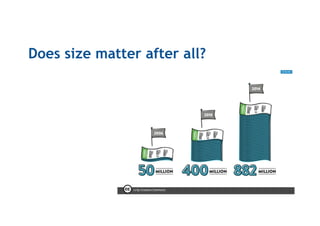
Does size matter after all?
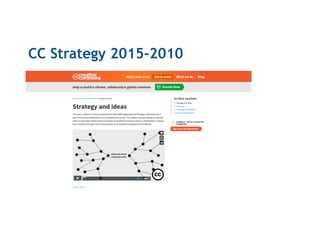
CC Strategy 2015-2010
Key Points
•  Discovery: Creating vibrant, usable commons, both on the platforms
where open content is hosted and also for those works individually
hosted (search content, analytics, meta-tagging, one click
attribution).
•  Collaboration: Helping creators across sectors, disciplines and
geographies to work together, to share open content and create new
works.
•  Advocacy: Pushing for positive reforms.
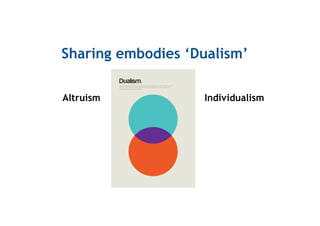
Sharing embodies ‘Dualism’
Altruism Individualism
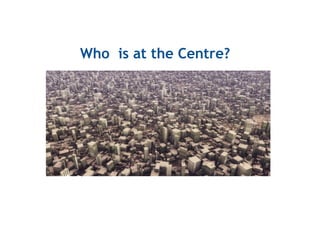
Who is at the Centre?
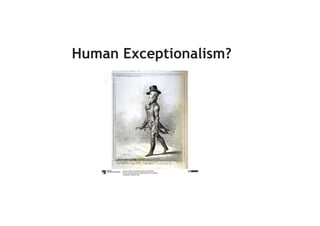
Human Exceptionalism?
Dignity as Human Exceptionalism
•  Greek / Roman philosophy: The ability of exercising virtuous control
over itself.
•  Christian philosophy: Divine creation and existence in the image and
likeness of God.
•  Modern philosophy: Rational autonomy and the ability of self
determination.
•  Post-modern philosophy: Humanity’s social recognition of each
other’s value.
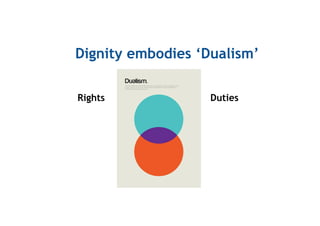
Dignity embodies ‘Dualism’
Rights Duties
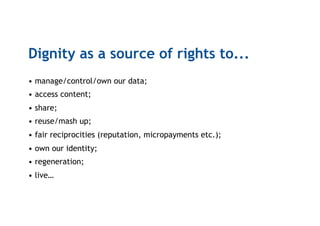
Dignity as a source of rights to...
• manage/control/own our data;
• access content;
• share;
• reuse/mash up;
• fair reciprocities (reputation, micropayments etc.);
• own our identity;
• regeneration;
• live…
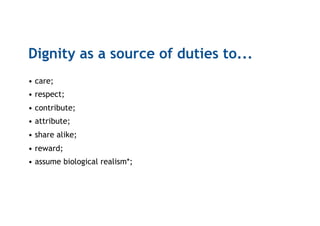
Dignity as a source of duties to...
• care;
• respect;
• contribute;
• attribute;
• share alike;
• reward;
• assume biological realism*;
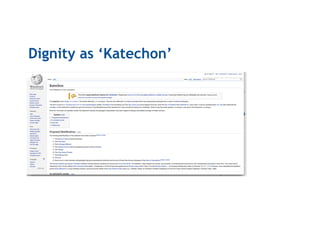
Dignity as ‘Katechon’
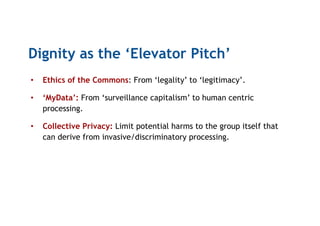
Dignity as the ‘Elevator Pitch’
•  Ethics of the Commons: From ‘legality’ to ‘legitimacy’.
•  ‘MyData’: From ‘surveillance capitalism’ to human centric
processing.
•  Collective Privacy: Limit potential harms to the group itself that
can derive from invasive/discriminatory processing.
Ethics of the Commons
•  Human centric.
•  Usable.
•  Guarantees of autonomous individualism.
•  Dynamic social relationships, culture and ecosystems.
•  Commons based reciprocities.
•  Open business environment.
•  Trusted peer production.
To be continued
@alexnousias
alexandros.nousias@gmail.com

Commonification Sharing and Creative Commons. Alexandros Nousias

  • 1.
    Commonification, Sharing andCreative Commons: Towards Platforms of Digital Dignity Alexandros Nousias CC Greece
  • 2.
    Agenda 1.  Current PlatformTrends 2.  Commonification 3.  Sharing 4.  The Creative Commons 5.  Digital Dignity 6.  Thinking Out Loud
  • 7.
    Platform Design asa Philosophy •  What a person is.
  • 8.
    Platform Design asa Philosophy •  What a person is. •  Where meaning comes from.
  • 9.
    Platform Design asa Philosophy •  What a person is. •  Where meaning comes from. •  The nature of freedom.
  • 10.
    Platform Design asa Philosophy •  What a person is. •  Where meaning comes from. •  The nature of freedom. •  The nature of an ideal society
  • 11.
    Commons Declaration Policy Thecommons collaborative economy represents a different public policy model. Organisational commons models can be an inspiration for public administrations, becoming more efficient and making better use of public resources, as well as opening, new channels for the participation and activation of civil society in solving common problems and public needs through commons-private partnerships. It is a way of moving from prevailing privatisation to ‘commonification’, through the involvement of citizens and democratic institutions in the provision and production of public goods and services, without having to fall into a private framework or state recentralisation, but via the activation of citizenship. Source, contributors and more info at: http://procomuns.net/en/policy/
  • 12.
  • 13.
  • 14.
  • 15.
    ‘Commonification’ •  Norms •  Procedures • Customary institutions •  ‘Datafication’ of reality
  • 16.
    ‘Commonification’ •  Norms •  Procedures • Customary institutions •  ‘Datafication’ (of reality) •  Control rather than ownership (of the data)
  • 17.
  • 18.
    Open Value Network • Open, horizontal, large scale cooperation and coordination.
  • 19.
    Open Value Network • Open, horizontal, large scale cooperation and coordination. •  Responsible stewardship of the shared wealth & assets.
  • 20.
    Open Value Network • Open, horizontal, large scale cooperation and coordination. •  Responsible stewardship of the shared wealth & assets. •  Allowing individual access, use, authorship and ownership ‘where appropriate’.
  • 21.
    Open Value Network • Open, horizontal, large scale cooperation and coordination. •  Responsible stewardship of the shared wealth & assets. •  Allowing individual access, use, authorship and ownership ‘where appropriate’. •  Careful accounting of individual inputs and outcomes via a common ledger system.
  • 22.
    Open Value Network • Open, horizontal, large scale cooperation and coordination. •  Responsible stewardship of the shared wealth & assets. •  Allowing individual access, use, authorship and ownership ‘where appropriate’. •  Careful accounting of individual inputs and outcomes via a common ledger system. •  Distribution of fair rewards based on contributions measured by actual contributions, experience, influence etc.
  • 23.
    Our Hypotheses 1/2 1. People would claim ownership and be willing to make data available if they start benefit from it. 2.  Sharing is a good business. 3.  The individual shall decide. 4.  We need processes for value judgments regarding privacy, copyrights, fair use, exceptions/limitations, sharing, ethics etc.
  • 24.
    Our Hypotheses 2/2 Commonsas an avant-garde form of -capitalist- production
  • 25.
    Does size matterafter all?
  • 26.
  • 27.
    Key Points •  Discovery:Creating vibrant, usable commons, both on the platforms where open content is hosted and also for those works individually hosted (search content, analytics, meta-tagging, one click attribution). •  Collaboration: Helping creators across sectors, disciplines and geographies to work together, to share open content and create new works. •  Advocacy: Pushing for positive reforms.
  • 28.
  • 29.
    Who is atthe Centre?
  • 31.
  • 32.
    Dignity as HumanExceptionalism •  Greek / Roman philosophy: The ability of exercising virtuous control over itself. •  Christian philosophy: Divine creation and existence in the image and likeness of God. •  Modern philosophy: Rational autonomy and the ability of self determination. •  Post-modern philosophy: Humanity’s social recognition of each other’s value.
  • 33.
  • 34.
    Dignity as asource of rights to... • manage/control/own our data; • access content; • share; • reuse/mash up; • fair reciprocities (reputation, micropayments etc.); • own our identity; • regeneration; • live…
  • 35.
    Dignity as asource of duties to... • care; • respect; • contribute; • attribute; • share alike; • reward; • assume biological realism*;
  • 36.
  • 37.
    Dignity as the‘Elevator Pitch’ •  Ethics of the Commons: From ‘legality’ to ‘legitimacy’. •  ‘MyData’: From ‘surveillance capitalism’ to human centric processing. •  Collective Privacy: Limit potential harms to the group itself that can derive from invasive/discriminatory processing.
  • 38.
    Ethics of theCommons •  Human centric. •  Usable. •  Guarantees of autonomous individualism. •  Dynamic social relationships, culture and ecosystems. •  Commons based reciprocities. •  Open business environment. •  Trusted peer production.
  • 39.