DR. PARUL, Asst. Prof.
HHM, MSOB
What is the
digestive
system?
The digestive system is a
continuous tube that
begins at the mouth and
ends at the anus.
Measuring about 30 feet
long in the average adult, it
is known as the alimentary
canal or gastrointestinal
tract. It has 3 functions:
the digestion of food into
nutrients, the absorption
of nutrients into the
bloodstream, and the
elimination of solid
wastes.
The mouth:
salivary
glands…
Three pairs of glands
open into the oral
cavity, producing
saliva: the parotid
, sublingual
and submandibular
glands.
The sensory organs such as
the nose and eyes send a
message to the brain, the
brain sends the message to
the salivary glands, and they
secrete the chemicals to
begin the digestive process.
The mouth:
tongue
The tongue is a
muscle covered with
a mucous membrane.
It has a rear portion
called the root, the
tip, and the central
body. It is covered
with taste buds and
raised elevations
called papillae
The taste buds taste sweet, sour, salt, bitter, and savory.
The mouth: teeth The teeth are used
for chewing the
food…mastication.
The food is broken
apart and mixed with
saliva to form a
bolus, ready to be
swallowed.
Muscular constrictions move the bolus through
the pharynx (soft palate at the back of the mouth)
and into the esophagus while blocking the
opening to the larynx and preventing the food
from entering the airway.
The esophagus…
The food is moved down
the esophagus toward
the stomach by wavelike
muscular contractions
called peristalsis. At the
opening of the stomach
is the lower esophageal
sphincter. This is a
muscle valve that
permits the passage of
food, but not the backup
of stomach contents
under normal conditions.
The stomach…
The stomach is a
muscular,
expandable organ,
the upper portion
called the fundus
and the lower
portion called the
antrum.
Hydrochloric acid
and other gastric
juices convert the
food to a semiliquid
state called chyme.
Chyme passes through the
pyloric sphincter valve at
the bottom of the stomach,
into the small intestine.
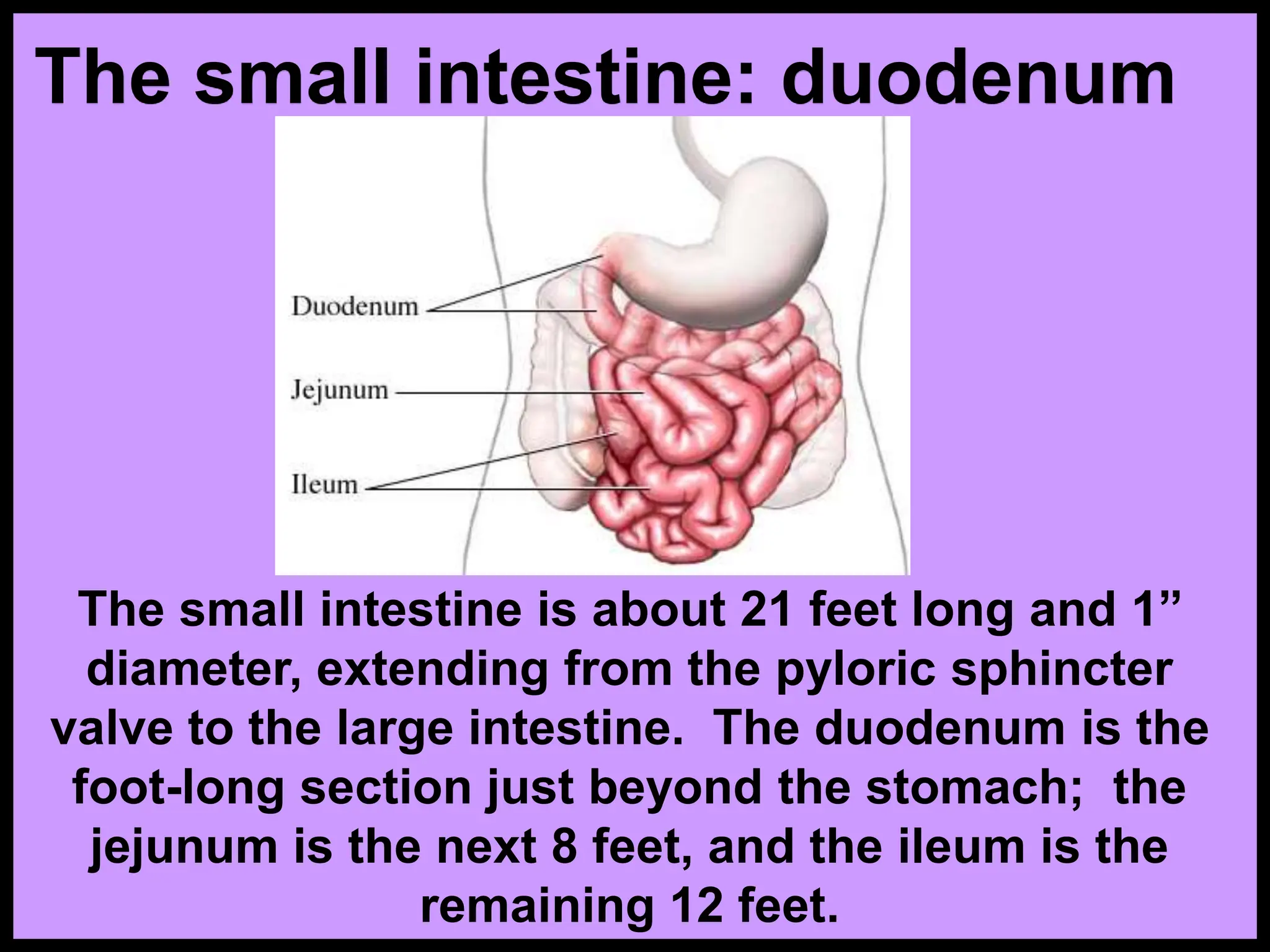
The small intestine: duodenum
The small intestine is about 21 feet long and 1”
diameter, extending from the pyloric sphincter
valve to the large intestine. The duodenum is the
foot-long section just beyond the stomach; the
jejunum is the next 8 feet, and the ileum is the
remaining 12 feet.
The liver’s primary
contribution to digestion
is the production of bile
or gall which drains into
the duodenum, and some
is stored in the
gallbladder. It travels
through the hepatic
ducts, which merge
together. Bile helps
digest fats. The liver also
stores iron and the fat-
soluble vitamins A, D, E,
and K.
The small intestine: the liver
Bile stored in the
gallbladder becomes
more concentrated,
increasing its potency
and intensifying its
effect. When chyme
containing fat leaves
the stomach, the
gallbladder contracts
and discharges bile
through the cystic
duct and common bile
duct and into the
duodenum of the small
intestine.
The small intestine:
the gallbladder
The pancreas
secretes pancreatic
juice into the
duodenum via the
pancreatic duct which
merges with the
common bile duct.
This pancreatic juice
contains digestive
enzymes and
bicarbonate ions.
It’s role is so vital to digestion, that a person
would starve without it, even if they were
consuming an adequate amount of food.
The small intestine: the pancreas
The jejunum and ilium are lined
with hair-like protrusions calIed
villi. They slow the passage of
food, and allow food particles to
be captured in among these
finger-like villi -- so that the
blood inside the villi can absorb
the nutrients in the food. Villus
capillaries collect amino acids
(proteins) and glucose (simple
sugars). Villus lacteals collect
absorbed fatty acids.
The small intestine: the jejunum
and ilium
The function of the
large intestine, or
bowel, is to absorb the
remaining water and
nutrients from
indigestible food matter,
store unusable food
matter (wastes), and then
eliminate the wastes
from the body. The large
intestine is subdivided
into the cecum and the
ascending/transverse/
descending/and sigmoid
colon sections.
The large intestine is
only about 4-5 feet in
length, and 2 ½ inches
in diameter.
The small intestine:
the large intestine
The rectum is where
feces are stored until
they leave the
digestive system,
through the anus as a
bowel movement.
The rectum and anus…
As the rectal walls expand
with waste material, receptors
from the nervous system
stimulate the desire to
defecate. For defecation or
egestion, we consciously
relax the external anal
sphincter muscle to expel the
waste through the anus.

anatomy: Human digestive system and its parts

  • 1.
    DR. PARUL, Asst.Prof. HHM, MSOB
  • 2.
    What is the digestive system? Thedigestive system is a continuous tube that begins at the mouth and ends at the anus. Measuring about 30 feet long in the average adult, it is known as the alimentary canal or gastrointestinal tract. It has 3 functions: the digestion of food into nutrients, the absorption of nutrients into the bloodstream, and the elimination of solid wastes.
  • 3.
    The mouth: salivary glands… Three pairsof glands open into the oral cavity, producing saliva: the parotid , sublingual and submandibular glands. The sensory organs such as the nose and eyes send a message to the brain, the brain sends the message to the salivary glands, and they secrete the chemicals to begin the digestive process.
  • 4.
    The mouth: tongue The tongueis a muscle covered with a mucous membrane. It has a rear portion called the root, the tip, and the central body. It is covered with taste buds and raised elevations called papillae The taste buds taste sweet, sour, salt, bitter, and savory.
  • 5.
    The mouth: teethThe teeth are used for chewing the food…mastication. The food is broken apart and mixed with saliva to form a bolus, ready to be swallowed. Muscular constrictions move the bolus through the pharynx (soft palate at the back of the mouth) and into the esophagus while blocking the opening to the larynx and preventing the food from entering the airway.
  • 6.
    The esophagus… The foodis moved down the esophagus toward the stomach by wavelike muscular contractions called peristalsis. At the opening of the stomach is the lower esophageal sphincter. This is a muscle valve that permits the passage of food, but not the backup of stomach contents under normal conditions.
  • 7.
    The stomach… The stomachis a muscular, expandable organ, the upper portion called the fundus and the lower portion called the antrum. Hydrochloric acid and other gastric juices convert the food to a semiliquid state called chyme. Chyme passes through the pyloric sphincter valve at the bottom of the stomach, into the small intestine.
  • 8.
    The small intestine:duodenum The small intestine is about 21 feet long and 1” diameter, extending from the pyloric sphincter valve to the large intestine. The duodenum is the foot-long section just beyond the stomach; the jejunum is the next 8 feet, and the ileum is the remaining 12 feet.
  • 9.
    The liver’s primary contributionto digestion is the production of bile or gall which drains into the duodenum, and some is stored in the gallbladder. It travels through the hepatic ducts, which merge together. Bile helps digest fats. The liver also stores iron and the fat- soluble vitamins A, D, E, and K. The small intestine: the liver
  • 10.
    Bile stored inthe gallbladder becomes more concentrated, increasing its potency and intensifying its effect. When chyme containing fat leaves the stomach, the gallbladder contracts and discharges bile through the cystic duct and common bile duct and into the duodenum of the small intestine. The small intestine: the gallbladder
  • 11.
    The pancreas secretes pancreatic juiceinto the duodenum via the pancreatic duct which merges with the common bile duct. This pancreatic juice contains digestive enzymes and bicarbonate ions. It’s role is so vital to digestion, that a person would starve without it, even if they were consuming an adequate amount of food. The small intestine: the pancreas
  • 12.
    The jejunum andilium are lined with hair-like protrusions calIed villi. They slow the passage of food, and allow food particles to be captured in among these finger-like villi -- so that the blood inside the villi can absorb the nutrients in the food. Villus capillaries collect amino acids (proteins) and glucose (simple sugars). Villus lacteals collect absorbed fatty acids. The small intestine: the jejunum and ilium
  • 13.
    The function ofthe large intestine, or bowel, is to absorb the remaining water and nutrients from indigestible food matter, store unusable food matter (wastes), and then eliminate the wastes from the body. The large intestine is subdivided into the cecum and the ascending/transverse/ descending/and sigmoid colon sections. The large intestine is only about 4-5 feet in length, and 2 ½ inches in diameter. The small intestine: the large intestine
  • 14.
    The rectum iswhere feces are stored until they leave the digestive system, through the anus as a bowel movement. The rectum and anus… As the rectal walls expand with waste material, receptors from the nervous system stimulate the desire to defecate. For defecation or egestion, we consciously relax the external anal sphincter muscle to expel the waste through the anus.