General Anaesthetics
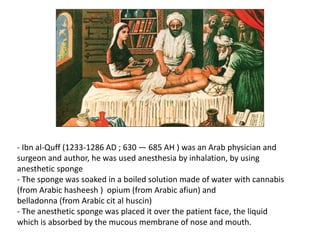
- Ibn al-Quff (1233-1286 AD ; 630 — 685 AH ) was an Arab physician and
surgeon and author, he was used anesthesia by inhalation, by using
anesthetic sponge
- The sponge was soaked in a boiled solution made of water with cannabis
(from Arabic hasheesh ) opium (from Arabic afiun) and
belladonna (from Arabic cit al huscin)
- The anesthetic sponge was placed it over the patient face, the liquid
which is absorbed by the mucous membrane of nose and mouth.
3
General Anaesthetics
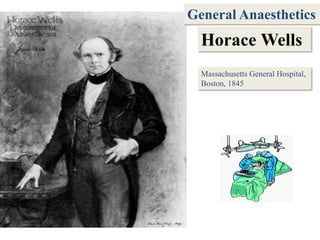
Horace Wells
Massachusetts General Hospital,
Boston, 1845
General anesthesia is a reversible state of
central nervous system (CNS)
depression, causing loss of response to and
perception of stimuli.
5
Rapid smooth loss of consciousness.
An ideal General Anaesthetic……….
Rapid reversible upon discontinuation
Possess a wide margin of safety.
6
General Anaesthetics
The subject is not rousable by
external stimuli
Objectives:
Sedation and reduced anxiety
Lack of awareness and amnesia
Skeletal muscle relaxation
Suppression of undesirable reflexes
No single anesthetic agent currently available when used
alone can achieve all of these desired effects.
Analgesia
PATIENT FACTORS IN SELECTION OF ANESTHESIA
Status of organ systems
Cardiovascular system
Respiratory system
Liver and kidney
Pregnancy
PATIENT FACTORS IN SELECTION OF ANESTHESIA
Concomitant use of drugs
Multiple adjunct agents
H2 blockers (famotidine, ranitidine)
Benzodiazepines (midazolam, diazepam)
Nonopioids (acetaminophen, celecoxib) or opioids (fentanyl)
Antihistamines (diphenhydramine)
Antiemetics (ondansetron)
Anticholinergics (glycopyrrolate)
Premedications facilitate smooth induction of anesthesia
and lower required anesthetic doses.
However, they can also enhance undesirable anesthetic
effects (hypoventilation) and, when coadministered, may
produce negative effects not observed when given
individually.
PATIENT FACTORS IN SELECTION OF ANESTHESIA
Concomitant use of drugs
Concomitant use of other drugs
Patients may take medications for underlying diseases or abuse
drugs that alter response to anesthetics.
For example, alcoholics have elevated levels of liver enzymes
that metabolize anesthetics, and drug abusers may be tolerant to
opioids.
General anesthesia phases (stages):
I) Induction: is the time from administration of a potent
anesthetic (IV anesthetics) to development of effective
anesthesia, depends on fast effective concentrations of
anesthetic reach the brain.(N.B.) (Child.)
2) Maintenance: provides sustained anesthesia, is
commonly provided with inhaled anesthetics. (fent.) (IV
drugs)
3) Recovery: is the time from discontinuation of
anesthetic until consciousness.
Stages of Anaesthesia [Depth of Anesthesia]
These stages were defined for the original anesthetic
Ether, which produces a slow onset of anesthesia.
With modern anesthetics, the stages merge because
of the rapid onset of stage III.
Stage I (Induction); is the period between
the initial administration of the induction
agents and loss of consciousness, during
this stage:
• Patient conscious.
• Analgesia.
Stage II (Delirium/Excitement): is the
period following loss of consciousness and
excited and delirious activity, during this
stage:
• Irregular respiration.
• Irregular heart rate.
• Uncentrolled movements.
• Vomiting.
3) Stage III (Surgical Anaesthesia): is the
ideal stage for surgery, during this stage:
• Patient is unconscious.
• Regular respiration.
• No vomiting.
• No pain reflexes.
• Normal Blood pressure.
• Normal pupil size.
• Slow eye movements.
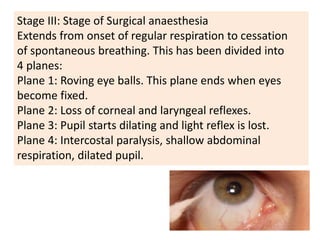
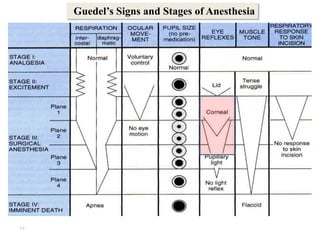
Stage III: Stage of Surgical anaesthesia
Extends from onset of regular respiration to cessation
of spontaneous breathing. This has been divided into
4 planes:
Plane 1: Roving eye balls. This plane ends when eyes
become fixed.
Plane 2: Loss of corneal and laryngeal reflexes.
Plane 3: Pupil starts dilating and light reflex is lost.
Plane 4: Intercostal paralysis, shallow abdominal
respiration, dilated pupil.
17
Guedel’s Signs and Stages of Anesthesia
Stage IV (Medullary paralysis or
overdose): is the stage where too much
medication has been given and the patient
has severe brain stem or medullary
depression.
• Respiratory depression.
• Hypotension.
• Very weak pulse.
• Death may occur.
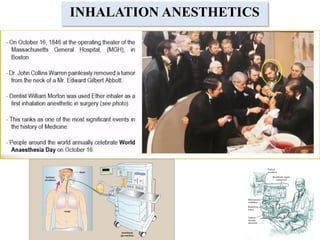
INHALATION ANESTHETICS
Minimum Alveolar Concentration (MAC) (potncy)
 MAC: is the minimum concentration of inhaled
anesthetic in the lung needed to produces anesthesia
in 50% of patients.
 MAC used to measures the potency of inhaled
anesthetics, MAC is small for potent anesthetics
such as Halothane and large for less potent agents
such as Nitrous oxide.
 Factors that can increase MAC: hyperthermia,
drugs that increase CNS catecholamines, and
chronic ethanol abuse.
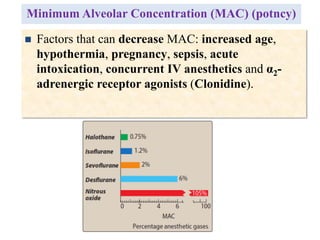
Minimum Alveolar Concentration (MAC) (potncy)
 Factors that can decrease MAC: increased age,
hypothermia, pregnancy, sepsis, acute
intoxication, concurrent IV anesthetics and α2-
adrenergic receptor agonists (Clonidine).
Factors affecting the uptake and distribution of inhalation
anesthetics
 Alveolar wash-in
This refers to replacement of normal lung gases with the
inspired anesthetic mixture.
the functional residual capacity of the lung time
ventilatory rate time of wash-in
24
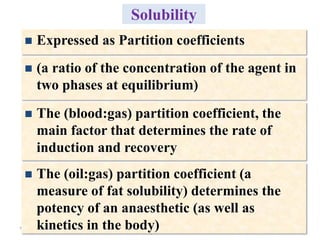
Solubility
 (a ratio of the concentration of the agent in
two phases at equilibrium)
 The (blood:gas) partition coefficient, the
main factor that determines the rate of
induction and recovery
 The (oil:gas) partition coefficient (a
measure of fat solubility) determines the
potency of an anaesthetic (as well as
kinetics in the body)
 Expressed as Partition coefficients
25
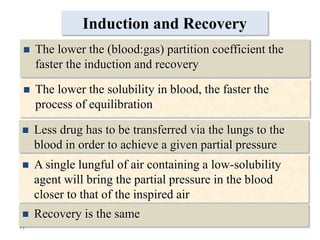
Induction and Recovery
 The lower the solubility in blood, the faster the
process of equilibration
 Less drug has to be transferred via the lungs to the
blood in order to achieve a given partial pressure
 A single lungful of air containing a low-solubility
agent will bring the partial pressure in the blood
closer to that of the inspired air
 Recovery is the same
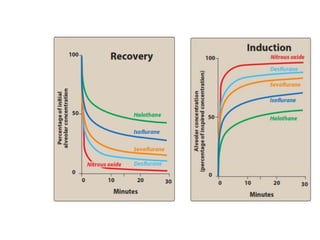
 The lower the (blood:gas) partition coefficient the
faster the induction and recovery
26
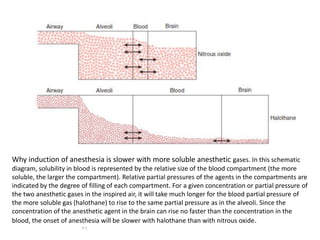
Why induction of anesthesia is slower with more soluble anesthetic gases. In this schematic
diagram, solubility in blood is represented by the relative size of the blood compartment (the more
soluble, the larger the compartment). Relative partial pressures of the agents in the compartments are
indicated by the degree of filling of each compartment. For a given concentration or partial pressure of
the two anesthetic gases in the inspired air, it will take much longer for the blood partial pressure of
the more soluble gas (halothane) to rise to the same partial pressure as in the alveoli. Since the
concentration of the anesthetic agent in the brain can rise no faster than the concentration in the
blood, the onset of anesthesia will be slower with halothane than with nitrous oxide.
 Cardiac output
 For inhaled anesthetics, higher CO removes
anesthetic from the alveoli faster (due to increased
blood flow through the lungs) and thus slows the rate
of rise in alveolar concentration of gas.
 It therefore takes longer for the gas to reach
equilibrium between the alveoli and the site of action
in the brain.
higher CO = slower induction
 Alveolar-to-venous partial pressure gradient of
anesthetic
The greater the difference in anesthetic concentration
between alveolar (arterial) and venous blood, the higher
the uptake and the slower the induction.
 Washout:
When an inhalation anesthetic is discontinued, the body
becomes the “source” that drives the anesthetic back
into the alveolar space.
The same factors that influence attainment of steady
state with an inspired anesthetic determine the time
course of its clearance from the body.
Mechanism of Action
General anesthetics have been in clinical use
for more than 160 years. but their
mechanism of action remains unknown.
• Theories of the possible mechanisms;
A) Lipid Theory; first proposed in 184 7.
They suggested that general anesthetics may act by
dissolving in the fatty fraction of brain cells and
removing fatty constituents from them, thus changing
activity of brain cells and inducing anesthesia (In
1899 Hans Horst Meyer published the first
experimental evidence of the fact that anesthetic
potency is related to lipid solubility; The Meyer—
Overton correlation).
B) Ion Channels:
1) Potentiate GABAA receptors sensitivity to GABA.
2) Inhibition of NMDA receptors.
3) Increase activity of the inhibitory glycine
receptors.
34
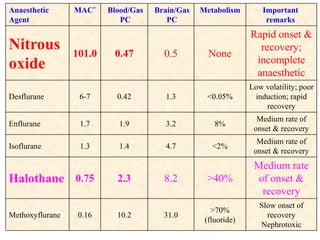
Important
remarks
Metabolism
Brain/Gas
PC
Blood/Gas
PC
MAC*
Anaesthetic
Agent
Rapid onset &
recovery;
incomplete
anaesthetic
None
0.5
0.47
101.0
Nitrous
oxide
Low volatility; poor
induction; rapid
recovery
<0.05%
1.3
0.42
6-7
Desflurane
Medium rate of
onset & recovery
8%
3.2
1.9
1.7
Enflurane
Medium rate of
onset & recovery
<2%
4.7
1.4
1.3
Isoflurane
Medium rate
of onset &
recovery
>40%
8.2
2.3
0.75
Halothane
Slow onset of
recovery
Nephrotoxic
>70%
(fluoride)
31.0
10.2
0.16
Methoxyflurane
35
Note: An inhalational anaesthetic agent
with low solubility in blood shows fast
induction time and also recovery time
(e.g. nitrous oxide), and an agent with
relatively high solubility in blood shows
slower induction and recovery time (e.g.
halothane).
36
Second Gas Effect
The MAC of an inhalational anaesthetic
can be reduced by a concurrent use of
another inhalational agent; thus, a concurrent use of
nitrous oxide with halothane would reduce the MAC for halothane and also the presence
of the latter would reduce the MAC for nitrous oxide. It has been suggested that the
presence of agent (gas) facilitates the uptake (transport into the pulmonary blood) of the
other agent. Therefore, it is called the second gas effect. This effect is utilised for using
reduced inspired partial pressure for certain agents, particularly, nitrous oxide which has
a high MAC (>100%) which is practically difficult to achieve. Further, a reduction in
MAC can also be achieved by the use of adjuvant drugs like narcotic analgesics or
sedative-hypnotics.
click
37
Intravenous Anaesthetics
Thiopental sodium
Thiopental is the most commonly used
intravenous anaesthetic in Iraq, usually
in combination with inhaled general
anaesthetics.
38
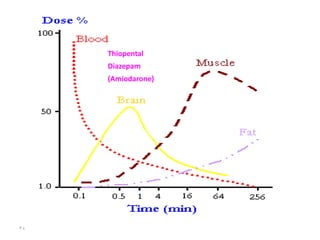
Thiopental
Diazepam
(Amiodarone)
39
Propofol
The major advantage of propofol is that it has a useful
antiemetic action. This probably is responsible for the
observation that postoperative vomiting is uncommon
with propofol.
Etomidate
It is a potent hypnotic (5 minutes) used for induction of
anaesthesia. Its major advantages over other agents that
it causes minimal cardiovascular and respiratory
depressant effects.
40
Adverse Effects and
Important Remarks
Effect on
CVS Res
INDUCTION (i.v.)
Contraindicated in
porphyria


YES
NO
YES
Thiopental
Increases cerebral blood
flow.
Contraindicated in open
eye surgery, neurosurgery
(brain), pre-eclampsia
(hypertension);
hypertensive,
hallucinogenic,
emergence delirium
NO

NO
YES
YES
Ketamine
Amnesia
Hypnosis
Analgesia
Muscle
Relaxation
Heart
rate
&
Blood
pressure
Response
to
CO
2
&
hypoxia
41
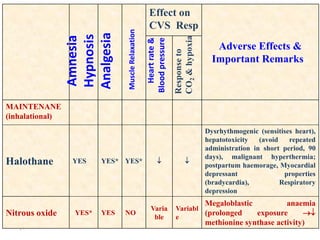
Adverse Effects &
Important Remarks
Effect on
CVS Resp
MAINTENANE
(inhalational)
Dysrhythmogenic (sensitises heart),
hepatotoxicity (avoid repeated
administration in short period, 90
days), malignant hyperthermia;
postpartum haemorage, Myocardial
depressant properties
(bradycardia), Respiratory
depression


YES*
YES*
YES
Halothane
Megaloblastic anaemia
(prolonged exposure 
methionine synthase activity)
Variabl
e
Varia
ble
NO
YES
YES*
Nitrous oxide
Amnesia
Hypnosis
Analgesia
Muscle
Relaxation
Heart
rate
&
Blood
pressure
Response
to
CO
2
&
hypoxia
42
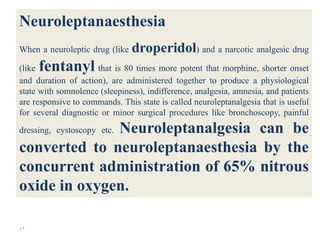
Neuroleptanaesthesia
When a neuroleptic drug (like droperidol) and a narcotic analgesic drug
(like fentanyl that is 80 times more potent that morphine, shorter onset
and duration of action), are administered together to produce a physiological
state with somnolence (sleepiness), indifference, analgesia, amnesia, and patients
are responsive to commands. This state is called neuroleptanalgesia that is useful
for several diagnostic or minor surgical procedures like bronchoscopy, painful
dressing, cystoscopy etc. Neuroleptanalgesia can be
converted to neuroleptanaesthesia by the
concurrent administration of 65% nitrous
oxide in oxygen.
43
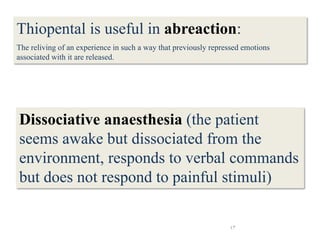
Dissociative anaesthesia (the patient
seems awake but dissociated from the
environment, responds to verbal commands
but does not respond to painful stimuli)
Thiopental is useful in abreaction:
The reliving of an experience in such a way that previously repressed emotions
associated with it are released.
44
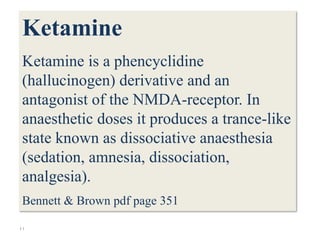
Ketamine
Ketamine is a phencyclidine
(hallucinogen) derivative and an
antagonist of the NMDA-receptor. In
anaesthetic doses it produces a trance-like
state known as dissociative anaesthesia
(sedation, amnesia, dissociation,
analgesia).
Bennett & Brown pdf page 351
8hyjhhcdgydgyuguidhiudcgiudcgiudgcdu963.pdf

8hyjhhcdgydgyuguidhiudcgiudcgiudgcdu963.pdf

  • 1.
  • 2.
    - Ibn al-Quff(1233-1286 AD ; 630 — 685 AH ) was an Arab physician and surgeon and author, he was used anesthesia by inhalation, by using anesthetic sponge - The sponge was soaked in a boiled solution made of water with cannabis (from Arabic hasheesh ) opium (from Arabic afiun) and belladonna (from Arabic cit al huscin) - The anesthetic sponge was placed it over the patient face, the liquid which is absorbed by the mucous membrane of nose and mouth.
  • 3.
  • 4.
    General anesthesia isa reversible state of central nervous system (CNS) depression, causing loss of response to and perception of stimuli.
  • 5.
    5 Rapid smooth lossof consciousness. An ideal General Anaesthetic………. Rapid reversible upon discontinuation Possess a wide margin of safety.
  • 6.
    6 General Anaesthetics The subjectis not rousable by external stimuli Objectives: Sedation and reduced anxiety Lack of awareness and amnesia Skeletal muscle relaxation Suppression of undesirable reflexes No single anesthetic agent currently available when used alone can achieve all of these desired effects. Analgesia
  • 7.
    PATIENT FACTORS INSELECTION OF ANESTHESIA Status of organ systems Cardiovascular system Respiratory system Liver and kidney Pregnancy
  • 8.
    PATIENT FACTORS INSELECTION OF ANESTHESIA Concomitant use of drugs Multiple adjunct agents H2 blockers (famotidine, ranitidine) Benzodiazepines (midazolam, diazepam) Nonopioids (acetaminophen, celecoxib) or opioids (fentanyl) Antihistamines (diphenhydramine) Antiemetics (ondansetron) Anticholinergics (glycopyrrolate)
  • 9.
    Premedications facilitate smoothinduction of anesthesia and lower required anesthetic doses. However, they can also enhance undesirable anesthetic effects (hypoventilation) and, when coadministered, may produce negative effects not observed when given individually.
  • 10.
    PATIENT FACTORS INSELECTION OF ANESTHESIA Concomitant use of drugs Concomitant use of other drugs Patients may take medications for underlying diseases or abuse drugs that alter response to anesthetics. For example, alcoholics have elevated levels of liver enzymes that metabolize anesthetics, and drug abusers may be tolerant to opioids.
  • 11.
    General anesthesia phases(stages): I) Induction: is the time from administration of a potent anesthetic (IV anesthetics) to development of effective anesthesia, depends on fast effective concentrations of anesthetic reach the brain.(N.B.) (Child.) 2) Maintenance: provides sustained anesthesia, is commonly provided with inhaled anesthetics. (fent.) (IV drugs) 3) Recovery: is the time from discontinuation of anesthetic until consciousness.
  • 12.
    Stages of Anaesthesia[Depth of Anesthesia] These stages were defined for the original anesthetic Ether, which produces a slow onset of anesthesia. With modern anesthetics, the stages merge because of the rapid onset of stage III.
  • 13.
    Stage I (Induction);is the period between the initial administration of the induction agents and loss of consciousness, during this stage: • Patient conscious. • Analgesia.
  • 14.
    Stage II (Delirium/Excitement):is the period following loss of consciousness and excited and delirious activity, during this stage: • Irregular respiration. • Irregular heart rate. • Uncentrolled movements. • Vomiting.
  • 15.
    3) Stage III(Surgical Anaesthesia): is the ideal stage for surgery, during this stage: • Patient is unconscious. • Regular respiration. • No vomiting. • No pain reflexes. • Normal Blood pressure. • Normal pupil size. • Slow eye movements.
  • 16.
    Stage III: Stageof Surgical anaesthesia Extends from onset of regular respiration to cessation of spontaneous breathing. This has been divided into 4 planes: Plane 1: Roving eye balls. This plane ends when eyes become fixed. Plane 2: Loss of corneal and laryngeal reflexes. Plane 3: Pupil starts dilating and light reflex is lost. Plane 4: Intercostal paralysis, shallow abdominal respiration, dilated pupil.
  • 17.
    17 Guedel’s Signs andStages of Anesthesia
  • 18.
    Stage IV (Medullaryparalysis or overdose): is the stage where too much medication has been given and the patient has severe brain stem or medullary depression. • Respiratory depression. • Hypotension. • Very weak pulse. • Death may occur.
  • 20.
  • 21.
    Minimum Alveolar Concentration(MAC) (potncy)  MAC: is the minimum concentration of inhaled anesthetic in the lung needed to produces anesthesia in 50% of patients.  MAC used to measures the potency of inhaled anesthetics, MAC is small for potent anesthetics such as Halothane and large for less potent agents such as Nitrous oxide.  Factors that can increase MAC: hyperthermia, drugs that increase CNS catecholamines, and chronic ethanol abuse.
  • 22.
    Minimum Alveolar Concentration(MAC) (potncy)  Factors that can decrease MAC: increased age, hypothermia, pregnancy, sepsis, acute intoxication, concurrent IV anesthetics and α2- adrenergic receptor agonists (Clonidine).
  • 23.
    Factors affecting theuptake and distribution of inhalation anesthetics  Alveolar wash-in This refers to replacement of normal lung gases with the inspired anesthetic mixture. the functional residual capacity of the lung time ventilatory rate time of wash-in
  • 24.
    24 Solubility  (a ratioof the concentration of the agent in two phases at equilibrium)  The (blood:gas) partition coefficient, the main factor that determines the rate of induction and recovery  The (oil:gas) partition coefficient (a measure of fat solubility) determines the potency of an anaesthetic (as well as kinetics in the body)  Expressed as Partition coefficients
  • 25.
    25 Induction and Recovery The lower the solubility in blood, the faster the process of equilibration  Less drug has to be transferred via the lungs to the blood in order to achieve a given partial pressure  A single lungful of air containing a low-solubility agent will bring the partial pressure in the blood closer to that of the inspired air  Recovery is the same  The lower the (blood:gas) partition coefficient the faster the induction and recovery
  • 26.
    26 Why induction ofanesthesia is slower with more soluble anesthetic gases. In this schematic diagram, solubility in blood is represented by the relative size of the blood compartment (the more soluble, the larger the compartment). Relative partial pressures of the agents in the compartments are indicated by the degree of filling of each compartment. For a given concentration or partial pressure of the two anesthetic gases in the inspired air, it will take much longer for the blood partial pressure of the more soluble gas (halothane) to rise to the same partial pressure as in the alveoli. Since the concentration of the anesthetic agent in the brain can rise no faster than the concentration in the blood, the onset of anesthesia will be slower with halothane than with nitrous oxide.
  • 28.
     Cardiac output For inhaled anesthetics, higher CO removes anesthetic from the alveoli faster (due to increased blood flow through the lungs) and thus slows the rate of rise in alveolar concentration of gas.  It therefore takes longer for the gas to reach equilibrium between the alveoli and the site of action in the brain. higher CO = slower induction
  • 29.
     Alveolar-to-venous partialpressure gradient of anesthetic The greater the difference in anesthetic concentration between alveolar (arterial) and venous blood, the higher the uptake and the slower the induction.
  • 30.
     Washout: When aninhalation anesthetic is discontinued, the body becomes the “source” that drives the anesthetic back into the alveolar space. The same factors that influence attainment of steady state with an inspired anesthetic determine the time course of its clearance from the body.
  • 31.
    Mechanism of Action Generalanesthetics have been in clinical use for more than 160 years. but their mechanism of action remains unknown. • Theories of the possible mechanisms;
  • 32.
    A) Lipid Theory;first proposed in 184 7. They suggested that general anesthetics may act by dissolving in the fatty fraction of brain cells and removing fatty constituents from them, thus changing activity of brain cells and inducing anesthesia (In 1899 Hans Horst Meyer published the first experimental evidence of the fact that anesthetic potency is related to lipid solubility; The Meyer— Overton correlation).
  • 33.
    B) Ion Channels: 1)Potentiate GABAA receptors sensitivity to GABA. 2) Inhibition of NMDA receptors. 3) Increase activity of the inhibitory glycine receptors.
  • 34.
    34 Important remarks Metabolism Brain/Gas PC Blood/Gas PC MAC* Anaesthetic Agent Rapid onset & recovery; incomplete anaesthetic None 0.5 0.47 101.0 Nitrous oxide Lowvolatility; poor induction; rapid recovery <0.05% 1.3 0.42 6-7 Desflurane Medium rate of onset & recovery 8% 3.2 1.9 1.7 Enflurane Medium rate of onset & recovery <2% 4.7 1.4 1.3 Isoflurane Medium rate of onset & recovery >40% 8.2 2.3 0.75 Halothane Slow onset of recovery Nephrotoxic >70% (fluoride) 31.0 10.2 0.16 Methoxyflurane
  • 35.
    35 Note: An inhalationalanaesthetic agent with low solubility in blood shows fast induction time and also recovery time (e.g. nitrous oxide), and an agent with relatively high solubility in blood shows slower induction and recovery time (e.g. halothane).
  • 36.
    36 Second Gas Effect TheMAC of an inhalational anaesthetic can be reduced by a concurrent use of another inhalational agent; thus, a concurrent use of nitrous oxide with halothane would reduce the MAC for halothane and also the presence of the latter would reduce the MAC for nitrous oxide. It has been suggested that the presence of agent (gas) facilitates the uptake (transport into the pulmonary blood) of the other agent. Therefore, it is called the second gas effect. This effect is utilised for using reduced inspired partial pressure for certain agents, particularly, nitrous oxide which has a high MAC (>100%) which is practically difficult to achieve. Further, a reduction in MAC can also be achieved by the use of adjuvant drugs like narcotic analgesics or sedative-hypnotics. click
  • 37.
    37 Intravenous Anaesthetics Thiopental sodium Thiopentalis the most commonly used intravenous anaesthetic in Iraq, usually in combination with inhaled general anaesthetics.
  • 38.
  • 39.
    39 Propofol The major advantageof propofol is that it has a useful antiemetic action. This probably is responsible for the observation that postoperative vomiting is uncommon with propofol. Etomidate It is a potent hypnotic (5 minutes) used for induction of anaesthesia. Its major advantages over other agents that it causes minimal cardiovascular and respiratory depressant effects.
  • 40.
    40 Adverse Effects and ImportantRemarks Effect on CVS Res INDUCTION (i.v.) Contraindicated in porphyria   YES NO YES Thiopental Increases cerebral blood flow. Contraindicated in open eye surgery, neurosurgery (brain), pre-eclampsia (hypertension); hypertensive, hallucinogenic, emergence delirium NO  NO YES YES Ketamine Amnesia Hypnosis Analgesia Muscle Relaxation Heart rate & Blood pressure Response to CO 2 & hypoxia
  • 41.
    41 Adverse Effects & ImportantRemarks Effect on CVS Resp MAINTENANE (inhalational) Dysrhythmogenic (sensitises heart), hepatotoxicity (avoid repeated administration in short period, 90 days), malignant hyperthermia; postpartum haemorage, Myocardial depressant properties (bradycardia), Respiratory depression   YES* YES* YES Halothane Megaloblastic anaemia (prolonged exposure  methionine synthase activity) Variabl e Varia ble NO YES YES* Nitrous oxide Amnesia Hypnosis Analgesia Muscle Relaxation Heart rate & Blood pressure Response to CO 2 & hypoxia
  • 42.
    42 Neuroleptanaesthesia When a neurolepticdrug (like droperidol) and a narcotic analgesic drug (like fentanyl that is 80 times more potent that morphine, shorter onset and duration of action), are administered together to produce a physiological state with somnolence (sleepiness), indifference, analgesia, amnesia, and patients are responsive to commands. This state is called neuroleptanalgesia that is useful for several diagnostic or minor surgical procedures like bronchoscopy, painful dressing, cystoscopy etc. Neuroleptanalgesia can be converted to neuroleptanaesthesia by the concurrent administration of 65% nitrous oxide in oxygen.
  • 43.
    43 Dissociative anaesthesia (thepatient seems awake but dissociated from the environment, responds to verbal commands but does not respond to painful stimuli) Thiopental is useful in abreaction: The reliving of an experience in such a way that previously repressed emotions associated with it are released.
  • 44.
    44 Ketamine Ketamine is aphencyclidine (hallucinogen) derivative and an antagonist of the NMDA-receptor. In anaesthetic doses it produces a trance-like state known as dissociative anaesthesia (sedation, amnesia, dissociation, analgesia). Bennett & Brown pdf page 351