FORMATIVE
AND
SUMMATIVE
TEST
FORMATIVE
It is best thought of as an assessment for learning
is the use of day-to-day assessments to gauge and explore pupils’
understanding of a topic. They determine student needs, which
teachers use to form learning outcomes in order to prioritise student
achievement and success.
Formative assessments are one of the teaching
strategies used to help inform the learning ‘in the
moment’. Formative assessment is continuous, informal
and should have a central and pivotal role in every maths
classroom
FORMATIVE
If used correctly, it will have a high impact on current learning and
help you guide your instruction and teaching by giving ongoing
feedback on students’ progress.
Having an assessment with low stakes allows pupils to
develop their skills, confidence and user experience
before attempting a summative assessment with high
stakes. It also makes room for self-assessment.
SUMMATIVE
takes place after pupils’ have completed a block of work, whether
that be on a term or modular basis. They are a more formal way to
sum up pupil progress and are often compared against a standard
benchmark.
There are different types of summative evaluations that we
carry out ‘after the event’, often periodic (rather than
continuous), and they are often measured against a set standard.
Summative assessment can be thought of as helping to validate
and ‘check’ formative assessment – it is a periodic measure of
how children are, overall, progressing in their mathematics
learning.
• Difference 1: Purpose: the
purpose of formative
assessments is to improve
learning, while the purpose
of summative assessments
is to gain a measure of
attainment (e.g. a final
grade).
A breakdown of
the differences
between
formative and
summative
assessments
Difference 2: Frequency:
formative assessment occurs
regularly throughout every
lesson. Summative
assessments occur at the
end of a teaching-learning
cycle or at the end of class
A breakdown of
the differences
between
formative and
summative
assessments
• Difference 3: Type of
Assessment: formative
assessments are likely
to be low-stakes and
summative assessments
are likely to be high-
stakes.
A breakdown of
the differences
between
formative and
summative
assessments
A breakdown of
the differences
between
formative and
summative
assessments
• Difference 4: Outcome:
teachers provide feedback
to improve learning following
formative assessments. The
outcome of a summative
assessment is a final grade
or score that is used as a
measure of attainment.
• For example, ‘test style
questions’ can be used both as
formative assessment (perhaps
as exit tickets – questions given
to children at the end of the
lesson to check understanding) or
summative (perhaps as an end of
an instructional unit test or
check).
Importantly, it is not the
‘form’that assessment
takes that determines
whether it is
formative or
summative, instead it
is how it is being
used.
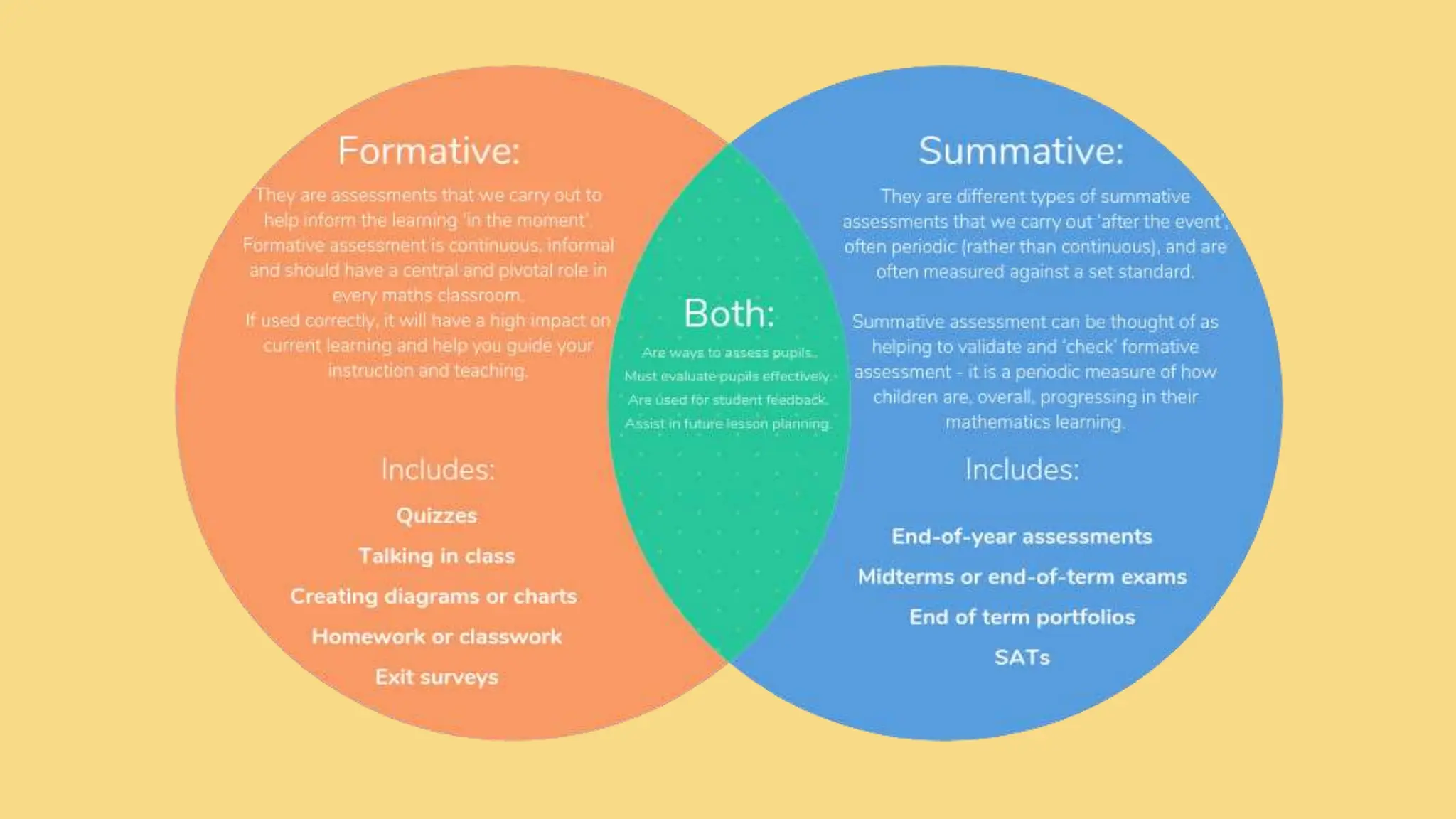
Formative vs summative assessment
comparison chart
This Venn diagram shows the
difference and similarities between the
two assessment types very clearly.
A simple way to compare and
contrast between formative and
summative assessment.
Formative assessment is an intrinsic part of both
teaching and pupil progression. This form of assessment
does not rely upon tests and results, but rather the
ability to adapt to classroom blockers as they arise.
It should indicate what a good piece of work is and why
this is the case, but it also gives you as a teacher a
chance to see when things are not going so well and act
upon it and see improvements.
During a lesson, all adults in the classroom should be on a
‘constant assessment mission’ through interactions with pupils.
How to use formative assessments in
your lessons
Teachers should be moving around the room, interacting
with each child, and assessing their progress towards
the learning objective.
Summative assessment helps to demonstrate the extent of
pupils success in meeting specific goals. It is a method than can
be used to quantify student performance and achievement, and
due to its data driven nature, it is a great way to provide a
numerical basis for the student’s next step.
How to use SUMMATIVE assessments in
your lessons
MGA PAGSUSULIT
PARA SA
PAGTAYA SA
PAKIKINIG
KAHULUGAN NG PAKIKINIG
Ang pakikinig ay isang aktibong proseso ng
pagtanggap ng mensahe sa pamamagitan ng
pandinig at pag?iisip. Aktibo ito sapagkat
nagbibigay?daan ito sa isang tao na pag-iisipan
,tandaan at suriin ang kahulugan at kabuluhan ng
mga salitang kanyang napakinggan.(Arrogante et
al, 2001).
KAHULUGAN NG PAKIKINIG
Ito rin ay pagtugong mental at pisikal sa
mensaheng nais ipabatid ng tagapagdala ng
mensahe. Ang sensoring pakikinig ay nananatiling
bukas at gumagana kahit na tayo ay may
ginagawa. At naririnig ang mga tunog na
nagsisilbing stimuli. Ang wave stimuli na ito ay
dumaraan sa auditory nerve patungo sa utak
KAHULUGAN NG PAKIKINIG
Ang sensoring pakikinig ay nananatiling bukas at
gumagana kahit na tayo ay may ginagawa.
Ang pakikinig ay isang paraan sa pagtanggap ng
mensahe sa pamamagitan ng pandinig.
KAHULUGAN NG PAKIKINIG
Ang pakikinig ay ang kakayahang matukoy at
maunawaan kung ano ang sinasabi ng ating kausap.
Ito’y prosesong panloob na hindi tuwirang nakikita
KAHULUGAN NG PAKIKINIG
Nakapaloob sa kasanayang ito ang pag-unawa sa
diin at bigkas, balarila at talasalitaan at
pagpapakahulugan sa nais iparating ng
tagapagsalita. Ang mahusay na tagapakinig ay may
kakayahang magawa ito ng sabay-sabay
• Makakuha at makapagpalitan ng
impormasyon
• Matamo ang pagkaunawa
• Mapasaya ang sarili
• Makibahagi sa pangyayaring
nagaganap sa lipunan
LAYUNIN NG EPEKTIBONG
PAKIKINIG
• Maraming trabaho at gawain ang
mahigpit na nakasalalay sa epektibong
pakikinig
• Nakatutulong nang malaki ang epektibong
pakikinig upang ang isang tao ay matutp
at mabuhay nang matiwasay.
KAHALAGAHAN NG PAKIKINIG
• Paghihinuha kung ano ang magiging paksa ng
usapan. •
• Paghuhula ng hindi kilalang salita o parirala. •
• Paggamit ng sariling kaalaman sa paksa para sa
dagliang pag-unawa. •
• Pagtukoy sa mga mahahalagang kaisipan at
pagbabale-wala ng mga di?mahalagang
impormasyon.
MGA KASANAYANG MICRO SA PAKIKINIG
(ENABLING SKILLS) (Nagtali si Willis,
(binanggit kay Yagang: 1993)
• Pagpapanatili ng mga mahahalagang impormasyon sa
pamamagitan ng pagtatala o paglalagom. • Pagkilala sa mga
diskors marker tulad ng kung gayon, ngayon, sa wakas, atb. •
• Pagkikila sa mga cohesive devices gaya ng mga pangatnig,
panghalip, atb. •
• Pag-unawa sa ibat ibang hulwarang intonasyon at paggamit ng
diin na maaaring maging hudyat ng mensahe at kalagayang
sosyal.
• • Pag-unawa sa mga pahiwatig na impormasyon tulad ng
intensyon o saloobin ng tagapagsalita.
MGA KASANAYANG MICRO SA PAKIKINIG
(ENABLING SKILLS) (Nagtali si Willis,
(binanggit kay Yagang: 1993)
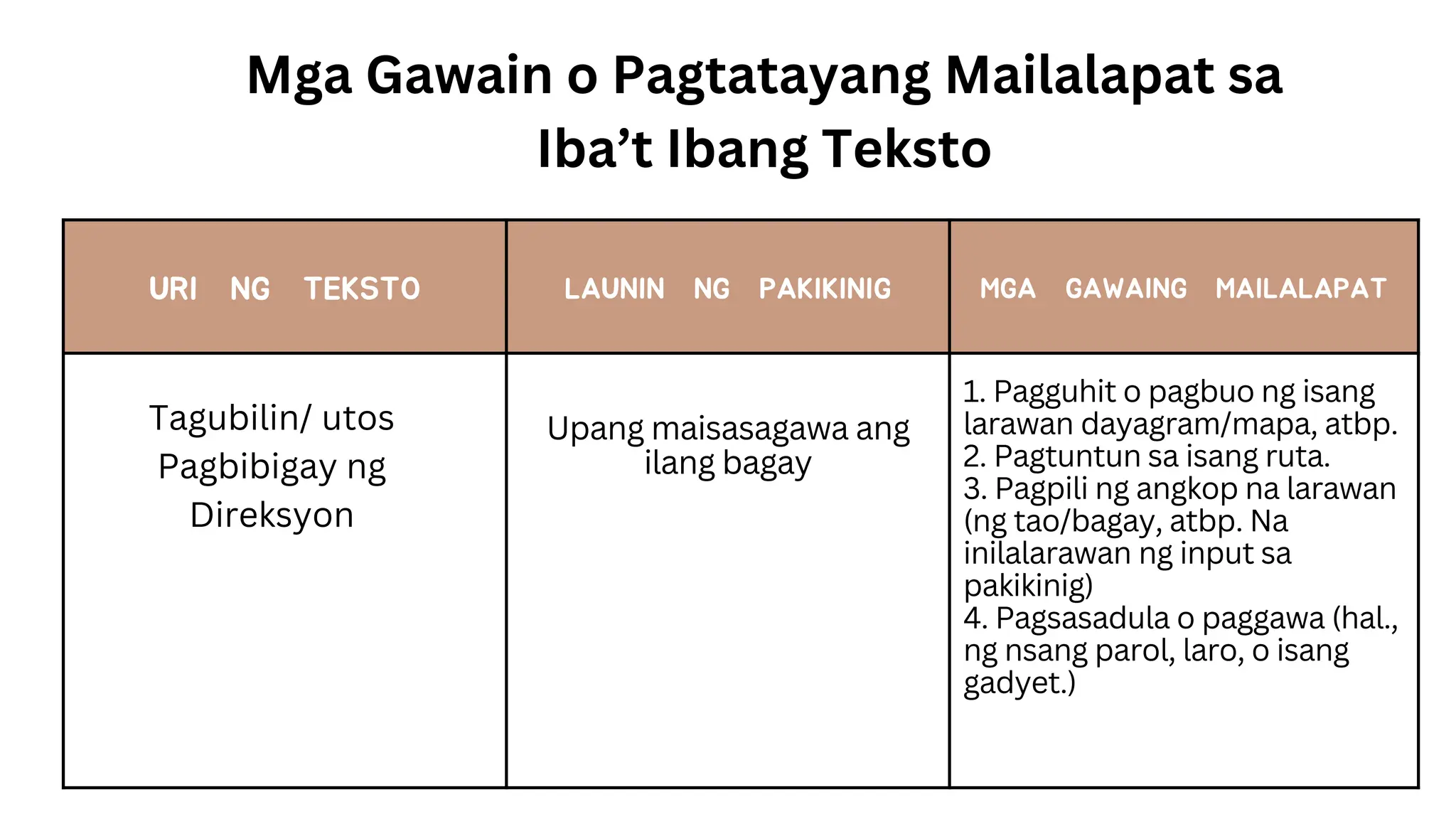
URI NG TEKSTO LAUNIN NG PAKIKINIG MGA GAWAING MAILALAPAT
Mga Gawain o Pagtatayang Mailalapat sa
Iba’t Ibang Teksto
Upang maisasagawa ang
ilang bagay
1. Pagguhit o pagbuo ng isang
larawan dayagram/mapa, atbp.
2. Pagtuntun sa isang ruta.
3. Pagpili ng angkop na larawan
(ng tao/bagay, atbp. Na
inilalarawan ng input sa
pakikinig)
4. Pagsasadula o paggawa (hal.,
ng nsang parol, laro, o isang
gadyet.)
Tagubilin/ utos
Pagbibigay ng
Direksyon
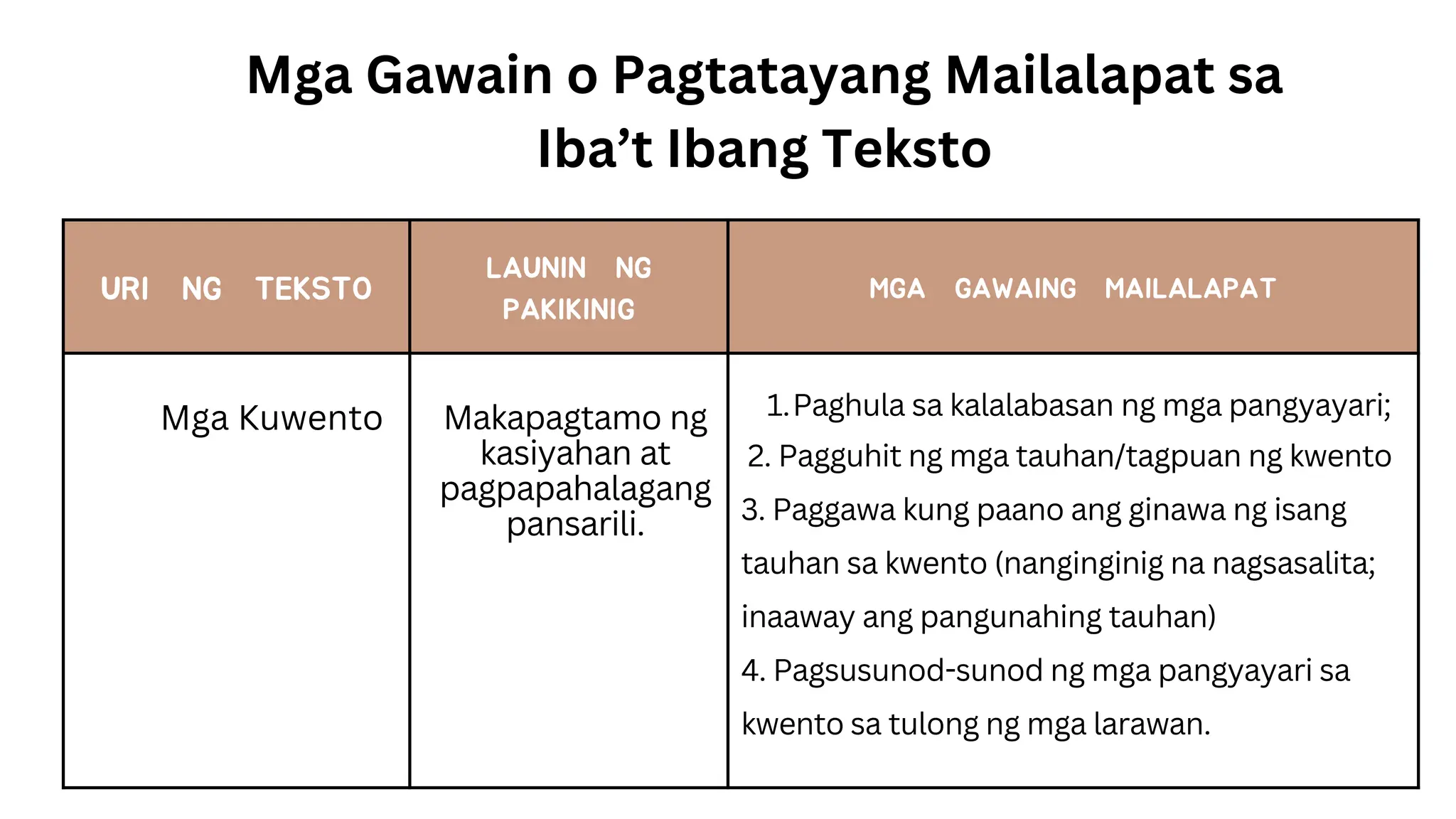
URI NG TEKSTO
LAUNIN NG
PAKIKINIG
MGA GAWAING MAILALAPAT
Mga Gawain o Pagtatayang Mailalapat sa
Iba’t Ibang Teksto
Makapagtamo ng
kasiyahan at
pagpapahalagang
pansarili.
1.Paghula sa kalalabasan ng mga pangyayari;
2. Pagguhit ng mga tauhan/tagpuan ng kwento
3. Paggawa kung paano ang ginawa ng isang
tauhan sa kwento (nanginginig na nagsasalita;
inaaway ang pangunahing tauhan)
4. Pagsusunod-sunod ng mga pangyayari sa
kwento sa tulong ng mga larawan.
Mga Kuwento
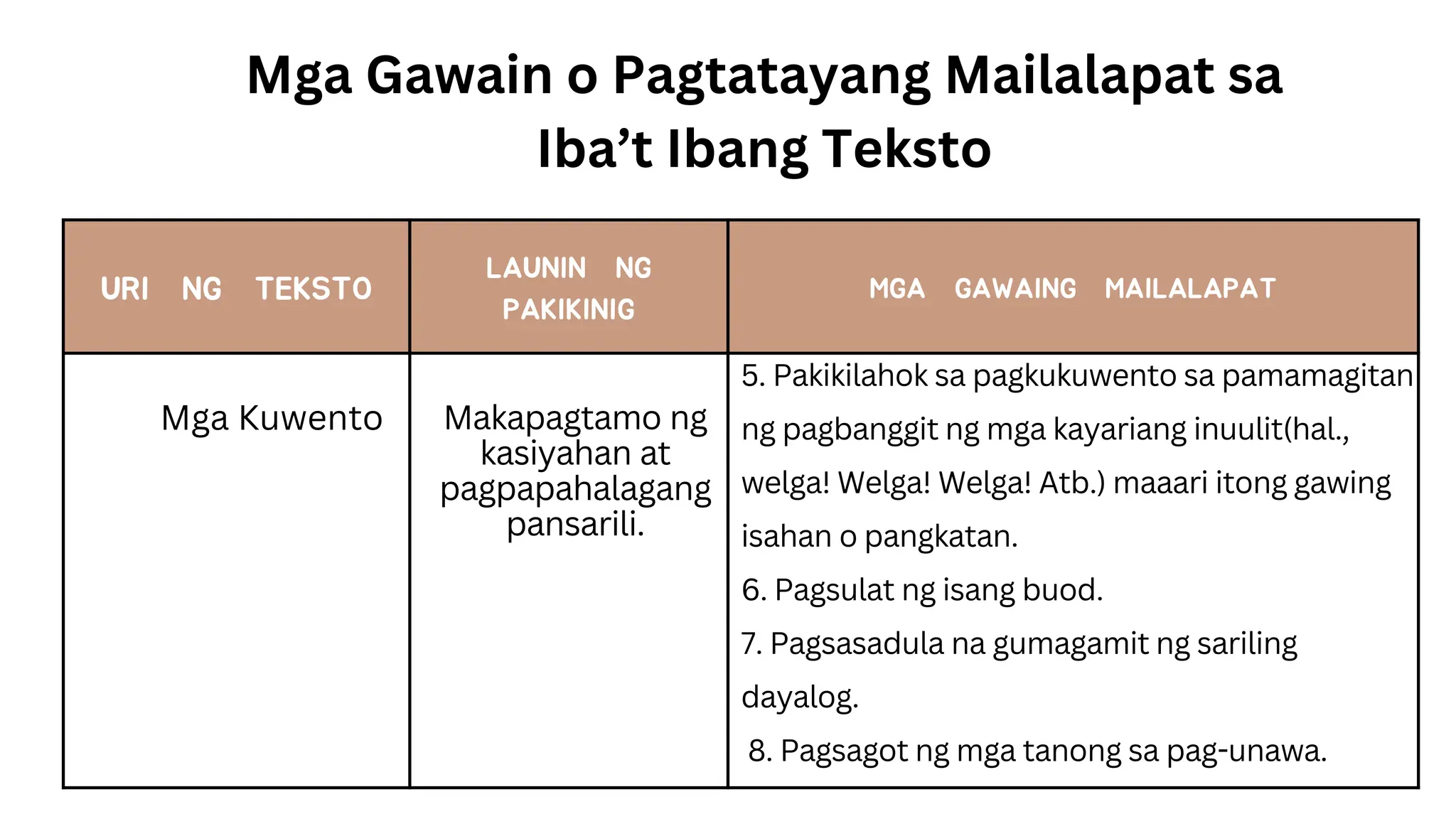
URI NG TEKSTO
LAUNIN NG
PAKIKINIG
MGA GAWAING MAILALAPAT
Mga Gawain o Pagtatayang Mailalapat sa
Iba’t Ibang Teksto
Makapagtamo ng
kasiyahan at
pagpapahalagang
pansarili.
5. Pakikilahok sa pagkukuwento sa pamamagitan
ng pagbanggit ng mga kayariang inuulit(hal.,
welga! Welga! Welga! Atb.) maaari itong gawing
isahan o pangkatan.
6. Pagsulat ng isang buod.
7. Pagsasadula na gumagamit ng sariling
dayalog.
8. Pagsagot ng mga tanong sa pag-unawa.
Mga Kuwento
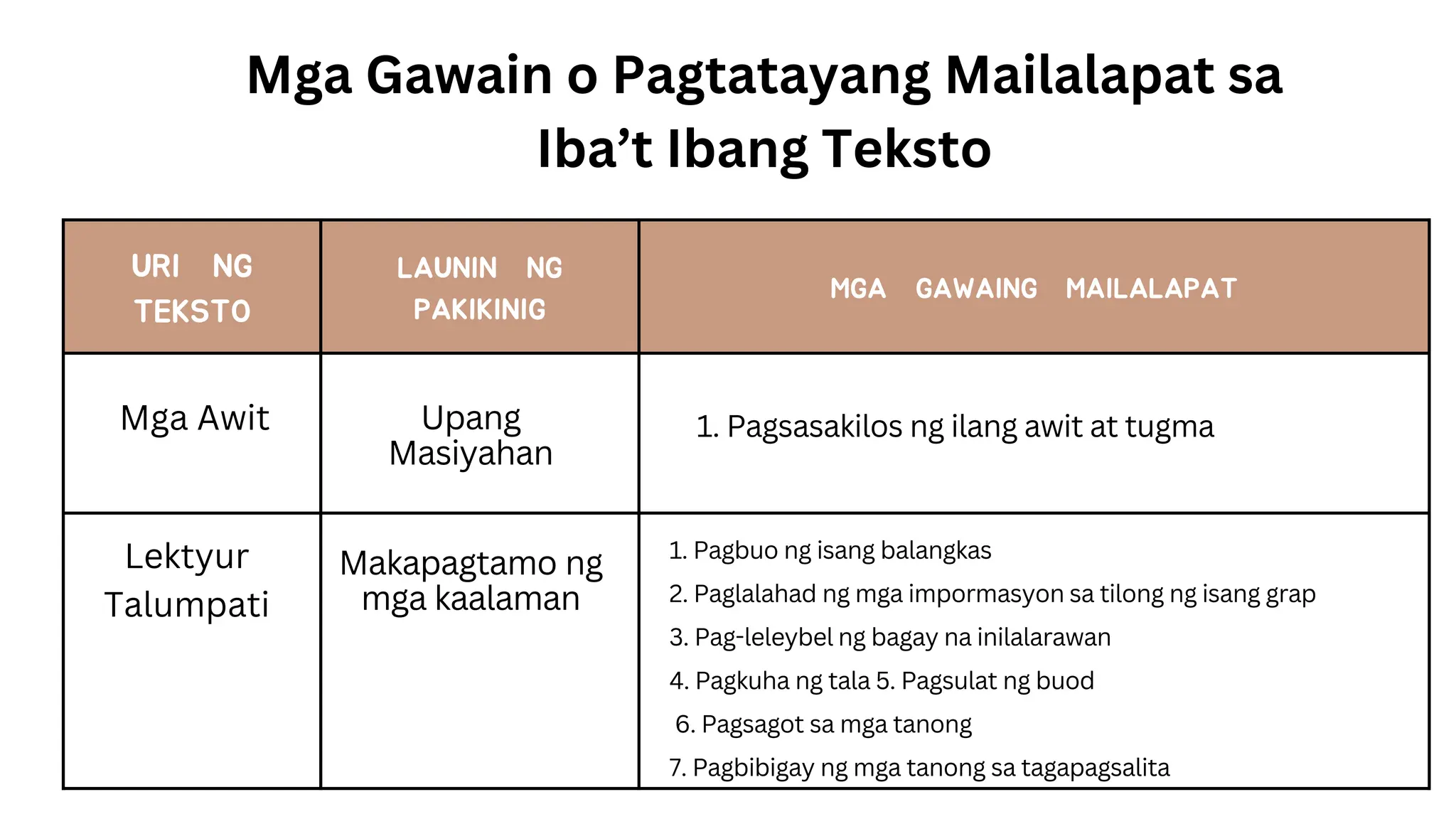
URI NG
TEKSTO
LAUNIN NG
PAKIKINIG
MGA GAWAING MAILALAPAT
Mga Gawain o Pagtatayang Mailalapat sa
Iba’t Ibang Teksto
Upang
Masiyahan
1. Pagsasakilos ng ilang awit at tugma
Mga Awit
Lektyur
Talumpati
Makapagtamo ng
mga kaalaman
1. Pagbuo ng isang balangkas
2. Paglalahad ng mga impormasyon sa tilong ng isang grap
3. Pag-leleybel ng bagay na inilalarawan
4. Pagkuha ng tala 5. Pagsulat ng buod
6. Pagsagot sa mga tanong
7. Pagbibigay ng mga tanong sa tagapagsalita
URI NG
TEKSTO
LAUNIN NG
PAKIKINIG
MGA GAWAING MAILALAPAT
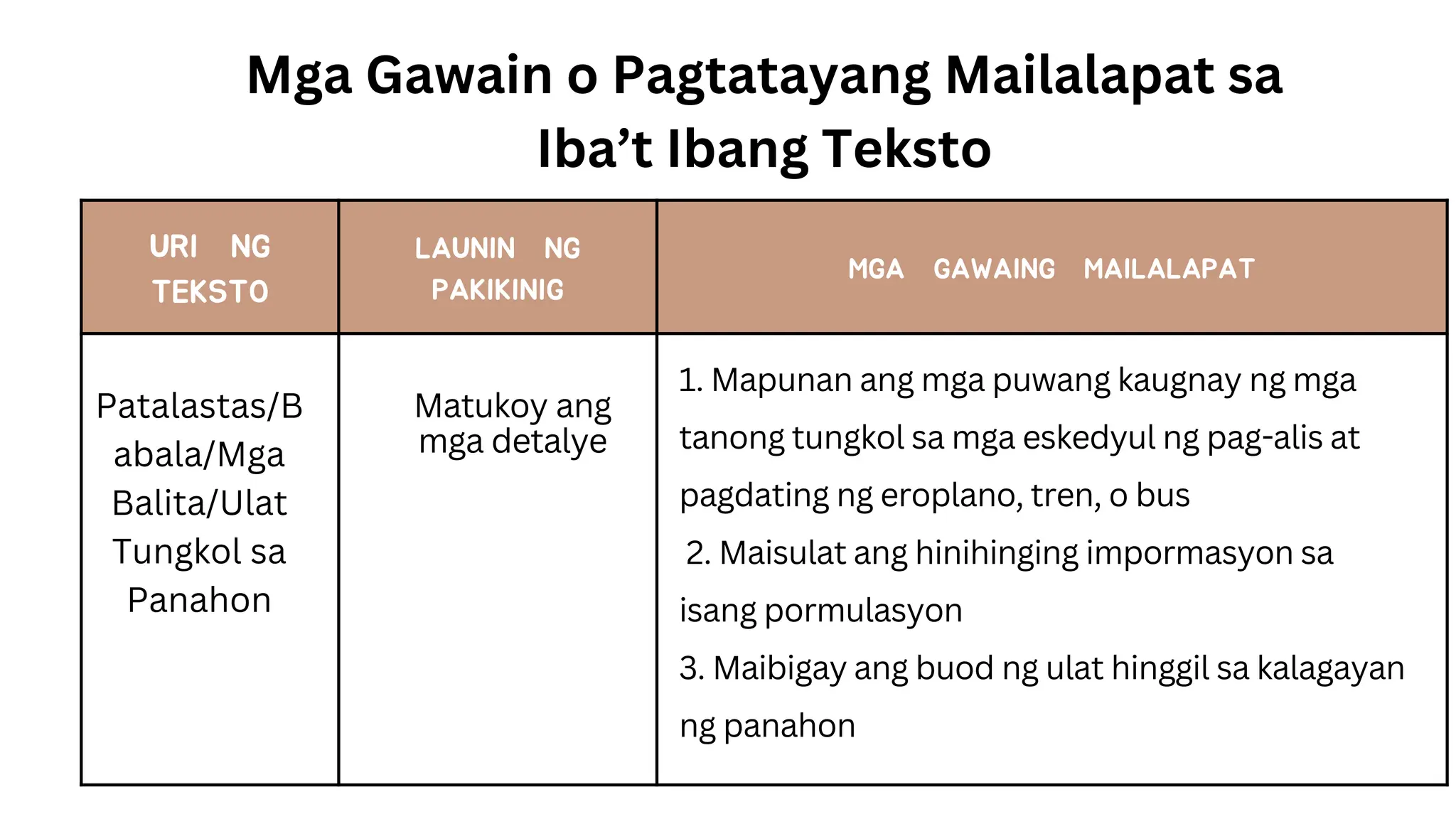
Mga Gawain o Pagtatayang Mailalapat sa
Iba’t Ibang Teksto
Patalastas/B
abala/Mga
Balita/Ulat
Tungkol sa
Panahon
Matukoy ang
mga detalye
1. Mapunan ang mga puwang kaugnay ng mga
tanong tungkol sa mga eskedyul ng pag-alis at
pagdating ng eroplano, tren, o bus
2. Maisulat ang hinihinging impormasyon sa
isang pormulasyon
3. Maibigay ang buod ng ulat hinggil sa kalagayan
ng panahon
MARAMING
SALAMAT SA
PAKIKINIG

DIFINITION OF FORMATIVE AND SUMMATIVE TEST.pptx

  • 1.
  • 2.
    FORMATIVE It is bestthought of as an assessment for learning is the use of day-to-day assessments to gauge and explore pupils’ understanding of a topic. They determine student needs, which teachers use to form learning outcomes in order to prioritise student achievement and success. Formative assessments are one of the teaching strategies used to help inform the learning ‘in the moment’. Formative assessment is continuous, informal and should have a central and pivotal role in every maths classroom
  • 3.
    FORMATIVE If used correctly,it will have a high impact on current learning and help you guide your instruction and teaching by giving ongoing feedback on students’ progress. Having an assessment with low stakes allows pupils to develop their skills, confidence and user experience before attempting a summative assessment with high stakes. It also makes room for self-assessment.
  • 4.
    SUMMATIVE takes place afterpupils’ have completed a block of work, whether that be on a term or modular basis. They are a more formal way to sum up pupil progress and are often compared against a standard benchmark. There are different types of summative evaluations that we carry out ‘after the event’, often periodic (rather than continuous), and they are often measured against a set standard. Summative assessment can be thought of as helping to validate and ‘check’ formative assessment – it is a periodic measure of how children are, overall, progressing in their mathematics learning.
  • 5.
    • Difference 1:Purpose: the purpose of formative assessments is to improve learning, while the purpose of summative assessments is to gain a measure of attainment (e.g. a final grade). A breakdown of the differences between formative and summative assessments
  • 6.
    Difference 2: Frequency: formativeassessment occurs regularly throughout every lesson. Summative assessments occur at the end of a teaching-learning cycle or at the end of class A breakdown of the differences between formative and summative assessments
  • 7.
    • Difference 3:Type of Assessment: formative assessments are likely to be low-stakes and summative assessments are likely to be high- stakes. A breakdown of the differences between formative and summative assessments
  • 8.
    A breakdown of thedifferences between formative and summative assessments • Difference 4: Outcome: teachers provide feedback to improve learning following formative assessments. The outcome of a summative assessment is a final grade or score that is used as a measure of attainment.
  • 9.
    • For example,‘test style questions’ can be used both as formative assessment (perhaps as exit tickets – questions given to children at the end of the lesson to check understanding) or summative (perhaps as an end of an instructional unit test or check). Importantly, it is not the ‘form’that assessment takes that determines whether it is formative or summative, instead it is how it is being used.
  • 10.
    Formative vs summativeassessment comparison chart This Venn diagram shows the difference and similarities between the two assessment types very clearly.
  • 12.
    A simple wayto compare and contrast between formative and summative assessment. Formative assessment is an intrinsic part of both teaching and pupil progression. This form of assessment does not rely upon tests and results, but rather the ability to adapt to classroom blockers as they arise. It should indicate what a good piece of work is and why this is the case, but it also gives you as a teacher a chance to see when things are not going so well and act upon it and see improvements.
  • 13.
    During a lesson,all adults in the classroom should be on a ‘constant assessment mission’ through interactions with pupils. How to use formative assessments in your lessons Teachers should be moving around the room, interacting with each child, and assessing their progress towards the learning objective.
  • 14.
    Summative assessment helpsto demonstrate the extent of pupils success in meeting specific goals. It is a method than can be used to quantify student performance and achievement, and due to its data driven nature, it is a great way to provide a numerical basis for the student’s next step. How to use SUMMATIVE assessments in your lessons
  • 15.
  • 16.
    KAHULUGAN NG PAKIKINIG Angpakikinig ay isang aktibong proseso ng pagtanggap ng mensahe sa pamamagitan ng pandinig at pag?iisip. Aktibo ito sapagkat nagbibigay?daan ito sa isang tao na pag-iisipan ,tandaan at suriin ang kahulugan at kabuluhan ng mga salitang kanyang napakinggan.(Arrogante et al, 2001).
  • 17.
    KAHULUGAN NG PAKIKINIG Itorin ay pagtugong mental at pisikal sa mensaheng nais ipabatid ng tagapagdala ng mensahe. Ang sensoring pakikinig ay nananatiling bukas at gumagana kahit na tayo ay may ginagawa. At naririnig ang mga tunog na nagsisilbing stimuli. Ang wave stimuli na ito ay dumaraan sa auditory nerve patungo sa utak
  • 18.
    KAHULUGAN NG PAKIKINIG Angsensoring pakikinig ay nananatiling bukas at gumagana kahit na tayo ay may ginagawa. Ang pakikinig ay isang paraan sa pagtanggap ng mensahe sa pamamagitan ng pandinig.
  • 19.
    KAHULUGAN NG PAKIKINIG Angpakikinig ay ang kakayahang matukoy at maunawaan kung ano ang sinasabi ng ating kausap. Ito’y prosesong panloob na hindi tuwirang nakikita
  • 20.
    KAHULUGAN NG PAKIKINIG Nakapaloobsa kasanayang ito ang pag-unawa sa diin at bigkas, balarila at talasalitaan at pagpapakahulugan sa nais iparating ng tagapagsalita. Ang mahusay na tagapakinig ay may kakayahang magawa ito ng sabay-sabay
  • 21.
    • Makakuha atmakapagpalitan ng impormasyon • Matamo ang pagkaunawa • Mapasaya ang sarili • Makibahagi sa pangyayaring nagaganap sa lipunan LAYUNIN NG EPEKTIBONG PAKIKINIG
  • 22.
    • Maraming trabahoat gawain ang mahigpit na nakasalalay sa epektibong pakikinig • Nakatutulong nang malaki ang epektibong pakikinig upang ang isang tao ay matutp at mabuhay nang matiwasay. KAHALAGAHAN NG PAKIKINIG
  • 23.
    • Paghihinuha kungano ang magiging paksa ng usapan. • • Paghuhula ng hindi kilalang salita o parirala. • • Paggamit ng sariling kaalaman sa paksa para sa dagliang pag-unawa. • • Pagtukoy sa mga mahahalagang kaisipan at pagbabale-wala ng mga di?mahalagang impormasyon. MGA KASANAYANG MICRO SA PAKIKINIG (ENABLING SKILLS) (Nagtali si Willis, (binanggit kay Yagang: 1993)
  • 24.
    • Pagpapanatili ngmga mahahalagang impormasyon sa pamamagitan ng pagtatala o paglalagom. • Pagkilala sa mga diskors marker tulad ng kung gayon, ngayon, sa wakas, atb. • • Pagkikila sa mga cohesive devices gaya ng mga pangatnig, panghalip, atb. • • Pag-unawa sa ibat ibang hulwarang intonasyon at paggamit ng diin na maaaring maging hudyat ng mensahe at kalagayang sosyal. • • Pag-unawa sa mga pahiwatig na impormasyon tulad ng intensyon o saloobin ng tagapagsalita. MGA KASANAYANG MICRO SA PAKIKINIG (ENABLING SKILLS) (Nagtali si Willis, (binanggit kay Yagang: 1993)
  • 25.
    URI NG TEKSTOLAUNIN NG PAKIKINIG MGA GAWAING MAILALAPAT Mga Gawain o Pagtatayang Mailalapat sa Iba’t Ibang Teksto Upang maisasagawa ang ilang bagay 1. Pagguhit o pagbuo ng isang larawan dayagram/mapa, atbp. 2. Pagtuntun sa isang ruta. 3. Pagpili ng angkop na larawan (ng tao/bagay, atbp. Na inilalarawan ng input sa pakikinig) 4. Pagsasadula o paggawa (hal., ng nsang parol, laro, o isang gadyet.) Tagubilin/ utos Pagbibigay ng Direksyon
  • 26.
    URI NG TEKSTO LAUNINNG PAKIKINIG MGA GAWAING MAILALAPAT Mga Gawain o Pagtatayang Mailalapat sa Iba’t Ibang Teksto Makapagtamo ng kasiyahan at pagpapahalagang pansarili. 1.Paghula sa kalalabasan ng mga pangyayari; 2. Pagguhit ng mga tauhan/tagpuan ng kwento 3. Paggawa kung paano ang ginawa ng isang tauhan sa kwento (nanginginig na nagsasalita; inaaway ang pangunahing tauhan) 4. Pagsusunod-sunod ng mga pangyayari sa kwento sa tulong ng mga larawan. Mga Kuwento
  • 27.
    URI NG TEKSTO LAUNINNG PAKIKINIG MGA GAWAING MAILALAPAT Mga Gawain o Pagtatayang Mailalapat sa Iba’t Ibang Teksto Makapagtamo ng kasiyahan at pagpapahalagang pansarili. 5. Pakikilahok sa pagkukuwento sa pamamagitan ng pagbanggit ng mga kayariang inuulit(hal., welga! Welga! Welga! Atb.) maaari itong gawing isahan o pangkatan. 6. Pagsulat ng isang buod. 7. Pagsasadula na gumagamit ng sariling dayalog. 8. Pagsagot ng mga tanong sa pag-unawa. Mga Kuwento
  • 28.
    URI NG TEKSTO LAUNIN NG PAKIKINIG MGAGAWAING MAILALAPAT Mga Gawain o Pagtatayang Mailalapat sa Iba’t Ibang Teksto Upang Masiyahan 1. Pagsasakilos ng ilang awit at tugma Mga Awit Lektyur Talumpati Makapagtamo ng mga kaalaman 1. Pagbuo ng isang balangkas 2. Paglalahad ng mga impormasyon sa tilong ng isang grap 3. Pag-leleybel ng bagay na inilalarawan 4. Pagkuha ng tala 5. Pagsulat ng buod 6. Pagsagot sa mga tanong 7. Pagbibigay ng mga tanong sa tagapagsalita
  • 29.
    URI NG TEKSTO LAUNIN NG PAKIKINIG MGAGAWAING MAILALAPAT Mga Gawain o Pagtatayang Mailalapat sa Iba’t Ibang Teksto Patalastas/B abala/Mga Balita/Ulat Tungkol sa Panahon Matukoy ang mga detalye 1. Mapunan ang mga puwang kaugnay ng mga tanong tungkol sa mga eskedyul ng pag-alis at pagdating ng eroplano, tren, o bus 2. Maisulat ang hinihinging impormasyon sa isang pormulasyon 3. Maibigay ang buod ng ulat hinggil sa kalagayan ng panahon
  • 30.