Types Of Computer
Analog ComputerDigital Computer Hybrid Computer
Micro Computer
Main-Frame
Computer
Super Computer
Mini
Computer
Home PC
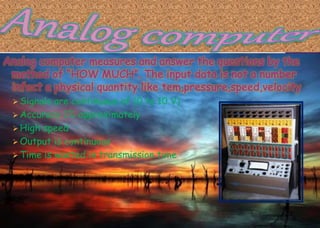
Analog computer measures and answer the questions by the
method of “HOW MUCH”. The input data is not a number
infect a physical quantity like tem,pressure,speed,velocity.
 Signals are continuous of (0 to 10 V)
 Accuracy 1% approximately
 High speed
 Output is continuous
 Time is wasted in transmission time
Digital computer counts and answer the questions by the
method of “ HOW MANY”. The input data is represented by
a number.These are used for the logical and arithmetic
operations.
 Signals are two level of (0 V or 5 V).
 Accuracy unlimited
 Low speed seqential as well as parallel processing
 Output is continuous but obtain when computation is
completed.
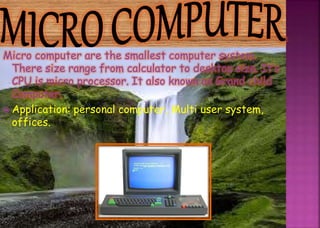
Micro computer are the smallest computer system.
There size range from calculator to desktop size. It’s
CPU is micro processor. It also known as Grand child
Computer.
 Application: personal computer, Multi user system,
offices.
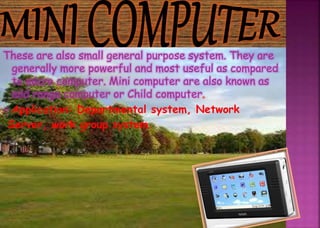
These are also small general purpose system. They are
generally more powerful and most useful as compared
to micro computer. Mini computer are also known as
mid range computer or Child computer.
 Application: Departmental system, Network
Server, work group system.
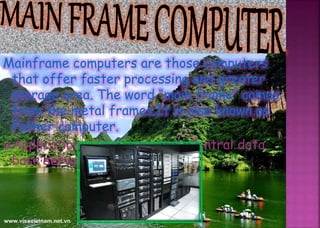
Mainframe computers are those computers
that offer faster processing and greater
storage area. The word “main frame” comes
from the metal frames.It is also known as
Father computer.
Application- Host computer, Central data
base server.
 Super computer are those computer which are
designed for scientific job like weather forecasting
and artificial intelligence etc. They are fastest and
expensive. A super computer contains a number of
CPU which operates in parallel to make it faster. It is
also known grand father computer.
 Application: weather forecasting, weapons research
and development.
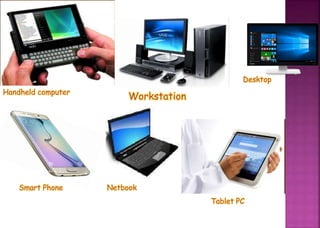
 Desktop
 Workstation
 Netbook
 Tablet PC
 Handheld computer
 Smart Phone
Handheld computer
Workstation
Smart Phone Netbook
Tablet PC
Desktop
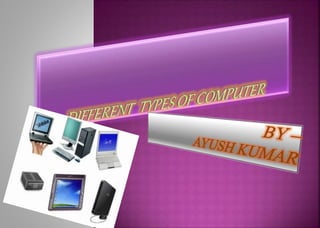
Different types of computers

Different types of computers

  • 2.
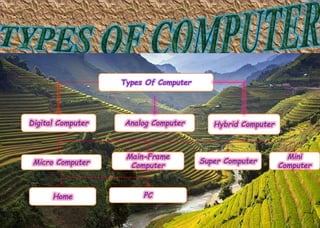
    Types Of Computer AnalogComputerDigital Computer Hybrid Computer Micro Computer Main-Frame Computer Super Computer Mini Computer Home PC
  • 3.
    Analog computer measuresand answer the questions by the method of “HOW MUCH”. The input data is not a number infect a physical quantity like tem,pressure,speed,velocity.  Signals are continuous of (0 to 10 V)  Accuracy 1% approximately  High speed  Output is continuous  Time is wasted in transmission time
  • 4.
    Digital computer countsand answer the questions by the method of “ HOW MANY”. The input data is represented by a number.These are used for the logical and arithmetic operations.  Signals are two level of (0 V or 5 V).  Accuracy unlimited  Low speed seqential as well as parallel processing  Output is continuous but obtain when computation is completed.
  • 5.
    Micro computer arethe smallest computer system. There size range from calculator to desktop size. It’s CPU is micro processor. It also known as Grand child Computer.  Application: personal computer, Multi user system, offices.
  • 6.
    These are alsosmall general purpose system. They are generally more powerful and most useful as compared to micro computer. Mini computer are also known as mid range computer or Child computer.  Application: Departmental system, Network Server, work group system.
  • 7.
    Mainframe computers arethose computers that offer faster processing and greater storage area. The word “main frame” comes from the metal frames.It is also known as Father computer. Application- Host computer, Central data base server.
  • 8.
     Super computerare those computer which are designed for scientific job like weather forecasting and artificial intelligence etc. They are fastest and expensive. A super computer contains a number of CPU which operates in parallel to make it faster. It is also known grand father computer.  Application: weather forecasting, weapons research and development.
  • 9.
     Desktop  Workstation Netbook  Tablet PC  Handheld computer  Smart Phone
  • 10.