TYPES
TYPES
OF
OF
COMPUTER
COMPUTER
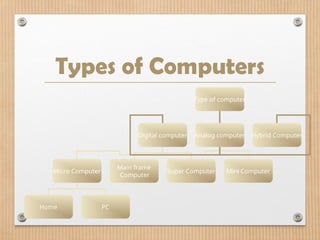
Types of Computers
Type of computer
Digital computer Analog computer Hybrid Computer
Micro Computer
Main frame
Computer
Super Computer
Home PC
Mini Computer
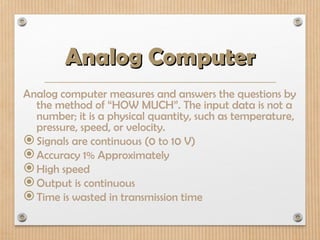
Analog Computer
Analog Computer
Analog computer measures and answers the questions by
the method of “HOW MUCH”. The input data is not a
number; it is a physical quantity, such as temperature,
pressure, speed, or velocity.
Signals are continuous (0 to 10 V)
Accuracy 1% Approximately
High speed
Output is continuous
Time is wasted in transmission time
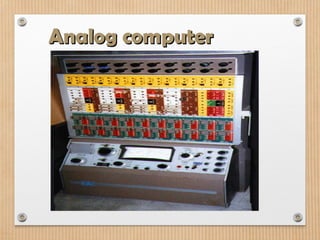
Analog computer
Analog computer
Digital Computers
Digital Computers
Digital computer counts and answers the questions by the
method of “HOW Many”. The input data is represented
by a number. These are used for the logical and
arithmetic operations.
 Signals are two levels of (0 V or 5 V)
 Accuracy unlimited
 low-speed sequential as well as parallel processing
 Output is continuous but obtained when computation is
completed.
Micro Computer
Micro Computer
Microcomputers are the smallest computer
systems. Their size ranges from a calculator
to a desktop. Its CPU is a microprocessor. It
is also known as the Grandchild Computer.
• Application: - personal computer, multi-user
system, offices.
Mini Computer
Mini Computer
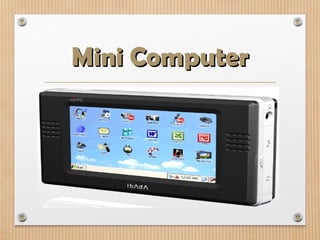
These are also small, general-purpose systems.
They are generally more powerful and more
useful than compared to microcomputer. Mini
computers are also known as mid-range
computers or Child computers.
• Application:- Departmental systems, Network
Servers, work group systems.
Mini Computer
Mini Computer
Mainframe Computer
Mainframe Computer
Mainframe computers are those computers
that offer faster processing and greater
storage capacity. The word “mainframe”
comes from the metal frames. It is also
known as Father Computer.
• Application – Host computer, Central
database server.
Super Computer
Super Computer
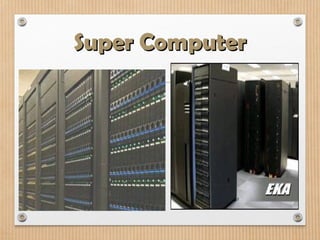
 Supercomputers are those computers that are
designed for scientific jobs like weather forecasting
and artificial intelligence etc. They are the fastest
and expensive. A supercomputer contains a number
of CPUs that operate in parallel to make it faster. It
is also known as grand grand-grandfather computer.
Application – whether forecasting, weapons
research, or development.
Super Computer
Super Computer
Hybrid Computer
Hybrid Computer
The combination of features of analog
and digital computers is called a hybrid
computer. The main examples are the
central national defense and the
passenger flight radar system. They are
also used to control robots.
Classification of Digital Computers
• Desktop
• Workstation
• Notebook
• Tablet PC
• Handheld computer
• Smartphone
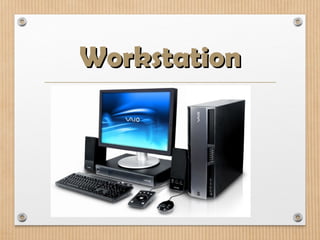
Workstation
Workstation
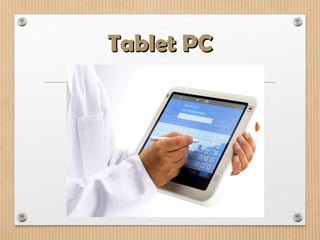
Tablet PC
Tablet PC
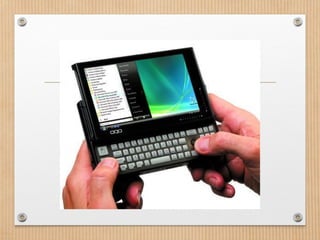
Handheld PC(PDA)
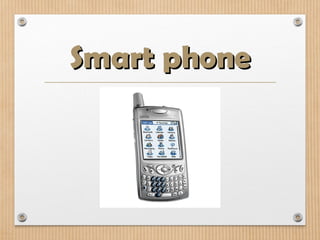
Smart phone
Smart phone
Types of Computers :
Types of Computers Analog Computers: The
analog computer is almost an extinct type of
computer these days. It is different from a
digital computer in respect that it can
perform numerous mathematical operations
simultaneously. It is also unique in terms of
operation as it utilizes continuous variables
for the purpose of mathematical
computation. It utilizes mechanical,
hydraulic, or electrical energy or operation
Hybrid computers:
Hybrid computers: These types of computers are,
as the name suggests, a combination of both
Analog and Digital computers. The Digital
computers, which work on the principle of the
binary digit system of “0” and “1”, can give very
precise results. But the problem is that they are too
slow and incapable of large-scale mathematical
operations. In the hybrid types of computers, the
Digital counterparts convert the analog signals to
perform Robotics and Process control
Types-of-Computer-Ppt.ppt POWERPOINT PPT

Types-of-Computer-Ppt.ppt POWERPOINT PPT

  • 1.
  • 2.
    Types of Computers Typeof computer Digital computer Analog computer Hybrid Computer Micro Computer Main frame Computer Super Computer Home PC Mini Computer
  • 3.
    Analog Computer Analog Computer Analogcomputer measures and answers the questions by the method of “HOW MUCH”. The input data is not a number; it is a physical quantity, such as temperature, pressure, speed, or velocity. Signals are continuous (0 to 10 V) Accuracy 1% Approximately High speed Output is continuous Time is wasted in transmission time
  • 4.
  • 5.
    Digital Computers Digital Computers Digitalcomputer counts and answers the questions by the method of “HOW Many”. The input data is represented by a number. These are used for the logical and arithmetic operations.  Signals are two levels of (0 V or 5 V)  Accuracy unlimited  low-speed sequential as well as parallel processing  Output is continuous but obtained when computation is completed.
  • 6.
    Micro Computer Micro Computer Microcomputersare the smallest computer systems. Their size ranges from a calculator to a desktop. Its CPU is a microprocessor. It is also known as the Grandchild Computer. • Application: - personal computer, multi-user system, offices.
  • 7.
    Mini Computer Mini Computer Theseare also small, general-purpose systems. They are generally more powerful and more useful than compared to microcomputer. Mini computers are also known as mid-range computers or Child computers. • Application:- Departmental systems, Network Servers, work group systems.
  • 8.
  • 9.
    Mainframe Computer Mainframe Computer Mainframecomputers are those computers that offer faster processing and greater storage capacity. The word “mainframe” comes from the metal frames. It is also known as Father Computer. • Application – Host computer, Central database server.
  • 10.
    Super Computer Super Computer Supercomputers are those computers that are designed for scientific jobs like weather forecasting and artificial intelligence etc. They are the fastest and expensive. A supercomputer contains a number of CPUs that operate in parallel to make it faster. It is also known as grand grand-grandfather computer. Application – whether forecasting, weapons research, or development.
  • 11.
  • 12.
    Hybrid Computer Hybrid Computer Thecombination of features of analog and digital computers is called a hybrid computer. The main examples are the central national defense and the passenger flight radar system. They are also used to control robots.
  • 13.
    Classification of DigitalComputers Classification of Digital Computers • Desktop • Workstation • Notebook • Tablet PC • Handheld computer • Smartphone
  • 14.
  • 15.
  • 16.
  • 17.
  • 18.
    Types of Computers: Types of Computers Analog Computers: The analog computer is almost an extinct type of computer these days. It is different from a digital computer in respect that it can perform numerous mathematical operations simultaneously. It is also unique in terms of operation as it utilizes continuous variables for the purpose of mathematical computation. It utilizes mechanical, hydraulic, or electrical energy or operation
  • 19.
    Hybrid computers: Hybrid computers:These types of computers are, as the name suggests, a combination of both Analog and Digital computers. The Digital computers, which work on the principle of the binary digit system of “0” and “1”, can give very precise results. But the problem is that they are too slow and incapable of large-scale mathematical operations. In the hybrid types of computers, the Digital counterparts convert the analog signals to perform Robotics and Process control