TECHNIQUES OF COUNSELING
SUBJECT: Nursing Education
Prof.(Dr.) Virendra Singh Choudhary
INTRODUCTION:-
COUNSELING
Guidance and counseling are not
synonymous terms. Counseling is a part
of guidance or it is a specialized service
of guidance. It is an accepting, trusting
and safe relationship in which client
learns to discuss freely what upsets him.
DEFINITION:- Counseling is mental
learning process which involves two
individuals, one seeking help and other a
professionally trained person helping the
first to orient and direct him towards a goal
which leads to his maximum development
and growth in his environment. - Willy and
Andrew
Counseling is the helping relationship
that includes some one seeking help,
someone willing to give help, who is
capable or trained to help, in a setting
that permits help to be given and
received”- Cormier and Hackney
(1987)
TECHNIQUES REQUIRED FOR
EFFECTIVE COUNSELLING:-
Counseling requires some skills on the part of the
counselor to effectively counsel the client by exploring
the problem situation and suggesting alternatives for the
same.
1. Active Listening:- Easy to describe but difficult to
practice it is the skill of listening to the client actively,
attentively while maintaining eye to eye contact and at the
same time, observing the nonverbal behaviour shown by
the client. The technique of active listening includes:-
• Maintaining good eye to eye contact with client
• Have open posture
• Saying “carry on” ‘huhuu” “nodding the head to
agree with the client statements” to encourage the
client to speak more.
• Don’t make any interruption in between when
the client is talking
• Ask questions whenever necessary to facilitate
conversation.
2. Reflecting:- The counselor refers back the
questions, feelings and any other important
statements to the client so that, he can assume that
the counselor understands what he intends to
understand him.
3. Focusing:- Spotlighting any idea or even a
single word which seems to be significant for a
given problem situation.
4. Summarizing and Paraphrasing:- It is the
brief restatement and rewording in own words of
the main points what the client has communicated
to the counselor to clarify the meaning of message
so that, the client can assume that the counselor
has understood the crux of his problem as well as
the counselor becomes sure that, he has understood
what the counselee intends to communicate him.
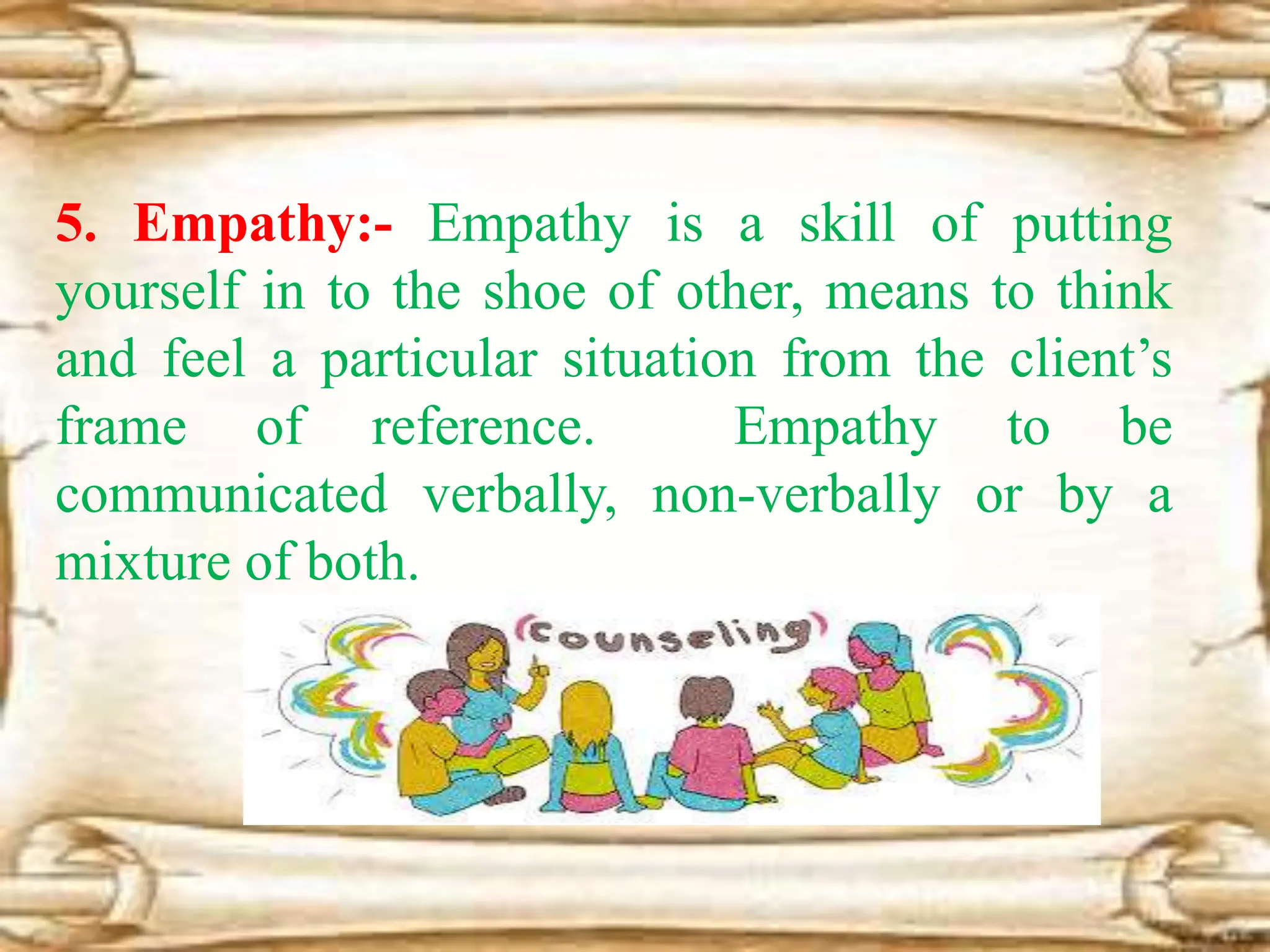
5. Empathy:- Empathy is a skill of putting
yourself in to the shoe of other, means to think
and feel a particular situation from the client’s
frame of reference. Empathy to be
communicated verbally, non-verbally or by a
mixture of both.
INSTRUMENTS FOR EVALUATION:-
Interview:- It is the heart of the counseling
process in which counselor and counselee meets
face to face and conducts a formal talk with a
definite purpose.
 It serves the purpose of obtaining and giving
information from and to the students as well as
sometime, it may be useful tool for need
assessment of the guidance and counseling
services in a particular educational institute.
 It provides opportunity to the counselee to
explore his conflicts, problems, learning
difficulties so that the counselor can determine a
plan of guidance for him.
 Counselor can exploit this opportunity to
gather background personal information about the
student.
 Interview should be well planned in advance to
achieve desired outcomes.
PROCEDURE FOR INTERVIEW:-
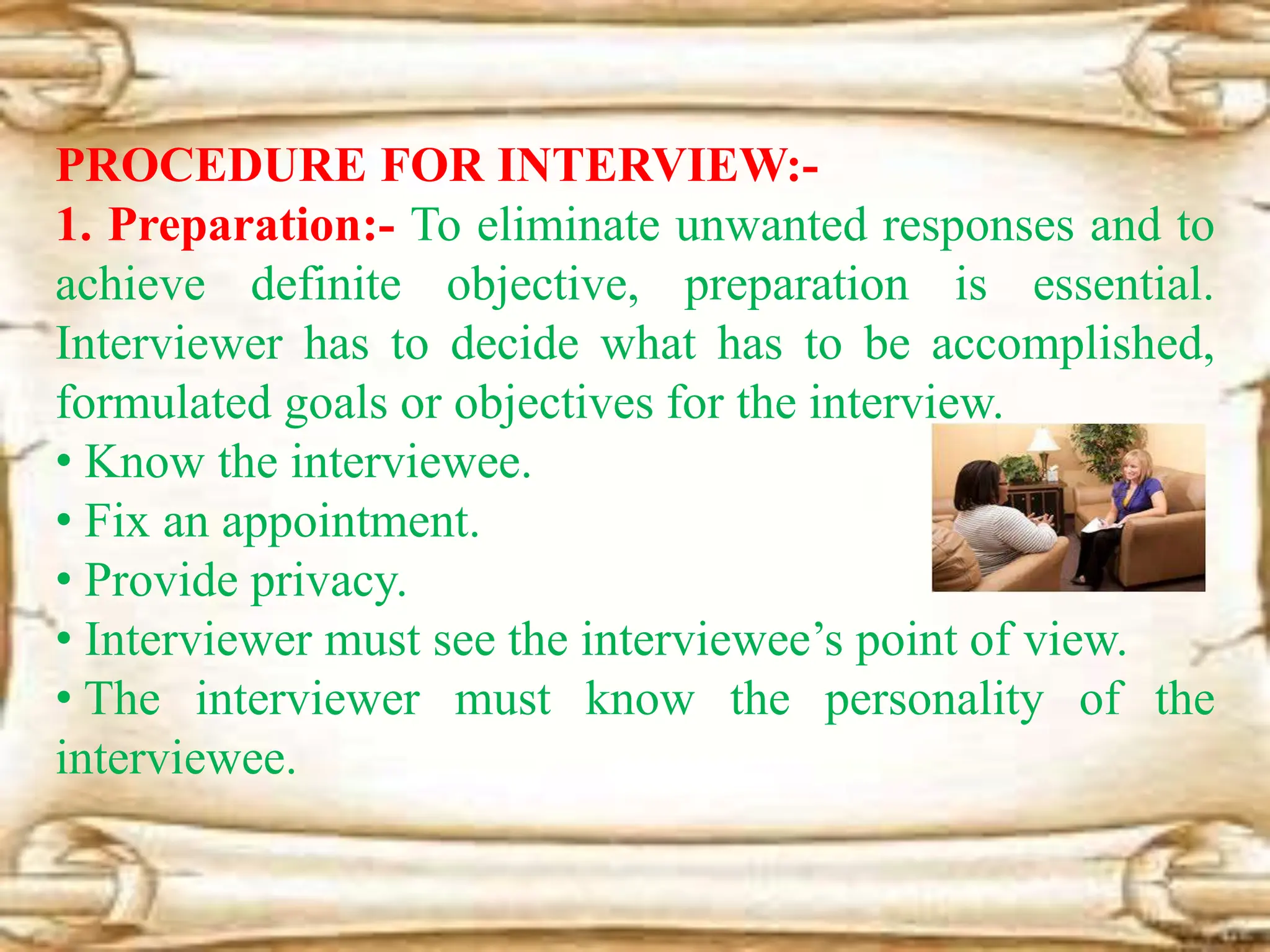
1. Preparation:- To eliminate unwanted responses and to
achieve definite objective, preparation is essential.
Interviewer has to decide what has to be accomplished,
formulated goals or objectives for the interview.
• Know the interviewee.
• Fix an appointment.
• Provide privacy.
• Interviewer must see the interviewee’s point of view.
• The interviewer must know the personality of the
interviewee.
2. The process:-
• Establish rapport.
• Help the interviewee feel at ease and ready to talk.
• Help the interviewee to obtain and organize into a
meaningful pattern of the information.
• The interviewer should ask unambiguous questions,
listen to the interviewee’s responses and he should have
control over the interview.
• In the closing phase of interview any additional
information is needed, he can add in the remarks.
3. Interpretation:- The counsellor has to listen
to the client’s conversation and responses,he
should distinguish between facts and fictions.
Interpretation requires skill and great
understanding. Interviewer has to interpret
carefully the ideas, attitudes and responses of the
interviewee.
4. Developing insight into the problems of
counselee and put the action into a plan of
work.
5. Recording of the total interview process
is necessary for follow- up services and to
take necessary plan of action.
CHARACTERISTICS OF A COUNSELOR:-
1.Leadership:- A good counselor should
possess leadership qualities (ability to lead
others) to direct and lead the process of
counseling (directive approach).
2. Interpersonal relationship:- Interpersonal
relationship is pivotal for the success of
counseling; therefore, a counselor should posses
qualities of building effective interpersonal
relationship, openness, attentive and active
listener, friendliness, ability to show warmth
and attitude of acceptance towards others,
tactfulness, tolerance, patience and empathy.
3. Nonjudgmental:-
Counselor should be
non-judgmental. Making
personal judgment of the
situation dilutes the aim
and effectiveness of the
counseling.

4. Personal values:- Counselor should
be aware of his self (social, private,
spiritual self), personal values,
prejudices, belief, culture and attitude
so that, counselor can put these factors
on hold to develop an objective
perspective of client’s situation.
5. Communication skills:- More or less
counseling is a communicative process
which takes place between counselor and
counselee; therefore, a counselor must
have good communication skills.
6. Respect for human being:- Counselor
should be able to show due respect to the
person being counseled without
considering cast, creed, race, culture and
personal preferences. He should be aware
of and respect a person’s individuality in
terms of unique values, attributes, and
skills.
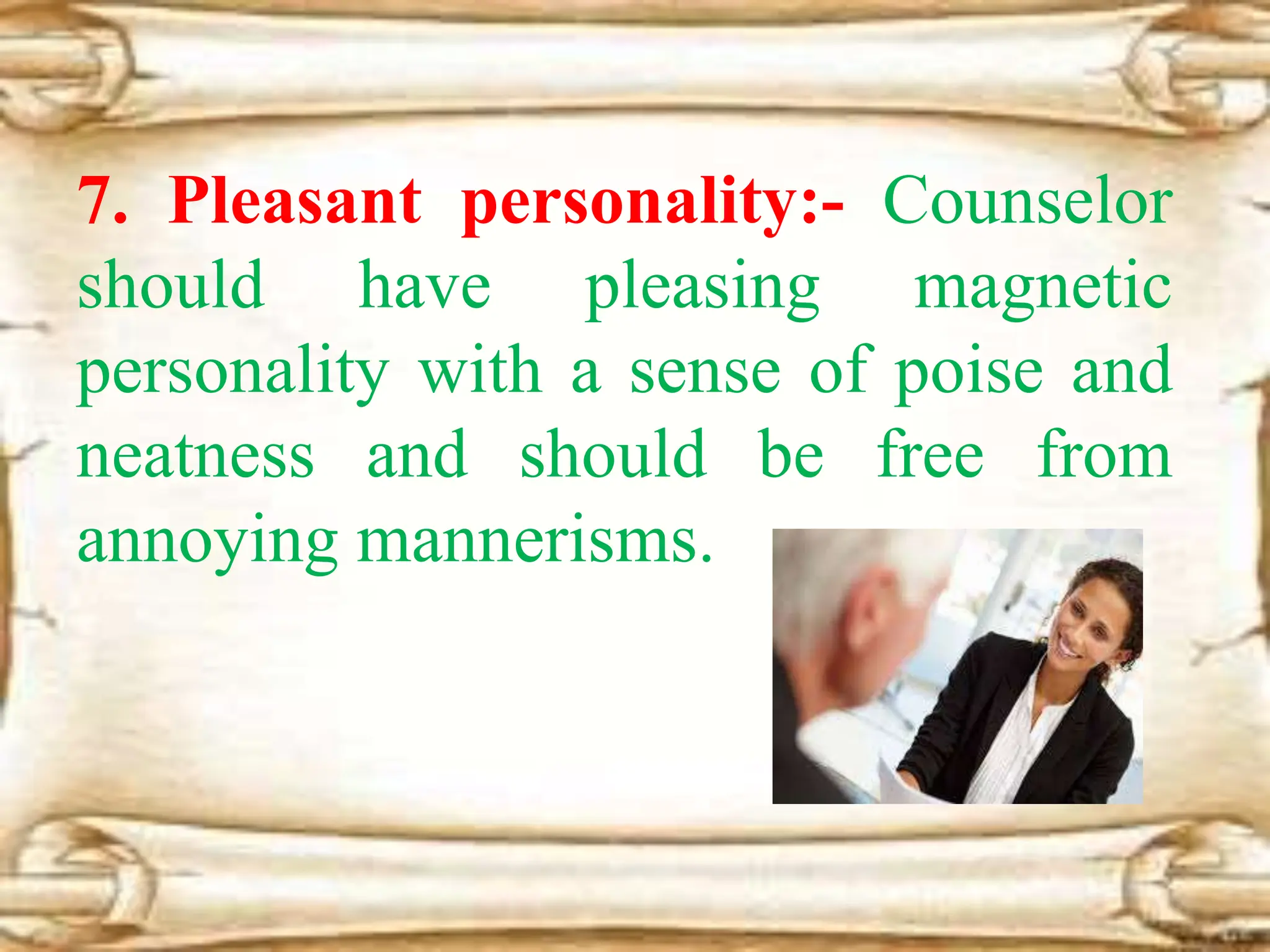
7. Pleasant personality:- Counselor
should have pleasing magnetic
personality with a sense of poise and
neatness and should be free from
annoying mannerisms.
8. Energetic: A counselor should be
highly energetic to deal with the
number of clients, emotionally
draining and physically demanding
situations which require a lot of
efforts and time.
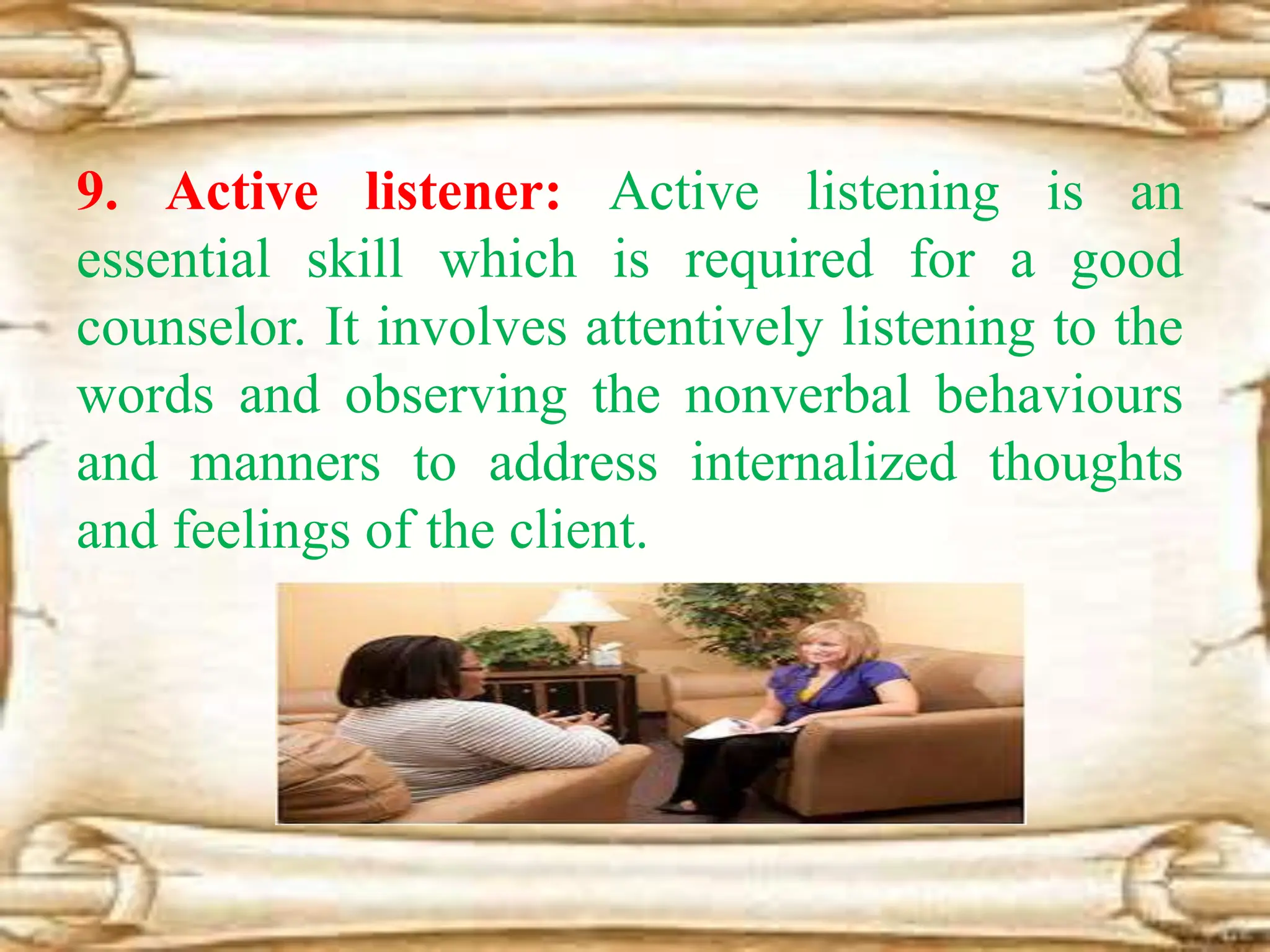
9. Active listener: Active listening is an
essential skill which is required for a good
counselor. It involves attentively listening to the
words and observing the nonverbal behaviours
and manners to address internalized thoughts
and feelings of the client.
10. Intellectual competence: It is a mandatory
requirement without which one cannot become
a professional counselor although, non-
professional counselor does not require any
degree or diploma but they must be
intellectually competent, have knowledge of
many areas of interest to handle variety of
situations presented by the counselee before
him.
11. Flexibility: Flexibility means ability to
change responses as per the demand of the
situation. A counselor should not be rigid to
follow the same line in all the situations rather
he should be flexible enough to adopt what is
workable in a given situation. For example,
While counseling a child who is relatively mute
will require different counseling strategies as
compared to a child who is relatively outspoken.
12. Philosophy of life: A good counsellor should have
a positive philosophy of life, good character and civic
sense. He should also have positive attitude towards
life.
13. Credibility and trustworthiness: Credibility can
be achieved by displaying consistency and honesty in
the statements and the actions. A credible counselor is
straightforward with their clients and behaves in such a
manner that their clients respect and trust their words.
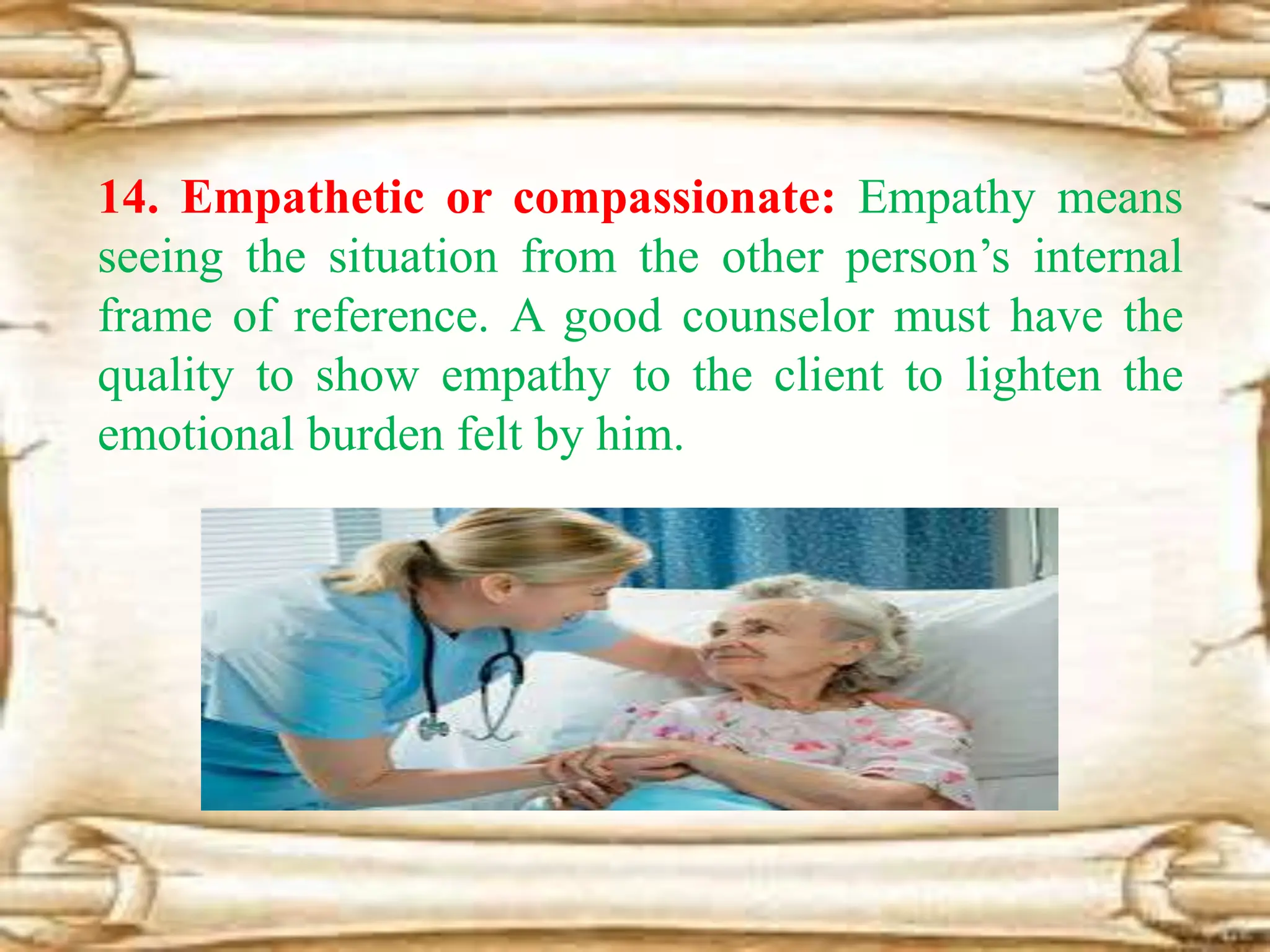
14. Empathetic or compassionate: Empathy means
seeing the situation from the other person’s internal
frame of reference. A good counselor must have the
quality to show empathy to the client to lighten the
emotional burden felt by him.
PROBLEMS IN COUNSELLING
1. Lack of knowledge on the part of counselor: Lack
of knowledge of the different areas of interest may pose
a difficulty for the counselor. A counselor who is not
through with the process, tools and techniques and basic
communication skills may not serve as an effective
counselor. It requires provision of in-service education
for the nursing faculty so that they can provide effective
guidance and counseling services for the nursing
students.
2. Personal values: It is mandatory for the
counselor that he should keep on hold his
personal values and preferences while providing
counseling to the students, but it is quite difficult
to achieve a satisfactory hold on the personal
values for most of the nursing faculties and they
impose the same on the counselee. Hence
compromising the effectiveness of the
counseling.
3. Lack of objectivity: Involvement of the subjectivity
in the counseling process by the counselor reduces its
effectiveness.
4. Lack of physical facilities and other resources:
Most of the nursing colleges are lacking in separate
physical facilities and provision of professional
guidance counselor which leads to disorganized and
ineffective delivery of the counseling services to the
students.
RESEARCH INPUT:
Effects of HIV Counseling and testing on Sexual Risk Behavior:
A Meta – Analytic Review of Published Research
Lance S. Weinhardt et al
It provides an effective means of secondary prevention for HIV
positive individuals, but as conducted in the reviewed studies, is
not an effective primary prevention strategy for uninfected
participants.Theory driven research with attention given to the
context of testing is needed to further explicate the determinants
of behavior change resulting from HIV counseling and testing
and the effectiveness of specific counseling approaches.
SUMMARIZATION:
 Introduction
 Definition
 Techniques for effective counseling
 Instruments for evaluation
- Interview
 Characteristics of a counselor
 Problems in counseling
 Research input
RECAPTUALIZATION:
• Define counseling
• Enlist the techniques for counseling
• What are the problems in counseling?
BIBLIOGRAPHY:
• Neeraja KP; “Textbook of Nursing Education”,
published by Jaypee, 1st edition, Pp 468-469,482-483.
• B Sankaranarayanan; “Learning and Teaching
Nursing”, published by Jaypee, 4th edition, Pp 244-246.
• Patidar Anuraj Bhai; “Communication and Nursing
Education”, published by Pearson, Pp 307-317.
• Basavanthappa BT; “Nursing education”, published by
Jaypee, Pp 886-888.
• www.ncbi.nlm.nih.gov
DIFFERENT TYPE OF TECHNIQUES OF COUNSELING.pptx

DIFFERENT TYPE OF TECHNIQUES OF COUNSELING.pptx

  • 1.
    TECHNIQUES OF COUNSELING SUBJECT:Nursing Education Prof.(Dr.) Virendra Singh Choudhary
  • 2.
    INTRODUCTION:- COUNSELING Guidance and counselingare not synonymous terms. Counseling is a part of guidance or it is a specialized service of guidance. It is an accepting, trusting and safe relationship in which client learns to discuss freely what upsets him.
  • 3.
    DEFINITION:- Counseling ismental learning process which involves two individuals, one seeking help and other a professionally trained person helping the first to orient and direct him towards a goal which leads to his maximum development and growth in his environment. - Willy and Andrew
  • 4.
    Counseling is thehelping relationship that includes some one seeking help, someone willing to give help, who is capable or trained to help, in a setting that permits help to be given and received”- Cormier and Hackney (1987)
  • 5.
    TECHNIQUES REQUIRED FOR EFFECTIVECOUNSELLING:- Counseling requires some skills on the part of the counselor to effectively counsel the client by exploring the problem situation and suggesting alternatives for the same. 1. Active Listening:- Easy to describe but difficult to practice it is the skill of listening to the client actively, attentively while maintaining eye to eye contact and at the same time, observing the nonverbal behaviour shown by the client. The technique of active listening includes:-
  • 6.
    • Maintaining goodeye to eye contact with client • Have open posture • Saying “carry on” ‘huhuu” “nodding the head to agree with the client statements” to encourage the client to speak more. • Don’t make any interruption in between when the client is talking • Ask questions whenever necessary to facilitate conversation.
  • 7.
    2. Reflecting:- Thecounselor refers back the questions, feelings and any other important statements to the client so that, he can assume that the counselor understands what he intends to understand him. 3. Focusing:- Spotlighting any idea or even a single word which seems to be significant for a given problem situation.
  • 8.
    4. Summarizing andParaphrasing:- It is the brief restatement and rewording in own words of the main points what the client has communicated to the counselor to clarify the meaning of message so that, the client can assume that the counselor has understood the crux of his problem as well as the counselor becomes sure that, he has understood what the counselee intends to communicate him.
  • 9.
    5. Empathy:- Empathyis a skill of putting yourself in to the shoe of other, means to think and feel a particular situation from the client’s frame of reference. Empathy to be communicated verbally, non-verbally or by a mixture of both.
  • 10.
    INSTRUMENTS FOR EVALUATION:- Interview:-It is the heart of the counseling process in which counselor and counselee meets face to face and conducts a formal talk with a definite purpose.  It serves the purpose of obtaining and giving information from and to the students as well as sometime, it may be useful tool for need assessment of the guidance and counseling services in a particular educational institute.
  • 11.
     It providesopportunity to the counselee to explore his conflicts, problems, learning difficulties so that the counselor can determine a plan of guidance for him.  Counselor can exploit this opportunity to gather background personal information about the student.  Interview should be well planned in advance to achieve desired outcomes.
  • 12.
    PROCEDURE FOR INTERVIEW:- 1.Preparation:- To eliminate unwanted responses and to achieve definite objective, preparation is essential. Interviewer has to decide what has to be accomplished, formulated goals or objectives for the interview. • Know the interviewee. • Fix an appointment. • Provide privacy. • Interviewer must see the interviewee’s point of view. • The interviewer must know the personality of the interviewee.
  • 13.
    2. The process:- •Establish rapport. • Help the interviewee feel at ease and ready to talk. • Help the interviewee to obtain and organize into a meaningful pattern of the information. • The interviewer should ask unambiguous questions, listen to the interviewee’s responses and he should have control over the interview. • In the closing phase of interview any additional information is needed, he can add in the remarks.
  • 14.
    3. Interpretation:- Thecounsellor has to listen to the client’s conversation and responses,he should distinguish between facts and fictions. Interpretation requires skill and great understanding. Interviewer has to interpret carefully the ideas, attitudes and responses of the interviewee.
  • 15.
    4. Developing insightinto the problems of counselee and put the action into a plan of work. 5. Recording of the total interview process is necessary for follow- up services and to take necessary plan of action.
  • 16.
    CHARACTERISTICS OF ACOUNSELOR:- 1.Leadership:- A good counselor should possess leadership qualities (ability to lead others) to direct and lead the process of counseling (directive approach).
  • 17.
    2. Interpersonal relationship:-Interpersonal relationship is pivotal for the success of counseling; therefore, a counselor should posses qualities of building effective interpersonal relationship, openness, attentive and active listener, friendliness, ability to show warmth and attitude of acceptance towards others, tactfulness, tolerance, patience and empathy.
  • 18.
    3. Nonjudgmental:- Counselor shouldbe non-judgmental. Making personal judgment of the situation dilutes the aim and effectiveness of the counseling.
  • 19.
    4. Personal values:-Counselor should be aware of his self (social, private, spiritual self), personal values, prejudices, belief, culture and attitude so that, counselor can put these factors on hold to develop an objective perspective of client’s situation.
  • 20.
    5. Communication skills:-More or less counseling is a communicative process which takes place between counselor and counselee; therefore, a counselor must have good communication skills.
  • 21.
    6. Respect forhuman being:- Counselor should be able to show due respect to the person being counseled without considering cast, creed, race, culture and personal preferences. He should be aware of and respect a person’s individuality in terms of unique values, attributes, and skills.
  • 22.
    7. Pleasant personality:-Counselor should have pleasing magnetic personality with a sense of poise and neatness and should be free from annoying mannerisms.
  • 23.
    8. Energetic: Acounselor should be highly energetic to deal with the number of clients, emotionally draining and physically demanding situations which require a lot of efforts and time.
  • 24.
    9. Active listener:Active listening is an essential skill which is required for a good counselor. It involves attentively listening to the words and observing the nonverbal behaviours and manners to address internalized thoughts and feelings of the client.
  • 25.
    10. Intellectual competence:It is a mandatory requirement without which one cannot become a professional counselor although, non- professional counselor does not require any degree or diploma but they must be intellectually competent, have knowledge of many areas of interest to handle variety of situations presented by the counselee before him.
  • 26.
    11. Flexibility: Flexibilitymeans ability to change responses as per the demand of the situation. A counselor should not be rigid to follow the same line in all the situations rather he should be flexible enough to adopt what is workable in a given situation. For example, While counseling a child who is relatively mute will require different counseling strategies as compared to a child who is relatively outspoken.
  • 27.
    12. Philosophy oflife: A good counsellor should have a positive philosophy of life, good character and civic sense. He should also have positive attitude towards life. 13. Credibility and trustworthiness: Credibility can be achieved by displaying consistency and honesty in the statements and the actions. A credible counselor is straightforward with their clients and behaves in such a manner that their clients respect and trust their words.
  • 28.
    14. Empathetic orcompassionate: Empathy means seeing the situation from the other person’s internal frame of reference. A good counselor must have the quality to show empathy to the client to lighten the emotional burden felt by him.
  • 29.
    PROBLEMS IN COUNSELLING 1.Lack of knowledge on the part of counselor: Lack of knowledge of the different areas of interest may pose a difficulty for the counselor. A counselor who is not through with the process, tools and techniques and basic communication skills may not serve as an effective counselor. It requires provision of in-service education for the nursing faculty so that they can provide effective guidance and counseling services for the nursing students.
  • 30.
    2. Personal values:It is mandatory for the counselor that he should keep on hold his personal values and preferences while providing counseling to the students, but it is quite difficult to achieve a satisfactory hold on the personal values for most of the nursing faculties and they impose the same on the counselee. Hence compromising the effectiveness of the counseling.
  • 31.
    3. Lack ofobjectivity: Involvement of the subjectivity in the counseling process by the counselor reduces its effectiveness. 4. Lack of physical facilities and other resources: Most of the nursing colleges are lacking in separate physical facilities and provision of professional guidance counselor which leads to disorganized and ineffective delivery of the counseling services to the students.
  • 32.
    RESEARCH INPUT: Effects ofHIV Counseling and testing on Sexual Risk Behavior: A Meta – Analytic Review of Published Research Lance S. Weinhardt et al It provides an effective means of secondary prevention for HIV positive individuals, but as conducted in the reviewed studies, is not an effective primary prevention strategy for uninfected participants.Theory driven research with attention given to the context of testing is needed to further explicate the determinants of behavior change resulting from HIV counseling and testing and the effectiveness of specific counseling approaches.
  • 33.
    SUMMARIZATION:  Introduction  Definition Techniques for effective counseling  Instruments for evaluation - Interview  Characteristics of a counselor  Problems in counseling  Research input
  • 34.
    RECAPTUALIZATION: • Define counseling •Enlist the techniques for counseling • What are the problems in counseling?
  • 35.
    BIBLIOGRAPHY: • Neeraja KP;“Textbook of Nursing Education”, published by Jaypee, 1st edition, Pp 468-469,482-483. • B Sankaranarayanan; “Learning and Teaching Nursing”, published by Jaypee, 4th edition, Pp 244-246. • Patidar Anuraj Bhai; “Communication and Nursing Education”, published by Pearson, Pp 307-317. • Basavanthappa BT; “Nursing education”, published by Jaypee, Pp 886-888. • www.ncbi.nlm.nih.gov