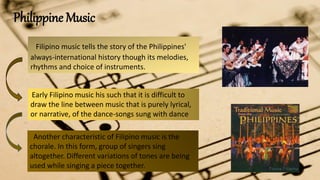
Filipino music tells the story of the Philippines'
always-international history though its melodies,
rhythms and choice of instruments.
Early Filipino music his such that it is difficult to
draw the line between music that is purely lyrical,
or narrative, of the dance-songs sung with dance
Philippine Music
Another characteristic of Filipino music is the
chorale. In this form, group of singers sing
altogether. Different variations of tones are being
used while singing a piece together.
Philippine contemporary music
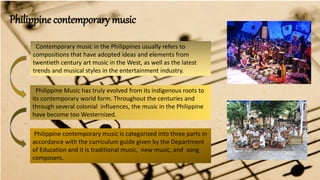
Contemporary music in the Philippines usually refers to
compositions that have adopted ideas and elements from
twentieth century art music in the West, as well as the latest
trends and musical styles in the entertainment industry.
Philippine Music has truly evolved from its indigenous roots to
its contemporary world form. Throughout the centuries and
through several colonial influences, the music in the Philippine
have become too Westernized.
Philippine contemporary music is categorized into three parts in
accordance with the curriculum guide given by the Department
of Education and it is traditional music, new music, and song
composers.
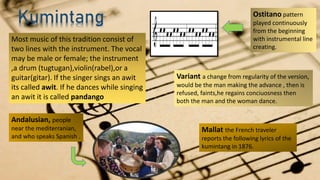
Kumintang
The kumintang is the name given to several distinct. styles,
techniques and forms in music and dance. originating in the areas
used by early Spanish. cartographers and chronicles to denote a
large. province centering around what is known as Batangas.
The kumintang is an indigenous courtship or bridal song
that shares the same sense of heart and passion. Many
people oftentimes confuse harana and kundiman.
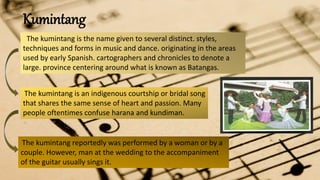
The kumintang reportedly was performed by a woman or by a
couple. However, man at the wedding to the accompaniment
of the guitar usually sings it.
Variant a change from regularity of the version,
would be the man making the advance , then is
refused, faints,he regains conciuosness then
both the man and the woman dance.
Kumintang
Andalusian, people
near the mediterranian,
and who speaks Spanish .
Mallat the French traveler
reports the following lyrics of the
kumintang in 1876.
Ostitano pattern
played continuously
from the beginning
with instrumental line
creating.
Most music of this tradition consist of
two lines with the instrument. The vocal
may be male or female; the instrument
,a drum (tugtugan),violin(rabel),or a
guitar(gitar). If the singer sings an awit
its called awit. If he dances while singing
an awit it is called pandango
Traditional LowlandFilipino music
Diuna -work , nuptial song
Talingdao-similar to the pandanggo
Soliranin- sad,monotonous song sung on hot days
Dolanin- merry song of love,nuptial song
Hila-hila- bangca song with question and answer
Manigpasin- similar to
munera,sequidillas,manchegas,galacian group
songs with questions and answer.
Oyayi- cradle song
Halohoo- andante songs
Umbay- sentimental songs sung by orphan,or
by,the stick
Umiguing- song of of dressmakers
Ombayi- funeral songs sung by relatives
Sambitan- funeral song sung by relatives
Sambotani- feast songs a accompanied by
shouting,clapping and the kudyapi
Tagumpay- victory songs (also dipaginin)
Hiliraw- sweet chorus songs,recreational songs
Tagulaylay- song of grief brought by war or love
Tadek- love dance
Paujulay- wedding dance
Mahinhin- courtship dance
Hele-hele- lullaby
Dadansoy- dance of wine,gatherers
Danza- modern love song
Kumintang- and the kundiman are treated
separately and in more detasil
Villancio
A gladsome song, characterized by a perky rhythm emphasized by
three accompanying instruments: castanets, triangle, and guitar.
Rhytmic villancio may e distinguish from another Spanish carols from
which is the lullaby. Although this style did not take deep root in the
Philippines, the Spanish carol has endearing charms.
Villancio often highlighted by the pure notes of the triangle and
with words suffused with the tender, simple feeling og country
folks
Contemporary peasant songs
Mondaza is the art of singing resorted by the
peasant when cleaning the rice fields of weeds or
doing any work requiring collective effort.
Composo is narrative song form song
introduced by the following lines
Esmayling is a balitaw song form,
whichworks like a poetic with two singers
discoursing on a subject from different view
points
Ako po ay tabi
at ako ay babati
Huwag mamumuno
Lawit ang buhawi
Na mga kasama
O mga senyores ,pamatii ninyo
Akon iga-asoy ini nga composo
Iday man iniabat inin
Kasing kasing ko
A balitaw song form, which works like a poetic with two singers
discoursing on a subject from different view points.
Esmayling
These song are heard at mas actions ,rallies,demonstration againt military
oppression,confrontation meetings against oppressive landlords,at military training session
educational meetings, and anniversary celebration,and during festivities as wedding and
victories.
• Madaling araw (Santiago)
• Anak ng Dalita(Santiago)
• Bituing Marikit(Music by Abelardo)
• Kundiman ng 1800 (Folk Kundiman)
• Himutok (Music by Abelardo)
• Awit ng Magsasaka( Martsa) Dalagang Filipina(Balitaw)
• Mariposa-Aliparo(1899)(Danza)
Religious influence on the Philippine music
The Augustinian fathers introduced varied chants, the
Benedictiones emphasized the uplifting Gregorian chant .
They prepare solfeggio for church function.
In 1601,the Augustinian Fathes of liliw Laguna organized there
own orchestra. In 1653,Fr. Juan de Torres brought some musical
instrument from spain and organized another orchestra in Manila.
In 1870 Fr, Toribio Vargas organized the orchestra which directed
by Marcelo Admay.
From the early period of Christianity ,masses in parish
churches were accompanied by orchestral and at
times,even brass bands.
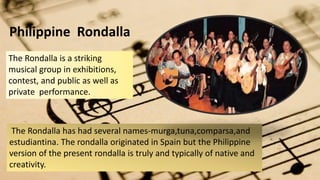
Philippine Rondalla
The Rondalla has had several names-murga,tuna,comparsa,and
estudiantina. The rondalla originated in Spain but the Philippine
version of the present rondalla is truly and typically of native and
creativity.
The Rondalla is a striking
musical group in exhibitions,
contest, and public as well as
private performance.
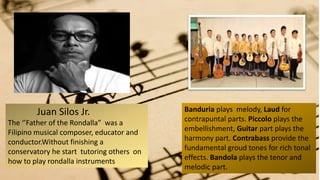
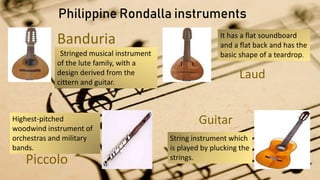
Banduria plays melody, Laud for
contrapuntal parts. Piccolo plays the
embellishment, Guitar part plays the
harmony part. Contrabass provide the
fundamental groud tones for rich tonal
effects. Bandola plays the tenor and
melodic part.
Juan Silos Jr.
The ‘’Father of the Rondalla” was a
Filipino musical composer, educator and
conductor.Without finishing a
conservatory he start tutoring others on
how to play rondalla instruments
Philippine Rondalla instruments
Stringed musical instrument
of the lute family, with a
design derived from the
cittern and guitar.
It has a flat soundboard
and a flat back and has the
basic shape of a teardrop.
Banduria
Laud
Piccolo
Highest-pitched
woodwind instrument of
orchestras and military
bands.
String instrument which
is played by plucking the
strings.
Guitar
Philippine Rondalla Instrument
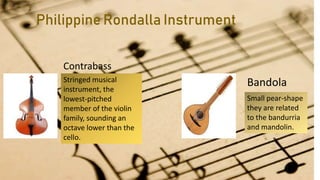
Contrabass
Stringed musical
instrument, the
lowest-pitched
member of the violin
family, sounding an
octave lower than the
cello.
Small pear-shape
they are related
to the bandurria
and mandolin.
Bandola
The Guitar
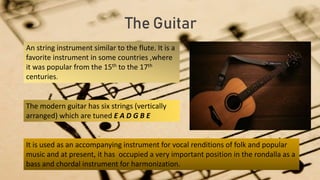
An string instrument similar to the flute. It is a
favorite instrument in some countries ,where
it was popular from the 15th to the 17th
centuries.
The modern guitar has six strings (vertically
arranged) which are tuned E A D G B E
It is used as an accompanying instrument for vocal renditions of folk and popular
music and at present, it has occupied a very important position in the rondalla as a
bass and chordal instrument for harmonization.
Fundamentalparts of guitar
The headstock sits at the
top of the neck (opposite
the body) where the tuning
machines and nut are
installed.
The neck of a guitar is the
long, thin piece of wood
between the headstock and
the body where you’ll find
the fretboard, frets, and
truss rod. Necks are typically
attached to the body with
bolts, glue, or sometimes
both.
The body of your guitar plays a
large part in the tonal
characteristics of your instrument.
Let’s take a look at the parts of the
guitar body and then highlight some
of the similarities and differences
between an acoustic and electric
guitar body.
[
]
[
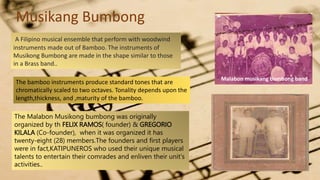
A Filipino musical ensemble that perform with woodwind
instruments made out of Bamboo. The instruments of
Musikong Bumbong are made in the shape similar to those
in a Brass band..
The bamboo instruments produce standard tones that are
chromatically scaled to two octaves. Tonality depends upon the
length,thickness, and ,maturity of the bamboo.
The Malabon Musikong bumbong was originally
organized by th FELIX RAMOS( founder) & GREGORIO
KILALA (Co-founder), when it was organized it has
twenty-eight (28) members.The founders and first players
were in fact,KATIPUNEROS who used their unique musical
talents to entertain their comrades and enliven their unit's
activities..
Musikang Bumbong
Malabon musikang bumbong band
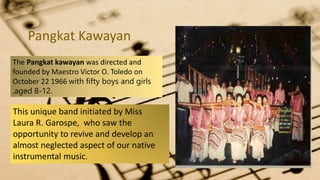
Pangkat Kawayan
The Pangkat kawayan was directed and
founded by Maestro Victor O. Toledo on
October 22 1966 with fifty boys and girls
,aged 8-12.
This unique band initiated by Miss
Laura R. Garospe, who saw the
opportunity to revive and develop an
almost neglected aspect of our native
instrumental music.
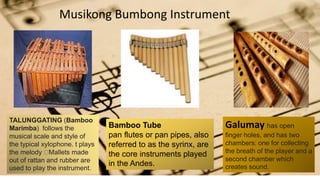
Musikong Bumbong Instrument
TALUNGGATING (Bamboo
Marimba) follows the
musical scale and style of
the typical xylophone. t plays
the melody Mallets made
out of rattan and rubber are
used to play the instrument.
Bamboo Tube
pan flutes or pan pipes, also
referred to as the syrinx, are
the core instruments played
in the Andes.
Galumay has open
finger holes, and has two
chambers: one for collecting
the breath of the player and a
second chamber which
creates sound.
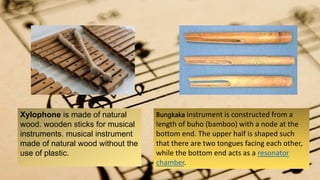
Xylophone is made of natural
wood. wooden sticks for musical
instruments. musical instrument
made of natural wood without the
use of plastic.
Bungkaka instrument is constructed from a
length of buho (bamboo) with a node at the
bottom end. The upper half is shaped such
that there are two tongues facing each other,
while the bottom end acts as a resonator
chamber.
THANK YOU

Different Music Types in the Philippines

  • 2.
    Filipino music tellsthe story of the Philippines' always-international history though its melodies, rhythms and choice of instruments. Early Filipino music his such that it is difficult to draw the line between music that is purely lyrical, or narrative, of the dance-songs sung with dance Philippine Music Another characteristic of Filipino music is the chorale. In this form, group of singers sing altogether. Different variations of tones are being used while singing a piece together.
  • 3.
    Philippine contemporary music Contemporarymusic in the Philippines usually refers to compositions that have adopted ideas and elements from twentieth century art music in the West, as well as the latest trends and musical styles in the entertainment industry. Philippine Music has truly evolved from its indigenous roots to its contemporary world form. Throughout the centuries and through several colonial influences, the music in the Philippine have become too Westernized. Philippine contemporary music is categorized into three parts in accordance with the curriculum guide given by the Department of Education and it is traditional music, new music, and song composers.
  • 4.
    Kumintang The kumintang isthe name given to several distinct. styles, techniques and forms in music and dance. originating in the areas used by early Spanish. cartographers and chronicles to denote a large. province centering around what is known as Batangas. The kumintang is an indigenous courtship or bridal song that shares the same sense of heart and passion. Many people oftentimes confuse harana and kundiman. The kumintang reportedly was performed by a woman or by a couple. However, man at the wedding to the accompaniment of the guitar usually sings it.
  • 5.
    Variant a changefrom regularity of the version, would be the man making the advance , then is refused, faints,he regains conciuosness then both the man and the woman dance. Kumintang Andalusian, people near the mediterranian, and who speaks Spanish . Mallat the French traveler reports the following lyrics of the kumintang in 1876. Ostitano pattern played continuously from the beginning with instrumental line creating. Most music of this tradition consist of two lines with the instrument. The vocal may be male or female; the instrument ,a drum (tugtugan),violin(rabel),or a guitar(gitar). If the singer sings an awit its called awit. If he dances while singing an awit it is called pandango
  • 6.
    Traditional LowlandFilipino music Diuna-work , nuptial song Talingdao-similar to the pandanggo Soliranin- sad,monotonous song sung on hot days Dolanin- merry song of love,nuptial song Hila-hila- bangca song with question and answer Manigpasin- similar to munera,sequidillas,manchegas,galacian group songs with questions and answer. Oyayi- cradle song Halohoo- andante songs Umbay- sentimental songs sung by orphan,or by,the stick Umiguing- song of of dressmakers Ombayi- funeral songs sung by relatives Sambitan- funeral song sung by relatives Sambotani- feast songs a accompanied by shouting,clapping and the kudyapi Tagumpay- victory songs (also dipaginin) Hiliraw- sweet chorus songs,recreational songs Tagulaylay- song of grief brought by war or love Tadek- love dance Paujulay- wedding dance Mahinhin- courtship dance Hele-hele- lullaby Dadansoy- dance of wine,gatherers Danza- modern love song Kumintang- and the kundiman are treated separately and in more detasil
  • 7.
    Villancio A gladsome song,characterized by a perky rhythm emphasized by three accompanying instruments: castanets, triangle, and guitar. Rhytmic villancio may e distinguish from another Spanish carols from which is the lullaby. Although this style did not take deep root in the Philippines, the Spanish carol has endearing charms. Villancio often highlighted by the pure notes of the triangle and with words suffused with the tender, simple feeling og country folks
  • 8.
    Contemporary peasant songs Mondazais the art of singing resorted by the peasant when cleaning the rice fields of weeds or doing any work requiring collective effort. Composo is narrative song form song introduced by the following lines Esmayling is a balitaw song form, whichworks like a poetic with two singers discoursing on a subject from different view points Ako po ay tabi at ako ay babati Huwag mamumuno Lawit ang buhawi Na mga kasama O mga senyores ,pamatii ninyo Akon iga-asoy ini nga composo Iday man iniabat inin Kasing kasing ko
  • 9.
    A balitaw songform, which works like a poetic with two singers discoursing on a subject from different view points. Esmayling These song are heard at mas actions ,rallies,demonstration againt military oppression,confrontation meetings against oppressive landlords,at military training session educational meetings, and anniversary celebration,and during festivities as wedding and victories. • Madaling araw (Santiago) • Anak ng Dalita(Santiago) • Bituing Marikit(Music by Abelardo) • Kundiman ng 1800 (Folk Kundiman) • Himutok (Music by Abelardo) • Awit ng Magsasaka( Martsa) Dalagang Filipina(Balitaw) • Mariposa-Aliparo(1899)(Danza)
  • 10.
    Religious influence onthe Philippine music The Augustinian fathers introduced varied chants, the Benedictiones emphasized the uplifting Gregorian chant . They prepare solfeggio for church function. In 1601,the Augustinian Fathes of liliw Laguna organized there own orchestra. In 1653,Fr. Juan de Torres brought some musical instrument from spain and organized another orchestra in Manila. In 1870 Fr, Toribio Vargas organized the orchestra which directed by Marcelo Admay. From the early period of Christianity ,masses in parish churches were accompanied by orchestral and at times,even brass bands.
  • 11.
    Philippine Rondalla The Rondallahas had several names-murga,tuna,comparsa,and estudiantina. The rondalla originated in Spain but the Philippine version of the present rondalla is truly and typically of native and creativity. The Rondalla is a striking musical group in exhibitions, contest, and public as well as private performance.
  • 12.
    Banduria plays melody,Laud for contrapuntal parts. Piccolo plays the embellishment, Guitar part plays the harmony part. Contrabass provide the fundamental groud tones for rich tonal effects. Bandola plays the tenor and melodic part. Juan Silos Jr. The ‘’Father of the Rondalla” was a Filipino musical composer, educator and conductor.Without finishing a conservatory he start tutoring others on how to play rondalla instruments
  • 13.
    Philippine Rondalla instruments Stringedmusical instrument of the lute family, with a design derived from the cittern and guitar. It has a flat soundboard and a flat back and has the basic shape of a teardrop. Banduria Laud Piccolo Highest-pitched woodwind instrument of orchestras and military bands. String instrument which is played by plucking the strings. Guitar
  • 14.
    Philippine Rondalla Instrument Contrabass Stringedmusical instrument, the lowest-pitched member of the violin family, sounding an octave lower than the cello. Small pear-shape they are related to the bandurria and mandolin. Bandola
  • 15.
    The Guitar An stringinstrument similar to the flute. It is a favorite instrument in some countries ,where it was popular from the 15th to the 17th centuries. The modern guitar has six strings (vertically arranged) which are tuned E A D G B E It is used as an accompanying instrument for vocal renditions of folk and popular music and at present, it has occupied a very important position in the rondalla as a bass and chordal instrument for harmonization.
  • 16.
    Fundamentalparts of guitar Theheadstock sits at the top of the neck (opposite the body) where the tuning machines and nut are installed. The neck of a guitar is the long, thin piece of wood between the headstock and the body where you’ll find the fretboard, frets, and truss rod. Necks are typically attached to the body with bolts, glue, or sometimes both. The body of your guitar plays a large part in the tonal characteristics of your instrument. Let’s take a look at the parts of the guitar body and then highlight some of the similarities and differences between an acoustic and electric guitar body. [ ] [
  • 17.
    A Filipino musicalensemble that perform with woodwind instruments made out of Bamboo. The instruments of Musikong Bumbong are made in the shape similar to those in a Brass band.. The bamboo instruments produce standard tones that are chromatically scaled to two octaves. Tonality depends upon the length,thickness, and ,maturity of the bamboo. The Malabon Musikong bumbong was originally organized by th FELIX RAMOS( founder) & GREGORIO KILALA (Co-founder), when it was organized it has twenty-eight (28) members.The founders and first players were in fact,KATIPUNEROS who used their unique musical talents to entertain their comrades and enliven their unit's activities.. Musikang Bumbong Malabon musikang bumbong band
  • 18.
    Pangkat Kawayan The Pangkatkawayan was directed and founded by Maestro Victor O. Toledo on October 22 1966 with fifty boys and girls ,aged 8-12. This unique band initiated by Miss Laura R. Garospe, who saw the opportunity to revive and develop an almost neglected aspect of our native instrumental music.
  • 19.
    Musikong Bumbong Instrument TALUNGGATING(Bamboo Marimba) follows the musical scale and style of the typical xylophone. t plays the melody Mallets made out of rattan and rubber are used to play the instrument. Bamboo Tube pan flutes or pan pipes, also referred to as the syrinx, are the core instruments played in the Andes. Galumay has open finger holes, and has two chambers: one for collecting the breath of the player and a second chamber which creates sound.
  • 20.
    Xylophone is madeof natural wood. wooden sticks for musical instruments. musical instrument made of natural wood without the use of plastic. Bungkaka instrument is constructed from a length of buho (bamboo) with a node at the bottom end. The upper half is shaped such that there are two tongues facing each other, while the bottom end acts as a resonator chamber.
  • 21.