Diction & HaikuWriting Workshop #3
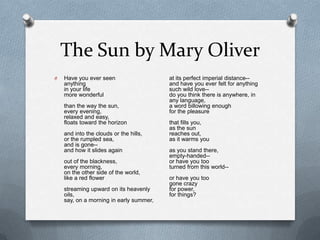
The Sun by Mary OliverHave you ever seen anything in your life more wonderful than the way the sun, every evening, relaxed and easy, floats toward the horizon and into the clouds or the hills, or the rumpled sea, and is gone-- and how it slides again out of the blackness, every morning, on the other side of the world, like a red flower streaming upward on its heavenly oils, say, on a morning in early summer, at its perfect imperial distance-- and have you ever felt for anything such wild love-- do you think there is anywhere, in any language, a word billowing enough for the pleasure that fills you, as the sun reaches out, as it warms you as you stand there, empty-handed-- or have you too turned from this world-- or have you too gone crazy for power, for things?
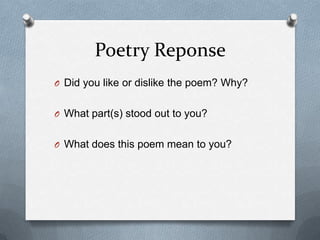
Poetry ReponseDid you like or dislike the poem? Why?What part(s) stood out to you?What does this poem mean to you?
Word PoolDiction: Word ChoiceHaiku: an unrhymed poem of Japanese originSyllable: a unit of spoken language(The word syll-a-ble has 3. How many does your name have?)Insight: the power or act of seeing into a situation
Writing Warm UpZen Meditation Image CardsStream of Consciousness free write
Contemporary HaikuUse of three (or fewer) lines of 17 or fewer syllables. Maybe 5-7-5, maybe not.Use of imagery (like a season word)Contrast and compare two events, images or situationsTraditional Japanese haiku focuses on nature and the place of humans in it. Modern haiku poets, both in Japan and the West, consider a broader range of subject matter suitable, including urban contexts.
Seasonal ImageryWinter = burden, cold, sadness, hunger, tranquility or peace. Use words like "snow," "ice," "dead tree," "leafless," etc.Summer= feelings of warmth, vibrancy, love, anger, temptation, etc. Use imagery of the sky, beaches, heat, or romance.Autumn = decay, belief in the supernatural, jealousy, saying goodbye, loss, regret. Use images like falling leaves, shadows and autumn colors.Spring =innocence, youth, passion and fickleness. Anything with blossoms, new plantsand warm rains can imply spring.
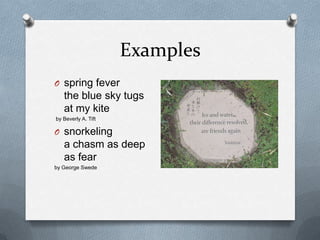
Examplesspring feverthe blue sky tugsat my kiteby Beverly A. Tiftsnorkelinga chasm as deepas fearby George Swede
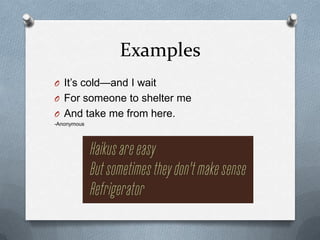
ExamplesIt’s cold—and I waitFor someone to shelter meAnd take me from here.-Anonymous
Nature WalkGuidelines for Walking MeditationWalk alone and in silence.We will wander and wonder for 15 minutes.Bring your notebook and pen with you!Write down words or phrases that could be used in your haiku.When you hear the chime, walk to Ms. Fajkus so we can go back inside.
HomeworkWrite and illustrate one (1) haiku. Take your time; choose your words carefully. Write or type it neatly on a half-sheet of blank white paper. Turn it in at the beginning of the next workshop.The best ones will go up on the wall for all to see.

Diction and Haiku

  • 1.
  • 2.
    The Sun byMary OliverHave you ever seen anything in your life more wonderful than the way the sun, every evening, relaxed and easy, floats toward the horizon and into the clouds or the hills, or the rumpled sea, and is gone-- and how it slides again out of the blackness, every morning, on the other side of the world, like a red flower streaming upward on its heavenly oils, say, on a morning in early summer, at its perfect imperial distance-- and have you ever felt for anything such wild love-- do you think there is anywhere, in any language, a word billowing enough for the pleasure that fills you, as the sun reaches out, as it warms you as you stand there, empty-handed-- or have you too turned from this world-- or have you too gone crazy for power, for things?
  • 3.
    Poetry ReponseDid youlike or dislike the poem? Why?What part(s) stood out to you?What does this poem mean to you?
  • 4.
    Word PoolDiction: WordChoiceHaiku: an unrhymed poem of Japanese originSyllable: a unit of spoken language(The word syll-a-ble has 3. How many does your name have?)Insight: the power or act of seeing into a situation
  • 5.
    Writing Warm UpZenMeditation Image CardsStream of Consciousness free write
  • 6.
    Contemporary HaikuUse ofthree (or fewer) lines of 17 or fewer syllables. Maybe 5-7-5, maybe not.Use of imagery (like a season word)Contrast and compare two events, images or situationsTraditional Japanese haiku focuses on nature and the place of humans in it. Modern haiku poets, both in Japan and the West, consider a broader range of subject matter suitable, including urban contexts.
  • 7.
    Seasonal ImageryWinter =burden, cold, sadness, hunger, tranquility or peace. Use words like "snow," "ice," "dead tree," "leafless," etc.Summer= feelings of warmth, vibrancy, love, anger, temptation, etc. Use imagery of the sky, beaches, heat, or romance.Autumn = decay, belief in the supernatural, jealousy, saying goodbye, loss, regret. Use images like falling leaves, shadows and autumn colors.Spring =innocence, youth, passion and fickleness. Anything with blossoms, new plantsand warm rains can imply spring.
  • 8.
    Examplesspring feverthe bluesky tugsat my kiteby Beverly A. Tiftsnorkelinga chasm as deepas fearby George Swede
  • 9.
    ExamplesIt’s cold—and IwaitFor someone to shelter meAnd take me from here.-Anonymous
  • 10.
    Nature WalkGuidelines forWalking MeditationWalk alone and in silence.We will wander and wonder for 15 minutes.Bring your notebook and pen with you!Write down words or phrases that could be used in your haiku.When you hear the chime, walk to Ms. Fajkus so we can go back inside.
  • 11.
    HomeworkWrite and illustrateone (1) haiku. Take your time; choose your words carefully. Write or type it neatly on a half-sheet of blank white paper. Turn it in at the beginning of the next workshop.The best ones will go up on the wall for all to see.