By Sherry Salant
Communication Arts 10-12 grade
 Missouri Standards                              3
Difference between Poetry and Prose               4
Where did it Begin?                               5
Rules of the Haiku                                 6

Talk the talk of a Haiku                           7

Examples of Haikus                               9-11

Write you own Haiku                             12-13
Questions and Answers                                 14
                                      The Haiku/S.Salant   2
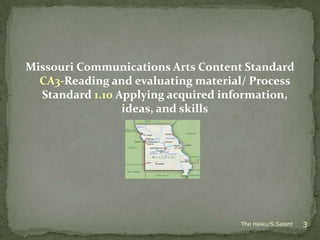
Missouri Communications Arts Content Standard
  CA3-Reading and evaluating material/ Process
  Standard 1.10 Applying acquired information,
                 ideas, and skills


                                    The Haiku/S.Salant   3
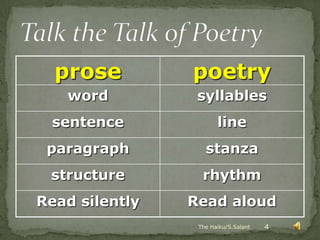
prose         poetry
   word          syllables
 sentence              line
 paragraph         stanza
 structure        rhythm
Read silently   Read aloud
                 The Haiku/S.Salant   4
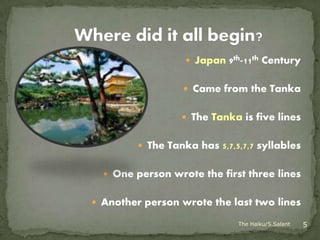
 Japan 9th-11th Century


                   Came from the Tanka


                   The Tanka is five lines


          The Tanka has 5,7,5,7,7 syllables


   One person wrote the first three lines


 Another person wrote the last two lines

                              The Haiku/S.Salant   5
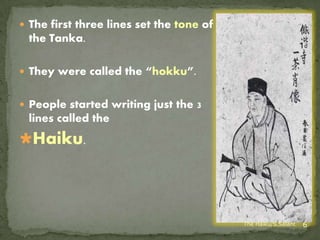
 The first three lines set the tone of
 the Tanka.

 They were called the “hokku”.


 People started writing just the 3
 lines called the
Haiku.


                                          The Haiku/S.Salant   6
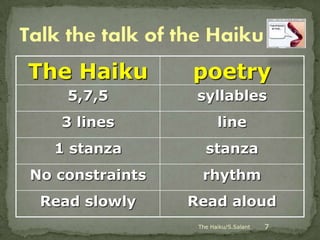
The Haiku        poetry
    5,7,5         syllables
   3 lines              line
  1 stanza          stanza
No constraints     rhythm
 Read slowly     Read aloud
                  The Haiku/S.Salant   7
 Three lines 5,7,5
 A moment in time captured like a photo
 A moment in nature or human nature
 The first line or two is the image
 The last line or two explains how you feel about
  it
        Precipitation
        Brings more anticipation
        And contemplation.
                                        The Haiku/S.Salant   8
The Haiku/S.Salant   9
The Haiku/S.Salant   10
The Haiku/S.Salant   11
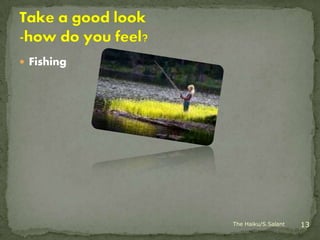
Start with a photo
     Tell me what you see
     Listen to the syllables
How do you feel about the image?
       Let’s try this one …
 Fishing


            The Haiku/S.Salant   13
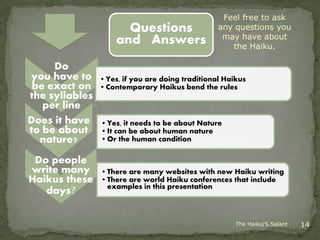
Feel free to ask
                      Questions                   any questions you
                                                   may have about
                    and Answers                      the Haiku.

     Do
you have to     • Yes, if you are doing traditional Haikus
 be exact on    • Contemporary Haikus bend the rules
the syllables
   per line
Does it have    • Yes, it needs to be about Nature
to be about     • It can be about human nature
  nature?       • Or the human condition

 Do people
write many      • There are many websites with new Haiku writing
Haikus these    • There are world Haiku conferences that include
                  examples in this presentation
   days?


                                                       The Haiku/S.Salant   14
All images were retrieved from
      Google.com/images Web 01/08/10

Hass, Robert, ed., The Essential Haiku: Versions of Basho,
      Buson, & Issa. Hopewell, NJ.: The Ecco Press., 1994.

 haikumom. (2009). haiku northwest seabeck retreat 2009
      [video]. Retrieved January 10, 2010 from
      http://www.youtube.com/watch?v=WMKA14Imqzw

Patterns in Poetry retrieved from
       www.cranberrydesigns.com/poetry/haiku/history.htm
 skipperoohoo. (2009). haikus [video]. Retrieved January 10,
                                                       2010 from
      ww.youtube.com/watch?v=CLX3cS14zs&feature=player_embedded


                                                             The Haiku/S.Salant   15

The Haikufinaljan11

  • 1.
  • 2.
     Missouri Standards 3 Difference between Poetry and Prose 4 Where did it Begin? 5 Rules of the Haiku 6 Talk the talk of a Haiku 7 Examples of Haikus 9-11 Write you own Haiku 12-13 Questions and Answers 14 The Haiku/S.Salant 2
  • 3.
    Missouri Communications ArtsContent Standard CA3-Reading and evaluating material/ Process Standard 1.10 Applying acquired information, ideas, and skills The Haiku/S.Salant 3
  • 4.
    prose poetry word syllables sentence line paragraph stanza structure rhythm Read silently Read aloud The Haiku/S.Salant 4
  • 5.
     Japan 9th-11thCentury  Came from the Tanka  The Tanka is five lines  The Tanka has 5,7,5,7,7 syllables  One person wrote the first three lines  Another person wrote the last two lines The Haiku/S.Salant 5
  • 6.
     The firstthree lines set the tone of the Tanka.  They were called the “hokku”.  People started writing just the 3 lines called the Haiku. The Haiku/S.Salant 6
  • 7.
    The Haiku poetry 5,7,5 syllables 3 lines line 1 stanza stanza No constraints rhythm Read slowly Read aloud The Haiku/S.Salant 7
  • 8.
     Three lines5,7,5  A moment in time captured like a photo  A moment in nature or human nature  The first line or two is the image  The last line or two explains how you feel about it Precipitation Brings more anticipation And contemplation. The Haiku/S.Salant 8
  • 9.
  • 10.
  • 11.
  • 12.
    Start with aphoto Tell me what you see Listen to the syllables How do you feel about the image? Let’s try this one …
  • 13.
     Fishing The Haiku/S.Salant 13
  • 14.
    Feel free toask Questions any questions you may have about and Answers the Haiku. Do you have to • Yes, if you are doing traditional Haikus be exact on • Contemporary Haikus bend the rules the syllables per line Does it have • Yes, it needs to be about Nature to be about • It can be about human nature nature? • Or the human condition Do people write many • There are many websites with new Haiku writing Haikus these • There are world Haiku conferences that include examples in this presentation days? The Haiku/S.Salant 14
  • 15.
    All images wereretrieved from Google.com/images Web 01/08/10 Hass, Robert, ed., The Essential Haiku: Versions of Basho, Buson, & Issa. Hopewell, NJ.: The Ecco Press., 1994.  haikumom. (2009). haiku northwest seabeck retreat 2009  [video]. Retrieved January 10, 2010 from  http://www.youtube.com/watch?v=WMKA14Imqzw Patterns in Poetry retrieved from www.cranberrydesigns.com/poetry/haiku/history.htm  skipperoohoo. (2009). haikus [video]. Retrieved January 10, 2010 from  ww.youtube.com/watch?v=CLX3cS14zs&feature=player_embedded The Haiku/S.Salant 15

Editor's Notes

  • #3 Just click on each topic and you can go directly to the slide.
  • #8 Now that we know the rules of poetry. Here they are in terms of the Haiku.
  • #10 These are some Haikus that are on Youtube. They are very traditional in style.
  • #11 These Haiku writers are reciting their own Haikus. These are regular people who write poetry.
  • #12 I wrote this Haiku when I took my first creative writing class at Parkway Central.
  • #14 Remember, the first line is five syllables of this moment in time. The next line is 7 syllables and the last line is another five syllables. In the last two line or in the last line, tell me how you feel about this image.
  • #15 These are the most often asked questions about Haikus.
  • #16 Are there any questions? I will be happy to discuss this with you after class. Thank you.