DIAGRAMMING SENTENCES
Diagramming sentences provides a way of picturing the
structure of a sentence. By placing the various parts of a
sentence in relation to the basic subject-verb relationship, we
can see how the parts fit together and how the meaning of a
sentence branches out, just as the branches of a plant ramify
from the stem in space and time. Most students who work at
diagramming sentences derive a clearer understanding of how
sentences work — as well as satisfaction in the pictorial
rendering of sentence structure. This presentation touches
upon only the basics of diagramming. Use the hyperlinks back
to the Guide to Grammar and Writing (this color) for
additional information.
DIAGRAMMING SENTENCES
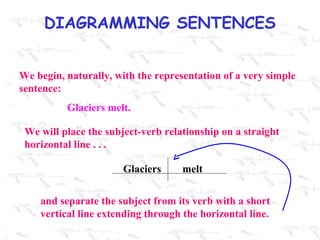
We begin, naturally, with the representation of a very simple
sentence:
Glaciers melt.
We will place the subject-verb relationship on a straight
horizontal line . . .
Glaciers

melt

and separate the subject from its verb with a short
vertical line extending through the horizontal line.
DIAGRAMMING SENTENCES
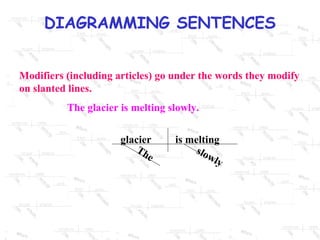
Modifiers (including articles) go under the words they modify
on slanted lines.
The glacier is melting slowly.
glacier
Th
e

is melting
slo
wly
DIAGRAMMING SENTENCES
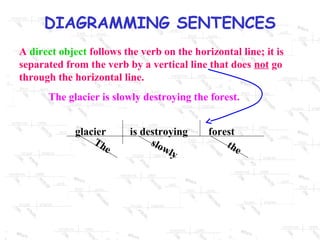
A direct object follows the verb on the horizontal line; it is
separated from the verb by a vertical line that does not go
through the horizontal line.
The glacier is slowly destroying the forest.
glacier
Th
e

is destroying
slo
wly

forest
the
DIAGRAMMING SENTENCES
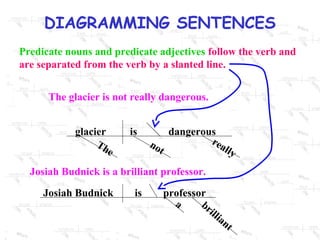
Predicate nouns and predicate adjectives follow the verb and
are separated from the verb by a slanted line.
The glacier is not really dangerous.
glacier
Th
e

is

dangerous
rea
no
lly
t

Josiah Budnick is a brilliant professor.
Josiah Budnick

is

professor
a
br
il

l ia

nt
DIAGRAMMING SENTENCES
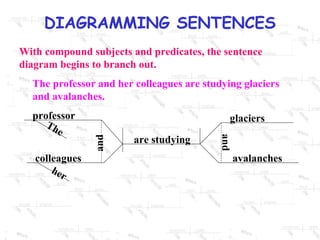
With compound subjects and predicates, the sentence
diagram begins to branch out.
The professor and her colleagues are studying glaciers
and avalanches.

colleagues
her

and

glaciers
are studying

and

professor
Th
e

avalanches
DIAGRAMMING SENTENCES
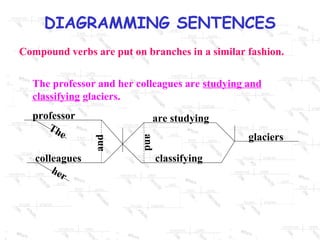
Compound verbs are put on branches in a similar fashion.
The professor and her colleagues are studying and
classifying glaciers.

colleagues
her

and

are studying
glaciers

and

professor
Th
e

classifying
DIAGRAMMING SENTENCES
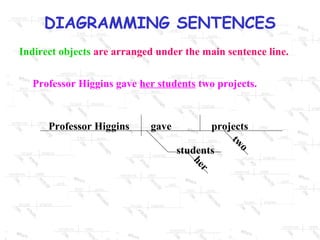
Indirect objects are arranged under the main sentence line.
Professor Higgins gave her students two projects.

Professor Higgins

gave

projects
tw
o
students
r
he
DIAGRAMMING SENTENCES
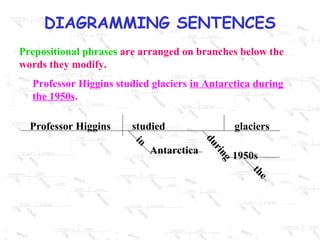
Prepositional phrases are arranged on branches below the
words they modify.
Professor Higgins studied glaciers in Antarctica during
the 1950s.
Professor Higgins

glaciers
g
rin
du

studied
in
Antarctica

1950s
th
e
DIAGRAMMING SENTENCES
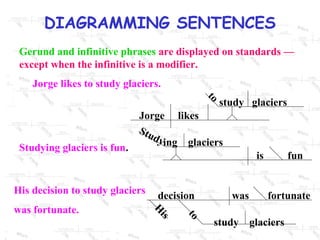
Gerund and infinitive phrases are displayed on standards —
except when the infinitive is a modifier.
Jorge likes to study glaciers.

to

study glaciers

Jorge likes
Stu
dy
ing glaciers
Studying glaciers is fun.

His decision to study glaciers

to

is
H

was fortunate.

decision

is

was
study

fun

fortunate
glaciers
DIAGRAMMING SENTENCES
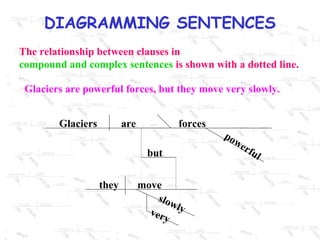
The relationship between clauses in
compound and complex sentences is shown with a dotted line.
Glaciers are powerful forces, but they move very slowly.
Glaciers

are

forces
but

they

move
slo
wly
ver
y

po
we
rf u
l
DIAGRAMMING SENTENCES
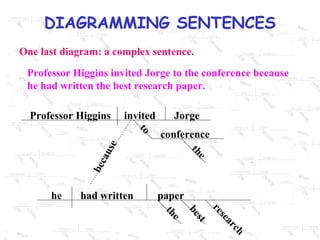
One last diagram: a complex sentence.
Professor Higgins invited Jorge to the conference because
he had written the best research paper.
invited
to

Jorge
conference

he

had written

e
th

be
cau
se

Professor Higgins

paper
ar
se
re
st
be

e
th

ch
DIAGRAMMING SENTENCES
Be sure to review the rest of the material on
DIAGRAMMING SENTENCES in the Guide to Grammar
and Writing. Soon, you will be diagramming sentences in your
sleep and be the envy of the entire neighborhood! As a writer,
you will be surprised at the additional confidence you gain by
mastering these visual renderings of sentence patterns.
DIAGRAMMING SENTENCES

This PowerPoint presentation was created by
Charles Darling, PhD
Professor of English and Webmaster
Capital Community College
Hartford, Connecticut
copyright November 1999

Basic Grammar Diagrams[1]

  • 1.
    DIAGRAMMING SENTENCES Diagramming sentencesprovides a way of picturing the structure of a sentence. By placing the various parts of a sentence in relation to the basic subject-verb relationship, we can see how the parts fit together and how the meaning of a sentence branches out, just as the branches of a plant ramify from the stem in space and time. Most students who work at diagramming sentences derive a clearer understanding of how sentences work — as well as satisfaction in the pictorial rendering of sentence structure. This presentation touches upon only the basics of diagramming. Use the hyperlinks back to the Guide to Grammar and Writing (this color) for additional information.
  • 2.
    DIAGRAMMING SENTENCES We begin,naturally, with the representation of a very simple sentence: Glaciers melt. We will place the subject-verb relationship on a straight horizontal line . . . Glaciers melt and separate the subject from its verb with a short vertical line extending through the horizontal line.
  • 3.
    DIAGRAMMING SENTENCES Modifiers (includingarticles) go under the words they modify on slanted lines. The glacier is melting slowly. glacier Th e is melting slo wly
  • 4.
    DIAGRAMMING SENTENCES A directobject follows the verb on the horizontal line; it is separated from the verb by a vertical line that does not go through the horizontal line. The glacier is slowly destroying the forest. glacier Th e is destroying slo wly forest the
  • 5.
    DIAGRAMMING SENTENCES Predicate nounsand predicate adjectives follow the verb and are separated from the verb by a slanted line. The glacier is not really dangerous. glacier Th e is dangerous rea no lly t Josiah Budnick is a brilliant professor. Josiah Budnick is professor a br il l ia nt
  • 6.
    DIAGRAMMING SENTENCES With compoundsubjects and predicates, the sentence diagram begins to branch out. The professor and her colleagues are studying glaciers and avalanches. colleagues her and glaciers are studying and professor Th e avalanches
  • 7.
    DIAGRAMMING SENTENCES Compound verbsare put on branches in a similar fashion. The professor and her colleagues are studying and classifying glaciers. colleagues her and are studying glaciers and professor Th e classifying
  • 8.
    DIAGRAMMING SENTENCES Indirect objectsare arranged under the main sentence line. Professor Higgins gave her students two projects. Professor Higgins gave projects tw o students r he
  • 9.
    DIAGRAMMING SENTENCES Prepositional phrasesare arranged on branches below the words they modify. Professor Higgins studied glaciers in Antarctica during the 1950s. Professor Higgins glaciers g rin du studied in Antarctica 1950s th e
  • 10.
    DIAGRAMMING SENTENCES Gerund andinfinitive phrases are displayed on standards — except when the infinitive is a modifier. Jorge likes to study glaciers. to study glaciers Jorge likes Stu dy ing glaciers Studying glaciers is fun. His decision to study glaciers to is H was fortunate. decision is was study fun fortunate glaciers
  • 11.
    DIAGRAMMING SENTENCES The relationshipbetween clauses in compound and complex sentences is shown with a dotted line. Glaciers are powerful forces, but they move very slowly. Glaciers are forces but they move slo wly ver y po we rf u l
  • 12.
    DIAGRAMMING SENTENCES One lastdiagram: a complex sentence. Professor Higgins invited Jorge to the conference because he had written the best research paper. invited to Jorge conference he had written e th be cau se Professor Higgins paper ar se re st be e th ch
  • 13.
    DIAGRAMMING SENTENCES Be sureto review the rest of the material on DIAGRAMMING SENTENCES in the Guide to Grammar and Writing. Soon, you will be diagramming sentences in your sleep and be the envy of the entire neighborhood! As a writer, you will be surprised at the additional confidence you gain by mastering these visual renderings of sentence patterns.
  • 14.
    DIAGRAMMING SENTENCES This PowerPointpresentation was created by Charles Darling, PhD Professor of English and Webmaster Capital Community College Hartford, Connecticut copyright November 1999