Diabetes in
America
Morbidity, Mortality and
Future Hopes(Presented by Team D: Tomas, Susan, Jeanne and Kathie)
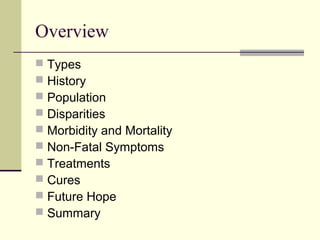
Overview
 Types
 History
 Population
 Disparities
 Morbidity and Mortality
 Non-Fatal Symptoms
 Treatments
 Cures
 Future Hope
 Summary
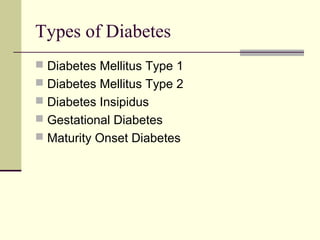
Types of Diabetes
 Diabetes Mellitus Type 1
 Diabetes Mellitus Type 2
 Diabetes Insipidus
 Gestational Diabetes
 Maturity Onset Diabetes
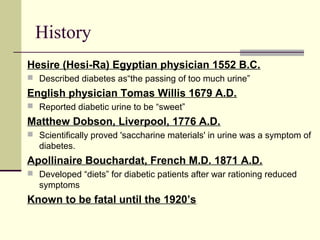
History
Hesire (Hesi-Ra) Egyptian physician 1552 B.C.
 Described diabetes as“the passing of too much urine”
English physician Tomas Willis 1679 A.D.
 Reported diabetic urine to be “sweet”
Matthew Dobson, Liverpool, 1776 A.D.
 Scientifically proved 'saccharine materials' in urine was a symptom of
diabetes.
Apollinaire Bouchardat, French M.D. 1871 A.D.
 Developed “diets” for diabetic patients after war rationing reduced
symptoms
Known to be fatal until the 1920’s
Population
23.6 million Americans have Diabetes
 17.9 diagnosed and 5.7 million undiagnosed
1 in every 400-600 children and adolescents
 186,200 under the age of 20
23.5 million are between the ages of 20-60
 12 million men and 11.5 million women
 12.2 million are over the age of 60
 http://www.youtube.com/watch?v=sTgBvJsHcCk
Disparities
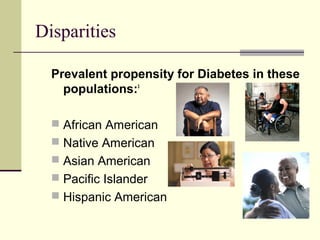
Prevalent propensity for Diabetes in these
populations:3
 African American
 Native American
 Asian American
 Pacific Islander
 Hispanic American
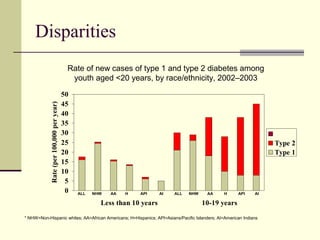
Disparities
0
5
10
15
20
25
30
35
40
45
50
Less than 10 years 10-19 years
Rate(per100,000peryear)
Type 2
Type 1
ALL NHW AA H API AI ALL NHW AA H API AI
* NHW=Non-Hispanic whites; AA=African Americans; H=Hispanics; API=Asians/Pacific Islanders; AI=American Indians
Rate of new cases of type 1 and type 2 diabetes among
youth aged <20 years, by race/ethnicity, 2002–2003
Morbidity and Mortality
Heart Disease and Stroke
 Attributed 68% to heart disease related deaths
 Attributed 16% to stroke related deaths
 Death rate 2 to 4 times higher than non-diabetics
High Blood Pressure
 Found in 75% of diabetic adults
Blindness
 Leading cause among adults age 20-74 with diabetes
Morbidity and Mortality
Kidney Disease
 Leading cause of kidney failure
 Accounts for 44% of all reports
Neuropathy (Nervous System Damage)
 60% to 70% have mild to severe form
Amputations
 Accounts for 60% of non-traumatic lower-limb
amputations
Mortality
 Seventh leading cause of death in 2004
Non-Fatal Complications
 Bladder control problems for women
 Erectile dysfunction for men
 Kidney Disease
 Gastro paresis
 Eye Disease
Common Symptoms
 Frequent urination
 Increase blood sugar (hyperglycemia)
 Irritability / Rage
 Neuropathy
 Slow to heal
 Sweet breath and urine
Treatments
 For Type 1: Insulin, Nutrition, Exercise
 For Type 2: Medication, Nutrition, Exercise
 Increase your level of physical activity.
 Keep up with physical check ups with your
doctor.
 Follow the advice of your physician
 Insulin therapy
 Oral medications
 Eat a well balanced diet low in sugar/carbs.
Future Hope
 Estimated 438 million to be diagnosed by 2030
 Increase of 3% children with Type 1 by 2030
 Researchers working to isolate “diabetic” gene
 Researchers searching stem-cell replacement for
type 1
 Educators and Medical professionals increasing
awareness to community gardening
 Increased awareness of healthy eating habits
 Correlation between diet and nutrition
Summary
Type 1 Diabetes accounts for 5-10% of all
diabetes cases in America
 Type 2 Diabetes is a growing epidemic not
just an adult disease anymore; it can be
easily managed through:
 Healthy Eating
 Exercise
 Education
 Seventh cause of death in America but it
does not have to be.
References
Your Family and Diabetes. (2010). History of Diabetes. Retrieved from http://www.your-family-
and-diabetes.com/history_of_diabetes.html
American Diabetes Association. (2010). Diabetes Statistics. Retrieved from
http://www.diabetes.org/diabetes-basics/diabetes-statistics/
Center for Disease Control. (2007). National Diabetes Fact Sheet 2007. Retrieved from
http://www.cdc.gov/diabetes/pubs/pdf/ndfs_2007.pdf
American Diabetes Association, (2003). Diabetes A to Z (5th ed.). Alexandria, Virginia:
American Diabetes Association.
Barrier, P. (2005). Type 2 Diabetes for Beginners. Alexandria, Virginia: American Diabetes
Association.
National Institute of Diabetes. (2009). Complications of Diabetes. Retrieved from
http://diabetes.niddk.nih.gov/complications/
Oxford Publishing, Inc.. (2010). "Diabetes" the Oxford Companion to the Body. Retrieved from
http://www.oxfordreference.com/views/ENTRY.html?subview=Main&entry=t128.e274
References (Cont’d)
McCoy, M., & Bass, P.F. (2009, November). Recognizing Key Diabetes Symptoms.
http://www.everydayhealth.com/diabetes/recognizing-the-symptoms-of-
diabetes.aspx.
Global stats on p.1: from Diabetes Atlas 2009: www.diabetesatlas.org/content/foreword-0
National stats on p.1: www.phac-aspc.gc.ca/publicat/2008/dicndss-dacsnsd-04-05/pwdd-
iadd-eng.php
Map of diabetes prevalence:
www.diabetesatlas.org/sites/default/files/Map2.1%26lowbar;Prevalence
%26lowbar;2010.jpg
Diabetes and depression: www.diabetes.ca/about-
diabetes/living/complications/depression
World Diabetes Congress general info: www.idf.org/media (press releases)

Diabetes In America

  • 1.
    Diabetes in America Morbidity, Mortalityand Future Hopes(Presented by Team D: Tomas, Susan, Jeanne and Kathie)
  • 2.
    Overview  Types  History Population  Disparities  Morbidity and Mortality  Non-Fatal Symptoms  Treatments  Cures  Future Hope  Summary
  • 3.
    Types of Diabetes Diabetes Mellitus Type 1  Diabetes Mellitus Type 2  Diabetes Insipidus  Gestational Diabetes  Maturity Onset Diabetes
  • 4.
    History Hesire (Hesi-Ra) Egyptianphysician 1552 B.C.  Described diabetes as“the passing of too much urine” English physician Tomas Willis 1679 A.D.  Reported diabetic urine to be “sweet” Matthew Dobson, Liverpool, 1776 A.D.  Scientifically proved 'saccharine materials' in urine was a symptom of diabetes. Apollinaire Bouchardat, French M.D. 1871 A.D.  Developed “diets” for diabetic patients after war rationing reduced symptoms Known to be fatal until the 1920’s
  • 5.
    Population 23.6 million Americanshave Diabetes  17.9 diagnosed and 5.7 million undiagnosed 1 in every 400-600 children and adolescents  186,200 under the age of 20 23.5 million are between the ages of 20-60  12 million men and 11.5 million women  12.2 million are over the age of 60  http://www.youtube.com/watch?v=sTgBvJsHcCk
  • 6.
    Disparities Prevalent propensity forDiabetes in these populations:3  African American  Native American  Asian American  Pacific Islander  Hispanic American
  • 7.
    Disparities 0 5 10 15 20 25 30 35 40 45 50 Less than 10years 10-19 years Rate(per100,000peryear) Type 2 Type 1 ALL NHW AA H API AI ALL NHW AA H API AI * NHW=Non-Hispanic whites; AA=African Americans; H=Hispanics; API=Asians/Pacific Islanders; AI=American Indians Rate of new cases of type 1 and type 2 diabetes among youth aged <20 years, by race/ethnicity, 2002–2003
  • 8.
    Morbidity and Mortality HeartDisease and Stroke  Attributed 68% to heart disease related deaths  Attributed 16% to stroke related deaths  Death rate 2 to 4 times higher than non-diabetics High Blood Pressure  Found in 75% of diabetic adults Blindness  Leading cause among adults age 20-74 with diabetes
  • 9.
    Morbidity and Mortality KidneyDisease  Leading cause of kidney failure  Accounts for 44% of all reports Neuropathy (Nervous System Damage)  60% to 70% have mild to severe form Amputations  Accounts for 60% of non-traumatic lower-limb amputations Mortality  Seventh leading cause of death in 2004
  • 10.
    Non-Fatal Complications  Bladdercontrol problems for women  Erectile dysfunction for men  Kidney Disease  Gastro paresis  Eye Disease
  • 11.
    Common Symptoms  Frequenturination  Increase blood sugar (hyperglycemia)  Irritability / Rage  Neuropathy  Slow to heal  Sweet breath and urine
  • 12.
    Treatments  For Type1: Insulin, Nutrition, Exercise  For Type 2: Medication, Nutrition, Exercise  Increase your level of physical activity.  Keep up with physical check ups with your doctor.  Follow the advice of your physician  Insulin therapy  Oral medications  Eat a well balanced diet low in sugar/carbs.
  • 13.
    Future Hope  Estimated438 million to be diagnosed by 2030  Increase of 3% children with Type 1 by 2030  Researchers working to isolate “diabetic” gene  Researchers searching stem-cell replacement for type 1  Educators and Medical professionals increasing awareness to community gardening  Increased awareness of healthy eating habits  Correlation between diet and nutrition
  • 14.
    Summary Type 1 Diabetesaccounts for 5-10% of all diabetes cases in America  Type 2 Diabetes is a growing epidemic not just an adult disease anymore; it can be easily managed through:  Healthy Eating  Exercise  Education  Seventh cause of death in America but it does not have to be.
  • 15.
    References Your Family andDiabetes. (2010). History of Diabetes. Retrieved from http://www.your-family- and-diabetes.com/history_of_diabetes.html American Diabetes Association. (2010). Diabetes Statistics. Retrieved from http://www.diabetes.org/diabetes-basics/diabetes-statistics/ Center for Disease Control. (2007). National Diabetes Fact Sheet 2007. Retrieved from http://www.cdc.gov/diabetes/pubs/pdf/ndfs_2007.pdf American Diabetes Association, (2003). Diabetes A to Z (5th ed.). Alexandria, Virginia: American Diabetes Association. Barrier, P. (2005). Type 2 Diabetes for Beginners. Alexandria, Virginia: American Diabetes Association. National Institute of Diabetes. (2009). Complications of Diabetes. Retrieved from http://diabetes.niddk.nih.gov/complications/ Oxford Publishing, Inc.. (2010). "Diabetes" the Oxford Companion to the Body. Retrieved from http://www.oxfordreference.com/views/ENTRY.html?subview=Main&entry=t128.e274
  • 16.
    References (Cont’d) McCoy, M.,& Bass, P.F. (2009, November). Recognizing Key Diabetes Symptoms. http://www.everydayhealth.com/diabetes/recognizing-the-symptoms-of- diabetes.aspx. Global stats on p.1: from Diabetes Atlas 2009: www.diabetesatlas.org/content/foreword-0 National stats on p.1: www.phac-aspc.gc.ca/publicat/2008/dicndss-dacsnsd-04-05/pwdd- iadd-eng.php Map of diabetes prevalence: www.diabetesatlas.org/sites/default/files/Map2.1%26lowbar;Prevalence %26lowbar;2010.jpg Diabetes and depression: www.diabetes.ca/about- diabetes/living/complications/depression World Diabetes Congress general info: www.idf.org/media (press releases)