 Herefordshire Council Home Improvement
Agency
 “You at Home”
 Philippa Winstanley
 Promoting Independent Living Services Manager
 3rd October 2019
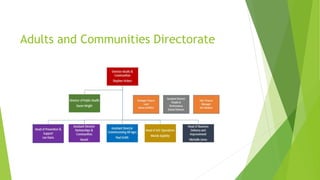
Adults and Communities Directorate
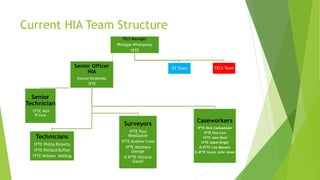
Current HIA Team Structure
Senior Officer
HIA
Kanute Kindamba
1FTE
Senior
Technician
1FTE Neil
Prince
Technicians
1FTE Phillip Ricketts
1FTE Richard Bufton
1FTE William Watling
Surveyors
1FTE Paul
Woollaston
1FTE Andrew Cross
1FTE Matthew
George
0.5FTE Victoria
Gauld
Caseworkers
1FTE Nick Cadwallader
1FTE Eira Levi
1FTE Jane Reid
1FTE Isabel Bright
0.6FTE Lisa Massam
0.4FTE locum Julie Jones
PILS Manager
Philippa Winstanley
1FTE
OT Team TECS Team
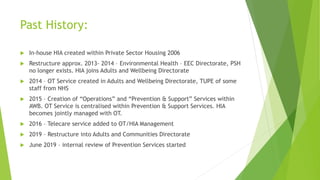
Past History:
 In-house HIA created within Private Sector Housing 2006
 Restructure approx. 2013- 2014 – Environmental Health – EEC Directorate, PSH
no longer exists. HIA joins Adults and Wellbeing Directorate
 2014 – OT Service created in Adults and Wellbeing Directorate, TUPE of some
staff from NHS
 2015 – Creation of “Operations” and “Prevention & Support” Services within
AWB. OT Service is centralised within Prevention & Support Services. HIA
becomes jointly managed with OT.
 2016 – Telecare service added to OT/HIA Management
 2019 – Restructure into Adults and Communities Directorate
 June 2019 – internal review of Prevention Services started
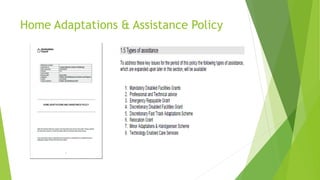
Home Adaptations & Assistance Policy
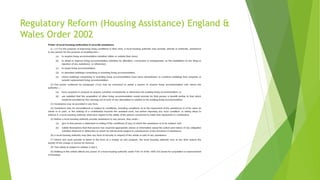
Regulatory Reform (Housing Assistance) England &
Wales Order 2002
Housing & Technology
Project
for
People with
Learning Disabilities
January 2017- March 2018 Herefordshire Council
“Having a home guarantees a place in the community and is
part of how people are accepted as equal citizens”
(DOH September 2016)
 Half of the population of adults with learning disabilities
in England live with their families, most of the remainder
(33%) live in residential care.
 Only 15% of adults with learning disabilities have a secure
long-term tenancy or their own home.
 This is in comparison with 70% of the general adult
population who own their own home and nearly 30% who
rent.
What we did:
 Properties identified by survey sent to existing schemes
 Put in a successful bid to DOH to retrofit 13 properties with adaptations and
technology
 Received £285,000 from DOH and added an additional £85k + from capital
funds
 Delivered a council led project with input and support from housing and care
providers
 Liaison with staff in 2gether NHS Trust LD Team
 Technology providers – Tunstall/ Just Checking/ Brain In Hand – formed part of
project group
 Limited time available – Launched Sept 2016, Application by end October
2016, MOU signed off January 2017, completion of project by March 2018.
Final report to DOH Autumn 2018
 Total of 81 people supported by adaptations/technology installed
The type of works included:
 Shower rooms/ Washing & Drying WC/ wheelchair accessible front door/ zero
pressure internal fire doors/ ramped access
 Finger print lock releases/ video door entry systems
 Linked fire control panels to lifeline alarms for automatic contact to call
centre if fire alarm went off
 Proximity sensor to alert staff to whereabouts of an individual in selected
areas to avoid property damage (linked to pager via nurse call system)
 Electronically opening blinds – to allow all to use sensory room without
damage to curtains
 Sensory Baths – to maximise engagement in personal hygiene/ sensory
stimulation & relaxation
Type of works cont:
 Provided “Buddi” bracelet trackers for 3 residents to allow them to access the
community independently without a support worker but with emergency
support if needed
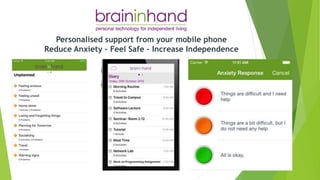
 Trialled “Brain in Hand” with several residents to support with anxiety
management and access support in an emergency when accessing community
facilities
 Installed “Just Checking” systems to allow an evaluation of potential for
independent living and plan support delivery.
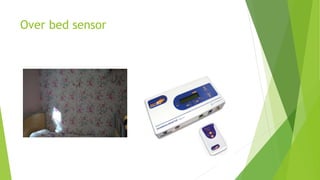
 Provision of overbed movement / epilepsy sensor
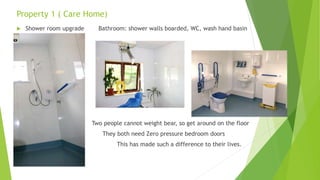
Property 1 ( Care Home)
 Shower room upgrade Bathroom: shower walls boarded, WC, wash hand basin
Two people cannot weight bear, so get around on the floor
They both need Zero pressure bedroom doors
This has made such a difference to their lives.
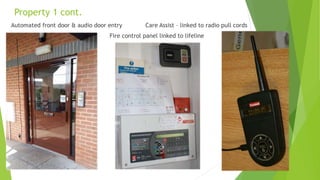
Property 1 cont.
Automated front door & audio door entry Care Assist – linked to radio pull cords
Fire control panel linked to lifeline
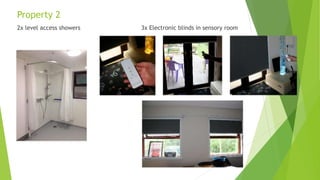
Property 2
2x level access showers 3x Electronic blinds in sensory room
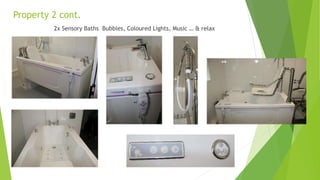
Property 2 cont.
2x Sensory Baths Bubbles, Coloured Lights, Music … & relax
#
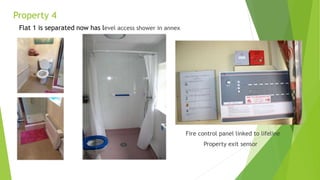
Property 4
Flat 1 is separated now has level access shower in annex
Fire control panel linked to lifeline
Property exit sensor
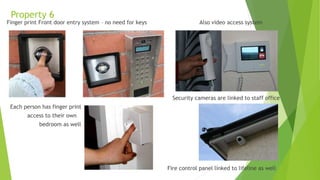
Property 6
Finger print Front door entry system – no need for keys Also video access system
Security cameras are linked to staff office
Each person has finger print
access to their own
bedroom as well
Fire control panel linked to lifeline as well
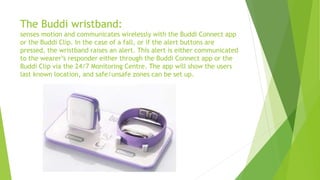
The Buddi wristband:
senses motion and communicates wirelessly with the Buddi Connect app
or the Buddi Clip. In the case of a fall, or if the alert buttons are
pressed, the wristband raises an alert. This alert is either communicated
to the wearer’s responder either through the Buddi Connect app or the
Buddi Clip via the 24/7 Monitoring Centre. The app will show the users
last known location, and safe/unsafe zones can be set up.
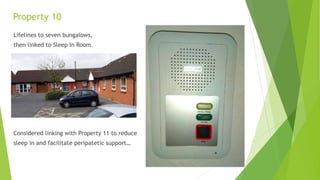
Property 10
Lifelines to seven bungalows,
then linked to Sleep In Room.
Considered linking with Property 11 to reduce
sleep in and facilitate peripatetic support…
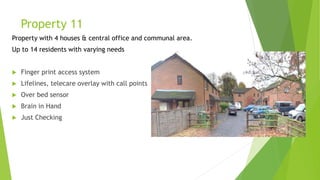
Property 11
Property with 4 houses & central office and communal area.
Up to 14 residents with varying needs
 Finger print access system
 Lifelines, telecare overlay with call points
 Over bed sensor
 Brain in Hand
 Just Checking
Personalised support from your mobile phone
Reduce Anxiety – Feel Safe – Increase Independence
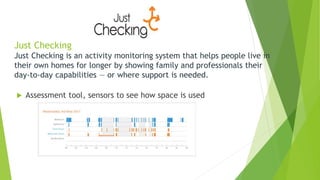
Just Checking
Just Checking is an activity monitoring system that helps people live in
their own homes for longer by showing family and professionals their
day-to-day capabilities — or where support is needed.
 Assessment tool, sensors to see how space is used
Over bed sensor
Outcomes expected from the Project
 The improvements are expected to:
 increase satisfaction with the housing offer 
 enhance the ability of residents to participate more easily and with more
confidence in the local community. 
 Improve the quality of the care and support provided by greater personalisation to
maximise independence 
 People with emergency housing needs will have more options that are more
appropriate to their needs? ?
 the cost of emergency provision will reduce over time? ?
 …as will the cost of some care packages as people’s abilities and strengths are
more readily recognised 
 there will be a reduction in the cost of care and support packages and that support
that is provided will be more personalised and appropriate for the individual. 
What we also learnt …..
1. Need more detailed skills assessments & appropriate skills development
programmes to identify & provide proactive support in “supported living”.
2. Clearer measurements of behaviours and mood to evidence needs, changes
and improvements
3. Sleep in issues – assessment details- what is the need and why?
4. Joint working – council/NHS/commissioners/providers
5. Apply the learning to inform and plan future supported living arrangements
6. Links with current/future Home Adaptations & Assistance policy
7. Inspire the providers – eg subsequent meeting with one provider to look at
technology to help change night time support model.
8. Communications & culture change within other provider staff – how to
promote this?
Wider outcomes for practice:
What have we done since then…….
 PILS Manager involvement with Accommodation Group with Operations &
Housing Commissioning. Reviewing “supported living”.
 Ongoing joint working between Operations/OT/HIA/TECs around supported
living options for individuals
 2 new supported living properties identified and adapted for individuals
 Review of development of 10 Supported Living Flats – lessons learnt
 Option of combining Supported Living & Accessible Homes Register under
consideration
 Ongoing use of technology installations with DFGS by OT/HIA staff
 Business Case for Assessment & Demonstration Centre
 3 new Technology Projects currently being launched
Case Studies
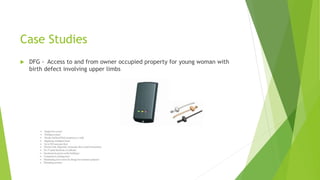
 DFG - Access to and from owner occupied property for young woman with
birth defect involving upper limbs
 Two young people with learning disabilities in a relationship moved in
together into new property, having lived separately in supported living and
shared lives arrangements.
 Various adaptations provided by DFG including wheelchair accessible kitchen
facilities including work surfaces & high-low sink, also LAS, CT hoists, closomat WC
 Home life going really well – including new kitten!
New “Supported Living” arrangement - two young people with learning
disabilities leaving home.
 Closomat WCs, LAS, finger print door opening system
 Technology advice facilitated for father of autistic child around barn
conversion development for integrated technology safety features without
restricting movement and access – private and DFG works – “making the
property safe for the disabled occupant”.
 Plan to install of air conditioning for 50yr old man with LD and autism, plus
adaption to provide additional living space – “making the property safe for
the disabled occupant”. Discussions ongoing with Housing Commissioners and
RP about future tenancy and use of the property.
Current Technology Projects
 3 new pilots including:
 Trail of new room sensing systems to detect falls, changes in usual activity or
unhealthy room conditions
 Use of digital technology to support reablement and evidenced based assessment
with a view to facilitating discharge & support, maximising independence and
safety at home
 Technology to help identify those at risk of frailty and prevent the onset of frailty.
This will have the effect of reducing falls by supporting people to maintain their
muscle mass (the key indicator of frailty) and their hydration levels.
Thank you for listening!
Any questions?

Herefordshire hia foundations presentation 03 oct2

  • 1.
     Herefordshire CouncilHome Improvement Agency  “You at Home”  Philippa Winstanley  Promoting Independent Living Services Manager  3rd October 2019
  • 2.
  • 3.
    Current HIA TeamStructure Senior Officer HIA Kanute Kindamba 1FTE Senior Technician 1FTE Neil Prince Technicians 1FTE Phillip Ricketts 1FTE Richard Bufton 1FTE William Watling Surveyors 1FTE Paul Woollaston 1FTE Andrew Cross 1FTE Matthew George 0.5FTE Victoria Gauld Caseworkers 1FTE Nick Cadwallader 1FTE Eira Levi 1FTE Jane Reid 1FTE Isabel Bright 0.6FTE Lisa Massam 0.4FTE locum Julie Jones PILS Manager Philippa Winstanley 1FTE OT Team TECS Team
  • 4.
    Past History:  In-houseHIA created within Private Sector Housing 2006  Restructure approx. 2013- 2014 – Environmental Health – EEC Directorate, PSH no longer exists. HIA joins Adults and Wellbeing Directorate  2014 – OT Service created in Adults and Wellbeing Directorate, TUPE of some staff from NHS  2015 – Creation of “Operations” and “Prevention & Support” Services within AWB. OT Service is centralised within Prevention & Support Services. HIA becomes jointly managed with OT.  2016 – Telecare service added to OT/HIA Management  2019 – Restructure into Adults and Communities Directorate  June 2019 – internal review of Prevention Services started
  • 5.
    Home Adaptations &Assistance Policy
  • 6.
    Regulatory Reform (HousingAssistance) England & Wales Order 2002
  • 7.
    Housing & Technology Project for Peoplewith Learning Disabilities January 2017- March 2018 Herefordshire Council
  • 8.
    “Having a homeguarantees a place in the community and is part of how people are accepted as equal citizens” (DOH September 2016)  Half of the population of adults with learning disabilities in England live with their families, most of the remainder (33%) live in residential care.  Only 15% of adults with learning disabilities have a secure long-term tenancy or their own home.  This is in comparison with 70% of the general adult population who own their own home and nearly 30% who rent.
  • 9.
    What we did: Properties identified by survey sent to existing schemes  Put in a successful bid to DOH to retrofit 13 properties with adaptations and technology  Received £285,000 from DOH and added an additional £85k + from capital funds  Delivered a council led project with input and support from housing and care providers  Liaison with staff in 2gether NHS Trust LD Team  Technology providers – Tunstall/ Just Checking/ Brain In Hand – formed part of project group  Limited time available – Launched Sept 2016, Application by end October 2016, MOU signed off January 2017, completion of project by March 2018. Final report to DOH Autumn 2018  Total of 81 people supported by adaptations/technology installed
  • 10.
    The type ofworks included:  Shower rooms/ Washing & Drying WC/ wheelchair accessible front door/ zero pressure internal fire doors/ ramped access  Finger print lock releases/ video door entry systems  Linked fire control panels to lifeline alarms for automatic contact to call centre if fire alarm went off  Proximity sensor to alert staff to whereabouts of an individual in selected areas to avoid property damage (linked to pager via nurse call system)  Electronically opening blinds – to allow all to use sensory room without damage to curtains  Sensory Baths – to maximise engagement in personal hygiene/ sensory stimulation & relaxation
  • 11.
    Type of workscont:  Provided “Buddi” bracelet trackers for 3 residents to allow them to access the community independently without a support worker but with emergency support if needed  Trialled “Brain in Hand” with several residents to support with anxiety management and access support in an emergency when accessing community facilities  Installed “Just Checking” systems to allow an evaluation of potential for independent living and plan support delivery.  Provision of overbed movement / epilepsy sensor
  • 12.
    Property 1 (Care Home)  Shower room upgrade Bathroom: shower walls boarded, WC, wash hand basin Two people cannot weight bear, so get around on the floor They both need Zero pressure bedroom doors This has made such a difference to their lives.
  • 13.
    Property 1 cont. Automatedfront door & audio door entry Care Assist – linked to radio pull cords Fire control panel linked to lifeline
  • 14.
    Property 2 2x levelaccess showers 3x Electronic blinds in sensory room
  • 15.
    Property 2 cont. 2xSensory Baths Bubbles, Coloured Lights, Music … & relax #
  • 16.
    Property 4 Flat 1is separated now has level access shower in annex Fire control panel linked to lifeline Property exit sensor
  • 17.
    Property 6 Finger printFront door entry system – no need for keys Also video access system Security cameras are linked to staff office Each person has finger print access to their own bedroom as well Fire control panel linked to lifeline as well
  • 18.
    The Buddi wristband: sensesmotion and communicates wirelessly with the Buddi Connect app or the Buddi Clip. In the case of a fall, or if the alert buttons are pressed, the wristband raises an alert. This alert is either communicated to the wearer’s responder either through the Buddi Connect app or the Buddi Clip via the 24/7 Monitoring Centre. The app will show the users last known location, and safe/unsafe zones can be set up.
  • 19.
    Property 10 Lifelines toseven bungalows, then linked to Sleep In Room. Considered linking with Property 11 to reduce sleep in and facilitate peripatetic support…
  • 20.
    Property 11 Property with4 houses & central office and communal area. Up to 14 residents with varying needs  Finger print access system  Lifelines, telecare overlay with call points  Over bed sensor  Brain in Hand  Just Checking
  • 21.
    Personalised support fromyour mobile phone Reduce Anxiety – Feel Safe – Increase Independence
  • 22.
    Just Checking Just Checkingis an activity monitoring system that helps people live in their own homes for longer by showing family and professionals their day-to-day capabilities — or where support is needed.  Assessment tool, sensors to see how space is used
  • 23.
  • 24.
    Outcomes expected fromthe Project  The improvements are expected to:  increase satisfaction with the housing offer   enhance the ability of residents to participate more easily and with more confidence in the local community.   Improve the quality of the care and support provided by greater personalisation to maximise independence   People with emergency housing needs will have more options that are more appropriate to their needs? ?  the cost of emergency provision will reduce over time? ?  …as will the cost of some care packages as people’s abilities and strengths are more readily recognised   there will be a reduction in the cost of care and support packages and that support that is provided will be more personalised and appropriate for the individual. 
  • 25.
    What we alsolearnt ….. 1. Need more detailed skills assessments & appropriate skills development programmes to identify & provide proactive support in “supported living”. 2. Clearer measurements of behaviours and mood to evidence needs, changes and improvements 3. Sleep in issues – assessment details- what is the need and why? 4. Joint working – council/NHS/commissioners/providers 5. Apply the learning to inform and plan future supported living arrangements 6. Links with current/future Home Adaptations & Assistance policy 7. Inspire the providers – eg subsequent meeting with one provider to look at technology to help change night time support model. 8. Communications & culture change within other provider staff – how to promote this?
  • 26.
    Wider outcomes forpractice: What have we done since then…….
  • 27.
     PILS Managerinvolvement with Accommodation Group with Operations & Housing Commissioning. Reviewing “supported living”.  Ongoing joint working between Operations/OT/HIA/TECs around supported living options for individuals  2 new supported living properties identified and adapted for individuals  Review of development of 10 Supported Living Flats – lessons learnt  Option of combining Supported Living & Accessible Homes Register under consideration  Ongoing use of technology installations with DFGS by OT/HIA staff  Business Case for Assessment & Demonstration Centre  3 new Technology Projects currently being launched
  • 28.
    Case Studies  DFG- Access to and from owner occupied property for young woman with birth defect involving upper limbs
  • 29.
     Two youngpeople with learning disabilities in a relationship moved in together into new property, having lived separately in supported living and shared lives arrangements.  Various adaptations provided by DFG including wheelchair accessible kitchen facilities including work surfaces & high-low sink, also LAS, CT hoists, closomat WC  Home life going really well – including new kitten! New “Supported Living” arrangement - two young people with learning disabilities leaving home.  Closomat WCs, LAS, finger print door opening system
  • 30.
     Technology advicefacilitated for father of autistic child around barn conversion development for integrated technology safety features without restricting movement and access – private and DFG works – “making the property safe for the disabled occupant”.  Plan to install of air conditioning for 50yr old man with LD and autism, plus adaption to provide additional living space – “making the property safe for the disabled occupant”. Discussions ongoing with Housing Commissioners and RP about future tenancy and use of the property.
  • 31.
    Current Technology Projects 3 new pilots including:  Trail of new room sensing systems to detect falls, changes in usual activity or unhealthy room conditions  Use of digital technology to support reablement and evidenced based assessment with a view to facilitating discharge & support, maximising independence and safety at home  Technology to help identify those at risk of frailty and prevent the onset of frailty. This will have the effect of reducing falls by supporting people to maintain their muscle mass (the key indicator of frailty) and their hydration levels.
  • 32.
    Thank you forlistening! Any questions?

Editor's Notes