Global Effectiveness Training, Consulting  & Development  In A World of Differences, We Make All the Difference in the World dfa  Dean Foster Associates
Why Cross-Cultural Training? 60%+ OF ALL INTERNATIONAL JOINT VENTURES FAIL How much would a failed international project cost your organization? 30% - 50% OF ALL EXPATRIATE MANAGERS FAIL*  The average SUCCESSFUL assignment represents an investment of over $1,000,000 USD, and a failed assignment can cost your organization almost THREE TIMES that amount. 48% OF ALL RETURNING EXPATRIATES  LEAVE  Almost half the international human resource investment your organization makes is lost or benefits the competition, while your organization fails to capture its most important global talent.  * Less than expected performance (“blackouts” & “brownouts”)
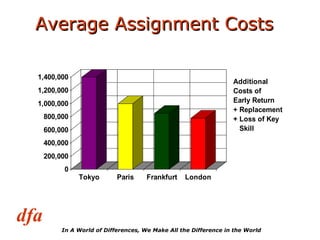
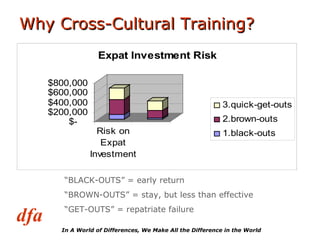
Average Assignment Costs
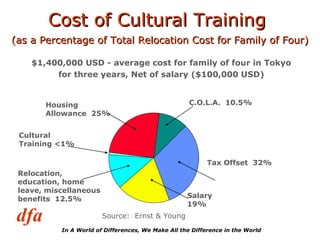
Cost of Cultural Training  (as a Percentage of Total Relocation Cost for Family of Four) $1,400,000 USD - average cost for family of four in Tokyo for three years, Net of salary ($100,000 USD) Cultural Training <1% Housing Allowance  25% Relocation, education, home leave, miscellaneous benefits  12.5% C.O.L.A.  10.5% Salary  19% Tax Offset  32% Source:  Ernst & Young
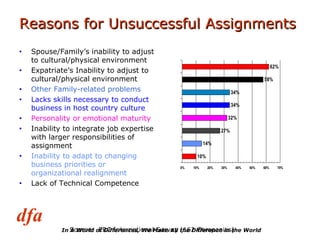
Reasons for Unsuccessful Assignments Spouse/Family’s inability to adjust to cultural/physical environment Expatriate’s Inability to adjust to cultural/physical environment Other Family-related problems Lacks skills necessary to conduct business in host country culture Personality or emotional maturity Inability to integrate job expertise with larger responsibilities of assignment Inability to adapt to changing business priorities or organizational realignment Lack of Technical Competence Source:  ERC International Survey (162 Companies)
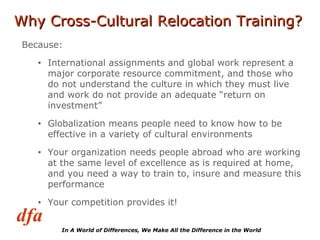
Why Cross-Cultural Relocation Training? Because: International assignments and global work represent a major corporate resource commitment, and those who do not understand the culture in which they must live and work do not provide an adequate “return on investment” Globalization means people need to know how to be effective in a variety of cultural environments Your organization needs people abroad who are working at the same level of excellence as is required at home, and you need a way to train to, insure and measure this performance Your competition provides it!
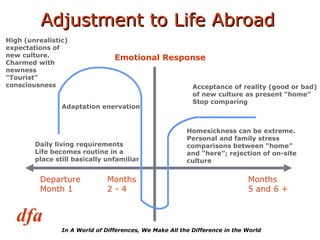
Adjustment to Life Abroad Emotional Response Departure Month 1 Months 5 and 6 + Homesickness can be extreme. Personal and family stress comparisons between “home” and “here”; rejection of on-site culture Months  2 - 4 Acceptance of reality (good or bad) of new culture as present “home” Stop comparing Daily living requirements Life becomes routine in a place still basically unfamiliar Adaptation enervation High (unrealistic) expectations of new culture. Charmed with newness “ Tourist” consciousness
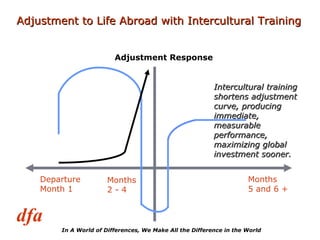
Adjustment to Life Abroad with Intercultural Training Adjustment Response Departure Month 1 Months 5 and 6 + Months  2 - 4 Intercultural training shortens adjustment curve, producing immediate, measurable performance, maximizing global investment sooner.
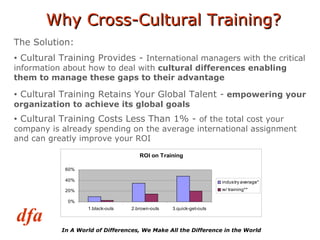
Why Cross-Cultural Training?   The Solution: Cultural Training Provides -  International managers with the critical information about how to deal with  cultural differences enabling them to manage these gaps to their advantage Cultural Training Retains Your Global Talent -   empowering your organization to achieve its global goals Cultural Training Costs Less Than 1% -  of the total cost your company is already spending on the average international assignment and can greatly improve your ROI
Why Cross-Cultural Training?   “ BLACK-OUTS” = early return “ BROWN-OUTS” = stay, but less than effective “ GET-OUTS” = repatriate failure
Directed and led by recognized leader and founder of field  Over 20 Years Cross-cultural Training Experience:  Core competency is  only  Intercultural training & consulting Not just cross-cultural training:  Premier, future - oriented ‘Global Effectiveness’ Training  Unmatched worldwide resources & depth  Original 100+ worldwide trainer & resource network DFA certification process, Dean Foster wrote books “ CULTURE COMPASS” online software Full assignment assessment & support: Trainer E-support  - On-line/on-site assessment & evaluation : SRI  “ Five Point” Global Support Training Relocation and Global Business Curriculum & Consulting Customization inherent to every program Independent, uncompromising client-focus About DFA: From the Founding…To the Future…
Criteria for Effective Intercultural Training All Programs Must: Provide “deep” cultural awareness Be driven by adjustment and adaptation concerns Be designed to meet the needs of all stakeholders Focus on relevant, up-to-date information Employ adult-learner methodologies Be an integral component of organizational global strategy, and provide multicultural global skills Be global, application, theory, design, philosophy, going beyond traditional cross-cultural theory to  global effectiveness training .
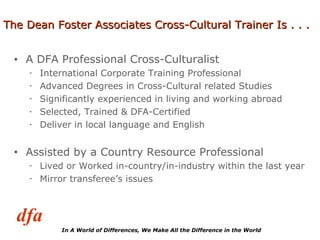
The Dean Foster Associates Cross-Cultural Trainer Is . . . A DFA Professional Cross-Culturalist International Corporate Training Professional Advanced Degrees in Cross-Cultural related Studies Significantly experienced in living and working abroad Selected, Trained & DFA-Certified Deliver in local language and English Assisted by a Country Resource Professional Lived or Worked in-country/in-industry within the last year Mirror transferee’s issues
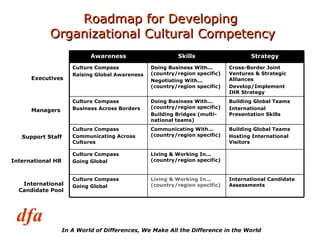
Roadmap for Developing  Organizational Cultural Competency  Executives Managers International HR Support Staff International Candidate Pool Awareness Skills Strategy Culture Compass Raising Global Awareness Doing Business With... (country/region specific) Negotiating With... (country/region specific) Cross-Border Joint Ventures & Strategic Alliances Develop/Implement  IHR Strategy Culture Compass Business Across Borders Doing Business With... (country/region specific) Building Bridges (multi-national teams) Building Global Teams International Presentation Skills Culture Compass Communicating Across Cultures Communicating With... (country/region specific) Building Global Teams Hosting International Visitors Culture Compass Going Global Living & Working In... (country/region specific) Culture Compass Going Global Living & Working In... (country/region specific) International Candidate Assessments
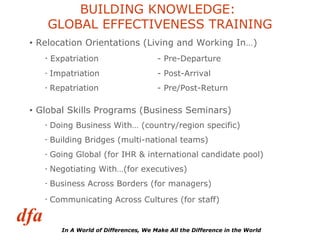
BUILDING KNOWLEDGE:  GLOBAL EFFECTIVENESS TRAINING Relocation Orientations (Living and Working In…) Expatriation - Pre-Departure Impatriation - Post-Arrival Repatriation - Pre/Post-Return Global Skills Programs (Business Seminars) Doing Business With… (country/region specific) Building Bridges (multi-national teams) Going Global (for IHR & international candidate pool) Negotiating With…(for executives) Business Across Borders (for managers) Communicating Across Cultures (for staff)
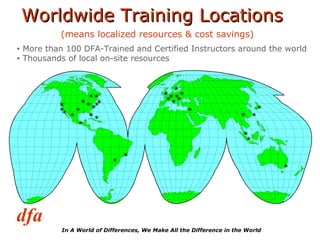
* * * * * * * * * * * * * * * * * * * * * * * * * * * * * * * * More than 100 DFA-Trained and Certified Instructors around the world Thousands of local on-site resources Worldwide Training Locations (means localized resources & cost savings)
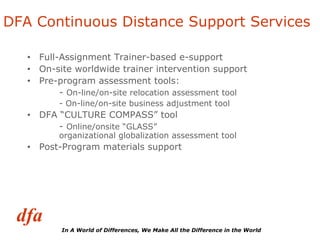
DFA Continuous Distance Support Services Full-Assignment Trainer-based e-support On-site worldwide trainer intervention support Pre-program assessment tools: -  On-line/on-site relocation assessment tool - On-line/on-site business adjustment tool DFA “CULTURE COMPASS” tool -  Online/onsite “GLASS”      organizational globalization assessment tool Post-Program materials support
INITIATION OR QUERY… 1. Contact DFA 770-366-6736  [email_address] 2. We consult with you & client, and send you: - course overview - questionnaire - initiation form 3. We contact assignees, arrange logistics, copy you on  relevant details 4. We deliver program, copy you on all feedback 5. We invoice you / you invoice client

Dfa Presentation

  • 1.
    Global Effectiveness Training,Consulting & Development In A World of Differences, We Make All the Difference in the World dfa Dean Foster Associates
  • 2.
    Why Cross-Cultural Training?60%+ OF ALL INTERNATIONAL JOINT VENTURES FAIL How much would a failed international project cost your organization? 30% - 50% OF ALL EXPATRIATE MANAGERS FAIL* The average SUCCESSFUL assignment represents an investment of over $1,000,000 USD, and a failed assignment can cost your organization almost THREE TIMES that amount. 48% OF ALL RETURNING EXPATRIATES LEAVE Almost half the international human resource investment your organization makes is lost or benefits the competition, while your organization fails to capture its most important global talent. * Less than expected performance (“blackouts” & “brownouts”)
  • 3.
  • 4.
    Cost of CulturalTraining (as a Percentage of Total Relocation Cost for Family of Four) $1,400,000 USD - average cost for family of four in Tokyo for three years, Net of salary ($100,000 USD) Cultural Training <1% Housing Allowance 25% Relocation, education, home leave, miscellaneous benefits 12.5% C.O.L.A. 10.5% Salary 19% Tax Offset 32% Source: Ernst & Young
  • 5.
    Reasons for UnsuccessfulAssignments Spouse/Family’s inability to adjust to cultural/physical environment Expatriate’s Inability to adjust to cultural/physical environment Other Family-related problems Lacks skills necessary to conduct business in host country culture Personality or emotional maturity Inability to integrate job expertise with larger responsibilities of assignment Inability to adapt to changing business priorities or organizational realignment Lack of Technical Competence Source: ERC International Survey (162 Companies)
  • 6.
    Why Cross-Cultural RelocationTraining? Because: International assignments and global work represent a major corporate resource commitment, and those who do not understand the culture in which they must live and work do not provide an adequate “return on investment” Globalization means people need to know how to be effective in a variety of cultural environments Your organization needs people abroad who are working at the same level of excellence as is required at home, and you need a way to train to, insure and measure this performance Your competition provides it!
  • 7.
    Adjustment to LifeAbroad Emotional Response Departure Month 1 Months 5 and 6 + Homesickness can be extreme. Personal and family stress comparisons between “home” and “here”; rejection of on-site culture Months 2 - 4 Acceptance of reality (good or bad) of new culture as present “home” Stop comparing Daily living requirements Life becomes routine in a place still basically unfamiliar Adaptation enervation High (unrealistic) expectations of new culture. Charmed with newness “ Tourist” consciousness
  • 8.
    Adjustment to LifeAbroad with Intercultural Training Adjustment Response Departure Month 1 Months 5 and 6 + Months 2 - 4 Intercultural training shortens adjustment curve, producing immediate, measurable performance, maximizing global investment sooner.
  • 9.
    Why Cross-Cultural Training? The Solution: Cultural Training Provides - International managers with the critical information about how to deal with cultural differences enabling them to manage these gaps to their advantage Cultural Training Retains Your Global Talent - empowering your organization to achieve its global goals Cultural Training Costs Less Than 1% - of the total cost your company is already spending on the average international assignment and can greatly improve your ROI
  • 10.
    Why Cross-Cultural Training? “ BLACK-OUTS” = early return “ BROWN-OUTS” = stay, but less than effective “ GET-OUTS” = repatriate failure
  • 11.
    Directed and ledby recognized leader and founder of field Over 20 Years Cross-cultural Training Experience: Core competency is only Intercultural training & consulting Not just cross-cultural training: Premier, future - oriented ‘Global Effectiveness’ Training Unmatched worldwide resources & depth Original 100+ worldwide trainer & resource network DFA certification process, Dean Foster wrote books “ CULTURE COMPASS” online software Full assignment assessment & support: Trainer E-support - On-line/on-site assessment & evaluation : SRI “ Five Point” Global Support Training Relocation and Global Business Curriculum & Consulting Customization inherent to every program Independent, uncompromising client-focus About DFA: From the Founding…To the Future…
  • 12.
    Criteria for EffectiveIntercultural Training All Programs Must: Provide “deep” cultural awareness Be driven by adjustment and adaptation concerns Be designed to meet the needs of all stakeholders Focus on relevant, up-to-date information Employ adult-learner methodologies Be an integral component of organizational global strategy, and provide multicultural global skills Be global, application, theory, design, philosophy, going beyond traditional cross-cultural theory to global effectiveness training .
  • 13.
    The Dean FosterAssociates Cross-Cultural Trainer Is . . . A DFA Professional Cross-Culturalist International Corporate Training Professional Advanced Degrees in Cross-Cultural related Studies Significantly experienced in living and working abroad Selected, Trained & DFA-Certified Deliver in local language and English Assisted by a Country Resource Professional Lived or Worked in-country/in-industry within the last year Mirror transferee’s issues
  • 14.
    Roadmap for Developing Organizational Cultural Competency Executives Managers International HR Support Staff International Candidate Pool Awareness Skills Strategy Culture Compass Raising Global Awareness Doing Business With... (country/region specific) Negotiating With... (country/region specific) Cross-Border Joint Ventures & Strategic Alliances Develop/Implement IHR Strategy Culture Compass Business Across Borders Doing Business With... (country/region specific) Building Bridges (multi-national teams) Building Global Teams International Presentation Skills Culture Compass Communicating Across Cultures Communicating With... (country/region specific) Building Global Teams Hosting International Visitors Culture Compass Going Global Living & Working In... (country/region specific) Culture Compass Going Global Living & Working In... (country/region specific) International Candidate Assessments
  • 15.
    BUILDING KNOWLEDGE: GLOBAL EFFECTIVENESS TRAINING Relocation Orientations (Living and Working In…) Expatriation - Pre-Departure Impatriation - Post-Arrival Repatriation - Pre/Post-Return Global Skills Programs (Business Seminars) Doing Business With… (country/region specific) Building Bridges (multi-national teams) Going Global (for IHR & international candidate pool) Negotiating With…(for executives) Business Across Borders (for managers) Communicating Across Cultures (for staff)
  • 16.
    * * ** * * * * * * * * * * * * * * * * * * * * * * * * * * * * More than 100 DFA-Trained and Certified Instructors around the world Thousands of local on-site resources Worldwide Training Locations (means localized resources & cost savings)
  • 17.
    DFA Continuous DistanceSupport Services Full-Assignment Trainer-based e-support On-site worldwide trainer intervention support Pre-program assessment tools: - On-line/on-site relocation assessment tool - On-line/on-site business adjustment tool DFA “CULTURE COMPASS” tool - Online/onsite “GLASS” organizational globalization assessment tool Post-Program materials support
  • 18.
    INITIATION OR QUERY…1. Contact DFA 770-366-6736 [email_address] 2. We consult with you & client, and send you: - course overview - questionnaire - initiation form 3. We contact assignees, arrange logistics, copy you on relevant details 4. We deliver program, copy you on all feedback 5. We invoice you / you invoice client

Editor's Notes

  • #2 _______________________________________________________________________________________________________________________________________________________________________________________________________________________________________________________________________________________________________________________________________________________________________________________________________________________________________________________________________________________________________________