CROSS CULTURAL
CO A CHI NG & CO NS U LTI NG
Contact : Agnes Menso - + 33 (0) 676 280 953 - info@agnesmenso-coaching.com - www.agnesmenso-coaching.com
Tableofcontents
2
P.03 INTRODUCTION
P.04 YOUR COACH
	
	 P.05 / Agnes Menso
	 P.06 / Ethics & confidentiality
	 Clients’ references
P.07 OUR APPROACH
	
P.09 ADAPTATION AND INTEGRATION OF EXPATRIATE
/ IMPATRIATE IN THE ORGANIZATION
	
	 P.10 / Individual cross cultural coaching for Executives
	 P.12 / Collective coaching
	 P.13 / Team-building
P.14 PARTNER’S SUPPORT
	
	 P.15 / Individual cross cultural Coaching and Consulting
	 P.16 / Skills assessment
P.17 CROSS CULTURAL SEMINARS
	
	 P.18 / In-company seminars
	 P.19 / Partner’s integration
	 Assistance to departure
P.20 BACK HOME
	
	 P.21 / Expatriate reintegration coaching
	 P.22 / Partner’s reintegration coaching
P.23 CHANGE MANAGEMENT
P.25 WHAT ELSE?
TABLE
OF CONTENTS
3
Introducrion
Cross cultural coaching and
consulting’s goal is to help you
understand and cope with cultural
dimensions, values and beliefs
that you are not familiar with.
It enables you to set up appropriate
behaviors and communication in
a complex environment in respect
of your identity and integrity.
It will also help you manage stress
issues and conflicts that may pollute
and disturb relationships.
Cross cultural coaching and
consulting will allow you to
optimize and transform these
cultural differences into
tremendous growth potential
in an unknown environment.
All these services are tailor-made
and designed for Executives,
Managers and their families.
They can be taken either separately
or combined with each other.
INTRODUCTION
THE COACH’S WORD
Management in a cross cultural
context could be called “Dealing
and coping with opposites”.
4
YOUR COACH
As a cross-cultural Coach and
Consultant, I want to offer you
my expertise.
Highly passionate about my
job and human relationships,
my experience and involvement
ensure challenging sessions,
based on empathy rules
of confidentiality and integrity.
«I have always been used
to dealing with cross-cultural
environments: first, as a child
with foreign origins, then as a
teenager and now as an adult.»
5
Agnes mainly addresses Executive Committees,
project management teams, in both team-building
and individual coaching sessions.
Agnes combines her coaching experience with
a Consultant perspective in Change Management
and is also a lecturer on “Y-gen” and “Emotions
management as a key success factor in change
management within organizations”.
Before launching her own company, Agnes
worked as a free-lance Consultant in international
mobility. She also worked for eight years as
a Marketing & Communication Manager
and Budget Director in different fields: industry,
banking & insurance and advertising agencies.
She graduated from a French business school
and has lived and worked in the UK and Germany.
As a Coach she graduated from HEC Business
School and holds an Executive Master
in Consulting & Coaching for Change
(HEC-Oxford Saïd Business School).
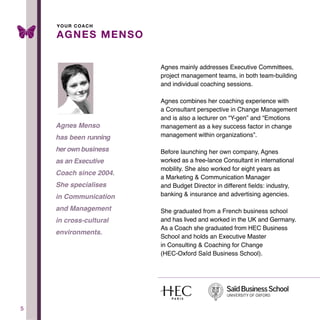
AGNES MENSO
Agnes Menso
has been running
her own business
as an Executive
Coach since 2004.
She specialises
in Communication
and Management
in cross-cultural
environments.
YOUR COACH
6
ETHICS & CONFIDENTIALITY
Individual and collective coaching sessions
are confidential. No information will be given
to anyone without prior agreement.
The client can give up the assignment at any
time. The coach can also reserve the right to
stop the mission. In these both circumstances,
an end session will be proposed to the client
and set-up. Coaching practice is regularly
subjected to supervision conducted by an
external professional.
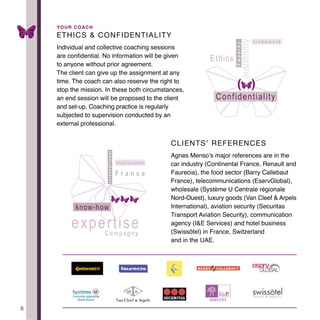
CLIENTS’ REFERENCES
Agnes Menso’s major references are in the
car industry (Continental France, Renault and
Faurecia), the food sector (Barry Callebaut
France), telecommunications (EservGlobal),
wholesale (Système U Centrale régionale
Nord-Ouest), luxury goods (Van Cleef & Arpels
International), aviation security (Securitas
Transport Aviation Security), communication
agency (I&E Services) and hotel business
(Swissôtel) in France, Switzerland
and in the UAE.
YOUR COACH
7
OUR APPROACH
To offer you tailor-made services,
it is vital to take time to clearly
understand what you are looking for.
Activity-based learning is built upon
systemic and transitional tools.
Though it seems more dynamic
than indoor seminars, we are willing
to make those as participating as
possible by integrating educational
and creative role playing.
Whatever you choose, each
session is subject to a rigorous
debriefing where empathy,
respect and confidentiality
are assured.
8
Should you choose a cooking challenge, a treasure hunt, a horse
workshop or theatre, activity-based learning facilitates immediate
behavioural consciousness.
These tailor-made approaches enable each member to sharpen his /
her individual efficiency to enhance the collective performance to reach
a goal. It helps participants reflect on their management and communication
styles, leadership, emotions, priorities and stress management.
These activities last approximately between one and two days and have
been especially designed for groups starting at 8 people in France and
abroad, both in French and in English.
These are being conducted by one or two professional Coaches and
by experts (Chef, actors theatre...) dedicated to your workshop.
ACTIVITY-BASED LEARNING
INDOOR SEMINARS
OUR APPROACH
We are mainly going to use coaching tools, creatvity and role playing
to focus on the relationships between individuals. This will allow them
be conscious in the way they interact between them in a system that
can be either the team, the organisation or other counterparts.
This training takes into account words, tone of voice and body language.
In that context, it gives priority to how the relationship is being led,
if it is pleasant, performing, efficient, or on the contrary, if it generates
stress or misunderstandings.
They enable individuals to understand if and how they are being heard
and to what extent, what is being said - or not, generates a kind
of behaviour.
The coach’s work is to make the individual or the group aware of the
problems and lead them to find appropriate actions based on individual
and collective performance.
These workshops mainly suit executive committees, middle
and top management as well as functional or operational teams
for a team-building or a « change » management project.
These seminars can be perceived as a kind of mirror in the sense
that they help participants analyse, better understand
and improve their verbal and non-verbal communication
with one or several persons they are talking to or dealing with.
9
ADAPTATION & INTEGRATION OF EXPATRIATE
/ IMPATRIATE IN THE ORGANIZATION
In order to adapt, the best services
we are able to provide for these
Executives and Managers are
individual cross cultural coaching,
collective coaching and team
building. These different kinds
of services can be either taken
individually or combined to
each other.
Whatever their choice, these
coaching and consulting services
will take place in a rigorous
framework, where empathy,
confidentiality and respect prevail.
A relocated Executive
or Manager is expected to adapt
and perform rapidly in his / her
new working environment.
No matter what the cross cultural
issues he / she has to deal with.
10
Cross cultural coaching addresses any Manager or
Executive who needs to perform quickly in a new and
international context. Its objective is to help the client
adapt rapidly in an unknown environment, in France
or abroad without getting himself / herself lost.
The objective is to help the expatriate be operational
more quickly through action plans that are going to
give visible results, in respect of the client’s values,
beliefs, identity and integrity.
INDIVIDUAL CROSS CULTURAL
COACHING FOR EXECUTIVES
Coaching is concrete
work conducted within
a rigorous framework
and with clearly defined
objectives.
A cross cultural
environment makes
individual coaching
more complex in the
sense that it includes
parameters that cannot
be really mastered.
ADAPTATION & INTEGRATION OF EXPATRIATE / IMPATRIATE IN THE ORGANIZATION
>>>
In a cross cultural environment executive coaching requires
a multidimensional expertise both in coaching and consulting.
Due to their position, Executives can face a deep loneliness
that can be accentuated due to expatriation.
During a coaching session the Executive is free: free to express his / her
personal emotions and feelings, free to share his / her doubts, free to
talk about sensitive topics that cannot be discussed within and outside
the company and free to reflect on his / her values and sense-making,
without being afraid of judgment.
1111
INDIVIDUAL CROSS CULTURAL / COACHING FOR EXECUTIVES
ADAPTATION & INTEGRATION OF EXPATRIATE / IMPATRIATE IN THE ORGANIZATION
The coach’s work is divided into two parts.
He / she facilitates talents mobilisation and skills
development in order to restore self-confidence
to help achieve the client’s goal. The coach is also
here to focus with empathy on the client’s points
of improvement and support him / her in any of his
/ her actions to reach his / her objectives.
Cross cultural coaching usually starts before the
beginning of a mission and will give the client the
main key success factors to understand, manage
and use a different culture. This understanding may
be difficult but is vital in the sense that it conditions
the expatriation success.
A coaching session usually lasts from 1.1/2 to 2
hours. This service usually lasts a few months after
arrival and can warn the Executive or Manager
regarding a potential over-adaptation that can lead
to stress and burn-out. Experience shows that
approximately ten sessions, with a session every
2 weeks, are enough for an in-depth work.
Individual coaching covers several topics. It can be focused on beliefs,
values, emotions and how they are going to be used to adapt the best.
It helps the client reflect on what he / she wants and what he / she needs
to succeed and face this paradigm. It can also deal with communication,
management and leadership skills development and improvement,
empowerment, the taking of a new position with new responsibilities,
and stress management…
1212
Collective coaching is very operational. It addresses
executive committees, functional and operational
teams. It is based on talents and skills in order to
improve teams’ working conditions: communication
improvement, resolution of conflicts, and change
management that can generate a deep disruption…
It can take different aspects. It can be the attendance of an
executive meeting where interpersonal communication,
power games and management style are observed.
But it can also consist of the observation, analysis and
debriefing of a newly promoted Engineer who needs
to take in hand his / her team.
In this context trust is a key factor. Indeed collective
coaching assumes that each participant is ready
to put in the service of the group his / her individual
skills to make the group grow and perform better.
It leads participants to think as a team and not
as individuals anymore.
Collective coaching success mainly relies on the
boss’ involvement, motivation and capability to
challenge himself / herself and leads his / her team
to change.
COLLECTIVE COACHING
Each group has
a tremendous potential
of competences, skills,
talents and creativity
that is often
scarcely used.
ADAPTATION & INTEGRATION OF EXPATRIATE / IMPATRIATE IN THE ORGANIZATION
The Coach is in charge of the group dynamic. He / she helps the group
analyse its strengths and points of improvement, and find appropriate
actions for the team to perform better.
1313
To be more efficient we advise you to combine
this service with collective coaching and for some
people with individual coaching.
This service takes place outside the company
and usually lasts two days.
The wide variety of exercises, role playing and
debriefings give the opportunity to get to know
others more easily, develop unrecognized competencies,
solve conflicts and make people work together.
TEAM-BUILDING
Team building mainly
focuses on a
relationships’
improvement among
people. It is based
on individual and
collective motivation
in order to reach
an objective.
ADAPTATION & INTEGRATION OF EXPATRIATE / IMPATRIATE IN THE ORGANIZATION
Team building develops group dynamics in order for a team to perform
better in the long term, both internally and externally.
1414
PARTNER’S SUPPORT
This may potentially weaken
the couple and jeopardize
the expatriate’s career.
Though more and more young fema-
les tend to expatriate, we are mainly
dealing with a spouse who has fol-
lowed her partner, and whose social
status has changed tremendously.
She has to deal mainly with logistics
issues and is not Mrs Smith anymore,
but Mr. Smith’s spouse…
Relocation has to be discussed
and the decision has to be made
by the two partners.
Though companies mainly focus
on the Executive’s integration,
and scarcely take into account
the partner’s, this is also part of their
responsibility: to give the partner
the opportunity to adapt and
manage successfully.
75% of international missions
stop before completion.
This comes from the fact that
the expatriate’s partner did not
manage to integrate himself /
herself successfully in his / her
new environment.
1515
We advise you to set-up a few coaching sessions
prior to departure. These interviews will help the
partner express his / her feelings, emotions and
doubts but will allow him / her to think about a new-life
project with both short and long-terms objectives.
Indeed we know that relocation success is mainly
based on the partner’s integration. Very often we are
dealing with the expatriate’s spouse who loses his
/ her points of reference, who has not chosen to be
relocated and has had to give up family, friends and a
good position. He / she usually feels pretty lonely with
the children at school and her husband / his wife at
work. This is why, to ensure mission success,
it is essential that companies be concerned about
spouse’s status and his / her well-being.
These sessions can go on for one year after arrival to
support him / her and help him / her make this period
of time a priceless and unique experience.
We cannot say for sure how many sessions will be
needed, as it really depends on the motivation
to adapt and adjust to this new paradigm.
INDIVIDUAL CROSS CULTURAL
COACHING AND CONSULTING
In relocation, companies
usually focus on the
employees who leave
their country but
scarcely take into
account families and
especially partners.
PARTNER’S SUPPORT
We advise you to combine individual cross cultural coaching
with assessment skills. Though we are going to work on different aspects,
it can be appropriate to combine these two services in order to be more
efficient and successful.
1616
SKILLS ASSESSMENT
PARTNER’S SUPPORT
It also gives the opportunity to identify gaps that need
to be filled and competencies that should be developed.
Trust that is being built between the client and the
Consultant is the key success factor. There is no rule
to estimate when skills assessment should be set-up.
One of the major points in this situation would be to
listen to one’s needs and motivations to start this
process, and to talk openly and frankly to the
Consultant whose job is to advise the client in
respect of his / her interests and integrity.
Relocation can be
an appropriate time
to think about a different
professional future.
Skills assessment
enables the individual
to review competencies
and talents that have
been gained, and to be
potentially transferred
from one field
to the other.
It allows the client to design a project that can fit in his / her new
life-project. It creates dynamics and may help restore self-confidence.
1717
CROSS CULTURAL SEMINARS
Cross cultural seminars are
designed both for Executives
their family to help them cope with
French culture at work and on an
everyday life basis. Our expertise
in other countries enables us to
provide you with this assistance.
In both cases, these seminars are
based on our experience on both
living and working in France - as
French - and abroad.
You will be given concrete tools
to lead you as quickly as possible
to autonomy.
These seminars can be combined
with any coaching or skills
assessment services.
Geographical proximity does not
mean cultural - and or linguistic -
proximity.
1818
These seminars usually last two days and are
tailor-made for Executives and Managers who
need to adapt quickly and perform before arriving
in France. They can be set-up both for individuals
and teams, and are designed to help them get used
to French culture and cope with it.
During these seminars we are going to work on
several aspects:
• Managing time in a polychronic vs. a monochronic 		
culture
• Managing information in an implicit vs. explicit culture
• Relationship to hierarchy in a strong power vs. small 		
power distance
• Relationship to groups: individualism vs. collectivism
• Relationship to risk : weak vs. strong uncertainty avoidance
• Vision of manager’s role: femininity vs. masculinity
• Corporate values
• …
IN-COMPANY SEMINARS
WORKING IN FRANCE
Though you are
going to work
in an international
environment you will
have to deal with the
French, their customs
and habits, and
sometimes their
sense of humor.
CROSS CULTURAL SEMINARS
We are going to give you a few clues to help you better
understand French mentality, French business world -
and especially implicit French communication in business -
to give adapted presentations, cooperate with your hierarchy,
peers and subordinates as well as manage meetings.
1919
In the same register we also advise the impatriate
to participate to everyday life seminars to have
a broader knowledge of French culture.
These integration seminars will be mainly focused on:
• The French educational system
• French bureaucracy and the notion of “service public”
• The Paris - Province opposition
• Food, culture, shopping, leisure and vacation
• Making friends and communicating with the French
• Current issues in French society
A limited and selective piece of advice can also be
implemented if needed.
Should you be relocated to UK, Germany,
Spain, Switzerland, Belgium, China and
the United Arabic Emirates, feel free to contact us.
We would be happy to assist you.
PARTNER’S INTEGRATION
LIVING IN FRANCE
ASSISTANCE TO DEPARTURE
If possible,
we recommend
the partner to follow
in-company seminars
as it gives an accurate
view of French systems
and French values.
We are used to dealing
in several countries.
CROSS CULTURAL SEMINARS
2020
BACK HOME
According to a survey conducted in
2011, reintegration is hard to manage
for 42% of them.
Only 28% have been promoted and
35% estimate that their company has
filled their needs in terms of position.
38% of them indicate that it has
facilitated their reintegration.
These figures may explain why 47%
left their company after they return...
If companies want to make the most
of their expatriates’ expertise, they
should set up appropriate services to
help them reconnect and share what
they have learned.
When coming back, expatriates
and their families have to face
a reverse cultural shock.
They usually feel somehow
out of touch with reality in their
home country.
2121
Usually companies have very few contacts
with their employees when they are abroad.
They tend somehow to forget them and usually
feel a little overwhelmed when they come back.
They do not really know how to enhance their
Executives’ experience and do not know either
how to manage them. Moreover, because of distance,
these Executives have been neither included nor
consulted in the company’s strategy and may
disagree with it.
At this time, it is not uncommon that either expatriates
set off again for a new mission abroad - which will
make their return to “normal life” more difficult -
or leave the company for a competitor, that is ready
to acknowledge their skills, their talents and the added
value they can bring to run the business..
It is hard to say how many reintegration coaching
sessions are needed. They usually start before the
expatriate’s leave and they both rely on his / her will
to come back and on the company’s wish to integrate
him / her successfully.
EXPATRIATE REINTEGRATION COACHING
Even after a short
period of time in
relocation, coming
back home for
expatriates may not
be as easy as it
should be.
BACK HOME
Expatriate reintegration coaching’s objective is to help the expatriate
share and pass on his / her knowledge. It can also be set-up for this
Manager’s hierarchy, peers and subordinates to cooperate either on a
collective or individual level.
2222
He / she has to get used to a country he / she
may have totally or partly put aside and find
his / her marks.
Like for the Executive it is hard to estimate how
many coaching sessions are needed as it depends
on his / her will to adapt to this new life.
Nevertheless we advise to start these sessions
prior to departure.
PARTNER’S REINTEGRATION COACHING
The issue for the
partner’s integration
is approximately
the same as for
the Executive’s.
BACK HOME
2323
CHANGE MANAGEMENT
This is a paradox that Executives
and Managers cannot shirk and
have to deal with.
The objective of this service is to
give the client the main tools to have
an appropriate communication and
manage change successfully in
respect of organizational, collective
and individual values.
Change management consists
in handling simultaneously
the end of a paradigm and the
beginning of a new one.
An international context makes
this more challenging.
2424
It can be a company’s move, an identity loss
due to a M&A, the departure of a symbolic leader,
a new product launch or the abandonment
of a business activity…
On top of managing a new identity, a new culture
with new values and unknown ways of working,
Executives and Managers have to integrate
cross cultural parameters - that may be
sometimes religious.
The objective of this service is to help the client
analyze, handle this complexity, set-up and follow
action plans. It can be combined with collective
and individual coaching
The objective of this service is to help the client
analyze, handle this complexity, set-up and follow
action plans as well as provide him / her with
appropriate tools to communicate efficiently.
This service can be combined with collective
and individual coaching.
CHANGE MANAGEMENT
There is a large
variety of change
management projects.
There is no miracle solution to manage change successfully.
It is more a question of associating and setting a few elements in motion
with appropriate processes in a rigorous way.
Tableofcontents
25
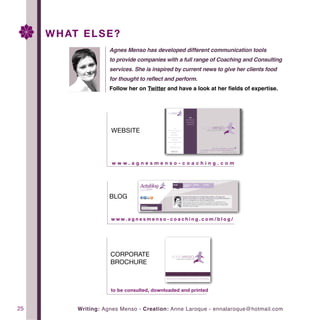
			 Agnes Menso has developed different communication tools
			 to provide companies with a full range of Coaching and Consulting
			 services. She is inspired by current news to give her clients food
			 for thought to reflect and perform.
			 Follow her on Twitter and have a look at her fields of expertise.
Writing: Agnes Menso - Creation: Anne Laroque - ennalaroque@hotmail.com
WHAT ELSE?
WEBSITE
w w w . a g n e s m e n s o - c o a c h i n g . c o m
CORPORATE
BROCHURE
to be consulted, downloaded and printed
BLOG
w w w . a g n e s m e n s o - c o a c h i n g . c o m / b l o g /
AGNES MENSO
Cell : + 33 (0) 676 280 953
info@agnesmenso-coaching.com
Paris, France
www.agnesmenso-coaching.com
June2012,allrightsreserved©

Cross cultural coaching and consulting

  • 1.
    CROSS CULTURAL CO ACHI NG & CO NS U LTI NG Contact : Agnes Menso - + 33 (0) 676 280 953 - info@agnesmenso-coaching.com - www.agnesmenso-coaching.com
  • 2.
    Tableofcontents 2 P.03 INTRODUCTION P.04 YOURCOACH P.05 / Agnes Menso P.06 / Ethics & confidentiality Clients’ references P.07 OUR APPROACH P.09 ADAPTATION AND INTEGRATION OF EXPATRIATE / IMPATRIATE IN THE ORGANIZATION P.10 / Individual cross cultural coaching for Executives P.12 / Collective coaching P.13 / Team-building P.14 PARTNER’S SUPPORT P.15 / Individual cross cultural Coaching and Consulting P.16 / Skills assessment P.17 CROSS CULTURAL SEMINARS P.18 / In-company seminars P.19 / Partner’s integration Assistance to departure P.20 BACK HOME P.21 / Expatriate reintegration coaching P.22 / Partner’s reintegration coaching P.23 CHANGE MANAGEMENT P.25 WHAT ELSE? TABLE OF CONTENTS
  • 3.
    3 Introducrion Cross cultural coachingand consulting’s goal is to help you understand and cope with cultural dimensions, values and beliefs that you are not familiar with. It enables you to set up appropriate behaviors and communication in a complex environment in respect of your identity and integrity. It will also help you manage stress issues and conflicts that may pollute and disturb relationships. Cross cultural coaching and consulting will allow you to optimize and transform these cultural differences into tremendous growth potential in an unknown environment. All these services are tailor-made and designed for Executives, Managers and their families. They can be taken either separately or combined with each other. INTRODUCTION THE COACH’S WORD Management in a cross cultural context could be called “Dealing and coping with opposites”.
  • 4.
    4 YOUR COACH As across-cultural Coach and Consultant, I want to offer you my expertise. Highly passionate about my job and human relationships, my experience and involvement ensure challenging sessions, based on empathy rules of confidentiality and integrity. «I have always been used to dealing with cross-cultural environments: first, as a child with foreign origins, then as a teenager and now as an adult.»
  • 5.
    5 Agnes mainly addressesExecutive Committees, project management teams, in both team-building and individual coaching sessions. Agnes combines her coaching experience with a Consultant perspective in Change Management and is also a lecturer on “Y-gen” and “Emotions management as a key success factor in change management within organizations”. Before launching her own company, Agnes worked as a free-lance Consultant in international mobility. She also worked for eight years as a Marketing & Communication Manager and Budget Director in different fields: industry, banking & insurance and advertising agencies. She graduated from a French business school and has lived and worked in the UK and Germany. As a Coach she graduated from HEC Business School and holds an Executive Master in Consulting & Coaching for Change (HEC-Oxford Saïd Business School). AGNES MENSO Agnes Menso has been running her own business as an Executive Coach since 2004. She specialises in Communication and Management in cross-cultural environments. YOUR COACH
  • 6.
    6 ETHICS & CONFIDENTIALITY Individualand collective coaching sessions are confidential. No information will be given to anyone without prior agreement. The client can give up the assignment at any time. The coach can also reserve the right to stop the mission. In these both circumstances, an end session will be proposed to the client and set-up. Coaching practice is regularly subjected to supervision conducted by an external professional. CLIENTS’ REFERENCES Agnes Menso’s major references are in the car industry (Continental France, Renault and Faurecia), the food sector (Barry Callebaut France), telecommunications (EservGlobal), wholesale (Système U Centrale régionale Nord-Ouest), luxury goods (Van Cleef & Arpels International), aviation security (Securitas Transport Aviation Security), communication agency (I&E Services) and hotel business (Swissôtel) in France, Switzerland and in the UAE. YOUR COACH
  • 7.
    7 OUR APPROACH To offeryou tailor-made services, it is vital to take time to clearly understand what you are looking for. Activity-based learning is built upon systemic and transitional tools. Though it seems more dynamic than indoor seminars, we are willing to make those as participating as possible by integrating educational and creative role playing. Whatever you choose, each session is subject to a rigorous debriefing where empathy, respect and confidentiality are assured.
  • 8.
    8 Should you choosea cooking challenge, a treasure hunt, a horse workshop or theatre, activity-based learning facilitates immediate behavioural consciousness. These tailor-made approaches enable each member to sharpen his / her individual efficiency to enhance the collective performance to reach a goal. It helps participants reflect on their management and communication styles, leadership, emotions, priorities and stress management. These activities last approximately between one and two days and have been especially designed for groups starting at 8 people in France and abroad, both in French and in English. These are being conducted by one or two professional Coaches and by experts (Chef, actors theatre...) dedicated to your workshop. ACTIVITY-BASED LEARNING INDOOR SEMINARS OUR APPROACH We are mainly going to use coaching tools, creatvity and role playing to focus on the relationships between individuals. This will allow them be conscious in the way they interact between them in a system that can be either the team, the organisation or other counterparts. This training takes into account words, tone of voice and body language. In that context, it gives priority to how the relationship is being led, if it is pleasant, performing, efficient, or on the contrary, if it generates stress or misunderstandings. They enable individuals to understand if and how they are being heard and to what extent, what is being said - or not, generates a kind of behaviour. The coach’s work is to make the individual or the group aware of the problems and lead them to find appropriate actions based on individual and collective performance. These workshops mainly suit executive committees, middle and top management as well as functional or operational teams for a team-building or a « change » management project. These seminars can be perceived as a kind of mirror in the sense that they help participants analyse, better understand and improve their verbal and non-verbal communication with one or several persons they are talking to or dealing with.
  • 9.
    9 ADAPTATION & INTEGRATIONOF EXPATRIATE / IMPATRIATE IN THE ORGANIZATION In order to adapt, the best services we are able to provide for these Executives and Managers are individual cross cultural coaching, collective coaching and team building. These different kinds of services can be either taken individually or combined to each other. Whatever their choice, these coaching and consulting services will take place in a rigorous framework, where empathy, confidentiality and respect prevail. A relocated Executive or Manager is expected to adapt and perform rapidly in his / her new working environment. No matter what the cross cultural issues he / she has to deal with.
  • 10.
    10 Cross cultural coachingaddresses any Manager or Executive who needs to perform quickly in a new and international context. Its objective is to help the client adapt rapidly in an unknown environment, in France or abroad without getting himself / herself lost. The objective is to help the expatriate be operational more quickly through action plans that are going to give visible results, in respect of the client’s values, beliefs, identity and integrity. INDIVIDUAL CROSS CULTURAL COACHING FOR EXECUTIVES Coaching is concrete work conducted within a rigorous framework and with clearly defined objectives. A cross cultural environment makes individual coaching more complex in the sense that it includes parameters that cannot be really mastered. ADAPTATION & INTEGRATION OF EXPATRIATE / IMPATRIATE IN THE ORGANIZATION >>> In a cross cultural environment executive coaching requires a multidimensional expertise both in coaching and consulting. Due to their position, Executives can face a deep loneliness that can be accentuated due to expatriation. During a coaching session the Executive is free: free to express his / her personal emotions and feelings, free to share his / her doubts, free to talk about sensitive topics that cannot be discussed within and outside the company and free to reflect on his / her values and sense-making, without being afraid of judgment.
  • 11.
    1111 INDIVIDUAL CROSS CULTURAL/ COACHING FOR EXECUTIVES ADAPTATION & INTEGRATION OF EXPATRIATE / IMPATRIATE IN THE ORGANIZATION The coach’s work is divided into two parts. He / she facilitates talents mobilisation and skills development in order to restore self-confidence to help achieve the client’s goal. The coach is also here to focus with empathy on the client’s points of improvement and support him / her in any of his / her actions to reach his / her objectives. Cross cultural coaching usually starts before the beginning of a mission and will give the client the main key success factors to understand, manage and use a different culture. This understanding may be difficult but is vital in the sense that it conditions the expatriation success. A coaching session usually lasts from 1.1/2 to 2 hours. This service usually lasts a few months after arrival and can warn the Executive or Manager regarding a potential over-adaptation that can lead to stress and burn-out. Experience shows that approximately ten sessions, with a session every 2 weeks, are enough for an in-depth work. Individual coaching covers several topics. It can be focused on beliefs, values, emotions and how they are going to be used to adapt the best. It helps the client reflect on what he / she wants and what he / she needs to succeed and face this paradigm. It can also deal with communication, management and leadership skills development and improvement, empowerment, the taking of a new position with new responsibilities, and stress management…
  • 12.
    1212 Collective coaching isvery operational. It addresses executive committees, functional and operational teams. It is based on talents and skills in order to improve teams’ working conditions: communication improvement, resolution of conflicts, and change management that can generate a deep disruption… It can take different aspects. It can be the attendance of an executive meeting where interpersonal communication, power games and management style are observed. But it can also consist of the observation, analysis and debriefing of a newly promoted Engineer who needs to take in hand his / her team. In this context trust is a key factor. Indeed collective coaching assumes that each participant is ready to put in the service of the group his / her individual skills to make the group grow and perform better. It leads participants to think as a team and not as individuals anymore. Collective coaching success mainly relies on the boss’ involvement, motivation and capability to challenge himself / herself and leads his / her team to change. COLLECTIVE COACHING Each group has a tremendous potential of competences, skills, talents and creativity that is often scarcely used. ADAPTATION & INTEGRATION OF EXPATRIATE / IMPATRIATE IN THE ORGANIZATION The Coach is in charge of the group dynamic. He / she helps the group analyse its strengths and points of improvement, and find appropriate actions for the team to perform better.
  • 13.
    1313 To be moreefficient we advise you to combine this service with collective coaching and for some people with individual coaching. This service takes place outside the company and usually lasts two days. The wide variety of exercises, role playing and debriefings give the opportunity to get to know others more easily, develop unrecognized competencies, solve conflicts and make people work together. TEAM-BUILDING Team building mainly focuses on a relationships’ improvement among people. It is based on individual and collective motivation in order to reach an objective. ADAPTATION & INTEGRATION OF EXPATRIATE / IMPATRIATE IN THE ORGANIZATION Team building develops group dynamics in order for a team to perform better in the long term, both internally and externally.
  • 14.
    1414 PARTNER’S SUPPORT This maypotentially weaken the couple and jeopardize the expatriate’s career. Though more and more young fema- les tend to expatriate, we are mainly dealing with a spouse who has fol- lowed her partner, and whose social status has changed tremendously. She has to deal mainly with logistics issues and is not Mrs Smith anymore, but Mr. Smith’s spouse… Relocation has to be discussed and the decision has to be made by the two partners. Though companies mainly focus on the Executive’s integration, and scarcely take into account the partner’s, this is also part of their responsibility: to give the partner the opportunity to adapt and manage successfully. 75% of international missions stop before completion. This comes from the fact that the expatriate’s partner did not manage to integrate himself / herself successfully in his / her new environment.
  • 15.
    1515 We advise youto set-up a few coaching sessions prior to departure. These interviews will help the partner express his / her feelings, emotions and doubts but will allow him / her to think about a new-life project with both short and long-terms objectives. Indeed we know that relocation success is mainly based on the partner’s integration. Very often we are dealing with the expatriate’s spouse who loses his / her points of reference, who has not chosen to be relocated and has had to give up family, friends and a good position. He / she usually feels pretty lonely with the children at school and her husband / his wife at work. This is why, to ensure mission success, it is essential that companies be concerned about spouse’s status and his / her well-being. These sessions can go on for one year after arrival to support him / her and help him / her make this period of time a priceless and unique experience. We cannot say for sure how many sessions will be needed, as it really depends on the motivation to adapt and adjust to this new paradigm. INDIVIDUAL CROSS CULTURAL COACHING AND CONSULTING In relocation, companies usually focus on the employees who leave their country but scarcely take into account families and especially partners. PARTNER’S SUPPORT We advise you to combine individual cross cultural coaching with assessment skills. Though we are going to work on different aspects, it can be appropriate to combine these two services in order to be more efficient and successful.
  • 16.
    1616 SKILLS ASSESSMENT PARTNER’S SUPPORT Italso gives the opportunity to identify gaps that need to be filled and competencies that should be developed. Trust that is being built between the client and the Consultant is the key success factor. There is no rule to estimate when skills assessment should be set-up. One of the major points in this situation would be to listen to one’s needs and motivations to start this process, and to talk openly and frankly to the Consultant whose job is to advise the client in respect of his / her interests and integrity. Relocation can be an appropriate time to think about a different professional future. Skills assessment enables the individual to review competencies and talents that have been gained, and to be potentially transferred from one field to the other. It allows the client to design a project that can fit in his / her new life-project. It creates dynamics and may help restore self-confidence.
  • 17.
    1717 CROSS CULTURAL SEMINARS Crosscultural seminars are designed both for Executives their family to help them cope with French culture at work and on an everyday life basis. Our expertise in other countries enables us to provide you with this assistance. In both cases, these seminars are based on our experience on both living and working in France - as French - and abroad. You will be given concrete tools to lead you as quickly as possible to autonomy. These seminars can be combined with any coaching or skills assessment services. Geographical proximity does not mean cultural - and or linguistic - proximity.
  • 18.
    1818 These seminars usuallylast two days and are tailor-made for Executives and Managers who need to adapt quickly and perform before arriving in France. They can be set-up both for individuals and teams, and are designed to help them get used to French culture and cope with it. During these seminars we are going to work on several aspects: • Managing time in a polychronic vs. a monochronic culture • Managing information in an implicit vs. explicit culture • Relationship to hierarchy in a strong power vs. small power distance • Relationship to groups: individualism vs. collectivism • Relationship to risk : weak vs. strong uncertainty avoidance • Vision of manager’s role: femininity vs. masculinity • Corporate values • … IN-COMPANY SEMINARS WORKING IN FRANCE Though you are going to work in an international environment you will have to deal with the French, their customs and habits, and sometimes their sense of humor. CROSS CULTURAL SEMINARS We are going to give you a few clues to help you better understand French mentality, French business world - and especially implicit French communication in business - to give adapted presentations, cooperate with your hierarchy, peers and subordinates as well as manage meetings.
  • 19.
    1919 In the sameregister we also advise the impatriate to participate to everyday life seminars to have a broader knowledge of French culture. These integration seminars will be mainly focused on: • The French educational system • French bureaucracy and the notion of “service public” • The Paris - Province opposition • Food, culture, shopping, leisure and vacation • Making friends and communicating with the French • Current issues in French society A limited and selective piece of advice can also be implemented if needed. Should you be relocated to UK, Germany, Spain, Switzerland, Belgium, China and the United Arabic Emirates, feel free to contact us. We would be happy to assist you. PARTNER’S INTEGRATION LIVING IN FRANCE ASSISTANCE TO DEPARTURE If possible, we recommend the partner to follow in-company seminars as it gives an accurate view of French systems and French values. We are used to dealing in several countries. CROSS CULTURAL SEMINARS
  • 20.
    2020 BACK HOME According toa survey conducted in 2011, reintegration is hard to manage for 42% of them. Only 28% have been promoted and 35% estimate that their company has filled their needs in terms of position. 38% of them indicate that it has facilitated their reintegration. These figures may explain why 47% left their company after they return... If companies want to make the most of their expatriates’ expertise, they should set up appropriate services to help them reconnect and share what they have learned. When coming back, expatriates and their families have to face a reverse cultural shock. They usually feel somehow out of touch with reality in their home country.
  • 21.
    2121 Usually companies havevery few contacts with their employees when they are abroad. They tend somehow to forget them and usually feel a little overwhelmed when they come back. They do not really know how to enhance their Executives’ experience and do not know either how to manage them. Moreover, because of distance, these Executives have been neither included nor consulted in the company’s strategy and may disagree with it. At this time, it is not uncommon that either expatriates set off again for a new mission abroad - which will make their return to “normal life” more difficult - or leave the company for a competitor, that is ready to acknowledge their skills, their talents and the added value they can bring to run the business.. It is hard to say how many reintegration coaching sessions are needed. They usually start before the expatriate’s leave and they both rely on his / her will to come back and on the company’s wish to integrate him / her successfully. EXPATRIATE REINTEGRATION COACHING Even after a short period of time in relocation, coming back home for expatriates may not be as easy as it should be. BACK HOME Expatriate reintegration coaching’s objective is to help the expatriate share and pass on his / her knowledge. It can also be set-up for this Manager’s hierarchy, peers and subordinates to cooperate either on a collective or individual level.
  • 22.
    2222 He / shehas to get used to a country he / she may have totally or partly put aside and find his / her marks. Like for the Executive it is hard to estimate how many coaching sessions are needed as it depends on his / her will to adapt to this new life. Nevertheless we advise to start these sessions prior to departure. PARTNER’S REINTEGRATION COACHING The issue for the partner’s integration is approximately the same as for the Executive’s. BACK HOME
  • 23.
    2323 CHANGE MANAGEMENT This isa paradox that Executives and Managers cannot shirk and have to deal with. The objective of this service is to give the client the main tools to have an appropriate communication and manage change successfully in respect of organizational, collective and individual values. Change management consists in handling simultaneously the end of a paradigm and the beginning of a new one. An international context makes this more challenging.
  • 24.
    2424 It can bea company’s move, an identity loss due to a M&A, the departure of a symbolic leader, a new product launch or the abandonment of a business activity… On top of managing a new identity, a new culture with new values and unknown ways of working, Executives and Managers have to integrate cross cultural parameters - that may be sometimes religious. The objective of this service is to help the client analyze, handle this complexity, set-up and follow action plans. It can be combined with collective and individual coaching The objective of this service is to help the client analyze, handle this complexity, set-up and follow action plans as well as provide him / her with appropriate tools to communicate efficiently. This service can be combined with collective and individual coaching. CHANGE MANAGEMENT There is a large variety of change management projects. There is no miracle solution to manage change successfully. It is more a question of associating and setting a few elements in motion with appropriate processes in a rigorous way.
  • 25.
    Tableofcontents 25 Agnes Mensohas developed different communication tools to provide companies with a full range of Coaching and Consulting services. She is inspired by current news to give her clients food for thought to reflect and perform. Follow her on Twitter and have a look at her fields of expertise. Writing: Agnes Menso - Creation: Anne Laroque - ennalaroque@hotmail.com WHAT ELSE? WEBSITE w w w . a g n e s m e n s o - c o a c h i n g . c o m CORPORATE BROCHURE to be consulted, downloaded and printed BLOG w w w . a g n e s m e n s o - c o a c h i n g . c o m / b l o g /
  • 26.
    AGNES MENSO Cell :+ 33 (0) 676 280 953 info@agnesmenso-coaching.com Paris, France www.agnesmenso-coaching.com June2012,allrightsreserved©