GLOBALISATION,  WAGES AND  WELFARE REFORM The ‘Middle Mass’ and the ‘Marginalised Minority’ in twenty-first century Australia Peter Saunders Centre for Independent Studies Keynote address to Dept of Employment and Workplace Relations All SES Conference, Sydney, 2 August 2007
What  exactly  is the problem we want to solve?   How to raise workforce participation?   Mainly an  economic  concern due to ageing population:  Australia participation rate is 13 th  out of 30 in OECD… …  but working age: retiree ratio will fall in 40 years from 5.6:1 to 2.4:1 if nothing is done* How to reduce welfare dependency? An  economic  and  sociological  concern: stemming the rise of a dependency culture *NATSEM/AMP
How to raise workforce participation (1)  Reduce early retirement: 7.5 % point fall in participation by 55-59 males in 25 years Match best OECD > GDP per capita 10% higher Policy = super reforms (& age pension changes?)
How to raise workforce participation 1)  Reduce early retirement: 7.5 % point fall in participation by 55-59 males in 25 years Match best OECD > GDP per capita 10% higher Policy = super reforms (& age pension changes?) (2)  Get women back into jobs: Australia 20/30 in OECD for women under 45 350,000 women say they want more paid work Policy = tax/FTB reform + child care/parental leave inducements
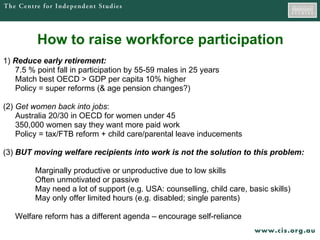
How to raise workforce participation 1)  Reduce early retirement: 7.5 % point fall in participation by 55-59 males in 25 years Match best OECD > GDP per capita 10% higher Policy = super reforms (& age pension changes?) (2)  Get women back into jobs : Australia 20/30 in OECD for women under 45 350,000 women say they want more paid work Policy = tax/FTB reform + child care/parental leave inducements (3)  BUT moving welfare recipients into work is not the solution to this problem: Marginally productive or unproductive due to low skills Often unmotivated or passive May need a lot of support (e.g. USA: counselling, child care, basic skills) May only offer limited hours (e.g. disabled; single parents) Welfare reform has a different agenda – encourage self-reliance
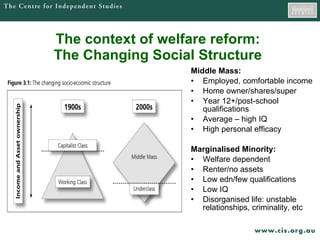
The context of welfare reform: The Changing Social Structure Middle Mass: Employed, comfortable income Home owner/shares/super Year 12+/post-school qualifications Average – high IQ High personal efficacy Marginalised Minority: Welfare dependent Renter/no assets Low edn/few qualifications Low IQ Disorganised life: unstable relationships, criminality, etc
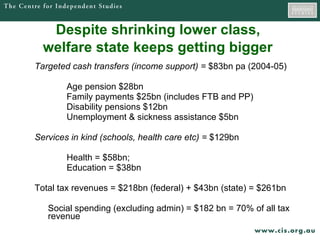
Despite shrinking lower class,  welfare state keeps getting bigger   Targeted cash transfers (income support) =  $83bn pa (2004-05) Age pension $28bn Family payments $25bn (includes FTB and PP) Disability pensions $12bn Unemployment & sickness assistance $5bn Services in kind (schools, health care etc) =  $129bn Health = $58bn;  Education = $38bn Total tax revenues = $218bn (federal) + $43bn (state) = $261bn Social spending (excluding admin) = $182 bn = 70% of all tax revenue
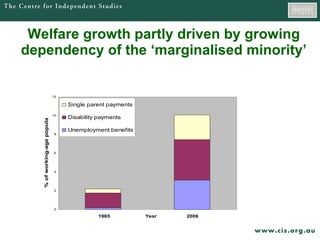
Welfare growth partly driven by growing dependency of the ‘marginalised minority’
But welfare growth also driven by  increasing dependency of the ‘middle mass’  Family support payments:  9 in 10 families with children  receive family payments (also child care benefits/ allowances, baby bonus, etc); Age pension:  8 out of 10 over 65 receive a government age pension (54% of retirees get a full government age pension and another 28% get a partial pension); Health:  Pre-1982 68% insured themselves; Now 6 out of 10 rely entirely on Medicare for their health care (no health insurance)
Why is a big welfare state a problem? (1) Economic effects Necessitates high taxation with high deadweight costs:  Every extra $1 raised costs $1.20 in lost output (take fewer risks, work fewer hours) Problem of high EMTRs  due to progressive income tax plus means-tested benefits Sustainability over time:   Spending on age pension will increase by 1.9% points of GDP in 40 years as majority will still get a part pension in 2040 Federal health expenditure up from 3.8% to 7.3% GDP in 40 years;  Spending on aged care up from 0.8% to 2% GDP
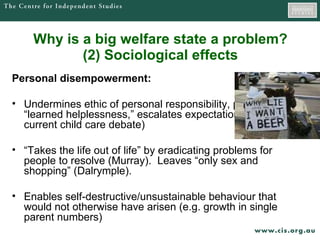
Why is a big welfare state a problem? (2) Sociological effects Personal disempowerment: Undermines ethic of personal responsibility, promotes “learned helplessness,” escalates expectations (e.g. current child care debate) “ Takes the life out of life” by eradicating problems for people to resolve (Murray).  Leaves “only sex and shopping” (Dalrymple). Enables self-destructive/unsustainable behaviour that would not otherwise have arisen (e.g. growth in single parent numbers)
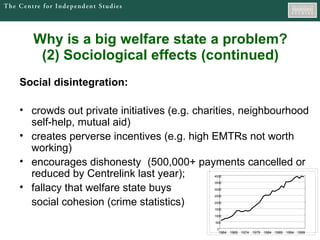
Why is a big welfare state a problem? (2) Sociological effects (continued) Social disintegration: crowds out private initiatives (e.g. charities, neighbourhood self-help, mutual aid) creates perverse incentives (e.g. high EMTRs not worth working)  encourages dishonesty  ( 500,000+ payments cancelled or reduced by Centrelink last year); fallacy that welfare state buys  social cohesion (crime statistics) 0 500 1000 1500 2000 2500 3000 3500 4000 1964 1969 1974 1979 1984 1989 1994 1999
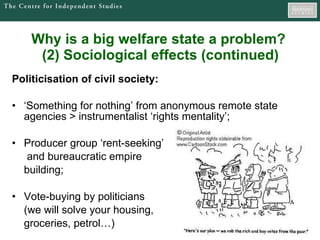
Why is a big welfare state a problem?  (2) Sociological effects (continued) Politicisation of civil society: ‘ Something for nothing’ from anonymous remote state agencies > instrumentalist ‘rights mentality’ ; Producer group ‘rent-seeking’    and bureaucratic empire  building;  Vote-buying by politicians (we will solve your housing, groceries, petrol…)
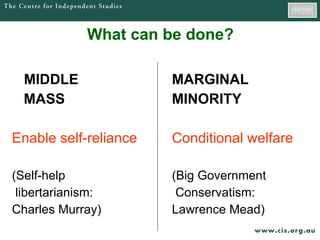
What can be done? MIDDLE  MARGINAL  MASS MINORITY Enable self-reliance Conditional welfare (Self-help (Big Government  libertarianism:  Conservatism: Charles Murray) Lawrence Mead)
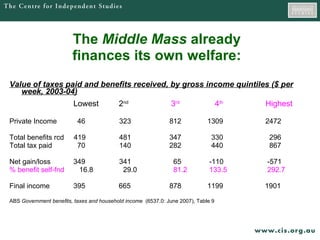
The  Middle Mass  already  finances its own welfare:  Value of taxes paid and benefits received, by gross income quintiles ($ per week, 2003-04) Lowest   2 nd   3 rd   4 th Highest Private Income   46   323 812   1309 2472 Total benefits rcd  419   481 347   330     296 Total tax paid   70   140 282   440     867 Net gain/loss 349   341    65    -110    -571 % benefit self-fnd   16.8   29.0     81.2   133.5    292.7 Final income 395  665 878    1199   1901 ABS  Government benefits, taxes and household income  (6537.0: June 2007), Table 9
“ Couple households with dependent children paid $519 per week in taxes [in 2003--4] and received $501 per week in benefits” (ABS, June 2007) Incidence of tax payments and welfare receipts for different types of households ($ per week, 2001-02) Single Couple Couple Couple Couple Couple Couple Single person <35 kids kids kids 55-64 >65 person <35 no kids <5yrs 5-14 15-24 no kids no kids >65 Private income 630.8 1390.6 1095.4 1160.0 1395.6 684.5 287.6 150.7 Total Benefits  101.7 107.2 292.3 507.8 564.1 264.5 548.8 351.3 Total taxes  208.5 426.9 373.8 393.5 474.4 223.4 102.3   56.1 Net cost/benefit -106.7 -319.7 -81.6 114.3   89.7   41.1 446.5 295.1 Final income 524.1 1070.9 1013.9 1274.3 1485.3 725.6 734.1 445.   Rachel Lloyd, Ann Harding and Neil Warren,  Redistribution, the welfare state and lifetime transitions  Paper to the conference on ‘Transitions and Risk’, Melbourne, 24 February 2005, Table 1.
Plus lifetime churning:   “ A significant proportion of income taxes paid during the lifetime are returned to the  same individuals  in the form of cash transfers during some other period of their lifecycle” (Ann Harding) e.g. Average Australian pays in taxes for 73% of the government health care they receive (even the bottom decile pays for $62,000 of its $177,000 lifetime health benefits – 2006 prices)   At least half of all welfare state spending ($85bn) is churned rather than redistributed So most people could afford to buy what they need if they didn’t pay so much tax
How could self-reliance of  Middle Mass be restored? Voluntary  age pension opt-outs  in return for tax-exempted super contributions (up to extra 9% of salary) Voluntary  Medicare opt-outs  in return for $2,500 p.a. tax reductions to fund personal medical savings accounts Denationalise the Future Fund - $3,000 seed money for every Australian, to grow into  personal earnings replacement accounts  with 1% annual levy to replace first 6 months of benefits No  income tax  until subsistence income has been earned;  child tax credits  to replace family payments
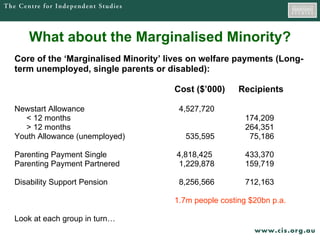
What about the Marginalised Minority? Core of the ‘Marginalised Minority’ lives on welfare payments (Long- term unemployed, single parents or disabled): Cost ($’000) Recipients Newstart Allowance   4,527,720   < 12 months   174,209 > 12 months   264,351 Youth Allowance (unemployed)     535,595   75,186 Parenting Payment Single  4,818,425   433,370 Parenting Payment Partnered   1,229,878   159,719 Disability Support Pension   8,256,566   712,163 1.7m people costing $20bn p.a. Look at each group in turn…
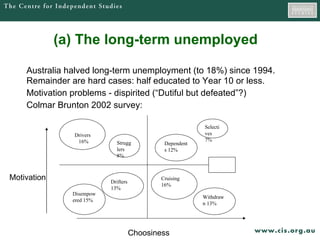
(a) The long-term unemployed Australia halved long-term unemployment (to 18%) since 1994.  Remainder are hard cases: half educated to Year 10 or less.  Motivation problems - dispirited (“Dutiful but defeated”?)  Colmar Brunton 2002 survey: Motivation Choosiness Strugglers 8% Drivers 16% Cruising 16% Withdrawn 13% Dependents 12% Selectives 7% Disempowered 15% Drifters 13%
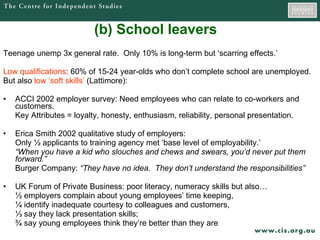
(b) School leavers Teenage unemp 3x general rate.  Only 10% is long-term but ‘scarring effects.’  Low qualifications : 60% of 15-24 year-olds who don’t complete school are unemployed. But also  low ‘soft skills’  (Lattimore): ACCI 2002 employer survey: Need employees who can relate to co-workers and customers.  Key Attributes = loyalty, honesty, enthusiasm, reliability, personal presentation.  Erica Smith 2002 qualitative study of employers: Only  ½ applicants to training agency met  ‘base level of employability.’  “ When you have a kid who slouches and chews and swears, you’d never put them forward.” Burger Company:  “They have no idea.  They don’t understand the responsibilities”  UK Forum of Private Business: poor literacy, numeracy skills but also… ½  employers complain about young employees’ time keeping,  ¼ identify inadequate courtesy to colleagues and customers,  ⅓  say they lack presentation skills;  ¾ say young employees think they’re better than they are
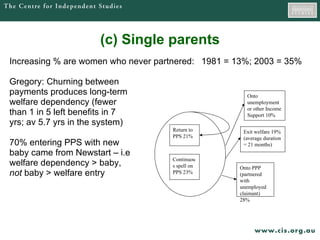
(c) Single parents Increasing % are women who never partnered:  1981 = 13%; 2003 = 35%  Gregory: Churning between  payments produces long-term  welfare dependency (fewer  than 1 in 5 left benefits in 7  yrs; av 5.7 yrs in the system)  70% entering PPS with new  baby came from Newstart – i.e welfare dependency > baby, not  baby > welfare entry  Continuous spell on PPS 23% Return to PPS 21% Onto PPP (partnered with unemployed claimant) 28% Onto unemployment or other Income Support 10% Exit welfare 19% (average duration = 21 months)
(d) DSP Claimants 60% are males: DSP is claimed by half of all inactive men (420,000) – 54% are over 50 Men claiming they cannot work = 3% in 1970, 6% today; 2/3rds have ‘moderate’ or less core limitations Av duration = 7yrs (then retire); av 9.5yrs altogether on welfare Rise is mainly ‘displaced unemployment’ – half of new entrants come from long-term unemployment  (NB: parallel to single mothers pattern)
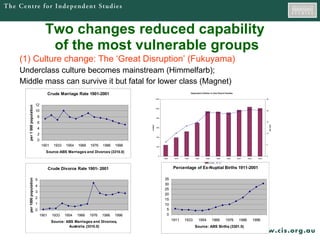
Two changes reduced capability  of the most vulnerable groups (1) Culture change: The ‘Great Disruption’ (Fukuyama)  Underclass culture becomes mainstream (Himmelfarb);  Middle mass can survive it but fatal for lower class (Magnet)
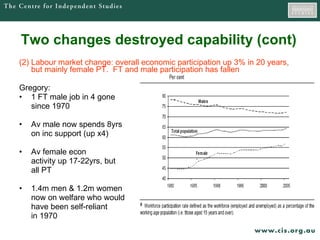
Two changes destroyed capability (cont) (2) Labour market change: overall economic participation up 3% in 20 years, but mainly female PT.  FT and male participation has fallen Gregory: 1 FT male job in 4 gone since 1970 Av male now spends 8yrs on inc support (up x4) Av female econ activity up 17-22yrs, but all PT 1.4m men & 1.2m women now on welfare who would have been self-reliant in 1970
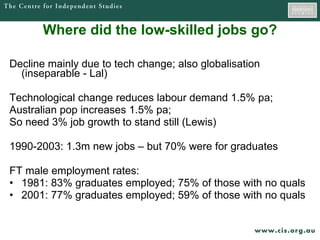
Where did the low-skilled jobs go? Decline mainly due to tech change; also globalisation (inseparable - Lal)  Technological change reduces labour demand 1.5% pa; Australian pop increases 1.5% pa; So need 3% job growth to stand still (Lewis) 1990-2003: 1.3m new jobs – but 70% were for graduates FT male employment rates: 1981: 83% graduates employed; 75% of those with no quals 2001: 77% graduates employed; 59% of those with no quals
What can be done for low-skilled jobless? Neither tech change nor globalization can be reversed, so only 3 possibilities: Train them  and raise their school retention rates so they can compete for skilled jobs; Cut unskilled wages  to generate more low skill jobs; Accept conditional welfare  will be long-term reality for many in the marginalised minority
(1) Training/education OECD evidence:   Training works for women returning to lab force; less effect for others & no effect for young unemployed “ No significant cross-country correlation” with employment rates:  those who get trained crowd out those who don’t (i.e. a positional good)
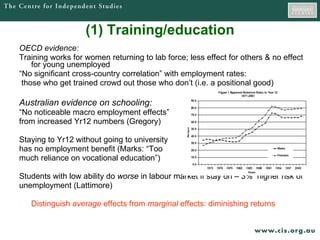
(1) Training/education OECD evidence: Training works for women returning to lab force; less effect for others & no effect for young unemployed “ No significant cross-country correlation” with employment rates:  those who get trained crowd out those who don’t (i.e. a positional good) Australian evidence on schooling: “ No noticeable macro employment effects”  from increased Yr12 numbers (Gregory) Staying to Yr12 without going to university  has no employment benefit (Marks: “Too  much reliance on vocational education”) Students with low ability do  worse  in labour market if stay on – 3%  higher risk of  unemployment (Lattimore) Distinguish  average  effects from  marginal  effects: diminishing returns
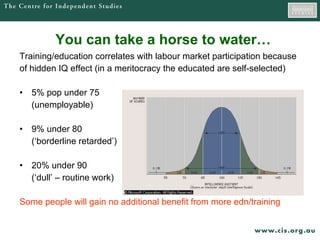
You can take a horse to water… Training/education correlates with labour market participation because  of hidden IQ effect (in a meritocracy the educated are self-selected) 5% pop under 75 (unemployable) 9% under 80 (‘borderline retarded’) 20% under 90 (‘dull’ – routine work) Some people will gain no additional benefit from more edn/training
 
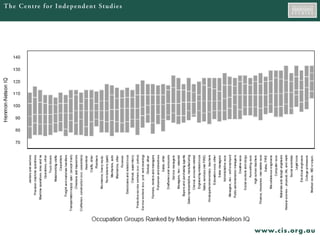
No job where bottom quartile has IQ <80 (yet 9% of population is this low) No job where median is <90 (yet 20% are this low) Pessimistic conclusion: Only limited scope for ed/training to push low IQ jobless into skilled jobs (e.g. engineers, kindergarten teachers, sales reps all >90) Optimistic conclusion: 18% of Australian jobs are unskilled and 1/5 th  of the population has IQ below 90 – so there are jobs for the less intelligent to do… … and there could be more, but only at lower wages…
(2) Create more unskilled opportunities Services up from 50% to 75% of all jobs in 25 years Much personal service work immune to globalization (can’t be exported) and tech change (can’t be automated) Potential demand for such work likely to grow: ageing population > personal care/shopping/home maintenance jobs;  increased female work > child care demand Problems: these are  low value jobs  – therefore low wage they demand  ‘soft skills ’ (responsibility etc), which may be why they are mainly female (women score higher on EQ)
Low value jobs, so cut minimum wage Aus 2 nd  highest min wage in OECD But need big reduction (at least 20%?) to generate even 100,000 more jobs (Frijters & Gregory) USA wage of low-paid job fell 17% 1980-1995 > ‘working poverty’ (rather than European high unemployment) Politically unpalatable here but can avoid working poverty: Employer subsidies don’t work; EITCs can work but BIG flaw of increasing welfare dependency higher up (= more middle class welfare) Answer: Scrap income tax on low earners + Family tax credit
How do we strengthen ‘soft skills’? Shift in skills demand due to tech change and service economy (Lewis): motor skills down 29% in 10 years,  cognitive skills up 22%,  interactive skills up 32% But social (interactive) skills are a problem (employer surveys): Legacy of ‘great disruption’ (esp. males: no father figure etc); Rights mentality: resistance to McJobs (‘job snobs’; male pride) “ The main barrier to work is not low skills: it is work discipline” (Mead) NB: Social awareness correlates with IQ (Murray) – those with low  cognitive skills also tend to have low social skills Answer: Conditional (paternalistic) welfare to do what families used to do
(3) Paternalistic Welfare   PPS and DSB :  Allow reforms to bed down but… Remove incentive to have children while already on benefits. Long-term Unemployment: 6 month time limit then FT ‘Work for Dole’ (to avoid habituation to long-term unemployment); Personal Temporary Income Replacement savings accounts to cover 1 st  6 months of any claim (seeded by Future Fund share-out) Youth unemployment: “ Only in very exceptional circumstances should there be an entitlement to financial support when not working or learning” (Tony Nicholson, BSL);   Default: structured, disciplined civil alternative to military – curb male assertiveness, provide substitute father figures, create responsibility, build genuine self-esteem (Mead)
Conclusion Case for reducing reliance on government support is more sociological than economic – don’t confuse with workforce participation policy agenda Main scope for reduced reliance is middle class welfare – ‘middle mass’ must rediscover self-reliance through personal saving/insurance model (compensated by tax opt outs) ‘ Marginalised minority’ will continue needing support. They wont be helped into work by more edn/training.  Some will benefit from increased service work if min wage is reduced to generate more low-skill jobs. Also need action on ‘soft’ (social) skills & attributes (esp for young males) if they are to be employable

Dewr presentation aug 07

  • 1.
    GLOBALISATION, WAGESAND WELFARE REFORM The ‘Middle Mass’ and the ‘Marginalised Minority’ in twenty-first century Australia Peter Saunders Centre for Independent Studies Keynote address to Dept of Employment and Workplace Relations All SES Conference, Sydney, 2 August 2007
  • 2.
    What exactly is the problem we want to solve? How to raise workforce participation? Mainly an economic concern due to ageing population: Australia participation rate is 13 th out of 30 in OECD… … but working age: retiree ratio will fall in 40 years from 5.6:1 to 2.4:1 if nothing is done* How to reduce welfare dependency? An economic and sociological concern: stemming the rise of a dependency culture *NATSEM/AMP
  • 3.
    How to raiseworkforce participation (1) Reduce early retirement: 7.5 % point fall in participation by 55-59 males in 25 years Match best OECD > GDP per capita 10% higher Policy = super reforms (& age pension changes?)
  • 4.
    How to raiseworkforce participation 1) Reduce early retirement: 7.5 % point fall in participation by 55-59 males in 25 years Match best OECD > GDP per capita 10% higher Policy = super reforms (& age pension changes?) (2) Get women back into jobs: Australia 20/30 in OECD for women under 45 350,000 women say they want more paid work Policy = tax/FTB reform + child care/parental leave inducements
  • 5.
    How to raiseworkforce participation 1) Reduce early retirement: 7.5 % point fall in participation by 55-59 males in 25 years Match best OECD > GDP per capita 10% higher Policy = super reforms (& age pension changes?) (2) Get women back into jobs : Australia 20/30 in OECD for women under 45 350,000 women say they want more paid work Policy = tax/FTB reform + child care/parental leave inducements (3) BUT moving welfare recipients into work is not the solution to this problem: Marginally productive or unproductive due to low skills Often unmotivated or passive May need a lot of support (e.g. USA: counselling, child care, basic skills) May only offer limited hours (e.g. disabled; single parents) Welfare reform has a different agenda – encourage self-reliance
  • 6.
    The context ofwelfare reform: The Changing Social Structure Middle Mass: Employed, comfortable income Home owner/shares/super Year 12+/post-school qualifications Average – high IQ High personal efficacy Marginalised Minority: Welfare dependent Renter/no assets Low edn/few qualifications Low IQ Disorganised life: unstable relationships, criminality, etc
  • 7.
    Despite shrinking lowerclass, welfare state keeps getting bigger Targeted cash transfers (income support) = $83bn pa (2004-05) Age pension $28bn Family payments $25bn (includes FTB and PP) Disability pensions $12bn Unemployment & sickness assistance $5bn Services in kind (schools, health care etc) = $129bn Health = $58bn; Education = $38bn Total tax revenues = $218bn (federal) + $43bn (state) = $261bn Social spending (excluding admin) = $182 bn = 70% of all tax revenue
  • 8.
    Welfare growth partlydriven by growing dependency of the ‘marginalised minority’
  • 9.
    But welfare growthalso driven by increasing dependency of the ‘middle mass’ Family support payments: 9 in 10 families with children receive family payments (also child care benefits/ allowances, baby bonus, etc); Age pension: 8 out of 10 over 65 receive a government age pension (54% of retirees get a full government age pension and another 28% get a partial pension); Health: Pre-1982 68% insured themselves; Now 6 out of 10 rely entirely on Medicare for their health care (no health insurance)
  • 10.
    Why is abig welfare state a problem? (1) Economic effects Necessitates high taxation with high deadweight costs: Every extra $1 raised costs $1.20 in lost output (take fewer risks, work fewer hours) Problem of high EMTRs due to progressive income tax plus means-tested benefits Sustainability over time: Spending on age pension will increase by 1.9% points of GDP in 40 years as majority will still get a part pension in 2040 Federal health expenditure up from 3.8% to 7.3% GDP in 40 years; Spending on aged care up from 0.8% to 2% GDP
  • 11.
    Why is abig welfare state a problem? (2) Sociological effects Personal disempowerment: Undermines ethic of personal responsibility, promotes “learned helplessness,” escalates expectations (e.g. current child care debate) “ Takes the life out of life” by eradicating problems for people to resolve (Murray). Leaves “only sex and shopping” (Dalrymple). Enables self-destructive/unsustainable behaviour that would not otherwise have arisen (e.g. growth in single parent numbers)
  • 12.
    Why is abig welfare state a problem? (2) Sociological effects (continued) Social disintegration: crowds out private initiatives (e.g. charities, neighbourhood self-help, mutual aid) creates perverse incentives (e.g. high EMTRs not worth working) encourages dishonesty ( 500,000+ payments cancelled or reduced by Centrelink last year); fallacy that welfare state buys social cohesion (crime statistics) 0 500 1000 1500 2000 2500 3000 3500 4000 1964 1969 1974 1979 1984 1989 1994 1999
  • 13.
    Why is abig welfare state a problem? (2) Sociological effects (continued) Politicisation of civil society: ‘ Something for nothing’ from anonymous remote state agencies > instrumentalist ‘rights mentality’ ; Producer group ‘rent-seeking’ and bureaucratic empire building; Vote-buying by politicians (we will solve your housing, groceries, petrol…)
  • 14.
    What can bedone? MIDDLE MARGINAL MASS MINORITY Enable self-reliance Conditional welfare (Self-help (Big Government libertarianism: Conservatism: Charles Murray) Lawrence Mead)
  • 15.
    The MiddleMass already finances its own welfare: Value of taxes paid and benefits received, by gross income quintiles ($ per week, 2003-04) Lowest 2 nd 3 rd 4 th Highest Private Income 46 323 812 1309 2472 Total benefits rcd 419 481 347 330 296 Total tax paid 70 140 282 440 867 Net gain/loss 349 341 65 -110 -571 % benefit self-fnd 16.8 29.0 81.2 133.5 292.7 Final income 395 665 878 1199 1901 ABS Government benefits, taxes and household income (6537.0: June 2007), Table 9
  • 16.
    “ Couple householdswith dependent children paid $519 per week in taxes [in 2003--4] and received $501 per week in benefits” (ABS, June 2007) Incidence of tax payments and welfare receipts for different types of households ($ per week, 2001-02) Single Couple Couple Couple Couple Couple Couple Single person <35 kids kids kids 55-64 >65 person <35 no kids <5yrs 5-14 15-24 no kids no kids >65 Private income 630.8 1390.6 1095.4 1160.0 1395.6 684.5 287.6 150.7 Total Benefits 101.7 107.2 292.3 507.8 564.1 264.5 548.8 351.3 Total taxes 208.5 426.9 373.8 393.5 474.4 223.4 102.3 56.1 Net cost/benefit -106.7 -319.7 -81.6 114.3 89.7 41.1 446.5 295.1 Final income 524.1 1070.9 1013.9 1274.3 1485.3 725.6 734.1 445. Rachel Lloyd, Ann Harding and Neil Warren, Redistribution, the welfare state and lifetime transitions Paper to the conference on ‘Transitions and Risk’, Melbourne, 24 February 2005, Table 1.
  • 17.
    Plus lifetime churning: “ A significant proportion of income taxes paid during the lifetime are returned to the same individuals in the form of cash transfers during some other period of their lifecycle” (Ann Harding) e.g. Average Australian pays in taxes for 73% of the government health care they receive (even the bottom decile pays for $62,000 of its $177,000 lifetime health benefits – 2006 prices) At least half of all welfare state spending ($85bn) is churned rather than redistributed So most people could afford to buy what they need if they didn’t pay so much tax
  • 18.
    How could self-relianceof Middle Mass be restored? Voluntary age pension opt-outs in return for tax-exempted super contributions (up to extra 9% of salary) Voluntary Medicare opt-outs in return for $2,500 p.a. tax reductions to fund personal medical savings accounts Denationalise the Future Fund - $3,000 seed money for every Australian, to grow into personal earnings replacement accounts with 1% annual levy to replace first 6 months of benefits No income tax until subsistence income has been earned; child tax credits to replace family payments
  • 19.
    What about theMarginalised Minority? Core of the ‘Marginalised Minority’ lives on welfare payments (Long- term unemployed, single parents or disabled): Cost ($’000) Recipients Newstart Allowance 4,527,720 < 12 months 174,209 > 12 months 264,351 Youth Allowance (unemployed) 535,595 75,186 Parenting Payment Single 4,818,425 433,370 Parenting Payment Partnered 1,229,878 159,719 Disability Support Pension 8,256,566 712,163 1.7m people costing $20bn p.a. Look at each group in turn…
  • 20.
    (a) The long-termunemployed Australia halved long-term unemployment (to 18%) since 1994. Remainder are hard cases: half educated to Year 10 or less. Motivation problems - dispirited (“Dutiful but defeated”?) Colmar Brunton 2002 survey: Motivation Choosiness Strugglers 8% Drivers 16% Cruising 16% Withdrawn 13% Dependents 12% Selectives 7% Disempowered 15% Drifters 13%
  • 21.
    (b) School leaversTeenage unemp 3x general rate. Only 10% is long-term but ‘scarring effects.’ Low qualifications : 60% of 15-24 year-olds who don’t complete school are unemployed. But also low ‘soft skills’ (Lattimore): ACCI 2002 employer survey: Need employees who can relate to co-workers and customers. Key Attributes = loyalty, honesty, enthusiasm, reliability, personal presentation. Erica Smith 2002 qualitative study of employers: Only ½ applicants to training agency met ‘base level of employability.’ “ When you have a kid who slouches and chews and swears, you’d never put them forward.” Burger Company: “They have no idea. They don’t understand the responsibilities” UK Forum of Private Business: poor literacy, numeracy skills but also… ½ employers complain about young employees’ time keeping, ¼ identify inadequate courtesy to colleagues and customers, ⅓ say they lack presentation skills; ¾ say young employees think they’re better than they are
  • 22.
    (c) Single parentsIncreasing % are women who never partnered: 1981 = 13%; 2003 = 35% Gregory: Churning between payments produces long-term welfare dependency (fewer than 1 in 5 left benefits in 7 yrs; av 5.7 yrs in the system) 70% entering PPS with new baby came from Newstart – i.e welfare dependency > baby, not baby > welfare entry Continuous spell on PPS 23% Return to PPS 21% Onto PPP (partnered with unemployed claimant) 28% Onto unemployment or other Income Support 10% Exit welfare 19% (average duration = 21 months)
  • 23.
    (d) DSP Claimants60% are males: DSP is claimed by half of all inactive men (420,000) – 54% are over 50 Men claiming they cannot work = 3% in 1970, 6% today; 2/3rds have ‘moderate’ or less core limitations Av duration = 7yrs (then retire); av 9.5yrs altogether on welfare Rise is mainly ‘displaced unemployment’ – half of new entrants come from long-term unemployment (NB: parallel to single mothers pattern)
  • 24.
    Two changes reducedcapability of the most vulnerable groups (1) Culture change: The ‘Great Disruption’ (Fukuyama) Underclass culture becomes mainstream (Himmelfarb); Middle mass can survive it but fatal for lower class (Magnet)
  • 25.
    Two changes destroyedcapability (cont) (2) Labour market change: overall economic participation up 3% in 20 years, but mainly female PT. FT and male participation has fallen Gregory: 1 FT male job in 4 gone since 1970 Av male now spends 8yrs on inc support (up x4) Av female econ activity up 17-22yrs, but all PT 1.4m men & 1.2m women now on welfare who would have been self-reliant in 1970
  • 26.
    Where did thelow-skilled jobs go? Decline mainly due to tech change; also globalisation (inseparable - Lal) Technological change reduces labour demand 1.5% pa; Australian pop increases 1.5% pa; So need 3% job growth to stand still (Lewis) 1990-2003: 1.3m new jobs – but 70% were for graduates FT male employment rates: 1981: 83% graduates employed; 75% of those with no quals 2001: 77% graduates employed; 59% of those with no quals
  • 27.
    What can bedone for low-skilled jobless? Neither tech change nor globalization can be reversed, so only 3 possibilities: Train them and raise their school retention rates so they can compete for skilled jobs; Cut unskilled wages to generate more low skill jobs; Accept conditional welfare will be long-term reality for many in the marginalised minority
  • 28.
    (1) Training/education OECDevidence: Training works for women returning to lab force; less effect for others & no effect for young unemployed “ No significant cross-country correlation” with employment rates: those who get trained crowd out those who don’t (i.e. a positional good)
  • 29.
    (1) Training/education OECDevidence: Training works for women returning to lab force; less effect for others & no effect for young unemployed “ No significant cross-country correlation” with employment rates: those who get trained crowd out those who don’t (i.e. a positional good) Australian evidence on schooling: “ No noticeable macro employment effects” from increased Yr12 numbers (Gregory) Staying to Yr12 without going to university has no employment benefit (Marks: “Too much reliance on vocational education”) Students with low ability do worse in labour market if stay on – 3% higher risk of unemployment (Lattimore) Distinguish average effects from marginal effects: diminishing returns
  • 30.
    You can takea horse to water… Training/education correlates with labour market participation because of hidden IQ effect (in a meritocracy the educated are self-selected) 5% pop under 75 (unemployable) 9% under 80 (‘borderline retarded’) 20% under 90 (‘dull’ – routine work) Some people will gain no additional benefit from more edn/training
  • 31.
  • 32.
    No job wherebottom quartile has IQ <80 (yet 9% of population is this low) No job where median is <90 (yet 20% are this low) Pessimistic conclusion: Only limited scope for ed/training to push low IQ jobless into skilled jobs (e.g. engineers, kindergarten teachers, sales reps all >90) Optimistic conclusion: 18% of Australian jobs are unskilled and 1/5 th of the population has IQ below 90 – so there are jobs for the less intelligent to do… … and there could be more, but only at lower wages…
  • 33.
    (2) Create moreunskilled opportunities Services up from 50% to 75% of all jobs in 25 years Much personal service work immune to globalization (can’t be exported) and tech change (can’t be automated) Potential demand for such work likely to grow: ageing population > personal care/shopping/home maintenance jobs; increased female work > child care demand Problems: these are low value jobs – therefore low wage they demand ‘soft skills ’ (responsibility etc), which may be why they are mainly female (women score higher on EQ)
  • 34.
    Low value jobs,so cut minimum wage Aus 2 nd highest min wage in OECD But need big reduction (at least 20%?) to generate even 100,000 more jobs (Frijters & Gregory) USA wage of low-paid job fell 17% 1980-1995 > ‘working poverty’ (rather than European high unemployment) Politically unpalatable here but can avoid working poverty: Employer subsidies don’t work; EITCs can work but BIG flaw of increasing welfare dependency higher up (= more middle class welfare) Answer: Scrap income tax on low earners + Family tax credit
  • 35.
    How do westrengthen ‘soft skills’? Shift in skills demand due to tech change and service economy (Lewis): motor skills down 29% in 10 years, cognitive skills up 22%, interactive skills up 32% But social (interactive) skills are a problem (employer surveys): Legacy of ‘great disruption’ (esp. males: no father figure etc); Rights mentality: resistance to McJobs (‘job snobs’; male pride) “ The main barrier to work is not low skills: it is work discipline” (Mead) NB: Social awareness correlates with IQ (Murray) – those with low cognitive skills also tend to have low social skills Answer: Conditional (paternalistic) welfare to do what families used to do
  • 36.
    (3) Paternalistic Welfare PPS and DSB : Allow reforms to bed down but… Remove incentive to have children while already on benefits. Long-term Unemployment: 6 month time limit then FT ‘Work for Dole’ (to avoid habituation to long-term unemployment); Personal Temporary Income Replacement savings accounts to cover 1 st 6 months of any claim (seeded by Future Fund share-out) Youth unemployment: “ Only in very exceptional circumstances should there be an entitlement to financial support when not working or learning” (Tony Nicholson, BSL); Default: structured, disciplined civil alternative to military – curb male assertiveness, provide substitute father figures, create responsibility, build genuine self-esteem (Mead)
  • 37.
    Conclusion Case forreducing reliance on government support is more sociological than economic – don’t confuse with workforce participation policy agenda Main scope for reduced reliance is middle class welfare – ‘middle mass’ must rediscover self-reliance through personal saving/insurance model (compensated by tax opt outs) ‘ Marginalised minority’ will continue needing support. They wont be helped into work by more edn/training. Some will benefit from increased service work if min wage is reduced to generate more low-skill jobs. Also need action on ‘soft’ (social) skills & attributes (esp for young males) if they are to be employable