Advanced Software
Engineering
15 OCT,2022
Content :-
• Software Engineering.
• Advanced Software Engineering.
• Traditional Software Development Methodologies.
• Drawbacks of traditional methods.
• What is Agile?
• Agile Manifesto.
• Agile methods.
Software Engineering
• Software engineering deals with the design, development, testing,
and maintenance of software applications. Software engineers apply
engineering principles and knowledge of programming languages to
build software solutions for end users.
Advanced Software Engineering
• An advanced software engineer uses high-level programming skills
and technical expertise to design, execute, and assess software
programs. They focus on the organizational structure of the project
and typically set the time frame for the program's completion.
• Traditional
Software
Development
Methodologie
s.
• Waterfall Model.
• Spiral Model.
• Incremental Model.
• Iterative Model.
• V-Model.
• Drawbacks of traditional methods.
• Developers can’t go back to make changes.
• Testing is only done at the end with a very high delay.
• Very high maintenance effort.
• Low customer communication and satisfaction.
• Very high documentation effort.
• Requirements should be fully understood.
• Risk analysis requires highly specific domain expertise.
What is Agile?
• Agile software development methodology is an incremental software
development methodology, that provides a fast and simple way of
software developing based on the continuous customer involvement
which grantee better understanding for project requirement, project
quality and customer satisfaction.
Agile methods focus on the following :-
• Customer satisfaction.
• To Move Quickly.
• To Be Creative.
• To Adapt Changes.
• To Work On What On Hand.
Agile Manifesto
• Formal proclamation of 4 key values and 12 principles to
guide an iterative and people-centric approach to software
development.
Agile Values
• Individuals and interactions over processes and tools
• Working software over comprehensive documentation
• Customer collaboration over contract negotiation
• Responding to change over following a plan
Agile Principles
• Our highest priority is to satisfy the customer through early and
continuous delivery of valuable software.
• Welcome changing requirements, even late in development. Agile
processes harness change for the customer's competitive advantage.
• Deliver working software frequently, from a couple of weeks to a couple
of months, with a preference to the shorter timescale.
Agile Principles
• Business people and developers must work together daily throughout
the project.
• Build projects around motivated individuals. Give them the environment
and support they need, and trust them to get the job done.
• The most efficient and effective method of conveying information to and
within a development team is face-to-face conversation.
Agile Principles
• Working software is the primary measure of progress.
• Agile processes promote sustainable development. The sponsors,
developers, and users should be able to maintain a constant pace
indefinitely.
• Continuous attention to technical excellence and good design
enhances agility.
Agile Principles
• Simplicity--the art of maximizing the amount of work not done--is essential.
• The best architectures, requirements, and designs emerge from self-
organizing teams.
• At regular intervals, the team reflects on how to become more effective,
then tunes and adjusts its behavior accordingly.
Agile
Methods
Extreme Programming (XP)
LEAN
KANBAN
Adaptive SW development
Crystal Methods
Scrum
Scrum Principles
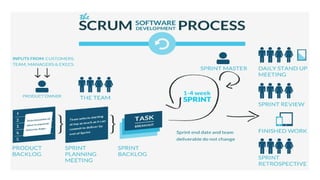
• Burndown chart: shows the work remaining within the sprint. Used
both to track sprint progress and to decide when items must be
removed from the sprint backlog and deferred to the next sprint.
• Product backlog. Product backlog is the complete list of requirements—
including bugs, enhancement requests, and usability and performance
improvements—that are not currently in the product release.
Scrum Principles
• ScrumMaster. is the person responsible for managing the Scrum
project. Sometimes it refers to a person who has become certified as a
ScrumMaster by taking ScrumMaster training.
Scrum Principles
• Sprint backlog. Sprint backlog is the list of backlog items assigned to
a sprint, but not yet completed. In common practice, no sprint
backlog item should take more than two days to complete. The sprint
backlog helps the team predict the level of effort required to
complete a sprint.
• product owner : handle communication with customer.
Daily Scrum
•1- Leaded by scrum master.
•2- 15 minutes duration.
•3- each team member should answer three questions
 What did I accomplish yesterday?
 What will I do today?
 What obstacles are impeding my progress?
User Story
• User Story is a small (actually, the smallest) piece of work that represents some value
to an end user and can be delivered during a sprint.
• As a [type of user], I want [an action] so that [a benefit/a value]
User Story
• Great User Stories always fit the INVEST set of criteria : Independent –
they can be developed in any sequence and changes to one User Story
don’t affect the others.
• Negotiable – it’s up for the team to decide how to implement them; there
is no rigidly fixed workflow.
• Valuable – each User Story delivers a detached unit of value to end users.
User Story
• Estimable – it’s quite easy to guess how much time the development of
a User Story will take.
• Small – it should go through the whole cycle (designing, coding,
testing) during one sprint.
• Testable – there should be clear acceptance criteria to check whether a
User Story is implemented appropriately.
Example for user stories for Uber app:-
• As a driver, I want to block badly behaved passengers so they are never
shown me again.
• As a passenger, I want to link the credit card to my profile so that I can pay
for a ride faster, easier and without cash.
• As a driver, I want to add photos of my car in my profile so that I can
attract more users.
Example for user stories for Uber app:-
• As a passenger, I want several available drivers to be displayed so that I can
choose the most suitable option for me.
• An acceptance criteria is a set of conditions that are used to confirm when
a Story is completed. Each user story should have priority – weight When
Development starts each user store is broken into tasks.

software_engineering_agile_methodology.pptx

  • 1.
  • 2.
    Content :- • SoftwareEngineering. • Advanced Software Engineering. • Traditional Software Development Methodologies. • Drawbacks of traditional methods. • What is Agile? • Agile Manifesto. • Agile methods.
  • 3.
    Software Engineering • Softwareengineering deals with the design, development, testing, and maintenance of software applications. Software engineers apply engineering principles and knowledge of programming languages to build software solutions for end users.
  • 4.
    Advanced Software Engineering •An advanced software engineer uses high-level programming skills and technical expertise to design, execute, and assess software programs. They focus on the organizational structure of the project and typically set the time frame for the program's completion.
  • 5.
    • Traditional Software Development Methodologie s. • WaterfallModel. • Spiral Model. • Incremental Model. • Iterative Model. • V-Model.
  • 6.
    • Drawbacks oftraditional methods. • Developers can’t go back to make changes. • Testing is only done at the end with a very high delay. • Very high maintenance effort. • Low customer communication and satisfaction. • Very high documentation effort. • Requirements should be fully understood. • Risk analysis requires highly specific domain expertise.
  • 7.
    What is Agile? •Agile software development methodology is an incremental software development methodology, that provides a fast and simple way of software developing based on the continuous customer involvement which grantee better understanding for project requirement, project quality and customer satisfaction.
  • 8.
    Agile methods focuson the following :- • Customer satisfaction. • To Move Quickly. • To Be Creative. • To Adapt Changes. • To Work On What On Hand.
  • 9.
    Agile Manifesto • Formalproclamation of 4 key values and 12 principles to guide an iterative and people-centric approach to software development.
  • 10.
    Agile Values • Individualsand interactions over processes and tools • Working software over comprehensive documentation • Customer collaboration over contract negotiation • Responding to change over following a plan
  • 11.
    Agile Principles • Ourhighest priority is to satisfy the customer through early and continuous delivery of valuable software. • Welcome changing requirements, even late in development. Agile processes harness change for the customer's competitive advantage. • Deliver working software frequently, from a couple of weeks to a couple of months, with a preference to the shorter timescale.
  • 12.
    Agile Principles • Businesspeople and developers must work together daily throughout the project. • Build projects around motivated individuals. Give them the environment and support they need, and trust them to get the job done. • The most efficient and effective method of conveying information to and within a development team is face-to-face conversation.
  • 13.
    Agile Principles • Workingsoftware is the primary measure of progress. • Agile processes promote sustainable development. The sponsors, developers, and users should be able to maintain a constant pace indefinitely. • Continuous attention to technical excellence and good design enhances agility.
  • 14.
    Agile Principles • Simplicity--theart of maximizing the amount of work not done--is essential. • The best architectures, requirements, and designs emerge from self- organizing teams. • At regular intervals, the team reflects on how to become more effective, then tunes and adjusts its behavior accordingly.
  • 15.
  • 17.
    Scrum Principles • Burndownchart: shows the work remaining within the sprint. Used both to track sprint progress and to decide when items must be removed from the sprint backlog and deferred to the next sprint. • Product backlog. Product backlog is the complete list of requirements— including bugs, enhancement requests, and usability and performance improvements—that are not currently in the product release.
  • 18.
    Scrum Principles • ScrumMaster.is the person responsible for managing the Scrum project. Sometimes it refers to a person who has become certified as a ScrumMaster by taking ScrumMaster training.
  • 19.
    Scrum Principles • Sprintbacklog. Sprint backlog is the list of backlog items assigned to a sprint, but not yet completed. In common practice, no sprint backlog item should take more than two days to complete. The sprint backlog helps the team predict the level of effort required to complete a sprint. • product owner : handle communication with customer.
  • 20.
    Daily Scrum •1- Leadedby scrum master. •2- 15 minutes duration. •3- each team member should answer three questions  What did I accomplish yesterday?  What will I do today?  What obstacles are impeding my progress?
  • 21.
    User Story • UserStory is a small (actually, the smallest) piece of work that represents some value to an end user and can be delivered during a sprint. • As a [type of user], I want [an action] so that [a benefit/a value]
  • 22.
    User Story • GreatUser Stories always fit the INVEST set of criteria : Independent – they can be developed in any sequence and changes to one User Story don’t affect the others. • Negotiable – it’s up for the team to decide how to implement them; there is no rigidly fixed workflow. • Valuable – each User Story delivers a detached unit of value to end users.
  • 23.
    User Story • Estimable– it’s quite easy to guess how much time the development of a User Story will take. • Small – it should go through the whole cycle (designing, coding, testing) during one sprint. • Testable – there should be clear acceptance criteria to check whether a User Story is implemented appropriately.
  • 24.
    Example for userstories for Uber app:- • As a driver, I want to block badly behaved passengers so they are never shown me again. • As a passenger, I want to link the credit card to my profile so that I can pay for a ride faster, easier and without cash. • As a driver, I want to add photos of my car in my profile so that I can attract more users.
  • 25.
    Example for userstories for Uber app:- • As a passenger, I want several available drivers to be displayed so that I can choose the most suitable option for me. • An acceptance criteria is a set of conditions that are used to confirm when a Story is completed. Each user story should have priority – weight When Development starts each user store is broken into tasks.