Key Principles of Success
as an Internet Engineer
How to succeed and be one of the “Best you can be.”
Barry Raveendran Greene
bgreene@senki.org
2
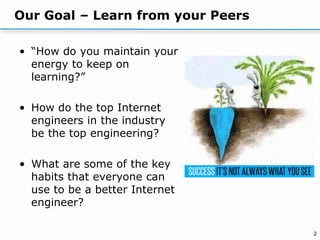
Our Goal – Learn from your Peers
• “How do you maintain your
energy to keep on
learning?”
• How do the top Internet
engineers in the industry
be the top engineering?
• What are some of the key
habits that everyone can
use to be a better Internet
engineer?
3
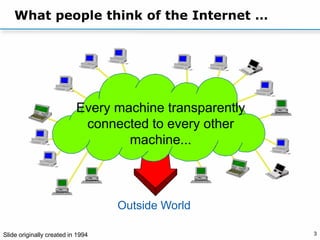
What people think of the Internet …
Outside World
Every machine transparently
connected to every other
machine...
Slide originally created in 1994
4
What the Internet really is …
Every Person
Virtually Connected to Each
Other....
Slide originally created in 1994
5
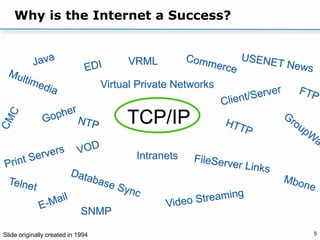
Why is the Internet a Success?
TCP/IP
Virtual Private Networks
Intranets
VRML
SNMP
Slide originally created in 1994
6
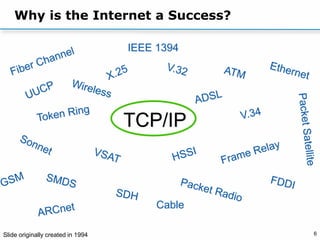
Why is the Internet a Success?
TCP/IP
Cable
IEEE 1394
Slide originally created in 1994
7
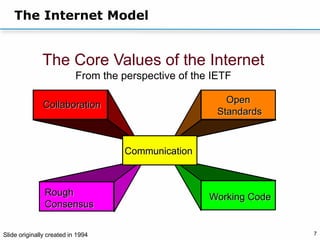
The Internet Model
Communication
Collaboration
Open
Standards
Rough
Consensus
Working Code
The Core Values of the Internet
From the perspective of the IETF
Slide originally created in 1994
8
7 Habits of Internet Engineering Success
• Be Disciplined
• Write it down!
• It is OK to be clueless – it is NOT OK to remain
clueless - ask for Clue
• RTFM
• Build a Network of People – Invest in that
network.
• Connect to all the other NOGs – Read, Watch,
Learn, and Ask Questions
9
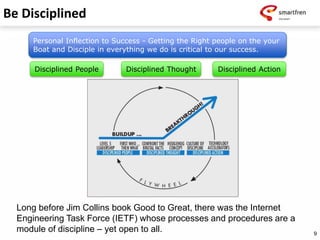
Be Disciplined
Personal Inflection to Success - Getting the Right people on the your
Boat and Disciple in everything we do is critical to our success.
Disciplined People Disciplined Thought Disciplined Action
Long before Jim Collins book Good to Great, there was the Internet
Engineering Task Force (IETF) whose processes and procedures are a
module of discipline – yet open to all.
10
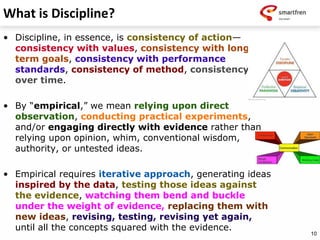
What is Discipline?
• Discipline, in essence, is consistency of action—
consistency with values, consistency with long-
term goals, consistency with performance
standards, consistency of method, consistency
over time.
• By “empirical,” we mean relying upon direct
observation, conducting practical experiments,
and/or engaging directly with evidence rather than
relying upon opinion, whim, conventional wisdom,
authority, or untested ideas.
• Empirical requires iterative approach, generating ideas
inspired by the data, testing those ideas against
the evidence, watching them bend and buckle
under the weight of evidence, replacing them with
new ideas, revising, testing, revising yet again,
until all the concepts squared with the evidence.
11
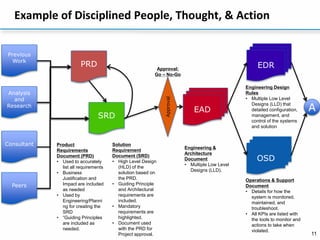
Example of Disciplined People, Thought, & Action
Previous
Work
Analysis
and
Research
Consultant
Peers
PRD
Product
Requirements
Document (PRD)
• Used to accurately
list all requirements
• Business
Justification and
Impact are included
as needed
• Used by
Engineering/Planni
ng for creating the
SRD
• “Guiding Principles
are included as
needed.
SRD
Solution
Requirement
Document (SRD)
• High Level Design
(HLD) of the
solution based on
the PRD.
• Guiding Principle
and Architectural
requirements are
included.
• Mandatory
requirements are
highlighted.
• Document used
with the PRD for
Project approval.
EAD
Engineering &
Architecture
Document
• Multiple Low Level
Designs (LLD).
EDR
Engineering Design
Rules
• Multiple Low Level
Designs (LLD) that
detailed configuration,
management, and
control of the systems
and solution
A
OSD
Operations & Support
Document
• Details for how the
system is monitored,
maintained, and
troubleshoot.
• All KPIs are listed with
the tools to monitor and
actions to take when
violated.
Approval
Approval:
Go – No-Go
12
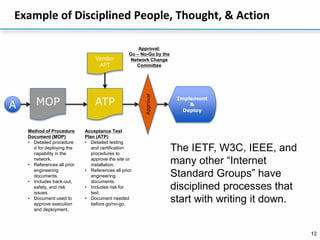
Example of Disciplined People, Thought, & Action
A MOP
Method of Procedure
Document (MOP)
• Detailed procedure
d for deploying the
capability in the
network.
• References all prior
engineering
documents.
• Includes back-out,
safety, and risk
issues.
• Document used to
approve execution
and deployment.
Approval
Approval:
Go – No-Go by the
Network Change
Committee
ATP
Acceptance Test
Plan (ATP)
• Detailed testing
and certification
procedures to
approve the site or
installation.
• References all prior
engineering
documents.
• Includes risk for
test.
• Document needed
before go/no-go.
Vendor
APT
Implement
&
Deploy
The IETF, W3C, IEEE, and
many other “Internet
Standard Groups” have
disciplined processes that
start with writing it down.
13
It is OK to be clueless ….
• The customers and the shareholders never ever
care who has the answer to a problem …. They
just want the problem solved!
• Asking people questions is one of the hardest
things for an engineer to do (it does not matter
where you are from).
• The Successful most successful engineering
talent in the Internet community all ask for clue.
• It is a network of people who build and
grow the Internet – people who depend on
each other – clueing each other in with
their knowledge – in the most powerful
collective the in the history of mankind.
14
RTFM
• Read the Freaking Manual!
• People pushed hard to get
materials open on the Internet.
• IETF, 3GPP (that Internet
group), and other groups put
all their materials freely on-
line.
• Go to the source, read, learn,
ask questions.
15
Home Work!
• Go to to the IETF Site (http://www.ietf.org/)
• Find the Working Groups
• Sign up to a working group’s mailing list.
• Download the Internet Drafts and Read.
• Read, watch, and observe how the working group
operate.
• Ask question privately …..
• Open Standards only work if you – YOU –
participate.
16
Build You Human Network
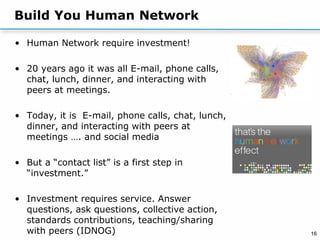
• Human Network require investment!
• 20 years ago it was all E-mail, phone calls,
chat, lunch, dinner, and interacting with
peers at meetings.
• Today, it is E-mail, phone calls, chat, lunch,
dinner, and interacting with peers at
meetings …. and social media
• But a “contact list” is a first step in
“investment.”
• Investment requires service. Answer
questions, ask questions, collective action,
standards contributions, teaching/sharing
with peers (IDNOG)
17
Connect to all the other NOGs
• Connect to all the other NOGs – Read,
Watch, Learn, and Ask Questions.
• Internet Operations Meeting is about
meeting, working, sharing, and
collaboration.
• Free, open, and private operational
consultation is CRITICAL to the Internet’s
success.
• Invest in your NOG! …. Benefit from all the
others …..
• Core Principle – Serve your peers who
cannot be physically present.
18
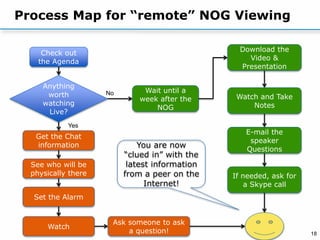
Process Map for “remote” NOG Viewing
Check out
the Agenda
Anything
worth
watching
Live?
Get the Chat
information
See who will be
physically there
Set the Alarm
Watch
Ask someone to ask
a question!
Wait until a
week after the
NOG
Download the
Video &
Presentation
Watch and Take
Notes
E-mail the
speaker
Questions
If needed, ask for
a Skype call
You are now
“clued in” with the
latest information
from a peer on the
Internet!
Yes
No
19
What’s Next?
• Connect via Linkedin:
id.linkedin.com/in/barryrgreene/
• Ask Questions …..

IDNOG - 2014

  • 1.
    Key Principles ofSuccess as an Internet Engineer How to succeed and be one of the “Best you can be.” Barry Raveendran Greene bgreene@senki.org
  • 2.
    2 Our Goal –Learn from your Peers • “How do you maintain your energy to keep on learning?” • How do the top Internet engineers in the industry be the top engineering? • What are some of the key habits that everyone can use to be a better Internet engineer?
  • 3.
    3 What people thinkof the Internet … Outside World Every machine transparently connected to every other machine... Slide originally created in 1994
  • 4.
    4 What the Internetreally is … Every Person Virtually Connected to Each Other.... Slide originally created in 1994
  • 5.
    5 Why is theInternet a Success? TCP/IP Virtual Private Networks Intranets VRML SNMP Slide originally created in 1994
  • 6.
    6 Why is theInternet a Success? TCP/IP Cable IEEE 1394 Slide originally created in 1994
  • 7.
    7 The Internet Model Communication Collaboration Open Standards Rough Consensus WorkingCode The Core Values of the Internet From the perspective of the IETF Slide originally created in 1994
  • 8.
    8 7 Habits ofInternet Engineering Success • Be Disciplined • Write it down! • It is OK to be clueless – it is NOT OK to remain clueless - ask for Clue • RTFM • Build a Network of People – Invest in that network. • Connect to all the other NOGs – Read, Watch, Learn, and Ask Questions
  • 9.
    9 Be Disciplined Personal Inflectionto Success - Getting the Right people on the your Boat and Disciple in everything we do is critical to our success. Disciplined People Disciplined Thought Disciplined Action Long before Jim Collins book Good to Great, there was the Internet Engineering Task Force (IETF) whose processes and procedures are a module of discipline – yet open to all.
  • 10.
    10 What is Discipline? •Discipline, in essence, is consistency of action— consistency with values, consistency with long- term goals, consistency with performance standards, consistency of method, consistency over time. • By “empirical,” we mean relying upon direct observation, conducting practical experiments, and/or engaging directly with evidence rather than relying upon opinion, whim, conventional wisdom, authority, or untested ideas. • Empirical requires iterative approach, generating ideas inspired by the data, testing those ideas against the evidence, watching them bend and buckle under the weight of evidence, replacing them with new ideas, revising, testing, revising yet again, until all the concepts squared with the evidence.
  • 11.
    11 Example of DisciplinedPeople, Thought, & Action Previous Work Analysis and Research Consultant Peers PRD Product Requirements Document (PRD) • Used to accurately list all requirements • Business Justification and Impact are included as needed • Used by Engineering/Planni ng for creating the SRD • “Guiding Principles are included as needed. SRD Solution Requirement Document (SRD) • High Level Design (HLD) of the solution based on the PRD. • Guiding Principle and Architectural requirements are included. • Mandatory requirements are highlighted. • Document used with the PRD for Project approval. EAD Engineering & Architecture Document • Multiple Low Level Designs (LLD). EDR Engineering Design Rules • Multiple Low Level Designs (LLD) that detailed configuration, management, and control of the systems and solution A OSD Operations & Support Document • Details for how the system is monitored, maintained, and troubleshoot. • All KPIs are listed with the tools to monitor and actions to take when violated. Approval Approval: Go – No-Go
  • 12.
    12 Example of DisciplinedPeople, Thought, & Action A MOP Method of Procedure Document (MOP) • Detailed procedure d for deploying the capability in the network. • References all prior engineering documents. • Includes back-out, safety, and risk issues. • Document used to approve execution and deployment. Approval Approval: Go – No-Go by the Network Change Committee ATP Acceptance Test Plan (ATP) • Detailed testing and certification procedures to approve the site or installation. • References all prior engineering documents. • Includes risk for test. • Document needed before go/no-go. Vendor APT Implement & Deploy The IETF, W3C, IEEE, and many other “Internet Standard Groups” have disciplined processes that start with writing it down.
  • 13.
    13 It is OKto be clueless …. • The customers and the shareholders never ever care who has the answer to a problem …. They just want the problem solved! • Asking people questions is one of the hardest things for an engineer to do (it does not matter where you are from). • The Successful most successful engineering talent in the Internet community all ask for clue. • It is a network of people who build and grow the Internet – people who depend on each other – clueing each other in with their knowledge – in the most powerful collective the in the history of mankind.
  • 14.
    14 RTFM • Read theFreaking Manual! • People pushed hard to get materials open on the Internet. • IETF, 3GPP (that Internet group), and other groups put all their materials freely on- line. • Go to the source, read, learn, ask questions.
  • 15.
    15 Home Work! • Goto to the IETF Site (http://www.ietf.org/) • Find the Working Groups • Sign up to a working group’s mailing list. • Download the Internet Drafts and Read. • Read, watch, and observe how the working group operate. • Ask question privately ….. • Open Standards only work if you – YOU – participate.
  • 16.
    16 Build You HumanNetwork • Human Network require investment! • 20 years ago it was all E-mail, phone calls, chat, lunch, dinner, and interacting with peers at meetings. • Today, it is E-mail, phone calls, chat, lunch, dinner, and interacting with peers at meetings …. and social media • But a “contact list” is a first step in “investment.” • Investment requires service. Answer questions, ask questions, collective action, standards contributions, teaching/sharing with peers (IDNOG)
  • 17.
    17 Connect to allthe other NOGs • Connect to all the other NOGs – Read, Watch, Learn, and Ask Questions. • Internet Operations Meeting is about meeting, working, sharing, and collaboration. • Free, open, and private operational consultation is CRITICAL to the Internet’s success. • Invest in your NOG! …. Benefit from all the others ….. • Core Principle – Serve your peers who cannot be physically present.
  • 18.
    18 Process Map for“remote” NOG Viewing Check out the Agenda Anything worth watching Live? Get the Chat information See who will be physically there Set the Alarm Watch Ask someone to ask a question! Wait until a week after the NOG Download the Video & Presentation Watch and Take Notes E-mail the speaker Questions If needed, ask for a Skype call You are now “clued in” with the latest information from a peer on the Internet! Yes No
  • 19.
    19 What’s Next? • Connectvia Linkedin: id.linkedin.com/in/barryrgreene/ • Ask Questions …..