M Kashif Farooq
 Lahore University of Management Sciences (LUMS),
                                             Pakistan
                                      Supervised by
                      Dr. Shafay Shamail, Dr. M Awais


                                         Presented at

                                       PRO-VE'08
9th IFIP Working Conference on Virtual Enterprises
                 Poznan, POLAND. 8 - 10 September 2008
Springer published this paper as a book
chapter. Now this book is available at Google
Books & Amazon
Objective


            This paper presents
        a framework of devolution
for a Virtual Enterprise (like e-government)
    Working as Collaborative Network
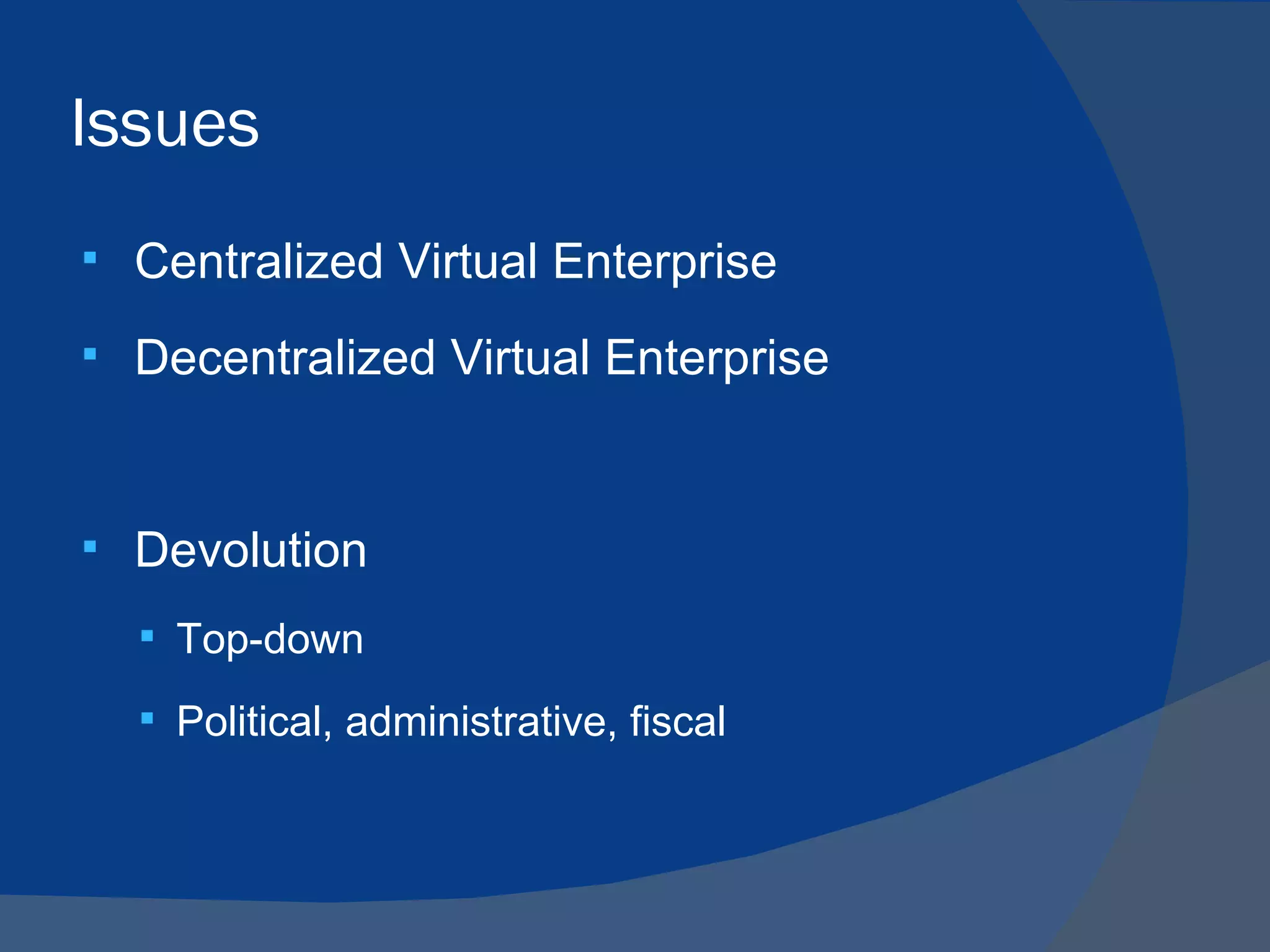
Issues
   Centralized Virtual Enterprise
   Decentralized Virtual Enterprise


   Devolution
     Top-down

     Political, administrative, fiscal
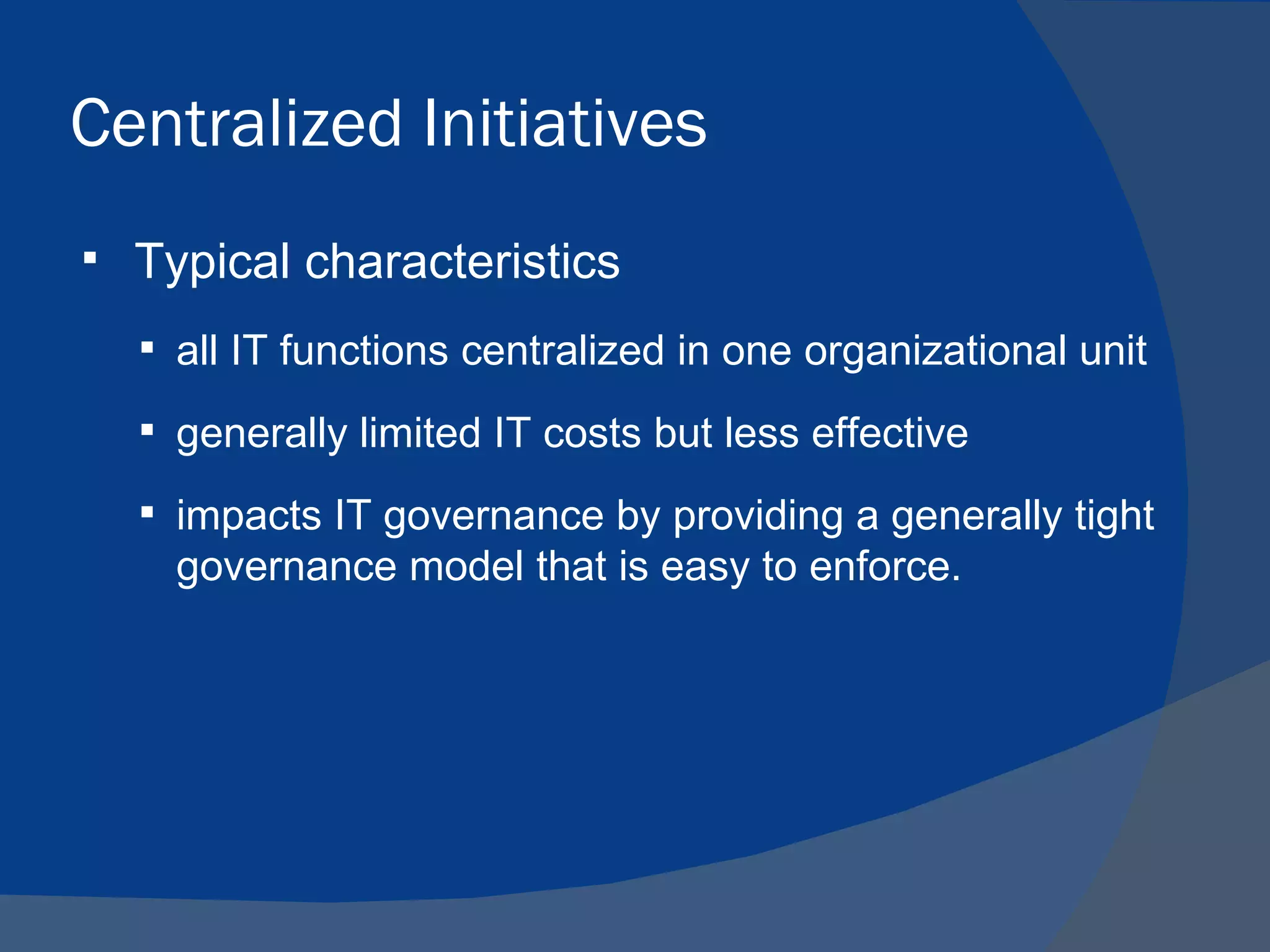
Centralized Initiatives
   Typical characteristics
     all IT functions centralized in one organizational unit

     generally limited IT costs but less effective

     impacts IT governance by providing a generally tight
      governance model that is easy to enforce.
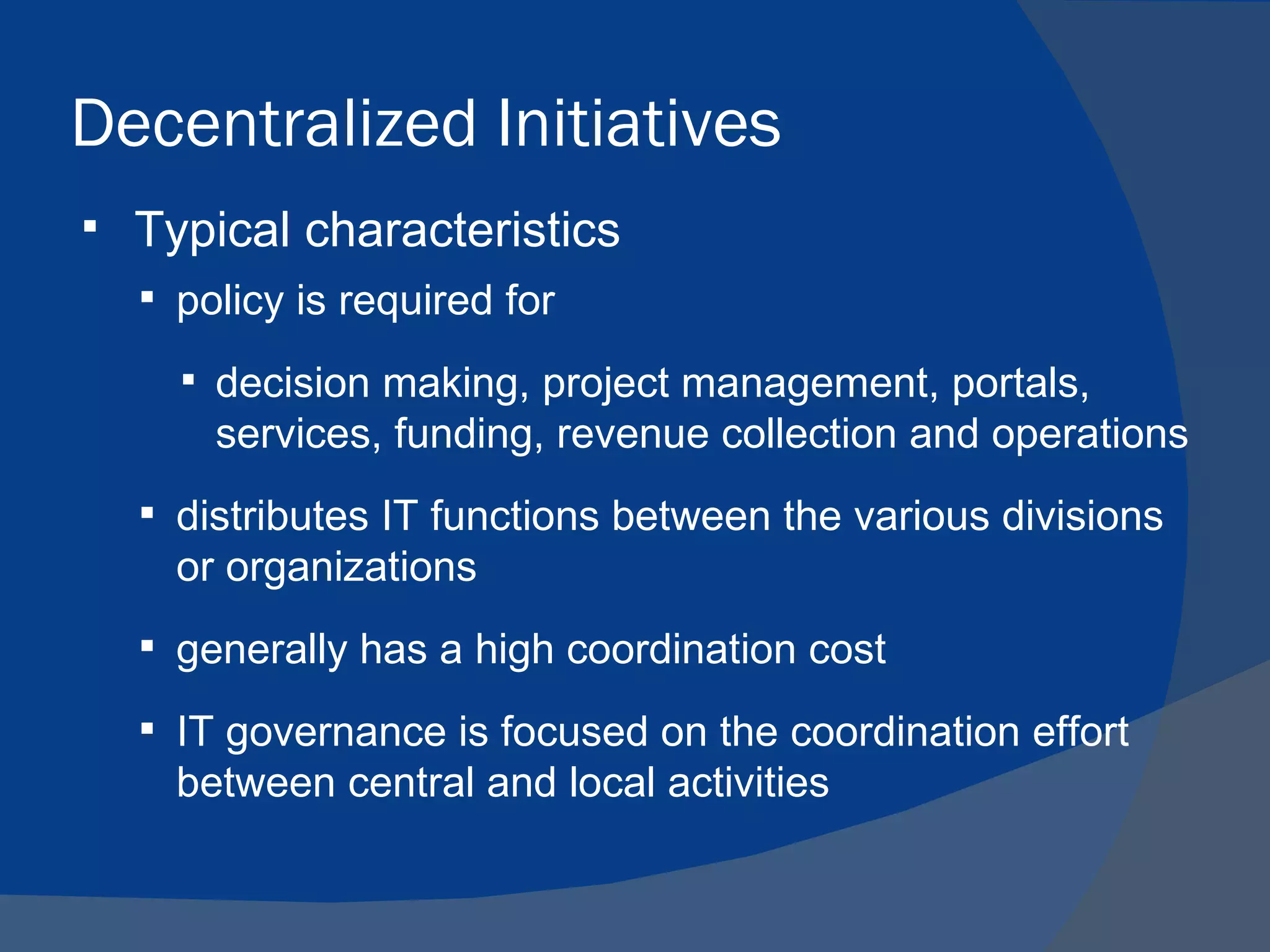
Decentralized Initiatives
   Typical characteristics
     policy is required for

       decision making, project management, portals,
        services, funding, revenue collection and operations
     distributes IT functions between the various divisions
      or organizations
     generally has a high coordination cost

     IT governance is focused on the coordination effort
      between central and local activities
Soufflé Theory of Decentralization
   Scale of devolution depends upon the size
    of the country, its resource base, human
    capacity and governance style (Parker,
    1995).
   The Soufflé theory of decentralization
    explains the role of political, fiscal and
    administrative devolutions and their result.
   We extend this theory for devolution in
    Virtual Enterprise.
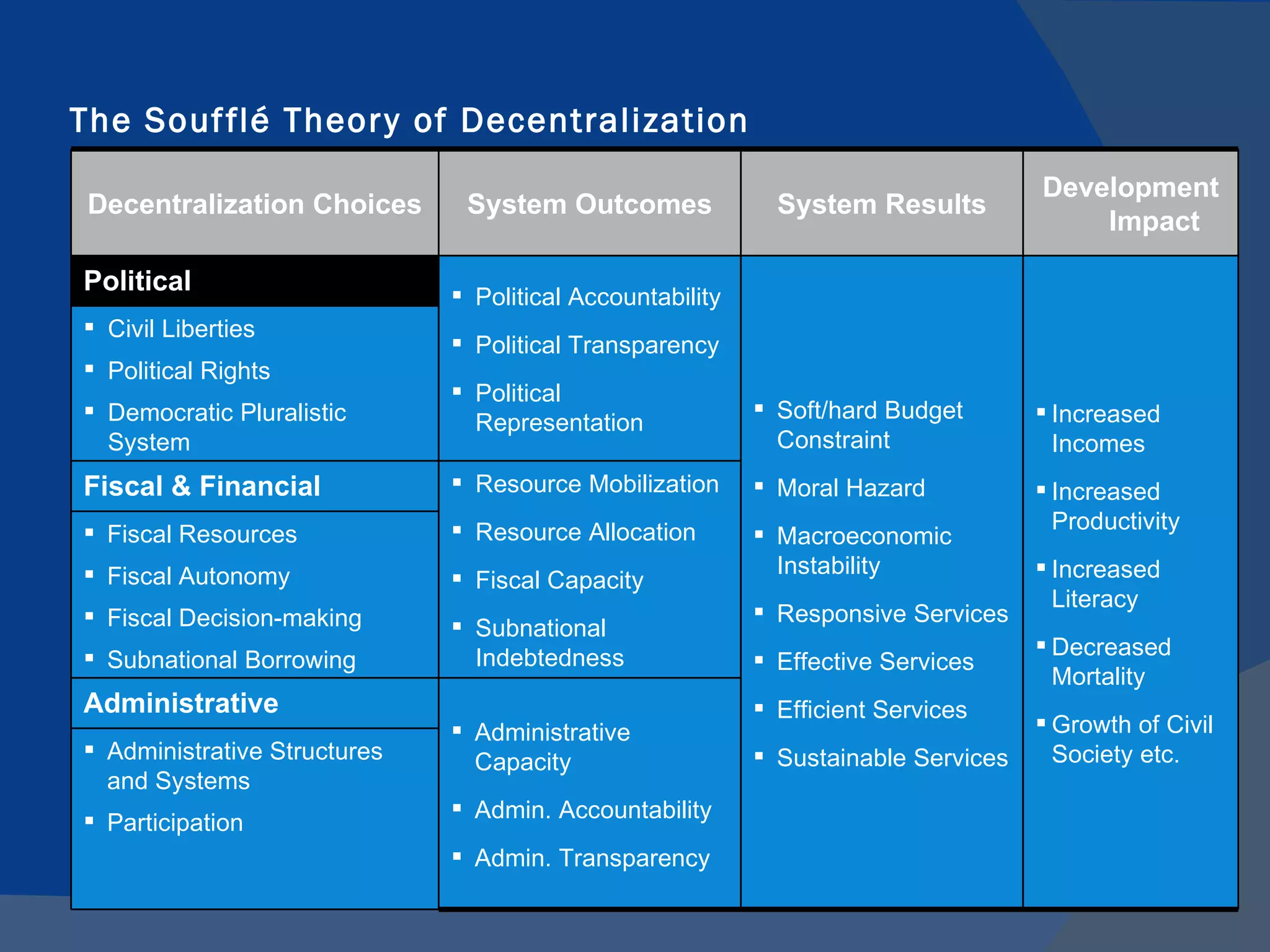
The Souf flé Theor y of Decentralization
                                                                                    Development
 Decentralization Choices      System Outcomes               System Results
                                                                                        Impact

Political                      Political Accountability
 Civil Liberties
                               Political Transparency
 Political Rights
                               Political
 Democratic Pluralistic                                    Soft/hard Budget        Increased
                                Representation
  System                                                     Constraint               Incomes
Fiscal & Financial             Resource Mobilization       Moral Hazard            Increased
 Fiscal Resources             Resource Allocation                                   Productivity
                                                            Macroeconomic
 Fiscal Autonomy                                            Instability             Increased
                               Fiscal Capacity
                                                                                      Literacy
 Fiscal Decision-making                                    Responsive Services
                               Subnational
                                                                                     Decreased
 Subnational Borrowing         Indebtedness                Effective Services
                                                                                      Mortality
Administrative                                              Efficient Services
                               Administrative                                       Growth of Civil
 Administrative Structures     Capacity                    Sustainable Services     Society etc.
  and Systems
                               Admin. Accountability
 Participation
                               Admin. Transparency
Proposed Framework: (1)


    Devolution in Virtual Enterprise

               Based on

   Soufflé Theory of Decentralization
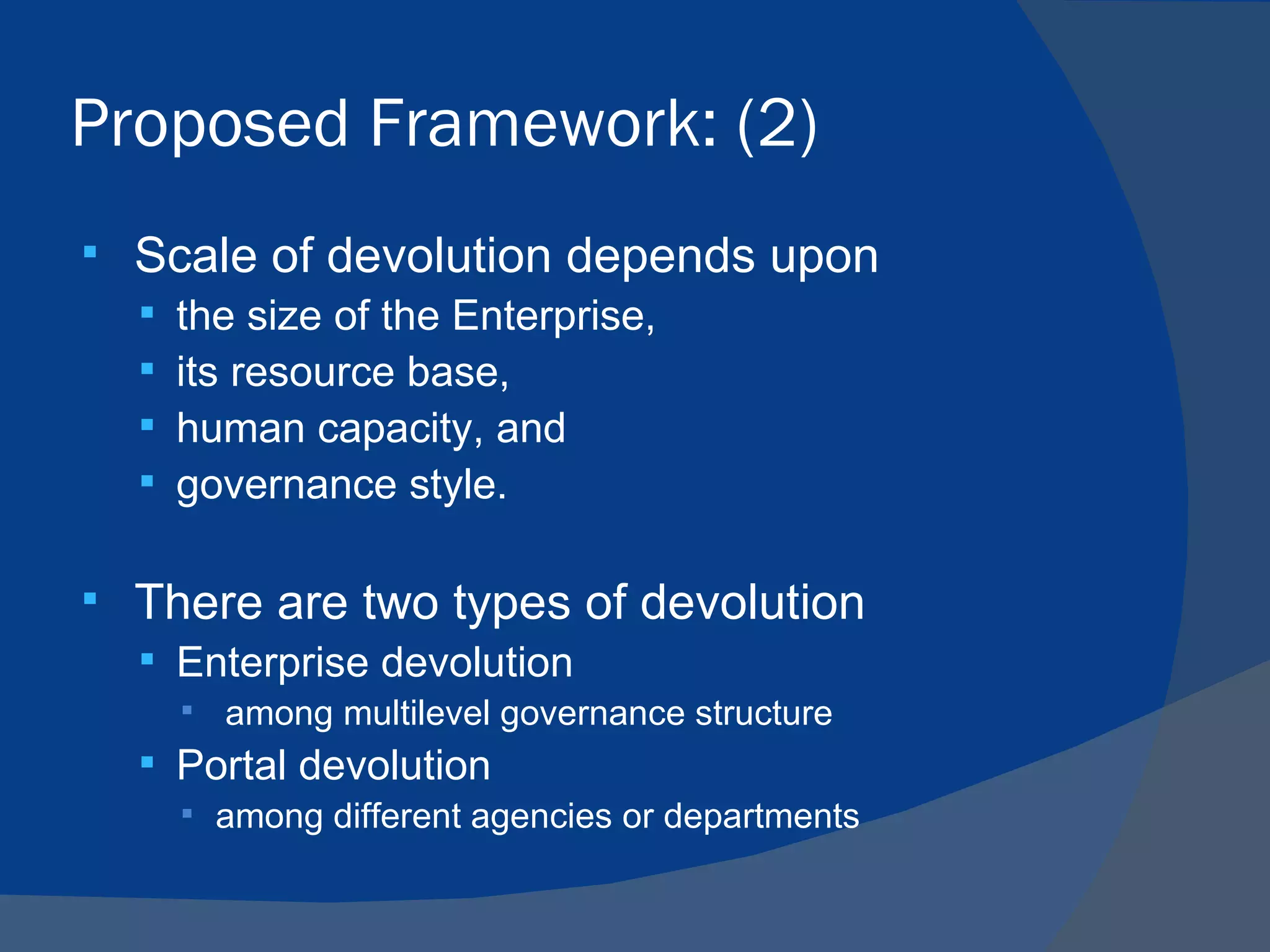
Proposed Framework: (2)
   Scale of devolution depends upon
       the size of the Enterprise,
       its resource base,
       human capacity, and
       governance style.

   There are two types of devolution
     Enterprise devolution
           among multilevel governance structure
     Portal devolution
         among different agencies or departments
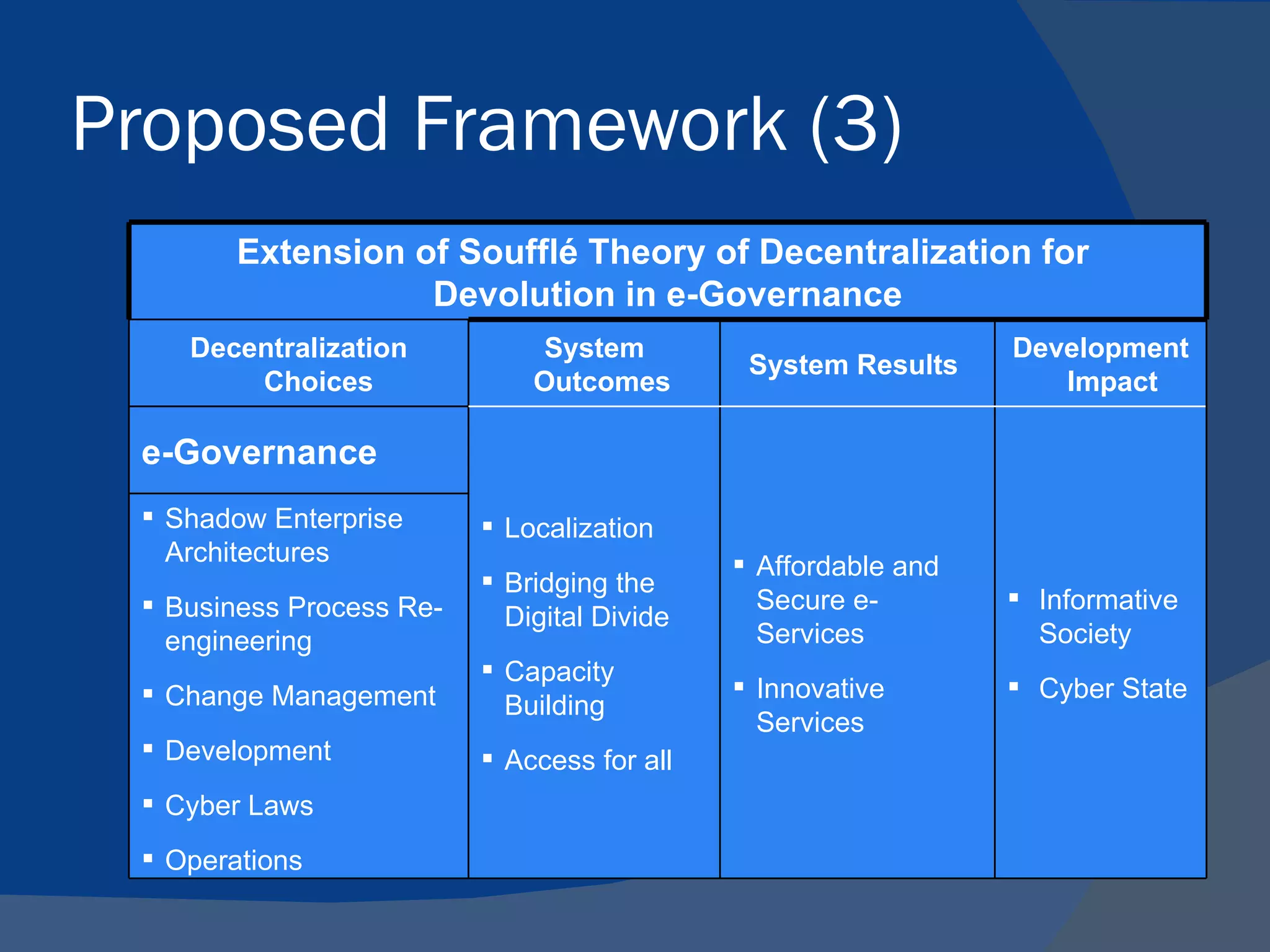
Proposed Framework (3)
        Extension of Soufflé Theory of Decentralization for
                   Devolution in e-Governance
    Decentralization           System                           Development
                                              System Results
        Choices               Outcomes                             Impact

 e-Governance
  Shadow Enterprise       Localization
   Architectures                              Affordable and
                           Bridging the
  Business Process Re-                        Secure e-         Informative
                            Digital Divide
   engineering                                 Services           Society
                           Capacity
  Change Management                          Innovative        Cyber State
                            Building
                                               Services
  Development             Access for all
  Cyber Laws
  Operations
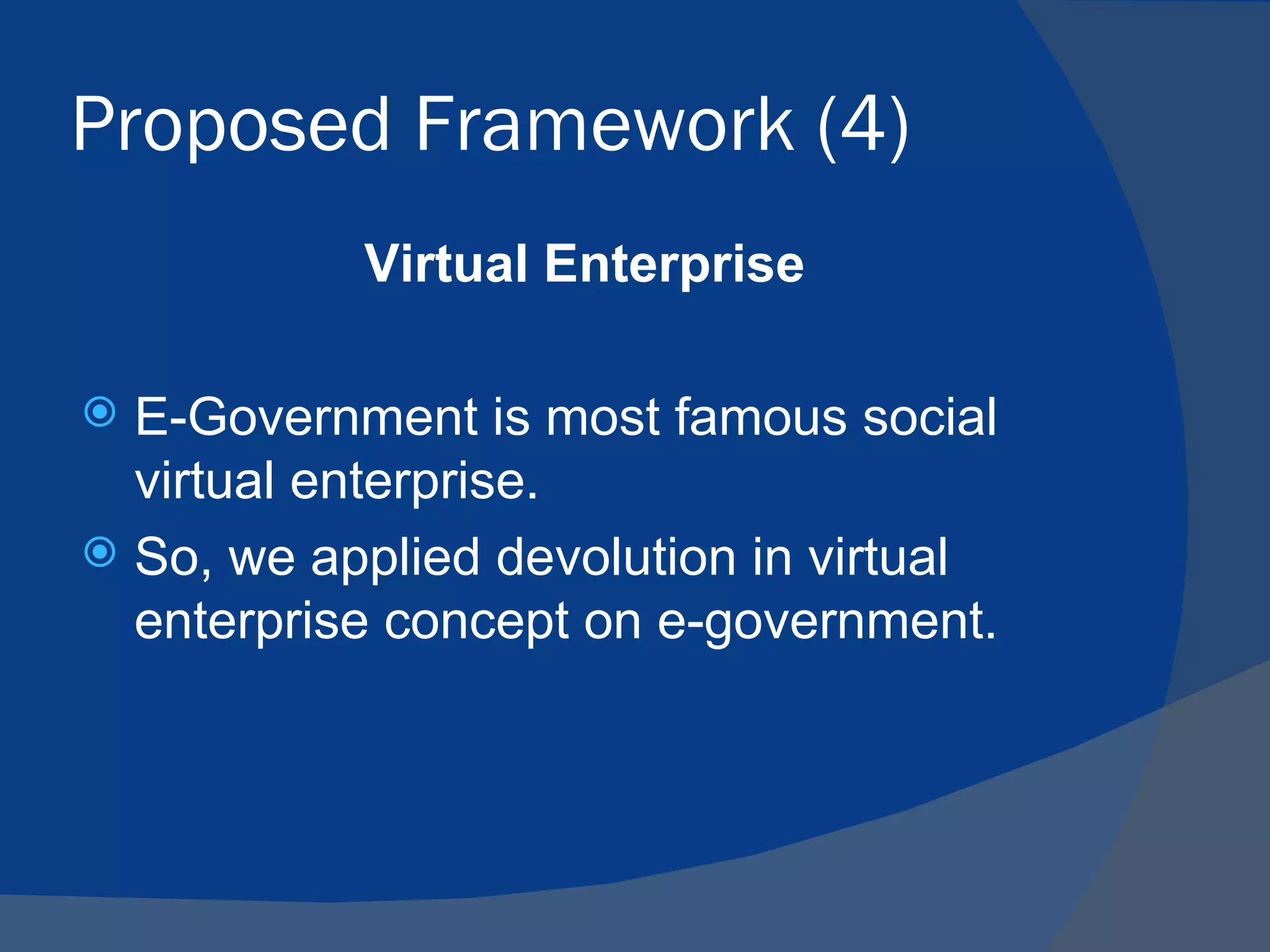
Proposed Framework (4)
           Virtual Enterprise

 E-Government is most famous social
  virtual enterprise.
 So, we applied devolution in virtual
  enterprise concept on e-government.
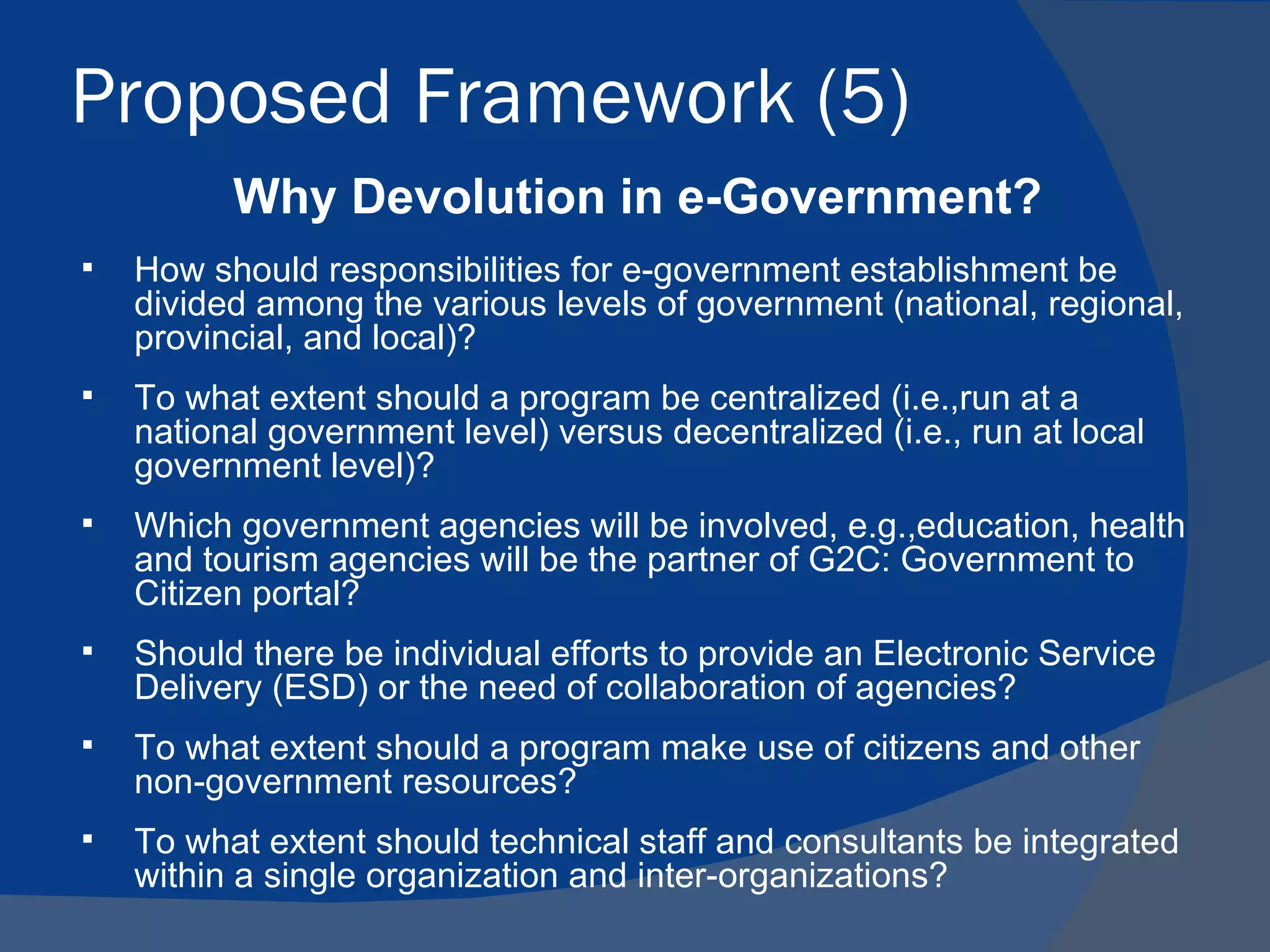
Proposed Framework (5)
          Why Devolution in e-Government?
   How should responsibilities for e-government establishment be
    divided among the various levels of government (national, regional,
    provincial, and local)?
   To what extent should a program be centralized (i.e.,run at a
    national government level) versus decentralized (i.e., run at local
    government level)?
   Which government agencies will be involved, e.g.,education, health
    and tourism agencies will be the partner of G2C: Government to
    Citizen portal?
   Should there be individual efforts to provide an Electronic Service
    Delivery (ESD) or the need of collaboration of agencies?
   To what extent should a program make use of citizens and other
    non-government resources?
   To what extent should technical staff and consultants be integrated
    within a single organization and inter-organizations?
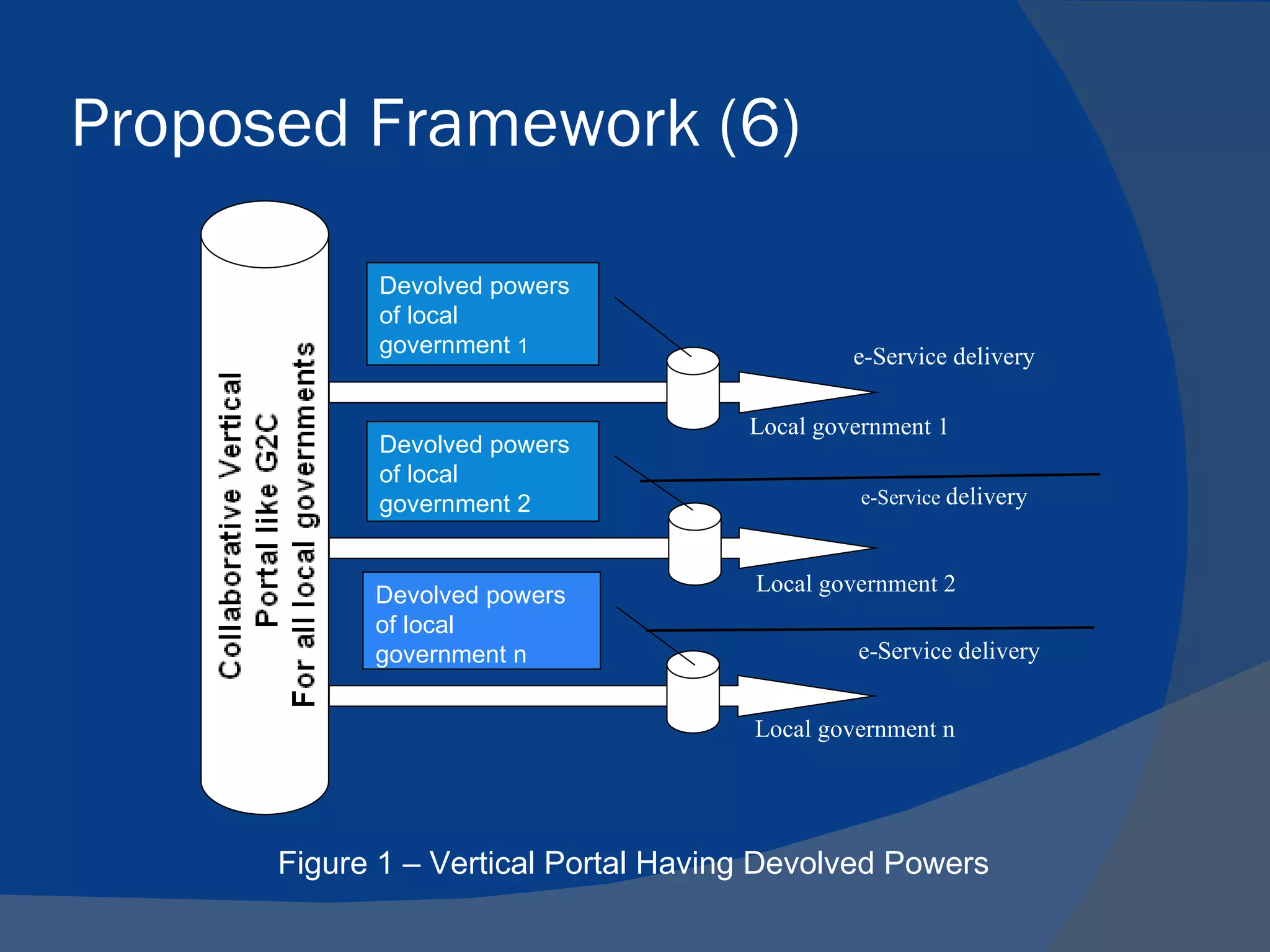
Proposed Framework (6)

            Devolved powers
            of local
            government 1                       e-Service delivery

                                      Local government 1
            Devolved powers
            of local
            government 2                        e-Service delivery


            Devolved powers           Local government 2
            of local
            government n                       e-Service delivery


                                      Local government n


      Figure 1 – Vertical Portal Having Devolved Powers
Proposed Framework (7)
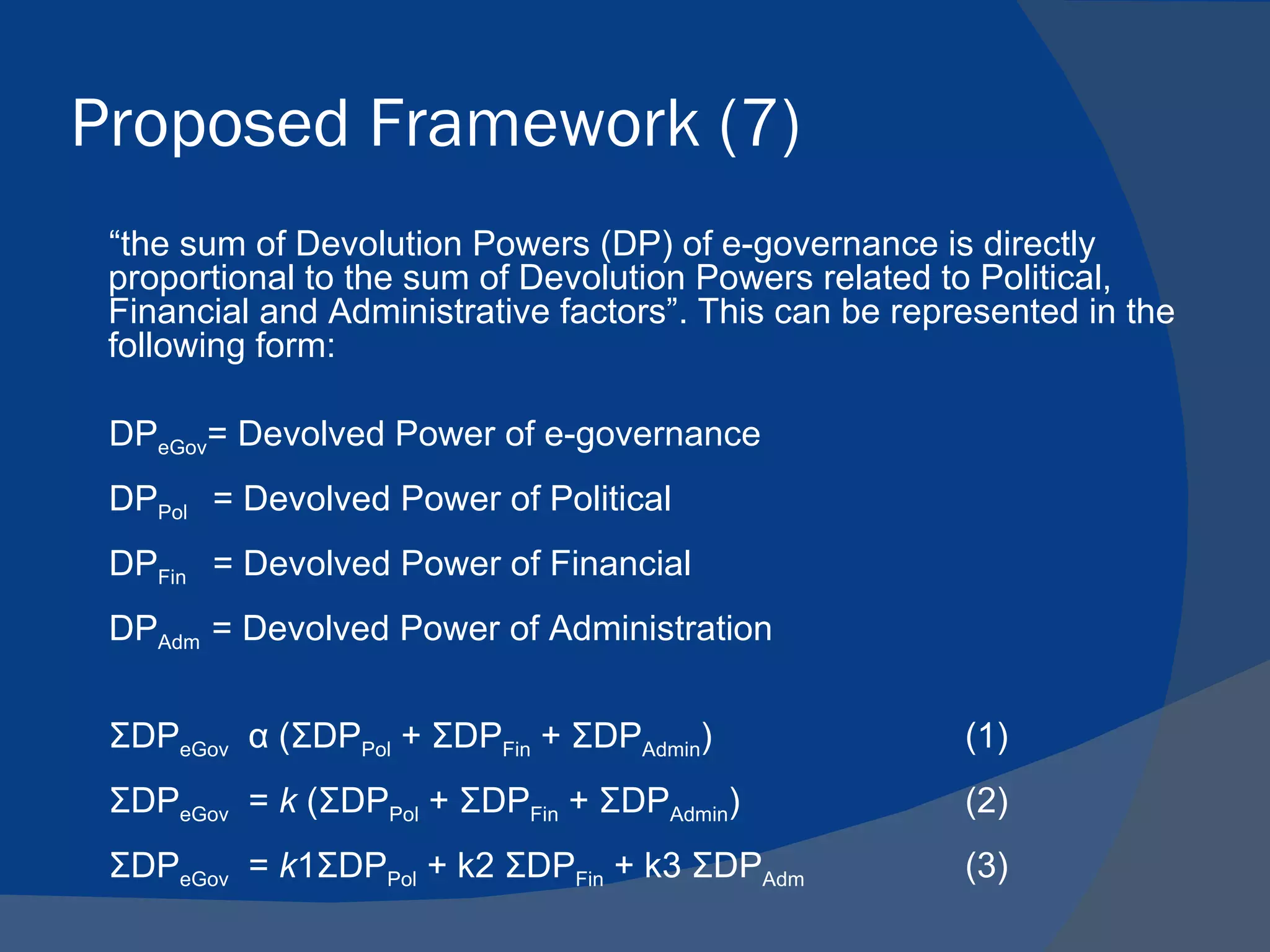
 “the sum of Devolution Powers (DP) of e-governance is directly
 proportional to the sum of Devolution Powers related to Political,
 Financial and Administrative factors”. This can be represented in the
 following form:

 DPeGov= Devolved Power of e-governance
 DPPol = Devolved Power of Political
 DPFin = Devolved Power of Financial
 DPAdm = Devolved Power of Administration


 ΣDPeGov α (ΣDPPol + ΣDPFin + ΣDPAdmin)                 (1)
 ΣDPeGov = k (ΣDPPol + ΣDPFin + ΣDPAdmin)               (2)
 ΣDPeGov = k1ΣDPPol + k2 ΣDPFin + k3 ΣDPAdm             (3)
a real scenario
   A Provincial Government initiated a
    centralized web portal through an IT
    agency of provincial government
   To represent 35 local governments and
    40 provincial departments.
   The IT agency trained personnel from
    portal partner departments and local
    governments to update contents.
a real scenario: Issues
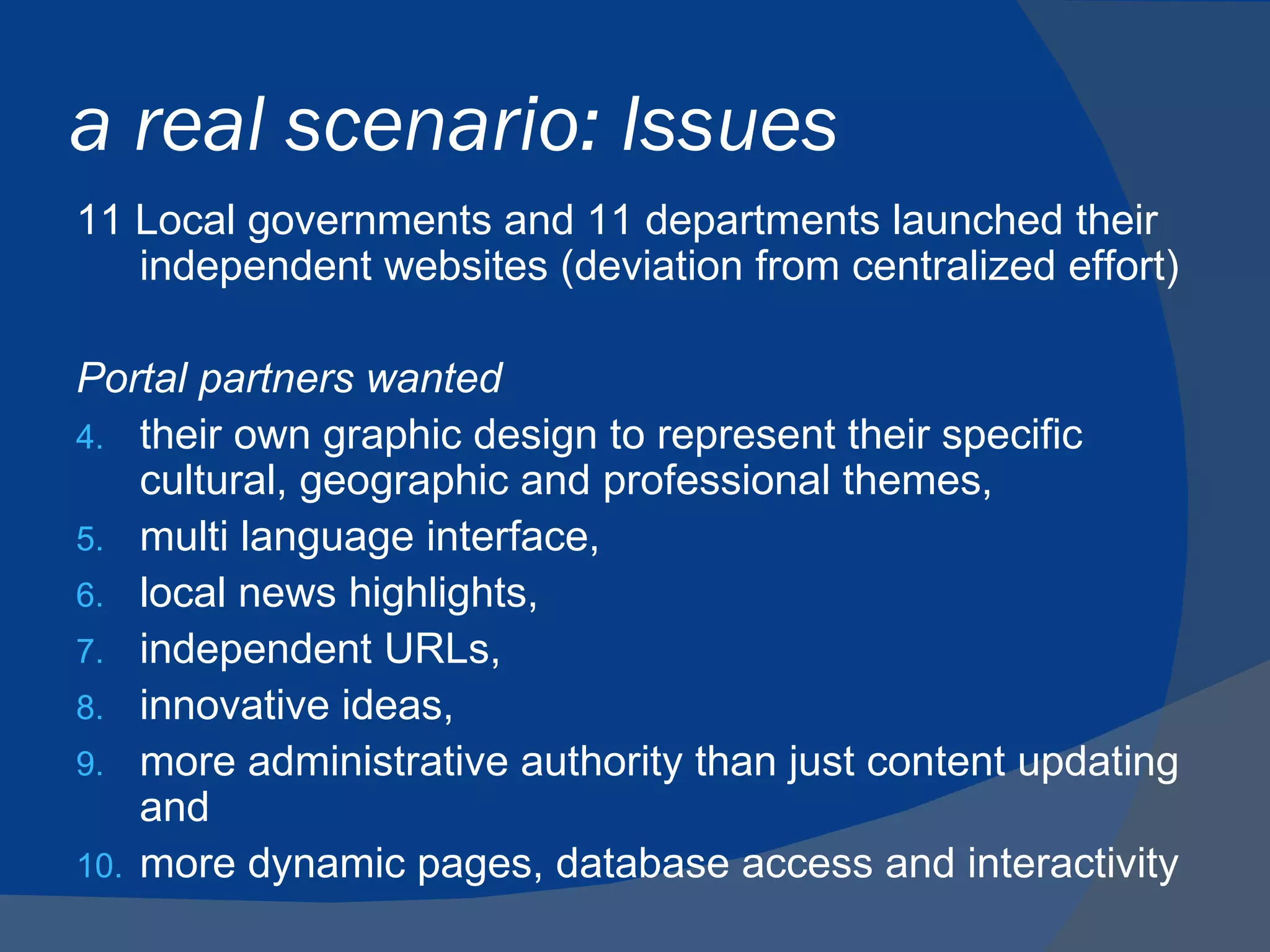
11 Local governments and 11 departments launched their
   independent websites (deviation from centralized effort)

Portal partners wanted
4. their own graphic design to represent their specific
    cultural, geographic and professional themes,
5. multi language interface,
6. local news highlights,
7. independent URLs,
8. innovative ideas,
9. more administrative authority than just content updating
    and
10. more dynamic pages, database access and interactivity
Solution: Degree of devolution for a
virtual enterprise
   We have tested our framework for degree
    of devolution on three selected local
    governments A, B, and C
   These local governments launched their
    own websites and came out from the
    sphere of centralized portal. We estimated
    capability maturity of these local
    governments by analyzing their websites
    and estimating how much devolved powers
    have been exercised in the area of political,
    fiscal and administration
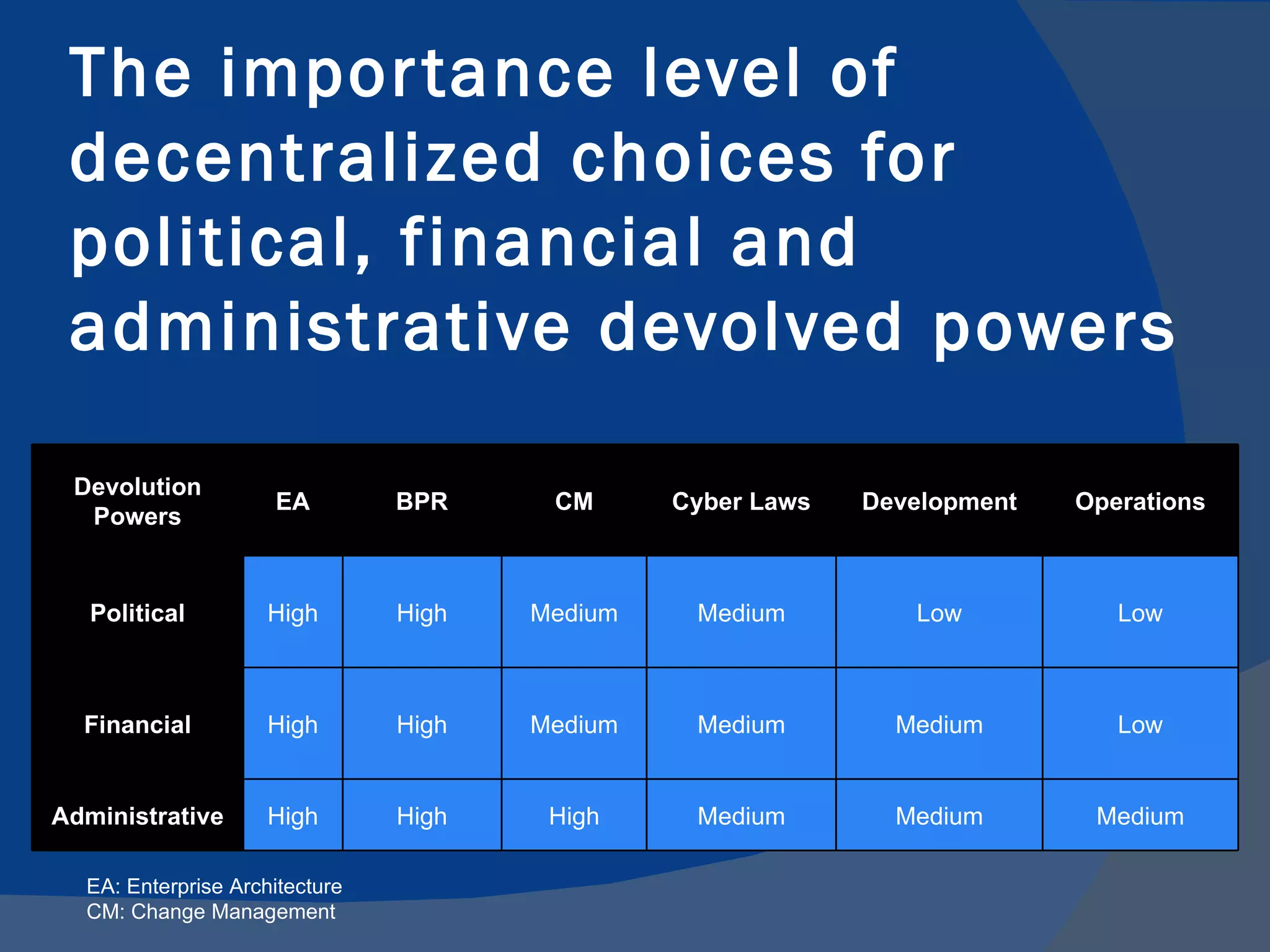
The impor tance level of
 decentralized choices for
 political, financial and
 administrative devolved powers

 Devolution
                     EA         BPR     CM      Cyber Laws   Development   Operations
  Powers


   Political         High       High   Medium    Medium         Low           Low


  Financial          High       High   Medium    Medium        Medium         Low


Administrative       High       High    High     Medium        Medium       Medium

  EA: Enterprise Architecture
  CM: Change Management
Implementation
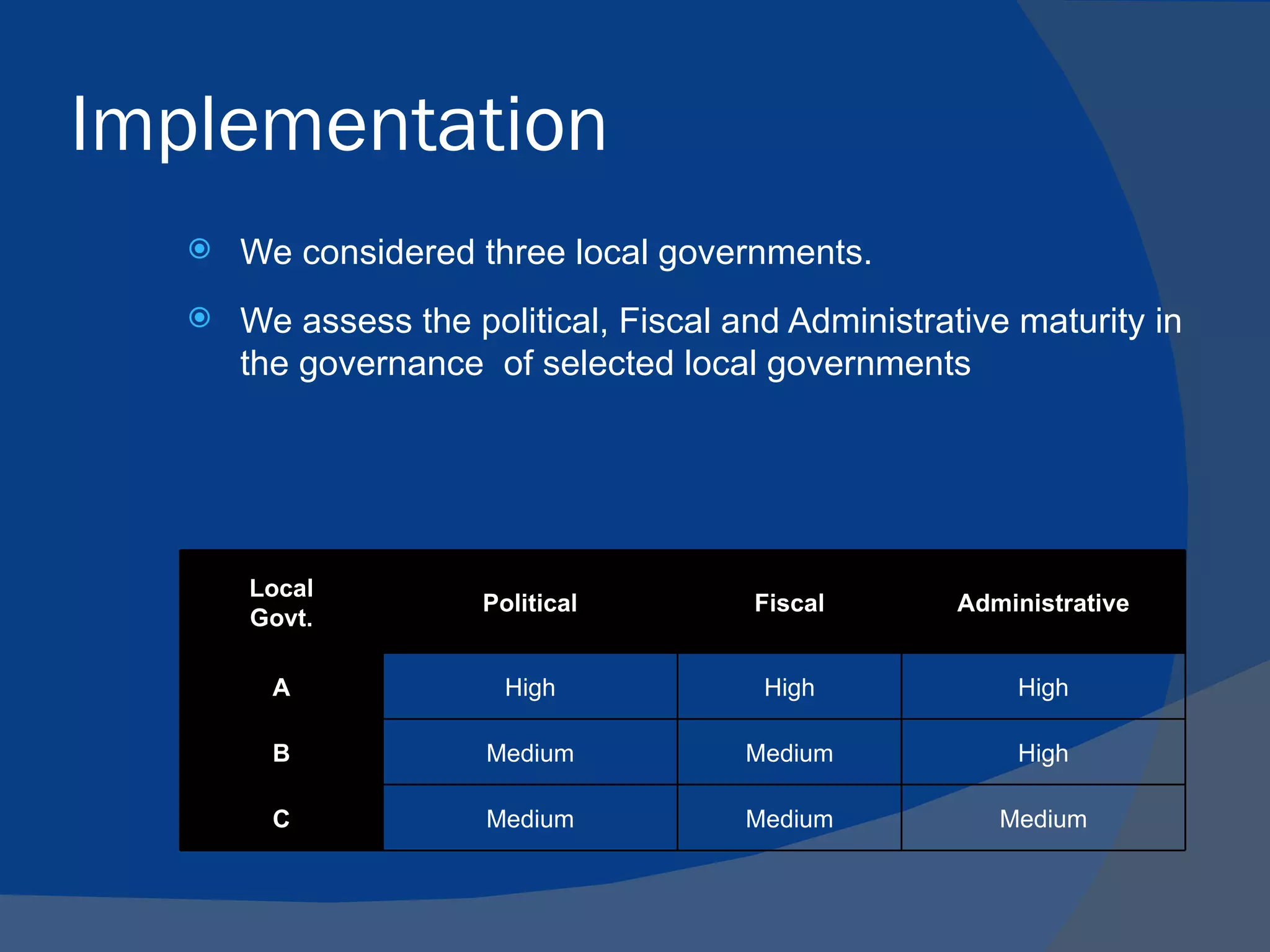
      We considered three local governments.
      We assess the political, Fiscal and Administrative maturity in
       the governance of selected local governments


       Local
                      Political         Fiscal        Administrative
       Govt.

         A              High             High             High

         B             Medium           Medium            High

         C             Medium           Medium           Medium
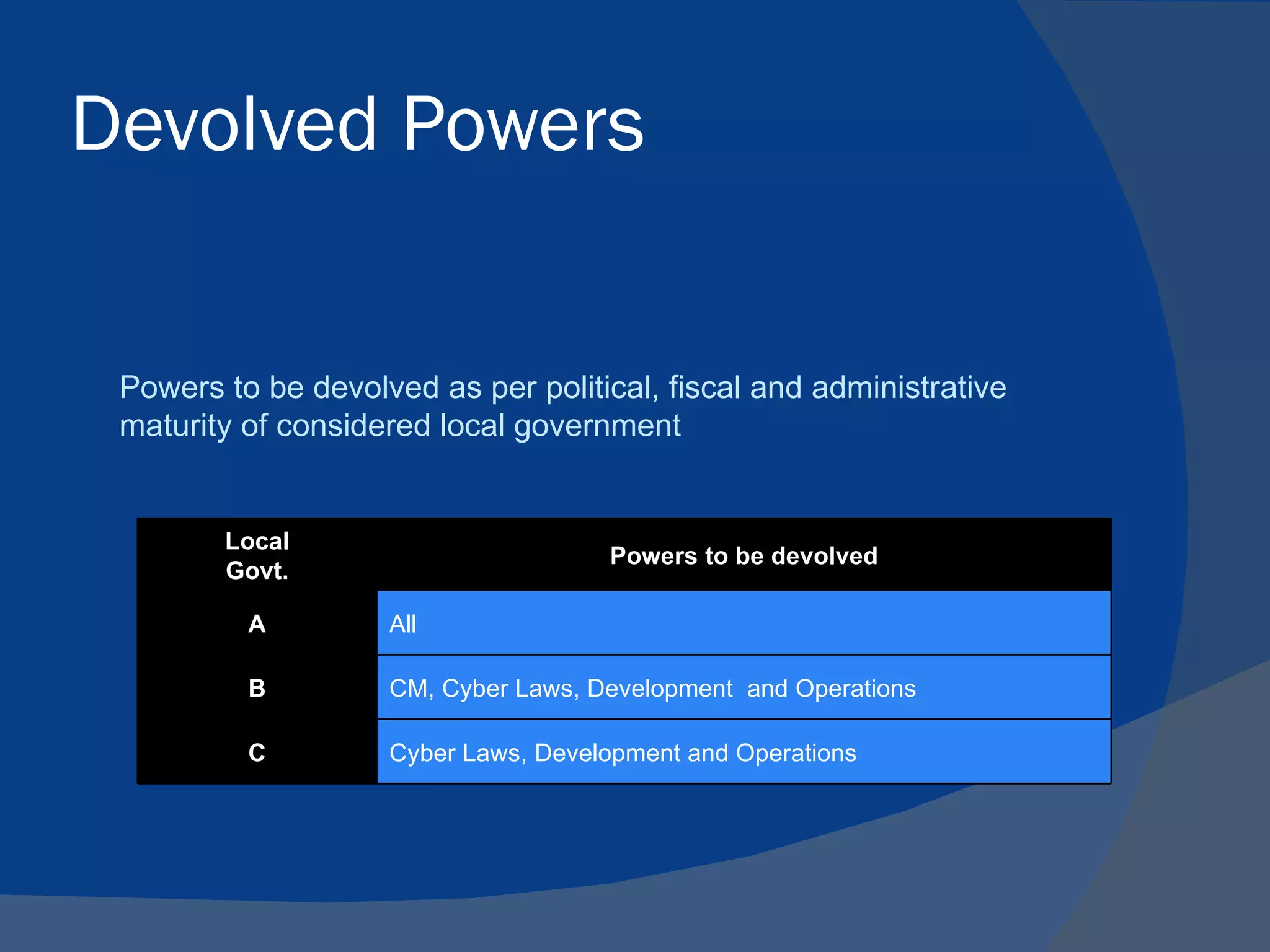
Devolved Powers


 Powers to be devolved as per political, fiscal and administrative
 maturity of considered local government


        Local
                                     Powers to be devolved
        Govt.

          A         All

          B         CM, Cyber Laws, Development and Operations

          C         Cyber Laws, Development and Operations
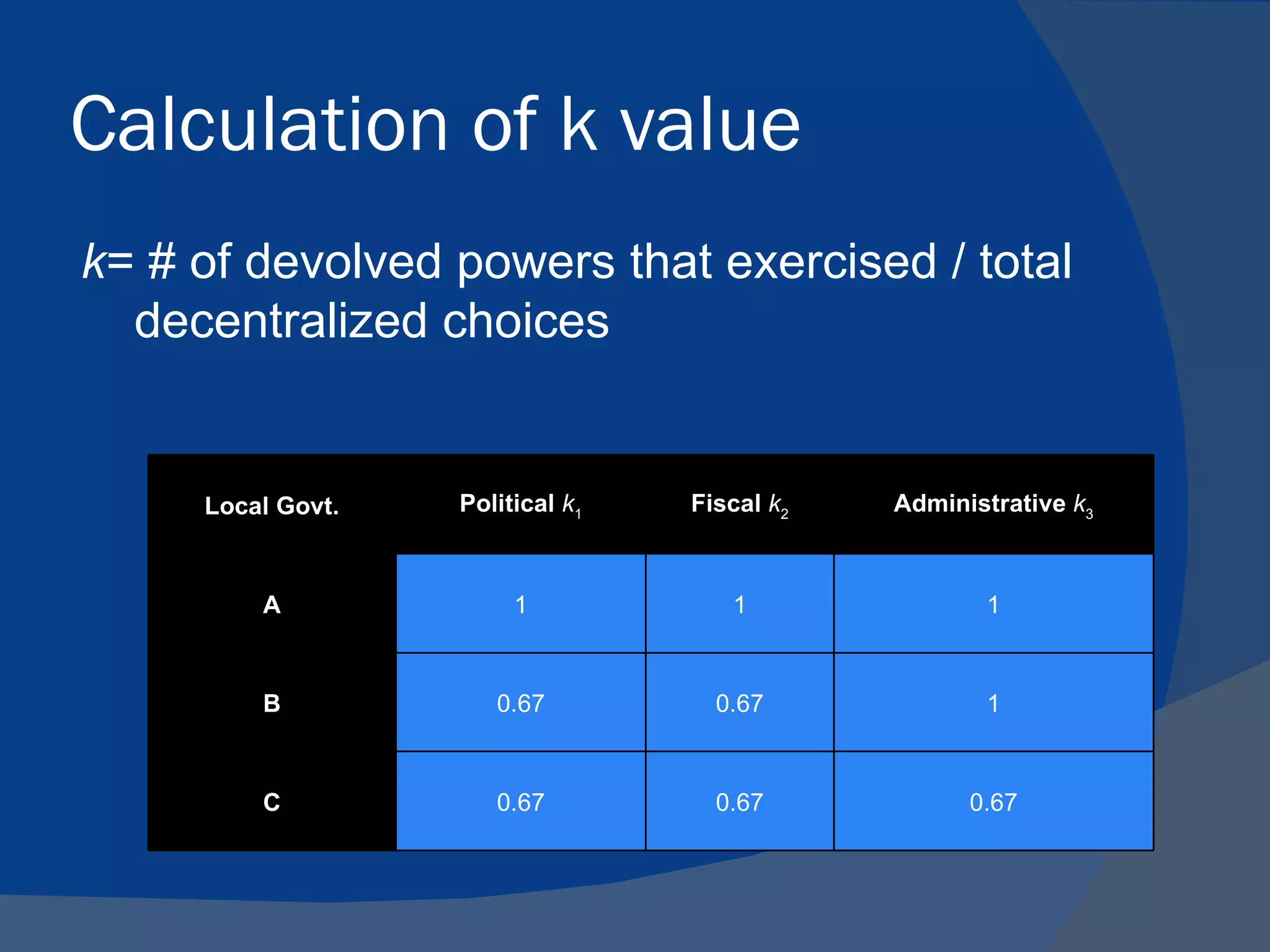
Calculation of k value
k= # of devolved powers that exercised / total
  decentralized choices


     Local Govt.   Political k1   Fiscal k2   Administrative k3


         A              1            1               1


         B            0.67          0.67             1


         C            0.67          0.67            0.67
Conclusion
   It is analyzed that degree of devolution in e-governance
    is proportional to other devolutions (political, fiscal and
    administrative).
   Proper degree of devolution is important for effective e-
    services.
   We have also proposed the extension in Soufflé theory
    and verified that it also supports the devolution in e-
    governance.
   We have applied our proposed framework of devolution
    in a virtual enterprise in the background of devolution in
    e-Government and calculated the relative degree of
    devolution in terms political, fiscal, and administrative
    strengths.

Devolution in a virtual enterprise

  • 1.
    M Kashif Farooq Lahore University of Management Sciences (LUMS), Pakistan Supervised by Dr. Shafay Shamail, Dr. M Awais Presented at PRO-VE'08 9th IFIP Working Conference on Virtual Enterprises Poznan, POLAND. 8 - 10 September 2008
  • 2.
    Springer published thispaper as a book chapter. Now this book is available at Google Books & Amazon
  • 3.
    Objective This paper presents a framework of devolution for a Virtual Enterprise (like e-government) Working as Collaborative Network
  • 4.
    Issues  Centralized Virtual Enterprise  Decentralized Virtual Enterprise  Devolution  Top-down  Political, administrative, fiscal
  • 5.
    Centralized Initiatives  Typical characteristics  all IT functions centralized in one organizational unit  generally limited IT costs but less effective  impacts IT governance by providing a generally tight governance model that is easy to enforce.
  • 6.
    Decentralized Initiatives  Typical characteristics  policy is required for  decision making, project management, portals, services, funding, revenue collection and operations  distributes IT functions between the various divisions or organizations  generally has a high coordination cost  IT governance is focused on the coordination effort between central and local activities
  • 7.
    Soufflé Theory ofDecentralization  Scale of devolution depends upon the size of the country, its resource base, human capacity and governance style (Parker, 1995).  The Soufflé theory of decentralization explains the role of political, fiscal and administrative devolutions and their result.  We extend this theory for devolution in Virtual Enterprise.
  • 8.
    The Souf fléTheor y of Decentralization Development Decentralization Choices System Outcomes System Results Impact Political  Political Accountability  Civil Liberties  Political Transparency  Political Rights  Political  Democratic Pluralistic  Soft/hard Budget  Increased Representation System Constraint Incomes Fiscal & Financial  Resource Mobilization  Moral Hazard  Increased  Fiscal Resources  Resource Allocation Productivity  Macroeconomic  Fiscal Autonomy Instability  Increased  Fiscal Capacity Literacy  Fiscal Decision-making  Responsive Services  Subnational  Decreased  Subnational Borrowing Indebtedness  Effective Services Mortality Administrative  Efficient Services  Administrative  Growth of Civil  Administrative Structures Capacity  Sustainable Services Society etc. and Systems  Admin. Accountability  Participation  Admin. Transparency
  • 9.
    Proposed Framework: (1) Devolution in Virtual Enterprise Based on Soufflé Theory of Decentralization
  • 10.
    Proposed Framework: (2)  Scale of devolution depends upon  the size of the Enterprise,  its resource base,  human capacity, and  governance style.  There are two types of devolution  Enterprise devolution  among multilevel governance structure  Portal devolution  among different agencies or departments
  • 11.
    Proposed Framework (3) Extension of Soufflé Theory of Decentralization for Devolution in e-Governance Decentralization System Development System Results Choices Outcomes Impact e-Governance  Shadow Enterprise  Localization Architectures  Affordable and  Bridging the  Business Process Re- Secure e-  Informative Digital Divide engineering Services Society  Capacity  Change Management  Innovative  Cyber State Building Services  Development  Access for all  Cyber Laws  Operations
  • 12.
    Proposed Framework (4) Virtual Enterprise  E-Government is most famous social virtual enterprise.  So, we applied devolution in virtual enterprise concept on e-government.
  • 13.
    Proposed Framework (5) Why Devolution in e-Government?  How should responsibilities for e-government establishment be divided among the various levels of government (national, regional, provincial, and local)?  To what extent should a program be centralized (i.e.,run at a national government level) versus decentralized (i.e., run at local government level)?  Which government agencies will be involved, e.g.,education, health and tourism agencies will be the partner of G2C: Government to Citizen portal?  Should there be individual efforts to provide an Electronic Service Delivery (ESD) or the need of collaboration of agencies?  To what extent should a program make use of citizens and other non-government resources?  To what extent should technical staff and consultants be integrated within a single organization and inter-organizations?
  • 14.
    Proposed Framework (6) Devolved powers of local government 1 e-Service delivery Local government 1 Devolved powers of local government 2 e-Service delivery Devolved powers Local government 2 of local government n e-Service delivery Local government n Figure 1 – Vertical Portal Having Devolved Powers
  • 15.
    Proposed Framework (7) “the sum of Devolution Powers (DP) of e-governance is directly proportional to the sum of Devolution Powers related to Political, Financial and Administrative factors”. This can be represented in the following form: DPeGov= Devolved Power of e-governance DPPol = Devolved Power of Political DPFin = Devolved Power of Financial DPAdm = Devolved Power of Administration ΣDPeGov α (ΣDPPol + ΣDPFin + ΣDPAdmin) (1) ΣDPeGov = k (ΣDPPol + ΣDPFin + ΣDPAdmin) (2) ΣDPeGov = k1ΣDPPol + k2 ΣDPFin + k3 ΣDPAdm (3)
  • 16.
    a real scenario  A Provincial Government initiated a centralized web portal through an IT agency of provincial government  To represent 35 local governments and 40 provincial departments.  The IT agency trained personnel from portal partner departments and local governments to update contents.
  • 17.
    a real scenario:Issues 11 Local governments and 11 departments launched their independent websites (deviation from centralized effort) Portal partners wanted 4. their own graphic design to represent their specific cultural, geographic and professional themes, 5. multi language interface, 6. local news highlights, 7. independent URLs, 8. innovative ideas, 9. more administrative authority than just content updating and 10. more dynamic pages, database access and interactivity
  • 18.
    Solution: Degree ofdevolution for a virtual enterprise  We have tested our framework for degree of devolution on three selected local governments A, B, and C  These local governments launched their own websites and came out from the sphere of centralized portal. We estimated capability maturity of these local governments by analyzing their websites and estimating how much devolved powers have been exercised in the area of political, fiscal and administration
  • 19.
    The impor tancelevel of decentralized choices for political, financial and administrative devolved powers Devolution EA BPR CM Cyber Laws Development Operations Powers Political High High Medium Medium Low Low Financial High High Medium Medium Medium Low Administrative High High High Medium Medium Medium EA: Enterprise Architecture CM: Change Management
  • 20.
    Implementation  We considered three local governments.  We assess the political, Fiscal and Administrative maturity in the governance of selected local governments Local Political Fiscal Administrative Govt. A High High High B Medium Medium High C Medium Medium Medium
  • 21.
    Devolved Powers Powersto be devolved as per political, fiscal and administrative maturity of considered local government Local Powers to be devolved Govt. A All B CM, Cyber Laws, Development and Operations C Cyber Laws, Development and Operations
  • 22.
    Calculation of kvalue k= # of devolved powers that exercised / total decentralized choices Local Govt. Political k1 Fiscal k2 Administrative k3 A 1 1 1 B 0.67 0.67 1 C 0.67 0.67 0.67
  • 23.
    Conclusion  It is analyzed that degree of devolution in e-governance is proportional to other devolutions (political, fiscal and administrative).  Proper degree of devolution is important for effective e- services.  We have also proposed the extension in Soufflé theory and verified that it also supports the devolution in e- governance.  We have applied our proposed framework of devolution in a virtual enterprise in the background of devolution in e-Government and calculated the relative degree of devolution in terms political, fiscal, and administrative strengths.