Reference Model for
    Devolution in e-
    Governance
M Kashif Farooq

Lahore University of Management Sciences (LUMS),
Pakistan

Presented at

ICEGOV2008
2nd International Conference on Theory and Practice of Electronic Governance
Cairo, Egypt, 1 - 4 December 2008.
Objective


        This paper presents
  a reference model of devolution
        for a e-Government
         By using RM-ODP
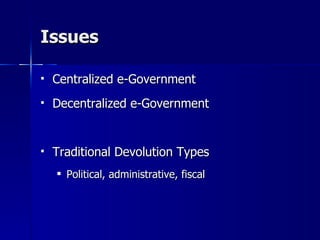
Issues

   Centralized e-Government
   Decentralized e-Government


   Traditional Devolution Types
     Political, administrative, fiscal
Centralized Initiatives

   Typical characteristics
     all IT functions centralized in one organizational
      unit
     generally limited IT costs but less effective
     impacts IT governance by providing a generally
      tight governance model that is easy to enforce.
Decentralized Initiatives

Typical characteristics
 policy is required for
      decision making, project management, portals,
       services, funding, revenue collection and
       operations
 distributes IT functions between the various divisions
  or organizations
 generally has a high coordination cost
 IT governance is focused on the coordination effort
  between central and local activities
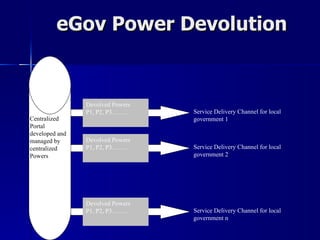
eGov Power Devolution


                Devolved Powers
                P1, P2, P3……..    Service Delivery Channel for local
Centralized                       government 1
Portal
developed and
managed by      Devolved Powers
centralized     P1, P2, P3……..    Service Delivery Channel for local
Powers                            government 2


                Devolved Powers
                P1, P2, P3……..    Service Delivery Channel for local
                                  government n
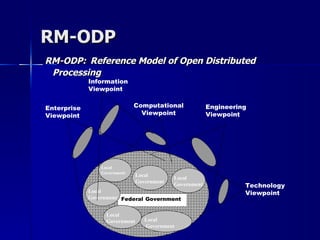
RM-ODP
RM-ODP: Reference Model of Open Distributed
 Processing
             Information
             Viewpoint


Enterprise                    Computational               Engineering
Viewpoint                       Viewpoint                 Viewpoint


                 Local
                 Government
                                Local
                                             Local
                                Government
                                             Government             Technology
             Local                                                  Viewpoint
             Government Federal Government


                   Local
                   Government      Local
                                   Government
Proposed Framework: (1)


Reference Model for
Devolution in e-Governance
based on
RM-ODP
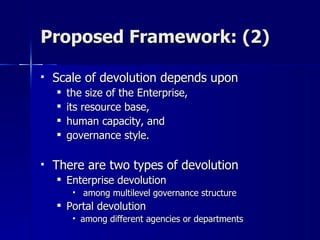
Proposed Framework: (2)

   Scale of devolution depends upon
       the size of the Enterprise,
       its resource base,
       human capacity, and
       governance style.

   There are two types of devolution
     Enterprise devolution
            among multilevel governance structure
     Portal devolution
            among different agencies or departments
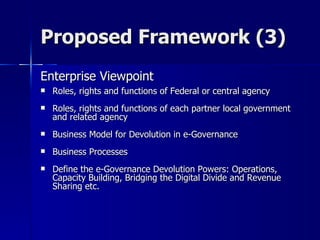
Proposed Framework (3)
Enterprise Viewpoint
   Roles, rights and functions of Federal or central agency
   Roles, rights and functions of each partner local government
    and related agency
   Business Model for Devolution in e-Governance
   Business Processes
   Define the e-Governance Devolution Powers: Operations,
    Capacity Building, Bridging the Digital Divide and Revenue
    Sharing etc.
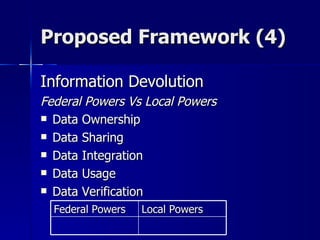
Proposed Framework (4)

Information Devolution
Federal Powers Vs Local Powers
 Data Ownership

 Data Sharing

 Data Integration

 Data Usage

 Data Verification

  Federal Powers   Local Powers
Proposed Framework (5)

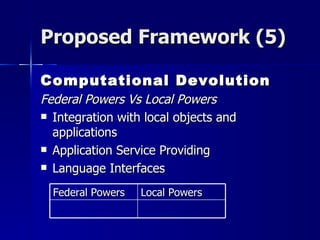
Computational Devolution
Federal Powers Vs Local Powers
 Integration with local objects and
  applications
 Application Service Providing

 Language Interfaces

  Federal Powers   Local Powers
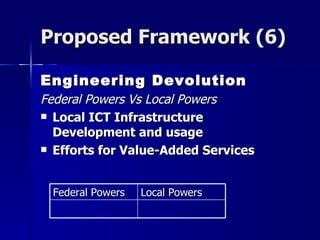
Proposed Framework (6)

Engineering Devolution
Federal Powers Vs Local Powers
 Local ICT Infrastructure
  Development and usage
 Efforts for Value-Added Services


 Federal Powers   Local Powers
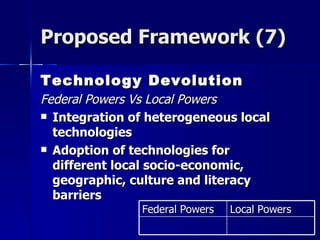
Proposed Framework (7)

Technology Devolution
Federal Powers Vs Local Powers
 Integration of heterogeneous local
  technologies
 Adoption of technologies for
  different local socio-economic,
  geographic, culture and literacy
  barriers
               Federal Powers   Local Powers
Proposed Framework (8)

Relationships among Devolution Powers
 Dependencies
    Many devolved powers are dependent on
    other devolved powers of the same
    viewpoint or the other viewpoint
   Constraints
    Many devolved powers are associated with
    some limitations
   Prerequisites
    Many devolved powers may be conditional
    with some other requirements
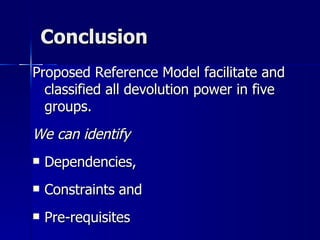
Conclusion
Proposed Reference Model facilitate and
  classified all devolution power in five
  groups.
We can identify
   Dependencies,
   Constraints and
   Pre-requisites

Reference model for devolution in e governance

  • 1.
    Reference Model for Devolution in e- Governance M Kashif Farooq Lahore University of Management Sciences (LUMS), Pakistan Presented at ICEGOV2008 2nd International Conference on Theory and Practice of Electronic Governance Cairo, Egypt, 1 - 4 December 2008.
  • 2.
    Objective This paper presents a reference model of devolution for a e-Government By using RM-ODP
  • 3.
    Issues  Centralized e-Government  Decentralized e-Government  Traditional Devolution Types  Political, administrative, fiscal
  • 4.
    Centralized Initiatives  Typical characteristics  all IT functions centralized in one organizational unit  generally limited IT costs but less effective  impacts IT governance by providing a generally tight governance model that is easy to enforce.
  • 5.
    Decentralized Initiatives Typical characteristics policy is required for  decision making, project management, portals, services, funding, revenue collection and operations  distributes IT functions between the various divisions or organizations  generally has a high coordination cost  IT governance is focused on the coordination effort between central and local activities
  • 6.
    eGov Power Devolution Devolved Powers P1, P2, P3…….. Service Delivery Channel for local Centralized government 1 Portal developed and managed by Devolved Powers centralized P1, P2, P3…….. Service Delivery Channel for local Powers government 2 Devolved Powers P1, P2, P3…….. Service Delivery Channel for local government n
  • 7.
    RM-ODP RM-ODP: Reference Modelof Open Distributed Processing Information Viewpoint Enterprise Computational Engineering Viewpoint Viewpoint Viewpoint Local Government Local Local Government Government Technology Local Viewpoint Government Federal Government Local Government Local Government
  • 8.
    Proposed Framework: (1) ReferenceModel for Devolution in e-Governance based on RM-ODP
  • 9.
    Proposed Framework: (2)  Scale of devolution depends upon  the size of the Enterprise,  its resource base,  human capacity, and  governance style.  There are two types of devolution  Enterprise devolution  among multilevel governance structure  Portal devolution  among different agencies or departments
  • 10.
    Proposed Framework (3) EnterpriseViewpoint  Roles, rights and functions of Federal or central agency  Roles, rights and functions of each partner local government and related agency  Business Model for Devolution in e-Governance  Business Processes  Define the e-Governance Devolution Powers: Operations, Capacity Building, Bridging the Digital Divide and Revenue Sharing etc.
  • 11.
    Proposed Framework (4) InformationDevolution Federal Powers Vs Local Powers  Data Ownership  Data Sharing  Data Integration  Data Usage  Data Verification Federal Powers Local Powers
  • 12.
    Proposed Framework (5) ComputationalDevolution Federal Powers Vs Local Powers  Integration with local objects and applications  Application Service Providing  Language Interfaces Federal Powers Local Powers
  • 13.
    Proposed Framework (6) EngineeringDevolution Federal Powers Vs Local Powers  Local ICT Infrastructure Development and usage  Efforts for Value-Added Services Federal Powers Local Powers
  • 14.
    Proposed Framework (7) TechnologyDevolution Federal Powers Vs Local Powers  Integration of heterogeneous local technologies  Adoption of technologies for different local socio-economic, geographic, culture and literacy barriers Federal Powers Local Powers
  • 15.
    Proposed Framework (8) Relationshipsamong Devolution Powers  Dependencies Many devolved powers are dependent on other devolved powers of the same viewpoint or the other viewpoint  Constraints Many devolved powers are associated with some limitations  Prerequisites Many devolved powers may be conditional with some other requirements
  • 16.
    Conclusion Proposed Reference Modelfacilitate and classified all devolution power in five groups. We can identify  Dependencies,  Constraints and  Pre-requisites