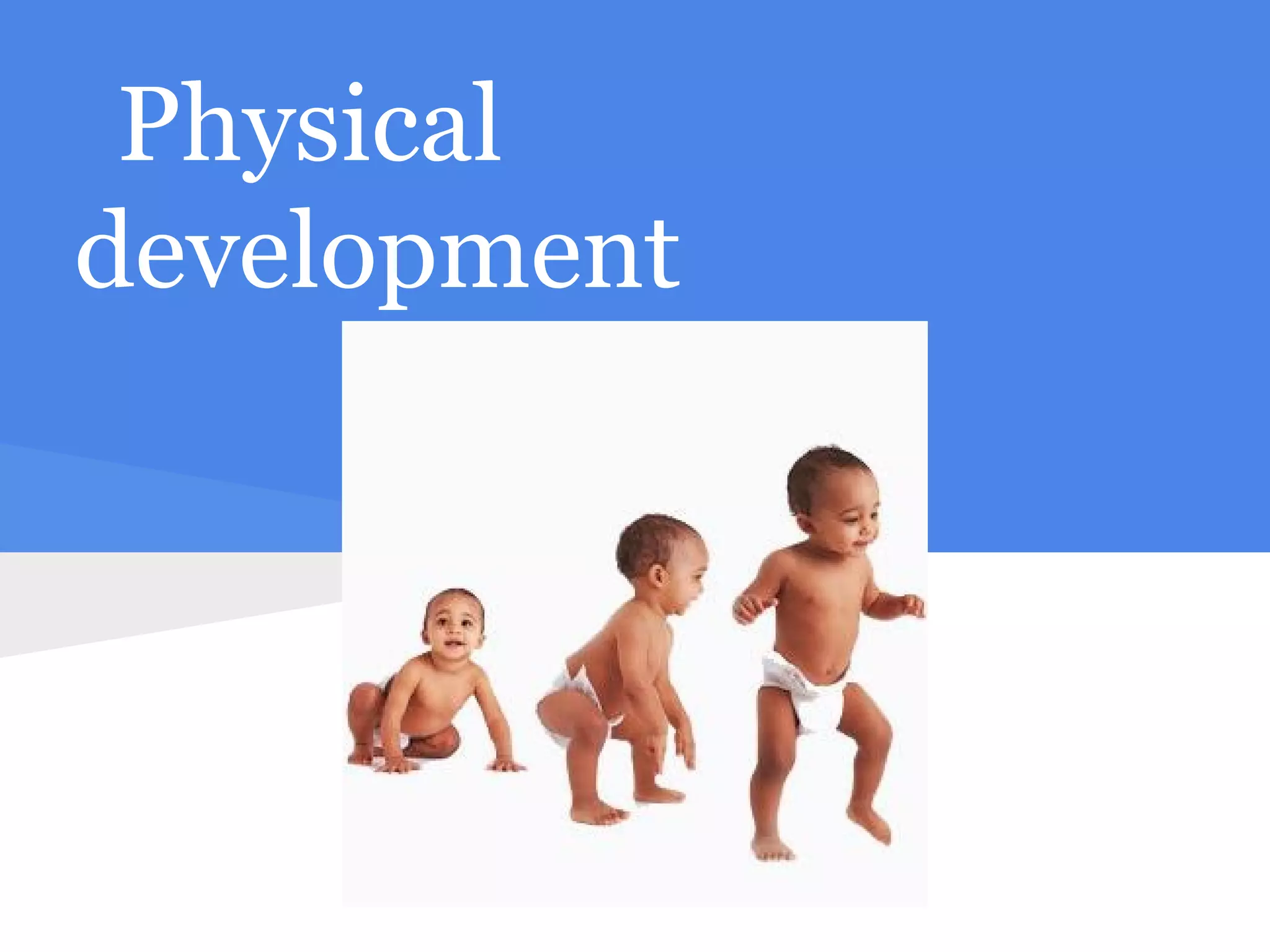
Physical
development
Predictable patterns of physical
development in childhood years

 •   The first two years are times of rapid physical
     development
 •   In the early childhood (2-6 years) growth slows a
     little but physical and cognitive capabilities are
     very extended.
 •   In the middle and late childhood (6-11) physical
     growth slows down further in preparation for
     puberty
Individual variations
•   Heredity
•   Lifestyle factors (including socioeconomic
    conditions)
•   Nutrition
Motor development
It is a lifelong process revealed principally
through changes in movement behaviour in
four phases:
•   Reflexive (foetus to 1)
•   Rudimentary (birth to 2)
•   fundamental (2 to 7)
•   specialised (7 to puberty)
three sets of skills develop: locomotion,
stability and manipulation.
theories of motor
development
•   Biological-maturation perspective: Views development
    as an internal process that is dictated by an individual's
    bodyclock.
•   Information-processing perspective: links motor
    development with decision making.
•   Ecological perspective: views development like the
    process that makes movements automated.
•   Linking motor and cognitive performance:
    neurobiological evidence links motor and cognitive
    performance by associating motor development with the
    beginning of certain perceptual and cognitive capacities.
Factors influencing motor
development
• Motor development follows a universal
    sequence
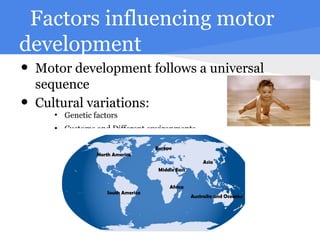
•   Cultural variations:
       ●
           Genetic factors
       ●
           Customs and Different environments
Some differences
 •   African and West Indian Cultures
Sitting and walking is very develop
5 months difference with european babies
 •   Jamaica
Formal handling: Massage and stretching exercises soon after birth to stimulate
body and to prepare for those milestones
Jamaican babies sit and walk earlier than European children
 •   Paraguay
Ache people of paraguay actively discourage their infants from crawling away from
their mothers.

•    Cultural practices can slow down motor development
Motor development is determined by both maturation
and the environmental factors.
         "They will all get there in the end"
Differences between sexes on
the performance of motor skills
 • Before the age of girls on certainare minimal, although
   boys outperform
                     11, differences
                                      gross motor skills with
     the exception of balance.
 •   Qualitative development in the performance of motor
     skills (such as hopping, throwing, running, etc.) across
     the school years for both sexes can be attributed to
     increases in body mass and height, physiological
     development and better neurological functioning.
 •   The role of biological differences is much diminished in
     the primary school years in contrast to the secondary
     school years where differences in body mass composition, and
     strength levels highlight the differences between boys and girls
     even further.
The importance of play
Environmental factors have a role to play in influencing
differences in motor development. Some studies tell us that older
girls‘ attitude towards sport can suffer if boys are allowed to join
in with their sporting activities.
In order to motivate girls to participate in physical activities and
sports, activities are oriented for both sexes separately. For girls-
"female-oriented" (activities such as dancing and
gymnastics are included) and for boys- "male-oriented"
(they play games such as rugby and soccer).
The social environment
The social environment in which children grow up impacts upon
individual motor skill proficiency by influencing values, knowledge
and skills. The first environment children are exposed to is the family.
They can influence their children in such ways:
•   including the provision of toys and sports equipment from an
    early age;
•   messaging about value they attach to physical activity and sports;
•   saying words of praise that encourage participation.
In the middle and childhood years, the influence of one's peers as a
socialisation agent in sport and activity increases. A lack of
competency in motor skills becomes most obvious in these years and
can lead to some children being excluded.
Activities engaged in together that include fun and
variety promote positive attitudes and a huge
variety of physical skills.
Unfortunately in many modern societies parents
harbour concerns about children's safety when
playing outdoors. But more and more spaces do
exist where children can play outdoor safely, they
have a lot of space to move with a range of
equipment that challenge growing bodies to climb,
roll, swing, balance etc.,
CONTROVERSY
Is outdoor play devalued in primary education practice?
 •   In the UK in the last 25 years we have seen a decline in the emphasis
     placed upon learning and physical play.
 •   Factors:
 1. Focus on children´s literacy and numeracy development.
 2. Narrowed view of the purposes of education.
 3. Adoption of a model that valued classroom learning instead of outdoors
    learning.

•.   According to Geva Blenkin and Marian Whitehead: "the most
     misunderstood dimension dimension of the planned curriculum is the
     creation of an environment in which education is to take place".
Outdoor learning
It is essential because:
1. Virtually all areas of the curriculum can be
accessed by outdoor learning.
2. It builds confidence and self-esteem.
3. It develops language in nursery children.
4. It benefits physical development.
5. It improve risks assessments.
6. It develops the large muscle groups.
7. It benefits heart and lung functioning and also
improves general health.
Outdoor learning
With these new evidences, the UK has seen a
revival in outdoor play practice and now many
young children receive regular access to the
outdoor environment.

However that happens only with children under
5 years old, not with older children.
Influence of PE and sport
PE provides many opportunities for children to
develop motor skills and sport coaches are
important socialising agents for children.
The school is the main institution in society for
the development of skills and physical activity.
Many studies have shown that sport influenced
five main areas of education:
Physical, affective, lifestyle, special and
cognitive development.
Influence of PE and sport
However the status of school sport has declined
and PE and sport are marginalised in the school
curriculum.
Theory in action
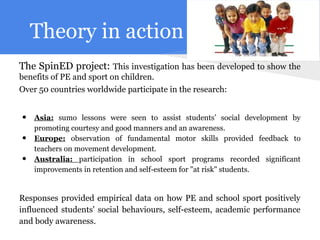
The SpinED project: This investigation has been developed to show the
benefits of PE and sport on children.
Over 50 countries worldwide participate in the research:


•   Asia: sumo lessons were seen to assist students’ social development by
    promoting courtesy and good manners and an awareness.
•   Europe: observation of fundamental motor skills provided feedback to
    teachers on movement development.
•   Australia: participation in school sport programs recorded significant
    improvements in retention and self-esteem for "at risk" students.


Responses provided empirical data on how PE and school sport positively
influenced students' social behaviours, self-esteem, academic performance
and body awareness.
Theory in action
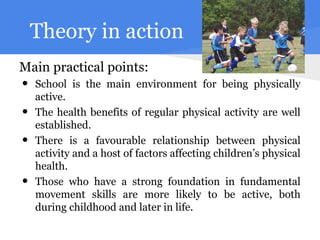
Main practical points:
•   School is the main environment for being physically
    active.
•   The health benefits of regular physical activity are well
    established.
•   There is a favourable relationship between physical
    activity and a host of factors affecting children’s physical
    health.
•   Those who have a strong foundation in fundamental
    movement skills are more likely to be active, both
    during childhood and later in life.

Developmental psychology 2 (easter)

  • 1.
  • 2.
    Predictable patterns ofphysical development in childhood years • The first two years are times of rapid physical development • In the early childhood (2-6 years) growth slows a little but physical and cognitive capabilities are very extended. • In the middle and late childhood (6-11) physical growth slows down further in preparation for puberty
  • 3.
    Individual variations • Heredity • Lifestyle factors (including socioeconomic conditions) • Nutrition
  • 4.
    Motor development It isa lifelong process revealed principally through changes in movement behaviour in four phases: • Reflexive (foetus to 1) • Rudimentary (birth to 2) • fundamental (2 to 7) • specialised (7 to puberty) three sets of skills develop: locomotion, stability and manipulation.
  • 5.
    theories of motor development • Biological-maturation perspective: Views development as an internal process that is dictated by an individual's bodyclock. • Information-processing perspective: links motor development with decision making. • Ecological perspective: views development like the process that makes movements automated. • Linking motor and cognitive performance: neurobiological evidence links motor and cognitive performance by associating motor development with the beginning of certain perceptual and cognitive capacities.
  • 6.
    Factors influencing motor development •Motor development follows a universal sequence • Cultural variations: ● Genetic factors ● Customs and Different environments
  • 7.
    Some differences • African and West Indian Cultures Sitting and walking is very develop 5 months difference with european babies • Jamaica Formal handling: Massage and stretching exercises soon after birth to stimulate body and to prepare for those milestones Jamaican babies sit and walk earlier than European children • Paraguay Ache people of paraguay actively discourage their infants from crawling away from their mothers. • Cultural practices can slow down motor development Motor development is determined by both maturation and the environmental factors. "They will all get there in the end"
  • 8.
    Differences between sexeson the performance of motor skills • Before the age of girls on certainare minimal, although boys outperform 11, differences gross motor skills with the exception of balance. • Qualitative development in the performance of motor skills (such as hopping, throwing, running, etc.) across the school years for both sexes can be attributed to increases in body mass and height, physiological development and better neurological functioning. • The role of biological differences is much diminished in the primary school years in contrast to the secondary school years where differences in body mass composition, and strength levels highlight the differences between boys and girls even further.
  • 9.
    The importance ofplay Environmental factors have a role to play in influencing differences in motor development. Some studies tell us that older girls‘ attitude towards sport can suffer if boys are allowed to join in with their sporting activities. In order to motivate girls to participate in physical activities and sports, activities are oriented for both sexes separately. For girls- "female-oriented" (activities such as dancing and gymnastics are included) and for boys- "male-oriented" (they play games such as rugby and soccer).
  • 10.
    The social environment Thesocial environment in which children grow up impacts upon individual motor skill proficiency by influencing values, knowledge and skills. The first environment children are exposed to is the family. They can influence their children in such ways: • including the provision of toys and sports equipment from an early age; • messaging about value they attach to physical activity and sports; • saying words of praise that encourage participation. In the middle and childhood years, the influence of one's peers as a socialisation agent in sport and activity increases. A lack of competency in motor skills becomes most obvious in these years and can lead to some children being excluded.
  • 11.
    Activities engaged intogether that include fun and variety promote positive attitudes and a huge variety of physical skills. Unfortunately in many modern societies parents harbour concerns about children's safety when playing outdoors. But more and more spaces do exist where children can play outdoor safely, they have a lot of space to move with a range of equipment that challenge growing bodies to climb, roll, swing, balance etc.,
  • 12.
    CONTROVERSY Is outdoor playdevalued in primary education practice? • In the UK in the last 25 years we have seen a decline in the emphasis placed upon learning and physical play. • Factors: 1. Focus on children´s literacy and numeracy development. 2. Narrowed view of the purposes of education. 3. Adoption of a model that valued classroom learning instead of outdoors learning. •. According to Geva Blenkin and Marian Whitehead: "the most misunderstood dimension dimension of the planned curriculum is the creation of an environment in which education is to take place".
  • 13.
    Outdoor learning It isessential because: 1. Virtually all areas of the curriculum can be accessed by outdoor learning. 2. It builds confidence and self-esteem. 3. It develops language in nursery children. 4. It benefits physical development. 5. It improve risks assessments. 6. It develops the large muscle groups. 7. It benefits heart and lung functioning and also improves general health.
  • 14.
    Outdoor learning With thesenew evidences, the UK has seen a revival in outdoor play practice and now many young children receive regular access to the outdoor environment. However that happens only with children under 5 years old, not with older children.
  • 15.
    Influence of PEand sport PE provides many opportunities for children to develop motor skills and sport coaches are important socialising agents for children. The school is the main institution in society for the development of skills and physical activity. Many studies have shown that sport influenced five main areas of education: Physical, affective, lifestyle, special and cognitive development.
  • 16.
    Influence of PEand sport However the status of school sport has declined and PE and sport are marginalised in the school curriculum.
  • 17.
    Theory in action TheSpinED project: This investigation has been developed to show the benefits of PE and sport on children. Over 50 countries worldwide participate in the research: • Asia: sumo lessons were seen to assist students’ social development by promoting courtesy and good manners and an awareness. • Europe: observation of fundamental motor skills provided feedback to teachers on movement development. • Australia: participation in school sport programs recorded significant improvements in retention and self-esteem for "at risk" students. Responses provided empirical data on how PE and school sport positively influenced students' social behaviours, self-esteem, academic performance and body awareness.
  • 18.
    Theory in action Mainpractical points: • School is the main environment for being physically active. • The health benefits of regular physical activity are well established. • There is a favourable relationship between physical activity and a host of factors affecting children’s physical health. • Those who have a strong foundation in fundamental movement skills are more likely to be active, both during childhood and later in life.