Development Of Economics
Chapter 13
•Balance of Payments, Debt, Financial Crises, and
Stabilization Policies
Group Members:
Sardar Safeer Sarwar Khan
Asfand Yar Altaf
Deedag Ali Nasir
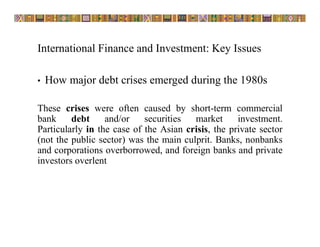
International Finance and Investment: Key Issues
• How major debt crises emerged during the 1980s
These crises were often caused by short-term commercial
bank debt and/or securities market investment.
Particularly in the case of the Asian crisis, the private sector
(not the public sector) was the main culprit. Banks, nonbanks
and corporations overborrowed, and foreign banks and private
investors overlent
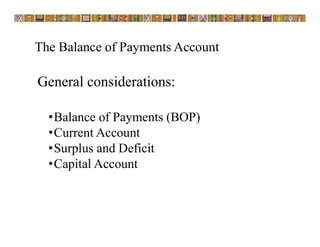
The Balance of Payments Account
General considerations:
•Balance of Payments (BOP)
•Current Account
•Surplus and Deficit
•Capital Account
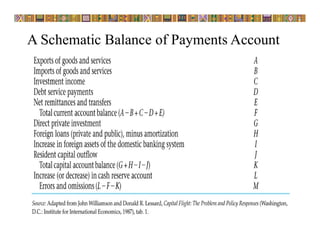
A Schematic Balance of Payments Account
The Balance of Payments Account
•General considerations (cont’d)
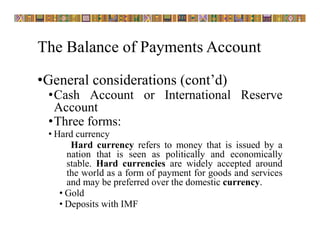
•Cash Account or International Reserve
Account
•Three forms:
• Hard currency
Hard currency refers to money that is issued by a
nation that is seen as politically and economically
stable. Hard currencies are widely accepted around
the world as a form of payment for goods and services
and may be preferred over the domestic currency.
• Gold
• Deposits with IMF
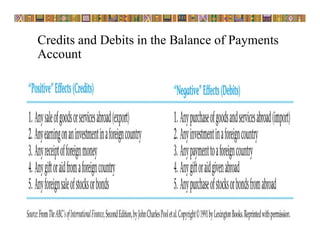
Credits and Debits in the Balance of Payments
Account
The Balance of Payments Account
•A hypothetical illustration: deficits and debts
•Current Account
These crises were often caused by short-term
commercial bank debt and/or securities market
investment. Particularly in the case of the
Asian crisis, the private sector (not the public
sector) was the main culprit. Banks, nonbanks and
corporations overborrowed, and foreign banks and
private investors overlent
•Capital Account
A deficit in the capital account means
money is flowing out of the country,
and it suggests the nation is increasing
its ownership of foreign assets. The
term "capital account" is used with a
narrower meaning by the International
Monetary Fund (IMF) and affiliated
sources.
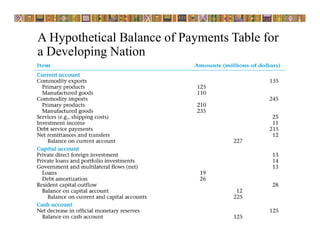
A Hypothetical Balance of Payments Table for
a Developing Nation
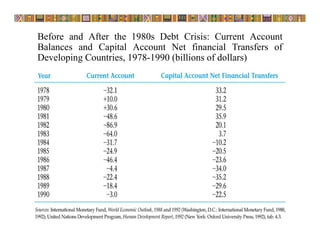
Before and After the 1980s Debt Crisis: Current Account
Balances and Capital Account Net financial Transfers of
Developing Countries, 1978-1990 (billions of dollars)
The Balance of Payments Account
• A hypothetical illustration: deficits and debts (cont’d)
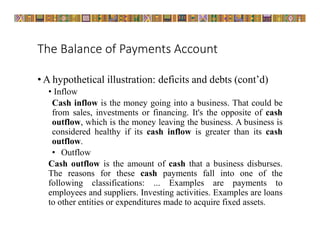
• Inflow
Cash inflow is the money going into a business. That could be
from sales, investments or financing. It's the opposite of cash
outflow, which is the money leaving the business. A business is
considered healthy if its cash inflow is greater than its cash
outflow.
• Outflow
Cash outflow is the amount of cash that a business disburses.
The reasons for these cash payments fall into one of the
following classifications: ... Examples are payments to
employees and suppliers. Investing activities. Examples are loans
to other entities or expenditures made to acquire fixed assets.
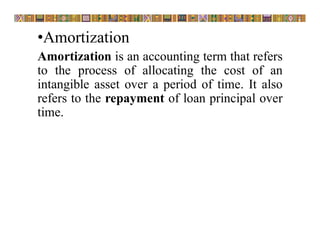
•Amortization
Amortization is an accounting term that refers
to the process of allocating the cost of an
intangible asset over a period of time. It also
refers to the repayment of loan principal over
time.
The Issue of Payment Deficits
•Some initial policy issues
•International reserves
•Restrictive fiscal and monetary policies:
•Structural adjustment
•Stabilization policies
•Special drawing rights (SDRs)
The Issue of Payment Deficits
•Trends in the Balance of Payments
A country's balance of payments tells you
whether it saves enough to pay for
its imports. It also reveals whether the
country produces enough economic
output to pay for its growth. The BOP is
reported for a quarter or a year.
TRENDS
Current Account
Current Account : Deficit
Current Account : U.S Deficit
Current Account : Trade Balance
Current Account : U.S Imports and Exports
Current Account : Trade Deficit
Current Account : U.S Trade Deficit
Financial Account
Capital Account
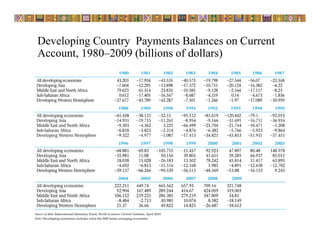
Developing Country Payments Balances on Current
Account, 1980–2009 (billions of dollars)
Accumulation of Debt and Emergence of
the Debt Crisis
•Background and analysis
•External debt
External debt is the portion of a
country's debt that was borrowed
from foreign lenders, including commercial
banks, governments, or international financial
institutions. These loans, including interest, must
usually be paid in the currency in which the loan
was made.
Debt service
• Featured snippet from the web
• Debt service is the cash that is required to cover the
repayment of interest and principal on a debt for a particular
period. If an individual is taking out a mortgage or a student
loan, the borrower needs to calculate the annual or
monthly debt service required on each loan
•Basic transfer
Transfer payment. ... In economics,
a transfer payment (or government transfer or
simply transfer) is a redistribution of income and
wealth by means of the government making a
payment, without goods or services being received in
return.
Accumulation of Debt and Emergence of the
Debt Crisis
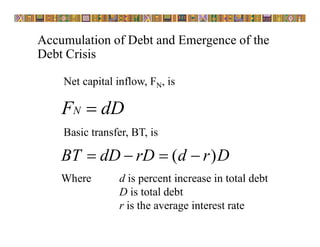
dDFN 
DrdrDdDBT )( 
Net capital inflow, FN, is
Where d is percent increase in total debt
D is total debt
r is the average interest rate
Basic transfer, BT, is
Accumulation of Debt and Emergence of
the Debt Crisis
•Origins of the 1980s Debt Crisis
•OPEC oil price increase
•Increased borrowing
•Excess of imports
•Lagging exports
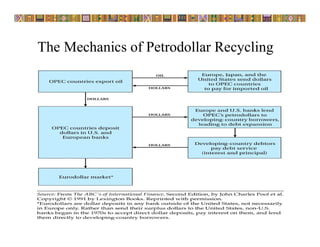
The Mechanics of Petrodollar Recycling
Accumulation of Debt and Emergence of the
Debt Crisis (cont’d)
•Origins of the Debt Crisis (cont’d)
•Debt-servicing obligations
•Debt-service payments
•Debt-servicing difficulty
•Oil shocks
Accumulation of Debt and Emergence of
the Debt Crisis (cont’d)
Origins of the Debt Crisis (cont’d)
•Developing countries’ two options:
•Curtail imports and restrictive fiscal and
monetary measures
•More external borrowing
Attempts at Alleviation: Macroeconomic Instability,
Classic IMF Stabilization Policies, and Their Critics
•The IMF stabilization program
•Macroeconomic instability
•Stabilization policies
•Four basic components of IMF stabilization
program:
• Liberalization of foreign exchange and imports control
• Devaluation of the official exchange rate
• Stringent domestic anti-inflation program
• Opening up of the economy to international commerce
Attempts at Alleviation: Macroeconomic Instability,
Classic IMF Stabilization Policies, and Their Critics
•The IMF stabilization program (cont’d)
•Such policies can be politically unpopular because
they hurt the lower- and middle-income groups.
• Less radical observers view the IMF as neither a
developmental nor an antidevelopmental
institution.
Attempts at Alleviation: Macroeconomic Instability,
Classic IMF Stabilization Policies, and Their Critics
•The IMF stabilization program (cont’d)
•Tactics for debt relief:
• Debtors’ cartel
• Restructuring
• Brady Plan
• Debt for equity swaps
• Debt for nature swaps
• Debt repudiation
“Odious Debt” and Its Prevention
•What is odious debt?
•Sovereign debt used by an
undemocratic government in a manner
contrary to the interests of its people
should be deemed invalid
Resolution of 1980s-1990s Debt Crises and
Continued Vulnerabilities
•Highly indebted poor countries (HIPCs)
• The heavily indebted poor countries (HIPC) are a group of
39 developing countries with high levels of poverty and debt
overhang which are eligible for special assistance from
the International Monetary Fund (IMF) and the World Bank.
•Some progress but vulnerabilities remain
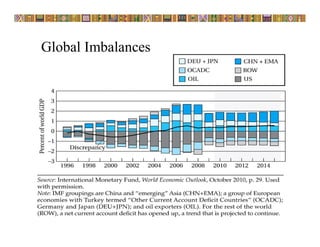
Global Imbalances
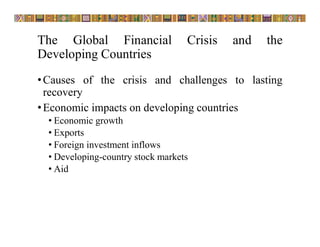
The Global Financial Crisis and the
Developing Countries
•Causes of the crisis and challenges to lasting
recovery
•Economic impacts on developing countries
• Economic growth
• Exports
• Foreign investment inflows
• Developing-country stock markets
• Aid
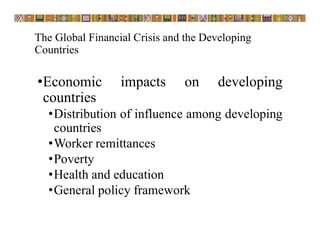
The Global Financial Crisis and the Developing
Countries
•Economic impacts on developing
countries
•Distribution of influence among developing
countries
•Worker remittances
•Poverty
•Health and education
•General policy framework
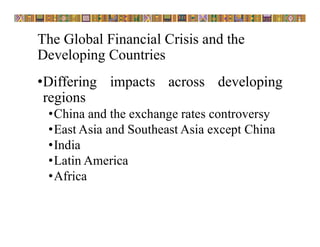
The Global Financial Crisis and the
Developing Countries
•Differing impacts across developing
regions
•China and the exchange rates controversy
•East Asia and Southeast Asia except China
•India
•Latin America
•Africa
The Global Financial Crisis and the
Developing Countries
•Prospects for recovery and stability
•Opportunities as well as dangers?
Concepts for Review
•Amortization
•Balance of payments
•Basic transfer
•Brady plan
•Capital account
•Capital flight
•Cash account
•Conditionality
•Current account
•Debt-for-equity swap
•Debt-for-nature swap
•Debtors’ cartel
•Debt repudiation
•Debt service
•Deficit
Concepts for Review (cont’d)
•Euro
•External debt
•Hard currency
•Highly indebted poor
countries (HIPCs)
•International reserve
account
•International reserves
•Macroeconomic
instability
•Odious debt
•Restructuring
•Special drawing rights
(SDRs)
•Stabilization policies
•Structural adjustment
loans
•Surplus

Development of economics

  • 1.
    Development Of Economics Chapter13 •Balance of Payments, Debt, Financial Crises, and Stabilization Policies Group Members: Sardar Safeer Sarwar Khan Asfand Yar Altaf Deedag Ali Nasir
  • 2.
    International Finance andInvestment: Key Issues • How major debt crises emerged during the 1980s These crises were often caused by short-term commercial bank debt and/or securities market investment. Particularly in the case of the Asian crisis, the private sector (not the public sector) was the main culprit. Banks, nonbanks and corporations overborrowed, and foreign banks and private investors overlent
  • 3.
    The Balance ofPayments Account General considerations: •Balance of Payments (BOP) •Current Account •Surplus and Deficit •Capital Account
  • 4.
    A Schematic Balanceof Payments Account
  • 5.
    The Balance ofPayments Account •General considerations (cont’d) •Cash Account or International Reserve Account •Three forms: • Hard currency Hard currency refers to money that is issued by a nation that is seen as politically and economically stable. Hard currencies are widely accepted around the world as a form of payment for goods and services and may be preferred over the domestic currency. • Gold • Deposits with IMF
  • 6.
    Credits and Debitsin the Balance of Payments Account
  • 7.
    The Balance ofPayments Account •A hypothetical illustration: deficits and debts •Current Account These crises were often caused by short-term commercial bank debt and/or securities market investment. Particularly in the case of the Asian crisis, the private sector (not the public sector) was the main culprit. Banks, nonbanks and corporations overborrowed, and foreign banks and private investors overlent
  • 8.
    •Capital Account A deficitin the capital account means money is flowing out of the country, and it suggests the nation is increasing its ownership of foreign assets. The term "capital account" is used with a narrower meaning by the International Monetary Fund (IMF) and affiliated sources.
  • 9.
    A Hypothetical Balanceof Payments Table for a Developing Nation
  • 10.
    Before and Afterthe 1980s Debt Crisis: Current Account Balances and Capital Account Net financial Transfers of Developing Countries, 1978-1990 (billions of dollars)
  • 11.
    The Balance ofPayments Account • A hypothetical illustration: deficits and debts (cont’d) • Inflow Cash inflow is the money going into a business. That could be from sales, investments or financing. It's the opposite of cash outflow, which is the money leaving the business. A business is considered healthy if its cash inflow is greater than its cash outflow. • Outflow Cash outflow is the amount of cash that a business disburses. The reasons for these cash payments fall into one of the following classifications: ... Examples are payments to employees and suppliers. Investing activities. Examples are loans to other entities or expenditures made to acquire fixed assets.
  • 12.
    •Amortization Amortization is anaccounting term that refers to the process of allocating the cost of an intangible asset over a period of time. It also refers to the repayment of loan principal over time.
  • 13.
    The Issue ofPayment Deficits •Some initial policy issues •International reserves •Restrictive fiscal and monetary policies: •Structural adjustment •Stabilization policies •Special drawing rights (SDRs)
  • 14.
    The Issue ofPayment Deficits •Trends in the Balance of Payments A country's balance of payments tells you whether it saves enough to pay for its imports. It also reveals whether the country produces enough economic output to pay for its growth. The BOP is reported for a quarter or a year.
  • 15.
    TRENDS Current Account Current Account: Deficit Current Account : U.S Deficit Current Account : Trade Balance Current Account : U.S Imports and Exports Current Account : Trade Deficit Current Account : U.S Trade Deficit Financial Account Capital Account
  • 16.
    Developing Country PaymentsBalances on Current Account, 1980–2009 (billions of dollars)
  • 17.
    Accumulation of Debtand Emergence of the Debt Crisis •Background and analysis •External debt External debt is the portion of a country's debt that was borrowed from foreign lenders, including commercial banks, governments, or international financial institutions. These loans, including interest, must usually be paid in the currency in which the loan was made.
  • 18.
    Debt service • Featuredsnippet from the web • Debt service is the cash that is required to cover the repayment of interest and principal on a debt for a particular period. If an individual is taking out a mortgage or a student loan, the borrower needs to calculate the annual or monthly debt service required on each loan •Basic transfer Transfer payment. ... In economics, a transfer payment (or government transfer or simply transfer) is a redistribution of income and wealth by means of the government making a payment, without goods or services being received in return.
  • 19.
    Accumulation of Debtand Emergence of the Debt Crisis dDFN  DrdrDdDBT )(  Net capital inflow, FN, is Where d is percent increase in total debt D is total debt r is the average interest rate Basic transfer, BT, is
  • 20.
    Accumulation of Debtand Emergence of the Debt Crisis •Origins of the 1980s Debt Crisis •OPEC oil price increase •Increased borrowing •Excess of imports •Lagging exports
  • 21.
    The Mechanics ofPetrodollar Recycling
  • 22.
    Accumulation of Debtand Emergence of the Debt Crisis (cont’d) •Origins of the Debt Crisis (cont’d) •Debt-servicing obligations •Debt-service payments •Debt-servicing difficulty •Oil shocks
  • 23.
    Accumulation of Debtand Emergence of the Debt Crisis (cont’d) Origins of the Debt Crisis (cont’d) •Developing countries’ two options: •Curtail imports and restrictive fiscal and monetary measures •More external borrowing
  • 24.
    Attempts at Alleviation:Macroeconomic Instability, Classic IMF Stabilization Policies, and Their Critics •The IMF stabilization program •Macroeconomic instability •Stabilization policies •Four basic components of IMF stabilization program: • Liberalization of foreign exchange and imports control • Devaluation of the official exchange rate • Stringent domestic anti-inflation program • Opening up of the economy to international commerce
  • 25.
    Attempts at Alleviation:Macroeconomic Instability, Classic IMF Stabilization Policies, and Their Critics •The IMF stabilization program (cont’d) •Such policies can be politically unpopular because they hurt the lower- and middle-income groups. • Less radical observers view the IMF as neither a developmental nor an antidevelopmental institution.
  • 26.
    Attempts at Alleviation:Macroeconomic Instability, Classic IMF Stabilization Policies, and Their Critics •The IMF stabilization program (cont’d) •Tactics for debt relief: • Debtors’ cartel • Restructuring • Brady Plan • Debt for equity swaps • Debt for nature swaps • Debt repudiation
  • 27.
    “Odious Debt” andIts Prevention •What is odious debt? •Sovereign debt used by an undemocratic government in a manner contrary to the interests of its people should be deemed invalid
  • 28.
    Resolution of 1980s-1990sDebt Crises and Continued Vulnerabilities •Highly indebted poor countries (HIPCs) • The heavily indebted poor countries (HIPC) are a group of 39 developing countries with high levels of poverty and debt overhang which are eligible for special assistance from the International Monetary Fund (IMF) and the World Bank. •Some progress but vulnerabilities remain
  • 29.
  • 30.
    The Global FinancialCrisis and the Developing Countries •Causes of the crisis and challenges to lasting recovery •Economic impacts on developing countries • Economic growth • Exports • Foreign investment inflows • Developing-country stock markets • Aid
  • 31.
    The Global FinancialCrisis and the Developing Countries •Economic impacts on developing countries •Distribution of influence among developing countries •Worker remittances •Poverty •Health and education •General policy framework
  • 32.
    The Global FinancialCrisis and the Developing Countries •Differing impacts across developing regions •China and the exchange rates controversy •East Asia and Southeast Asia except China •India •Latin America •Africa
  • 33.
    The Global FinancialCrisis and the Developing Countries •Prospects for recovery and stability •Opportunities as well as dangers?
  • 34.
    Concepts for Review •Amortization •Balanceof payments •Basic transfer •Brady plan •Capital account •Capital flight •Cash account •Conditionality •Current account •Debt-for-equity swap •Debt-for-nature swap •Debtors’ cartel •Debt repudiation •Debt service •Deficit
  • 35.
    Concepts for Review(cont’d) •Euro •External debt •Hard currency •Highly indebted poor countries (HIPCs) •International reserve account •International reserves •Macroeconomic instability •Odious debt •Restructuring •Special drawing rights (SDRs) •Stabilization policies •Structural adjustment loans •Surplus