Development of Analysis Rules to Identify 
Proper Noun from Bengali Sentence for 
Universal Networking language 
Prepared By- 
Md. Syeful Islam 
Sr. Software Engineer at- 
Samsung Research Institute Bangladesh 
Google scholar : http://scholar.google.com/citations?user=b0QDD2AAAAAJ&hl=en 
academia.edu: https://independent.academia.edu/SyefulIslam
Presentation covered… 
• Overview 
• Introducing with Universal Networking 
Language(UNL) 
• Proposed Proper Noun Conversion Approach 
• Result Analysis
Overview 
• Today the regional economies, societies, cultures and educations are integrated through a 
globe-spanning network of communication and trade. 
• This globalization trend evokes for a homogeneous platform so that each member of the 
platform can apprehend what other intimates and perpetuates the discussion in a 
mellifluous way. 
• However the barriers of languages throughout the world are continuously obviating the 
whole world from congregating into a single domain of sharing knowledge and information. 
• Therefore researcher works on various languages and tries to give a platform where multi 
lingual people can communicate through their native language. 
• Researcher analyze the language structure and form structural grammar and rules which 
used to translate one language to other. 
• From the last few years several language-specific translation systems have been proposed. 
• Since these systems are based on specific source and target languages, these have their own 
limitations. 
• As a consequence United Nations University/Institute of Advanced Studies (UNU/IAS) were 
decided to develop an inter-language translation program . 
• The corollary of their continuous research leads a common form of languages known as 
Universal Networking Language (UNL) and introduces UNL system.
Overview… 
• UNL system is an initiative to overcome the problem of language pairs in automated translation. 
UNL is an artificial language that is based on Interlingua approach.UNL acts as an intermediate 
form computer semantic language whereby any text written in a particular language is converted 
to text of any other forms of languages. 
• UNL system consists of major three components: 
- language resources 
- software for processing language resources (parser) and 
- supporting tools for maintaining and operating language processing software or 
developing language resources. 
• The parser of UNL system take input sentence and start parsing based on rules and convert it into 
corresponding universal word from word dictionary. 
• The challenge in detection of named is that such expressions are hard to analyze using UNL 
because they belong to the open class of expressions, i.e., there is an infinite variety and new 
expressions are constantly being invented. 
• Bengali is the seventh popular language in the world, second in India and the national language of 
Bangladesh. 
• So this is an important problem since search queries on UNL dictionary for proper nouns while all 
proper nouns(names) cannot be exhaustively maintained in the dictionary for automatic 
identification. 
In this research project we do this task , Proper noun detection and conversion.
Introducing with Universal Networking 
Language(UNL) 
What is the UNL? 
• The UNL consists of Universal words (UWs), Relations, Attributes, and UNL 
Knowledge Base. The Universal words constitute the vocabulary of the UNL, 
Relations and attribute constitutes the syntax of the UNL and UNL Knowledge Base 
constitutes the semantics of the UNL. 
Why the UNL is necessary? 
• A computer in future needs a capability to make knowledge processing. 
Knowledge processing means a computer takes over thought and judgment of 
humans using knowledge of humans. It is necessary to make a processing based 
on contents. Computers need to have knowledge for knowledge processing. It is 
necessary for computers to have a language to have knowledge like human. It is 
also necessary to have a language to process contents like human. The UNL is a 
language for computers to do so. 
• The UNL can express knowledge like a natural language. The UNL can express 
contents like a natural language.
Introducing with Universal Networking 
Language(UNL) 
What is different from others? 
• Systems which can deal with knowledge and contents have already been developed. But, 
their representation of knowledge or contents is different from each other. Moreover, their 
representations are language dependent. Namely, concept primitives used to represent 
knowledge are language dependent. Knowledge or contents of a system cannot be used in 
other systems. 
• The situation is same as machine translation. For example, if we put all the result of research 
and development of machine translation, we cannot realize multilingual machine translation 
systems which can break language barriers. 
Advantage of common language for computers 
• The UNL greatly reduces development cost of developing knowledge or contents necessary 
to make knowledge processing by sharing knowledge and contents. Furthermore, if every 
knowledge’s necessary for doing something by software is described in a language for 
computers such as the UNL, software only need to interpret instructions written in the 
language to perform it functions. And those instructions could be shared by other software. 
Then we can accumulate such knowledge for computer like a library for humans.
Introducing with Universal Networking Language(UNL) 
How the UNL express information? 
• The UNL expresses information or knowledge in the form of semantic network 
with hyper-node. UNL semantic network is made up of a set of binary relations, 
each binary relation is composed of a relation and two UWs that old the relation. 
Expression of Binary Relation 
• A binary relation of UNL is expressed in the following format: 
• <relation> ( <uw1>, <uw2> ) 
• In <relation>, one of the relations defined in the UNL Specifications is described. In 
<uw1> and <uw2>, the two UWs that hold the relation given at <relation> are 
described. Such a binary relation is interpreted as follows: 
Interpretation of Binary Relation 
• The semantic network [4] of UNL expression is a directed graph by means of the 
binary relations. The three elements of each binary relation have the following 
interrelationship: 
<uw1> --- <relation> --> <uw2> 
This interrelationship means that the UW given in <uw2> 
• Plays the role indicated by the relation given in <relation> and held by the UW 
given in <uw1>; whereas the UW given in <uw1> 
• holds the relation given in <relation> with the UW given in <uw2>. 
As mentioned above, all binary relations that compose a UNL expression has 
directions, and the semantic network of UNL expression is a directed graph.
Introducing with Universal Networking 
Language(UNL) 
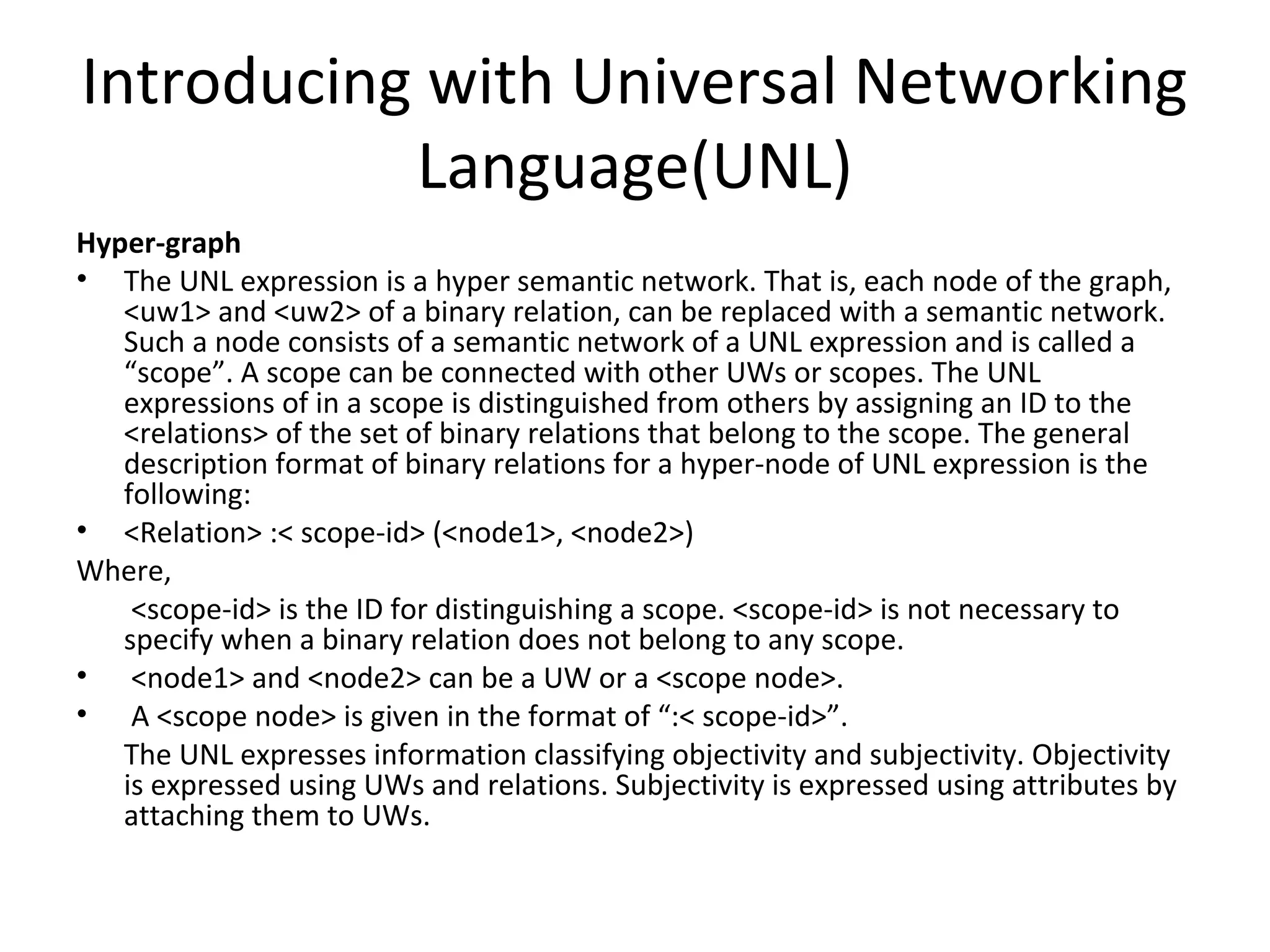
Hyper-graph 
• The UNL expression is a hyper semantic network. That is, each node of the graph, 
<uw1> and <uw2> of a binary relation, can be replaced with a semantic network. 
Such a node consists of a semantic network of a UNL expression and is called a 
“scope”. A scope can be connected with other UWs or scopes. The UNL 
expressions of in a scope is distinguished from others by assigning an ID to the 
<relations> of the set of binary relations that belong to the scope. The general 
description format of binary relations for a hyper-node of UNL expression is the 
following: 
• <Relation> :< scope-id> (<node1>, <node2>) 
Where, 
<scope-id> is the ID for distinguishing a scope. <scope-id> is not necessary to 
specify when a binary relation does not belong to any scope. 
• <node1> and <node2> can be a UW or a <scope node>. 
• A <scope node> is given in the format of “:< scope-id>”. 
The UNL expresses information classifying objectivity and subjectivity. Objectivity 
is expressed using UWs and relations. Subjectivity is expressed using attributes by 
attaching them to UWs.
Introducing with Universal Networking 
Language(UNL) 
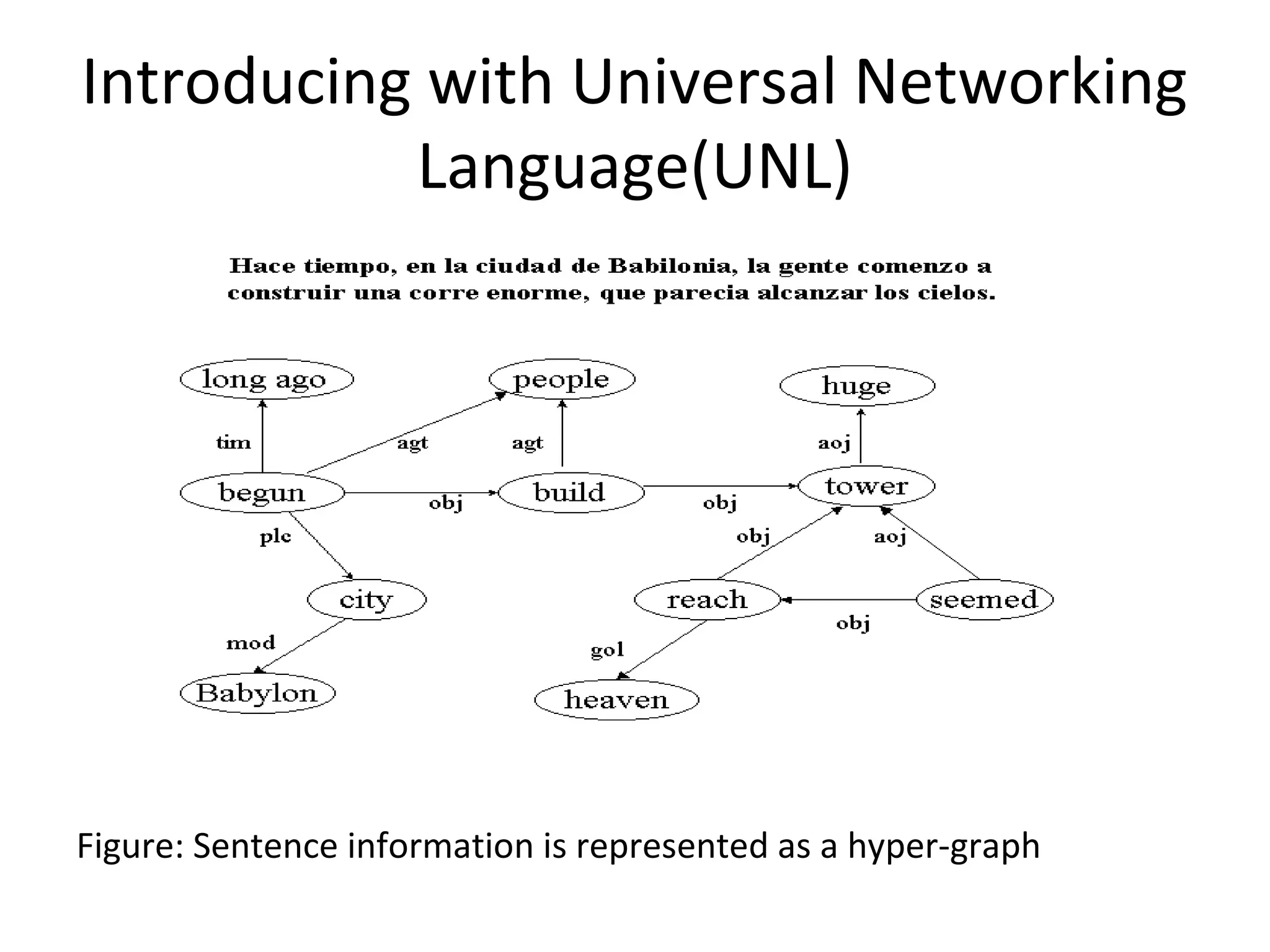
Figure: Sentence information is represented as a hyper-graph
Introducing with Universal Networking 
Language(UNL) 
UNL Expression 
[S:2] 
{org:es} 
Hace tiempo, en la ciudad de Babilonia, la gente comenzo a construir una torre 
enorme, que parecia alcanzar los cielos. 
{/org} 
{unl} 
tim(begin(icl>do).@entry.@past, long ago(icl>ago)) 
mod(city(icl>region).@def, Babylon(icl>city)) 
plc(begin(icl>do).@entry.@past, city (icl>region).@def) 
agt(begin(icl>do).@entry.@past, people(icl>person).@def) 
obj(begin(icl>do).@entry.@past, build(icl>do)) 
agt(build(icl>do), people.@def) 
obj(build(icl>do), tower(icl>building).@indef) 
aoj(huge(icl>big), tower(icl>building).@indef) 
aoj(seem(icl>be).@past, tower(icl>building).@indef) 
obj(seem(icl>be).@past, reach(icl>come).@begin.@soon) 
obj(reach(icl>come).@begin-soon, tower(icl>building).@indef) 
gol(reach(icl>come).@begin-soon, heaven(icl>region).@def.@pl) 
{/unl} 
[/S]
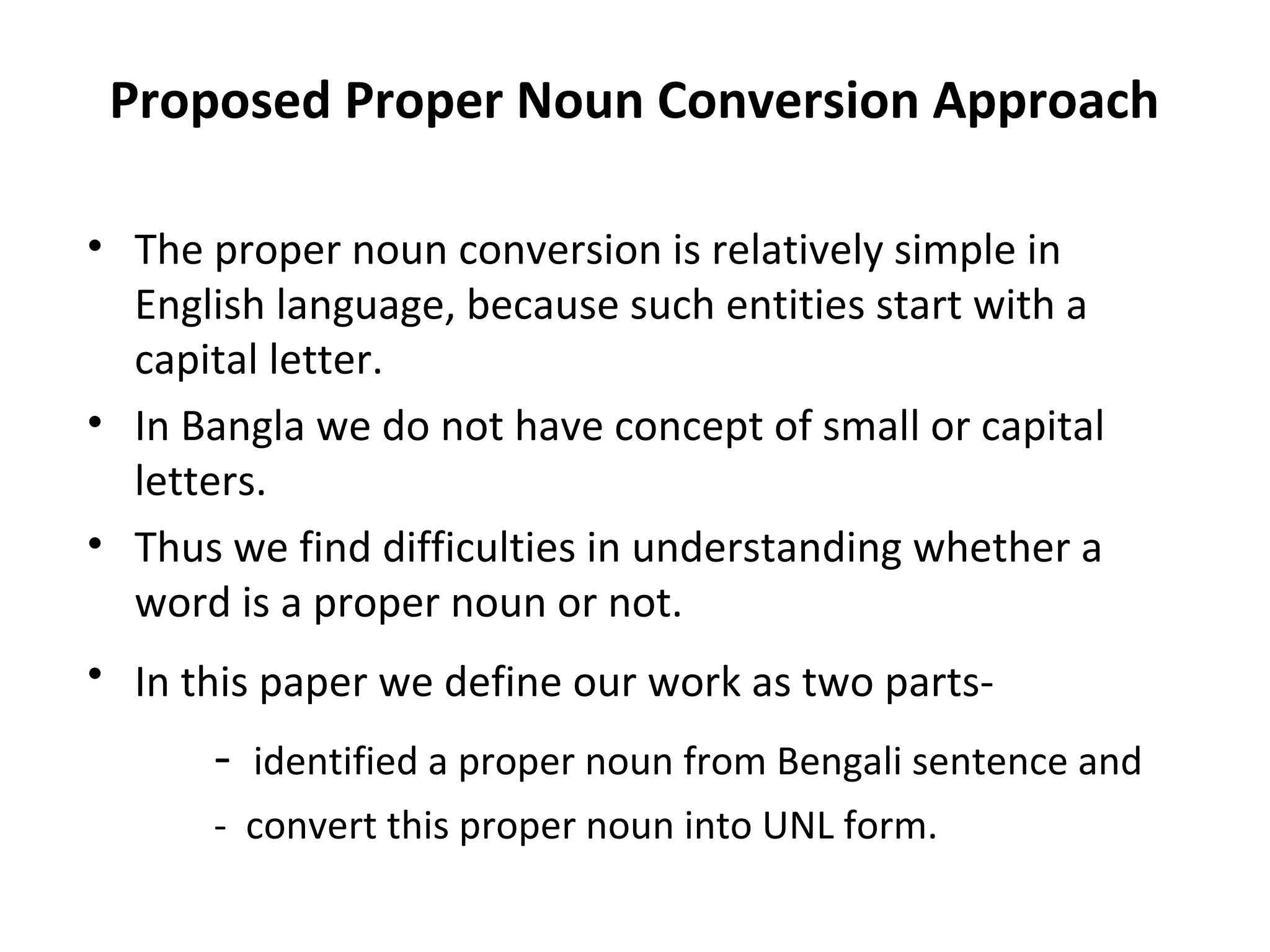
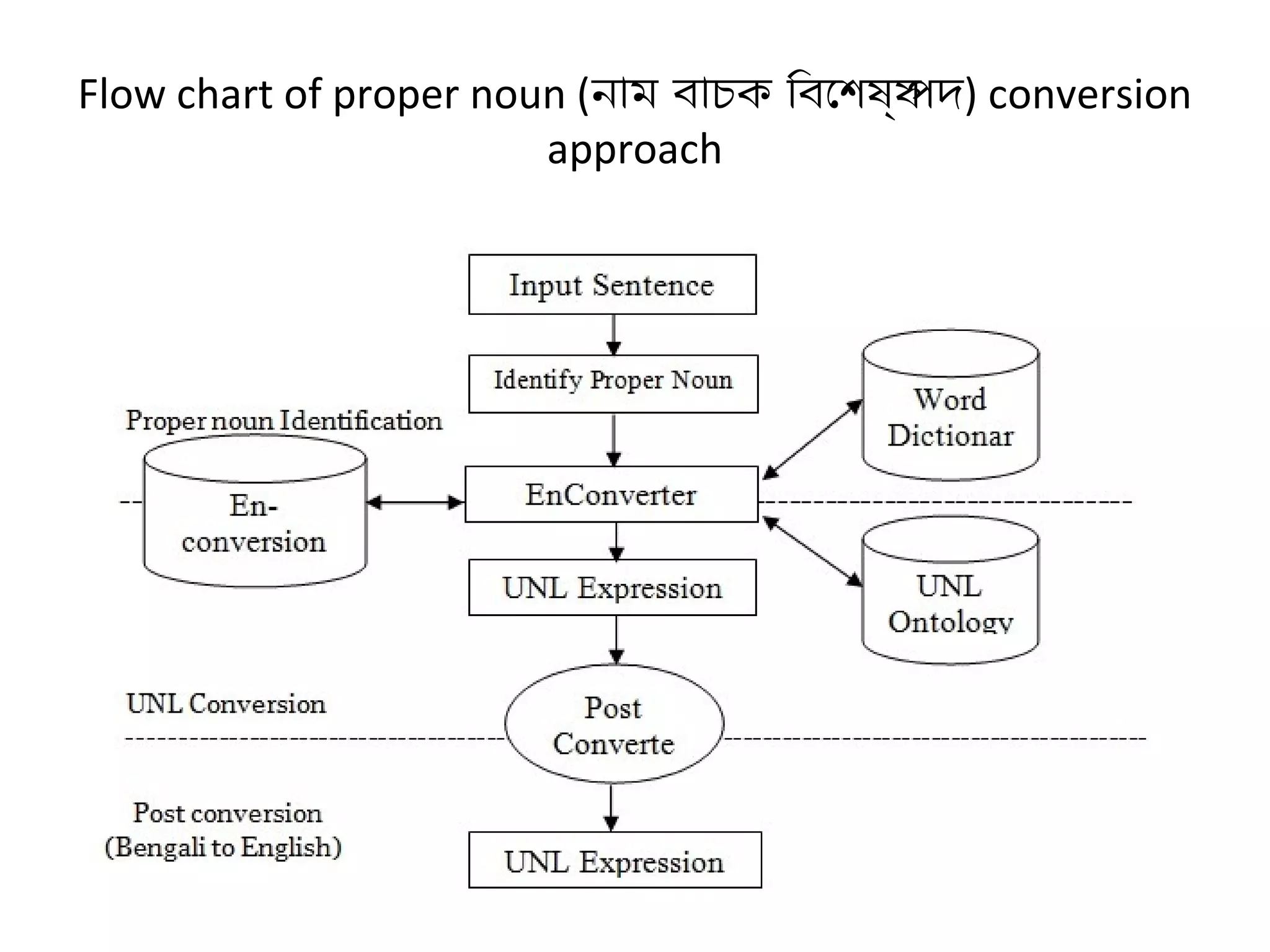
Proposed Proper Noun Conversion Approach 
• The proper noun conversion is relatively simple in 
English language, because such entities start with a 
capital letter. 
• In Bangla we do not have concept of small or capital 
letters. 
• Thus we find difficulties in understanding whether a 
word is a proper noun or not. 
• In this paper we define our work as two parts- 
- identified a proper noun from Bengali sentence and 
- convert this proper noun into UNL form.
Proposed Proper Noun Conversion Approach… 
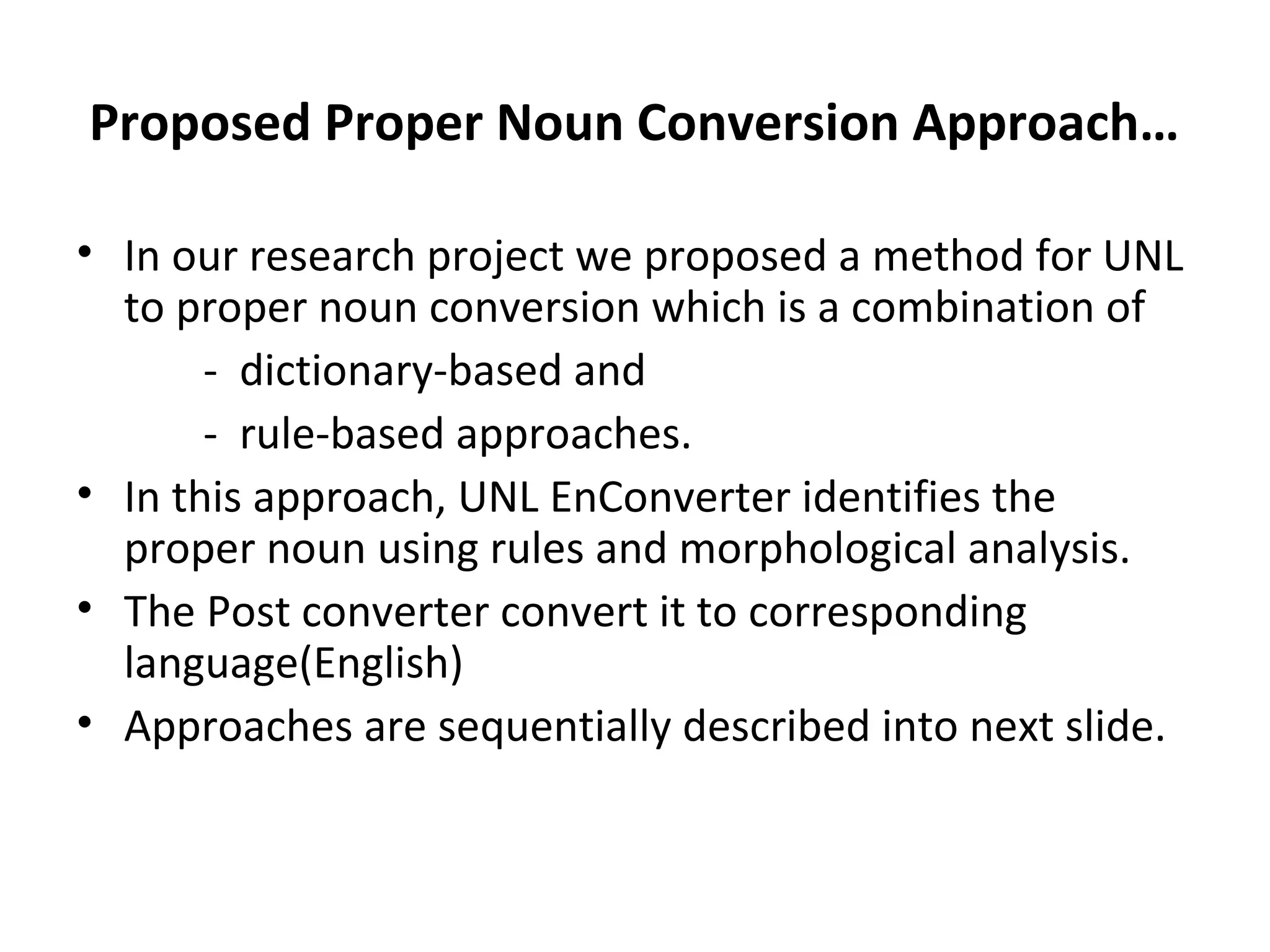
• In our research project we proposed a method for UNL 
to proper noun conversion which is a combination of 
- dictionary-based and 
- rule-based approaches. 
• In this approach, UNL EnConverter identifies the 
proper noun using rules and morphological analysis. 
• The Post converter convert it to corresponding 
language(English) 
• Approaches are sequentially described into next slide.
Flow chart of proper noun (নাম বাচক িবেশেষ্্য যপদ) conversion 
approach
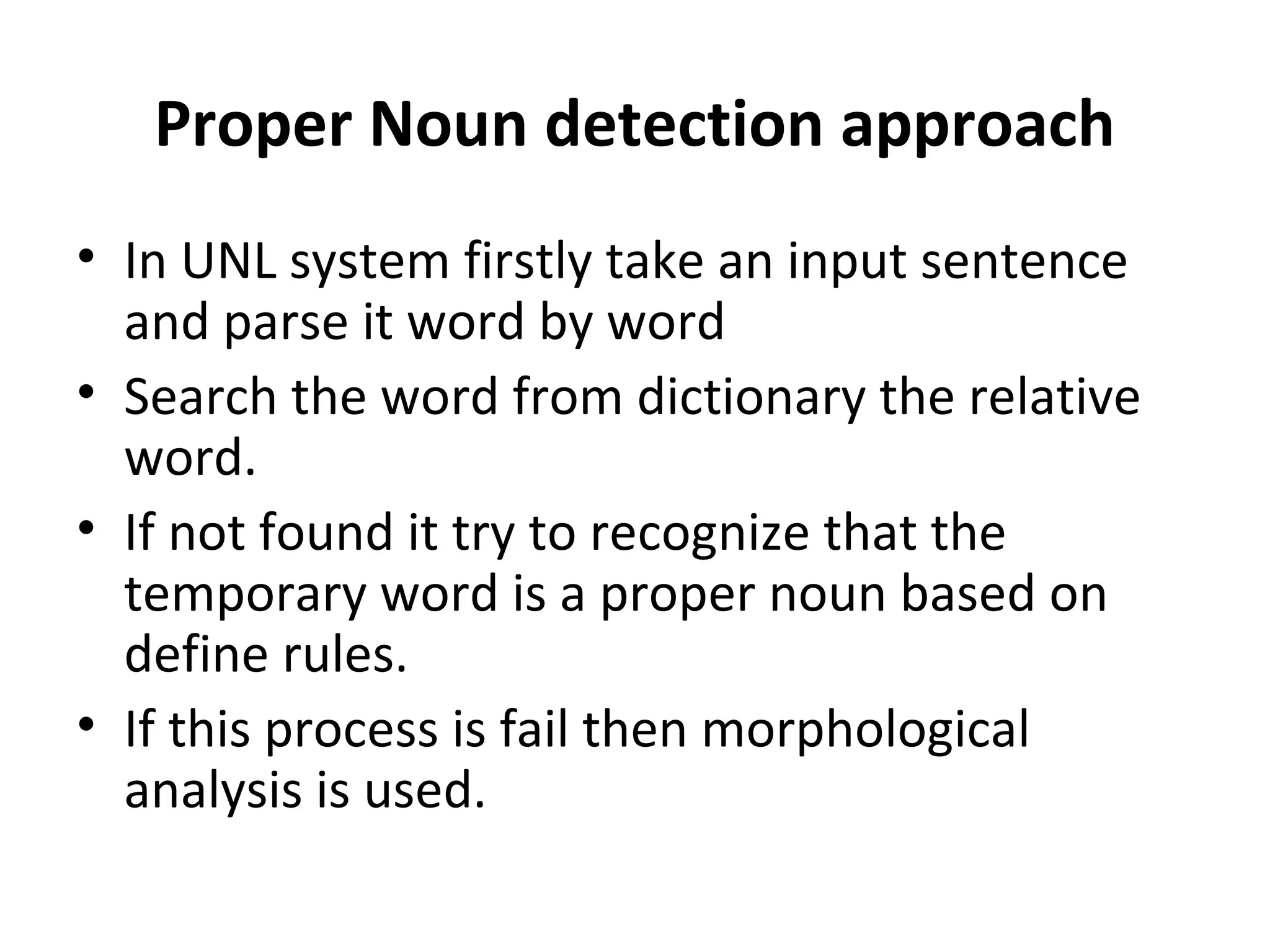
Proper Noun detection approach 
• In UNL system firstly take an input sentence 
and parse it word by word 
• Search the word from dictionary the relative 
word. 
• If not found it try to recognize that the 
temporary word is a proper noun based on 
define rules. 
• If this process is fail then morphological 
analysis is used.
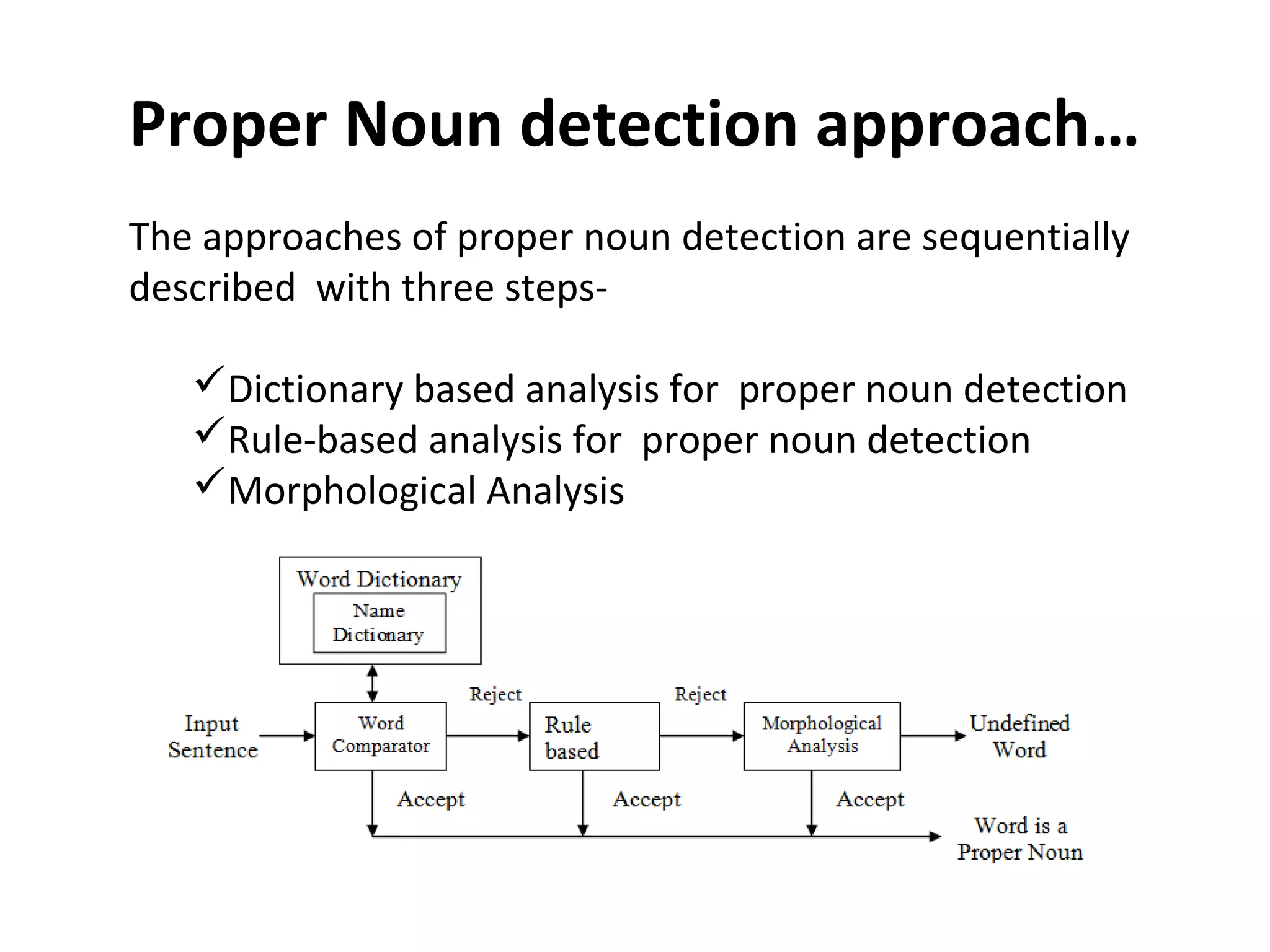
Proper Noun detection approach… 
The approaches of proper noun detection are sequentially 
described with three steps- 
Dictionary based analysis for proper noun detection 
Rule-based analysis for proper noun detection 
Morphological Analysis
Dictionary based analysis for proper 
noun detection 
• If a dictionary is maintained where we try to attach most commonly used 
proper noun and it is known as Name dictionary. Here we describe the 
dictionary based proper noun detection technique sequentially. 
• Firstly the input sentence is processed on en-converter which finds the 
word on word dictionary. If the word is found then it is converted into 
relative universal word. If not in dictionary then EnConverter creates a 
temporary entry for this word. 
• Secondly the en-converter finds the word with flag TEMP into name 
dictionary. If it is found then it is conceder as the word may be noun and 
apply rules to ensure. 
• Finally if the word is not in name dictionary then it sends into 
morphological analyzer to conform that the word is proper noun.
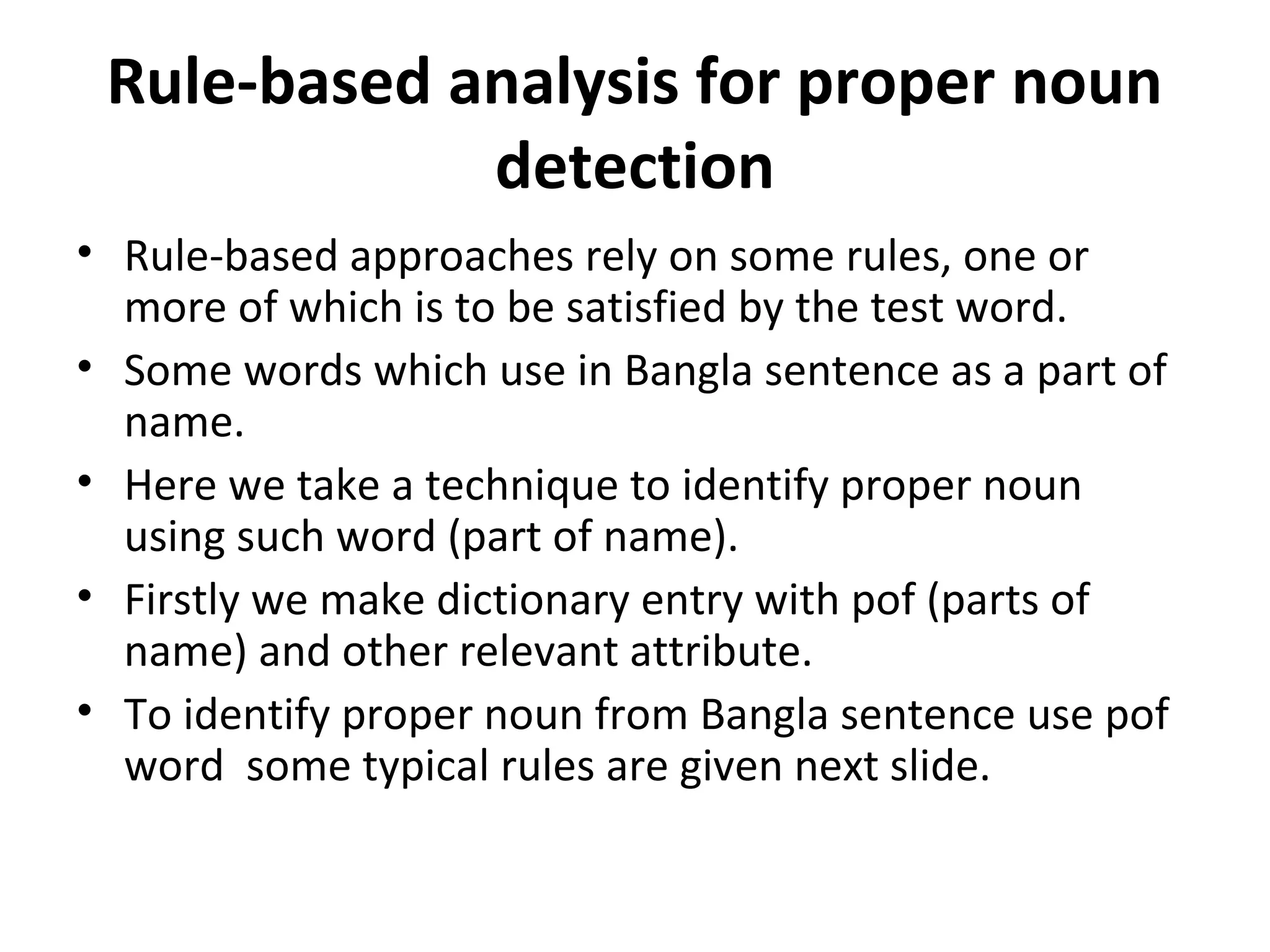
Rule-based analysis for proper noun 
detection 
• Rule-based approaches rely on some rules, one or 
more of which is to be satisfied by the test word. 
• Some words which use in Bangla sentence as a part of 
name. 
• Here we take a technique to identify proper noun 
using such word (part of name). 
• Firstly we make dictionary entry with pof (parts of 
name) and other relevant attribute. 
• To identify proper noun from Bangla sentence use pof 
word some typical rules are given next slide.
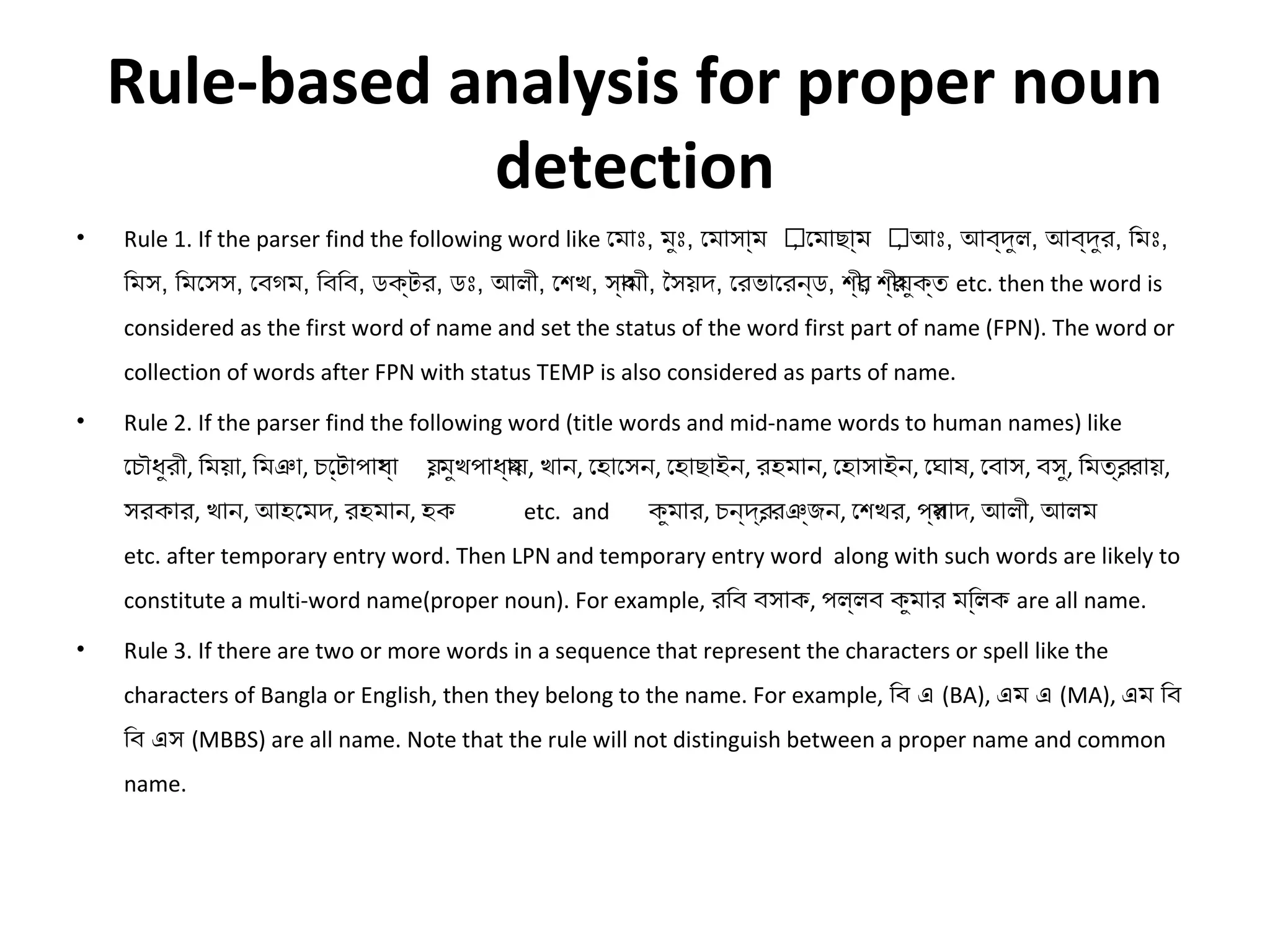
Rule-based analysis for proper noun 
detection 
• Rule 1. If the parser find the following word like েমাঃ, মুঃ, েমাসাম্যম ৎ, েমাছাম্যম ৎ, আঃ, আব্যদুল, আব্যদুর, িমঃ, 
িমস, িমেসস, েবগম, িবিব, ডক্যটর, ডঃ, আলী, েশেখ, স্যাবমী, ৈসয়দ, েরভােরন্যড, শে্যীর, শে্যীরযুক্যত etc. then the word is 
considered as the first word of name and set the status of the word first part of name (FPN). The word or 
collection of words after FPN with status TEMP is also considered as parts of name. 
• Rule 2. If the parser find the following word (title words and mid-name words to human names) like 
েচৌধুরী, িময়া, িমঞা, চে্যটটাপাযধ্যা য়, মুখপাধ্যাযয়, খান, েহােসন, েহাছাইন, রহমান, েহাসাইন, েঘাষ্, েবাস, বসু, িমত্যর, রায়, 
সরকার, খান, আহেমদ, রহমান, হক etc. and কুমার, চন্যদ্যর, রঞ্যজন, েশেখর, প্যসরাদ, আলী, আলম 
etc. after temporary entry word. Then LPN and temporary entry word along with such words are likely to 
constitute a multi-word name(proper noun). For example, রিব বসাক, পল্যলব কুমার মি্যললক are all name. 
• Rule 3. If there are two or more words in a sequence that represent the characters or spell like the 
characters of Bangla or English, then they belong to the name. For example, িব এ (BA), এম এ (MA), এম িব 
িব এস (MBBS) are all name. Note that the rule will not distinguish between a proper name and common 
name.
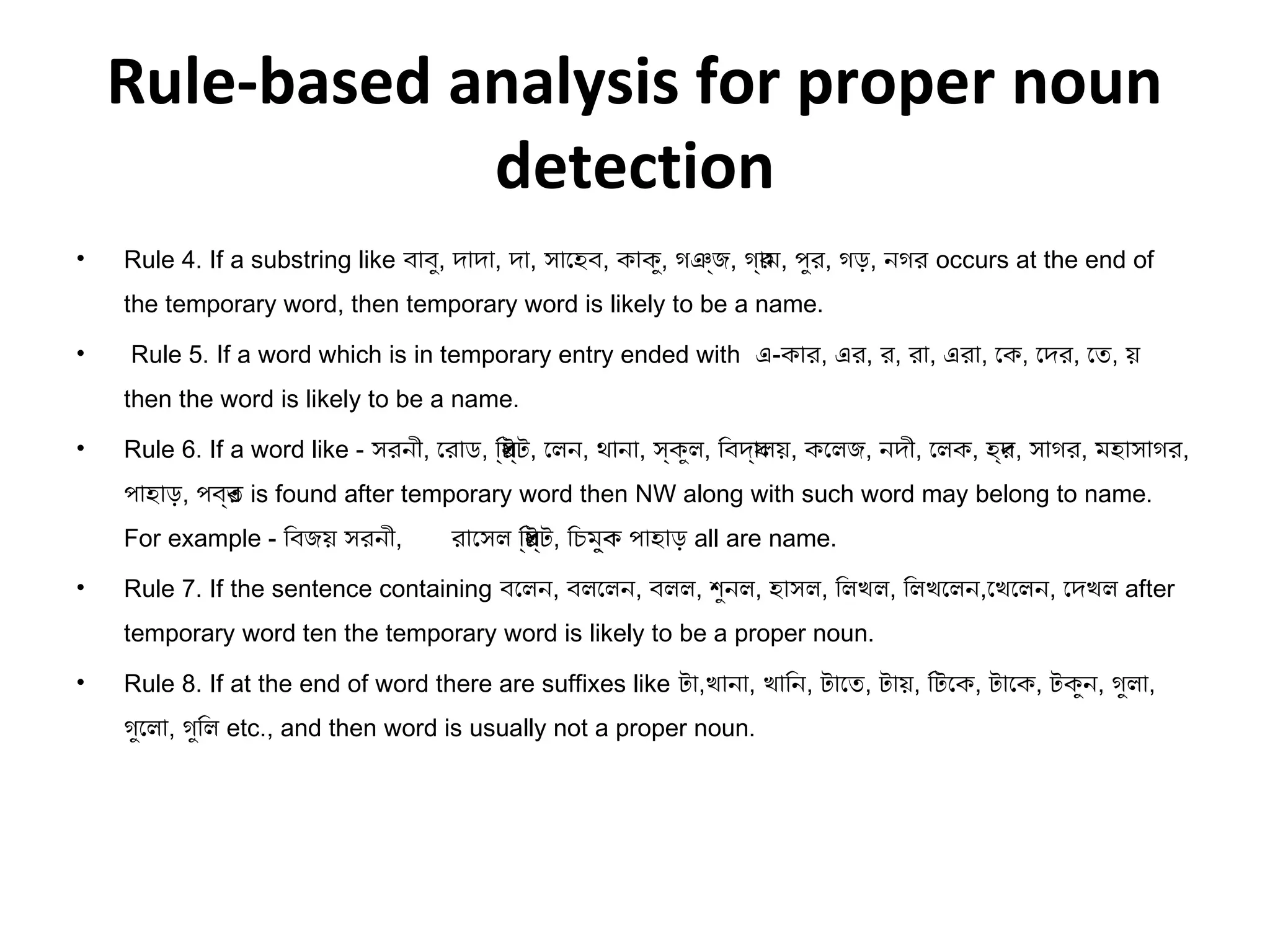
Rule-based analysis for proper noun 
detection 
• Rule 4. If a substring like বাবু, দাদা, দা, সােহব, কাকু, গঞজ্য, গ্যারম, পুর, গড়, নগর occurs at the end of 
the temporary word, then temporary word is likely to be a name. 
• Rule 5. If a word which is in temporary entry ended with এ-কার, এর, র, রা, এরা, েক, েদর, েত, য় 
then the word is likely to be a name. 
• Rule 6. If a word like - সরনী, েরাড, িরস্যট্যট, েলন, থানা, স্যকুল, িবদ্যাযলয়, কেলজ, নদী, েলক, হ্যদর, সাগর, মহাসাগর, 
পাহাড়, পব্যতর is found after temporary word then NW along with such word may belong to name. 
For example - িবজয় সরনী, রােসল িরস্যট্যট, িচমু্যকব পাহাড় all are name. 
• Rule 7. If the sentence containing বেলন, বলেলন, বলল, শেুনল, হাসল, িলখল, িলখেলন,েখেলন, েদখল after 
temporary word ten the temporary word is likely to be a proper noun. 
• Rule 8. If at the end of word there are suffixes like টা,খানা, খািন, টােত, টায়, িটেক, টােক, টকুন, গুলা, 
গুেলা, গুিল etc., and then word is usually not a proper noun.
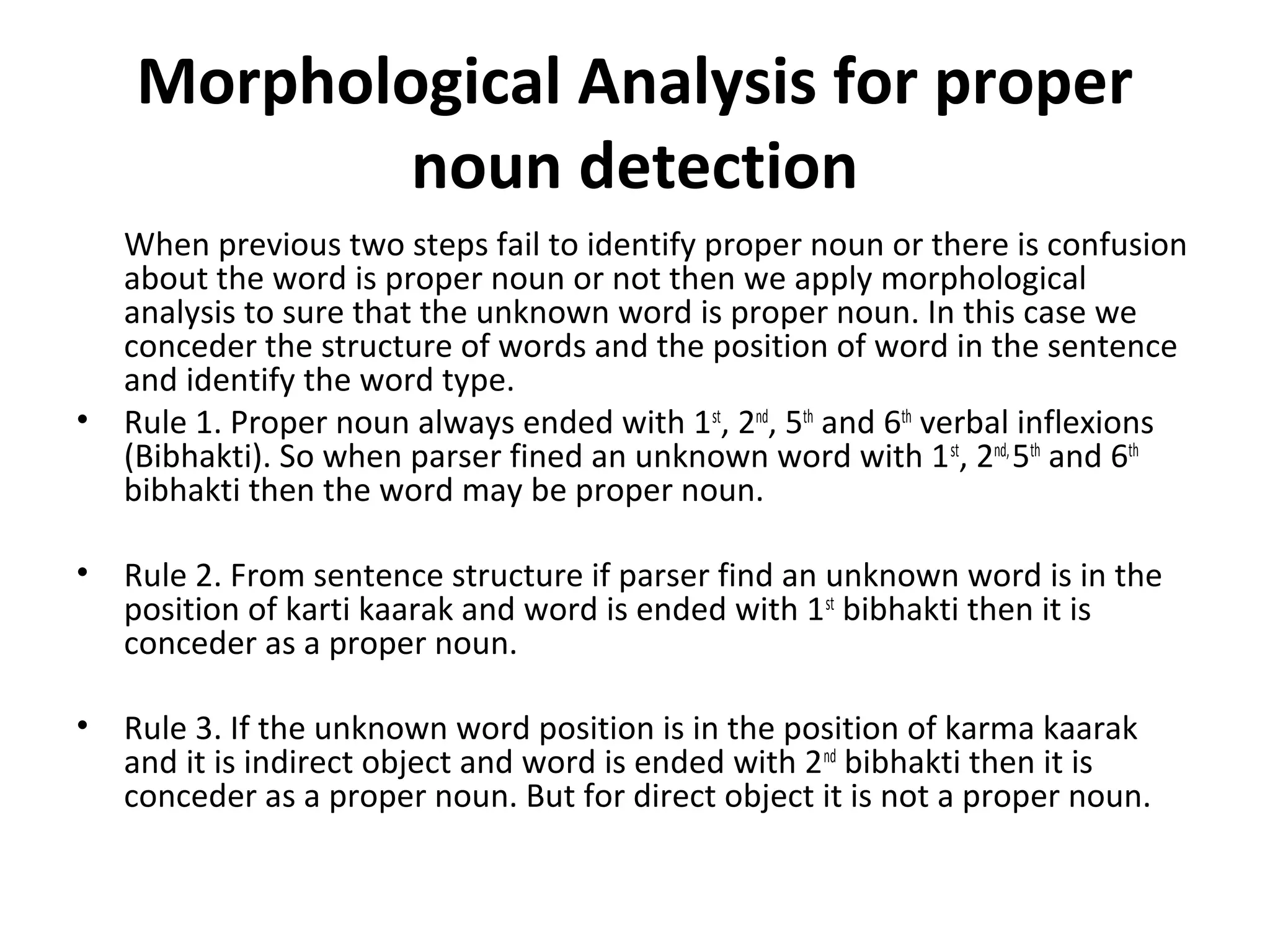
Morphological Analysis for proper 
noun detection 
When previous two steps fail to identify proper noun or there is confusion 
about the word is proper noun or not then we apply morphological 
analysis to sure that the unknown word is proper noun. In this case we 
conceder the structure of words and the position of word in the sentence 
and identify the word type. 
• Rule 1. Proper noun always ended with 1st, 2nd, 5th and 6th verbal inflexions 
(Bibhakti). So when parser fined an unknown word with 1st, 2nd, 5th and 6th 
bibhakti then the word may be proper noun. 
• Rule 2. From sentence structure if parser find an unknown word is in the 
position of karti kaarak and word is ended with 1st bibhakti then it is 
conceder as a proper noun. 
• Rule 3. If the unknown word position is in the position of karma kaarak 
and it is indirect object and word is ended with 2nd bibhakti then it is 
conceder as a proper noun. But for direct object it is not a proper noun.
Morphological Analysis for proper 
noun detection 
• Rule 4. If any sentence contains more than one word ended with 1st bibhakti then 
the first word is with flag unknown word then must be karti kaarak and the word is 
proper noun. 
• Rule 5. In case of apaadaan kaarak, if any word in the sentence ended with 5th 
bibhakti and the word is unknown then it must be noun. If most of all other’s noun 
are in word dictionary so unknown word ended with 5th bibhakti must be proper 
noun. 
• Rule 6. In case of adhikaran kaarak, if any word in the sentence ended with 7th 
bibhakti and the word is unknown then it may be the name of place. If the word is 
not in dictionary then it is conceder as proper noun (name of any pace).
Morphological Analysis for proper 
noun detection 
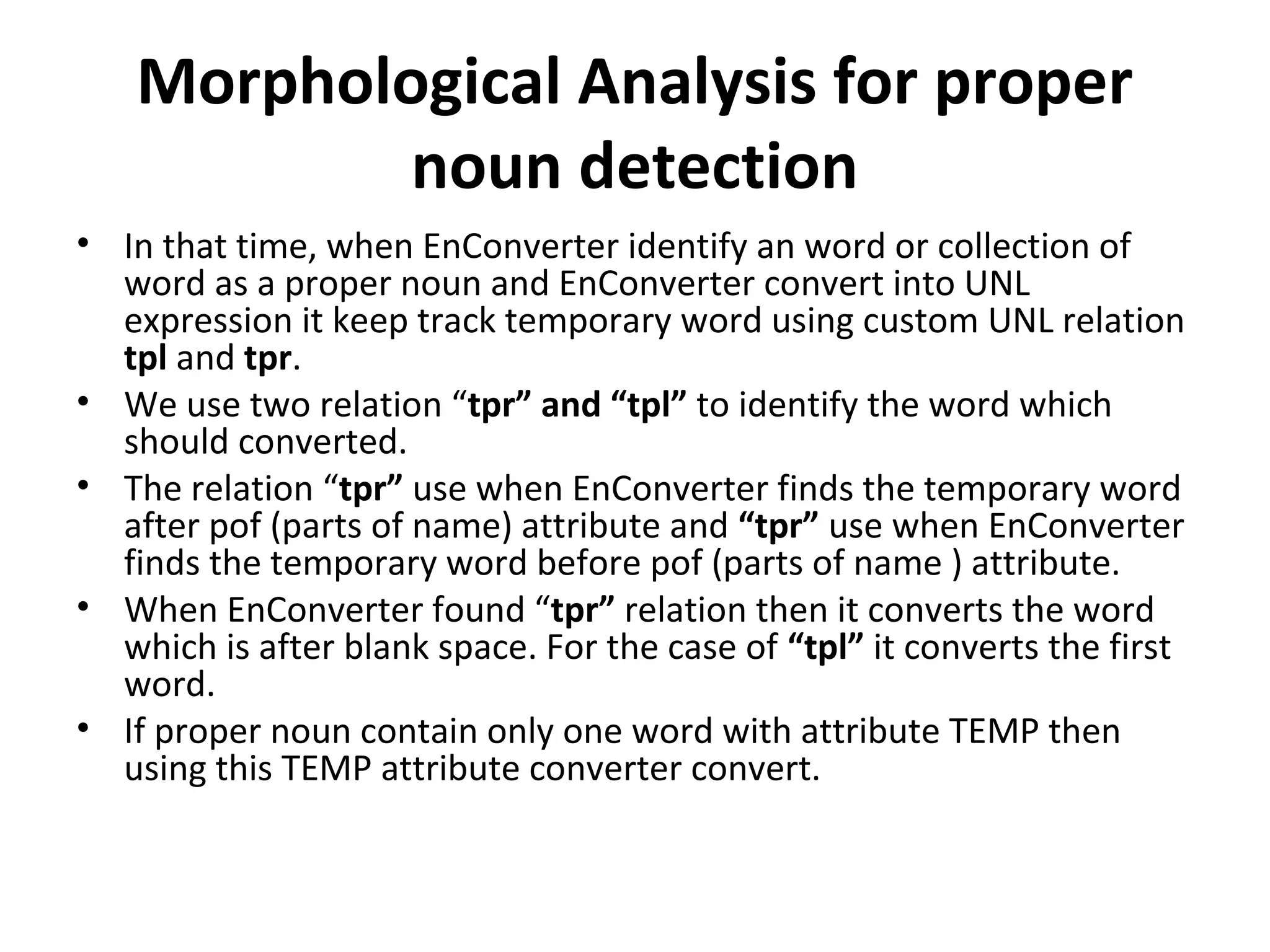
• In that time, when EnConverter identify an word or collection of 
word as a proper noun and EnConverter convert into UNL 
expression it keep track temporary word using custom UNL relation 
tpl and tpr. 
• We use two relation “tpr” and “tpl” to identify the word which 
should converted. 
• The relation “tpr” use when EnConverter finds the temporary word 
after pof (parts of name) attribute and “tpr” use when EnConverter 
finds the temporary word before pof (parts of name ) attribute. 
• When EnConverter found “tpr” relation then it converts the word 
which is after blank space. For the case of “tpl” it converts the first 
word. 
• If proper noun contain only one word with attribute TEMP then 
using this TEMP attribute converter convert.
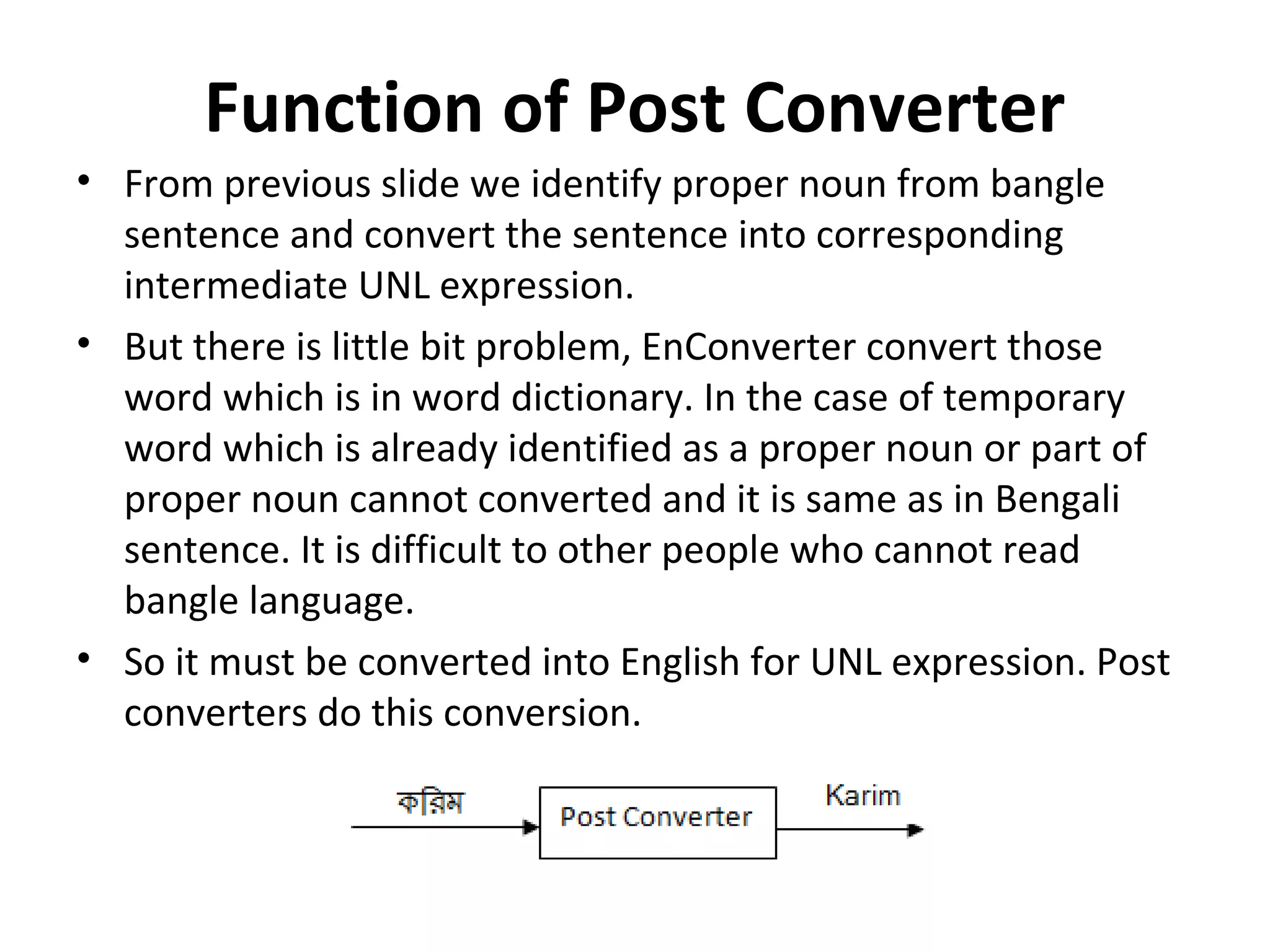
Function of Post Converter 
• From previous slide we identify proper noun from bangle 
sentence and convert the sentence into corresponding 
intermediate UNL expression. 
• But there is little bit problem, EnConverter convert those 
word which is in word dictionary. In the case of temporary 
word which is already identified as a proper noun or part of 
proper noun cannot converted and it is same as in Bengali 
sentence. It is difficult to other people who cannot read 
bangle language. 
• So it must be converted into English for UNL expression. Post 
converters do this conversion.
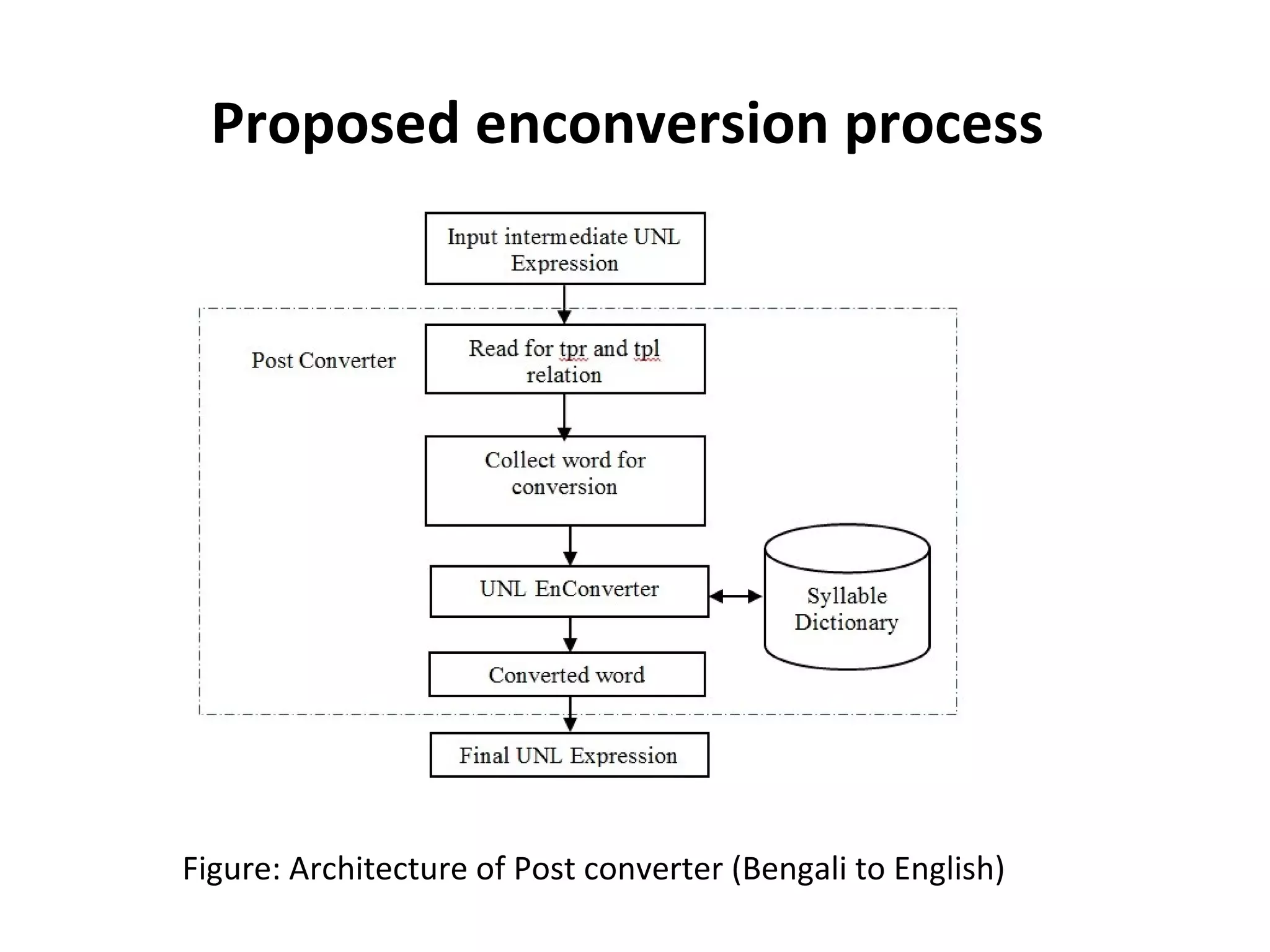
Proposed enconversion process 
Figure: Architecture of Post converter (Bengali to English)
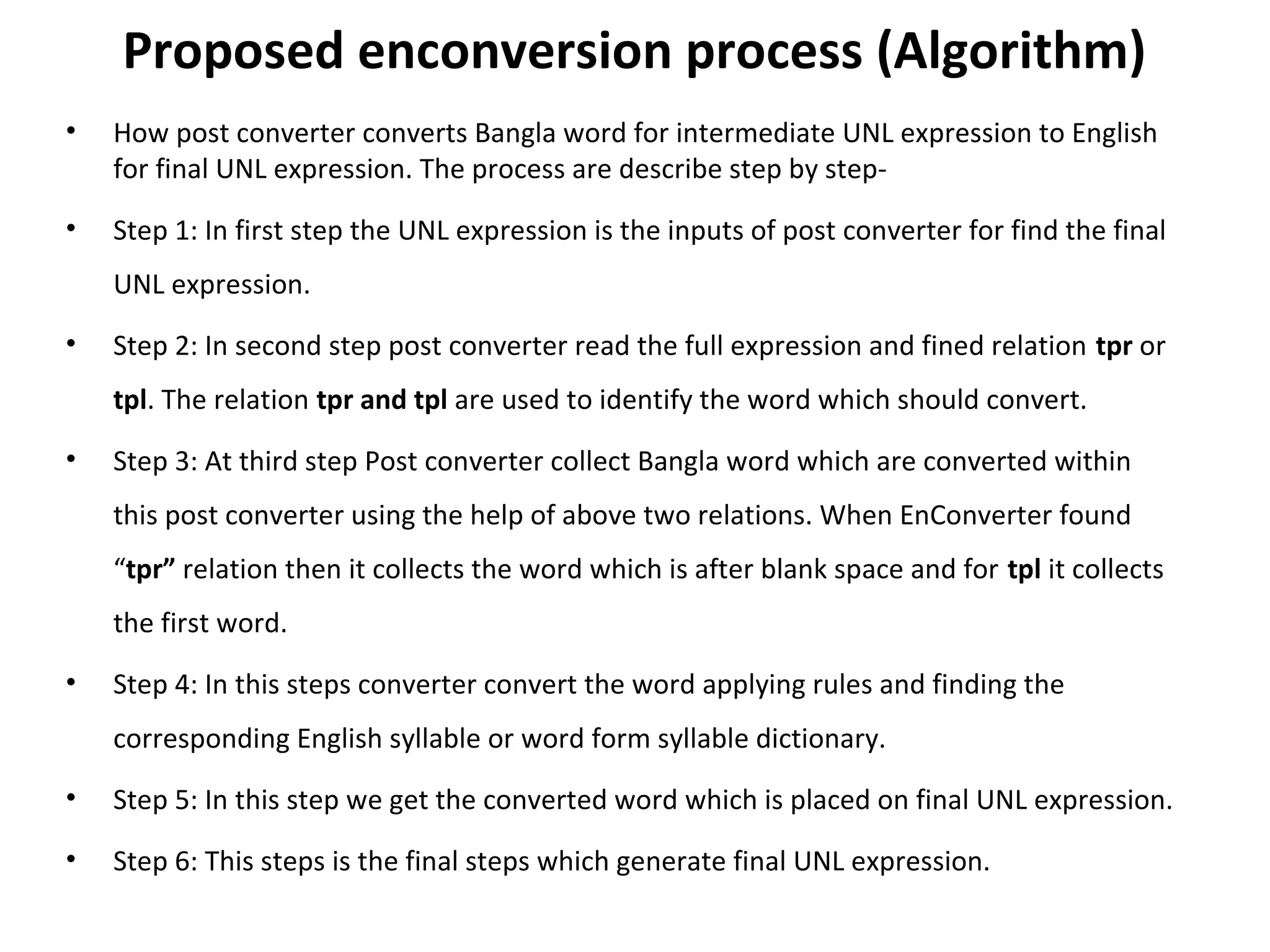
Proposed enconversion process (Algorithm) 
• How post converter converts Bangla word for intermediate UNL expression to English 
for final UNL expression. The process are describe step by step- 
• Step 1: In first step the UNL expression is the inputs of post converter for find the final 
UNL expression. 
• Step 2: In second step post converter read the full expression and fined relation tpr or 
tpl. The relation tpr and tpl are used to identify the word which should convert. 
• Step 3: At third step Post converter collect Bangla word which are converted within 
this post converter using the help of above two relations. When EnConverter found 
“tpr” relation then it collects the word which is after blank space and for tpl it collects 
the first word. 
• Step 4: In this steps converter convert the word applying rules and finding the 
corresponding English syllable or word form syllable dictionary. 
• Step 5: In this step we get the converted word which is placed on final UNL expression. 
• Step 6: This steps is the final steps which generate final UNL expression.
Dictionary Entries for Post Converter 
Here we have listed some dictionary entries for post converter. Table 1 shows the 
Bengali vowel and table 2 shows the shows the Bengali consonant and the 
corresponding entries in dictionary. In future we define the full phonetics for 
Bengali to English conversion. 
Bangla vowel Dictionary entries 
অ [অ]{} "a" (TEMP) <.,0,0> 
আ [আ]{} "a" (TEMP) <.,0,0> 
ই [ই]{} "i" (TEMP) <.,0,0> 
ঈ [ঈ]{} "ei" (TEMP) <.,0,0> 
উ [উ]{} "oo" (TEMP) <.,0,0> 
ঊ [ঊ]{} "u" (TEMP) <.,0,0> 
ঋ [ঋ]{} "rri" (TEMP) <.,0,0> 
এ [এ]{} "a" (TEMP) <.,0,0> 
ঐ [ঐ]{} "oi" (TEMP) <.,0,0> 
ও [ও]{} "o" (TEMP) <.,0,0> 
ঔ [ঔ]{} "ou" (TEMP) <.,0,0>
Dictionary Entries for Post Converter… 
Bangla consonant Dictionary entries 
ক [ক]{} "k" (TEMP) <.,0,0> 
খ [খ]{} "kh" (TEMP) <.,0,0> 
গ [গ]{} "g" (TEMP) <.,0,0> 
ঘ [ঘ]{} "gh" (TEMP) <.,0,0> 
ঙ [ঙ]{} "ng" (TEMP) <.,0,0> 
চ [চ]{} "c" (TEMP) <.,0,0> 
ছ [ছ]{} "ch" (TEMP) <.,0,0> 
জ [জ]{} "j" (TEMP) <.,0,0> 
ঝ [ঝ]{} "jh" (TEMP) <.,0,0> 
ঞ [ঞ]{} "niya" (TEMP) <.,0,0> 
ট [ট]{} "t" (TEMP) <.,0,0> 
ঠ [ঠ]{} "th" (TEMP) <.,0,0> 
ড [ড]{} "d" (TEMP) <.,0,0> 
ঢ [ঢ]{} "dh" (TEMP) <.,0,0> 
ণ [ণ]{} "n" (TEMP) <.,0,0> 
ত [ত]{} "t" (TEMP) <.,0,0> 
থ [থ]{} "th" (TEMP) <.,0,0> 
দ [দ]{} "d" (TEMP) <.,0,0> 
ধ [ধ]{} "dh" (TEMP) <.,0,0> 
ন [ন]{} "n" (TEMP) <.,0,0> 
প [প]{} "p" (TEMP) <.,0,0> 
ফ [ফ]{} "f" (TEMP) <.,0,0> 
ব [ব]{} "b" (TEMP) <.,0,0> 
ভ [ভ]{} "v" (TEMP) <.,0,0> 
ম [ম]{} "mm" (TEMP) <.,0,0> 
য [য]{} "z" (TEMP) <.,0,0> 
র [র]{} "r" (TEMP) <.,0,0> 
ল [ল]{} "l" (TEMP) <.,0,0> 
শ [শ]{} "s" (TEMP) <.,0,0> 
ষ [ষ]{} "sh" (TEMP) <.,0,0> 
স [স]{} "s" (TEMP) <.,0,0> 
হ [হ]{} "h" (TEMP) <.,0,0> 
ড় [ড়]{} "r" (TEMP) <.,0,0> 
ঢ় [ঢ়]{} "rh" (TEMP) <.,0,0> 
য় [য়]{} "y" (TEMP) <.,0,0> 
ৎ [ৎ]{} "t" (TEMP) <.,0,0>
Dictionary Entries for Post Converter… 
Bangla parts of word Dictionary entries 
কা [কা]{} "ka" (TEMP) <.,0,0> 
িক [িক]{} "ki" (TEMP) <.,0,0> 
কী [কী]{} "kei" (TEMP) <.,0,0> 
কু [কু]{} "koo" (TEMP) <.,0,0> 
কূ [কূ]{} "ku" (TEMP) <.,0,0> 
কৃ [কৃ]{} krriu" (TEMP) <.,0,0> 
েক [েক]{} "ka" (TEMP) <.,0,0> 
ৈক [ৈক]{} "koi" (TEMP) <.,0,0> 
েকা [েকা]{} "ko" (TEMP) <.,0,0> 
েকৌ [েকৌ]{} "kou" (TEMP) <.,0,0> 
ক্র [ক্]র{} "kra" (TEMP) <.,0,0> 
ক্য [ক্]য{} "kka" (TEMP) <.,0,0> 
Similarly for all consonant it should need to entries in word dictionary.
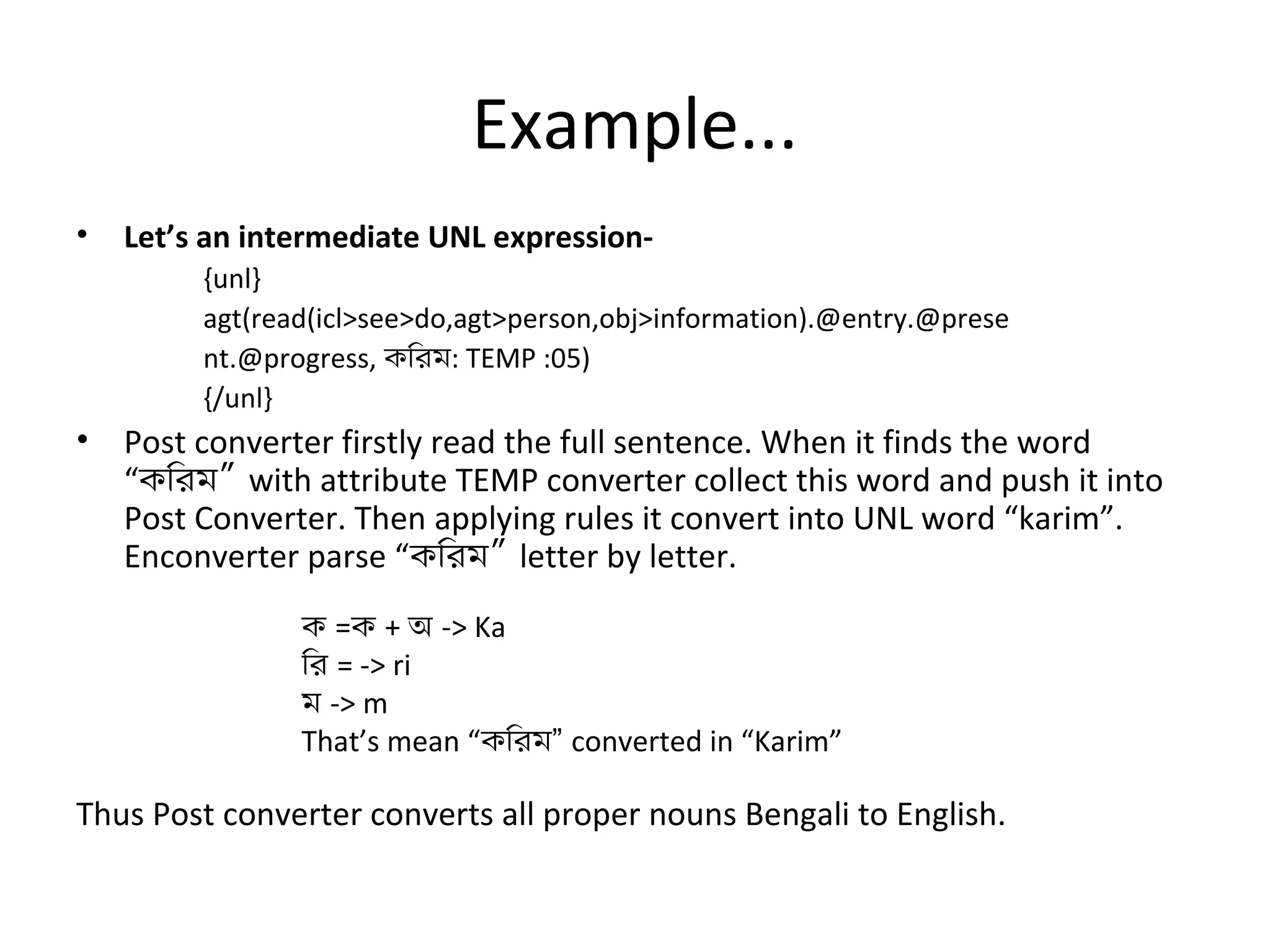
Example... 
• Let’s an intermediate UNL expression- 
{unl} 
agt(read(icl>see>do,agt>person,obj>information).@entry.@prese 
nt.@progress, কিরম: TEMP :05) 
{/unl} 
• Post converter firstly read the full sentence. When it finds the word 
“কিরম” with attribute TEMP converter collect this word and push it into 
Post Converter. Then applying rules it convert into UNL word “karim”. 
Enconverter parse “কিরম” letter by letter. 
ক =ক + অ -> Ka 
ির = -> ri 
ম -> m 
That’s mean “কিরম” converted in “Karim” 
Thus Post converter converts all proper nouns Bengali to English.
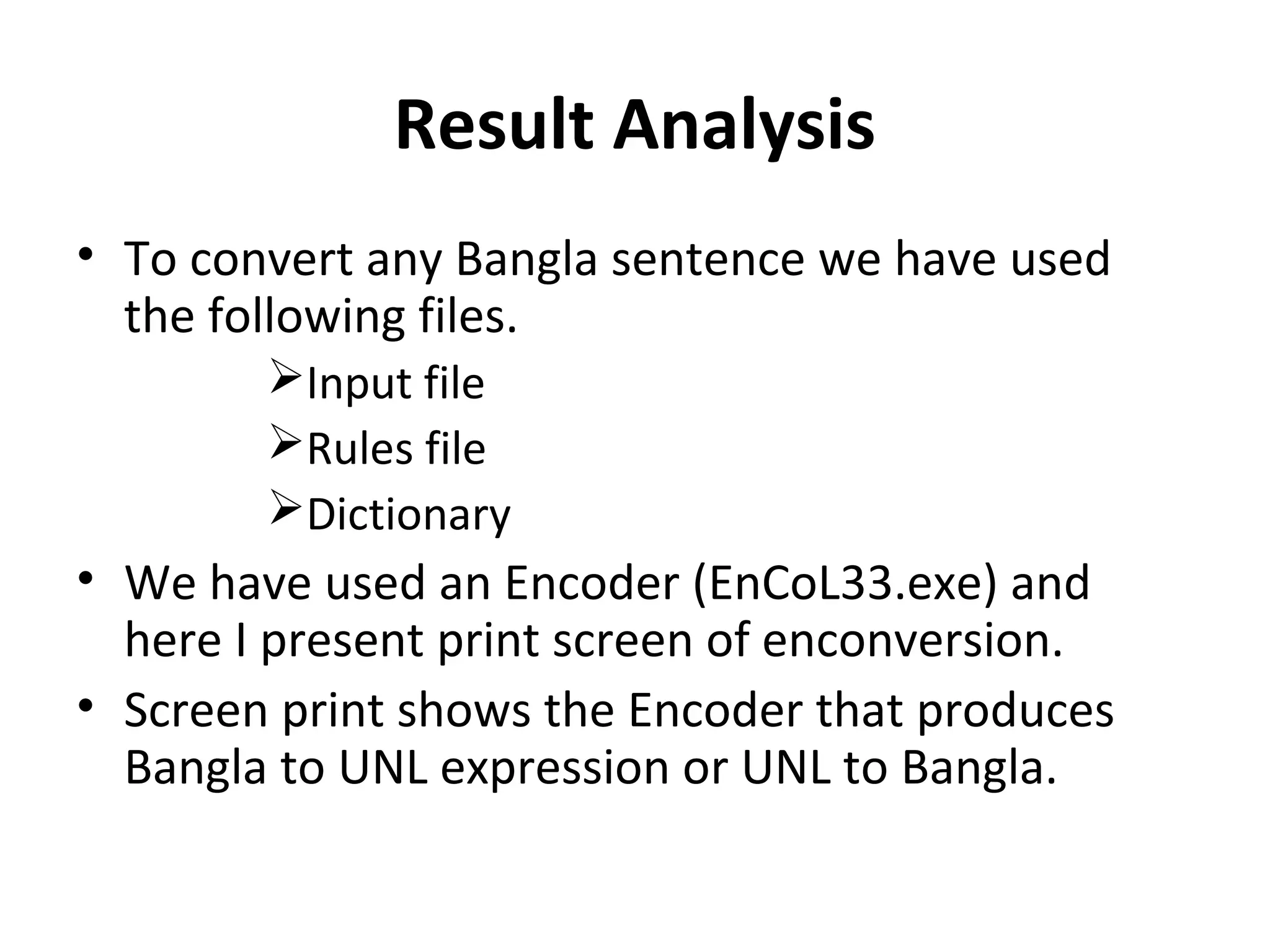
Result Analysis 
• To convert any Bangla sentence we have used 
the following files. 
Input file 
Rules file 
Dictionary 
• We have used an Encoder (EnCoL33.exe) and 
here I present print screen of enconversion. 
• Screen print shows the Encoder that produces 
Bangla to UNL expression or UNL to Bangla.
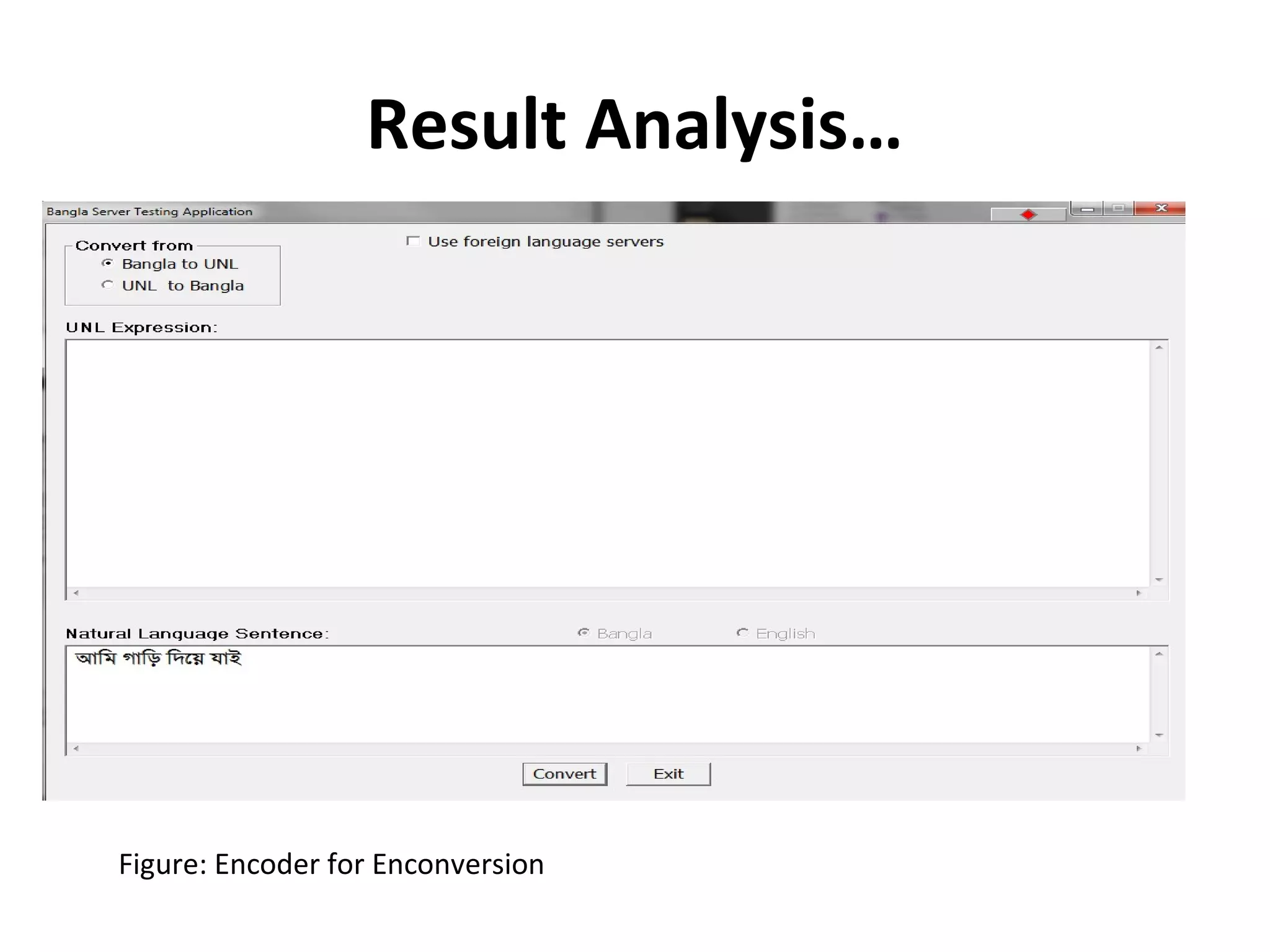
Result Analysis… 
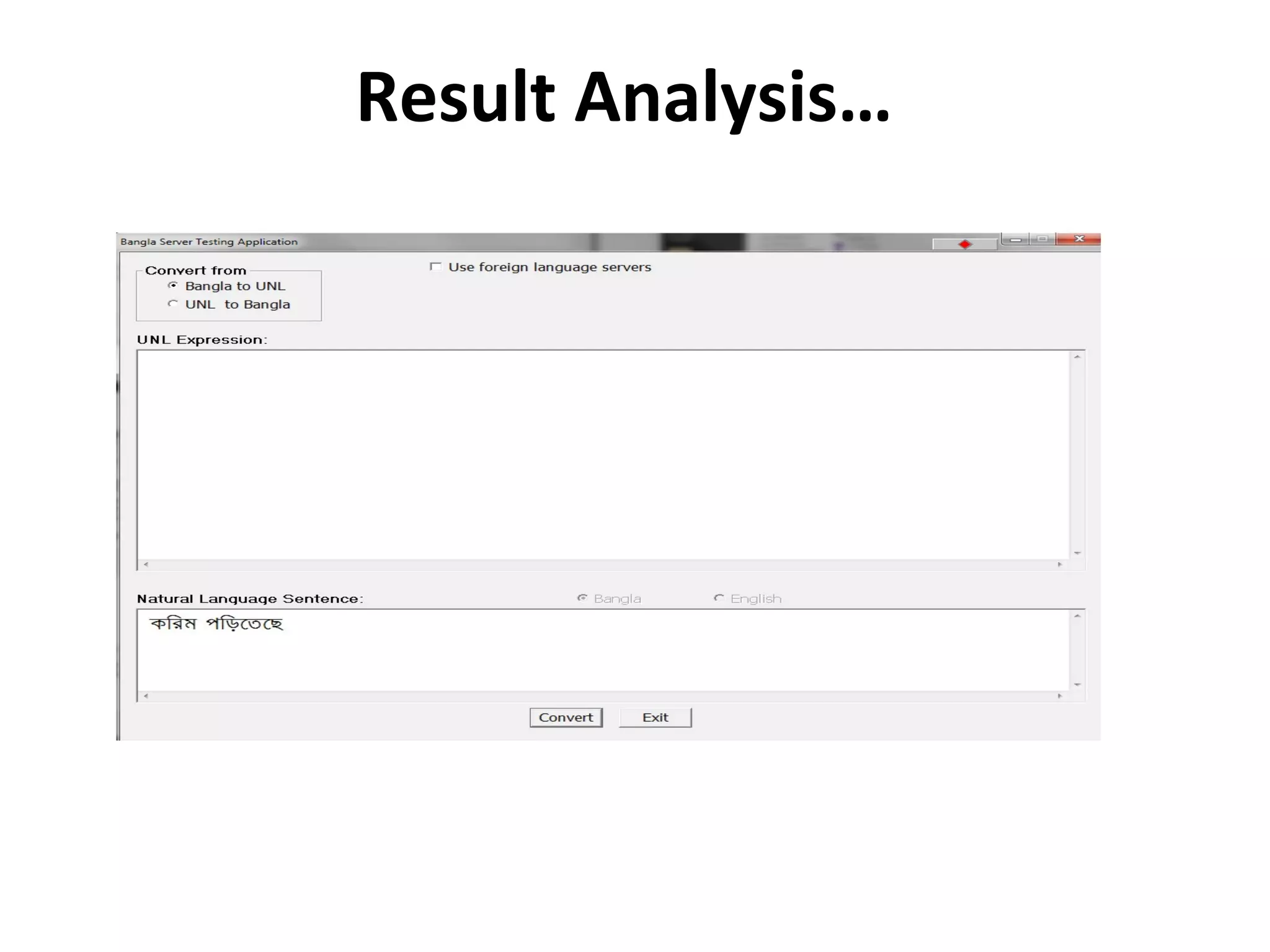
Figure: Encoder for Enconversion
Result Analysis… 
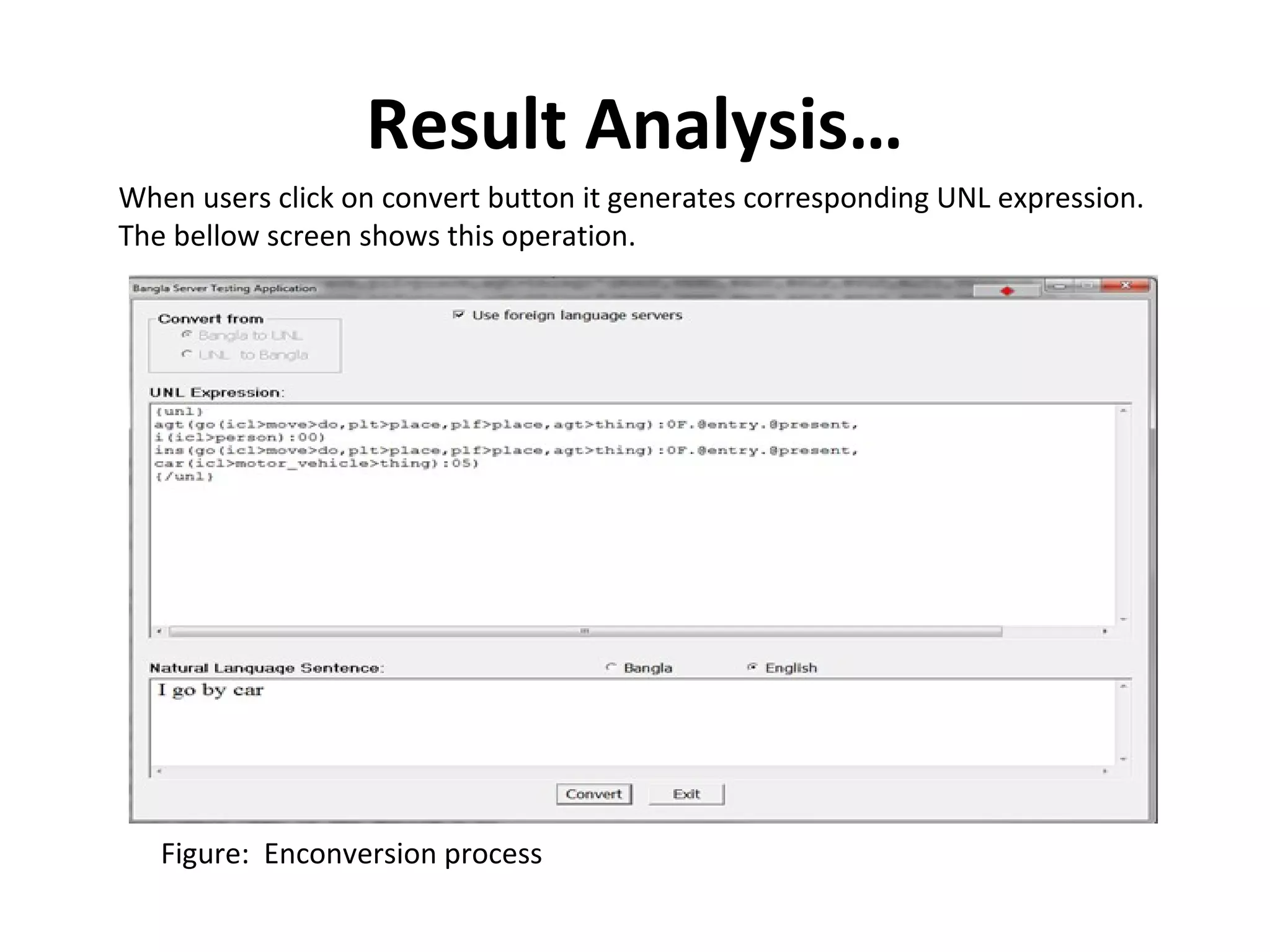
When users click on convert button it generates corresponding UNL expression. 
The bellow screen shows this operation. 
Figure: Enconversion process
Result Analysis… 
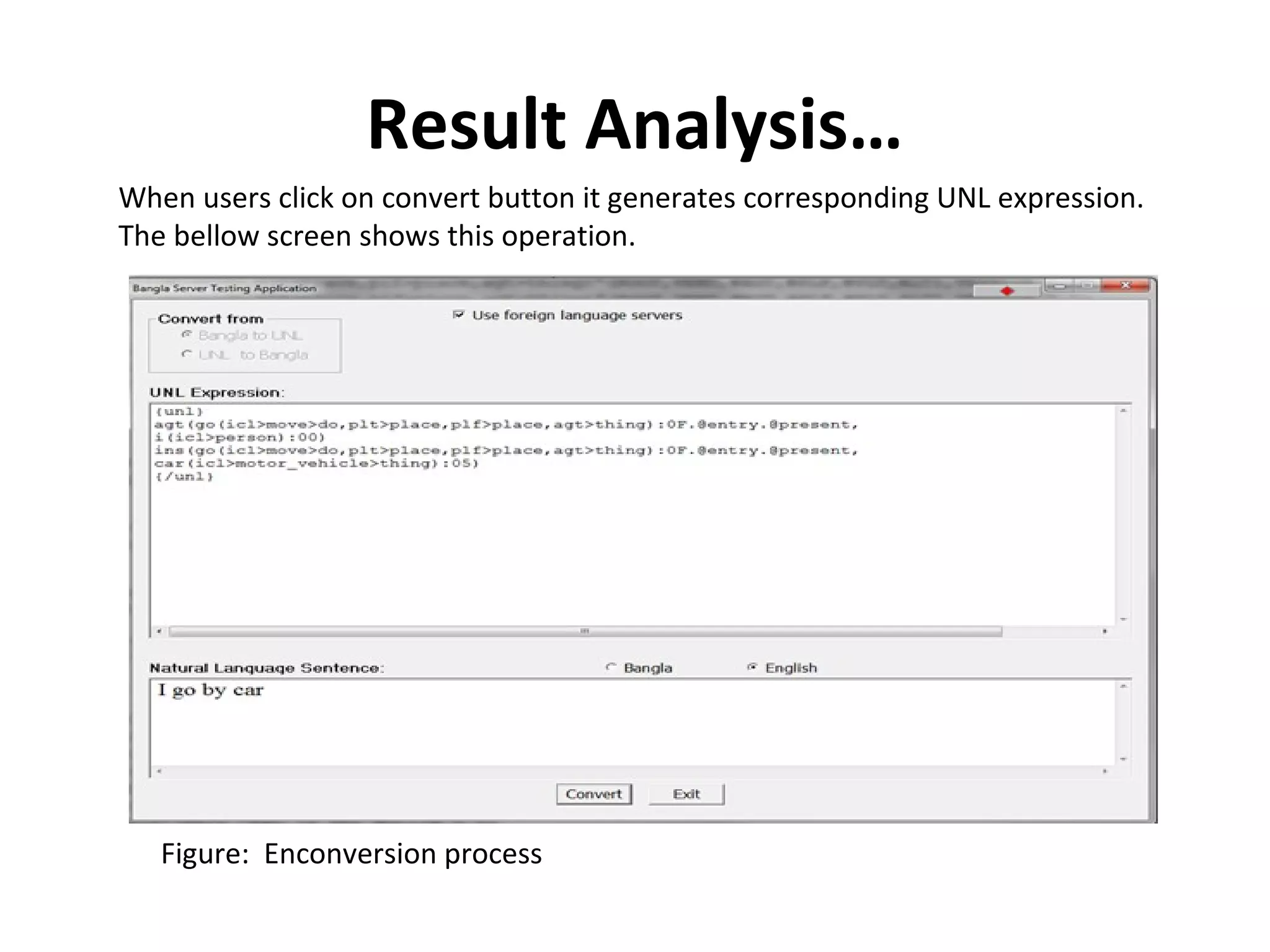
When users click on convert button it generates corresponding UNL expression. 
The bellow screen shows this operation. 
Figure: Enconversion process
Result Analysis… 
• For example, “কিরম পিড়েতেছ”, pronounce as Karim 
Poritechhe means “Karim is reading”. Here subject Karim 
initiates an action. So, agent (agt) relation is made between 
subject “Karim” and verb “read”. 
• The following dictionary entries are needed for conversion 
the sentence 
• [কিরম] {} “karim (icl>name,iof>person,com>male)(N) 
• [পড়] {} “read (icl>see>do,agt>person,obj>information) 
(ROOT,CEND,^ALT) 
• [ইেতেছ] {} “” (VI, CEND, CEG1, PRS, PRG, 3P)
Result Analysis…
Result Analysis… 
• But কিরম is the name of a person. So it is not needed to entry on 
dictionary. To convert this sentence into UNL expression when 
EnConverter finds word which is not in dictionaries then it creates a 
temporary entry. So if কিরম is not in dictionary then the temporary entry 
as like: 
• [কিরম ]{} "কিরম" (TEMP) <.,0,0>;.[]{} 
• Applied rules: R{:::} 
{^PRON,^N,^VERB,^ROOT,^ADJ,^ADV,^ABY,^KBIV,^BIV:+N,+PROP::} 
(BLK)P10; 
• After applying these rules it is conceder as a proper noun. And temporary 
entry converted as: 
• [কিরম]{}"কিরম" (N,PROP,TEMP) <.,0,0>;.[]{} 
• To convert this sentence into UNL expression morphological analysis is 
made between “পড়” (por) and “ইেতেছ” (itechhe) and semantic analysis is 
made between “কিরম” (karim) and “ িপেড়েতছ” (poritechhe)
Result Analysis… 
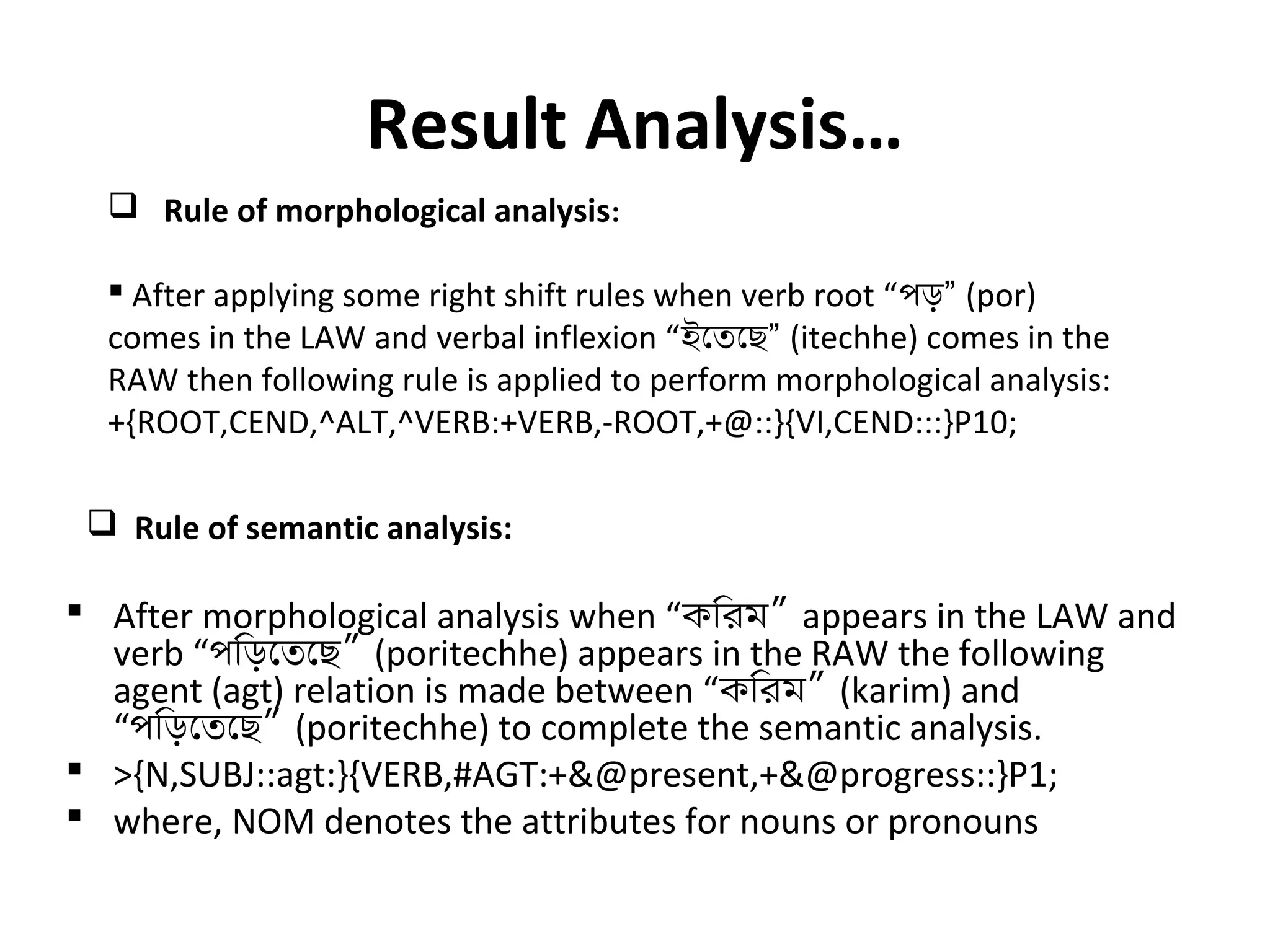
 Rule of morphological analysis: 
 After applying some right shift rules when verb root “পড়” (por) 
comes in the LAW and verbal inflexion “ইেতেছ” (itechhe) comes in the 
RAW then following rule is applied to perform morphological analysis: 
+{ROOT,CEND,^ALT,^VERB:+VERB,-ROOT,+@::}{VI,CEND:::}P10; 
 Rule of semantic analysis: 
 After morphological analysis when “কিরম” appears in the LAW and 
verb “পিড়েতেছ” (poritechhe) appears in the RAW the following 
agent (agt) relation is made between “কিরম” (karim) and 
“পিড়েতেছ” (poritechhe) to complete the semantic analysis. 
 >{N,SUBJ::agt:}{VERB,#AGT:+&@present,+&@progress::}P1; 
 where, NOM denotes the attributes for nouns or pronouns
Result Analysis… 
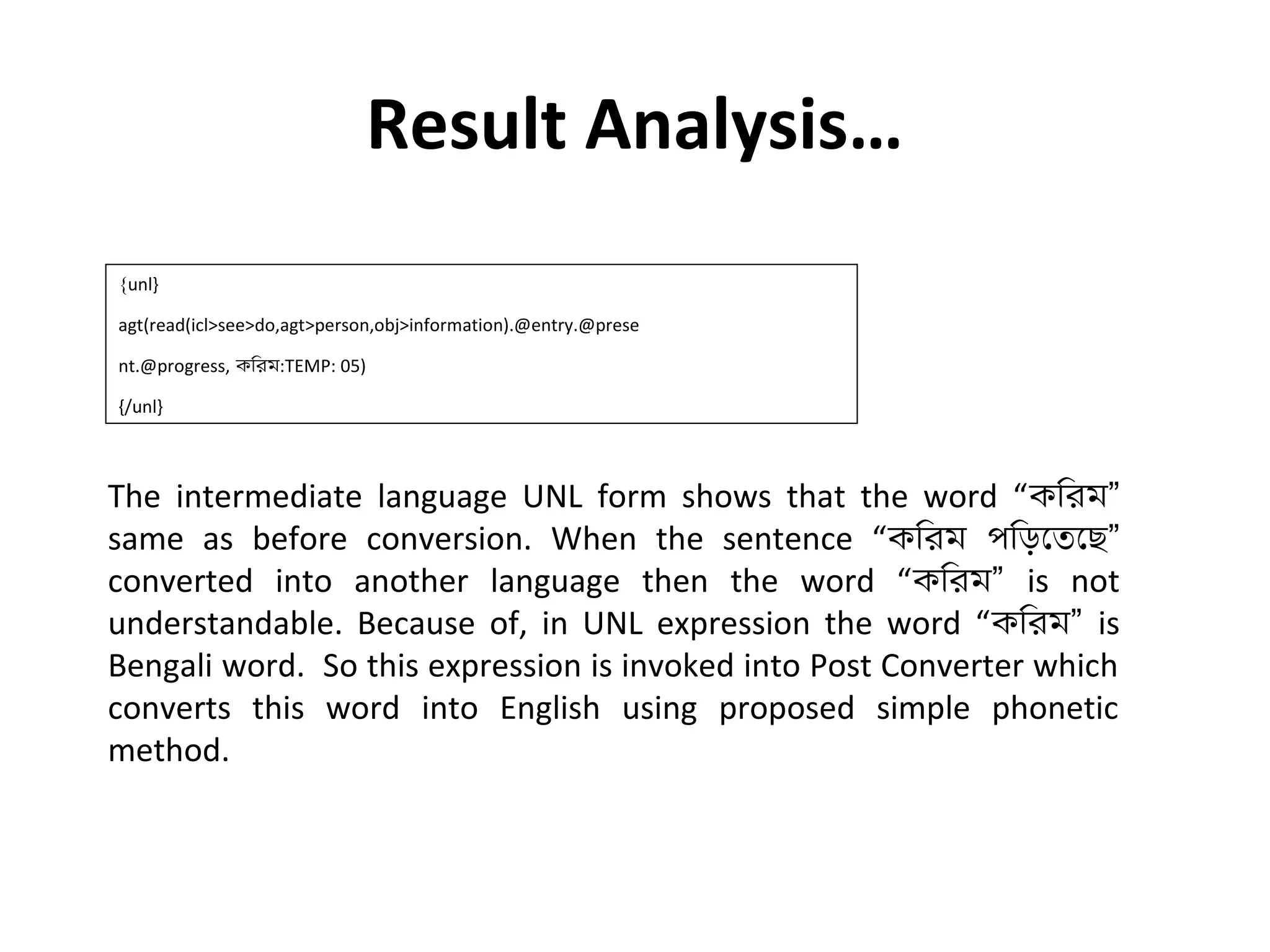
{unl} 
agt(read(icl>see>do,agt>person,obj>information).@entry.@prese 
nt.@progress, কিরম:TEMP: 05) 
{/unl} 
The intermediate language UNL form shows that the word “কিরম” 
same as before conversion. When the sentence “কিরম পিড়েতেছ” 
converted into another language then the word “কিরম” is not 
understandable. Because of, in UNL expression the word “কিরম” is 
Bengali word. So this expression is invoked into Post Converter which 
converts this word into English using proposed simple phonetic 
method.
Result Analysis… 
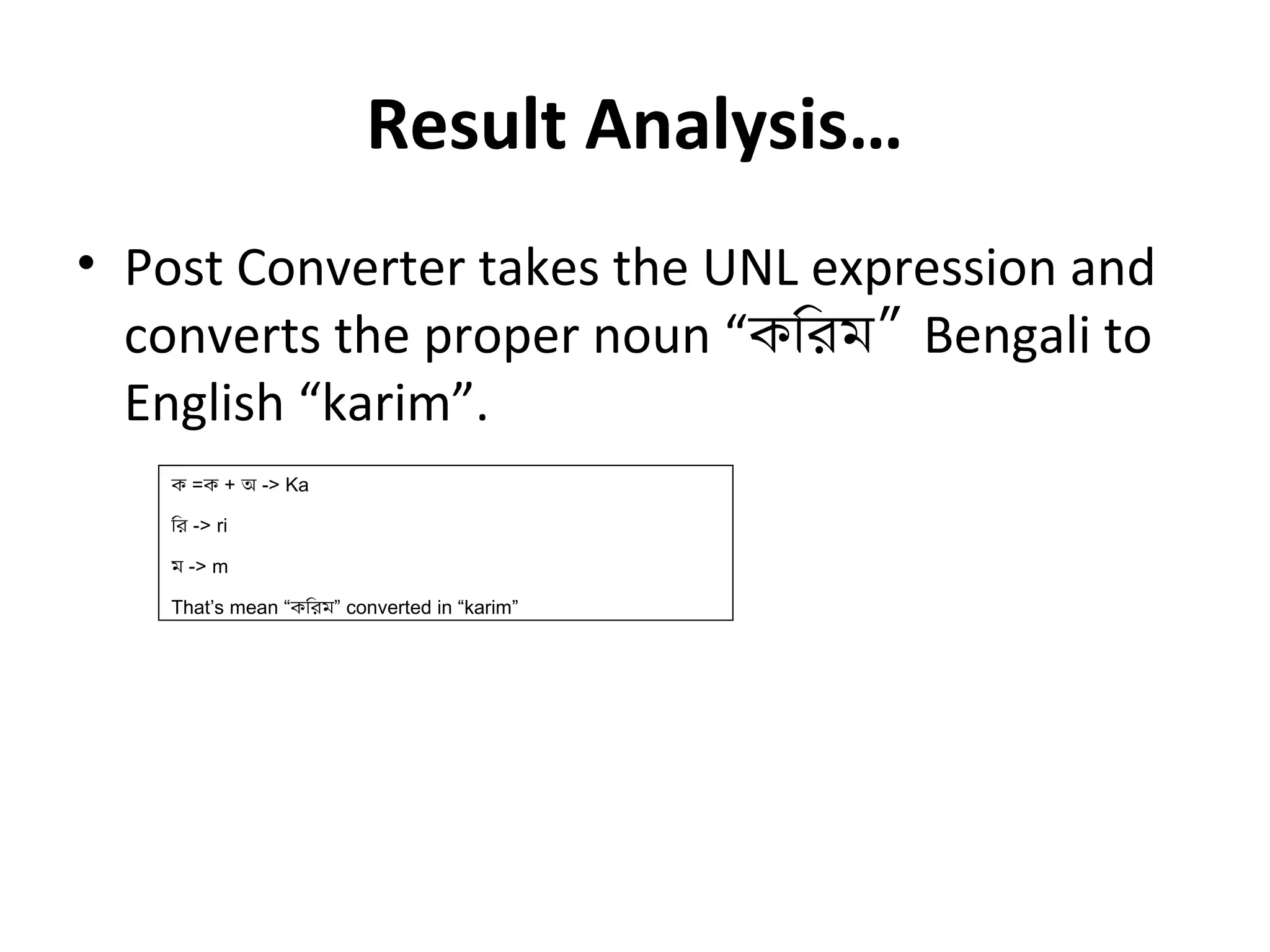
• Post Converter takes the UNL expression and 
converts the proper noun “কিরম” Bengali to 
English “karim”. 
ক =ক + অ -> Ka 
ির -> ri 
ম -> m 
That’s mean “কিরম” converted in “karim”
Result Analysis… 
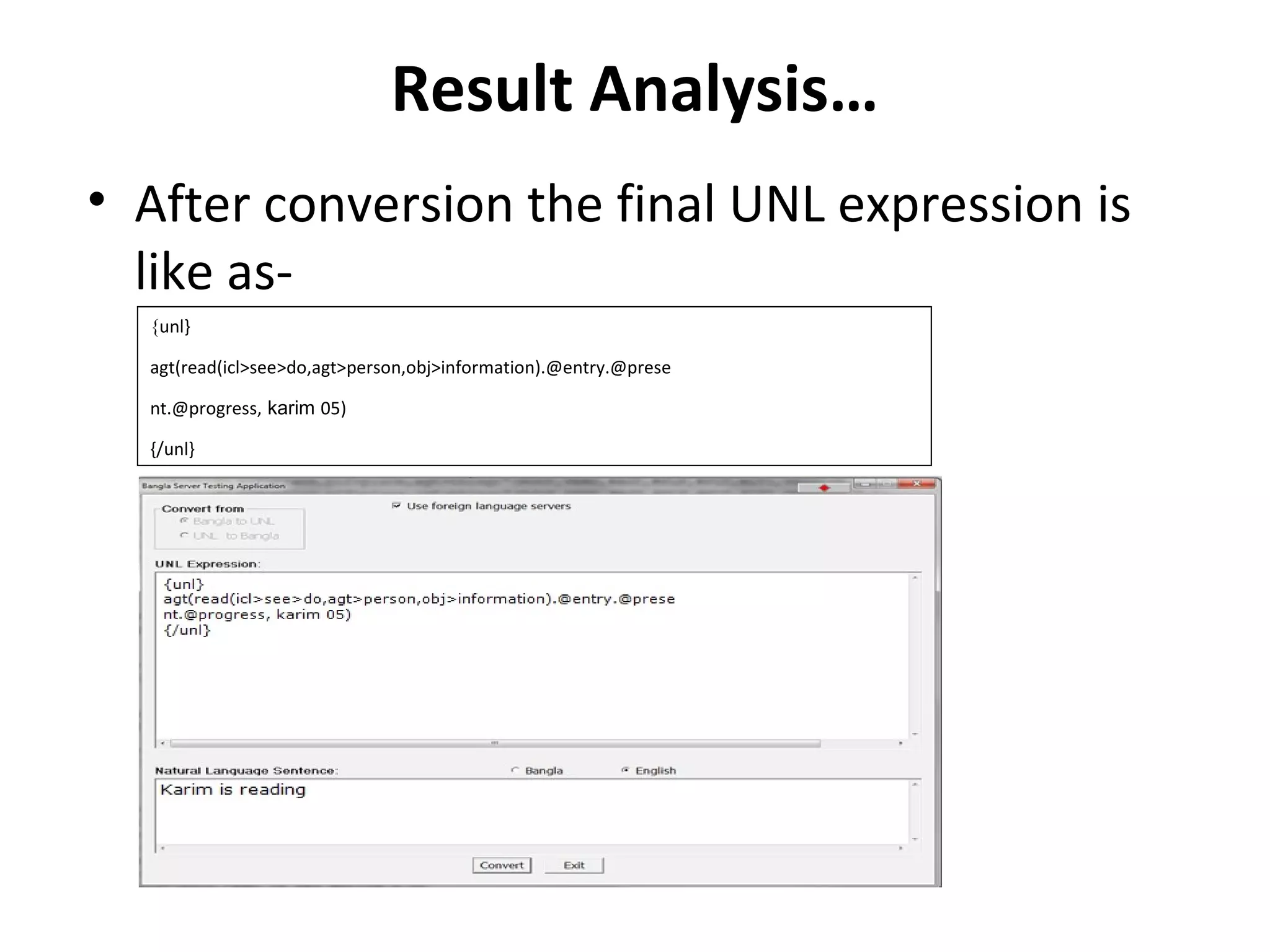
• After conversion the final UNL expression is 
like as- 
{unl} 
agt(read(icl>see>do,agt>person,obj>information).@entry.@prese 
nt.@progress, karim 05) 
{/unl}
Conclusion 
• In this paper we define our work as two parts, firstly identified a 
proper noun from Bengali sentence and secondly convert this 
proper noun into UNL form. 
• In the second parts we use a converter named as post converter 
which use simple phonetic method to convert Bengali to English 
and we only mention the simple procedure not complete. 
• Our future plan in this regards is give the complete rules for post 
converter. 
• We will also works on Bengali language and give the complete 
analysis rules for enconversion program to convert Bangla to UNL 
language and generation rules for deconversion program to convert 
any UNL documents to Bangla language. 
http://www.mecs-press.org/ijmecs/ijmecs-v6-n8/v6n8-1.html 
http://www.academia.edu/7985833/Design_Analysis_Rules_to_Identify_Proper_Noun_from_Bengali_Sentence_for_Universal_Networking_Language
THANK YOU

Development of analysis rules to identify proper noun from bengali sentence for universal networking language

  • 1.
    Development of AnalysisRules to Identify Proper Noun from Bengali Sentence for Universal Networking language Prepared By- Md. Syeful Islam Sr. Software Engineer at- Samsung Research Institute Bangladesh Google scholar : http://scholar.google.com/citations?user=b0QDD2AAAAAJ&hl=en academia.edu: https://independent.academia.edu/SyefulIslam
  • 2.
    Presentation covered… •Overview • Introducing with Universal Networking Language(UNL) • Proposed Proper Noun Conversion Approach • Result Analysis
  • 3.
    Overview • Todaythe regional economies, societies, cultures and educations are integrated through a globe-spanning network of communication and trade. • This globalization trend evokes for a homogeneous platform so that each member of the platform can apprehend what other intimates and perpetuates the discussion in a mellifluous way. • However the barriers of languages throughout the world are continuously obviating the whole world from congregating into a single domain of sharing knowledge and information. • Therefore researcher works on various languages and tries to give a platform where multi lingual people can communicate through their native language. • Researcher analyze the language structure and form structural grammar and rules which used to translate one language to other. • From the last few years several language-specific translation systems have been proposed. • Since these systems are based on specific source and target languages, these have their own limitations. • As a consequence United Nations University/Institute of Advanced Studies (UNU/IAS) were decided to develop an inter-language translation program . • The corollary of their continuous research leads a common form of languages known as Universal Networking Language (UNL) and introduces UNL system.
  • 4.
    Overview… • UNLsystem is an initiative to overcome the problem of language pairs in automated translation. UNL is an artificial language that is based on Interlingua approach.UNL acts as an intermediate form computer semantic language whereby any text written in a particular language is converted to text of any other forms of languages. • UNL system consists of major three components: - language resources - software for processing language resources (parser) and - supporting tools for maintaining and operating language processing software or developing language resources. • The parser of UNL system take input sentence and start parsing based on rules and convert it into corresponding universal word from word dictionary. • The challenge in detection of named is that such expressions are hard to analyze using UNL because they belong to the open class of expressions, i.e., there is an infinite variety and new expressions are constantly being invented. • Bengali is the seventh popular language in the world, second in India and the national language of Bangladesh. • So this is an important problem since search queries on UNL dictionary for proper nouns while all proper nouns(names) cannot be exhaustively maintained in the dictionary for automatic identification. In this research project we do this task , Proper noun detection and conversion.
  • 5.
    Introducing with UniversalNetworking Language(UNL) What is the UNL? • The UNL consists of Universal words (UWs), Relations, Attributes, and UNL Knowledge Base. The Universal words constitute the vocabulary of the UNL, Relations and attribute constitutes the syntax of the UNL and UNL Knowledge Base constitutes the semantics of the UNL. Why the UNL is necessary? • A computer in future needs a capability to make knowledge processing. Knowledge processing means a computer takes over thought and judgment of humans using knowledge of humans. It is necessary to make a processing based on contents. Computers need to have knowledge for knowledge processing. It is necessary for computers to have a language to have knowledge like human. It is also necessary to have a language to process contents like human. The UNL is a language for computers to do so. • The UNL can express knowledge like a natural language. The UNL can express contents like a natural language.
  • 6.
    Introducing with UniversalNetworking Language(UNL) What is different from others? • Systems which can deal with knowledge and contents have already been developed. But, their representation of knowledge or contents is different from each other. Moreover, their representations are language dependent. Namely, concept primitives used to represent knowledge are language dependent. Knowledge or contents of a system cannot be used in other systems. • The situation is same as machine translation. For example, if we put all the result of research and development of machine translation, we cannot realize multilingual machine translation systems which can break language barriers. Advantage of common language for computers • The UNL greatly reduces development cost of developing knowledge or contents necessary to make knowledge processing by sharing knowledge and contents. Furthermore, if every knowledge’s necessary for doing something by software is described in a language for computers such as the UNL, software only need to interpret instructions written in the language to perform it functions. And those instructions could be shared by other software. Then we can accumulate such knowledge for computer like a library for humans.
  • 7.
    Introducing with UniversalNetworking Language(UNL) How the UNL express information? • The UNL expresses information or knowledge in the form of semantic network with hyper-node. UNL semantic network is made up of a set of binary relations, each binary relation is composed of a relation and two UWs that old the relation. Expression of Binary Relation • A binary relation of UNL is expressed in the following format: • <relation> ( <uw1>, <uw2> ) • In <relation>, one of the relations defined in the UNL Specifications is described. In <uw1> and <uw2>, the two UWs that hold the relation given at <relation> are described. Such a binary relation is interpreted as follows: Interpretation of Binary Relation • The semantic network [4] of UNL expression is a directed graph by means of the binary relations. The three elements of each binary relation have the following interrelationship: <uw1> --- <relation> --> <uw2> This interrelationship means that the UW given in <uw2> • Plays the role indicated by the relation given in <relation> and held by the UW given in <uw1>; whereas the UW given in <uw1> • holds the relation given in <relation> with the UW given in <uw2>. As mentioned above, all binary relations that compose a UNL expression has directions, and the semantic network of UNL expression is a directed graph.
  • 8.
    Introducing with UniversalNetworking Language(UNL) Hyper-graph • The UNL expression is a hyper semantic network. That is, each node of the graph, <uw1> and <uw2> of a binary relation, can be replaced with a semantic network. Such a node consists of a semantic network of a UNL expression and is called a “scope”. A scope can be connected with other UWs or scopes. The UNL expressions of in a scope is distinguished from others by assigning an ID to the <relations> of the set of binary relations that belong to the scope. The general description format of binary relations for a hyper-node of UNL expression is the following: • <Relation> :< scope-id> (<node1>, <node2>) Where, <scope-id> is the ID for distinguishing a scope. <scope-id> is not necessary to specify when a binary relation does not belong to any scope. • <node1> and <node2> can be a UW or a <scope node>. • A <scope node> is given in the format of “:< scope-id>”. The UNL expresses information classifying objectivity and subjectivity. Objectivity is expressed using UWs and relations. Subjectivity is expressed using attributes by attaching them to UWs.
  • 9.
    Introducing with UniversalNetworking Language(UNL) Figure: Sentence information is represented as a hyper-graph
  • 10.
    Introducing with UniversalNetworking Language(UNL) UNL Expression [S:2] {org:es} Hace tiempo, en la ciudad de Babilonia, la gente comenzo a construir una torre enorme, que parecia alcanzar los cielos. {/org} {unl} tim(begin(icl>do).@entry.@past, long ago(icl>ago)) mod(city(icl>region).@def, Babylon(icl>city)) plc(begin(icl>do).@entry.@past, city (icl>region).@def) agt(begin(icl>do).@entry.@past, people(icl>person).@def) obj(begin(icl>do).@entry.@past, build(icl>do)) agt(build(icl>do), people.@def) obj(build(icl>do), tower(icl>building).@indef) aoj(huge(icl>big), tower(icl>building).@indef) aoj(seem(icl>be).@past, tower(icl>building).@indef) obj(seem(icl>be).@past, reach(icl>come).@begin.@soon) obj(reach(icl>come).@begin-soon, tower(icl>building).@indef) gol(reach(icl>come).@begin-soon, heaven(icl>region).@def.@pl) {/unl} [/S]
  • 11.
    Proposed Proper NounConversion Approach • The proper noun conversion is relatively simple in English language, because such entities start with a capital letter. • In Bangla we do not have concept of small or capital letters. • Thus we find difficulties in understanding whether a word is a proper noun or not. • In this paper we define our work as two parts- - identified a proper noun from Bengali sentence and - convert this proper noun into UNL form.
  • 12.
    Proposed Proper NounConversion Approach… • In our research project we proposed a method for UNL to proper noun conversion which is a combination of - dictionary-based and - rule-based approaches. • In this approach, UNL EnConverter identifies the proper noun using rules and morphological analysis. • The Post converter convert it to corresponding language(English) • Approaches are sequentially described into next slide.
  • 13.
    Flow chart ofproper noun (নাম বাচক িবেশেষ্্য যপদ) conversion approach
  • 14.
    Proper Noun detectionapproach • In UNL system firstly take an input sentence and parse it word by word • Search the word from dictionary the relative word. • If not found it try to recognize that the temporary word is a proper noun based on define rules. • If this process is fail then morphological analysis is used.
  • 15.
    Proper Noun detectionapproach… The approaches of proper noun detection are sequentially described with three steps- Dictionary based analysis for proper noun detection Rule-based analysis for proper noun detection Morphological Analysis
  • 16.
    Dictionary based analysisfor proper noun detection • If a dictionary is maintained where we try to attach most commonly used proper noun and it is known as Name dictionary. Here we describe the dictionary based proper noun detection technique sequentially. • Firstly the input sentence is processed on en-converter which finds the word on word dictionary. If the word is found then it is converted into relative universal word. If not in dictionary then EnConverter creates a temporary entry for this word. • Secondly the en-converter finds the word with flag TEMP into name dictionary. If it is found then it is conceder as the word may be noun and apply rules to ensure. • Finally if the word is not in name dictionary then it sends into morphological analyzer to conform that the word is proper noun.
  • 17.
    Rule-based analysis forproper noun detection • Rule-based approaches rely on some rules, one or more of which is to be satisfied by the test word. • Some words which use in Bangla sentence as a part of name. • Here we take a technique to identify proper noun using such word (part of name). • Firstly we make dictionary entry with pof (parts of name) and other relevant attribute. • To identify proper noun from Bangla sentence use pof word some typical rules are given next slide.
  • 18.
    Rule-based analysis forproper noun detection • Rule 1. If the parser find the following word like েমাঃ, মুঃ, েমাসাম্যম ৎ, েমাছাম্যম ৎ, আঃ, আব্যদুল, আব্যদুর, িমঃ, িমস, িমেসস, েবগম, িবিব, ডক্যটর, ডঃ, আলী, েশেখ, স্যাবমী, ৈসয়দ, েরভােরন্যড, শে্যীর, শে্যীরযুক্যত etc. then the word is considered as the first word of name and set the status of the word first part of name (FPN). The word or collection of words after FPN with status TEMP is also considered as parts of name. • Rule 2. If the parser find the following word (title words and mid-name words to human names) like েচৌধুরী, িময়া, িমঞা, চে্যটটাপাযধ্যা য়, মুখপাধ্যাযয়, খান, েহােসন, েহাছাইন, রহমান, েহাসাইন, েঘাষ্, েবাস, বসু, িমত্যর, রায়, সরকার, খান, আহেমদ, রহমান, হক etc. and কুমার, চন্যদ্যর, রঞ্যজন, েশেখর, প্যসরাদ, আলী, আলম etc. after temporary entry word. Then LPN and temporary entry word along with such words are likely to constitute a multi-word name(proper noun). For example, রিব বসাক, পল্যলব কুমার মি্যললক are all name. • Rule 3. If there are two or more words in a sequence that represent the characters or spell like the characters of Bangla or English, then they belong to the name. For example, িব এ (BA), এম এ (MA), এম িব িব এস (MBBS) are all name. Note that the rule will not distinguish between a proper name and common name.
  • 19.
    Rule-based analysis forproper noun detection • Rule 4. If a substring like বাবু, দাদা, দা, সােহব, কাকু, গঞজ্য, গ্যারম, পুর, গড়, নগর occurs at the end of the temporary word, then temporary word is likely to be a name. • Rule 5. If a word which is in temporary entry ended with এ-কার, এর, র, রা, এরা, েক, েদর, েত, য় then the word is likely to be a name. • Rule 6. If a word like - সরনী, েরাড, িরস্যট্যট, েলন, থানা, স্যকুল, িবদ্যাযলয়, কেলজ, নদী, েলক, হ্যদর, সাগর, মহাসাগর, পাহাড়, পব্যতর is found after temporary word then NW along with such word may belong to name. For example - িবজয় সরনী, রােসল িরস্যট্যট, িচমু্যকব পাহাড় all are name. • Rule 7. If the sentence containing বেলন, বলেলন, বলল, শেুনল, হাসল, িলখল, িলখেলন,েখেলন, েদখল after temporary word ten the temporary word is likely to be a proper noun. • Rule 8. If at the end of word there are suffixes like টা,খানা, খািন, টােত, টায়, িটেক, টােক, টকুন, গুলা, গুেলা, গুিল etc., and then word is usually not a proper noun.
  • 20.
    Morphological Analysis forproper noun detection When previous two steps fail to identify proper noun or there is confusion about the word is proper noun or not then we apply morphological analysis to sure that the unknown word is proper noun. In this case we conceder the structure of words and the position of word in the sentence and identify the word type. • Rule 1. Proper noun always ended with 1st, 2nd, 5th and 6th verbal inflexions (Bibhakti). So when parser fined an unknown word with 1st, 2nd, 5th and 6th bibhakti then the word may be proper noun. • Rule 2. From sentence structure if parser find an unknown word is in the position of karti kaarak and word is ended with 1st bibhakti then it is conceder as a proper noun. • Rule 3. If the unknown word position is in the position of karma kaarak and it is indirect object and word is ended with 2nd bibhakti then it is conceder as a proper noun. But for direct object it is not a proper noun.
  • 21.
    Morphological Analysis forproper noun detection • Rule 4. If any sentence contains more than one word ended with 1st bibhakti then the first word is with flag unknown word then must be karti kaarak and the word is proper noun. • Rule 5. In case of apaadaan kaarak, if any word in the sentence ended with 5th bibhakti and the word is unknown then it must be noun. If most of all other’s noun are in word dictionary so unknown word ended with 5th bibhakti must be proper noun. • Rule 6. In case of adhikaran kaarak, if any word in the sentence ended with 7th bibhakti and the word is unknown then it may be the name of place. If the word is not in dictionary then it is conceder as proper noun (name of any pace).
  • 22.
    Morphological Analysis forproper noun detection • In that time, when EnConverter identify an word or collection of word as a proper noun and EnConverter convert into UNL expression it keep track temporary word using custom UNL relation tpl and tpr. • We use two relation “tpr” and “tpl” to identify the word which should converted. • The relation “tpr” use when EnConverter finds the temporary word after pof (parts of name) attribute and “tpr” use when EnConverter finds the temporary word before pof (parts of name ) attribute. • When EnConverter found “tpr” relation then it converts the word which is after blank space. For the case of “tpl” it converts the first word. • If proper noun contain only one word with attribute TEMP then using this TEMP attribute converter convert.
  • 23.
    Function of PostConverter • From previous slide we identify proper noun from bangle sentence and convert the sentence into corresponding intermediate UNL expression. • But there is little bit problem, EnConverter convert those word which is in word dictionary. In the case of temporary word which is already identified as a proper noun or part of proper noun cannot converted and it is same as in Bengali sentence. It is difficult to other people who cannot read bangle language. • So it must be converted into English for UNL expression. Post converters do this conversion.
  • 24.
    Proposed enconversion process Figure: Architecture of Post converter (Bengali to English)
  • 25.
    Proposed enconversion process(Algorithm) • How post converter converts Bangla word for intermediate UNL expression to English for final UNL expression. The process are describe step by step- • Step 1: In first step the UNL expression is the inputs of post converter for find the final UNL expression. • Step 2: In second step post converter read the full expression and fined relation tpr or tpl. The relation tpr and tpl are used to identify the word which should convert. • Step 3: At third step Post converter collect Bangla word which are converted within this post converter using the help of above two relations. When EnConverter found “tpr” relation then it collects the word which is after blank space and for tpl it collects the first word. • Step 4: In this steps converter convert the word applying rules and finding the corresponding English syllable or word form syllable dictionary. • Step 5: In this step we get the converted word which is placed on final UNL expression. • Step 6: This steps is the final steps which generate final UNL expression.
  • 26.
    Dictionary Entries forPost Converter Here we have listed some dictionary entries for post converter. Table 1 shows the Bengali vowel and table 2 shows the shows the Bengali consonant and the corresponding entries in dictionary. In future we define the full phonetics for Bengali to English conversion. Bangla vowel Dictionary entries অ [অ]{} "a" (TEMP) <.,0,0> আ [আ]{} "a" (TEMP) <.,0,0> ই [ই]{} "i" (TEMP) <.,0,0> ঈ [ঈ]{} "ei" (TEMP) <.,0,0> উ [উ]{} "oo" (TEMP) <.,0,0> ঊ [ঊ]{} "u" (TEMP) <.,0,0> ঋ [ঋ]{} "rri" (TEMP) <.,0,0> এ [এ]{} "a" (TEMP) <.,0,0> ঐ [ঐ]{} "oi" (TEMP) <.,0,0> ও [ও]{} "o" (TEMP) <.,0,0> ঔ [ঔ]{} "ou" (TEMP) <.,0,0>
  • 27.
    Dictionary Entries forPost Converter… Bangla consonant Dictionary entries ক [ক]{} "k" (TEMP) <.,0,0> খ [খ]{} "kh" (TEMP) <.,0,0> গ [গ]{} "g" (TEMP) <.,0,0> ঘ [ঘ]{} "gh" (TEMP) <.,0,0> ঙ [ঙ]{} "ng" (TEMP) <.,0,0> চ [চ]{} "c" (TEMP) <.,0,0> ছ [ছ]{} "ch" (TEMP) <.,0,0> জ [জ]{} "j" (TEMP) <.,0,0> ঝ [ঝ]{} "jh" (TEMP) <.,0,0> ঞ [ঞ]{} "niya" (TEMP) <.,0,0> ট [ট]{} "t" (TEMP) <.,0,0> ঠ [ঠ]{} "th" (TEMP) <.,0,0> ড [ড]{} "d" (TEMP) <.,0,0> ঢ [ঢ]{} "dh" (TEMP) <.,0,0> ণ [ণ]{} "n" (TEMP) <.,0,0> ত [ত]{} "t" (TEMP) <.,0,0> থ [থ]{} "th" (TEMP) <.,0,0> দ [দ]{} "d" (TEMP) <.,0,0> ধ [ধ]{} "dh" (TEMP) <.,0,0> ন [ন]{} "n" (TEMP) <.,0,0> প [প]{} "p" (TEMP) <.,0,0> ফ [ফ]{} "f" (TEMP) <.,0,0> ব [ব]{} "b" (TEMP) <.,0,0> ভ [ভ]{} "v" (TEMP) <.,0,0> ম [ম]{} "mm" (TEMP) <.,0,0> য [য]{} "z" (TEMP) <.,0,0> র [র]{} "r" (TEMP) <.,0,0> ল [ল]{} "l" (TEMP) <.,0,0> শ [শ]{} "s" (TEMP) <.,0,0> ষ [ষ]{} "sh" (TEMP) <.,0,0> স [স]{} "s" (TEMP) <.,0,0> হ [হ]{} "h" (TEMP) <.,0,0> ড় [ড়]{} "r" (TEMP) <.,0,0> ঢ় [ঢ়]{} "rh" (TEMP) <.,0,0> য় [য়]{} "y" (TEMP) <.,0,0> ৎ [ৎ]{} "t" (TEMP) <.,0,0>
  • 28.
    Dictionary Entries forPost Converter… Bangla parts of word Dictionary entries কা [কা]{} "ka" (TEMP) <.,0,0> িক [িক]{} "ki" (TEMP) <.,0,0> কী [কী]{} "kei" (TEMP) <.,0,0> কু [কু]{} "koo" (TEMP) <.,0,0> কূ [কূ]{} "ku" (TEMP) <.,0,0> কৃ [কৃ]{} krriu" (TEMP) <.,0,0> েক [েক]{} "ka" (TEMP) <.,0,0> ৈক [ৈক]{} "koi" (TEMP) <.,0,0> েকা [েকা]{} "ko" (TEMP) <.,0,0> েকৌ [েকৌ]{} "kou" (TEMP) <.,0,0> ক্র [ক্]র{} "kra" (TEMP) <.,0,0> ক্য [ক্]য{} "kka" (TEMP) <.,0,0> Similarly for all consonant it should need to entries in word dictionary.
  • 29.
    Example... • Let’san intermediate UNL expression- {unl} agt(read(icl>see>do,agt>person,obj>information).@entry.@prese nt.@progress, কিরম: TEMP :05) {/unl} • Post converter firstly read the full sentence. When it finds the word “কিরম” with attribute TEMP converter collect this word and push it into Post Converter. Then applying rules it convert into UNL word “karim”. Enconverter parse “কিরম” letter by letter. ক =ক + অ -> Ka ির = -> ri ম -> m That’s mean “কিরম” converted in “Karim” Thus Post converter converts all proper nouns Bengali to English.
  • 30.
    Result Analysis •To convert any Bangla sentence we have used the following files. Input file Rules file Dictionary • We have used an Encoder (EnCoL33.exe) and here I present print screen of enconversion. • Screen print shows the Encoder that produces Bangla to UNL expression or UNL to Bangla.
  • 31.
    Result Analysis… Figure:Encoder for Enconversion
  • 32.
    Result Analysis… Whenusers click on convert button it generates corresponding UNL expression. The bellow screen shows this operation. Figure: Enconversion process
  • 33.
    Result Analysis… Whenusers click on convert button it generates corresponding UNL expression. The bellow screen shows this operation. Figure: Enconversion process
  • 34.
    Result Analysis… •For example, “কিরম পিড়েতেছ”, pronounce as Karim Poritechhe means “Karim is reading”. Here subject Karim initiates an action. So, agent (agt) relation is made between subject “Karim” and verb “read”. • The following dictionary entries are needed for conversion the sentence • [কিরম] {} “karim (icl>name,iof>person,com>male)(N) • [পড়] {} “read (icl>see>do,agt>person,obj>information) (ROOT,CEND,^ALT) • [ইেতেছ] {} “” (VI, CEND, CEG1, PRS, PRG, 3P)
  • 35.
  • 36.
    Result Analysis… •But কিরম is the name of a person. So it is not needed to entry on dictionary. To convert this sentence into UNL expression when EnConverter finds word which is not in dictionaries then it creates a temporary entry. So if কিরম is not in dictionary then the temporary entry as like: • [কিরম ]{} "কিরম" (TEMP) <.,0,0>;.[]{} • Applied rules: R{:::} {^PRON,^N,^VERB,^ROOT,^ADJ,^ADV,^ABY,^KBIV,^BIV:+N,+PROP::} (BLK)P10; • After applying these rules it is conceder as a proper noun. And temporary entry converted as: • [কিরম]{}"কিরম" (N,PROP,TEMP) <.,0,0>;.[]{} • To convert this sentence into UNL expression morphological analysis is made between “পড়” (por) and “ইেতেছ” (itechhe) and semantic analysis is made between “কিরম” (karim) and “ িপেড়েতছ” (poritechhe)
  • 37.
    Result Analysis… Rule of morphological analysis:  After applying some right shift rules when verb root “পড়” (por) comes in the LAW and verbal inflexion “ইেতেছ” (itechhe) comes in the RAW then following rule is applied to perform morphological analysis: +{ROOT,CEND,^ALT,^VERB:+VERB,-ROOT,+@::}{VI,CEND:::}P10;  Rule of semantic analysis:  After morphological analysis when “কিরম” appears in the LAW and verb “পিড়েতেছ” (poritechhe) appears in the RAW the following agent (agt) relation is made between “কিরম” (karim) and “পিড়েতেছ” (poritechhe) to complete the semantic analysis.  >{N,SUBJ::agt:}{VERB,#AGT:+&@present,+&@progress::}P1;  where, NOM denotes the attributes for nouns or pronouns
  • 38.
    Result Analysis… {unl} agt(read(icl>see>do,agt>person,obj>information).@entry.@prese nt.@progress, কিরম:TEMP: 05) {/unl} The intermediate language UNL form shows that the word “কিরম” same as before conversion. When the sentence “কিরম পিড়েতেছ” converted into another language then the word “কিরম” is not understandable. Because of, in UNL expression the word “কিরম” is Bengali word. So this expression is invoked into Post Converter which converts this word into English using proposed simple phonetic method.
  • 39.
    Result Analysis… •Post Converter takes the UNL expression and converts the proper noun “কিরম” Bengali to English “karim”. ক =ক + অ -> Ka ির -> ri ম -> m That’s mean “কিরম” converted in “karim”
  • 40.
    Result Analysis… •After conversion the final UNL expression is like as- {unl} agt(read(icl>see>do,agt>person,obj>information).@entry.@prese nt.@progress, karim 05) {/unl}
  • 41.
    Conclusion • Inthis paper we define our work as two parts, firstly identified a proper noun from Bengali sentence and secondly convert this proper noun into UNL form. • In the second parts we use a converter named as post converter which use simple phonetic method to convert Bengali to English and we only mention the simple procedure not complete. • Our future plan in this regards is give the complete rules for post converter. • We will also works on Bengali language and give the complete analysis rules for enconversion program to convert Bangla to UNL language and generation rules for deconversion program to convert any UNL documents to Bangla language. http://www.mecs-press.org/ijmecs/ijmecs-v6-n8/v6n8-1.html http://www.academia.edu/7985833/Design_Analysis_Rules_to_Identify_Proper_Noun_from_Bengali_Sentence_for_Universal_Networking_Language
  • 42.