COMMUNICATION
MEDIA CHANNELS
COMMUNICATION MEDIA
Communications media
refers to the means of
delivering and receiving
data or information.
NEW MEDIA AND SOCIAL MEDIA
Blogging and social
networking, the most prominent
forms of social media, tend to
resemble a typical mass media
style in the sense that there is
impersonality, no privacy nor
specific recipient of the messages
nor the obligation to respond.
NEW MEDIA AND SOCIAL
MEDIA
 People are more concerned with
expressing their opinions and
feelings about the issue at hand.
 It is not regulated by members
of the profession but by the
discourse of participants.
TELECOMMUNICATION
 refers to the transmission of
information by electromagnetic
means.
 Large volumes of information in the
forms of word, sounds, or images,
over long distances, are transmitted
in the form of electromagnetic
signals, by telegraph, telephone,
radio, or television.
IMPORTANCE
OF
SOCIAL SCIENCES
FUNCTIONS OF APPLIED
SOCIAL SCIENCE
 Applied social sciences help us
consider all helping situations to
be multicultural in the sense that
people’s uniqueness has to be
recognized in the helping
process.
 Purveyors of social justice,
inclusion, and caregiving
 Applied social sciences
services are indispensable to
the full transformation of a
child
 They help society see beyond
the behavior manifestation by
looking beneath them, and
address and uproot the
causes
SELF-DEVELOPMENT AND SOCIAL
SCIENCES
 Communication- empowers the individual
with listening and speaking skills in order
for them to be effective.
 Counseling- offers guidance in varying
situations of conflict and provides tools to
address issues of self-development.
 Social work- aid of emancipating the
marginalized individuals and facilitating
participation necessary for self-
development
PERSUASION
 At the heart of persuasion, is the
ability to understand well one’s
audience and their complexity.
 Persuasions often consist of very few
words making sure each one is very
important, simple, specific, and
exciting.
 Persuasions energize it self to move
audiences to desired and immediate
action.
ART AND
ENTERTAINMENT
 Art is a human activity that
involves the perceptions and
imagination of an artist trying to
communicate a selective re-
creation of reality and giving it
form into immediate perceptual
awareness.
 Noontime variety shows
 Movies, dramas, and theaters
 The industry requires creativity,
adaptability and offers the opportunity to
travel
 Through art and entertainment, we are
able to see life differently, without
imposing our values and perceptions on
it.
 Art and entertainment can provide
nurturance and keep communities
mentally and socially healthy.
NEWS AND INFORMATION
 The society is informed by simply
reading, listening, or watching just
about anything, through a formed
intermediary that tells them what is
good, important, and by accessing a
wide range of the means for them to
sort things out for themselves and find
their own version of truth.
 Use of Facebook, Twitter, etc.
 Development of mobile phones that
instantly link every mobile owner to the
internet.
 A social network “hashtag” can alert us
on important issues.
 Many majors news organization have now
opened their sites and allow users to
“share” , “like” or “recommend” content
on social media channels
 The media landscape is more vibrant in
offering faster and cheaper distribution
networks, fewer barriers to entry, and
more ways to consume information.
Applied social science in
this context can provide
encouragement and
empowerment to undeserved
communities to avail open
and free media channels to
voice out and consume
critical information.
ORGANIZING ADVOCACY
AND MOBILIZATION
 In our present day of free speech
and democracy, organizing
advocacy is very much part of
social cohesion.

 Core values of applied social
sciences foster the common
good, inclusion and a greater
sense of life in the community.
EDUCATION
 In 1972 report, UNESCO
essentially gave birth the four
pillars of education that continue
to informing shape global
education curricular
 Learning to know, learning to do,
learning to live together, and
learning to be.
 Education is an ongoing
process of improving
knowledge and skills and it is
an exceptional means of
bringing about personal
development and building
relationships among
individuals, groups, and
nations.
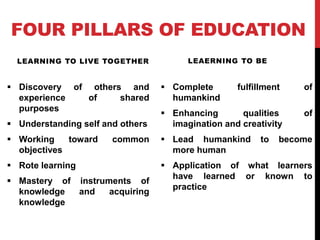
FOUR PILLARS OF EDUCATION
LEARNING TO LIVE TOGETHER
 Discovery of others and
experience of shared
purposes
 Understanding self and others
 Working toward common
objectives
 Rote learning
 Mastery of instruments of
knowledge and acquiring
knowledge
LEAERNING TO BE
 Complete fulfillment of
humankind
 Enhancing qualities of
imagination and creativity
 Lead humankind to become
more human
 Application of what learners
have learned or known to
practice
 Learner to experience
the pleasure of
knowing,
discovering,
Development of the
faculties of memory,
imagination,
reasoning, problem
solving and the
ability to think in a
coherent and critical
way
 Enables the and
understanding a
process
 Using one’s
education,
knowledge, skills
and attitudes as the
case in technical-
vocation education
and work skills
training
 Transforming
knowledge into
innovations
SOCIALIZATION
 Is a process by which society turns an
individual from being a child into a full-
pledged responsible adult or being an
outsider to becoming an insider.
 Enculturation- process by which one
acquires a culture of his or her
environment
 Acculturation- process of acquisition of
second culture
THANK YOU!

Communication Media Channels for everyday

  • 1.
  • 2.
    COMMUNICATION MEDIA Communications media refersto the means of delivering and receiving data or information.
  • 3.
    NEW MEDIA ANDSOCIAL MEDIA Blogging and social networking, the most prominent forms of social media, tend to resemble a typical mass media style in the sense that there is impersonality, no privacy nor specific recipient of the messages nor the obligation to respond.
  • 4.
    NEW MEDIA ANDSOCIAL MEDIA  People are more concerned with expressing their opinions and feelings about the issue at hand.  It is not regulated by members of the profession but by the discourse of participants.
  • 5.
    TELECOMMUNICATION  refers tothe transmission of information by electromagnetic means.  Large volumes of information in the forms of word, sounds, or images, over long distances, are transmitted in the form of electromagnetic signals, by telegraph, telephone, radio, or television.
  • 6.
  • 7.
    FUNCTIONS OF APPLIED SOCIALSCIENCE  Applied social sciences help us consider all helping situations to be multicultural in the sense that people’s uniqueness has to be recognized in the helping process.  Purveyors of social justice, inclusion, and caregiving
  • 8.
     Applied socialsciences services are indispensable to the full transformation of a child  They help society see beyond the behavior manifestation by looking beneath them, and address and uproot the causes
  • 9.
    SELF-DEVELOPMENT AND SOCIAL SCIENCES Communication- empowers the individual with listening and speaking skills in order for them to be effective.  Counseling- offers guidance in varying situations of conflict and provides tools to address issues of self-development.  Social work- aid of emancipating the marginalized individuals and facilitating participation necessary for self- development
  • 10.
    PERSUASION  At theheart of persuasion, is the ability to understand well one’s audience and their complexity.  Persuasions often consist of very few words making sure each one is very important, simple, specific, and exciting.  Persuasions energize it self to move audiences to desired and immediate action.
  • 11.
    ART AND ENTERTAINMENT  Artis a human activity that involves the perceptions and imagination of an artist trying to communicate a selective re- creation of reality and giving it form into immediate perceptual awareness.
  • 12.
     Noontime varietyshows  Movies, dramas, and theaters  The industry requires creativity, adaptability and offers the opportunity to travel  Through art and entertainment, we are able to see life differently, without imposing our values and perceptions on it.  Art and entertainment can provide nurturance and keep communities mentally and socially healthy.
  • 13.
    NEWS AND INFORMATION The society is informed by simply reading, listening, or watching just about anything, through a formed intermediary that tells them what is good, important, and by accessing a wide range of the means for them to sort things out for themselves and find their own version of truth.  Use of Facebook, Twitter, etc.
  • 14.
     Development ofmobile phones that instantly link every mobile owner to the internet.  A social network “hashtag” can alert us on important issues.  Many majors news organization have now opened their sites and allow users to “share” , “like” or “recommend” content on social media channels  The media landscape is more vibrant in offering faster and cheaper distribution networks, fewer barriers to entry, and more ways to consume information.
  • 15.
    Applied social sciencein this context can provide encouragement and empowerment to undeserved communities to avail open and free media channels to voice out and consume critical information.
  • 16.
    ORGANIZING ADVOCACY AND MOBILIZATION In our present day of free speech and democracy, organizing advocacy is very much part of social cohesion.  Core values of applied social sciences foster the common good, inclusion and a greater sense of life in the community.
  • 17.
    EDUCATION  In 1972report, UNESCO essentially gave birth the four pillars of education that continue to informing shape global education curricular  Learning to know, learning to do, learning to live together, and learning to be.
  • 18.
     Education isan ongoing process of improving knowledge and skills and it is an exceptional means of bringing about personal development and building relationships among individuals, groups, and nations.
  • 19.
    FOUR PILLARS OFEDUCATION LEARNING TO LIVE TOGETHER  Discovery of others and experience of shared purposes  Understanding self and others  Working toward common objectives  Rote learning  Mastery of instruments of knowledge and acquiring knowledge LEAERNING TO BE  Complete fulfillment of humankind  Enhancing qualities of imagination and creativity  Lead humankind to become more human  Application of what learners have learned or known to practice
  • 20.
     Learner toexperience the pleasure of knowing, discovering, Development of the faculties of memory, imagination, reasoning, problem solving and the ability to think in a coherent and critical way  Enables the and understanding a process  Using one’s education, knowledge, skills and attitudes as the case in technical- vocation education and work skills training  Transforming knowledge into innovations
  • 21.
    SOCIALIZATION  Is aprocess by which society turns an individual from being a child into a full- pledged responsible adult or being an outsider to becoming an insider.  Enculturation- process by which one acquires a culture of his or her environment  Acculturation- process of acquisition of second culture
  • 22.