A brief and (hopefully) simple guide to building an advocacy, courtesy of
Ben Kritz. After this one, though, it’ll start costing you, I am a professional
after all…
Work backwards from your goal to find your process framework.

Step One: Make sure your objective is clear. I think you
have that figured out pretty well, so that’s a great start!

BETTER SERVICE DELIVERY BY THE
GOVERNMENT TO THE PEOPLE
Stick to strategy fundamentals, the reason they’re “fundamental” is
because they work. We’re not trying to reinvent the wheel here.

The 5 Whys: If you’re not familiar with
them, what it means that any problem
(or, as in this case, a desired outcome)
can be investigated to its root cause(s)
by asking the question “Why?” five
times.
And the answer is….

BECAUSE there is improved government
transparency and accountability
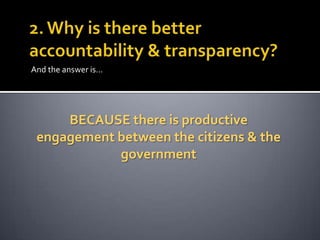
And the answer is…

BECAUSE there is productive
engagement between the citizens & the
government
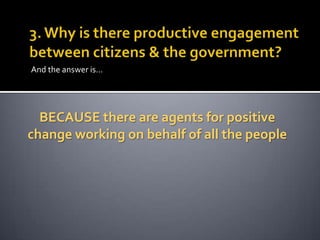
And the answer is…

BECAUSE there are agents for positive
change working on behalf of all the people
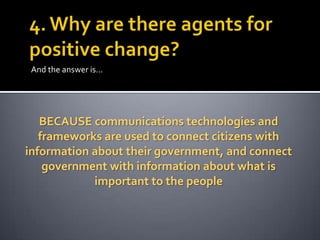
And the answer is…

BECAUSE communications technologies and
frameworks are used to connect citizens with
information about their government, and connect
government with information about what is
important to the people
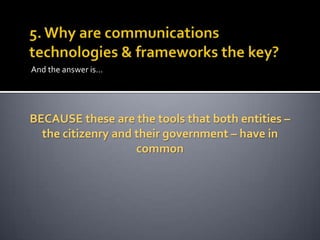
And the answer is…

BECAUSE these are the tools that both entities –
the citizenry and their government – have in
common
Process #1:
Engage the
Citizens
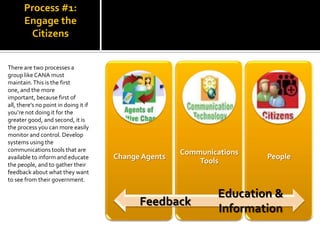
There are two processes a
group like CANA must
maintain. This is the first
one, and the more
important, because first of
all, there’s no point in doing it if
you’re not doing it for the
greater good, and second, it is
the process you can more easily
monitor and control. Develop
systems using the
communications tools that are
available to inform and educate
the people, and to gather their
feedback about what they want
to see from their government.

Change Agents

Communications
Tools

Feedback

People

Education &
Information
Process #2:
Engage the
Government
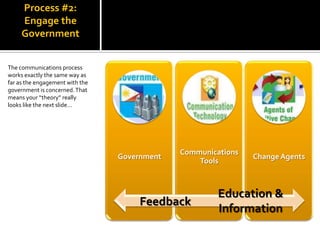
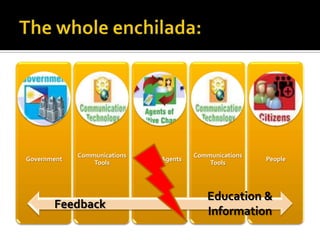
The communications process
works exactly the same way as
far as the engagement with the
government is concerned. That
means your “theory” really
looks like the next slide…

Government

Communications
Tools

Feedback

Change Agents

Education &
Information
Government

Communications
Tools

Feedback

Change Agents

Communications
Tools

People

Education &
Information
You’re on the right track, just don’t overthink things so much.

Hopefully this will help you conceptualize what you’re actually
trying to do: Your task is communication. Yes, there are a lot of
details beyond the basic concept – that’s to be expected. But as
long as you keep in mind that all this boils down to keeping the
people informed about what their government is doing for them
and keeping the government informed about what their people
want them to do, you should be able to sort it out.

Developing the CANA framework

  • 1.
    A brief and(hopefully) simple guide to building an advocacy, courtesy of Ben Kritz. After this one, though, it’ll start costing you, I am a professional after all…
  • 2.
    Work backwards fromyour goal to find your process framework. Step One: Make sure your objective is clear. I think you have that figured out pretty well, so that’s a great start! BETTER SERVICE DELIVERY BY THE GOVERNMENT TO THE PEOPLE
  • 3.
    Stick to strategyfundamentals, the reason they’re “fundamental” is because they work. We’re not trying to reinvent the wheel here. The 5 Whys: If you’re not familiar with them, what it means that any problem (or, as in this case, a desired outcome) can be investigated to its root cause(s) by asking the question “Why?” five times.
  • 4.
    And the answeris…. BECAUSE there is improved government transparency and accountability
  • 5.
    And the answeris… BECAUSE there is productive engagement between the citizens & the government
  • 6.
    And the answeris… BECAUSE there are agents for positive change working on behalf of all the people
  • 7.
    And the answeris… BECAUSE communications technologies and frameworks are used to connect citizens with information about their government, and connect government with information about what is important to the people
  • 8.
    And the answeris… BECAUSE these are the tools that both entities – the citizenry and their government – have in common
  • 9.
    Process #1: Engage the Citizens Thereare two processes a group like CANA must maintain. This is the first one, and the more important, because first of all, there’s no point in doing it if you’re not doing it for the greater good, and second, it is the process you can more easily monitor and control. Develop systems using the communications tools that are available to inform and educate the people, and to gather their feedback about what they want to see from their government. Change Agents Communications Tools Feedback People Education & Information
  • 10.
    Process #2: Engage the Government Thecommunications process works exactly the same way as far as the engagement with the government is concerned. That means your “theory” really looks like the next slide… Government Communications Tools Feedback Change Agents Education & Information
  • 11.
  • 12.
    You’re on theright track, just don’t overthink things so much. Hopefully this will help you conceptualize what you’re actually trying to do: Your task is communication. Yes, there are a lot of details beyond the basic concept – that’s to be expected. But as long as you keep in mind that all this boils down to keeping the people informed about what their government is doing for them and keeping the government informed about what their people want them to do, you should be able to sort it out.