Book Summary
Everybody Lies :
What the Internet Can Tell Us About Who We Really Are
Seth-Stephens-Davidowitz
 Internet search data leads to understanding of human behavior.
 This book brings in behavioral economics through big data
 People confess the strangest things on internet, leaving digital traces which can be
aggregated and analyzed - giving a never before view into their psyche.
 People tell Google (via the Google Searches) things that they may not tell anyone else.
 Good data science is less complicated, the best is intuitive.
 Big Data is easy to understand. If a study cannot be understood it is, more likely an issue with
the study than the person trying to understand it.
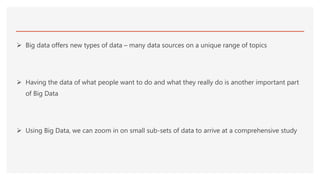
 Big data offers new types of data – many data sources on a unique range of topics
 Having the data of what people want to do and what they really do is another important part
of Big Data
 Using Big Data, we can zoom in on small sub-sets of data to arrive at a comprehensive study
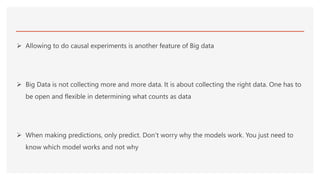
 Allowing to do causal experiments is another feature of Big data
 Big Data is not collecting more and more data. It is about collecting the right data. One has to
be open and flexible in determining what counts as data
 When making predictions, only predict. Don’t worry why the models work. You just need to
know which model works and not why
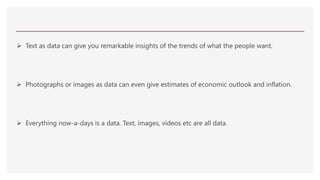
 Text as data can give you remarkable insights of the trends of what the people want.
 Photographs or images as data can even give estimates of economic outlook and inflation.
 Everything now-a-days is a data. Text, images, videos etc are all data.
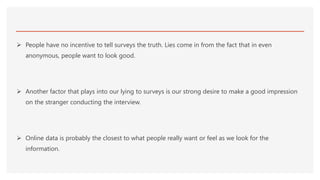
 People have no incentive to tell surveys the truth. Lies come in from the fact that in even
anonymous, people want to look good.
 Another factor that plays into our lying to surveys is our strong desire to make a good impression
on the stranger conducting the interview.
 Online data is probably the closest to what people really want or feel as we look for the
information.
 On social sites, we do not show our true selves. It is a painted picture.
 Great businesses are built on secrets of nature or secrets of people. The fact that people are
interested in what others do, formed one of the key success factors of Facebook.
 Netflix with its data and surveys, learnt – don’t trust what people tell you (surveys), trust what
they do (data).
 Search data shows that lecturing angry people will only stoke their fire. Offering a different
perspective and giving new information on the ‘angry topic’ is more effective.
 Many of the adult behaviors can be explained by the facts of when were we born and what
was going on during certain key years of growth.
 Big data allows to zoom in on specific but comprehensive data say – data by the minute or by the
hour. The world is too rich and complex for small data.
 Many companies use the doppelganger theme for dramatically improve their services and offering.
They see what people similar to you have done and offer recommendations as per that.
 Making randomized experiments in a digital space is easy, especially when you are online.
 A/B Testing – the reason for doing these tests is that people are unpredictable. Again,
difference between what they tell and what they do.
 Hundreds of A/B tests can lead you to a winning offering.
 In Predictions, one can come across the ‘Curse of Dimensionality’ – a thin line between
variables and observations. Too many variables, one is bound to get lucky ; increase the
observations and none of the variables will keep up. Most predictions have gone wrong
because of this.
 Overcoming this curse of dimensionality – try out many tests, different tests.
 Solution to a problem is not always big data. Human judgement can add a bit of weight. They
complement each other.
 Ethics is a very important part of big data. Analyzing trends, behavior's or macro issues is fine
but when it gets to personal data, there is a problem
 Using personal data to drive predictive behavior while unethical, currently is not possible as it
is a big jump for data science to analyse mass trends to individual behaviors.
 If used properly, this data will yield better living and this social science will become a real
science.

Book Summary : Everybody Lies

  • 1.
    Book Summary Everybody Lies: What the Internet Can Tell Us About Who We Really Are Seth-Stephens-Davidowitz
  • 2.
     Internet searchdata leads to understanding of human behavior.  This book brings in behavioral economics through big data  People confess the strangest things on internet, leaving digital traces which can be aggregated and analyzed - giving a never before view into their psyche.
  • 3.
     People tellGoogle (via the Google Searches) things that they may not tell anyone else.  Good data science is less complicated, the best is intuitive.  Big Data is easy to understand. If a study cannot be understood it is, more likely an issue with the study than the person trying to understand it.
  • 4.
     Big dataoffers new types of data – many data sources on a unique range of topics  Having the data of what people want to do and what they really do is another important part of Big Data  Using Big Data, we can zoom in on small sub-sets of data to arrive at a comprehensive study
  • 5.
     Allowing todo causal experiments is another feature of Big data  Big Data is not collecting more and more data. It is about collecting the right data. One has to be open and flexible in determining what counts as data  When making predictions, only predict. Don’t worry why the models work. You just need to know which model works and not why
  • 6.
     Text asdata can give you remarkable insights of the trends of what the people want.  Photographs or images as data can even give estimates of economic outlook and inflation.  Everything now-a-days is a data. Text, images, videos etc are all data.
  • 7.
     People haveno incentive to tell surveys the truth. Lies come in from the fact that in even anonymous, people want to look good.  Another factor that plays into our lying to surveys is our strong desire to make a good impression on the stranger conducting the interview.  Online data is probably the closest to what people really want or feel as we look for the information.
  • 8.
     On socialsites, we do not show our true selves. It is a painted picture.  Great businesses are built on secrets of nature or secrets of people. The fact that people are interested in what others do, formed one of the key success factors of Facebook.  Netflix with its data and surveys, learnt – don’t trust what people tell you (surveys), trust what they do (data).
  • 9.
     Search datashows that lecturing angry people will only stoke their fire. Offering a different perspective and giving new information on the ‘angry topic’ is more effective.  Many of the adult behaviors can be explained by the facts of when were we born and what was going on during certain key years of growth.
  • 10.
     Big dataallows to zoom in on specific but comprehensive data say – data by the minute or by the hour. The world is too rich and complex for small data.  Many companies use the doppelganger theme for dramatically improve their services and offering. They see what people similar to you have done and offer recommendations as per that.  Making randomized experiments in a digital space is easy, especially when you are online.
  • 11.
     A/B Testing– the reason for doing these tests is that people are unpredictable. Again, difference between what they tell and what they do.  Hundreds of A/B tests can lead you to a winning offering.  In Predictions, one can come across the ‘Curse of Dimensionality’ – a thin line between variables and observations. Too many variables, one is bound to get lucky ; increase the observations and none of the variables will keep up. Most predictions have gone wrong because of this.
  • 12.
     Overcoming thiscurse of dimensionality – try out many tests, different tests.  Solution to a problem is not always big data. Human judgement can add a bit of weight. They complement each other.  Ethics is a very important part of big data. Analyzing trends, behavior's or macro issues is fine but when it gets to personal data, there is a problem
  • 13.
     Using personaldata to drive predictive behavior while unethical, currently is not possible as it is a big jump for data science to analyse mass trends to individual behaviors.  If used properly, this data will yield better living and this social science will become a real science.