#CLOwebinar
The presentation will begin at the top of the hour.
A dial in number will not be provided.
Listen to today’s webinar using your computer’s
speakers or headphones.
Welcome to the webinar!
#CLOwebinar


Tools You Can Use
Audio Control
–  A dial in number will not be provided.
–  Adjust the volume by sliding the indicator
in the Media Player box to the right.
–  Also check your computer’s volume for
external speakers or headsets.
#CLOwebinar
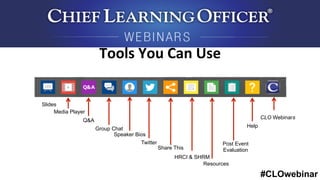
Tools	
  You	
  Can	
  Use	
  
Speaker Bios
Resources
Media Player
Q&A
Slides
Twitter
Help
Post Event
EvaluationShare This
Group Chat
HRCI & SHRM
CLO Webinars
#CLOwebinar


1. May I receive a copy of the slides?
YES! Click on the resource list located on the top right portion
of your screen.
2. May I review the webinar recording at a later date?
YES! You may log in again using today’s link to review the
presentation on-demand.
3. Is this webinar HRCI or SHRM certified?
YES! The HRCI and SHRM certification codes will appear in
the box to the right of the slides after the required watch-
time has elapsed.
Frequently	
  Asked	
  Ques6ons	
  
™
Developing Emotional
Intelligence Skills for
High Performance
Cultures


#WhilPower | @WeAreWhil
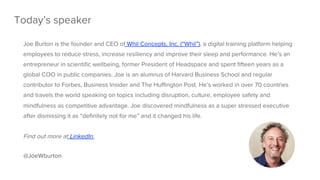
Joe Burton is the founder and CEO of Whil Concepts, Inc. (“Whil”), a digital training platform helping
employees to reduce stress, increase resiliency and improve their sleep and performance. He’s an
entrepreneur in scientific wellbeing, former President of Headspace and spent fifteen years as a
global COO in public companies. Joe is an alumnus of Harvard Business School and regular
contributor to Forbes, Business Insider and The Huffington Post. He's worked in over 70 countries
and travels the world speaking on topics including disruption, culture, employee safety and
mindfulness as competitive advantage. Joe discovered mindfulness as a super stressed executive
after dismissing it as “definitely not for me” and it changed his life.
Find out more at LinkedIn.

@JoeWburton

Today’s speaker
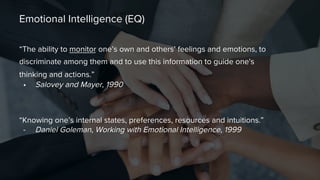
Emotional Intelligence (EQ)

“The ability to monitor one’s own and others’ feelings and emotions, to
discriminate among them and to use this information to guide one's
thinking and actions.”
•  Salovey and Mayer, 1990

“Knowing one’s internal states, preferences, resources and intuitions.” 
-  Daniel Goleman, Working with Emotional Intelligence, 1999
Welcome to Work

™
Work
Disruption, Stress and High Expectations
It’s a VUCA world

•  Volatile
•  Uncertain
•  Complex
•  Ambiguous
“The world is becoming more turbulent faster than most
organizations are becoming more resilient.”
•  Gary Hamel, What Matters Now, 2012
POLL
On a scale of 1-10,
what’s your organization’s level of stress?
1 = No stress 10 = We can’t even deal.
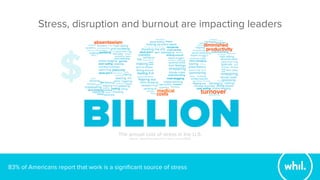
83% of Americans report that work is a significant source of stress 
The annual cost of stress in the U.S.
Source: Harris Interactive Work Stress Survey (2013)
Stress, disruption and burnout are impacting leaders
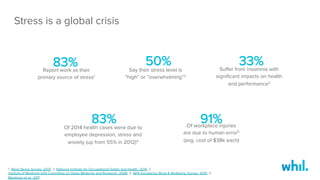
Report work as their
primary source of stress1
Stress is a global crisis
1. Work Stress Survey, 2013; 2. National Institute for Occupational Safety and Health, 2014; 3.
Institute of Medicine (US) Committee on Sleep Medicine and Research, 2006; 4. APA Excellence Work & Wellbeing Survey, 2015; 5.
Bleetman et al., 2011
Say their stress level is
“high” or “overwhelming”2
83% 
 50% 
Of 2014 health cases were due to
employee depression, stress and
anxiety (up from 55% in 2012)4
83% 
 Of workplace injuries
are due to human error5
(avg. cost of $38k each)
91% 
Suffer from insomnia with
significant impacts on health
and performance3
33%
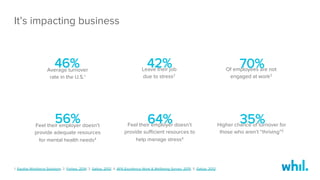
It’s impacting business 
1. Equifax Workforce Solutions; 2. Forbes, 2014; 3. Gallup, 2012; 4. APA Excellence Work & Wellbeing Survey, 2015; 5. Gallup, 2012
Average turnover
rate in the U.S.1
46% 
 Leave their job
due to stress2
42% 
 Of employees are not
engaged at work3
70% 
Feel their employer doesn’t
provide adequate resources
for mental health needs4
56% 
 Feel their employer doesn’t
provide sufficient resources to
help manage stress4
64% 
 Higher chance of turnover for
those who aren’t “thriving”5
35%
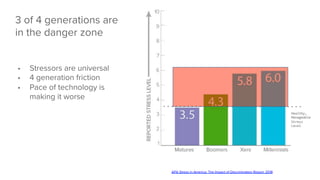
•  Stressors are universal
•  4 generation friction
•  Pace of technology is
making it worse
3 of 4 generations are 
in the danger zone
APA Stress in America: The Impact of Discrimination Report, 2016
Healthy,	
  
Manageable	
  
Stress	
  
Level	
  
Everything’s gonna be alright.
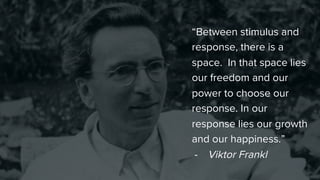
“Between stimulus and
response, there is a
space. In that space lies
our freedom and our
power to choose our
response. In our
response lies our growth
and our happiness.”
-  Viktor Frankl
The Market is Shifting to Favor EQ
™
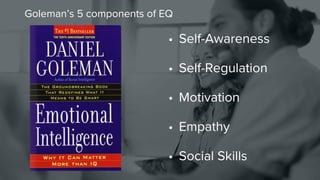
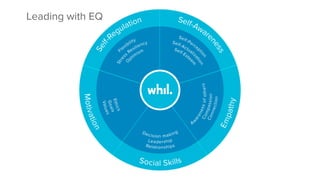
•  Self-Awareness
•  Self-Regulation
•  Motivation
•  Empathy
•  Social Skills
Goleman’s 5 components of EQ
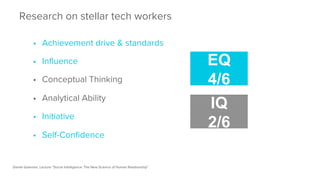
EQ
4/6
IQ
2/6
Daniel Goleman, Lecture “Social Intelligence: The New Science of Human Relationship”
Research on stellar tech workers
•  Achievement drive & standards
•  Influence
•  Conceptual Thinking
•  Analytical Ability
•  Initiative
•  Self-Confidence
1. Emotional Intelligence Consortium; 2. Goleman, 2011
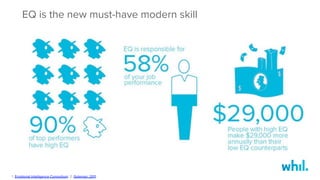
EQ is the new must-have modern skill
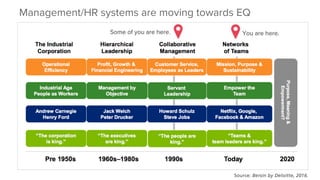
You are here.
Some of you are here.
Management/HR systems are moving towards EQ
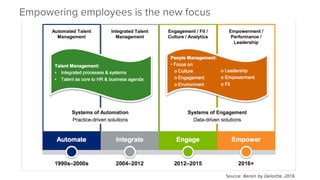
Empowering employees is the new focus
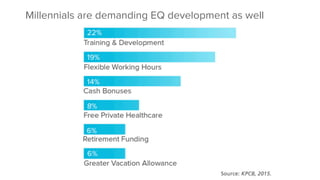
Millennials are demanding EQ development as well
Leading with EQ
POLL
On a scale of 1-10,
How important do you think EQ is for your company?
1 = Not at all 10 = Absolutely crucial
™
How to Train Emotional Intelligence
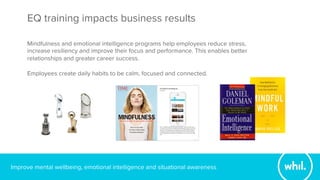
EQ training impacts business results
Improve mental wellbeing, emotional intelligence and situational awareness
Mindfulness and emotional intelligence programs help employees reduce stress,
increase resiliency and improve their focus and performance. This enables better
relationships and greater career success.

Employees create daily habits to be calm, focused and connected.
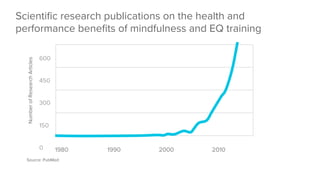
600
450
300
150
0
 1980
 1990
 2000
 2010
NumberofResearchArticles
Source: PubMed
Scientific research publications on the health and
performance benefits of mindfulness and EQ training
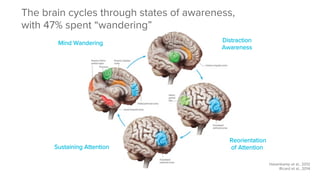
Mind Wandering
 Distraction
Awareness
Reorientation
of Attention
Sustaining Attention
Hasenkamp et al., 2012
Ricard et al., 2014
The brain cycles through states of awareness,
with 47% spent “wandering”
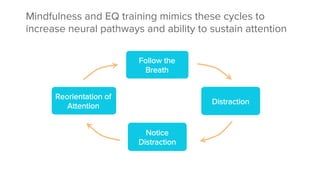
Follow the
Breath
Distraction
Reorientation of
Attention
Notice
Distraction
Mindfulness and EQ training mimics these cycles to
increase neural pathways and ability to sustain attention
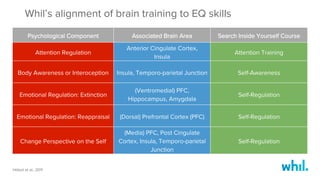
Hölzel et al., 2011
Whil’s alignment of brain training to EQ skills 

Psychological Component
 Associated Brain Area
 Search Inside Yourself Course
Attention Regulation
Anterior Cingulate Cortex, 
Insula
Attention Training
Body Awareness or Interoception
 Insula, Temporo-parietal Junction
 Self-Awareness
Emotional Regulation: Extinction
(Ventromedial) PFC,
Hippocampus, Amygdala
Self-Regulation
Emotional Regulation: Reappraisal
 (Dorsal) Prefrontal Cortex (PFC)
 Self-Regulation
Change Perspective on the Self
(Media) PFC, Post Cingulate
Cortex, Insula, Temporo-parietal
Junction
Self-Regulation
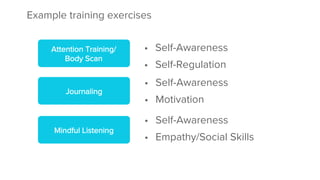
•  Self-Awareness
•  Self-Regulation
•  Self-Awareness
•  Motivation
•  Self-Awareness
•  Empathy/Social Skills
Example training exercises

Attention Training/
Body Scan
Journaling
Mindful Listening
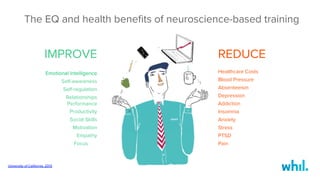
REDUCE
University of California, 2013

Healthcare Costs
Blood Pressure
Absenteeism
Depression 
Addiction
Insomnia
Anxiety 
Stress 
PTSD
Pain


The EQ and health benefits of neuroscience-based training

IMPROVE

Emotional Intelligence
Self-awareness
Self-regulation
Relationships
Performance
Productivity 
Social Skills
Motivation
Empathy


 Focus
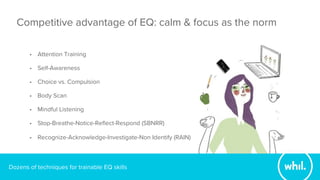
•  Attention Training
•  Self-Awareness
•  Choice vs. Compulsion
•  Body Scan
•  Mindful Listening
•  Stop-Breathe-Notice-Reflect-Respond (SBNRR)
•  Recognize-Acknowledge-Investigate-Non Identify (RAIN)
Dozens of techniques for trainable EQ skills
Competitive advantage of EQ: calm & focus as the norm
™
Why Does Big Business Care?
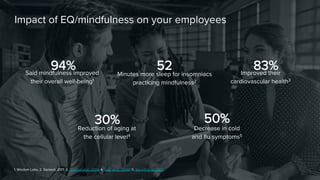
Said mindfulness improved
their overall well-being1
Impact of EQ/mindfulness on your employees
1. Wisdom Labs; 2. Garland, 2011; 3. Loucks et al., 2014; 4. Epel et al., 2009; 5. Barrett et al., 2012
Reduction of aging at
the cellular level4
94% 
30% 
Improved their
cardiovascular health3
83% 
Minutes more sleep for insomniacs
practicing mindfulness2 
52 
Decrease in cold
and flu symptoms5
50%
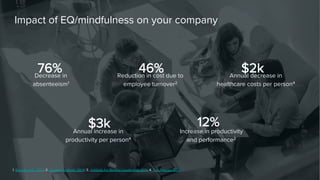
Decrease in
absenteeism1
Impact of EQ/mindfulness on your company
1. Barrett et al., 2012; 2. iOpener Institute, 2014; 3. Institute for Mindful Leadership, 2011, 4. The Atlantic, 2015
Increase in productivity
and performance2
76% 
12% 
Annual decrease in
healthcare costs per person4
$2k
Reduction in cost due to
employee turnover2
46% 
Annual increase in
productivity per person4
$3k
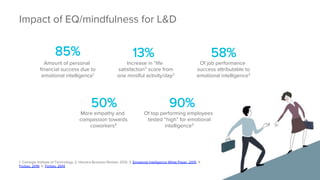
Impact of EQ/mindfulness for L&D
1. Carnegie Institute of Technology; 2. Harvard Business Review, 2012; 3. Emotional Intelligence White Paper, 2015; 4.
Forbes, 2016; 5. Forbes, 2014
Amount of personal
financial success due to
emotional intelligence1
85% 
Increase in “life
satisfaction” score from
one mindful activity/day2
13% 
Of job performance
success attributable to
emotional intelligence3
58%
Of top performing employees
tested “high” for emotional
intelligence5
90%
More empathy and
compassion towards
coworkers4
50%
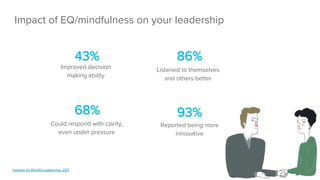
Improved decision
making ability
Impact of EQ/mindfulness on your leadership
Institute for Mindful Leadership, 2011
Could respond with clarity,
even under pressure
43% 
68% 
Listened to themselves
and others better
86% 
Reported being more
innovative
93%
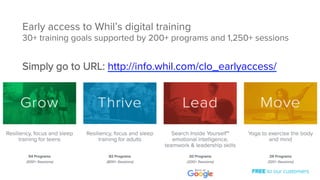
Early access to Whil’s digital training
30+ training goals supported by 200+ programs and 1,250+ sessions

Simply go to URL: http://info.whil.com/clo_earlyaccess/
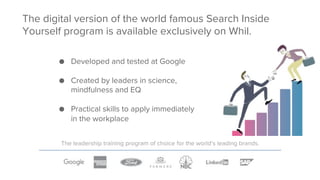
The digital version of the world famous Search Inside
Yourself program is available exclusively on Whil.
The leadership training program of choice for the world’s leading brands.
●  Developed and tested at Google

●  Created by leaders in science,
mindfulness and EQ

●  Practical skills to apply immediately
in the workplace
Search Inside Yourself with our “Lead” training
POLL
How much did you enjoy this webcast?
1.  Great - Loved it!
2.  Good.
3.  Meh, just okay.
4.  Not my thing. I’m sleeping right now.
everything’s gonna be alright.
joe@whil.com | @joeWburton
™
Thank You.
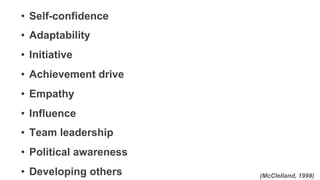
(McClelland, 1998)
•  Self-confidence
•  Adaptability
•  Initiative
•  Achievement drive
•  Empathy
•  Influence
•  Team leadership
•  Political awareness
•  Developing others
1.  Individually, assess
areas of strengths and
areas of growth.
2.  In dyads, Person A
shares examples of
areas of growth.
3.  Then Person B shares.
4.  Person A shares
examples of strengths.
5.  Then Person B shares.
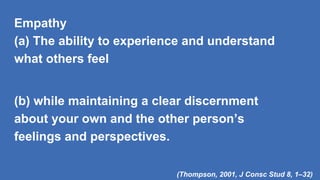
Empathy
(a) The ability to experience and understand
what others feel
(b) while maintaining a clear discernment
about your own and the other person’s
feelings and perspectives.
(Thompson, 2001, J Consc Stud 8, 1–32)
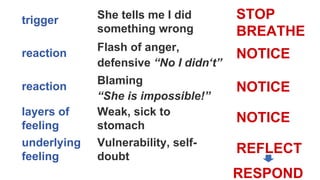
trigger She tells me I did
something wrong
STOP
BREATHE
reaction
Flash of anger,
defensive “No I didn‘t”
NOTICE
reaction
Blaming
“She is impossible!”
NOTICE
layers of
feeling
Weak, sick to
stomach
NOTICE
underlying
feeling
Vulnerability, self-
doubt
REFLECT
RESPOND
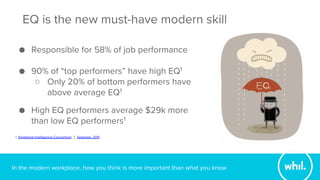
In the modern workplace, how you think is more important than what you know
EQ is the new must-have modern skill

●  Responsible for 58% of job performance

●  90% of “top performers” have high EQ1
○  Only 20% of bottom performers have
above average EQ1

●  High EQ performers average $29k more
than low EQ performers1

1. Emotional Intelligence Consortium; 2. Goleman, 2011
The Leadership Training Program Born at Google
●  Self Awareness
●  Self Manage
●  Emotional Resiliency
●  Communicating with Insight
●  Alignment and Envisioning
●  Leadership Presence
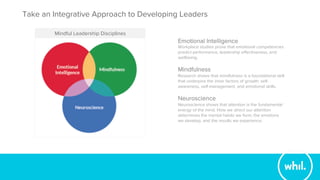
Mindful Leadership Disciplines
Take an Integrative Approach to Developing Leaders
Emotional Intelligence
Workplace studies prove that emotional competencies
predict performance, leadership effectiveness, and
wellbeing.

Mindfulness
Research shows that mindfulness is a foundational skill
that underpins the inner factors of growth: self-
awareness, self-management, and emotional skills.

Neuroscience
Neuroscience shows that attention is the fundamental
energy of the mind. How we direct our attention
determines the mental habits we form, the emotions
we develop, and the results we experience.
EQ > IQ
#CLOwebinar
Please complete the
webinar evaluation.
#CLOwebinar


Register for the next webinar!
How to Utilize eLearning to Cultivate a
Culture of Learning in the Workplace
Wednesday, January 18, 2016
Webinars start at 2 p.m. Eastern / 11 a.m. Pacific
Register for all upcoming Chief Learning Officer Webinars at
events.clomedia.com/webinars
OR click the icon on the widget bar!

Developing Emotional Intelligence Skills for High Performance Cultures

  • 1.
    #CLOwebinar The presentation willbegin at the top of the hour. A dial in number will not be provided. Listen to today’s webinar using your computer’s speakers or headphones. Welcome to the webinar!
  • 2.
    #CLOwebinar         Tools You Can Use Audio Control –  A dial in number will not be provided. –  Adjust the volume by sliding the indicator in the Media Player box to the right. –  Also check your computer’s volume for external speakers or headsets.
  • 3.
    #CLOwebinar Tools  You  Can  Use   Speaker Bios Resources Media Player Q&A Slides Twitter Help Post Event EvaluationShare This Group Chat HRCI & SHRM CLO Webinars
  • 4.
    #CLOwebinar         1. May I receive a copy of the slides? YES! Click on the resource list located on the top right portion of your screen. 2. May I review the webinar recording at a later date? YES! You may log in again using today’s link to review the presentation on-demand. 3. Is this webinar HRCI or SHRM certified? YES! The HRCI and SHRM certification codes will appear in the box to the right of the slides after the required watch- time has elapsed. Frequently  Asked  Ques6ons  
  • 5.
    ™ Developing Emotional Intelligence Skillsfor High Performance Cultures #WhilPower | @WeAreWhil
  • 6.
    Joe Burton isthe founder and CEO of Whil Concepts, Inc. (“Whil”), a digital training platform helping employees to reduce stress, increase resiliency and improve their sleep and performance. He’s an entrepreneur in scientific wellbeing, former President of Headspace and spent fifteen years as a global COO in public companies. Joe is an alumnus of Harvard Business School and regular contributor to Forbes, Business Insider and The Huffington Post. He's worked in over 70 countries and travels the world speaking on topics including disruption, culture, employee safety and mindfulness as competitive advantage. Joe discovered mindfulness as a super stressed executive after dismissing it as “definitely not for me” and it changed his life. Find out more at LinkedIn. @JoeWburton Today’s speaker
  • 7.
    Emotional Intelligence (EQ) “Theability to monitor one’s own and others’ feelings and emotions, to discriminate among them and to use this information to guide one's thinking and actions.” •  Salovey and Mayer, 1990 “Knowing one’s internal states, preferences, resources and intuitions.” -  Daniel Goleman, Working with Emotional Intelligence, 1999
  • 8.
    Welcome to Work ™ Work Disruption,Stress and High Expectations
  • 9.
    It’s a VUCAworld •  Volatile •  Uncertain •  Complex •  Ambiguous
  • 10.
    “The world isbecoming more turbulent faster than most organizations are becoming more resilient.” •  Gary Hamel, What Matters Now, 2012
  • 13.
    POLL On a scaleof 1-10, what’s your organization’s level of stress? 1 = No stress 10 = We can’t even deal.
  • 14.
    83% of Americansreport that work is a significant source of stress The annual cost of stress in the U.S. Source: Harris Interactive Work Stress Survey (2013) Stress, disruption and burnout are impacting leaders
  • 15.
    Report work astheir primary source of stress1 Stress is a global crisis 1. Work Stress Survey, 2013; 2. National Institute for Occupational Safety and Health, 2014; 3. Institute of Medicine (US) Committee on Sleep Medicine and Research, 2006; 4. APA Excellence Work & Wellbeing Survey, 2015; 5. Bleetman et al., 2011 Say their stress level is “high” or “overwhelming”2 83% 50% Of 2014 health cases were due to employee depression, stress and anxiety (up from 55% in 2012)4 83% Of workplace injuries are due to human error5 (avg. cost of $38k each) 91% Suffer from insomnia with significant impacts on health and performance3 33%
  • 16.
    It’s impacting business 1. Equifax Workforce Solutions; 2. Forbes, 2014; 3. Gallup, 2012; 4. APA Excellence Work & Wellbeing Survey, 2015; 5. Gallup, 2012 Average turnover rate in the U.S.1 46% Leave their job due to stress2 42% Of employees are not engaged at work3 70% Feel their employer doesn’t provide adequate resources for mental health needs4 56% Feel their employer doesn’t provide sufficient resources to help manage stress4 64% Higher chance of turnover for those who aren’t “thriving”5 35%
  • 17.
    •  Stressors areuniversal •  4 generation friction •  Pace of technology is making it worse 3 of 4 generations are in the danger zone APA Stress in America: The Impact of Discrimination Report, 2016 Healthy,   Manageable   Stress   Level  
  • 18.
  • 19.
    “Between stimulus and response,there is a space. In that space lies our freedom and our power to choose our response. In our response lies our growth and our happiness.” -  Viktor Frankl
  • 20.
    The Market isShifting to Favor EQ ™
  • 21.
    •  Self-Awareness •  Self-Regulation • Motivation •  Empathy •  Social Skills Goleman’s 5 components of EQ
  • 22.
    EQ 4/6 IQ 2/6 Daniel Goleman, Lecture“Social Intelligence: The New Science of Human Relationship” Research on stellar tech workers •  Achievement drive & standards •  Influence •  Conceptual Thinking •  Analytical Ability •  Initiative •  Self-Confidence
  • 23.
    1. Emotional IntelligenceConsortium; 2. Goleman, 2011 EQ is the new must-have modern skill
  • 24.
    You are here. Someof you are here. Management/HR systems are moving towards EQ
  • 25.
  • 26.
    Millennials are demandingEQ development as well
  • 27.
  • 28.
    POLL On a scaleof 1-10, How important do you think EQ is for your company? 1 = Not at all 10 = Absolutely crucial
  • 29.
    ™ How to TrainEmotional Intelligence
  • 30.
    EQ training impactsbusiness results Improve mental wellbeing, emotional intelligence and situational awareness Mindfulness and emotional intelligence programs help employees reduce stress, increase resiliency and improve their focus and performance. This enables better relationships and greater career success. Employees create daily habits to be calm, focused and connected.
  • 31.
    600 450 300 150 0 1980 1990 2000 2010 NumberofResearchArticles Source: PubMed Scientific research publications on the health and performance benefits of mindfulness and EQ training
  • 32.
    Mind Wandering Distraction Awareness Reorientation ofAttention Sustaining Attention Hasenkamp et al., 2012 Ricard et al., 2014 The brain cycles through states of awareness, with 47% spent “wandering”
  • 33.
    Follow the Breath Distraction Reorientation of Attention Notice Distraction Mindfulnessand EQ training mimics these cycles to increase neural pathways and ability to sustain attention
  • 34.
    Hölzel et al.,2011 Whil’s alignment of brain training to EQ skills Psychological Component Associated Brain Area Search Inside Yourself Course Attention Regulation Anterior Cingulate Cortex, Insula Attention Training Body Awareness or Interoception Insula, Temporo-parietal Junction Self-Awareness Emotional Regulation: Extinction (Ventromedial) PFC, Hippocampus, Amygdala Self-Regulation Emotional Regulation: Reappraisal (Dorsal) Prefrontal Cortex (PFC) Self-Regulation Change Perspective on the Self (Media) PFC, Post Cingulate Cortex, Insula, Temporo-parietal Junction Self-Regulation
  • 35.
    •  Self-Awareness •  Self-Regulation • Self-Awareness •  Motivation •  Self-Awareness •  Empathy/Social Skills Example training exercises Attention Training/ Body Scan Journaling Mindful Listening
  • 36.
    REDUCE University of California,2013 Healthcare Costs Blood Pressure Absenteeism Depression Addiction Insomnia Anxiety Stress PTSD Pain The EQ and health benefits of neuroscience-based training IMPROVE Emotional Intelligence Self-awareness Self-regulation Relationships Performance Productivity Social Skills Motivation Empathy Focus
  • 37.
    •  Attention Training • Self-Awareness •  Choice vs. Compulsion •  Body Scan •  Mindful Listening •  Stop-Breathe-Notice-Reflect-Respond (SBNRR) •  Recognize-Acknowledge-Investigate-Non Identify (RAIN) Dozens of techniques for trainable EQ skills Competitive advantage of EQ: calm & focus as the norm
  • 38.
    ™ Why Does BigBusiness Care?
  • 39.
    Said mindfulness improved theiroverall well-being1 Impact of EQ/mindfulness on your employees 1. Wisdom Labs; 2. Garland, 2011; 3. Loucks et al., 2014; 4. Epel et al., 2009; 5. Barrett et al., 2012 Reduction of aging at the cellular level4 94% 30% Improved their cardiovascular health3 83% Minutes more sleep for insomniacs practicing mindfulness2 52 Decrease in cold and flu symptoms5 50%
  • 40.
    Decrease in absenteeism1 Impact ofEQ/mindfulness on your company 1. Barrett et al., 2012; 2. iOpener Institute, 2014; 3. Institute for Mindful Leadership, 2011, 4. The Atlantic, 2015 Increase in productivity and performance2 76% 12% Annual decrease in healthcare costs per person4 $2k Reduction in cost due to employee turnover2 46% Annual increase in productivity per person4 $3k
  • 41.
    Impact of EQ/mindfulnessfor L&D 1. Carnegie Institute of Technology; 2. Harvard Business Review, 2012; 3. Emotional Intelligence White Paper, 2015; 4. Forbes, 2016; 5. Forbes, 2014 Amount of personal financial success due to emotional intelligence1 85% Increase in “life satisfaction” score from one mindful activity/day2 13% Of job performance success attributable to emotional intelligence3 58% Of top performing employees tested “high” for emotional intelligence5 90% More empathy and compassion towards coworkers4 50%
  • 42.
    Improved decision making ability Impactof EQ/mindfulness on your leadership Institute for Mindful Leadership, 2011 Could respond with clarity, even under pressure 43% 68% Listened to themselves and others better 86% Reported being more innovative 93%
  • 43.
    Early access toWhil’s digital training 30+ training goals supported by 200+ programs and 1,250+ sessions Simply go to URL: http://info.whil.com/clo_earlyaccess/
  • 44.
    The digital versionof the world famous Search Inside Yourself program is available exclusively on Whil. The leadership training program of choice for the world’s leading brands. ●  Developed and tested at Google ●  Created by leaders in science, mindfulness and EQ ●  Practical skills to apply immediately in the workplace
  • 45.
    Search Inside Yourselfwith our “Lead” training
  • 46.
    POLL How much didyou enjoy this webcast? 1.  Great - Loved it! 2.  Good. 3.  Meh, just okay. 4.  Not my thing. I’m sleeping right now.
  • 47.
    everything’s gonna bealright. joe@whil.com | @joeWburton ™ Thank You.
  • 48.
    (McClelland, 1998) •  Self-confidence • Adaptability •  Initiative •  Achievement drive •  Empathy •  Influence •  Team leadership •  Political awareness •  Developing others 1.  Individually, assess areas of strengths and areas of growth. 2.  In dyads, Person A shares examples of areas of growth. 3.  Then Person B shares. 4.  Person A shares examples of strengths. 5.  Then Person B shares.
  • 49.
    Empathy (a) The abilityto experience and understand what others feel (b) while maintaining a clear discernment about your own and the other person’s feelings and perspectives. (Thompson, 2001, J Consc Stud 8, 1–32)
  • 50.
    trigger She tellsme I did something wrong STOP BREATHE reaction Flash of anger, defensive “No I didn‘t” NOTICE reaction Blaming “She is impossible!” NOTICE layers of feeling Weak, sick to stomach NOTICE underlying feeling Vulnerability, self- doubt REFLECT RESPOND
  • 51.
    In the modernworkplace, how you think is more important than what you know EQ is the new must-have modern skill ●  Responsible for 58% of job performance ●  90% of “top performers” have high EQ1 ○  Only 20% of bottom performers have above average EQ1 ●  High EQ performers average $29k more than low EQ performers1 1. Emotional Intelligence Consortium; 2. Goleman, 2011
  • 52.
    The Leadership TrainingProgram Born at Google ●  Self Awareness ●  Self Manage ●  Emotional Resiliency ●  Communicating with Insight ●  Alignment and Envisioning ●  Leadership Presence
  • 53.
    Mindful Leadership Disciplines Takean Integrative Approach to Developing Leaders Emotional Intelligence Workplace studies prove that emotional competencies predict performance, leadership effectiveness, and wellbeing. Mindfulness Research shows that mindfulness is a foundational skill that underpins the inner factors of growth: self- awareness, self-management, and emotional skills. Neuroscience Neuroscience shows that attention is the fundamental energy of the mind. How we direct our attention determines the mental habits we form, the emotions we develop, and the results we experience.
  • 54.
  • 55.
  • 56.
    #CLOwebinar         Register for the next webinar! How to Utilize eLearning to Cultivate a Culture of Learning in the Workplace Wednesday, January 18, 2016 Webinars start at 2 p.m. Eastern / 11 a.m. Pacific Register for all upcoming Chief Learning Officer Webinars at events.clomedia.com/webinars OR click the icon on the widget bar!