

Customer Journey Maps to
Improve the Claims Experience
Friday 29 May 2015
With an Asia Pacific regional
presence and focus, we provide
human-centred business
design and innovation services
for clients across a variety of
sectors.
About Make
www.makestudios.com.au
Owen
Hodda
Human-Centred Design Lead
0401 855 380
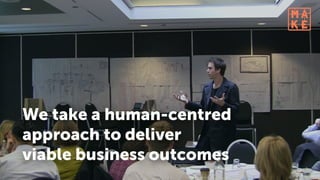
We take a human-centred
approach to deliver 

viable business outcomes
Customer
Journey
Maps to
Improve the
Claims
Experience
• Describing the end to end customer experience in order to
determine the key touch-points
• Identifying the most critical touch points on the journey to
pinpoint the key moments of truth
• Identifying the places where investment in higher levels of
service are more likely to attract or retain customers
• Overcoming common organisational obstacles
• Understanding how the customer journey extends beyond
your processes
• Uncovering your true customer goals, and mapping them
to your touchpoints
• Research methods to build an empathetic understanding
of customer experience
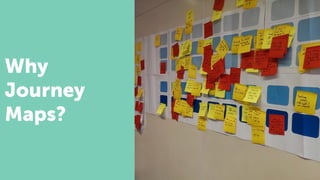
Why
Journey
Maps?
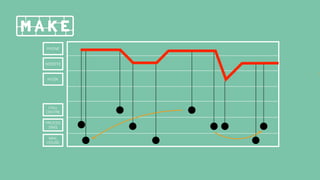
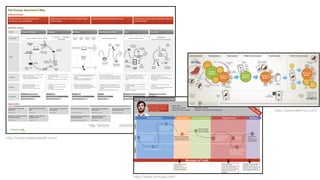
PHONE
MAIL
HOUSE
WEBSITE
KIOSK
CALL
CENTRE
PROCES
SING
FEELING
DOING
THINKING
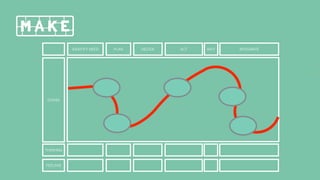
IDENTIFY NEED PLAN INTEGRATEDECIDE ACT WAIT
http://www.adaptivepath.com/
http://www.shmula.com/
http://www.delvinia.com/
Developing Customer Journey Maps
Some Principles
bigger than you
through your customers eyes
solve for the system
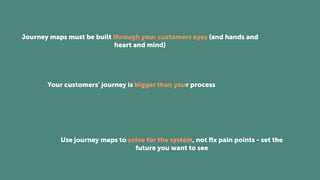
Journey maps must be built through your customers eyes (and hands and
heart and mind)
Your customers’ journey is bigger than your process
Use journey maps to solve for the system, not fix pain points - set the
future you want to see
Bigger Than
You
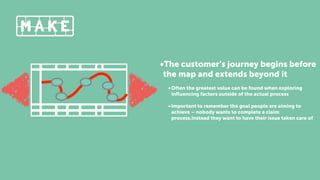
•The customer’s journey begins before
the map and extends beyond it
•Often the greatest value can be found when exploring
influencing factors outside of the actual process
•Important to remember the goal people are aiming to
achieve – nobody wants to complete a claim
process,instead they want to have their issue taken care of
•Uncovering true customer goals
•A goal is a state of existence, not the completion of a task
•Important to remember, as often a customer goal is not
increased efficiency, but to actually be led towards a state
of being
Solve For
The System
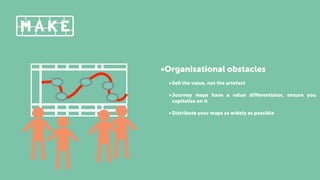
•Organisational obstacles
•Sell the value, not the artefact
•Journey maps have a value differentiator, ensure you
capitalise on it
•Distribute your maps as widely as possible
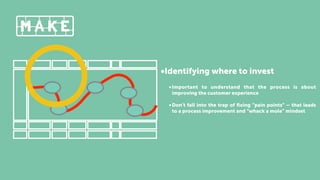
•Identifying where to invest
•Important to understand that the process is about
improving the customer experience
•Don’t fall into the trap of fixing “pain points” – that leads
to a process improvement and “whack a mole” mindset
Through
Your
Customers
Eyes
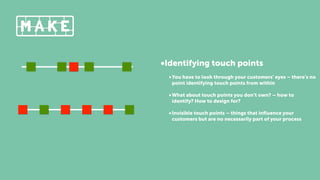
•Identifying touch points
•You have to look through your customers’ eyes – there’s no
point identifying touch points from within
•What about touch points you don’t own? – how to
identify? How to design for?
•Invisible touch points – things that influence your
customers but are no necessarily part of your process
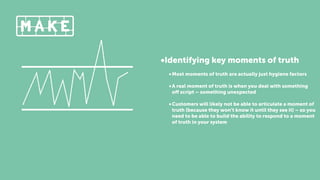
•Identifying key moments of truth
•Most moments of truth are actually just hygiene factors
•A real moment of truth is when you deal with something
off script – something unexpected
•Customers will likely not be able to articulate a moment of
truth (because they won’t know it until they see it) – so you
need to be able to build the ability to respond to a moment
of truth in your system
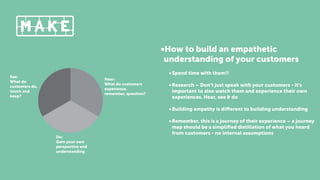
•How to build an empathetic
understanding of your customers
•Spend time with them!!
•Research – Don’t just speak with your customers - it’s
important to also watch them and experience their own
experiences. Hear, see & do
•Building empathy is different to building understanding
•Remember, this is a journey of their experience – a journey
map should be a simplified distillation of what you heard
from customers - no internal assumptions
Hear:
What do customers
experience,
remember, question?
See:
What do
customers do,
touch and
keep?
Do:
Gain your own
perspective and
understanding
Journey maps must be built through your customers eyes (and hands and
heart and mind)
Your customers’ journey is bigger than your process
Use journey maps to solve for the system, not fix pain points - set the
future you want to see
bigger than you
through your customers eyes
solve for the system
Human-Centred Business Design
www.makestudios.com.au

Developing Customer Journey Maps

  • 1.
    Customer Journey Mapsto Improve the Claims Experience Friday 29 May 2015
  • 2.
    With an AsiaPacific regional presence and focus, we provide human-centred business design and innovation services for clients across a variety of sectors. About Make www.makestudios.com.au Owen Hodda Human-Centred Design Lead 0401 855 380
  • 3.
    We take ahuman-centred approach to deliver 
 viable business outcomes
  • 4.
    Customer Journey Maps to Improve the Claims Experience •Describing the end to end customer experience in order to determine the key touch-points • Identifying the most critical touch points on the journey to pinpoint the key moments of truth • Identifying the places where investment in higher levels of service are more likely to attract or retain customers • Overcoming common organisational obstacles • Understanding how the customer journey extends beyond your processes • Uncovering your true customer goals, and mapping them to your touchpoints • Research methods to build an empathetic understanding of customer experience
  • 5.
  • 6.
  • 7.
  • 8.
  • 9.
  • 10.
    Developing Customer JourneyMaps Some Principles
  • 11.
    bigger than you throughyour customers eyes solve for the system
  • 12.
    Journey maps mustbe built through your customers eyes (and hands and heart and mind) Your customers’ journey is bigger than your process Use journey maps to solve for the system, not fix pain points - set the future you want to see
  • 13.
  • 14.
    •The customer’s journeybegins before the map and extends beyond it •Often the greatest value can be found when exploring influencing factors outside of the actual process •Important to remember the goal people are aiming to achieve – nobody wants to complete a claim process,instead they want to have their issue taken care of
  • 15.
    •Uncovering true customergoals •A goal is a state of existence, not the completion of a task •Important to remember, as often a customer goal is not increased efficiency, but to actually be led towards a state of being
  • 16.
  • 17.
    •Organisational obstacles •Sell thevalue, not the artefact •Journey maps have a value differentiator, ensure you capitalise on it •Distribute your maps as widely as possible
  • 18.
    •Identifying where toinvest •Important to understand that the process is about improving the customer experience •Don’t fall into the trap of fixing “pain points” – that leads to a process improvement and “whack a mole” mindset
  • 19.
  • 20.
    •Identifying touch points •Youhave to look through your customers’ eyes – there’s no point identifying touch points from within •What about touch points you don’t own? – how to identify? How to design for? •Invisible touch points – things that influence your customers but are no necessarily part of your process
  • 21.
    •Identifying key momentsof truth •Most moments of truth are actually just hygiene factors •A real moment of truth is when you deal with something off script – something unexpected •Customers will likely not be able to articulate a moment of truth (because they won’t know it until they see it) – so you need to be able to build the ability to respond to a moment of truth in your system
  • 22.
    •How to buildan empathetic understanding of your customers •Spend time with them!! •Research – Don’t just speak with your customers - it’s important to also watch them and experience their own experiences. Hear, see & do •Building empathy is different to building understanding •Remember, this is a journey of their experience – a journey map should be a simplified distillation of what you heard from customers - no internal assumptions Hear: What do customers experience, remember, question? See: What do customers do, touch and keep? Do: Gain your own perspective and understanding
  • 23.
    Journey maps mustbe built through your customers eyes (and hands and heart and mind) Your customers’ journey is bigger than your process Use journey maps to solve for the system, not fix pain points - set the future you want to see
  • 24.
    bigger than you throughyour customers eyes solve for the system
  • 25.