Finding the Gaps With a
Customer Experience Map
Jill Hewitt
Customer Experience Designer
jhewitt@catalystinc.com
www.catalystinc.com
  August 18, 2014
Who Is Catalyst?
2
 A marketing agency that
helps clients acquire, retain
and develop long-term
relationships with customers
 We specialize in the retail
and financial services
industries
 Jill Hewitt
 Customer Experience
Designer
Key Takeaways
1.  What is a customer experience map and
how to create one
2.  How to use a customer experience map to
pinpoint gaps in your customers’
experience
3.  How to apply your findings to create a
competitive advantage
Today’s Customer Experience
4
Source: venturebeat.com sponsored
post by Gigya: “The current state of
cross-channel commerce”, August 2014
The Omni-Channel Challenge
5
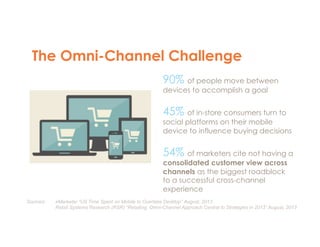
90% of people move between
devices to accomplish a goal
45% of in-store consumers turn to
social platforms on their mobile
device to influence buying decisions
54% of marketers cite not having a
consolidated customer view across
channels as the biggest roadblock
to a successful cross-channel
experience
Sources: eMarketer “US Time Spent on Mobile to Overtake Desktop” August, 2013
Retail Systems Research (RSR) “Retailing: Omni-Channel Approach Central to Strategies in 2013” August, 2013
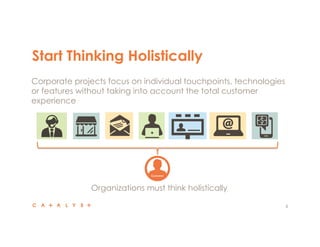
 Corporate projects focus on individual touchpoints, technologies
or features without taking into account the total customer
experience
Start Thinking Holistically
6
 Organizations must think holistically
What Is a Customer Experience Map?
7
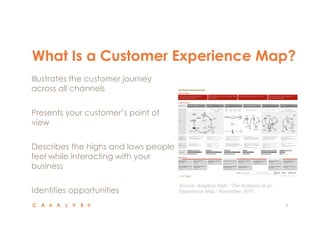
 Illustrates the customer journey
across all channels
 Presents your customer’s point of
view
 Describes the highs and lows people
feel while interacting with your
business
 Identifies opportunities
Source: Adaptive Path, “The Anatomy of an
Experience Map,” November, 2011
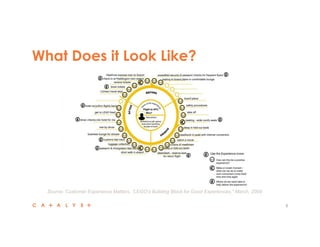
What Does it Look Like?
8
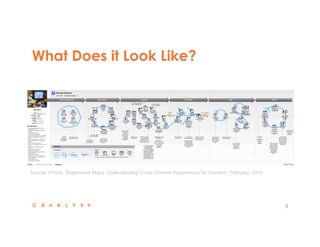
Source: nForm, “Experience Maps: Understanding Cross-Channel Experiences for Gamers,” February, 2010
What Does it Look Like?
9
Source: Customer Experience Matters, “LEGO’s Building Block for Good Experiences,” March, 2009
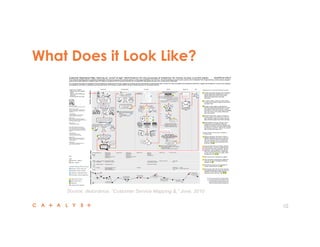
What Does it Look Like?
10
Source: desonance, “Customer Service Mapping &,” June, 2010
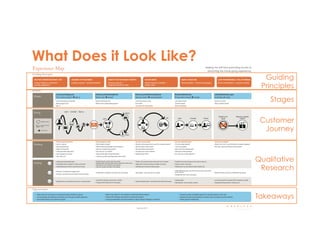
What Does it Look Like?
Guiding
Principles
Customer
Journey
Qualitative
Research
Takeaways
Stages
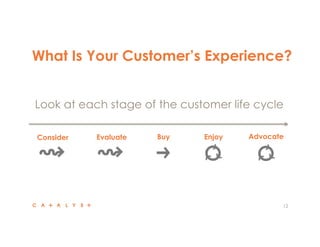
What Is Your Customer’s Experience?
12
 Look at each stage of the customer life cycle
Consider BuyEvaluate AdvocateEnjoy
Step 1: Inventory
Identify customer touch points across channels
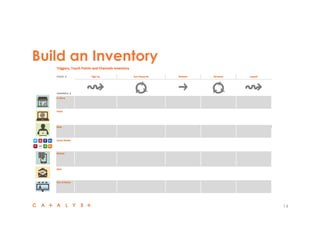
Build an Inventory
14
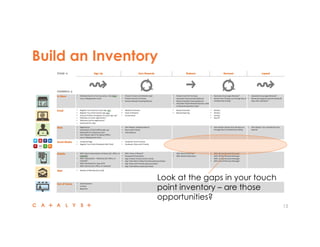
Build an Inventory
15
 Look at the gaps in your touch
point inventory – are those
opportunities?
Step 2: Research
Elicit the customer’s point of view
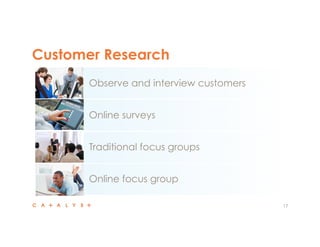
Observe and interview customers
Online surveys
Traditional focus groups
Online focus group
17
Customer Research
18
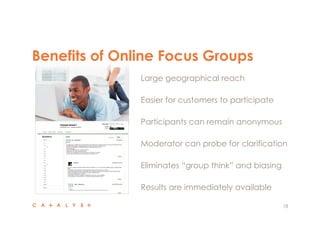
 Large geographical reach
 Easier for customers to participate
 Participants can remain anonymous
 Moderator can probe for clarification
 Eliminates “group think” and biasing
 Results are immediately available
Benefits of Online Focus Groups
Customer Feedback
19
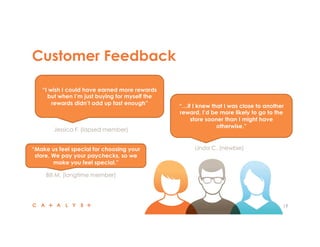
“…if I knew that I was close to another
reward, I’d be more likely to go to the
store sooner than I might have
otherwise.”
  Linda C. (newbie)
“I wish I could have earned more rewards
but when I’m just buying for myself the
rewards didn’t add up fast enough”
  Jessica F. (lapsed member)
  Bill M. (longtime member)
“Make us feel special for choosing your
store. We pay your paychecks, so we
make you feel special.”
Step 3: Workshops
Analyze and summarize what customers are thinking
and feeling
Stakeholder Workshops
21
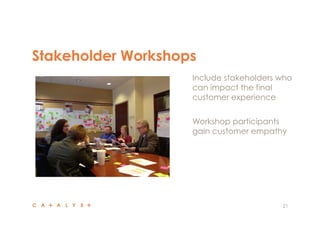
Include stakeholders who
can impact the final
customer experience
Workshop participants
gain customer empathy
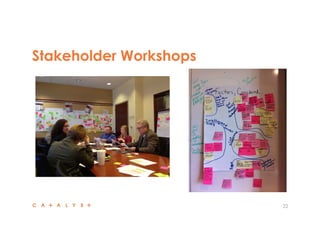
Stakeholder Workshops
22
Step 4: Feelings
Define the highs and lows
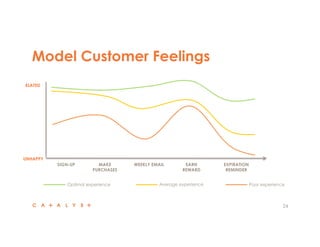
Model Customer Feelings
24
UNHAPPY
ELATED
Optimal experience Average experience Poor experience
SIGN-UP WEEKLY EMAILMAKE
PURCHASES
EXPIRATION
REMINDER
EARN
REWARD
Step 5: Map
Putting it all together
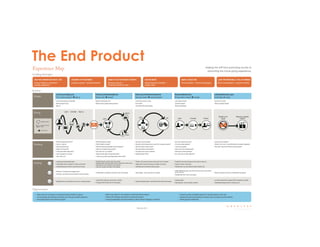
The End Product
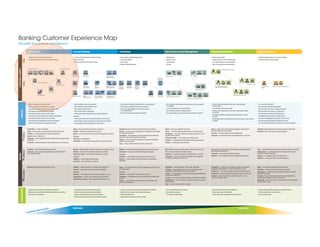
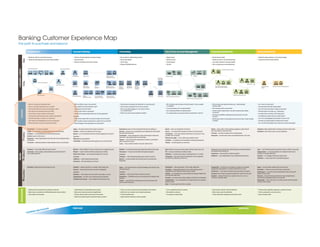
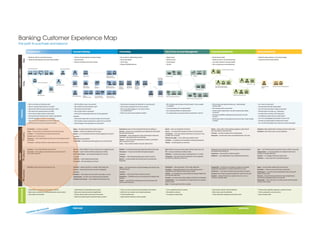
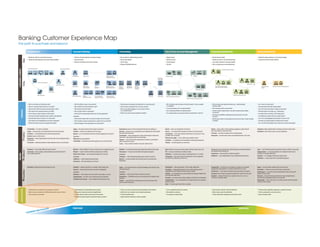
Customer Experience Map in Action
Banking
28
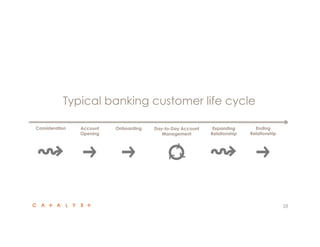
 Typical banking customer life cycle
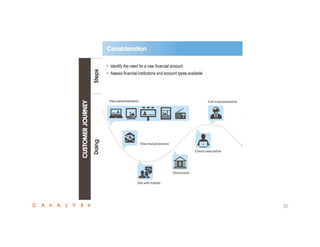
Consideration Onboarding Ending
Relationship
Account
Opening
Expanding
Relationship
Day-to-Day Account
Management
29
30
31
32
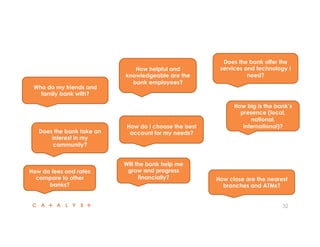
Who do my friends and
family bank with?
How do I choose the best
account for my needs?
Does the bank offer the
services and technology I
need?
How close are the nearest
branches and ATMs?
How do fees and rates
compare to other
banks?
How big is the bank’s
presence (local,
national,
international)?
Does the bank take an
interest in my
community?
How helpful and
knowledgeable are the
bank employees?
Will the bank help me
grow and progress
financially?
33
34
35
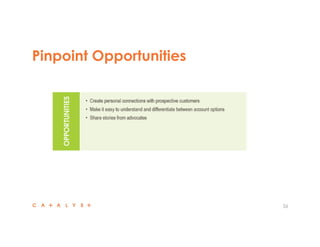
Pinpoint Opportunities
36
Identifying Customer Themes:
Guiding Principles
37
 Themes that carry through all stages of the life
cycle
 Use your guiding principles as a litmus test for
the success of organizational initiatives now
and in the future
Guiding Principles
38
Know me Remember me
Make me
feel special Help me succeed
Always be
there for me
Get better connected
to your customers.
Stay connected with
more relevant touches.
Proactively optimize
their account and
make product
suggestions that are
tailored to them.
Continue to improve
online tools and
technology.
Be there 24/7
for your customers:
whenever/wherever/
however.
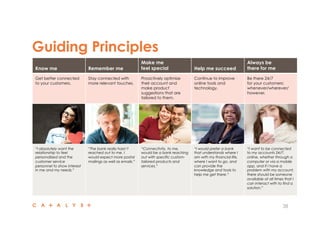
“I absolutely want the
relationship to feel
personalized and the
customer service
personnel to show interest
in me and my needs.”
“The bank really hasn’t
reached out to me. I
would expect more postal
mailings as well as emails.”
“Connectivity, to me,
would be a bank reaching
out with specific custom-
tailored products and
services.”
“I would prefer a bank
that understands where I
am with my financial life,
where I want to go, and
can provide the
knowledge and tools to
help me get there.”
“I want to be connected
to my accounts 24/7,
online, whether through a
computer or via a mobile
app, and if I have a
problem with my account,
there should be someone
available at all times that I
can interact with to find a
solution.”
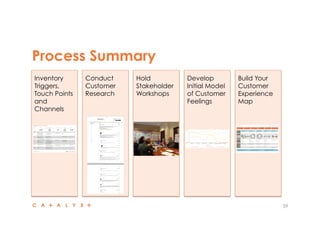
Process Summary
39
Inventory
Triggers,
Touch Points
and
Channels
Conduct
Customer
Research
Develop
Initial Model
of Customer
Feelings
Hold
Stakeholder
Workshops
Build Your
Customer
Experience
Map
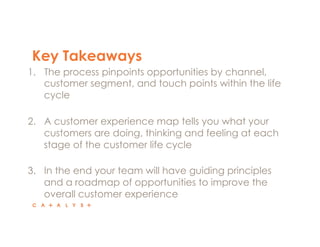
Key Takeaways
1.  The process pinpoints opportunities by channel,
customer segment, and touch points within the life
cycle
2.  A customer experience map tells you what your
customers are doing, thinking and feeling at each
stage of the customer life cycle
3.  In the end your team will have guiding principles
and a roadmap of opportunities to improve the
overall customer experience
Questions?
Jill Hewitt
585.720.4952
jhewitt@catalystinc.com
@jhewitt98
www.catalystinc.com
41

Find the Gaps with a Customer Experience Map CRMEvolution 2014

  • 1.
    Finding the GapsWith a Customer Experience Map Jill Hewitt Customer Experience Designer jhewitt@catalystinc.com www.catalystinc.com   August 18, 2014
  • 2.
    Who Is Catalyst? 2  Amarketing agency that helps clients acquire, retain and develop long-term relationships with customers  We specialize in the retail and financial services industries  Jill Hewitt  Customer Experience Designer
  • 3.
    Key Takeaways 1.  Whatis a customer experience map and how to create one 2.  How to use a customer experience map to pinpoint gaps in your customers’ experience 3.  How to apply your findings to create a competitive advantage
  • 4.
    Today’s Customer Experience 4 Source:venturebeat.com sponsored post by Gigya: “The current state of cross-channel commerce”, August 2014
  • 5.
    The Omni-Channel Challenge 5 90%of people move between devices to accomplish a goal 45% of in-store consumers turn to social platforms on their mobile device to influence buying decisions 54% of marketers cite not having a consolidated customer view across channels as the biggest roadblock to a successful cross-channel experience Sources: eMarketer “US Time Spent on Mobile to Overtake Desktop” August, 2013 Retail Systems Research (RSR) “Retailing: Omni-Channel Approach Central to Strategies in 2013” August, 2013
  • 6.
     Corporate projects focuson individual touchpoints, technologies or features without taking into account the total customer experience Start Thinking Holistically 6  Organizations must think holistically
  • 7.
    What Is aCustomer Experience Map? 7  Illustrates the customer journey across all channels  Presents your customer’s point of view  Describes the highs and lows people feel while interacting with your business  Identifies opportunities Source: Adaptive Path, “The Anatomy of an Experience Map,” November, 2011
  • 8.
    What Does itLook Like? 8 Source: nForm, “Experience Maps: Understanding Cross-Channel Experiences for Gamers,” February, 2010
  • 9.
    What Does itLook Like? 9 Source: Customer Experience Matters, “LEGO’s Building Block for Good Experiences,” March, 2009
  • 10.
    What Does itLook Like? 10 Source: desonance, “Customer Service Mapping &,” June, 2010
  • 11.
    What Does itLook Like? Guiding Principles Customer Journey Qualitative Research Takeaways Stages
  • 12.
    What Is YourCustomer’s Experience? 12  Look at each stage of the customer life cycle Consider BuyEvaluate AdvocateEnjoy
  • 13.
    Step 1: Inventory Identifycustomer touch points across channels
  • 14.
  • 15.
    Build an Inventory 15  Lookat the gaps in your touch point inventory – are those opportunities?
  • 16.
    Step 2: Research Elicitthe customer’s point of view
  • 17.
    Observe and interviewcustomers Online surveys Traditional focus groups Online focus group 17 Customer Research
  • 18.
    18  Large geographical reach  Easierfor customers to participate  Participants can remain anonymous  Moderator can probe for clarification  Eliminates “group think” and biasing  Results are immediately available Benefits of Online Focus Groups
  • 19.
    Customer Feedback 19 “…if Iknew that I was close to another reward, I’d be more likely to go to the store sooner than I might have otherwise.”   Linda C. (newbie) “I wish I could have earned more rewards but when I’m just buying for myself the rewards didn’t add up fast enough”   Jessica F. (lapsed member)   Bill M. (longtime member) “Make us feel special for choosing your store. We pay your paychecks, so we make you feel special.”
  • 20.
    Step 3: Workshops Analyzeand summarize what customers are thinking and feeling
  • 21.
    Stakeholder Workshops 21 Include stakeholderswho can impact the final customer experience Workshop participants gain customer empathy
  • 22.
  • 23.
    Step 4: Feelings Definethe highs and lows
  • 24.
    Model Customer Feelings 24 UNHAPPY ELATED Optimalexperience Average experience Poor experience SIGN-UP WEEKLY EMAILMAKE PURCHASES EXPIRATION REMINDER EARN REWARD
  • 25.
    Step 5: Map Puttingit all together
  • 26.
  • 27.
    Customer Experience Mapin Action Banking
  • 28.
    28  Typical banking customerlife cycle Consideration Onboarding Ending Relationship Account Opening Expanding Relationship Day-to-Day Account Management
  • 29.
  • 30.
  • 31.
  • 32.
    32 Who do myfriends and family bank with? How do I choose the best account for my needs? Does the bank offer the services and technology I need? How close are the nearest branches and ATMs? How do fees and rates compare to other banks? How big is the bank’s presence (local, national, international)? Does the bank take an interest in my community? How helpful and knowledgeable are the bank employees? Will the bank help me grow and progress financially?
  • 33.
  • 34.
  • 35.
  • 36.
  • 37.
    Identifying Customer Themes: GuidingPrinciples 37  Themes that carry through all stages of the life cycle  Use your guiding principles as a litmus test for the success of organizational initiatives now and in the future
  • 38.
    Guiding Principles 38 Know meRemember me Make me feel special Help me succeed Always be there for me Get better connected to your customers. Stay connected with more relevant touches. Proactively optimize their account and make product suggestions that are tailored to them. Continue to improve online tools and technology. Be there 24/7 for your customers: whenever/wherever/ however. “I absolutely want the relationship to feel personalized and the customer service personnel to show interest in me and my needs.” “The bank really hasn’t reached out to me. I would expect more postal mailings as well as emails.” “Connectivity, to me, would be a bank reaching out with specific custom- tailored products and services.” “I would prefer a bank that understands where I am with my financial life, where I want to go, and can provide the knowledge and tools to help me get there.” “I want to be connected to my accounts 24/7, online, whether through a computer or via a mobile app, and if I have a problem with my account, there should be someone available at all times that I can interact with to find a solution.”
  • 39.
    Process Summary 39 Inventory Triggers, Touch Points and Channels Conduct Customer Research Develop InitialModel of Customer Feelings Hold Stakeholder Workshops Build Your Customer Experience Map
  • 40.
    Key Takeaways 1.  Theprocess pinpoints opportunities by channel, customer segment, and touch points within the life cycle 2.  A customer experience map tells you what your customers are doing, thinking and feeling at each stage of the customer life cycle 3.  In the end your team will have guiding principles and a roadmap of opportunities to improve the overall customer experience
  • 41.