Developing civic participation
Overview
1. Learning lessons from involving residents in policy making
2. Working with residents to improve their communities
3. Developing a participation framework
1. Learning lessons from involving residents
in policy making
To ensure that the voices of citizens can shape policy
making, it’s important that leaders of local areas
 Create opportunities for residents to be involved
in designing and delivering policies and services
 Value the different strengths & expertise of people
from different backgrounds and sectors in shaping
the lives of people and our neighbourhoods
 Improve how we support participation with
residents and partners so that we work more in
partnership and devolve power to residents
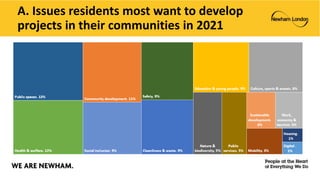
A. Issues residents most want to develop
projects in their communities in 2021
B. Strength of residents’ social connections and
peer to peer support
Majority of people accessed
the food service for support
during the pandemic
C. Issues important to residents to help everyone
recover from the pandemic
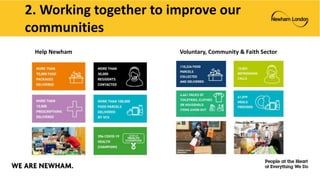
Help Newham Voluntary, Community & Faith Sector
2. Working together to improve our
communities
Building on the borough’s solidarity
A. Residents as “policy makers”
We have established the UK’s first permanent citizens assembly to
develop our future strategies in a way that is
Builds inclusion
Builds consensus
Builds skills
B. Residents as “budget makers”
• We run one of the country’s largest participatory
budgeting programmes, through our Community
Assemblies, where we provide £100k for each of our
neighbourhoods for people to decide on budget priorities
for those areas, and then what projects should be
funded.
• Each Community Neighbourhood has a working group
from the previous cycle of assemblies that consists of
local people who live, work or learn in the area,
councillors and council officers using an online
participatory budgeting platform.
• They work together to review the priorities and the
information that has emerged from the new cycle of
community assemblies. They then make an assessment
on the local priorities and advise on the appropriate
projects and activities, using their local knowledge of the
neighbourhood area.
https://newhamco-create.co.uk/en/folders/assemblies
C. Residents as “community builders”
https://newhamco-create.co.uk/en/folders/assemblies
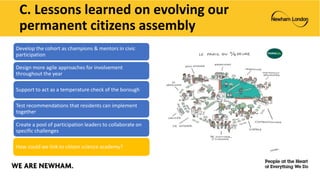
C. Lessons learned on evolving our
permanent citizens assembly
Develop the cohort as champions & mentors in civic
participation
Design more agile approaches for involvement
throughout the year
Support to act as a temperature check of the borough
Test recommendations that residents can implement
together
Create a pool of participation leaders to collaborate on
specific challenges
How could we link to citizen science academy?
3. How do we improve participation?
A. How do we improve how we support
residents to participate?
Quality
Improve the quality of
resident participation
activities
Experience
Improve the
experiences Newham
residents have when
they participate
Decisions
Enable the council to
make better informed
decisions
D. Developing a participation
framework
Training
Learn different participation methods
Access practical tools & show & tells
Apply the training on real scenarios
Collective
Share learning & solve issues with peers
Identify opportunities to collaborate
Shape future work on participation
Practice
Participants go on placements across partners
Applied learning on challenges set by partners
Scope
Collective &
Framework
Experiments, Training &
Learning
Understanding
peoples
experiences
Mapping
what’s
involved Identifying
themes
Seeking
Feedback and
refining
Rapid testing
of ideas
Measuring
impact
E. Test out how we improve
participation on specific issues
Social care &
health
Housing
Planning &
regeneration
Young
people
F. How would you want to be involved?
Share a case study
of good practice of
engagement &
participation
Share any training
you do on
participation
Host a session
sharing good
practice on
participation
Help shape the
development of a
participation
collective

Developing civic participation

  • 1.
  • 2.
    Overview 1. Learning lessonsfrom involving residents in policy making 2. Working with residents to improve their communities 3. Developing a participation framework
  • 3.
    1. Learning lessonsfrom involving residents in policy making To ensure that the voices of citizens can shape policy making, it’s important that leaders of local areas  Create opportunities for residents to be involved in designing and delivering policies and services  Value the different strengths & expertise of people from different backgrounds and sectors in shaping the lives of people and our neighbourhoods  Improve how we support participation with residents and partners so that we work more in partnership and devolve power to residents
  • 4.
    A. Issues residentsmost want to develop projects in their communities in 2021
  • 5.
    B. Strength ofresidents’ social connections and peer to peer support Majority of people accessed the food service for support during the pandemic
  • 6.
    C. Issues importantto residents to help everyone recover from the pandemic
  • 7.
    Help Newham Voluntary,Community & Faith Sector 2. Working together to improve our communities
  • 8.
    Building on theborough’s solidarity
  • 9.
    A. Residents as“policy makers” We have established the UK’s first permanent citizens assembly to develop our future strategies in a way that is Builds inclusion Builds consensus Builds skills
  • 10.
    B. Residents as“budget makers” • We run one of the country’s largest participatory budgeting programmes, through our Community Assemblies, where we provide £100k for each of our neighbourhoods for people to decide on budget priorities for those areas, and then what projects should be funded. • Each Community Neighbourhood has a working group from the previous cycle of assemblies that consists of local people who live, work or learn in the area, councillors and council officers using an online participatory budgeting platform. • They work together to review the priorities and the information that has emerged from the new cycle of community assemblies. They then make an assessment on the local priorities and advise on the appropriate projects and activities, using their local knowledge of the neighbourhood area. https://newhamco-create.co.uk/en/folders/assemblies
  • 11.
    C. Residents as“community builders” https://newhamco-create.co.uk/en/folders/assemblies
  • 12.
    C. Lessons learnedon evolving our permanent citizens assembly Develop the cohort as champions & mentors in civic participation Design more agile approaches for involvement throughout the year Support to act as a temperature check of the borough Test recommendations that residents can implement together Create a pool of participation leaders to collaborate on specific challenges How could we link to citizen science academy?
  • 13.
    3. How dowe improve participation?
  • 14.
    A. How dowe improve how we support residents to participate? Quality Improve the quality of resident participation activities Experience Improve the experiences Newham residents have when they participate Decisions Enable the council to make better informed decisions
  • 15.
    D. Developing aparticipation framework Training Learn different participation methods Access practical tools & show & tells Apply the training on real scenarios Collective Share learning & solve issues with peers Identify opportunities to collaborate Shape future work on participation Practice Participants go on placements across partners Applied learning on challenges set by partners
  • 16.
    Scope Collective & Framework Experiments, Training& Learning Understanding peoples experiences Mapping what’s involved Identifying themes Seeking Feedback and refining Rapid testing of ideas Measuring impact E. Test out how we improve participation on specific issues Social care & health Housing Planning & regeneration Young people
  • 17.
    F. How wouldyou want to be involved? Share a case study of good practice of engagement & participation Share any training you do on participation Host a session sharing good practice on participation Help shape the development of a participation collective

Editor's Notes

  • #3 From Democracy Commission, 2020 To inform the recommendations for the Democracy Commission, residents were engaged on the following topics: Involving residents in local decision making: Residents wanted the council and councillors being more visible, getting out and listening to residents and to involve them more in decisions and in developing services, communicate in a more transparent way and enable better feedback and accountability Using digital tools for local democracy: Council should better use digital tools to communicate and share information and promotion and outreach, give local people ways of speaking up online, and tackle barriers to digital exclusion Working in partnership with residents: The most important areas that residents thought the council should work with them on were public spaces, youth services, community safety, housing & homelessness, environment & climate change, planning & regeneration, traffic & parking and local businesses. They wanted greater co-production and empowering bottom up action Giving equal voice to all: Residents wanted improvements in reporting issues, accessing services and even making routine contact with the Council and for the Council, and in particular getting feedback from the Council, and issue such as not just listening to the loudest voices, tackling language & disability barriers to getting involved, using a range of formats to engage, reaching out through networks Supporting communities: supporting what community members are already doing, listening more to residents and providing education & training on local democracy & participation, raise the profile of councillors and supporting community centres & activities Choosing the best structures for local decision making: Improved transparency & scrutiny
  • #4 From Democracy Commission, 2020 To inform the recommendations for the Democracy Commission, residents were engaged on the following topics: Involving residents in local decision making: Residents wanted the council and councillors being more visible, getting out and listening to residents and to involve them more in decisions and in developing services, communicate in a more transparent way and enable better feedback and accountability Using digital tools for local democracy: Council should better use digital tools to communicate and share information and promotion and outreach, give local people ways of speaking up online, and tackle barriers to digital exclusion Working in partnership with residents: The most important areas that residents thought the council should work with them on were public spaces, youth services, community safety, housing & homelessness, environment & climate change, planning & regeneration, traffic & parking and local businesses. They wanted greater co-production and empowering bottom up action Giving equal voice to all: Residents wanted improvements in reporting issues, accessing services and even making routine contact with the Council and for the Council, and in particular getting feedback from the Council, and issue such as not just listening to the loudest voices, tackling language & disability barriers to getting involved, using a range of formats to engage, reaching out through networks Supporting communities: supporting what community members are already doing, listening more to residents and providing education & training on local democracy & participation, raise the profile of councillors and supporting community centres & activities Choosing the best structures for local decision making: Improved transparency & scrutiny
  • #5 Phase 1 started place in April, with a focus on local priority ideas. These ideas were submitted onto the Co-create platform during the first assembly events as well as at any time up to the deadline of 3rd May. Phase 2, over 1,000 residents voted on their top 3 priorities, announced on May 25th and a call out for project applications opened. Phase 3 Working Groups are now shortlisting and assessing approximately 200 proposals. Phase 1: Over 1,100 participants took part in the 16 Community Assemblies held across April, approximately 27% were new participants who attended a Community Assembly for the first time The number of users signed up to the platform since March increased by approximately 600 giving a total of 1,499 registered users During phase 1 of engagement, over 1,100 submissions of priority topics were submitted on the platform across the eight neighbourhoods The top 5 emerging themes on the platform were around: Public spaces and buildings, Health and welfare, Community development, Social inclusion, Safety The Community Assemblies process has a lot of elements to it that has stretched the functionality of the online engagement tool, however the developers are working with the council to upgrade and develop their platform to meet Newham's needs. Over 100 residents applied to be part of the Working Group process. Currently 188 residents, council officers, Cllrs and stakeholders form the eight Community Assembly Working Groups for this cycle. 24 active Cllrs are involved in the Working Group. The Working Groups have been involved with shortlisting of priorities and screening / scoring stage 1 and 2 project applications to put projects forward to the voting round. The group will is responsible for monitoring the delivery of community projects from August 2021. “It is good to see the council and residents having conversations and working together on this platform, to improve areas of Newham”. "The event was an eye opener it terms of Council's objectives to engage with and involve local communities to help shape and develop vital services and initiatives” “It's good to see neighbours and hear as well as share views, so often we mix with the same circles or see the same views on social media. The assemblies bring the community together” “The Community Assemblies are such a great idea. It was really good that so many people took part which can only mean that we are all very keen to be involved in positive change for where we live!” Phase 2: The top voted priorities for the whole borough were Environment, Community Safety, Green spaces and Parks, Inclusive and Improved indoor and outdoor spaces and Sustainable Development, Nature and Biodiversity. Phase 3: Where we are now Working groups are currently reviewing and scoring applications and will also be developing some project proposals. 2,249 users now registered on Newham co-create (66% increase since phase 1). 206 project ideas and 376 comments received on co-create platform. 193 stage 1 application of project proposals received. 150 applications are anticipated to progress onto stage 2. Service improvements are being filtered out and passed onto the appropriate service areas. Next steps Phase 3 Working Groups continue to score Stage 2 applications Phase 4 Second round of Community Assembly meetings from 5 to 15 July Phase 5 Local people to vote on projects for up to £100K from 16 to 26 July Phase 6 Delivery of projects commences August 2021 Autumn Community assembly progress report to be presented at Cabinet in October 2021 The next round of Community Assemblies will be held across the first two weeks of July on Zoom and will be an opportunity for local residents to hear about projects that will be going forward to the participatory budgeting phase and to also learn about how to vote for the projects online.
  • #6 NQ17. Do you have a spouse, partner, family member or friend to rely on if you have a serious problem? Q12. How often do you meet socially with friends, relatives or work colleagues? The likelihood of socialising each week is linked to disability and age
  • #7 Community cohesion, people are coming out of isolation but communities need support to come back even stronger There is a chance we may not be able to cope in the future Recovery: How do we help ensure all communities in Newham recover from the impact of the pandemic? (Time to Talk) Feeling tired, lost a lot of people, George Floyd’s murder has increased the speed of outlining racism Mental health has been affected due to loss of family and loved one, it's important to address and provide support Isolation that people have experienced have been amplified by the use of technology. Those who don’t have technology may not recover quickly. How can we help those who don't have appropriate support Elderly family members have shown resilience, despite being left alone. The impact has been significant and more vulnerable people may be left along for longer Working with the NHS to support people in the community and what the model should be for that and finding ways to understand residents better The impact on children with COVID-19, it has affected their health Specific services for the community are important Finance will be a key issue for many residents Huge impact on the education system and the children. Resilience in the community, although people have been lost, should be continued The issue of resourcing is important, there is a lot to do, in regards to furlough, job loss, PTSD, there needs to be clear policy to understand what is the key to solve this problem People have looked inward to find solutions but we need resources to support people. There isn't just one cure for all • Arts have a valuable role in mirroring our feelings and giving people support so that they can feel better and move forward People are concerned with mixing in larger groups, we need to find ways of engaging people into soft leisure, getting people confident to move forward and uplift the community Helping people emotionally, physical support is very important Depending on what is in our power to help people, creating opportunities for those to have a proper living wage job, doing things to create policies, having a dialogue to understand what will help people with finding jobs
  • #8 We set up Help Newham to mobilise staff and residents to provide emergency support during the pandemic. We set up the Newham Social Welfare Alliance which brings together frontline workers from local organisations to support residents together who are at risk of crisis or in crisis. We have set up local Health Champions to co-produce how we engage residents in protecting themselves from the virus, which is now leading a national network of Health Champions. We are supporting partners leading on participation programmes such as the London Prosperity Board’s citizen science programme and Birkbeck University’s community leadership programme in Newham, and commissioned Compost to support the borough’s voluntary, community & faith sector to develop its capability From Democracy Commission, 2020 To inform the recommendations for the Democracy Commission, residents were engaged on the following topics: Involving residents in local decision making: Residents wanted the council and councillors being more visible, getting out and listening to residents and to involve them more in decisions and in developing services, communicate in a more transparent way and enable better feedback and accountability Using digital tools for local democracy: Council should better use digital tools to communicate and share information and promotion and outreach, give local people ways of speaking up online, and tackle barriers to digital exclusion Working in partnership with residents: The most important areas that residents thought the council should work with them on were public spaces, youth services, community safety, housing & homelessness, environment & climate change, planning & regeneration, traffic & parking and local businesses. They wanted greater co-production and empowering bottom up action Giving equal voice to all: Residents wanted improvements in reporting issues, accessing services and even making routine contact with the Council and for the Council, and in particular getting feedback from the Council, and issue such as not just listening to the loudest voices, tackling language & disability barriers to getting involved, using a range of formats to engage, reaching out through networks Supporting communities: supporting what community members are already doing, listening more to residents and providing education & training on local democracy & participation, raise the profile of councillors and supporting community centres & activities Choosing the best structures for local decision making: Improved transparency & scrutiny
  • #9 Volunteering has always been part of everyday life in Newham. The contribution of volunteers during the Covid- 19 pandemic has been significant. It’s important to recognise that this huge effort was facilitated and supported by a solid foundation of existing volunteering activity. Volunteering has a great impact - it brings a host of benefits that are social and personal not only to the individual, but also to the organisations that they support to deliver so many services. Newham Staff Volunteering and aspirations There is great value to be realised from Employer Supported Volunteering (ESV), where staff from organisations and businesses are supported to volunteer in their community, and given the opportunity to contribute the act of giving time and support to their community. Experience from the Covid-19 pandemic response saw some of London Borough of Newham’s workforce support the establishment of #HelpNewham, where staff helped in the effort of responding to the call to help put together food parcels at foodbanks and made befriending calls to vulnerable residents who were shielding during the lockdown. This was a crucial lifeline to those who were lonely, isolated and in need of support. The council is committed to building upon this approach by introducing a council-wide Employer Supported Volunteering (ESV) Programme Newham Businesses Newham based businesses also have a continued part to play in contributing toward the ongoing volunteering effort in the borough, whether it is through encouraging more of their staff to volunteer locally or building closer links with smaller enterprises or supporting schools. Improved co-ordination of volunteering across the borough will harness volunteering opportunities and encourage greater contribution of corporate social responsibility. The Voluntary, Community and Faith Sector Attempts to estimate how many residents volunteer in Newham is a challenge, as volunteer recruitment and coordination can happen at a very local level. Establishing a Newham Baseline – This is still work in progress and will be compiled by the Newham Volunteering Hub, once established, and updated as soon as is possible. https://www.newham.gov.uk/coronavirus-covid-19/covid-health-champions https://www.headstartnewham.co.uk/activities/
  • #10 We invite residents to vote on the issues the assembly should focus on. The next assembly will focus on 15 Minute Neighbourhoods. Inclusive in that it recognises the different roles that people play to tackle issues. That’s why the Council invites a representative set of people and people with lived experience Ambitious in that they can genuinely tackle the challenges and that by the end of this assembly, residents can work out what are the most important priorities to focus on within this issue Strengths-building helping residents develop “policy making” skills in learning different levers we can use, building consensus between competing perspectives to develop recommendations
  • #11 From Democracy Commission, 2020 To inform the recommendations for the Democracy Commission, residents were engaged on the following topics: Involving residents in local decision making: Residents wanted the council and councillors being more visible, getting out and listening to residents and to involve them more in decisions and in developing services, communicate in a more transparent way and enable better feedback and accountability Using digital tools for local democracy: Council should better use digital tools to communicate and share information and promotion and outreach, give local people ways of speaking up online, and tackle barriers to digital exclusion Working in partnership with residents: The most important areas that residents thought the council should work with them on were public spaces, youth services, community safety, housing & homelessness, environment & climate change, planning & regeneration, traffic & parking and local businesses. They wanted greater co-production and empowering bottom up action Giving equal voice to all: Residents wanted improvements in reporting issues, accessing services and even making routine contact with the Council and for the Council, and in particular getting feedback from the Council, and issue such as not just listening to the loudest voices, tackling language & disability barriers to getting involved, using a range of formats to engage, reaching out through networks Supporting communities: supporting what community members are already doing, listening more to residents and providing education & training on local democracy & participation, raise the profile of councillors and supporting community centres & activities Choosing the best structures for local decision making: Improved transparency & scrutiny
  • #12 From Democracy Commission, 2020 To inform the recommendations for the Democracy Commission, residents were engaged on the following topics: Involving residents in local decision making: Residents wanted the council and councillors being more visible, getting out and listening to residents and to involve them more in decisions and in developing services, communicate in a more transparent way and enable better feedback and accountability Using digital tools for local democracy: Council should better use digital tools to communicate and share information and promotion and outreach, give local people ways of speaking up online, and tackle barriers to digital exclusion Working in partnership with residents: The most important areas that residents thought the council should work with them on were public spaces, youth services, community safety, housing & homelessness, environment & climate change, planning & regeneration, traffic & parking and local businesses. They wanted greater co-production and empowering bottom up action Giving equal voice to all: Residents wanted improvements in reporting issues, accessing services and even making routine contact with the Council and for the Council, and in particular getting feedback from the Council, and issue such as not just listening to the loudest voices, tackling language & disability barriers to getting involved, using a range of formats to engage, reaching out through networks Supporting communities: supporting what community members are already doing, listening more to residents and providing education & training on local democracy & participation, raise the profile of councillors and supporting community centres & activities Choosing the best structures for local decision making: Improved transparency & scrutiny
  • #14 https://www.involve.org.uk/resources/publications/project-reports/pathways-through-participation
  • #15 Participation is as much about us involving ourselves in the lives of our communities, as it is involving people in our work Participation can take place in any interaction we have - at the point of contacting a service, tackling an issue that affects you and your loved ones, shaping the priorities for the borough
  • #16 The development of the participation framework, training & collective will help people at different levels to better support participation The participation academy will be an intensive programme to train future leaders in participation. It will use the participation framework as its foundation and focus on training people to get to the highest ladder of participation. It will use the participation collective to co-design the academy, as well as attracting funding for it, providing trainers/tutors, promoting it and overseeing its development.
  • #17 Services, partners & residents
  • #18 Current focus: inclusive participation and co-production