Downloaded 22 times




![w w w . d a v i d c l a r k e . b l o gw w w . d a v i d c l a r k e . b l o g
State-sponsored propaganda
https://www.dni.gov/files/documents/ICA_2017_01.pdf
• ‘a Russian messaging strategy [was
developed] that blends covert
intelligence operations—such as cyber
activity—with overt efforts by Russian
Government agencies, state-funded
media, third-party intermediaries, and
paid social media users or “trolls.”’
• ‘We assess Moscow will apply lessons
learned from its Putin-ordered campaign
aimed at the US presidential election to
future influence efforts worldwide,
including against US allies and their
election processes.’
• ‘the Russian Government aspired to
help President-elect Trump’s election
chances when possible by discrediting
Secretary Clinton’; and that
January 2017 ODNI Report](https://image.slidesharecdn.com/clarkeiskotruth20170912-170912134237/85/Developing-a-KO-Response-to-Post-Truth-and-Fake-News-18-320.jpg)



![w w w . d a v i d c l a r k e . b l o gw w w . d a v i d c l a r k e . b l o g
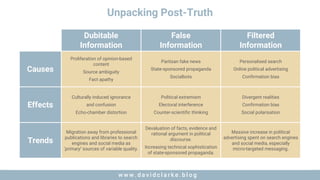
Dubitable information – trends
Migration away from professional
publications and libraries to online and
social media sources of variable quality.
‘34% of adults had used a public library service in the 12
months before being interviewed [in 2015]. This is a statistically
significant decrease [14%] since data collection began in
2005/06…’ Changing patterns of library use, Libraries Taskforce,
UK Dept. For Culture, Media & Sport, May 10, 2016:
https://librariestaskforce.blog.gov.uk/2016/05/10/changing-
patterns-of-library-use/
http://www.journalism.org/2016/05/26/news-
use-across-social-media-platforms-2016/
http://www.pewresearch.org/fact-
tank/2017/08/30/most-americans-
especially-millennials-say-libraries-can-help-
them-find-reliable-trustworthy-information/
Counter evidence
challenges the idea that
library use is in decline.](https://image.slidesharecdn.com/clarkeiskotruth20170912-170912134237/85/Developing-a-KO-Response-to-Post-Truth-and-Fake-News-32-320.jpg)
![w w w . d a v i d c l a r k e . b l o gw w w . d a v i d c l a r k e . b l o g
Need for impartial information during elections
https://www.electoral-reform.org.uk/doing-referendums-differently/
September 2016 ERS Article on the
EU Referendum:
• ‘glaring democratic deficiencies’
• ‘people felt they were ill-informed about
the issues’
• ‘misleading [campaign] claims could be
made with impunity’
• Need for ‘a minimum data set or
impartial information guide’
• Need for tools ‘for members of public to
host own debates’
• Need to make media coverage ‘more
deliberative than combative/binary.’](https://image.slidesharecdn.com/clarkeiskotruth20170912-170912134237/85/Developing-a-KO-Response-to-Post-Truth-and-Fake-News-33-320.jpg)

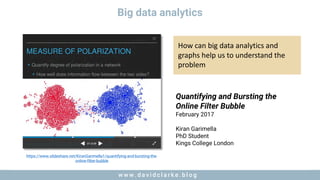

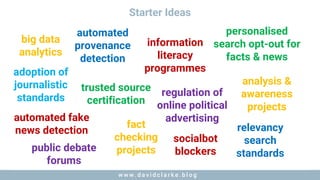
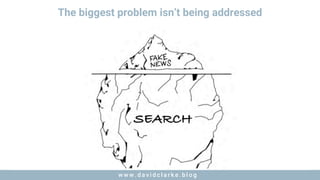
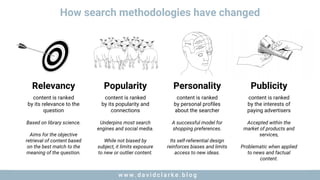



The document discusses the implications of the post-truth phenomenon characterized by the prevalence of fake news and the challenges of distinguishing factual information from opinion, exacerbated by personalized search algorithms and social media. It highlights how state-sponsored propaganda and computational propaganda distort democratic discourse and contribute to political polarization. The text also suggests several initiatives that could help mitigate these issues, including improved information literacy, automated fact-checking, and better regulation of online political advertising.


