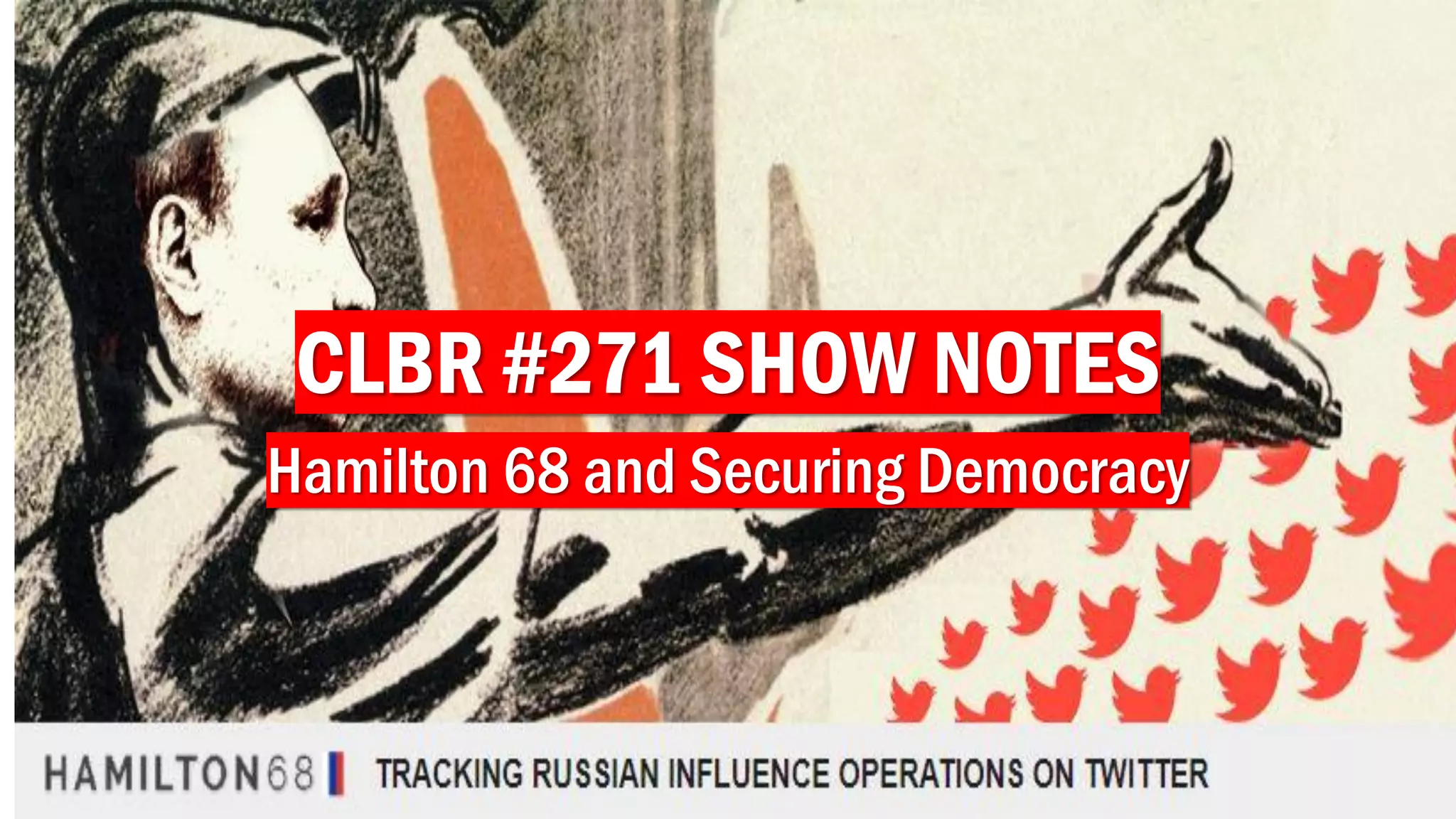
CLBR #271 SHOW NOTES
Hamilton 68 and Securing Democracy
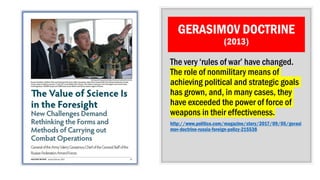
GERASIMOV DOCTRINE
(2013)
The very ‘rules of war’ have changed.
The role of nonmilitary means of
achieving political and strategic goals
has grown, and, in many cases, they
have exceeded the power of force of
weapons in their effectiveness.
http://www.politico.com/magazine/story/2017/09/05/gerasi
mov-doctrine-russia-foreign-policy-215538
We assess Russian President Vladimir Putin
ordered an influence campaign in 2016 aimed
at the US presidential election. Russia’s goals
were to undermine public faith in the US
democratic process, denigrate Secretary
Clinton, and harm her electability and
potential presidency. We further assess Putin
and the Russian Government developed a clear
preference for President-elect Trump. We have
high confidence in these judgments.
Moscow’s influence campaign followed a
Russian messaging strategy that blends covert
intelligence operations—such as cyber
activity—with overt efforts by Russian
Government agencies, state-funded media,
third-party intermediaries, and paid social
media users or “trolls.”
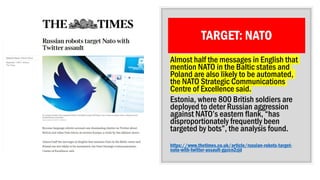
TARGET: NATO
Almost half the messages in English that
mention NATO in the Baltic states and
Poland are also likely to be automated,
the NATO Strategic Communications
Centre of Excellence said.
Estonia, where 800 British soldiers are
deployed to deter Russian aggression
against NATO’s eastern flank, “has
disproportionately frequently been
targeted by bots”, the analysis found.
https://www.thetimes.co.uk/article/russian-robots-target-
nato-with-twitter-assault-gpzcn2zjd
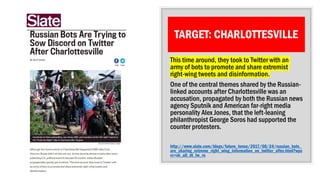
TARGET: CHARLOTTESVILLE
This time around, they took to Twitter with an
army of bots to promote and share extremist
right-wing tweets and disinformation.
One of the central themes shared by the Russian-
linked accounts after Charlottesville was an
accusation, propagated by both the Russian news
agency Sputnik and American far-right media
personality Alex Jones, that the left-leaning
philanthropist George Soros had supported the
counter protesters.
http://www.slate.com/blogs/future_tense/2017/08/24/russian_bots_
are_sharing_extreme_right_wing_information_on_twitter_after.html?wps
rc=sh_all_dt_tw_ru
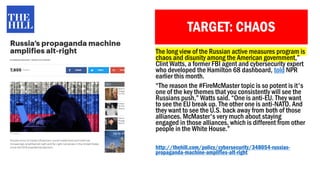
TARGET: CHAOS
The long view of the Russian active measures program is
chaos and disunity among the American government,”
Clint Watts, a former FBI agent and cybersecurity expert
who developed the Hamilton 68 dashboard, told NPR
earlier this month.
“The reason the #FireMcMaster topic is so potent is it's
one of the key themes that you consistently will see the
Russians push,” Watts said. “One is anti-EU. They want
to see the EU break up. The other one is anti-NATO. And
they want to see the U.S. back away from both of those
alliances. McMaster's very much about staying
engaged in those alliances, which is different from other
people in the White House.”
http://thehill.com/policy/cybersecurity/348054-russias-
propaganda-machine-amplifies-alt-right
FRENCH ACTION,
US INACTION
• Before campaigning in its recent Presidential race began, all
major parties in France were informed by the authorities of the
threat of outside interference and advised on how to make their
operations more secure. Disinformation attempts by Kremlin
outlets, targeting mainstream candidates and attempting to
bolster far-right candidate Marine Le Pen, were publicly
identified.
• The problem is that continued questions about Russian influence
efforts in 2016 are dominating the attention of Congress and the
U.S. media, without any serious discussion of how to defend
against and deter such activity now and in the future. As former
DNI Clapper has warned, Russia has already started to “prep the
battlefield [for] 2018.” Indeed, the Russians continue to use
social media and overt and covert propaganda outlets to
influence the political debate in the United States. The partisan
nature of much of the debate about Russia’s interference in
2016 also plays directly into Russian goals.
http://securingdemocracy.gmfus.org/blog/2017/07/17/lessons-france-fighting-russian-
interference-democracy
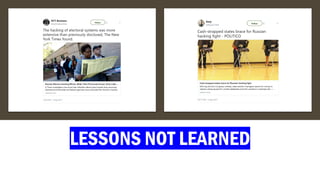
LESSONS NOT LEARNED
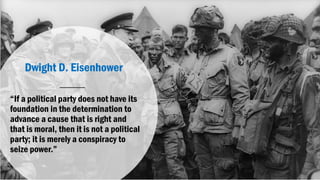
Dwight D. Eisenhower
“If a political party does not have its
foundation in the determination to
advance a cause that is right and
that is moral, then it is not a political
party; it is merely a conspiracy to
seize power.”
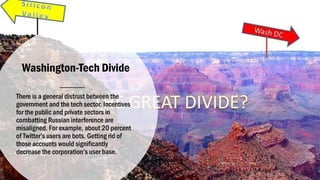
Washington-Tech Divide
There is a general distrust between the
government and the tech sector. Incentives
for the public and private sectors in
combatting Russian interference are
misaligned. For example, about 20 percent
of Twitter’s users are bots. Getting rid of
those accounts would significantly
decrease the corporation’s user base.
HAMILTON 68
“In the Federalist Papers No. 68,
Alexander Hamilton wrote of protecting
America’s electoral process from foreign
meddling. Today, we face foreign
interference of a type Hamilton could
scarcely have imagined."
HAMILTON
METHODOLOGY
• First, we tracked disinformation campaigns that synchronized with overt Russian
propaganda outlets like Sputnik and RT (Russia Today). We analyzed the social
networks of users who were promoting this disinformation to identify which
users were centrally involved, and to remove users who tweeted disinformation
casually, after encountering it online.
• Second, we identified a group of users online that openly professed to be pro-
Russian and tweeted primarily in support of Russian government policies and
themes. We analyzed followers of these accounts to identify a large and
interconnected social network that tweeted the same themes and content.
• Third, we identified accounts that appear to use automation to boost the signal
of other accounts linked to Russian influence operations. We assessed this
group by looking at accounts that had disproportionately large numbers of
interactions with other accounts (including sending and receiving retweets)
along with a very high number of tweets per day. These accounts may be bots,
meaning a piece of computer code that tweets automatically based on pre-
determined rules, or they may be cyborgs, meaning that some of their activity is
automated, which is then manually supplemented by a human user.
HAMILTON OBJECTIVE
• Samples from each of these three datasets were combined to
populate the dashboard monitoring list, with an eye toward
providing a representative snapshot of Russia’s English-
language influence operations on Twitter. Within the network
are numerous subgroups specializing in certain kinds of
content, such as Ukraine, Syria, or far-right views. The
content on the dashboard varies widely from day to day
depending on what is going on in the news.
• Our objective in providing this dashboard is to help ordinary
people, journalists, and other analysts identify Russian
messaging themes and detect active disinformation or attack
campaigns as soon as they begin. Exposing these messages
will make information consumers more resilient and reduce
the effectiveness of Russia’s attempts to influence
Americans’ thinking, and deter this activity in the future by
making it less effective.
TOP THEMES SAMPLE
• Updated on September 5, 6:57 PM
• We examined the top themes being promoted and/or amplified between
August 28th and September 4th.
• 68 stories listed among the Top/Trending URLs on the dashboard were
categorized by theme.
• Of these, over 25% have a primary theme of Anti-Americanism.
• Of 18 Anti-USA stories, 9 are Anti-State Department in the context of the
closure of Russian diplomatic facilities, and 6 are Anti-CIA in the context
of Syria. Both State and CIA can be viewed as the insiders, the DC
Establishment, the Deep State. In other words, when the US does
something the Kremlin doesn't like, it's not Trump who is blamed. It is
more like Russia is a victim of the same embedded forces in Washington
that are supposedly working against the President.
• 11 stories are Anti-Protest, 11 are in defence of Trump, 7 oppose the GOP
establishment, and 6 are anti-Democratic Party. Together, these broad
themes made up about 80% of all the promoted content during the
period.

Hamilton 68 and Securing Democracy

  • 1.
    CLBR #271 SHOWNOTES Hamilton 68 and Securing Democracy
  • 2.
    GERASIMOV DOCTRINE (2013) The very‘rules of war’ have changed. The role of nonmilitary means of achieving political and strategic goals has grown, and, in many cases, they have exceeded the power of force of weapons in their effectiveness. http://www.politico.com/magazine/story/2017/09/05/gerasi mov-doctrine-russia-foreign-policy-215538
  • 3.
    We assess RussianPresident Vladimir Putin ordered an influence campaign in 2016 aimed at the US presidential election. Russia’s goals were to undermine public faith in the US democratic process, denigrate Secretary Clinton, and harm her electability and potential presidency. We further assess Putin and the Russian Government developed a clear preference for President-elect Trump. We have high confidence in these judgments. Moscow’s influence campaign followed a Russian messaging strategy that blends covert intelligence operations—such as cyber activity—with overt efforts by Russian Government agencies, state-funded media, third-party intermediaries, and paid social media users or “trolls.”
  • 4.
    TARGET: NATO Almost halfthe messages in English that mention NATO in the Baltic states and Poland are also likely to be automated, the NATO Strategic Communications Centre of Excellence said. Estonia, where 800 British soldiers are deployed to deter Russian aggression against NATO’s eastern flank, “has disproportionately frequently been targeted by bots”, the analysis found. https://www.thetimes.co.uk/article/russian-robots-target- nato-with-twitter-assault-gpzcn2zjd
  • 5.
    TARGET: CHARLOTTESVILLE This timearound, they took to Twitter with an army of bots to promote and share extremist right-wing tweets and disinformation. One of the central themes shared by the Russian- linked accounts after Charlottesville was an accusation, propagated by both the Russian news agency Sputnik and American far-right media personality Alex Jones, that the left-leaning philanthropist George Soros had supported the counter protesters. http://www.slate.com/blogs/future_tense/2017/08/24/russian_bots_ are_sharing_extreme_right_wing_information_on_twitter_after.html?wps rc=sh_all_dt_tw_ru
  • 6.
    TARGET: CHAOS The longview of the Russian active measures program is chaos and disunity among the American government,” Clint Watts, a former FBI agent and cybersecurity expert who developed the Hamilton 68 dashboard, told NPR earlier this month. “The reason the #FireMcMaster topic is so potent is it's one of the key themes that you consistently will see the Russians push,” Watts said. “One is anti-EU. They want to see the EU break up. The other one is anti-NATO. And they want to see the U.S. back away from both of those alliances. McMaster's very much about staying engaged in those alliances, which is different from other people in the White House.” http://thehill.com/policy/cybersecurity/348054-russias- propaganda-machine-amplifies-alt-right
  • 7.
    FRENCH ACTION, US INACTION •Before campaigning in its recent Presidential race began, all major parties in France were informed by the authorities of the threat of outside interference and advised on how to make their operations more secure. Disinformation attempts by Kremlin outlets, targeting mainstream candidates and attempting to bolster far-right candidate Marine Le Pen, were publicly identified. • The problem is that continued questions about Russian influence efforts in 2016 are dominating the attention of Congress and the U.S. media, without any serious discussion of how to defend against and deter such activity now and in the future. As former DNI Clapper has warned, Russia has already started to “prep the battlefield [for] 2018.” Indeed, the Russians continue to use social media and overt and covert propaganda outlets to influence the political debate in the United States. The partisan nature of much of the debate about Russia’s interference in 2016 also plays directly into Russian goals. http://securingdemocracy.gmfus.org/blog/2017/07/17/lessons-france-fighting-russian- interference-democracy
  • 8.
  • 9.
    Dwight D. Eisenhower “Ifa political party does not have its foundation in the determination to advance a cause that is right and that is moral, then it is not a political party; it is merely a conspiracy to seize power.”
  • 10.
    Washington-Tech Divide There isa general distrust between the government and the tech sector. Incentives for the public and private sectors in combatting Russian interference are misaligned. For example, about 20 percent of Twitter’s users are bots. Getting rid of those accounts would significantly decrease the corporation’s user base.
  • 11.
    HAMILTON 68 “In theFederalist Papers No. 68, Alexander Hamilton wrote of protecting America’s electoral process from foreign meddling. Today, we face foreign interference of a type Hamilton could scarcely have imagined."
  • 12.
    HAMILTON METHODOLOGY • First, wetracked disinformation campaigns that synchronized with overt Russian propaganda outlets like Sputnik and RT (Russia Today). We analyzed the social networks of users who were promoting this disinformation to identify which users were centrally involved, and to remove users who tweeted disinformation casually, after encountering it online. • Second, we identified a group of users online that openly professed to be pro- Russian and tweeted primarily in support of Russian government policies and themes. We analyzed followers of these accounts to identify a large and interconnected social network that tweeted the same themes and content. • Third, we identified accounts that appear to use automation to boost the signal of other accounts linked to Russian influence operations. We assessed this group by looking at accounts that had disproportionately large numbers of interactions with other accounts (including sending and receiving retweets) along with a very high number of tweets per day. These accounts may be bots, meaning a piece of computer code that tweets automatically based on pre- determined rules, or they may be cyborgs, meaning that some of their activity is automated, which is then manually supplemented by a human user.
  • 13.
    HAMILTON OBJECTIVE • Samplesfrom each of these three datasets were combined to populate the dashboard monitoring list, with an eye toward providing a representative snapshot of Russia’s English- language influence operations on Twitter. Within the network are numerous subgroups specializing in certain kinds of content, such as Ukraine, Syria, or far-right views. The content on the dashboard varies widely from day to day depending on what is going on in the news. • Our objective in providing this dashboard is to help ordinary people, journalists, and other analysts identify Russian messaging themes and detect active disinformation or attack campaigns as soon as they begin. Exposing these messages will make information consumers more resilient and reduce the effectiveness of Russia’s attempts to influence Americans’ thinking, and deter this activity in the future by making it less effective.
  • 14.
    TOP THEMES SAMPLE •Updated on September 5, 6:57 PM • We examined the top themes being promoted and/or amplified between August 28th and September 4th. • 68 stories listed among the Top/Trending URLs on the dashboard were categorized by theme. • Of these, over 25% have a primary theme of Anti-Americanism. • Of 18 Anti-USA stories, 9 are Anti-State Department in the context of the closure of Russian diplomatic facilities, and 6 are Anti-CIA in the context of Syria. Both State and CIA can be viewed as the insiders, the DC Establishment, the Deep State. In other words, when the US does something the Kremlin doesn't like, it's not Trump who is blamed. It is more like Russia is a victim of the same embedded forces in Washington that are supposedly working against the President. • 11 stories are Anti-Protest, 11 are in defence of Trump, 7 oppose the GOP establishment, and 6 are anti-Democratic Party. Together, these broad themes made up about 80% of all the promoted content during the period.