Planning , Designing and Managing Heritage Tourism- both Tangible and
Intangible
Introduction;
Unlike normal travel, Heritage tourism remains different and distinct for the
reason that it remains focused and caters to specific purpose and needs of the
travel, involving people visiting areas of historical , cultural and natural
importance. Heritage tourism involves both cultural, historical and natural
resources, people’s customs and traditions, their heritage, history and way of
life, art and literature, lifestyles, value systems, traditions and beliefs. Heritage
involves learning about the distant past culture and social values of the visited
communities . It remains primarily exploratory in nature, intent and content.
Heritage Tourism provides one of the best options and accepted method to
study, analyze and understand the history, culture, traditions, social fabric,
societal value system, art and culture of any place, community and nation.
As per study made and analysis carried out, of the pattern and purpose of
tourism by the National Trust for Historic Preservation of USA, it was observed
that, “Increasing proportions of the travelers globally, are seeking unique travel
experiences that combine history, education, entertainment and authenticity”. A
cultural heritage tourism survey conducted in 2009 revealed that 78% of all U.S.
leisure travelers participated in the cultural and/or heritage activities while
traveling. These travelers have been found to stay longer, spend more money,
and travel more often when compared to other tourists. They also tend to be
older, better educated, more sophisticated, and often more affluent than other
tourists. Overseas cultural heritage travellers ,visiting the United States, tend to
be more first-time travelers and are found to stay longer
For effectively promoting, enhancing, creating awareness about the role and
importance of cultural heritage/monuments/natural sites and the need to
conserve/preserve them for posterity, the International Council on
Monuments and Sites (ICOMOS), in 1982, named 18th of April as World
Heritage Day, which later in the year1983, was approved by the General
Assembly of UNESCO . The day is celebrated to remind people and nations
to understand the role, relevance, need and importance of protecting,
preserving and promoting the valuable human heritage, its diversity, and
values. At local/city level, many local organizations, parastatal agencies, and
educational institutions have used and leveraged numerous strategies, options
and practices for involving communities and creating awareness among all the
stakeholders about promoting, preserving and conserving cultural heritage, by
launching mass campaigns for creating awareness by organising exhibitions;
issuing posters, printing literature, holding radio talks, preparing short videos,
organizing heritage festivals, defining heritage trails and organizing heritage
walk. Studies made by United Nations World Tourism Organization has also
revealed that “one of the pillars of the tourism industry has been people’s
inherent desire to see and learn about the cultural identity of different parts of the
world” which has now led to the rapid development of so called heritage tourism
or cultural tourism .
Defining Heritage Tourism;
Heritage tourism is often seen as synonymous with cultural tourism, historical
tourism, arts tourism, nature tourism or attractions related tourism. Accordingly,
looking at the entire gamut, heritage tourism has been defined differently and
distinctly by different experts, professionals, authors and organizations involved
in heritage tourism.
 Heritage tourism; is that branch of tourism which is oriented towards
the cultural heritage (both the tangible and the intangible) including the
location/ destination in which the tourism occurs. It is the practice of
travelling abroad to places of historical or cultural interests.
 Heritage tourism, encompasses natural heritage, such as caves,
nature reserves, gardens and marine parks, as well as built heritage,
like museums, monuments and historical buildings. It also involves
cultural events, festivals, performing arts and other forms of popular
culture.
 Heritage tourism, is "traveling to experience the places, artifacts and
activities that authentically represent the stories and people of the
past"
( The National Trust for Historic Preservation in the United States)
 Heritage tourism, is traveling to understand the cultures and places of
the past—including those of ancestors.
 Heritage Tourism, is defined as “traveling to experience the places,
artifacts, and activities that authentically represent the stories and
people of the past and present. It includes visitation to cultural, historic,
and natural resources.
 Heritage tourism ,is a niche/ subset of tourism which relates to visiting
centuries old cultural and heritage sites such as spiritual places, forts,
monuments, battlegrounds, industrial and geographical sites, and also
to experience authentic cultural activities and appreciate the
contributions made by our past civilizations.
 Heritage Tourism can be defined as that category of tourism, which is
primarily and essentially based on heritage; where heritage is the core
of the product that is offered and form the main motivating factor for
the consumer.
 Heritage Tourism, includes and involves history, culture and the land on
which people live. It includes both tangible and intangible elements
 Heritage tourism, is a practice where people visit heritage sites within a
country or travel abroad to historical places of significance to centuries
old past heritage and experience traditional heritage , monuments,
gardens and other places of historical, cultural, and natural
significance, as recognized by UNESCO/archaeological societies.
Typologies of Heritage Tourism
Heritage tourism, as an activity, has a long history spanning over centuries in
India, despite the fact that world heritage had recent origin in the 1970’s.
Despite forming an integral part of tourism sector, Heritage Tourism has grown
over a period time as an important ,vibrant and standalone industry, generating
large employment and revenue for the nations globally. In the fast changing
world, cultural Heritage is never static and never finite, it is always evolving and
devolving for the reason that new contexts are fast emerging in this fast
changing world. Heritage in its local and global context includes both tangible
and intangible elements involving;
 Historic buildings and Monuments
 Sites of important past historical and cultural events
 Traditional landscapes and indigenous wildlife
 Language, literature, music and art
 Traditional events and folklore practices
 Traditional lifestyles including food, drink and sports
 Vintage trains and rail services such as Orient Express
 Veteran Airliners
 Architecture of the luxurious hotels on the French Riviera,
 18th and 19th century health resorts
 Museums and Galleries defining nations heritage
World Heritage Sites;
Looking at the context, role and importance of cultural Heritage; The United
Nations Educational Scientific and Cultural Organization(UNESCO) launched
a mission which seeks to encourage identification, protection and
preservation of cultural and natural sites around the world, by the community
of nations falling under their jurisdiction , which are considered to be of
outstanding value for humanity, communities and nations. After the latest
addition to the UNESCO list of World Heritage Sites, India with 42 listed
World Heritage Sites, ranks 6th
among nations globally in terms of having
largest number of listed World Heritage Sites in the world. UNESCO mission
calls for
 Ensuring the protection of their natural and cultural heritage.
 Nominating sites within their national territory for inclusion in the
World Heritage List.
 Establishing management plans and setting up reporting system on
the state of conservation of their World Heritage Sites.
 Safeguarding the World Heritage Sites by providing technical
assistance and professional training.
 Providing emergency assistance for World Heritage Sites in
immediate danger.
 Creating public awareness regarding building activities related to
World Heritage conservation.
 Ensuring participation of the local population in the preservation of
cultural and natural heritage.
 Encouraging international cooperation in the conservation of World’s
Cultural and Natural heritage.
Importance of Heritage Tourism
Cultural/ Heritage tourism remains important, vital and critical to humanity,
communities ,societies, states and nations for the reasons it;
 Positively impact local and regional economy and society
 Establishes and reinforces local identity,
 Helps preserve the valuable cultural heritage
 Facilitates harmony and understanding among people and communities
of various nations and cultures
 Support diverse cultures and help renew tourism.
 Helps achieve goals of sustainable development enunciated by UN ;
 Helps identification, management/protection and making value addition to
the heritage;
 Effectively interpreting /stimulating the cultural resources.
 Achieving physical, economic and social benefits
 Providing resources for protection, preservation and making value
addition to valuable heritage .
 Blending education, entertainment and preservation of the cultural assets
 Making Infrastructural improvements including site beautification,
landscaping, installing facilities/seating /interpretation signs and
improvement of access roads, infrastructure and services.
.
Advantages/ Benefits of Heritage Tourism;
Heritage Tourism holds numerous advantages/benefits for the communities,
nations and environment . However, when not planned, managed and made
operational in a rational, objective and professional manner, heritage tourism
can also lead to damage, dilution and disaster, by promoting lack of
understanding/ appreciation of the culture and heritage of the place; diminishing
the protection and conservation of cultural heritage overtime and inadequate
integration of cultural heritage protection and management.
When strategically planned, designed, developed and managed,
Heritage Tourism hold numerous distinct advantages in terms of ;
 Providing realistic/effective, focused options for learning/discovering
something about another culture,
 Encouraging revival of traditions and the restoration of sites and
monuments besides contributing to the conservation and management of
heritage.(UNESCO)
 Helping strengthening, preserving and improving the visibility of heritage
sites/ resources /structures and promoting protection and sustainability, for
continued use.
 Generating large employment by creating additional jobs/promoting new
businesses, both within and outside the heritage industry;
 Increasing community pride and awareness in heritage,
 Connecting individuals to their cultural roots & growing renewed interest
into their history and culture,
 Showcasing shared traditions that can be passed on to younger
generation
 Providing economic boost to make cultures survive/ sustain , which
otherwise would have faced eradication/ disappearance due to
marginalization and poverty.
 Supporting economically numerous families; making them learn to speak
another language , helping to ensure that children remain in school and
be educated.
 Helping preserving culture and history by generating/investing resources
essential for ensuring that culture / history remains alive.
 Giving heritage institutions the opportunity to demonstrate their relevance
and importance.
 Creating synergy between tourism and culture for promoting socio-
economic development
 Making contribution to job creation; improvement of livelihoods and
poverty alleviation.
 Creating options for cultural exchange/ encourage national pride /
motivating communities to effectively manage cultural assets, and
engaging in conservation and restoration efforts.
 Dissuading Government officials from allowing developers to negatively
impact culturally significant spaces.
The benefits emerging out of Heritage Tourism can also be classified differently
and distinctly as Economic, Cultural, Social and Environmental benefits, as
detailed below;
Economic Benefits;
 Injecting additional resources into the economy, boosting businesses
and tax revenues
 Creating new jobs, businesses, events and attractions, for helping
and promoting diversity in the local economy
 Supporting small businesses , enabling them to grow , expand and
sustain.
 Promoting effective and efficient preservation and protection of vital
local resources
 Building and strengthening existing relationships among and within
local communities
 Helping encourage provision, development and maintenance of
new/existing community Amenities.
Social Benefits;
Social benefits of Heritage Tourism can be enumerated in terms of;
 Helping to build social capital for the local community
 Empowering Communities in social fabric
 Bringing communities into social mainstream
 Providing distinct recognition to local communities/areas
 Promoting preservation of local traditions, customs, and culture.
 Promoting positive behavior on the part of the community
 Helping improve the image and pride of local community.
 Promoting community beautification and making value addition
 Building opportunities for healthy and useful community relationships
and partnerships
 Providing research, education, and work-placement opportunities for
students
 Creating enjoyable opportunities for both local residents and visitors
attracted to the cultural arts, history and preservation
 Boosting local investment in heritage resources and amenities that
support tourism related services and infrastructure
 Helping maintain buildings of culture and contribute to the innovation
and business diversification
Environmental Benefits
Environmental benefits of Heritages Tourism can be listed as;
 Helping encourages culture of conservation and preservation of
valuable heritage
 Making valuable additions to the level of awareness of the tourist
site, tourist attraction and area’s significance
 Helping encourages local residents and visitors to be mindful about
their impact on the natural and built environment
 Investing in infrastructures/services including sewage and water
resources in the heritage
 Improving bio-diversity, making value addition to flora& fauna and
promoting/ expanding and enlarging proportion of green areas.
 Landscaping available area within/outside the heritage
buildings/objects etc.
Limitation Of Heritage Tourism
Heritage tourism is known for its dualities and contradictions; positivity and
negativities towards the community, state and place where objects of heritage
are located and accordingly, needs to be handled with care and caution. When
mishandled and mismanaged, heritage related tourism can also prove
to be a disaster by adversely impacting the place, people, heritage and
the environment. Mass tourism has invariably adversely impacted the places
of historical /cultural importance, by creating dissatisfaction in the overall visitor’s
experience; reduction in number of visitors; loss in profit; unwarranted pressure
on infrastructure; hampered conservation efforts; damage to natural ecosystems
and devaluation of site’s significance (United Nations World Tourism
Organization). It also leads to overlooking the lesser known culturally significant
sites, both by tourists and government along with distribution of resources and
benefits derived by heritage tourism. When not planned/structured/managed
properly, realistically and rationally, Heritage Tourism can lead to;
 Creating numerous social and cultural problem/ disasters, not just for the
heritage but also for the society
 Turning tourism into circus-by destroying/hurting culture.
 Bringing many diseases and causing many social, political and cultural
issues like brothels, prostitution etc.,
 Hurting the environment due to large influx of people coming to a
place having limited capacity to accommodate visitors
 Causing bleaching and damage to coral reefs through snorkeling , diving,
cruise shipping; generating chemicals from sunscreen - disrupting the
reproduction /growth cycles of the corals.
 Neglecting preserving/ protecting/ promoting by commercialization of
heritage – focusing more on the interest of tourists / tourism, at the cost
of heritage.
 Destroying heritage, due to lack of appreciation of the value of precious
cultural/natural resources, by both local communities and tourists, major
issue facing developing countries where tourism is considered the
primary source of economic growth/reduction of poverty (Salazar and Zhu
243).
 Promoting unplanned , haphazard and mushroom growth and
development
 Creating high degree of congestion due to concentration of large number
of activities and population
 Addition of large scale unauthorized and sub-standard construction/ built
environment.
 Promoting rapid growth/mushrooming of slums
 Creating problems of mobility- traffic and transportation- induction of large
number of tourism related vehicles; parking etc.
 Adversely impacting the existing infrastructure/ services- both in
quality/quantity.
 Creating numerous growth and developmental related problems
for the local residents
 Increasing cost of living and adversely impacting quality of life.
 Creating problems of sanitation/solid waste management.
 Promoting rapid/mushroom growth of hotels/eating places.
 Incentivizing the growth of irrational/mixed/non-compatible land-
uses.
 Promoting large scale migration of people from within/outside the
state
 Creating space for high degree of land speculation leading to
large rise in land values etc.
 Causing pollution, congestions, increased costs for public services/
infrastructures, and destruction of cultural resources.
 Undertaking irrational/unplanned development to build roads and parking
spaces, adversely impacting the eco-sensitive areas/water bodies in close
vicinity.
 Damaging the authenticity and identity of local culture by foreign tourists.
Heritage Tourism in India
Known to be repository of culture and historical/ religious monuments and
natural heritage, India in general and hill areas in particular, have emerged as
the global destination for Heritage Tourism. Large number of initiatives taken by
the Government of India ,Ministry of Tourism and Culture and incentives/benefits
offered by/to the states, has helped in not only boosting India/hill area’s image
as destinations for heritage tourism, but has led to global recognition of India/hill
areas, registering enormous growth in number of Heritage Tourists visiting
during the last few years.
Hill area’s rich heritage is amply reflected in the various temples, palaces,
monuments, and forts that can be found in all part of hill states. The most popular
heritage tourism destinations in India/hill areas and maximum number of tourists
who come and visit the hill states/cities include Srinagar, Leh, Ladakh, Kulu,
Manali, Shimla, Dalhousie, Nainital, Sonmarg, Darjeeling, Mussoorie etc. for its
wonderful climate; valuable flora & fauna, , bio-diversity, unique culture,
supportive environment; Rajasthan, as a state, with its rich heritage , antique
paintings, jade jewelry, palaces, and costumes, attract thousands of tourists each
year. Taj Mahal, being one of the seven wonders of the world; Mahabalipuram
with sculptural/architectural sites, cave temples and temple city’ of Madurai, are
visited by large number of tourists annually.
Triad of three cities of Delhi, Agra and Jaipur, known for their wonderful heritage
sites, palaces, temples, masjids, forts, tombs etc., have emerged as the golden
triangle in the circles of Heritage Tourism. Kerala, Assam , Goa, Himachal
Pradesh, Jammu& Kashmir, Leh and Ladakh, Uttarakhand, North-East States,
Uttar Pradesh, Kerala, Madhya Pradesh, Goa, Karnataka, Maharashtra with
wealth of natural heritage, have emerged as the epic centers of Natural Tourism.
Despite the fact that Heritage tourism India, has grown manyfold in recent years
but there still exists enough potential and scope for India to emerge as the global
destination for Heritage Tourism. This will require identification of more sites of
cultural and natural heritage, marketing India as global heritage destination,
putting in place rational and realistic policies, learning from good
national/international practices, involving communities, promoting capacity of
urban local bodies in area of tourism, marking dedicated resources for tourism,
leveraging heritage and bringing on board government of India; Tourism
Boards; public sector; private sector; North-Eastern Hill State Council and all the
stakeholders. Strength of Heritage Tourism needs to be leveraged on priority, for
the reasons that, Indian Culture and heritage tourists area known to stay longer
and spend lot more money than other tourists do. One study showed that a
Heritage Tourist, spent 38% higher per day and stayed 22% longer when
compared to other kind of travellers, which can be effectively leveraged for
removing unemployment and improving economic status of the poor.
Globally heritage has been recognized as an integral and essential
part/feature/element of tourism industry. Over a period of time, heritage has
emerged as an important source for promoting tourism. Many nations are
promoting Heritage Tourism to attract tourists across the globe for the reasons,
Heritage Tourism is known to be most productive, best revenue generator
besides making large contribution to local employment, economy and prosperity.
Statistics also indicate that culture and heritage tourism continue to grow rapidly,
especially in OECD and APEC regions with direct global value of culture and
heritage tourism placed well over $1billion dollars and approximately $327
million for the Asia Pacific region. Heritage Tourism is directly responsible for
creating more than 50 million jobs in APEC countries, with indirect benefits of
culture and heritage tourism are thought to be of the order of $1 billion and
account for a further 75 million jobs across the region.
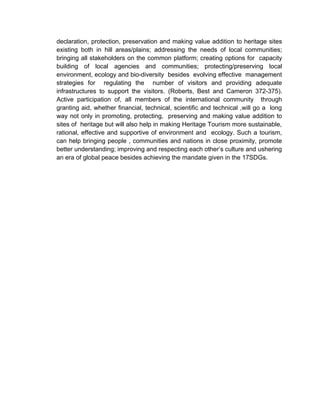
Studies made and analysis carried out in various nations/spaces has
demonstrated that dualities are also invariably built in the Heritage Tourism, in
terms of both positivity’s and
negativities. Heritage Tourism
adversely impact indigenous
peoples whose land and culture
are being visited by tourists.
Accordingly, such tourism must be
managed in a socially responsible
manner. In order to make optimum
use of Heritage Tourism, it will be
imperative to build on its strength
and eliminate all negativities
embedded in the Heritage Tourism
by promoting integration & bringing close collaboration between tourism and
Heritage. Such an approach should invariably be built on the premise of; putting
in place an effective management strategy that prioritizes the identification,
declaration, protection, preservation and making value addition to heritage sites
existing both in hill areas/plains; addressing the needs of local communities;
bringing all stakeholders on the common platform; creating options for capacity
building of local agencies and communities; protecting/preserving local
environment, ecology and bio-diversity besides evolving effective management
strategies for regulating the number of visitors and providing adequate
infrastructures to support the visitors. (Roberts, Best and Cameron 372-375).
Active participation of, all members of the international community through
granting aid, whether financial, technical, scientific and technical ,will go a long
way not only in promoting, protecting, preserving and making value addition to
sites of heritage but will also help in making Heritage Tourism more sustainable,
rational, effective and supportive of environment and ecology. Such a tourism,
can help bringing people , communities and nations in close proximity, promote
better understanding; improving and respecting each other’s culture and ushering
an era of global peace besides achieving the mandate given in the 17SDGs.

Managing Tourim- Tangible and Intangible.docx

  • 1.
    Planning , Designingand Managing Heritage Tourism- both Tangible and Intangible Introduction; Unlike normal travel, Heritage tourism remains different and distinct for the reason that it remains focused and caters to specific purpose and needs of the travel, involving people visiting areas of historical , cultural and natural importance. Heritage tourism involves both cultural, historical and natural resources, people’s customs and traditions, their heritage, history and way of life, art and literature, lifestyles, value systems, traditions and beliefs. Heritage involves learning about the distant past culture and social values of the visited communities . It remains primarily exploratory in nature, intent and content. Heritage Tourism provides one of the best options and accepted method to study, analyze and understand the history, culture, traditions, social fabric, societal value system, art and culture of any place, community and nation. As per study made and analysis carried out, of the pattern and purpose of tourism by the National Trust for Historic Preservation of USA, it was observed that, “Increasing proportions of the travelers globally, are seeking unique travel experiences that combine history, education, entertainment and authenticity”. A cultural heritage tourism survey conducted in 2009 revealed that 78% of all U.S. leisure travelers participated in the cultural and/or heritage activities while traveling. These travelers have been found to stay longer, spend more money, and travel more often when compared to other tourists. They also tend to be older, better educated, more sophisticated, and often more affluent than other tourists. Overseas cultural heritage travellers ,visiting the United States, tend to be more first-time travelers and are found to stay longer For effectively promoting, enhancing, creating awareness about the role and importance of cultural heritage/monuments/natural sites and the need to conserve/preserve them for posterity, the International Council on Monuments and Sites (ICOMOS), in 1982, named 18th of April as World Heritage Day, which later in the year1983, was approved by the General Assembly of UNESCO . The day is celebrated to remind people and nations to understand the role, relevance, need and importance of protecting,
  • 2.
    preserving and promotingthe valuable human heritage, its diversity, and values. At local/city level, many local organizations, parastatal agencies, and educational institutions have used and leveraged numerous strategies, options and practices for involving communities and creating awareness among all the stakeholders about promoting, preserving and conserving cultural heritage, by launching mass campaigns for creating awareness by organising exhibitions; issuing posters, printing literature, holding radio talks, preparing short videos, organizing heritage festivals, defining heritage trails and organizing heritage walk. Studies made by United Nations World Tourism Organization has also revealed that “one of the pillars of the tourism industry has been people’s inherent desire to see and learn about the cultural identity of different parts of the world” which has now led to the rapid development of so called heritage tourism or cultural tourism . Defining Heritage Tourism; Heritage tourism is often seen as synonymous with cultural tourism, historical tourism, arts tourism, nature tourism or attractions related tourism. Accordingly, looking at the entire gamut, heritage tourism has been defined differently and distinctly by different experts, professionals, authors and organizations involved in heritage tourism.  Heritage tourism; is that branch of tourism which is oriented towards the cultural heritage (both the tangible and the intangible) including the location/ destination in which the tourism occurs. It is the practice of travelling abroad to places of historical or cultural interests.  Heritage tourism, encompasses natural heritage, such as caves, nature reserves, gardens and marine parks, as well as built heritage, like museums, monuments and historical buildings. It also involves cultural events, festivals, performing arts and other forms of popular culture.  Heritage tourism, is "traveling to experience the places, artifacts and activities that authentically represent the stories and people of the past" ( The National Trust for Historic Preservation in the United States)  Heritage tourism, is traveling to understand the cultures and places of the past—including those of ancestors.  Heritage Tourism, is defined as “traveling to experience the places, artifacts, and activities that authentically represent the stories and people of the past and present. It includes visitation to cultural, historic, and natural resources.
  • 3.
     Heritage tourism,is a niche/ subset of tourism which relates to visiting centuries old cultural and heritage sites such as spiritual places, forts, monuments, battlegrounds, industrial and geographical sites, and also to experience authentic cultural activities and appreciate the contributions made by our past civilizations.  Heritage Tourism can be defined as that category of tourism, which is primarily and essentially based on heritage; where heritage is the core of the product that is offered and form the main motivating factor for the consumer.  Heritage Tourism, includes and involves history, culture and the land on which people live. It includes both tangible and intangible elements  Heritage tourism, is a practice where people visit heritage sites within a country or travel abroad to historical places of significance to centuries old past heritage and experience traditional heritage , monuments, gardens and other places of historical, cultural, and natural significance, as recognized by UNESCO/archaeological societies. Typologies of Heritage Tourism Heritage tourism, as an activity, has a long history spanning over centuries in India, despite the fact that world heritage had recent origin in the 1970’s. Despite forming an integral part of tourism sector, Heritage Tourism has grown over a period time as an important ,vibrant and standalone industry, generating large employment and revenue for the nations globally. In the fast changing world, cultural Heritage is never static and never finite, it is always evolving and devolving for the reason that new contexts are fast emerging in this fast changing world. Heritage in its local and global context includes both tangible and intangible elements involving;  Historic buildings and Monuments  Sites of important past historical and cultural events  Traditional landscapes and indigenous wildlife  Language, literature, music and art  Traditional events and folklore practices  Traditional lifestyles including food, drink and sports  Vintage trains and rail services such as Orient Express  Veteran Airliners  Architecture of the luxurious hotels on the French Riviera,  18th and 19th century health resorts  Museums and Galleries defining nations heritage World Heritage Sites;
  • 4.
    Looking at thecontext, role and importance of cultural Heritage; The United Nations Educational Scientific and Cultural Organization(UNESCO) launched a mission which seeks to encourage identification, protection and preservation of cultural and natural sites around the world, by the community of nations falling under their jurisdiction , which are considered to be of outstanding value for humanity, communities and nations. After the latest addition to the UNESCO list of World Heritage Sites, India with 42 listed World Heritage Sites, ranks 6th among nations globally in terms of having largest number of listed World Heritage Sites in the world. UNESCO mission calls for  Ensuring the protection of their natural and cultural heritage.  Nominating sites within their national territory for inclusion in the World Heritage List.  Establishing management plans and setting up reporting system on the state of conservation of their World Heritage Sites.  Safeguarding the World Heritage Sites by providing technical assistance and professional training.  Providing emergency assistance for World Heritage Sites in immediate danger.  Creating public awareness regarding building activities related to World Heritage conservation.  Ensuring participation of the local population in the preservation of cultural and natural heritage.  Encouraging international cooperation in the conservation of World’s Cultural and Natural heritage. Importance of Heritage Tourism Cultural/ Heritage tourism remains important, vital and critical to humanity, communities ,societies, states and nations for the reasons it;  Positively impact local and regional economy and society  Establishes and reinforces local identity,  Helps preserve the valuable cultural heritage  Facilitates harmony and understanding among people and communities of various nations and cultures  Support diverse cultures and help renew tourism.  Helps achieve goals of sustainable development enunciated by UN ;  Helps identification, management/protection and making value addition to the heritage;  Effectively interpreting /stimulating the cultural resources.  Achieving physical, economic and social benefits
  • 5.
     Providing resourcesfor protection, preservation and making value addition to valuable heritage .  Blending education, entertainment and preservation of the cultural assets  Making Infrastructural improvements including site beautification, landscaping, installing facilities/seating /interpretation signs and improvement of access roads, infrastructure and services. . Advantages/ Benefits of Heritage Tourism; Heritage Tourism holds numerous advantages/benefits for the communities, nations and environment . However, when not planned, managed and made operational in a rational, objective and professional manner, heritage tourism can also lead to damage, dilution and disaster, by promoting lack of understanding/ appreciation of the culture and heritage of the place; diminishing the protection and conservation of cultural heritage overtime and inadequate integration of cultural heritage protection and management. When strategically planned, designed, developed and managed, Heritage Tourism hold numerous distinct advantages in terms of ;  Providing realistic/effective, focused options for learning/discovering something about another culture,  Encouraging revival of traditions and the restoration of sites and monuments besides contributing to the conservation and management of heritage.(UNESCO)  Helping strengthening, preserving and improving the visibility of heritage sites/ resources /structures and promoting protection and sustainability, for continued use.  Generating large employment by creating additional jobs/promoting new businesses, both within and outside the heritage industry;  Increasing community pride and awareness in heritage,  Connecting individuals to their cultural roots & growing renewed interest into their history and culture,  Showcasing shared traditions that can be passed on to younger generation  Providing economic boost to make cultures survive/ sustain , which otherwise would have faced eradication/ disappearance due to marginalization and poverty.  Supporting economically numerous families; making them learn to speak another language , helping to ensure that children remain in school and be educated.
  • 6.
     Helping preservingculture and history by generating/investing resources essential for ensuring that culture / history remains alive.  Giving heritage institutions the opportunity to demonstrate their relevance and importance.  Creating synergy between tourism and culture for promoting socio- economic development  Making contribution to job creation; improvement of livelihoods and poverty alleviation.  Creating options for cultural exchange/ encourage national pride / motivating communities to effectively manage cultural assets, and engaging in conservation and restoration efforts.  Dissuading Government officials from allowing developers to negatively impact culturally significant spaces. The benefits emerging out of Heritage Tourism can also be classified differently and distinctly as Economic, Cultural, Social and Environmental benefits, as detailed below; Economic Benefits;  Injecting additional resources into the economy, boosting businesses and tax revenues  Creating new jobs, businesses, events and attractions, for helping and promoting diversity in the local economy  Supporting small businesses , enabling them to grow , expand and sustain.  Promoting effective and efficient preservation and protection of vital local resources  Building and strengthening existing relationships among and within local communities  Helping encourage provision, development and maintenance of new/existing community Amenities. Social Benefits; Social benefits of Heritage Tourism can be enumerated in terms of;  Helping to build social capital for the local community  Empowering Communities in social fabric  Bringing communities into social mainstream  Providing distinct recognition to local communities/areas  Promoting preservation of local traditions, customs, and culture.  Promoting positive behavior on the part of the community  Helping improve the image and pride of local community.  Promoting community beautification and making value addition
  • 7.
     Building opportunitiesfor healthy and useful community relationships and partnerships  Providing research, education, and work-placement opportunities for students  Creating enjoyable opportunities for both local residents and visitors attracted to the cultural arts, history and preservation  Boosting local investment in heritage resources and amenities that support tourism related services and infrastructure  Helping maintain buildings of culture and contribute to the innovation and business diversification Environmental Benefits Environmental benefits of Heritages Tourism can be listed as;  Helping encourages culture of conservation and preservation of valuable heritage  Making valuable additions to the level of awareness of the tourist site, tourist attraction and area’s significance  Helping encourages local residents and visitors to be mindful about their impact on the natural and built environment  Investing in infrastructures/services including sewage and water resources in the heritage  Improving bio-diversity, making value addition to flora& fauna and promoting/ expanding and enlarging proportion of green areas.  Landscaping available area within/outside the heritage buildings/objects etc. Limitation Of Heritage Tourism Heritage tourism is known for its dualities and contradictions; positivity and negativities towards the community, state and place where objects of heritage are located and accordingly, needs to be handled with care and caution. When mishandled and mismanaged, heritage related tourism can also prove to be a disaster by adversely impacting the place, people, heritage and the environment. Mass tourism has invariably adversely impacted the places of historical /cultural importance, by creating dissatisfaction in the overall visitor’s experience; reduction in number of visitors; loss in profit; unwarranted pressure on infrastructure; hampered conservation efforts; damage to natural ecosystems and devaluation of site’s significance (United Nations World Tourism Organization). It also leads to overlooking the lesser known culturally significant sites, both by tourists and government along with distribution of resources and benefits derived by heritage tourism. When not planned/structured/managed properly, realistically and rationally, Heritage Tourism can lead to;
  • 8.
     Creating numeroussocial and cultural problem/ disasters, not just for the heritage but also for the society  Turning tourism into circus-by destroying/hurting culture.  Bringing many diseases and causing many social, political and cultural issues like brothels, prostitution etc.,  Hurting the environment due to large influx of people coming to a place having limited capacity to accommodate visitors  Causing bleaching and damage to coral reefs through snorkeling , diving, cruise shipping; generating chemicals from sunscreen - disrupting the reproduction /growth cycles of the corals.  Neglecting preserving/ protecting/ promoting by commercialization of heritage – focusing more on the interest of tourists / tourism, at the cost of heritage.  Destroying heritage, due to lack of appreciation of the value of precious cultural/natural resources, by both local communities and tourists, major issue facing developing countries where tourism is considered the primary source of economic growth/reduction of poverty (Salazar and Zhu 243).  Promoting unplanned , haphazard and mushroom growth and development  Creating high degree of congestion due to concentration of large number of activities and population  Addition of large scale unauthorized and sub-standard construction/ built environment.  Promoting rapid growth/mushrooming of slums  Creating problems of mobility- traffic and transportation- induction of large number of tourism related vehicles; parking etc.  Adversely impacting the existing infrastructure/ services- both in quality/quantity.  Creating numerous growth and developmental related problems for the local residents  Increasing cost of living and adversely impacting quality of life.  Creating problems of sanitation/solid waste management.  Promoting rapid/mushroom growth of hotels/eating places.  Incentivizing the growth of irrational/mixed/non-compatible land- uses.  Promoting large scale migration of people from within/outside the state  Creating space for high degree of land speculation leading to large rise in land values etc.
  • 9.
     Causing pollution,congestions, increased costs for public services/ infrastructures, and destruction of cultural resources.  Undertaking irrational/unplanned development to build roads and parking spaces, adversely impacting the eco-sensitive areas/water bodies in close vicinity.  Damaging the authenticity and identity of local culture by foreign tourists. Heritage Tourism in India Known to be repository of culture and historical/ religious monuments and natural heritage, India in general and hill areas in particular, have emerged as the global destination for Heritage Tourism. Large number of initiatives taken by the Government of India ,Ministry of Tourism and Culture and incentives/benefits offered by/to the states, has helped in not only boosting India/hill area’s image as destinations for heritage tourism, but has led to global recognition of India/hill areas, registering enormous growth in number of Heritage Tourists visiting during the last few years. Hill area’s rich heritage is amply reflected in the various temples, palaces, monuments, and forts that can be found in all part of hill states. The most popular heritage tourism destinations in India/hill areas and maximum number of tourists who come and visit the hill states/cities include Srinagar, Leh, Ladakh, Kulu, Manali, Shimla, Dalhousie, Nainital, Sonmarg, Darjeeling, Mussoorie etc. for its wonderful climate; valuable flora & fauna, , bio-diversity, unique culture, supportive environment; Rajasthan, as a state, with its rich heritage , antique paintings, jade jewelry, palaces, and costumes, attract thousands of tourists each year. Taj Mahal, being one of the seven wonders of the world; Mahabalipuram with sculptural/architectural sites, cave temples and temple city’ of Madurai, are visited by large number of tourists annually. Triad of three cities of Delhi, Agra and Jaipur, known for their wonderful heritage sites, palaces, temples, masjids, forts, tombs etc., have emerged as the golden triangle in the circles of Heritage Tourism. Kerala, Assam , Goa, Himachal Pradesh, Jammu& Kashmir, Leh and Ladakh, Uttarakhand, North-East States, Uttar Pradesh, Kerala, Madhya Pradesh, Goa, Karnataka, Maharashtra with wealth of natural heritage, have emerged as the epic centers of Natural Tourism. Despite the fact that Heritage tourism India, has grown manyfold in recent years but there still exists enough potential and scope for India to emerge as the global destination for Heritage Tourism. This will require identification of more sites of cultural and natural heritage, marketing India as global heritage destination, putting in place rational and realistic policies, learning from good
  • 10.
    national/international practices, involvingcommunities, promoting capacity of urban local bodies in area of tourism, marking dedicated resources for tourism, leveraging heritage and bringing on board government of India; Tourism Boards; public sector; private sector; North-Eastern Hill State Council and all the stakeholders. Strength of Heritage Tourism needs to be leveraged on priority, for the reasons that, Indian Culture and heritage tourists area known to stay longer and spend lot more money than other tourists do. One study showed that a Heritage Tourist, spent 38% higher per day and stayed 22% longer when compared to other kind of travellers, which can be effectively leveraged for removing unemployment and improving economic status of the poor. Globally heritage has been recognized as an integral and essential part/feature/element of tourism industry. Over a period of time, heritage has emerged as an important source for promoting tourism. Many nations are promoting Heritage Tourism to attract tourists across the globe for the reasons, Heritage Tourism is known to be most productive, best revenue generator besides making large contribution to local employment, economy and prosperity. Statistics also indicate that culture and heritage tourism continue to grow rapidly, especially in OECD and APEC regions with direct global value of culture and heritage tourism placed well over $1billion dollars and approximately $327 million for the Asia Pacific region. Heritage Tourism is directly responsible for creating more than 50 million jobs in APEC countries, with indirect benefits of culture and heritage tourism are thought to be of the order of $1 billion and account for a further 75 million jobs across the region. Studies made and analysis carried out in various nations/spaces has demonstrated that dualities are also invariably built in the Heritage Tourism, in terms of both positivity’s and negativities. Heritage Tourism adversely impact indigenous peoples whose land and culture are being visited by tourists. Accordingly, such tourism must be managed in a socially responsible manner. In order to make optimum use of Heritage Tourism, it will be imperative to build on its strength and eliminate all negativities embedded in the Heritage Tourism by promoting integration & bringing close collaboration between tourism and Heritage. Such an approach should invariably be built on the premise of; putting in place an effective management strategy that prioritizes the identification,
  • 11.
    declaration, protection, preservationand making value addition to heritage sites existing both in hill areas/plains; addressing the needs of local communities; bringing all stakeholders on the common platform; creating options for capacity building of local agencies and communities; protecting/preserving local environment, ecology and bio-diversity besides evolving effective management strategies for regulating the number of visitors and providing adequate infrastructures to support the visitors. (Roberts, Best and Cameron 372-375). Active participation of, all members of the international community through granting aid, whether financial, technical, scientific and technical ,will go a long way not only in promoting, protecting, preserving and making value addition to sites of heritage but will also help in making Heritage Tourism more sustainable, rational, effective and supportive of environment and ecology. Such a tourism, can help bringing people , communities and nations in close proximity, promote better understanding; improving and respecting each other’s culture and ushering an era of global peace besides achieving the mandate given in the 17SDGs.