A
Presentation
On
“REACTIVE POWDER CONCRETE”
Submitted
in partial fulfillment
for the award of Degree of
Bachelor of Technology in Department of Civil Engineering
PRESENTED TO: PRESENTED BY
Mr. Rohit Soni Rajesh Kumar Bunkar
H.O.D, (Civil Department) 22E1SBCEM10P202
DEPARTMENT OF CIVIL ENGINEERING
SRI BALAJI COLLEGE OF ENGINEERING & TECHNOLOGY
JAIPUR
NOVEMBER - 2024
CONTENT
• Introduction
• Composition of RPC
• Applications
• Properties
• Methodology
• Economic Aspects
• Environmental Impact & Sustainability
• Future Research in RPC
• Conclusion
• References
INTRODUCTION
• Reactive powder concrete (RPC) is the generic name for a class of cementious composite
materials developed by the technical division of Bouygues, in the early 1990s. It is
characterized by extremely good physical properties, particularly strength and ductility
• A composite material & ultra high strength with mechanical properties.
• Mixture of cement, silica fume, quartz powder, steel fiber(Optional) & super plasticized
with a very low water cement ratio.
• This compactness gives RPC ultra-high strength and durability. Reactive Powder Concretes
have compressive strengths ranging from 200 MPa to 800 MPa.
•Chard and Cheyrezy indicate the following principles for developing RPC:
• Elimination of coarse aggregates for enhancement of homogeneity
•Utilization of the pozzolanic properties of silica fume
•The optimal usage of super plasticizer to reduce w/c and improve workability
•Post-set heat-treatment for the enhancement of the microstructure
•Addition of small-sized steel fibers to improve ductility
SCOPE OF STUDY
• Foundry sand is used for the preparation of RPC.
• Steel fiber is introduced to improve ductility.
• Super plasticizers of different qualities are used to study their effects on the
workability and compressive strength of Reactive Powder Concrete.
• Silica fumes of different qualities are used to study their effects on the compressive
strength of Reactive Powder Concrete.
• Steel fibers of two different dimensions are used to compare the change in
compressive strength.
OBJECTIVE OF STUDY
• The main objectives of this experimental work is to study the effect of industrial
byproduct like foundry sand and fly ash in the Reactive Powder Concrete on its
various properties.
• To understand the waste utilization scenario of the foundry type industrial
byproduct in India.
• To ascertain the behavior of RPC mixed with foundry sand and fly ash, thereby,
examining the changes of properties like strength and ductility.
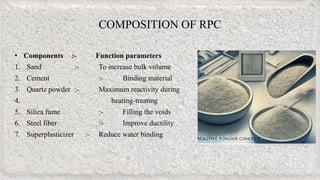
COMPOSITION OF RPC
• Components :- Function parameters
1. Sand :- To increase bulk volume
2. Cement :- Binding material
3. Quartz powder :- Maximum reactivity during
4. heating-treating
5. Silica fume :- Filling the voids
6. Steel fiber :- Improve ductility
7. Superplasticizer :- Reduce water binding
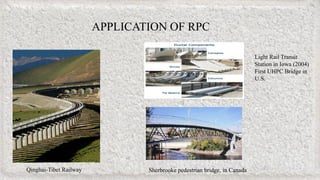
APPLICATION OF RPC
Qinghai-Tibet Railway
Light Rail Transit
Station in Iowa (2004)
First UHPC Bridge in
U.S.
Sherbrooke pedestrian bridge, in Canada
NEED OF STUDY
• To study the civil engineering applications of industrial byproduct like foundry
sand, which is technically sound and is environmentally safe.
• To study the use of Foundry sand as a partial replacement of Fine Aggregate to
achieve different property of concrete.
• To study the use of Fly ash as a replacement of Quartz powder and partial
replacement of Cement.
RPC MIX PROPORTIONS AND RATIOS
• Typical Proportions: Reactive Powder Concrete (RPC) typically consists of a mix of cement,
silica fume, quartz powder, sand, water, and steel fibers. A common proportion might include
around 70% cement, 15-20% silica fume, 5-10% quartz powder, and 2% steel fibers. The
amount of each ingredient is carefully calibrated to create a dense, strong matrix.
• Optimal Ratios: RPC requires a very low water-to-cement (W/C) ratio, often below 0.2,
achieved through the use of superplasticizers. This low W/C ratio minimizes porosity, which is
key to achieving RPC's remarkable strength and durability. The dense packing of particles
results in a concrete mix that resists compressive forces far better than conventional concrete.
ADVANCED INGREDIENTS IN RPC
• Nano-Silica and Other Nanomaterials: Researchers are increasingly adding nano-silica
and other nanomaterials to RPC. Nano-silica, in particular, improves the bonding
between cement particles, filling microscopic voids and further reducing porosity. This
enhancement results in even higher compressive strength and durability.
• Alternative Binders: To reduce the environmental impact of RPC, some researchers are
experimenting with alternative binders, like metakaolin or fly ash. These materials can
partially replace cement, reducing the carbon footprint of the mix while maintaining the
mechanical properties of RPC.
FIBER REINFORCEMENT IN RPC
• Types of Fibers: Steel fibers are the most commonly used type in RPC, but
alternatives like glass and carbon fibers are also used. Steel fibers contribute to the
overall strength and toughness of the RPC, allowing it to withstand tensile stresses
that would typically cause cracks in conventional concrete.
• Role of Fibers: Fibers in RPC create a network that bridges micro-cracks, thus
controlling crack propagation and increasing tensile strength. They play a crucial
role in enhancing RPC's ductility, making it ideal for structures that may
experience high tensile loads or impact forces.
RPC CASTING AND CURING PROCESS
• Casting Methods: Proper casting is essential for RPC as it is a dense and flowable
mix. Techniques such as vibration or self-compacting casting are often used to
ensure that the mix flows into every part of the mold without leaving air pockets.
• Curing Techniques: RPC typically undergoes heat curing to accelerate the hydration
process and achieve maximum strength. Autoclaving is another method used to cure
RPC under high pressure and temperature, significantly improving its durability and
mechanical properties.
MECHANICAL PROPERTIES OF RPC
• Compressive Strength: RPC's compressive strength ranges from 150 to 800 MPa,
significantly higher than traditional concrete, which is typically between 20 and 40
MPa. This strength allows RPC to be used in applications where heavy loads are
expected.
• Flexural and Tensile Strength: With a flexural strength up to 50 MPa, RPC resists
bending forces better than conventional concrete. Its tensile strength, enhanced by fiber
reinforcement, enables it to handle greater stresses, making it suitable for thin, load-
bearing structural elements.
DURABILITY OF RPC IN HARSH ENVIRONMENTS
• Resistance to Chloride Ion Penetration: Due to its dense microstructure, RPC
resists chloride penetration, making it highly durable in environments where chloride
exposure is high, such as coastal areas or regions where de-icing salts are used.
• Sulfate and Acid Resistance: RPC has shown high resistance to sulfate attacks,
which can cause deterioration in conventional concrete. Additionally, its low
permeability and high density protect it from acid attacks, increasing its lifespan in
chemically aggressive environments.
THERMAL AND FIRE RESISTANCE OF RPC
• Thermal Stability: RPC exhibits excellent thermal stability, maintaining its
structural integrity under high temperatures. Its dense structure and low
porosity mean it is less likely to spall under rapid heating.
• Fire Resistance: Due to its low water content and dense matrix, RPC is less
prone to explosive spalling in fire situations compared to traditional concrete.
This makes it a preferred material for structures where fire resistance is critical.
ARCHITECTURAL APPLICATIONS OF RPC
• Design Flexibility: RPC can be cast into thin, complex shapes, making it a
popular choice for architectural elements that combine aesthetics with
structural functionality. Its ability to form intricate designs allows architects to
push the limits of concrete design.
• Examples: Showcase iconic structures that use RPC for their facades or
structural components, such as high-rise buildings with unique designs that
require thin, lightweight, yet strong materials.
MARINE APPLICATIONS OF RPC
• Offshore Structures: RPC is ideal for offshore structures, such as oil rigs and
piers, that are exposed to saline water. Its resistance to chloride penetration and
sulfate attacks makes it suitable for long-term marine use.
• Seawalls and Breakwaters: In coastal defense applications, RPC can be used
to construct seawalls and breakwaters. Its high density and durability help it
resist the impact of waves and erosion, reducing maintenance costs.
• Objective: Achieve ultra-high strength and durability in RPC by optimizing
material selection, mix design, curing, and testing.
• Methodology Steps:
• Material selection
• Mix design
• Casting and compaction
• Curing
• Testing and analysis
METHODOLOGY
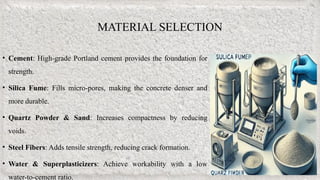
• Cement: High-grade Portland cement provides the foundation for
strength.
• Silica Fume: Fills micro-pores, making the concrete denser and
more durable.
• Quartz Powder & Sand: Increases compactness by reducing
voids.
• Steel Fibers: Adds tensile strength, reducing crack formation.
• Water & Superplasticizers: Achieve workability with a low
water-to-cement ratio.
MATERIAL SELECTION
MIX DESIGN OPTIMIZATION
• Mix Proportioning: Carefully balanced ratios (cement, silica fume, quartz
powder, sand, fibers, and superplasticizers) maximize strength and durability.
• Trial Mixes: Different ratios are tested to find the optimal balance between
strength, workability, and durability.
CASTING AND COMPACTION
• Casting Process: Place the concrete mix into molds carefully to avoid air
entrapment.
• Compaction: Use of vibration or self-compacting techniques to reduce voids
and achieve a dense matrix.
• Explanation: Proper casting and compaction ensure that RPC reaches its
potential strength. Compacting eliminates air gaps, which could weaken the
concrete.
CURING PROCESS
• Method: Often steam curing or autoclaving at elevated temperatures to
accelerate hydration.
• Time & Temperature: Optimal curing conditions (typically 90°C for several
hours) help RPC reach its ultra-high strength.
• Curing enhances the hydration process, leading to a dense matrix with few
micro-pores. Elevated temperature curing also shortens the time needed for
RPC to achieve its final strength.
TESTING PROCEDURES
• Compressive Strength Test: Measures the load RPC can withstand before
failure.
• Flexural and Tensile Tests: Assesses bending and tensile strength to ensure
RPC can handle high-stress applications.
• Durability Tests: Includes chloride penetration and sulfate resistance tests to
check longevity.
• Explanation: Testing ensures RPC meets structural and durability standards.
These tests confirm that the mix is capable of withstanding high loads and
environmental challenges.
ECONOMIC ASPECTS OF RPC
• Initial costs: the production cost of RPC is higher than conventional concrete
due to its high cement and silica fume content and the need for heat curing.
However, rpc’s strength and durability justify its use in critical infrastructure
projects.
• Long-term savings: despite its higher upfront costs, rpc’s low maintenance
requirements and long lifespan lead to cost savings over time. For structures
where maintenance is costly or difficult, RPC can be a financially viable choice.
ENVIRONMENTAL IMPACT AND
SUSTAINABILITY
•Resource Efficiency: Due to its high strength, RPC can be used in thinner
sections, reducing material use. This efficiency allows for less concrete to be
used in load-bearing structures, which conserves resources.
•Recyclability and Carbon Footprint: Efforts are being made to incorporate
recycled materials in RPC, such as recycled glass or industrial by-products, to
lower its carbon footprint. Additionally, researchers are exploring low-carbon
cement alternatives to make RPC more sustainable.
FUTURE RESEARCH DIRECTIONS IN RPC
• Potential Improvements: Research is ongoing to improve the workability of
RPC, reduce costs, and increase its sustainability by incorporating eco-friendly
materials. Researchers are also working to increase RPC's thermal conductivity
for applications where heat resistance is crucial.
• Emerging Applications: New areas for RPC use include earthquake-resistant
structures, high-performance pavements, and other infrastructure in seismically
active regions. The strength and durability of RPC make it an excellent candidate
for challenging applications in the future.
CONCLUSION
• Innovative Material: RPC offers exceptional strength, durability, and
resistance, making it suitable for demanding applications.
• Benefits: High compressive strength, longevity, and reduced weight allow for
efficient, long-lasting structures.
• Applications: Used in bridges, skyscrapers, and protective infrastructure,
showing great potential in structural engineering.
• Challenges: High production costs and material sourcing remain barriers, but
ongoing research aims to improve feasibility.
REFERENCES
• Richard, P., & Cheyrezy, M. (1995). Composition of Reactive Powder
Concrete. Cement and Concrete Research.
• Graybeal, B. (2007). Compressive behavior of ultra-high-performance fiber-
reinforced concrete. ACI Materials Journal.
Rajesh seminar carbon reactice powder.pptx

Rajesh seminar carbon reactice powder.pptx

  • 1.
    A Presentation On “REACTIVE POWDER CONCRETE” Submitted inpartial fulfillment for the award of Degree of Bachelor of Technology in Department of Civil Engineering PRESENTED TO: PRESENTED BY Mr. Rohit Soni Rajesh Kumar Bunkar H.O.D, (Civil Department) 22E1SBCEM10P202 DEPARTMENT OF CIVIL ENGINEERING SRI BALAJI COLLEGE OF ENGINEERING & TECHNOLOGY JAIPUR NOVEMBER - 2024
  • 2.
    CONTENT • Introduction • Compositionof RPC • Applications • Properties • Methodology • Economic Aspects • Environmental Impact & Sustainability • Future Research in RPC • Conclusion • References
  • 3.
    INTRODUCTION • Reactive powderconcrete (RPC) is the generic name for a class of cementious composite materials developed by the technical division of Bouygues, in the early 1990s. It is characterized by extremely good physical properties, particularly strength and ductility • A composite material & ultra high strength with mechanical properties. • Mixture of cement, silica fume, quartz powder, steel fiber(Optional) & super plasticized with a very low water cement ratio. • This compactness gives RPC ultra-high strength and durability. Reactive Powder Concretes have compressive strengths ranging from 200 MPa to 800 MPa.
  • 4.
    •Chard and Cheyrezyindicate the following principles for developing RPC: • Elimination of coarse aggregates for enhancement of homogeneity •Utilization of the pozzolanic properties of silica fume •The optimal usage of super plasticizer to reduce w/c and improve workability •Post-set heat-treatment for the enhancement of the microstructure •Addition of small-sized steel fibers to improve ductility
  • 5.
    SCOPE OF STUDY •Foundry sand is used for the preparation of RPC. • Steel fiber is introduced to improve ductility. • Super plasticizers of different qualities are used to study their effects on the workability and compressive strength of Reactive Powder Concrete. • Silica fumes of different qualities are used to study their effects on the compressive strength of Reactive Powder Concrete. • Steel fibers of two different dimensions are used to compare the change in compressive strength.
  • 6.
    OBJECTIVE OF STUDY •The main objectives of this experimental work is to study the effect of industrial byproduct like foundry sand and fly ash in the Reactive Powder Concrete on its various properties. • To understand the waste utilization scenario of the foundry type industrial byproduct in India. • To ascertain the behavior of RPC mixed with foundry sand and fly ash, thereby, examining the changes of properties like strength and ductility.
  • 7.
    COMPOSITION OF RPC •Components :- Function parameters 1. Sand :- To increase bulk volume 2. Cement :- Binding material 3. Quartz powder :- Maximum reactivity during 4. heating-treating 5. Silica fume :- Filling the voids 6. Steel fiber :- Improve ductility 7. Superplasticizer :- Reduce water binding
  • 8.
    APPLICATION OF RPC Qinghai-TibetRailway Light Rail Transit Station in Iowa (2004) First UHPC Bridge in U.S. Sherbrooke pedestrian bridge, in Canada
  • 9.
    NEED OF STUDY •To study the civil engineering applications of industrial byproduct like foundry sand, which is technically sound and is environmentally safe. • To study the use of Foundry sand as a partial replacement of Fine Aggregate to achieve different property of concrete. • To study the use of Fly ash as a replacement of Quartz powder and partial replacement of Cement.
  • 10.
    RPC MIX PROPORTIONSAND RATIOS • Typical Proportions: Reactive Powder Concrete (RPC) typically consists of a mix of cement, silica fume, quartz powder, sand, water, and steel fibers. A common proportion might include around 70% cement, 15-20% silica fume, 5-10% quartz powder, and 2% steel fibers. The amount of each ingredient is carefully calibrated to create a dense, strong matrix. • Optimal Ratios: RPC requires a very low water-to-cement (W/C) ratio, often below 0.2, achieved through the use of superplasticizers. This low W/C ratio minimizes porosity, which is key to achieving RPC's remarkable strength and durability. The dense packing of particles results in a concrete mix that resists compressive forces far better than conventional concrete.
  • 11.
    ADVANCED INGREDIENTS INRPC • Nano-Silica and Other Nanomaterials: Researchers are increasingly adding nano-silica and other nanomaterials to RPC. Nano-silica, in particular, improves the bonding between cement particles, filling microscopic voids and further reducing porosity. This enhancement results in even higher compressive strength and durability. • Alternative Binders: To reduce the environmental impact of RPC, some researchers are experimenting with alternative binders, like metakaolin or fly ash. These materials can partially replace cement, reducing the carbon footprint of the mix while maintaining the mechanical properties of RPC.
  • 12.
    FIBER REINFORCEMENT INRPC • Types of Fibers: Steel fibers are the most commonly used type in RPC, but alternatives like glass and carbon fibers are also used. Steel fibers contribute to the overall strength and toughness of the RPC, allowing it to withstand tensile stresses that would typically cause cracks in conventional concrete. • Role of Fibers: Fibers in RPC create a network that bridges micro-cracks, thus controlling crack propagation and increasing tensile strength. They play a crucial role in enhancing RPC's ductility, making it ideal for structures that may experience high tensile loads or impact forces.
  • 13.
    RPC CASTING ANDCURING PROCESS • Casting Methods: Proper casting is essential for RPC as it is a dense and flowable mix. Techniques such as vibration or self-compacting casting are often used to ensure that the mix flows into every part of the mold without leaving air pockets. • Curing Techniques: RPC typically undergoes heat curing to accelerate the hydration process and achieve maximum strength. Autoclaving is another method used to cure RPC under high pressure and temperature, significantly improving its durability and mechanical properties.
  • 14.
    MECHANICAL PROPERTIES OFRPC • Compressive Strength: RPC's compressive strength ranges from 150 to 800 MPa, significantly higher than traditional concrete, which is typically between 20 and 40 MPa. This strength allows RPC to be used in applications where heavy loads are expected. • Flexural and Tensile Strength: With a flexural strength up to 50 MPa, RPC resists bending forces better than conventional concrete. Its tensile strength, enhanced by fiber reinforcement, enables it to handle greater stresses, making it suitable for thin, load- bearing structural elements.
  • 15.
    DURABILITY OF RPCIN HARSH ENVIRONMENTS • Resistance to Chloride Ion Penetration: Due to its dense microstructure, RPC resists chloride penetration, making it highly durable in environments where chloride exposure is high, such as coastal areas or regions where de-icing salts are used. • Sulfate and Acid Resistance: RPC has shown high resistance to sulfate attacks, which can cause deterioration in conventional concrete. Additionally, its low permeability and high density protect it from acid attacks, increasing its lifespan in chemically aggressive environments.
  • 16.
    THERMAL AND FIRERESISTANCE OF RPC • Thermal Stability: RPC exhibits excellent thermal stability, maintaining its structural integrity under high temperatures. Its dense structure and low porosity mean it is less likely to spall under rapid heating. • Fire Resistance: Due to its low water content and dense matrix, RPC is less prone to explosive spalling in fire situations compared to traditional concrete. This makes it a preferred material for structures where fire resistance is critical.
  • 17.
    ARCHITECTURAL APPLICATIONS OFRPC • Design Flexibility: RPC can be cast into thin, complex shapes, making it a popular choice for architectural elements that combine aesthetics with structural functionality. Its ability to form intricate designs allows architects to push the limits of concrete design. • Examples: Showcase iconic structures that use RPC for their facades or structural components, such as high-rise buildings with unique designs that require thin, lightweight, yet strong materials.
  • 18.
    MARINE APPLICATIONS OFRPC • Offshore Structures: RPC is ideal for offshore structures, such as oil rigs and piers, that are exposed to saline water. Its resistance to chloride penetration and sulfate attacks makes it suitable for long-term marine use. • Seawalls and Breakwaters: In coastal defense applications, RPC can be used to construct seawalls and breakwaters. Its high density and durability help it resist the impact of waves and erosion, reducing maintenance costs.
  • 19.
    • Objective: Achieveultra-high strength and durability in RPC by optimizing material selection, mix design, curing, and testing. • Methodology Steps: • Material selection • Mix design • Casting and compaction • Curing • Testing and analysis METHODOLOGY
  • 20.
    • Cement: High-gradePortland cement provides the foundation for strength. • Silica Fume: Fills micro-pores, making the concrete denser and more durable. • Quartz Powder & Sand: Increases compactness by reducing voids. • Steel Fibers: Adds tensile strength, reducing crack formation. • Water & Superplasticizers: Achieve workability with a low water-to-cement ratio. MATERIAL SELECTION
  • 21.
    MIX DESIGN OPTIMIZATION •Mix Proportioning: Carefully balanced ratios (cement, silica fume, quartz powder, sand, fibers, and superplasticizers) maximize strength and durability. • Trial Mixes: Different ratios are tested to find the optimal balance between strength, workability, and durability.
  • 22.
    CASTING AND COMPACTION •Casting Process: Place the concrete mix into molds carefully to avoid air entrapment. • Compaction: Use of vibration or self-compacting techniques to reduce voids and achieve a dense matrix. • Explanation: Proper casting and compaction ensure that RPC reaches its potential strength. Compacting eliminates air gaps, which could weaken the concrete.
  • 23.
    CURING PROCESS • Method:Often steam curing or autoclaving at elevated temperatures to accelerate hydration. • Time & Temperature: Optimal curing conditions (typically 90°C for several hours) help RPC reach its ultra-high strength. • Curing enhances the hydration process, leading to a dense matrix with few micro-pores. Elevated temperature curing also shortens the time needed for RPC to achieve its final strength.
  • 24.
    TESTING PROCEDURES • CompressiveStrength Test: Measures the load RPC can withstand before failure. • Flexural and Tensile Tests: Assesses bending and tensile strength to ensure RPC can handle high-stress applications. • Durability Tests: Includes chloride penetration and sulfate resistance tests to check longevity. • Explanation: Testing ensures RPC meets structural and durability standards. These tests confirm that the mix is capable of withstanding high loads and environmental challenges.
  • 25.
    ECONOMIC ASPECTS OFRPC • Initial costs: the production cost of RPC is higher than conventional concrete due to its high cement and silica fume content and the need for heat curing. However, rpc’s strength and durability justify its use in critical infrastructure projects. • Long-term savings: despite its higher upfront costs, rpc’s low maintenance requirements and long lifespan lead to cost savings over time. For structures where maintenance is costly or difficult, RPC can be a financially viable choice.
  • 26.
    ENVIRONMENTAL IMPACT AND SUSTAINABILITY •ResourceEfficiency: Due to its high strength, RPC can be used in thinner sections, reducing material use. This efficiency allows for less concrete to be used in load-bearing structures, which conserves resources. •Recyclability and Carbon Footprint: Efforts are being made to incorporate recycled materials in RPC, such as recycled glass or industrial by-products, to lower its carbon footprint. Additionally, researchers are exploring low-carbon cement alternatives to make RPC more sustainable.
  • 27.
    FUTURE RESEARCH DIRECTIONSIN RPC • Potential Improvements: Research is ongoing to improve the workability of RPC, reduce costs, and increase its sustainability by incorporating eco-friendly materials. Researchers are also working to increase RPC's thermal conductivity for applications where heat resistance is crucial. • Emerging Applications: New areas for RPC use include earthquake-resistant structures, high-performance pavements, and other infrastructure in seismically active regions. The strength and durability of RPC make it an excellent candidate for challenging applications in the future.
  • 28.
    CONCLUSION • Innovative Material:RPC offers exceptional strength, durability, and resistance, making it suitable for demanding applications. • Benefits: High compressive strength, longevity, and reduced weight allow for efficient, long-lasting structures. • Applications: Used in bridges, skyscrapers, and protective infrastructure, showing great potential in structural engineering. • Challenges: High production costs and material sourcing remain barriers, but ongoing research aims to improve feasibility.
  • 29.
    REFERENCES • Richard, P.,& Cheyrezy, M. (1995). Composition of Reactive Powder Concrete. Cement and Concrete Research. • Graybeal, B. (2007). Compressive behavior of ultra-high-performance fiber- reinforced concrete. ACI Materials Journal.