The Development Graveyard:
How Software Projects Die


   Dr. Adam Kolawa - CEO, Parasoft

              October 29, 2009
Outline


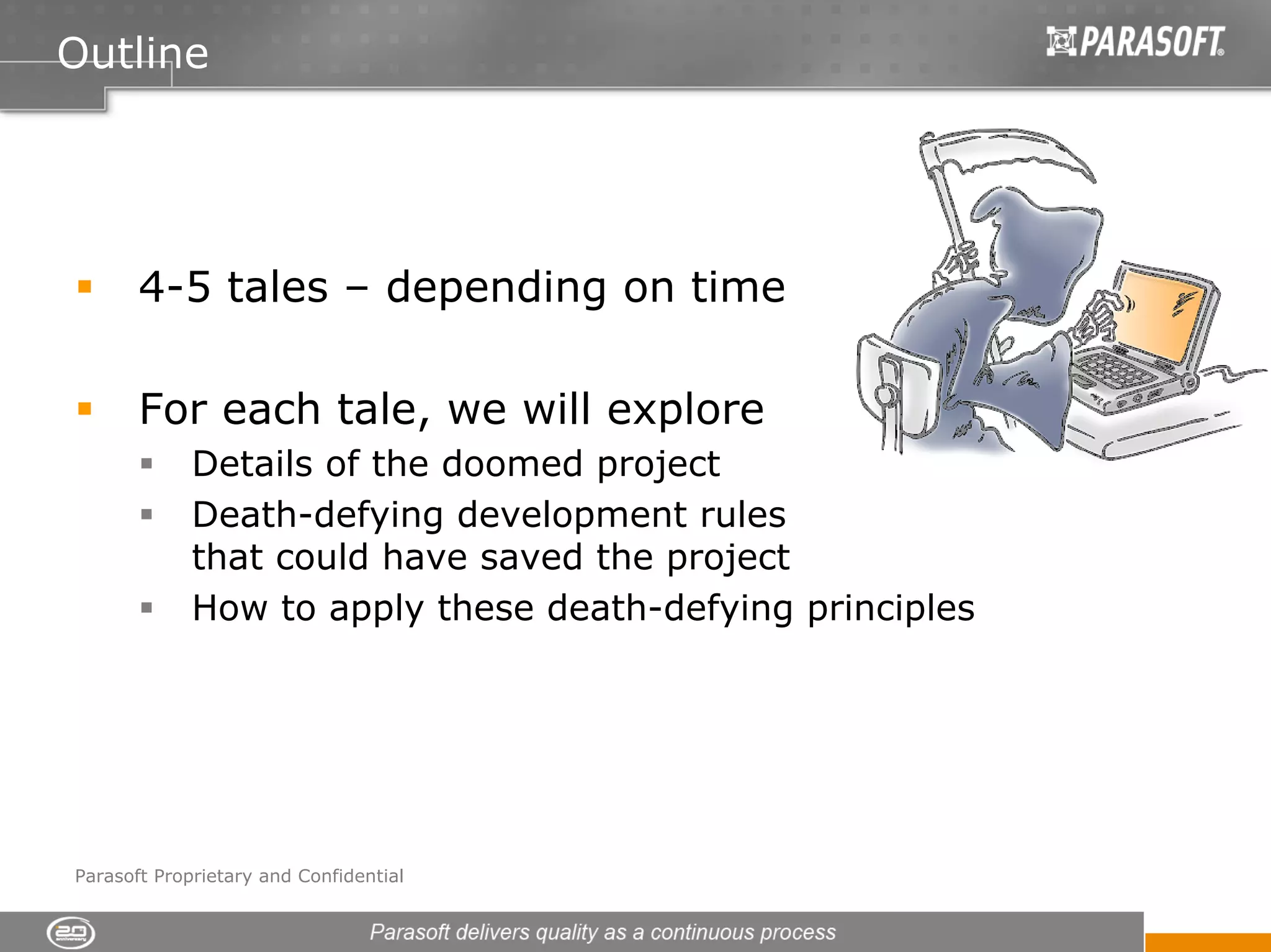
       4-5 tales – depending on time

       For each tale, we will explore
             Details of the doomed project
             Death-defying development rules
             that could have saved the project
             How to apply these death-defying principles


Parasoft Proprietary and Confidential
I: Doomed by changing requirements

      Submitted by Claude Hebert Jr.

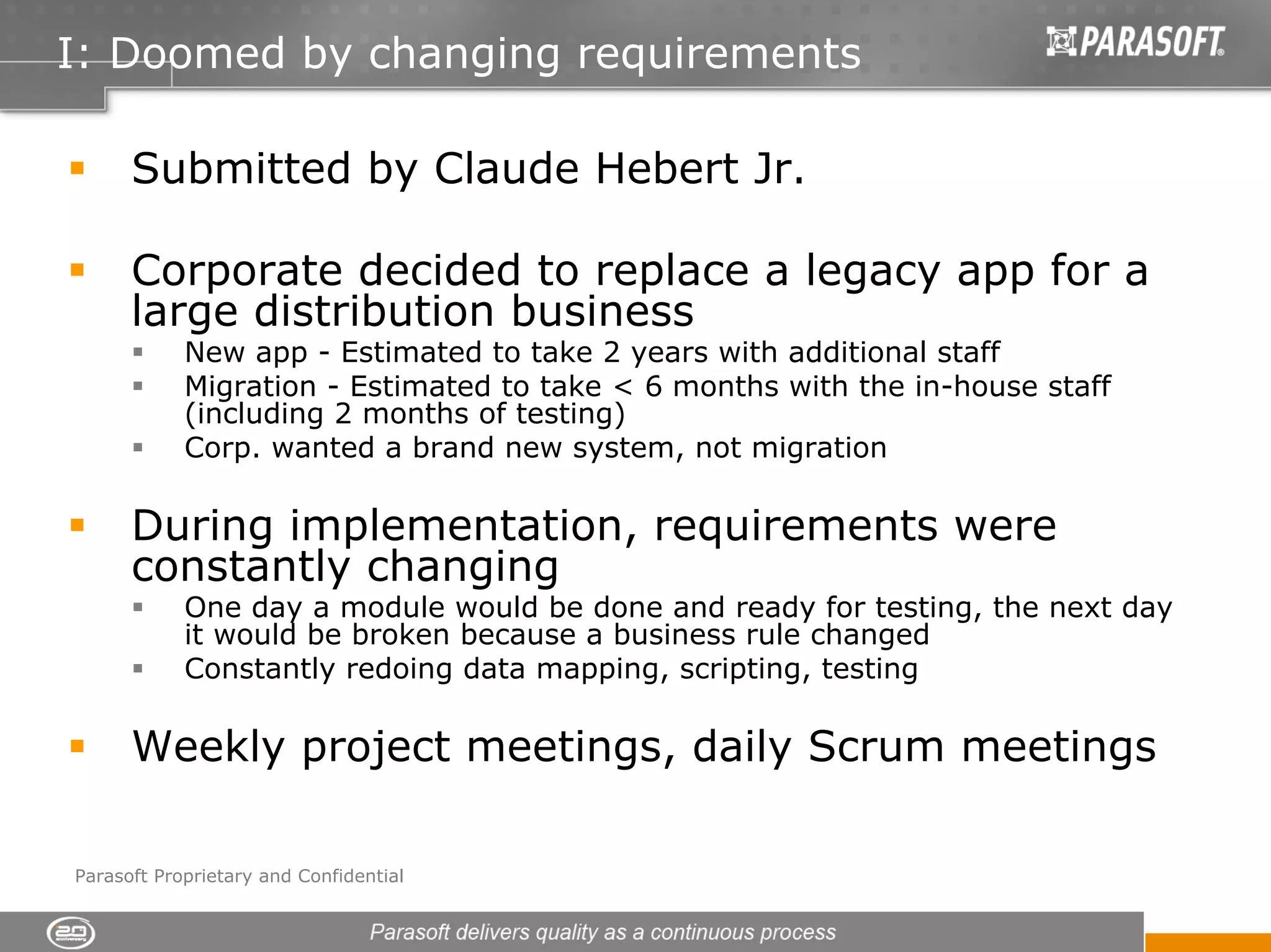
      Corporate decided to replace a legacy app for a
      large distribution business
            New app - Estimated to take 2 years with additional staff
            Migration - Estimated to take < 6 months with the in-house staff
            (including 2 months of testing)
            Corp. wanted a brand new system, not migration

      During implementation, requirements were
      constantly changing
            One day a module would be done and ready for testing, the next day
            it would be broken because a business rule changed
            Constantly redoing data mapping, scripting, testing

      Weekly project meetings, daily Scrum meetings

Parasoft Proprietary and Confidential
I: Doomed by changing requirements

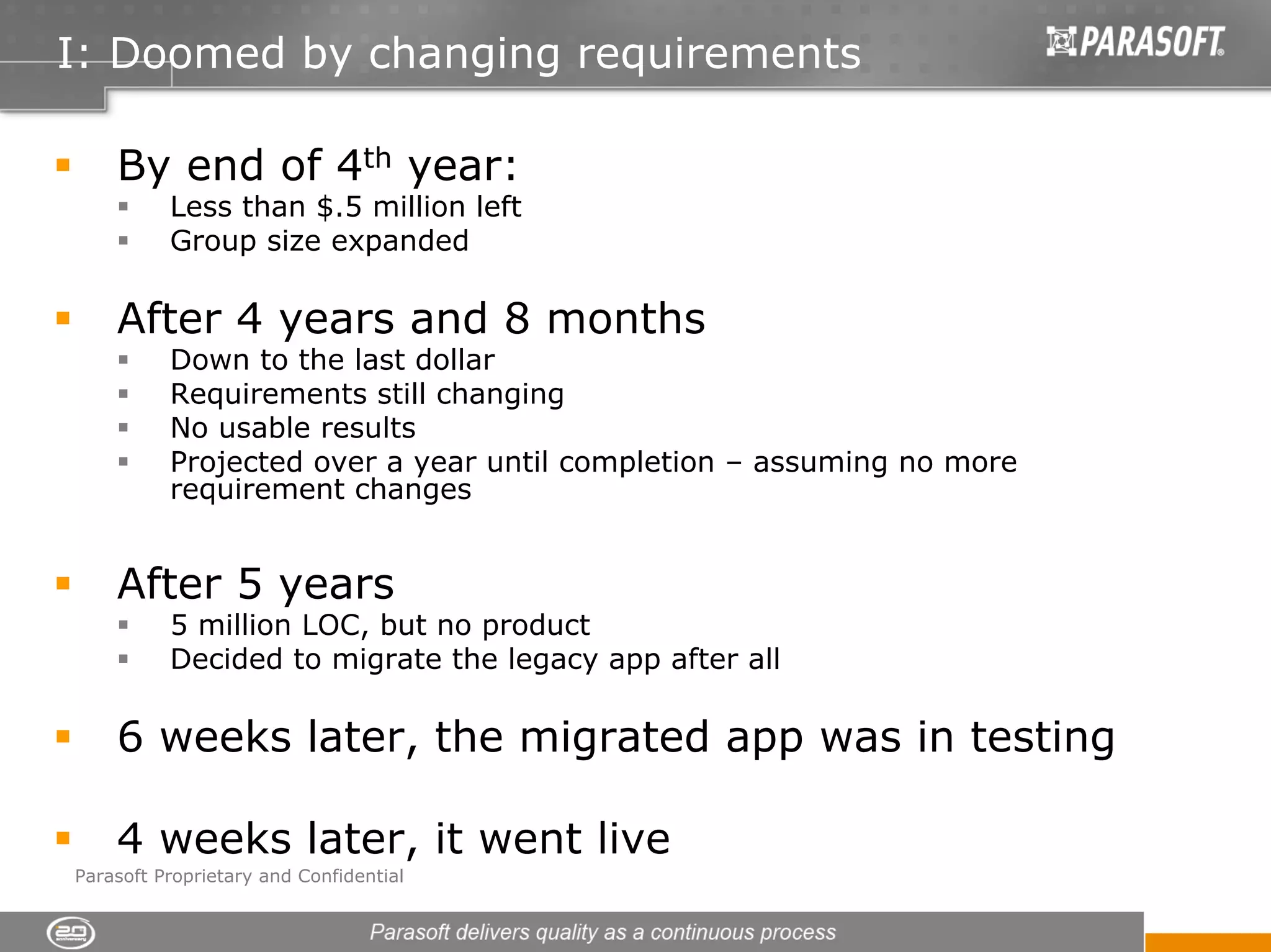
    By end of 4th year:
          Less than $.5 million left
          Group size expanded

    After 4 years and 8 months
          Down to the last dollar
          Requirements still changing
          No usable results
          Projected over a year until completion – assuming no more
          requirement changes


    After 5 years
          5 million LOC, but no product
          Decided to migrate the legacy app after all

    6 weeks later, the migrated app was in testing

    4 weeks later, it went live
Parasoft Proprietary and Confidential
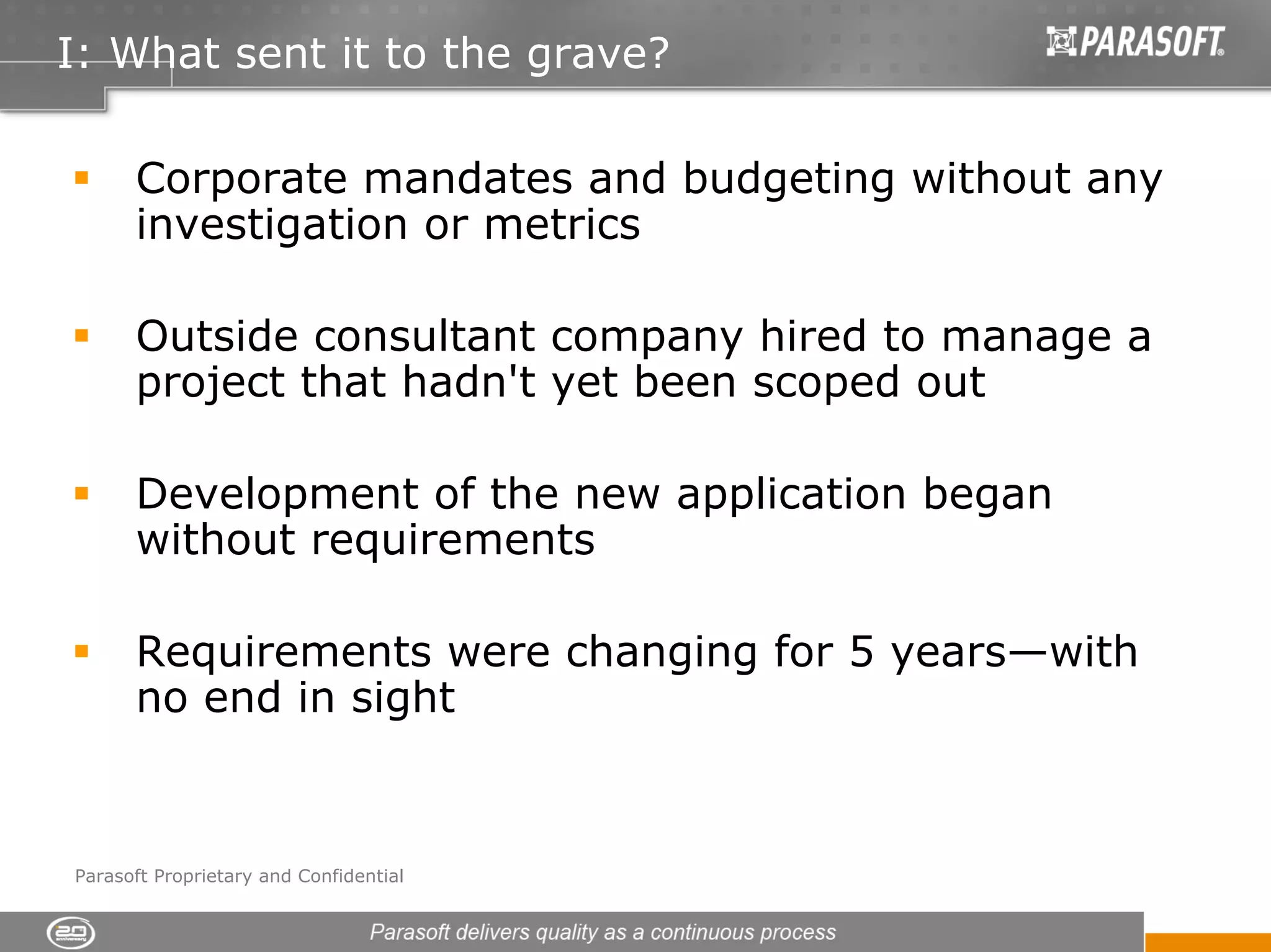
I: What sent it to the grave?

      Corporate mandates and budgeting without any
      investigation or metrics

      Outside consultant company hired to manage a
      project that hadn't yet been scoped out

      Development of the new application began
      without requirements

      Requirements were changing for 5 years—with
      no end in sight


Parasoft Proprietary and Confidential
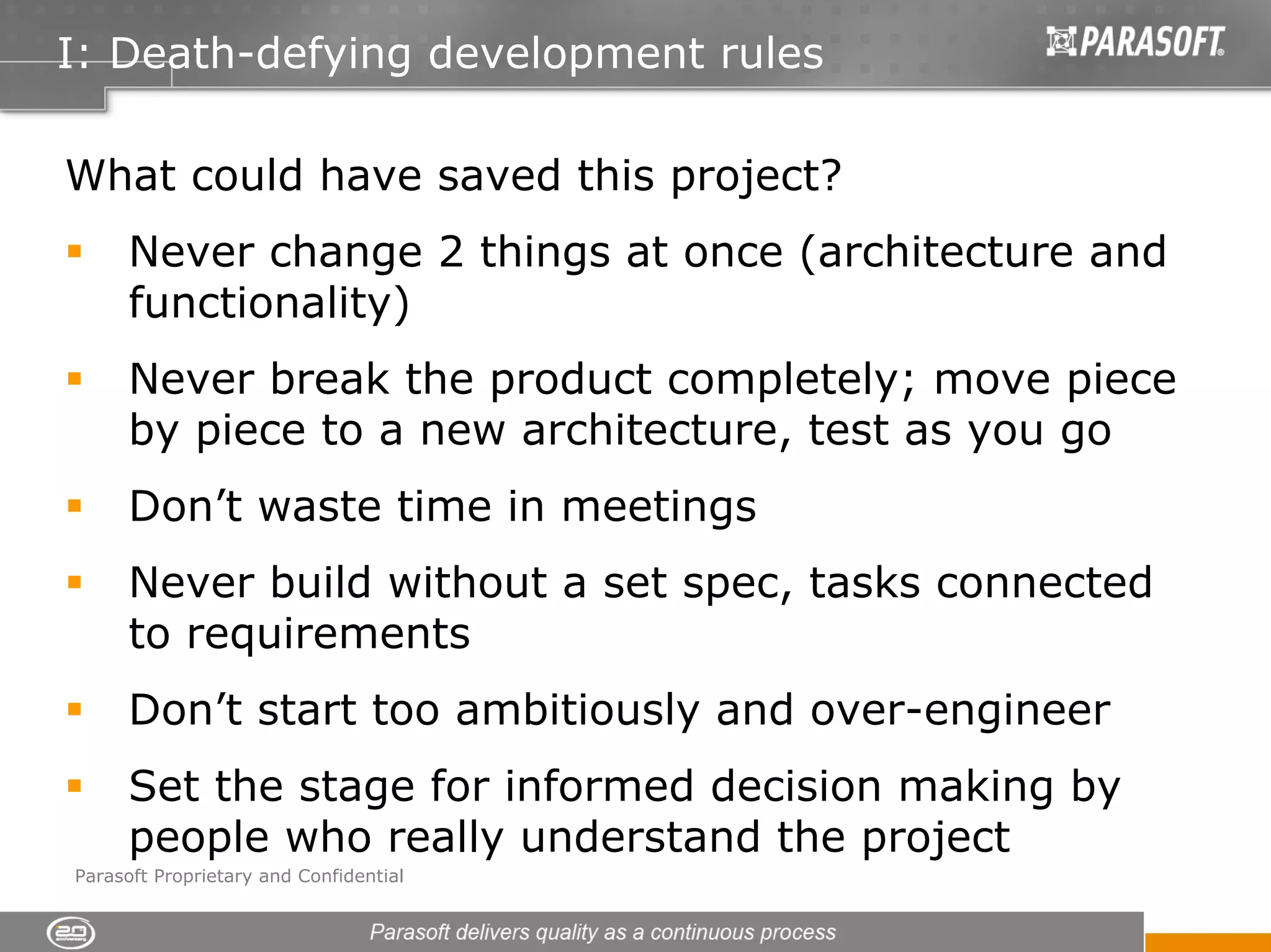
I: Death-defying development rules

What could have saved this project?
      Never change 2 things at once (architecture and
      functionality)
      Never break the product completely; move piece
      by piece to a new architecture, test as you go
      Don’t waste time in meetings
      Never build without a set spec, tasks connected
      to requirements
      Don’t start too ambitiously and over-engineer
      Set the stage for informed decision making by
      people who really understand the project
Parasoft Proprietary and Confidential
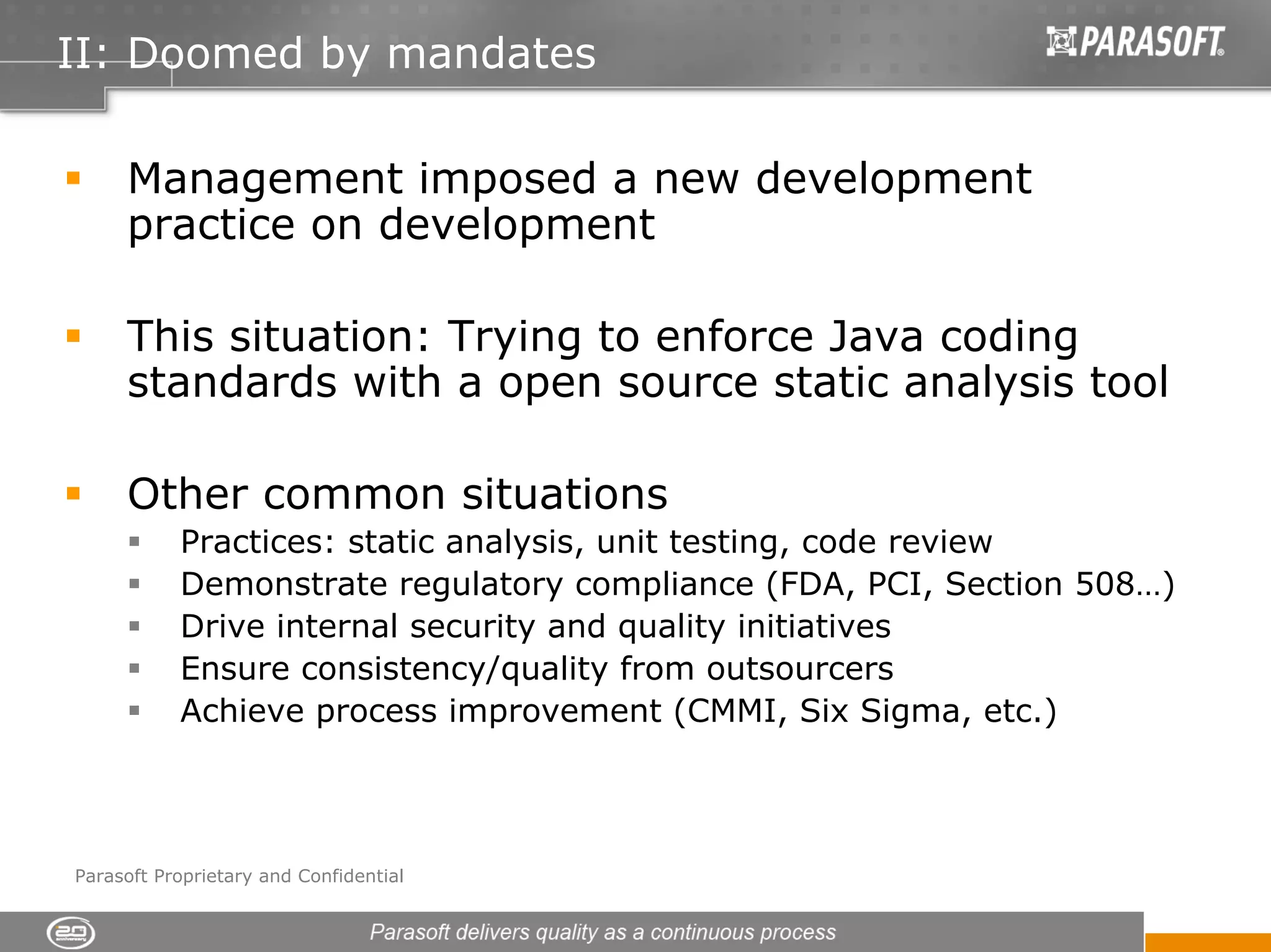
II: Doomed by mandates

     Management imposed a new development
     practice on development

     This situation: Trying to enforce Java coding
     standards with a open source static analysis tool

     Other common situations
           Practices: static analysis, unit testing, code review
           Demonstrate regulatory compliance (FDA, PCI, Section 508…)
           Drive internal security and quality initiatives
           Ensure consistency/quality from outsourcers
           Achieve process improvement (CMMI, Six Sigma, etc.)


Parasoft Proprietary and Confidential
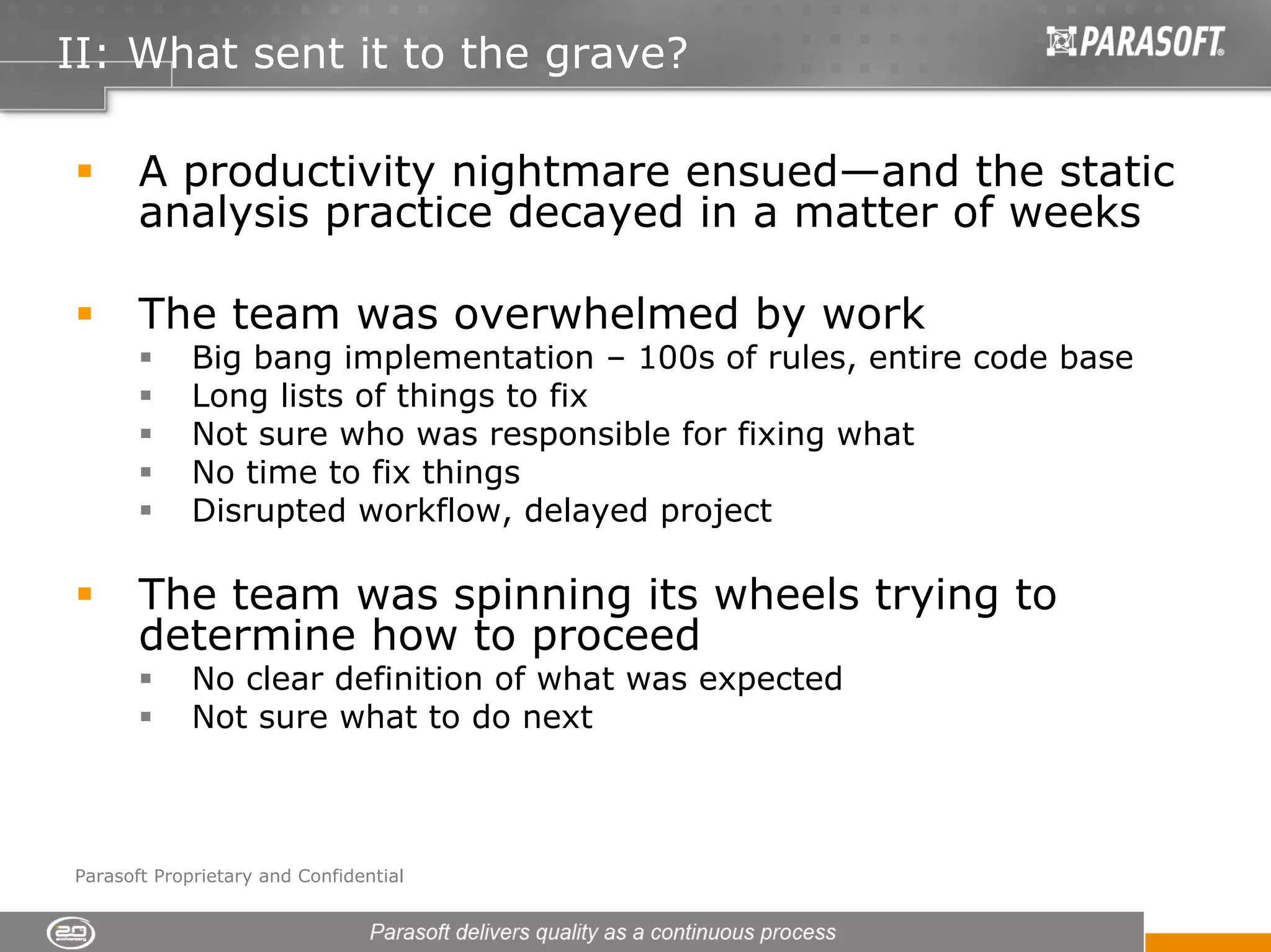
II: What sent it to the grave?

       A productivity nightmare ensued—and the static
       analysis practice decayed in a matter of weeks

       The team was overwhelmed by work
             Big bang implementation – 100s of rules, entire code base
             Long lists of things to fix
             Not sure who was responsible for fixing what
             No time to fix things
             Disrupted workflow, delayed project

       The team was spinning its wheels trying to
       determine how to proceed
             No clear definition of what was expected
             Not sure what to do next


Parasoft Proprietary and Confidential
II: Death-defying development rules


What could have saved this project?
  Enforce time-consuming practice with support
  and understanding


Parasoft Proprietary and Confidential
III: Doomed by prototyping not productizing


       Years ago, our own developers were working on
       a new defect prevention technology

       Prototyping was necessary… because the
       technology was so new, specs could not be
       clearly defined from the start


Parasoft Proprietary and Confidential
III: What sent it to the grave?


       The project was paralyzed by too long in
       prototyping
             Expected use cases worked—but little else did
             Like a typical “version 1” release—performs a limited
             scope of technology, but not robust
             Developed by trying to determine what they missed and
             retrofit it in
             Digressed into “debugging-driven development”


       Didn’t shift soon enough from prototyping to
       productizing with a group of solid developers


Parasoft Proprietary and Confidential
III: Death-defying development rules


What could have saved this project?
       To create a product (not just a prototype), you
       need to understand functional milestones, build
       and maintain a regression test suite
       Don’t let rough, self-confident developers take
       over the group
       Ensure that developers don’t hack the code,
       taking shortcuts that result in fragile, brittle
       implementations
       Bake quality in instead of trying to test problems
       out with debugging
Parasoft Proprietary and Confidential
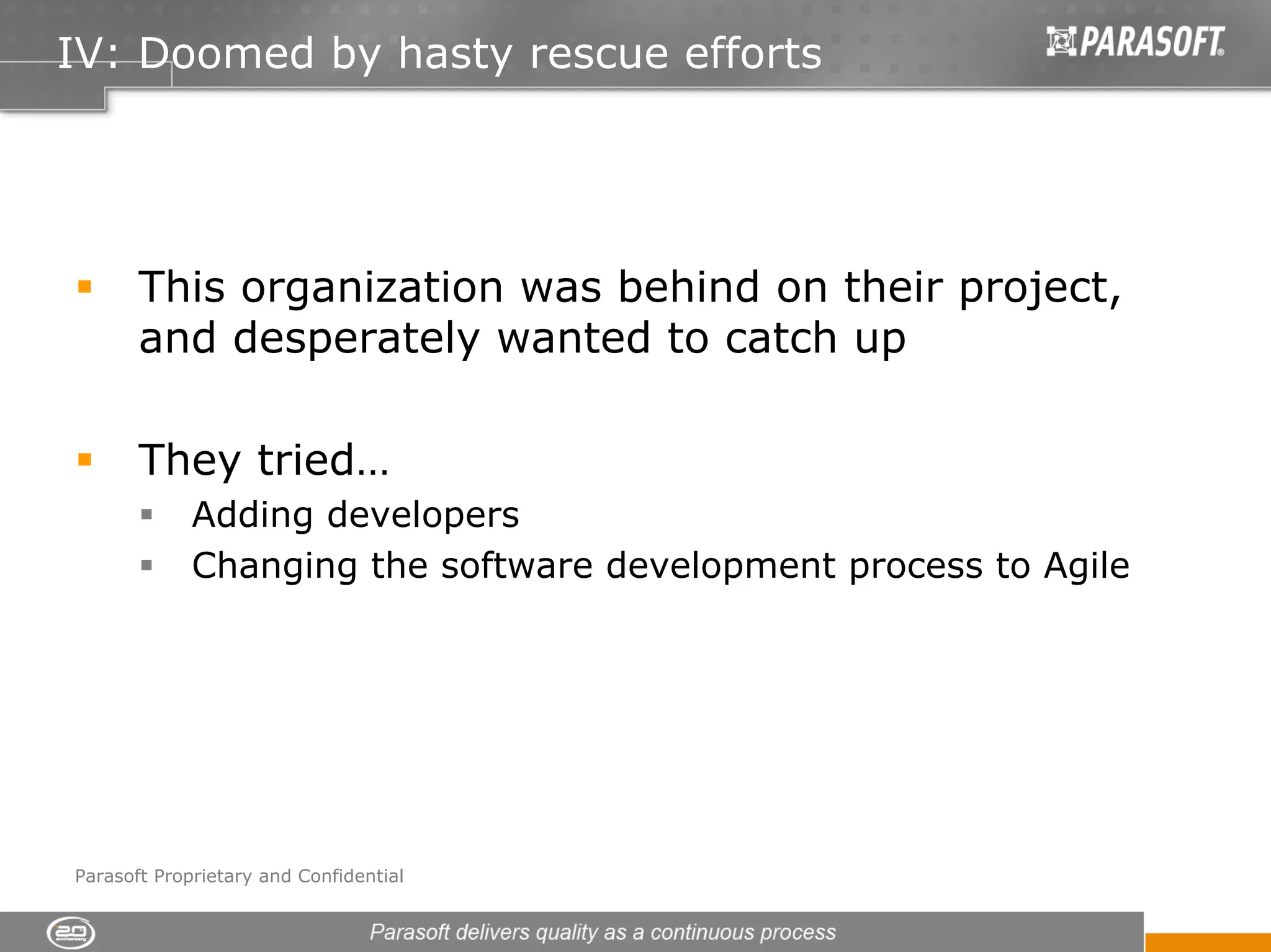
IV: Doomed by hasty rescue efforts


       This organization was behind on their project,
       and desperately wanted to catch up

       They tried…
             Adding developers
             Changing the software development process to Agile


Parasoft Proprietary and Confidential
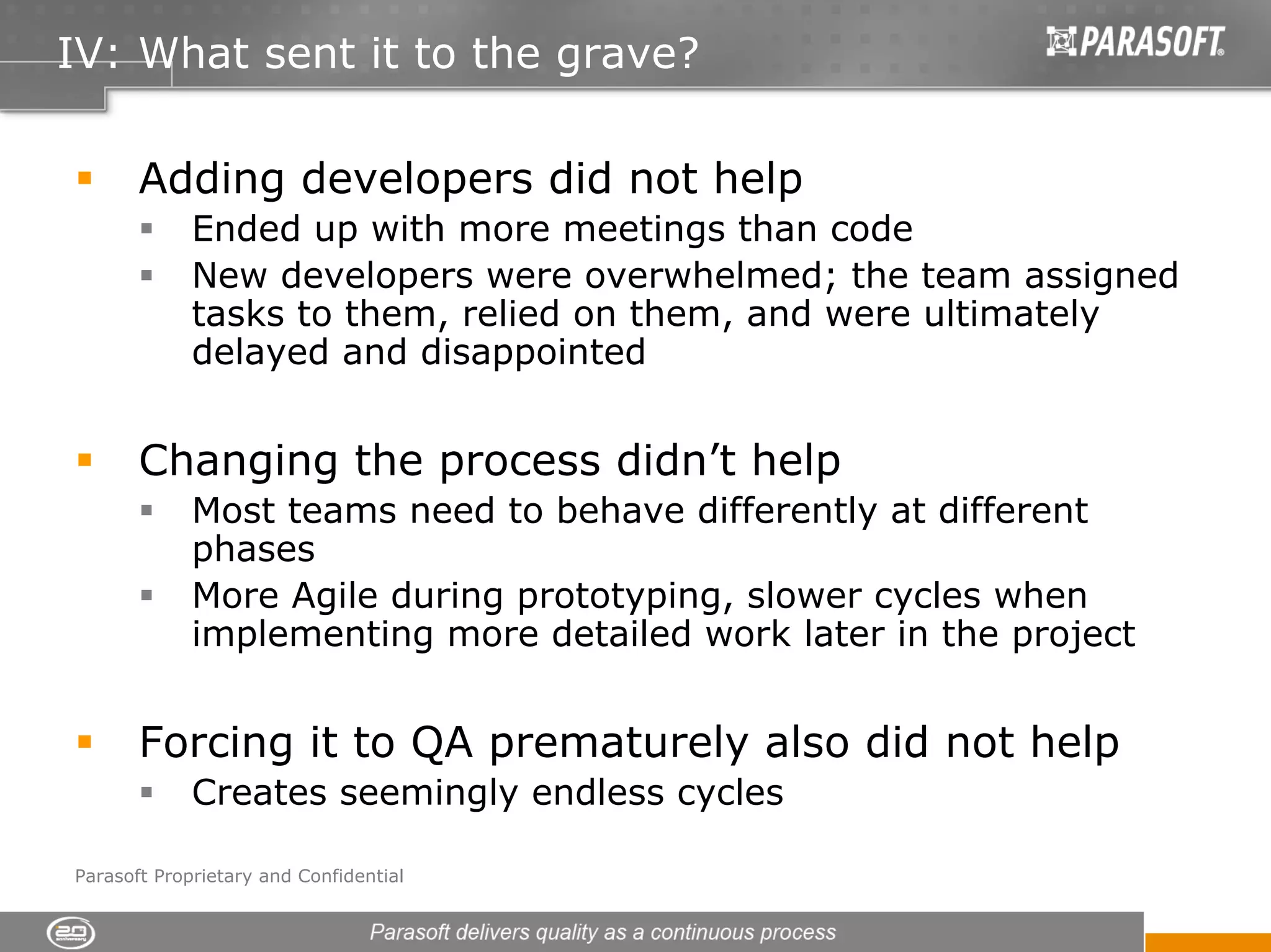
IV: What sent it to the grave?

       Adding developers did not help
             Ended up with more meetings than code
             New developers were overwhelmed; the team assigned
             tasks to them, relied on them, and were ultimately
             delayed and disappointed


       Changing the process didn’t help
             Most teams need to behave differently at different
             phases
             More Agile during prototyping, slower cycles when
             implementing more detailed work later in the project


       Forcing it to QA prematurely also did not help
             Creates seemingly endless cycles

Parasoft Proprietary and Confidential
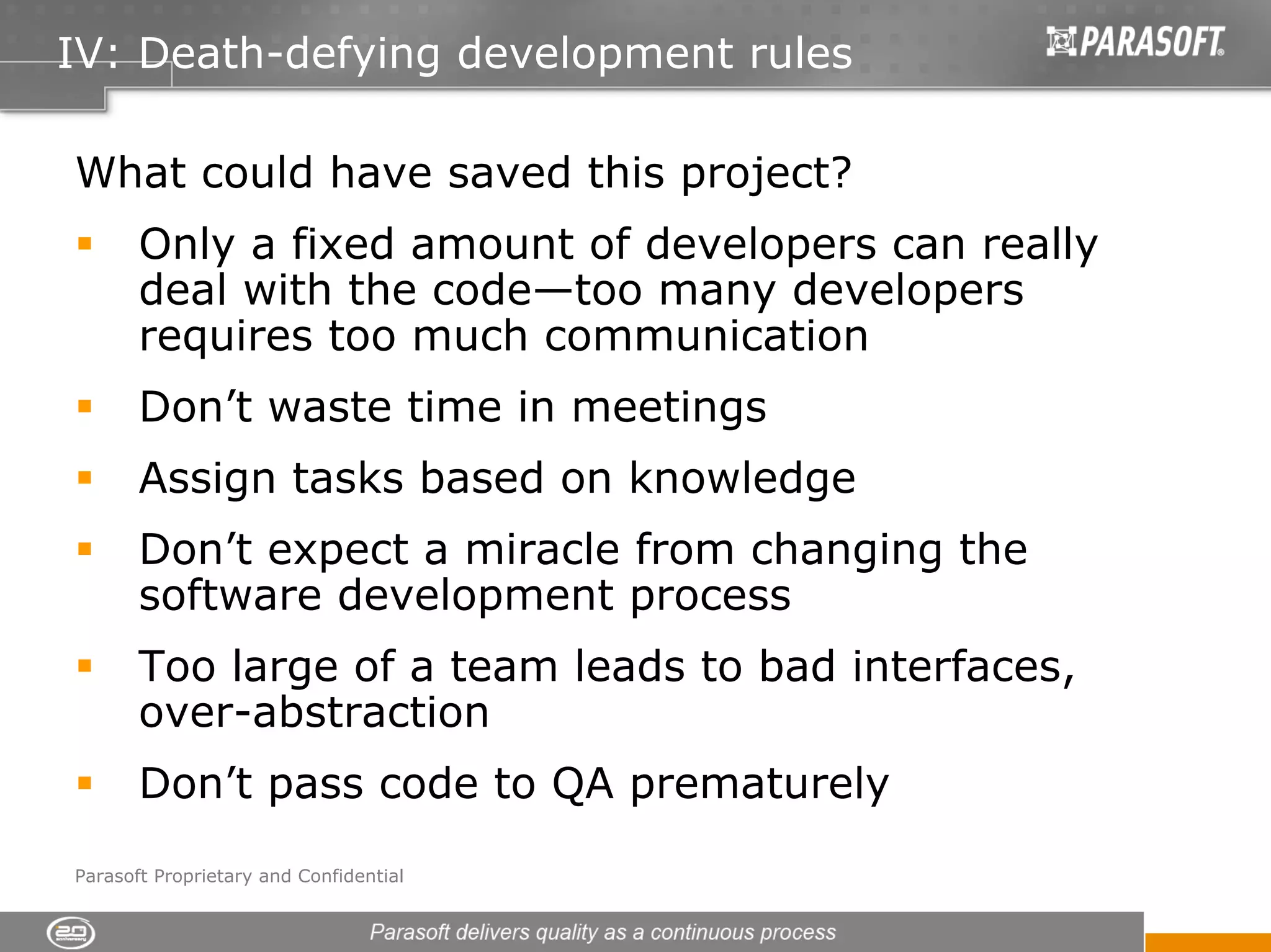
IV: Death-defying development rules

What could have saved this project?
       Only a fixed amount of developers can really
       deal with the code—too many developers
       requires too much communication
       Don’t waste time in meetings
       Assign tasks based on knowledge
       Don’t expect a miracle from changing the
       software development process
       Too large of a team leads to bad interfaces,
       over-abstraction
       Don’t pass code to QA prematurely
Parasoft Proprietary and Confidential
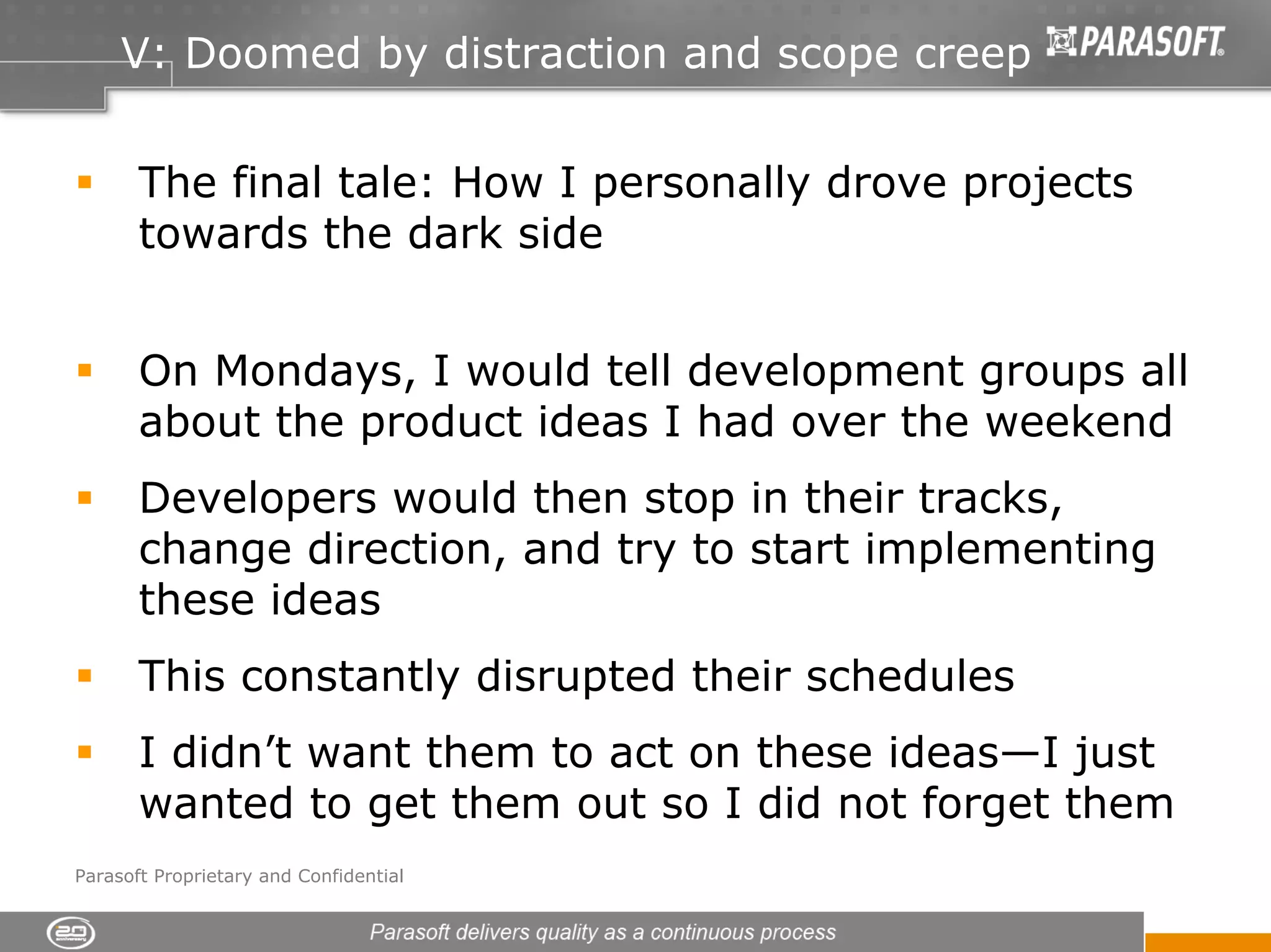
V: Doomed by distraction and scope creep


       The final tale: How I personally drove projects
       towards the dark side


       On Mondays, I would tell development groups all
       about the product ideas I had over the weekend
       Developers would then stop in their tracks,
       change direction, and try to start implementing
       these ideas
       This constantly disrupted their schedules
       I didn’t want them to act on these ideas—I just
       wanted to get them out so I did not forget them
Parasoft Proprietary and Confidential
V: What saved us from the grave?


         Concerto made me realize that this was driving
         us towards the grave

         Now, we add these ideas to a list
               Stored as requirements or feature requests

         They remain on the list, which is reviewed before
         the start of each new iteration
               Ideas are archived
               We see if ideas stand the test of time

         The best ideas are scheduled for a logical
         iteration
Parasoft Proprietary and Confidential

Software Development Graveyard

  • 1.
    The Development Graveyard: HowSoftware Projects Die Dr. Adam Kolawa - CEO, Parasoft October 29, 2009
  • 2.
    Outline 4-5 tales – depending on time For each tale, we will explore Details of the doomed project Death-defying development rules that could have saved the project How to apply these death-defying principles Parasoft Proprietary and Confidential
  • 3.
    I: Doomed bychanging requirements Submitted by Claude Hebert Jr. Corporate decided to replace a legacy app for a large distribution business New app - Estimated to take 2 years with additional staff Migration - Estimated to take < 6 months with the in-house staff (including 2 months of testing) Corp. wanted a brand new system, not migration During implementation, requirements were constantly changing One day a module would be done and ready for testing, the next day it would be broken because a business rule changed Constantly redoing data mapping, scripting, testing Weekly project meetings, daily Scrum meetings Parasoft Proprietary and Confidential
  • 4.
    I: Doomed bychanging requirements By end of 4th year: Less than $.5 million left Group size expanded After 4 years and 8 months Down to the last dollar Requirements still changing No usable results Projected over a year until completion – assuming no more requirement changes After 5 years 5 million LOC, but no product Decided to migrate the legacy app after all 6 weeks later, the migrated app was in testing 4 weeks later, it went live Parasoft Proprietary and Confidential
  • 5.
    I: What sentit to the grave? Corporate mandates and budgeting without any investigation or metrics Outside consultant company hired to manage a project that hadn't yet been scoped out Development of the new application began without requirements Requirements were changing for 5 years—with no end in sight Parasoft Proprietary and Confidential
  • 6.
    I: Death-defying developmentrules What could have saved this project? Never change 2 things at once (architecture and functionality) Never break the product completely; move piece by piece to a new architecture, test as you go Don’t waste time in meetings Never build without a set spec, tasks connected to requirements Don’t start too ambitiously and over-engineer Set the stage for informed decision making by people who really understand the project Parasoft Proprietary and Confidential
  • 7.
    II: Doomed bymandates Management imposed a new development practice on development This situation: Trying to enforce Java coding standards with a open source static analysis tool Other common situations Practices: static analysis, unit testing, code review Demonstrate regulatory compliance (FDA, PCI, Section 508…) Drive internal security and quality initiatives Ensure consistency/quality from outsourcers Achieve process improvement (CMMI, Six Sigma, etc.) Parasoft Proprietary and Confidential
  • 8.
    II: What sentit to the grave? A productivity nightmare ensued—and the static analysis practice decayed in a matter of weeks The team was overwhelmed by work Big bang implementation – 100s of rules, entire code base Long lists of things to fix Not sure who was responsible for fixing what No time to fix things Disrupted workflow, delayed project The team was spinning its wheels trying to determine how to proceed No clear definition of what was expected Not sure what to do next Parasoft Proprietary and Confidential
  • 9.
    II: Death-defying developmentrules What could have saved this project? Enforce time-consuming practice with support and understanding Parasoft Proprietary and Confidential
  • 10.
    III: Doomed byprototyping not productizing Years ago, our own developers were working on a new defect prevention technology Prototyping was necessary… because the technology was so new, specs could not be clearly defined from the start Parasoft Proprietary and Confidential
  • 11.
    III: What sentit to the grave? The project was paralyzed by too long in prototyping Expected use cases worked—but little else did Like a typical “version 1” release—performs a limited scope of technology, but not robust Developed by trying to determine what they missed and retrofit it in Digressed into “debugging-driven development” Didn’t shift soon enough from prototyping to productizing with a group of solid developers Parasoft Proprietary and Confidential
  • 12.
    III: Death-defying developmentrules What could have saved this project? To create a product (not just a prototype), you need to understand functional milestones, build and maintain a regression test suite Don’t let rough, self-confident developers take over the group Ensure that developers don’t hack the code, taking shortcuts that result in fragile, brittle implementations Bake quality in instead of trying to test problems out with debugging Parasoft Proprietary and Confidential
  • 13.
    IV: Doomed byhasty rescue efforts This organization was behind on their project, and desperately wanted to catch up They tried… Adding developers Changing the software development process to Agile Parasoft Proprietary and Confidential
  • 14.
    IV: What sentit to the grave? Adding developers did not help Ended up with more meetings than code New developers were overwhelmed; the team assigned tasks to them, relied on them, and were ultimately delayed and disappointed Changing the process didn’t help Most teams need to behave differently at different phases More Agile during prototyping, slower cycles when implementing more detailed work later in the project Forcing it to QA prematurely also did not help Creates seemingly endless cycles Parasoft Proprietary and Confidential
  • 15.
    IV: Death-defying developmentrules What could have saved this project? Only a fixed amount of developers can really deal with the code—too many developers requires too much communication Don’t waste time in meetings Assign tasks based on knowledge Don’t expect a miracle from changing the software development process Too large of a team leads to bad interfaces, over-abstraction Don’t pass code to QA prematurely Parasoft Proprietary and Confidential
  • 16.
    V: Doomed bydistraction and scope creep The final tale: How I personally drove projects towards the dark side On Mondays, I would tell development groups all about the product ideas I had over the weekend Developers would then stop in their tracks, change direction, and try to start implementing these ideas This constantly disrupted their schedules I didn’t want them to act on these ideas—I just wanted to get them out so I did not forget them Parasoft Proprietary and Confidential
  • 17.
    V: What savedus from the grave? Concerto made me realize that this was driving us towards the grave Now, we add these ideas to a list Stored as requirements or feature requests They remain on the list, which is reviewed before the start of each new iteration Ideas are archived We see if ideas stand the test of time The best ideas are scheduled for a logical iteration Parasoft Proprietary and Confidential