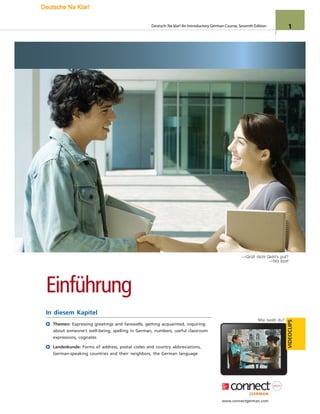
—Grüß dich! Geht’s gut?
—Na klar!
www.connectgerman.com
Wie heißt du?
In diesem Kapitel
Themen: Expressing greetings and farewells, getting acquainted, inquiring
about someone’s well-being, spelling in German, numbers, useful classroom
expressions, cognates
Landeskunde: Forms of address, postal codes and country abbreviations,
German-speaking countries and their neighbors, the German language
Einführung VIDEOCLIPS
Deutsch: Na klar! An Introductory German Course, Seventh Edition 1
Deutsche Na Klar!
Internationale Studenten
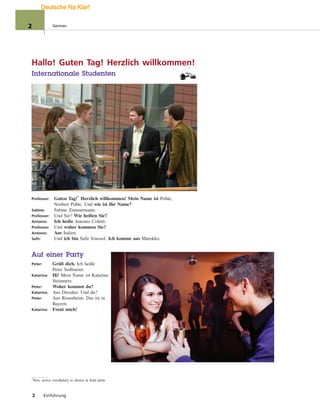
Hallo! Guten Tag! Herzlich willkommen!
Professor: Guten Tag!*
Herzlich willkommen! Mein Name ist Pohle,
Norbert Pohle. Und wie ist Ihr Name?
Sabine: Sabine Zimmermann.
Professor: Und Sie? Wie heißen Sie?
Antonio: Ich heiße Antonio Coletti.
Professor: Und woher kommen Sie?
Antonio: Aus Italien.
Safir: Und ich bin Safir Youssef. Ich komme aus Marokko.
Auf einer Party
Peter: Grüß dich. Ich heiße
Peter Sedlmeier.
Katarina: Hi! Mein Name ist Katarina
Steinmetz.
Peter: Woher kommst du?
Katarina: Aus Dresden. Und du?
Peter: Aus Rosenheim. Das ist in
Bayern.
Katarina: Freut mich!
*
New, active vocabulary is shown in bold print.
2 Einführung
2 German
Deutsche Na Klar!
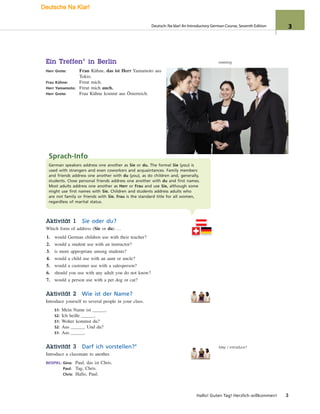
Ein Treffen° in Berlin
Herr Grote: Frau Kühne, das ist Herr Yamamoto aus
Tokio.
Frau Kühne: Freut mich.
Herr Yamamoto: Freut mich auch.
Herr Grote: Frau Kühne kommt aus Österreich.
Aktivität 1 Sie oder du?
Which form of address (Sie or du) …
1. would German children use with their teacher?
2. would a student use with an instructor?
3. is more appropriate among students?
4. would a child use with an aunt or uncle?
5. would a customer use with a salesperson?
6. should you use with any adult you do not know?
7. would a person use with a pet dog or cat?
Aktivität 2 Wie ist der Name?
Introduce yourself to several people in your class.
S1: Mein Name ist .
S2: Ich heiße .
S1: Woher kommst du?
S2: Aus . Und du?
S1: Aus .
Aktivität 3 Darf ich vorstellen?°
Introduce a classmate to another.
BEISPIEL: Gina: Paul, das ist Chris.
Paul: Tag, Chris.
Chris: Hallo, Paul.
Hallo! Guten Tag! Herzlich willkommen! 3
meeting
Sprach-Info
German speakers address one another as Sie or du. The formal Sie (you) is
used with strangers and even coworkers and acquaintances. Family members
and friends address one another with du (you), as do children and, generally,
students. Close personal friends address one another with du and first names.
Most adults address one another as Herr or Frau and use Sie, although some
might use first names with Sie. Children and students address adults who
are not family or friends with Sie. Frau is the standard title for all women,
regardless of marital status.
May I introduce?
Deutsch: Na klar! An Introductory German Course, Seventh Edition 3
Deutsche Na Klar!
Wie schreibt man das?°
When you introduce yourself or give information about yourself, you may have to
spell out words for clarification. In contrast to English, German follows fairly predict-
able spelling and pronunciation rules. You will gradually learn these rules throughout
the course.
The German alphabet has the same twenty-six letters as the English alphabet,
plus four other letters of its own. The four special German letters are written as fol-
lows. Note that the letter ß has no capital; SS is used instead.
Ä ä a-Umlaut: Bär, Käse
Ö ö o-Umlaut: böse, hören
Ü ü u-Umlaut: müde, Süden
ß sz („ess tsett“): süß, Straße
A pair of dots above a German vowel is called an “umlaut.” Although this book refers to
these vowels as a-, o-, or u-Umlaut, they are actually distinct letters. When spelling words,
speakers of German refer to them as they are pronounced. Listen carefully to these vowels
on the Deutsch: Na klar! audio recordings and in your instructor’s pronunciation of them.
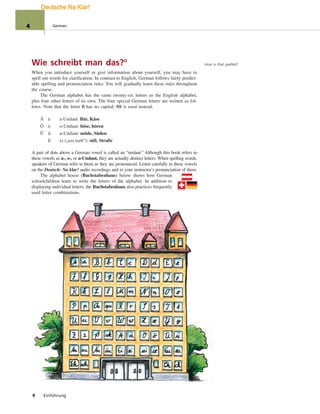
The alphabet house (Buchstabenhaus) below shows how German
schoolchildren learn to write the letters of the alphabet. In addition to
displaying individual letters, the Buchstabenhaus also practices frequently
used letter combinations.
4 Einführung
How is that spelled?
4 German
Deutsche Na Klar!
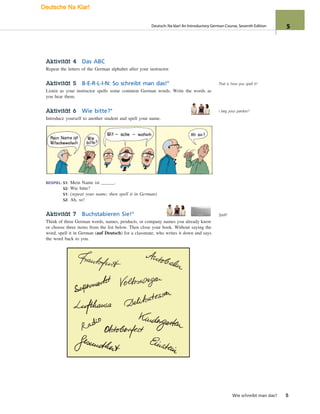
Aktivität 4 Das ABC
Repeat the letters of the German alphabet after your instructor.
Aktivität 5 B-E-R-L-I-N: So schreibt man das!°
Listen as your instructor spells some common German words. Write the words as
you hear them.
Aktivität 6 Wie bitte?°
Introduce yourself to another student and spell your name.
BEISPIEL: S1: Mein Name ist .
S2: Wie bitte?
S1: (repeat your name; then spell it in German)
S2: Ah, so!
Aktivität 7 Buchstabieren Sie!°
Think of three German words, names, products, or company names you already know
or choose three items from the list below. Then close your book. Without saying the
word, spell it in German (auf Deutsch) for a classmate, who writes it down and says
the word back to you.
Wie schreibt man das? 5
That is how you spell it!
I beg your pardon?
Spell!
Deutsch: Na klar! An Introductory German Course, Seventh Edition 5
Deutsche Na Klar!
GB
IRL
A
I
GR
E
P
H
B
L
F
NL
DK
PL
CZ
CH
FL
SK
RO
RUS
D
Tschüss!
Auf Wiedersehen!
Hi! —Hallo!
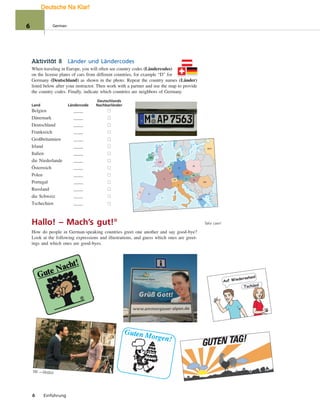
Aktivität 8 Länder und Ländercodes
When traveling in Europe, you will often see country codes (Ländercodes)
on the license plates of cars from different countries, for example “D” for
Germany (Deutschland) as shown in the photo. Repeat the country names (Länder)
listed below after your instructor. Then work with a partner and use the map to provide
the country codes. Finally, indicate which countries are neighbors of Germany.
Deutschlands
Land Ländercode Nachbarländer
Belgien
Dänemark
Deutschland
Frankreich
Großbritannien
Irland
Italien
die Niederlande
Österreich
Polen
Portugal
Russland
die Schweiz
Tschechien
Hallo! – Mach’s gut!°
How do people in German-speaking countries greet one another and say good-bye?
Look at the following expressions and illustrations, and guess which ones are greet-
ings and which ones are good-byes.
6 Einführung
Take care!
6 German
Deutsche Na Klar!
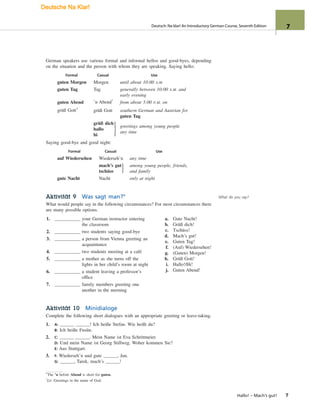
German speakers use various formal and informal hellos and good-byes, depending
on the situation and the person with whom they are speaking. Saying hello:
Formal Casual Use
guten Morgen Morgen until about 10:00 A.M.
guten Tag Tag generally between 10:00 A.M. and
early evening
guten Abend ’n Abend*
from about 5:00 P.M. on
grüß Gott†
grüß Gott southern German and Austrian for
guten Tag
grüß dich
hallo
hi
greetings among young people
any time
Saying good-bye and good night:
Formal Casual Use
auf Wiedersehen Wiederseh’n any time
mach’s gut
tschüss
among young people, friends,
and family
gute Nacht Nacht only at night
Aktivität 9 Was sagt man?°
What would people say in the following circumstances? For most circumstances there
are many possible options.
}
}
1. your German instructor entering
the classroom
2. two students saying good-bye
3. a person from Vienna greeting an
acquaintance
4. two students meeting at a café
5. a mother as she turns off the
lights in her child’s room at night
6. a student leaving a professor’s
office
7. family members greeting one
another in the morning
a. Gute Nacht!
b. Grüß dich!
c. Tschüss!
d. Mach’s gut!
e. Guten Tag!
f. (Auf) Wiedersehen!
g. (Guten) Morgen!
h. Grüß Gott!
i. Hallo!/Hi!
j. Guten Abend!
Aktivität 10 Minidialoge
Complete the following short dialogues with an appropriate greeting or leave-taking.
1. A: ! Ich heiße Stefan. Wie heißt du?
B: Ich heiße Fusün.
2. C: . Mein Name ist Eva Schrittmeier.
D: Und mein Name ist Georg Stillweg. Woher kommen Sie?
E: Aus Stuttgart.
3. F: Wiederseh’n und gute , Jan.
G: , Tarek, mach’s !
*The ’n before Abend is short for guten.
†
Lit. Greetings in the name of God.
Hallo! – Mach’s gut! 7
What do you say?
Deutsch: Na klar! An Introductory German Course, Seventh Edition 7
Deutsche Na Klar!
Na, wie gehts?
Ich fühl mich so kaputt!1
1
Ich … I feel so beat!
sehr gut,
ausgezeichnet
danke,
gut
es geht,
ganz gut
nicht besonders
gut
(sehr) schlecht
Na, wie geht’s?
Na, wie geht’s?°
German has several ways of asking How are you?
Wie geht es dir?
Wie geht’s?
a family member or friend
Wie geht es Ihnen, Herr Lindemann? an acquaintance
You can respond in a number of different ways.
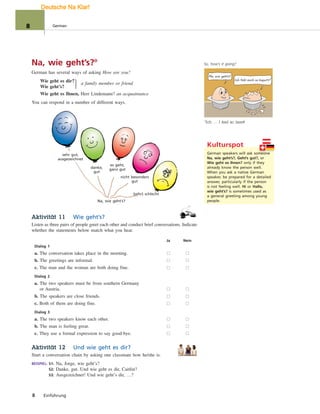
Aktivität 11 Wie geht’s?
Listen as three pairs of people greet each other and conduct brief conversations. Indicate
whether the statements below match what you hear.
Ja Nein
Dialog 1
a. The conversation takes place in the morning.
b. The greetings are informal.
c. The man and the woman are both doing fine.
Dialog 2
a. The two speakers must be from southern Germany
or Austria.
b. The speakers are close friends.
c. Both of them are doing fine.
Dialog 3
a. The two speakers know each other.
b. The man is feeling great.
c. They use a formal expression to say good-bye.
Aktivität 12 Und wie geht es dir?
Start a conversation chain by asking one classmate how he/she is.
BEISPIEL: S1: Na, Jorge, wie geht’s?
S2: Danke, gut. Und wie geht es dir, Caitlin?
S3: Ausgezeichnet! Und wie geht’s dir, …?
}
Kulturspot
German speakers will ask someone
Na, wie geht’s?, Geht’s gut?, or
Wie geht es Ihnen? only if they
already know the person well.
When you ask a native German
speaker, be prepared for a detailed
answer, particularly if the person
is not feeling well. Hi or Hallo,
wie geht’s? is sometimes used as
a general greeting among young
people.
meone
8 Einführung
So, how’s it going?
8 German
Deutsche Na Klar!
So zählt man auf Deutsch.°
0 null 9 neun 18 achtzehn 90 neunzig
1 eins 10 zehn 19 neunzehn 100 (ein)hundert
2 zwei 11 elf 20 zwanzig 200 zweihundert
3 drei 12 zwölf 30 dreißig 300 dreihundert
4 vier 13 dreizehn 40 vierzig 1 000 (ein)tausend
5 fünf 14 vierzehn 50 fünfzig 2 000 zweitausend
6 sechs 15 fünfzehn 60 sechzig 3 000 dreitausend
7 sieben 16 sechzehn 70 siebzig
8 acht 17 siebzehn 80 achtzig
The numbers 21 through 99 are formed by combining the numbers 1–9 with 20–90.
21 einundzwanzig
22 zweiundzwanzig
23 dreiundzwanzig
24 vierundzwanzig
25 fünfundzwanzig
26 sechsundzwanzig
27 siebenundzwanzig
28 achtundzwanzig
29 neunundzwanzig
The numbers one and seven are written as follows:
German uses a period or a space where English uses a comma.
In German-speaking countries, telephone numbers generally have a varying number
of digits and may be spoken as follows:
0 24 36 71 null zwei vier, drei sechs, sieben eins
[or] null, vierundzwanzig, sechsunddreißig, einundsiebzig
This is how you count in German.
So zählt man auf Deutsch. 9
Deutsch: Na klar! An Introductory German Course, Seventh Edition 9
Deutsche Na Klar!
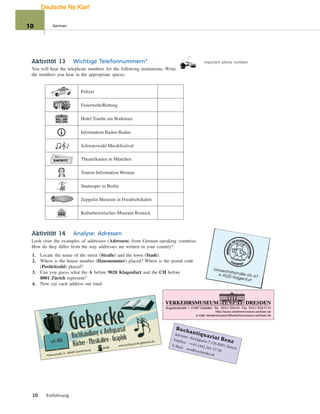
Important phone numbersAktivität 13 Wichtige Telefonnummern°
You will hear the telephone numbers for the following institutions. Write
the numbers you hear in the appropriate spaces.
Polizei
Feuerwehr/Rettung
Hotel Traube am Bodensee
Information Baden-Baden
Schwarzwald Musikfestival
EINTRITT
EINTRITT Theaterkarten in München
Tourist-Information Weimar
Staatsoper in Berlin
Zeppelin Museum in Friedrichshafen
Kulturhistorisches Museum Rostock
Aktivität 14 Analyse: Adressen
Look over the examples of addresses (Adressen) from German-speaking countries.
How do they differ from the way addresses are written in your country?
1. Locate the name of the street (Straße) and the town (Stadt).
2. Where is the house number (Hausnummer) placed? Where is the postal code
(Postleitzahl) placed?
3. Can you guess what the A before 9020 Klagenfurt and the CH before
8001 Zürich represent?
4. Now say each address out loud.
Adresse: Kirchgasse 7, CH-8001 Zürich
Telefon: ++41 (44) 261 57 50
E-Mail: eos@eosbooks.ch
Buchantiquariat Benz
10 Einführung
10 German
Deutsche Na Klar!
1
1. Ich … I don’t know what a
(ne= eine)
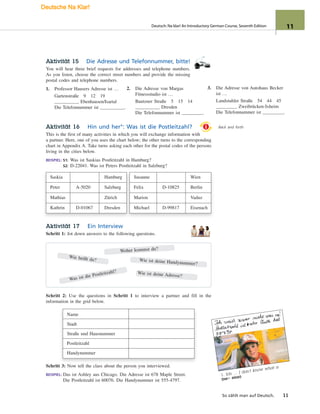
Aktivität 15 Die Adresse und Telefonnummer, bitte!
You will hear three brief requests for addresses and telephone numbers.
As you listen, choose the correct street numbers and provide the missing
postal codes and telephone numbers.
1. Professor Hausers Adresse ist …
Gartenstraße 9 12 19
Ebenhausen/Isartal
Die Telefonnummer ist .
Back and forth
3. Die Adresse von Autohaus Becker
ist …
Landstuhler Straße 54 44 45
Zweibrücken-Ixheim
Die Telefonnummer ist .
Aktivität 16 Hin und her°: Was ist die Postleitzahl?
This is the first of many activities in which you will exchange information with
a partner. Here, one of you uses the chart below; the other turns to the corresponding
chart in Appendix A. Take turns asking each other for the postal codes of the persons
living in the cities below.
BEISPIEL: S1: Was ist Saskias Postleitzahl in Hamburg?
S2: D-22041. Was ist Peters Postleitzahl in Salzburg?
Saskia Hamburg Susanne Wien
Peter A-5020 Salzburg Felix D-10825 Berlin
Mathias Zürich Marion Vaduz
Kathrin D-01067 Dresden Michael D-99817 Eisenach
Aktivität 17 Ein Interview
Schritt 1: Jot down answers to the following questions.
Schritt 2: Use the questions in Schritt 1 to interview a partner and fill in the
information in the grid below.
Name
Stadt
Straße und Hausnummer
Postleitzahl
Handynummer
Schritt 3: Now tell the class about the person you interviewed.
BEISPIEL: Das ist Ashley aus Chicago. Die Adresse ist 678 Maple Street.
Die Postleitzahl ist 60076. Die Handynummer ist 555-4797.
2. Die Adresse von Margas
Fitnessstudio ist …
Bautzner Straße 5 15 14
Dresden
Die Telefonnummer ist .
So zählt man auf Deutsch. 11
Woher kommst du?
Wie ist deine Handynummer?
Was ist die Postleitzahl? Wie ist deine Adresse?
Wie heißt du?
Deutsch: Na klar! An Introductory German Course, Seventh Edition 11
Deutsche Na Klar!
KULTURJOURNAL
Die deutsche Sprache
German and English: why do some
words look identical or very similar
in both languages? Even if you have
never studied German before, you will
soon see that you know or recognize
more German than you thought. For
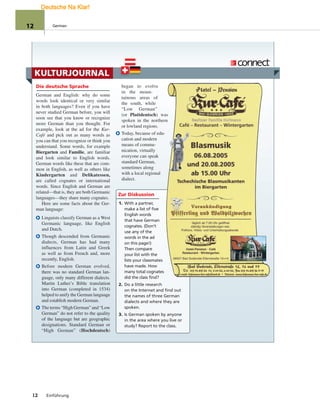
example, look at the ad for the Kur-
Café and pick out as many words as
you can that you recognize or think you
understand. Some words, for example
Biergarten and Familie, are familiar
and look similar to English words.
German words like these that are com-
mon in English, as well as others like
Kindergarten and Delikatessen,
are called cognates or international
words. Since English and German are
related—that is, they are both Germanic
languages—they share many cognates.
Here are some facts about the Ger-
man language:
Linguists classify German as a West
Germanic language, like English
and Dutch.
Though descended from Germanic
dialects, German has had many
influences from Latin and Greek
as well as from French and, more
recently, English.
Before modern German evolved,
there was no standard German lan-
guage, only many different dialects.
Martin Luther’s Bible translation
into German (completed in 1534)
helped to unify the German language
and establish modern German.
The terms “High German” and “Low
German” do not refer to the quality
of the language but are geographic
designations. Standard German or
“High German” (Hochdeutsch)
began to evolve
in the moun-
tainous areas of
the south, while
“Low German”
(or Plattdeutsch) was
spoken in the northern
or lowland regions.
Today, because of edu-
cation and modern
means of commu-
nication, virtually
everyone can speak
standard German,
sometimes along
with a local regional
dialect.
Zur Diskussion
1. With a partner,
make a list of five
English words
that have German
cognates. (Don’t
use any of the
words in the ad
on this page!)
Then compare
your list with the
lists your classmates
have made. How
many total cognates
did the class find?
2. Do a little research
on the Internet and find out
the names of three German
dialects and where they are
spoken.
3. Is German spoken by anyone
in the area where you live or
study? Report to the class.
12 Einführung
12 German
Deutsche Na Klar!
a. b.
e.
c.
d.
You already know some German!Sie können schon etwas Deutsch!°
Aktivität 18 Wie viel Deutsch verstehen Sie?
You have learned that you can use visual and verbal cues to understand
a considerable amount of written German. Now you will hear some short
radio announcements and news headlines. Listen for cognates and other verbal clues
as you try to understand the gist of what is being said. As you hear each item, write
its number in front of the topic(s) to which it corresponds. Not all the topics shown
will be mentioned.
Automobil Musik Sport
Bank Politik Tanz
Film Restaurant Theater
Kinder
Aktivität 19 Informationen finden
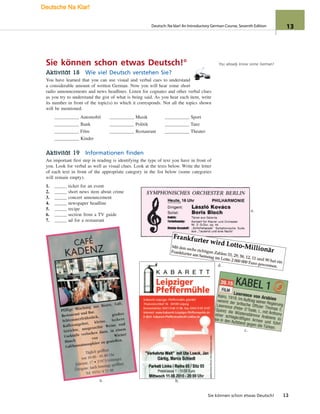
An important first step in reading is identifying the type of text you have in front of
you. Look for verbal as well as visual clues. Look at the texts below. Write the letter
of each text in front of the appropriate category in the list below (some categories
will remain empty).
1. ticket for an event
2. short news item about crime
3. concert announcement
4. newspaper headline
5. recipe
6. section from a TV guide
7. ad for a restaurant
Sie können schon etwas Deutsch! 13
Deutsch: Na klar! An Introductory German Course, Seventh Edition 13
Deutsche Na Klar!
KULTURJOURNAL
Wo spricht man Deutsch?°
Worldwide, there are some 100 mil-
lion people who speak German as their
native language. About 87 million of
them live in Europe. It is the official
language of Germany (Deutschland),
Austria (Österreich), and Liechten-
stein. It is one of four official lan-
guages of Switzerland (die Schweiz)
and one of three official languages of
Luxembourg and Belgium. German
is also spoken in regions of France,
Denmark, Italy, the Czech Republic,
Poland, Romania, Bosnia and Her-
zegovina, Hungary, Latvia, Lithu-
ania, Estonia, Russia, Slovakia, and
Ukraine.
German is also spoken by many
people as a first language in other
countries such as Brazil, Argentina,
Canada, and the United States (Penn-
sylvania Dutch). In Namibia, German
is spoken by a sizable minority.
According to U.S. census fig-
ures from 2012, over 40 million U.S.
citizens claim German descent. In
Canada, the figure is approximately
3 million.
Zur Diskussion
1. In which areas of your country
is German spoken?
2. Are there any German tradi-
tions, customs, or monuments
in your area? If so, describe
them.
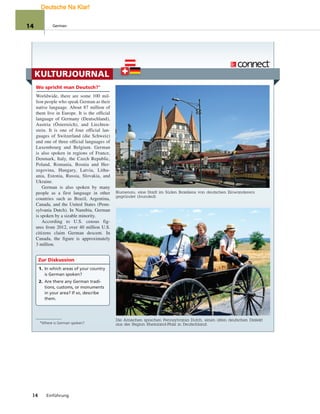
Blumenau, eine Stadt im Süden Brasiliens von deutschen Einwanderern
gegründet (founded).
Die Amischen sprechen Pennsylvania Dutch, einen alten deutschen Dialekt
aus der Region Rheinland-Pfalz in Deutschland.
14 Einführung
°Where is German spoken?
14 German
Deutsche Na Klar!
Nützliche Ausdrücke im Sprachkurs°
Ihr Deutschlehrer / Ihre Deutschlehrerin sagt:
Bitte … Please . . .
Hören Sie zu. Listen.
Schreiben Sie. Write.
Machen Sie die Bücher auf
Seite auf.
Open your books to
page .
Lesen Sie. Read.
Machen Sie die Bücher zu. Close your books.
Wiederholen Sie. Repeat.
Haben Sie Fragen? Do you have any questions?
[Ist] Alles klar? Is everything clear?
Noch einmal, bitte! Once more, please. / Could
you say that again, please?
Sie sagen:
Langsamer, bitte! Slower, please.
Wie bitte? Excuse me? What did you say?
Wie schreibt man ? How do you write ?
Ich habe eine Frage. I have a question.
Wie sagt man auf
Deutsch?
How do you say in
German?
Was bedeutet ? What does mean?
Das weiß ich nicht. I don’t know.
Ich verstehe das nicht. I don’t understand.
Alles klar. I get it.
Ja. Yes.
Nein. No.
Danke [schön]. Thank you.
Aktivität 20 Wie sagt man das auf Deutsch?
Match the English expressions to their German equivalents.
1. I have a question.
2. I don’t understand.
3. Is everything clear?
4. How do you write ?
5. Open your books.
6. What does mean?
7. Pardon, what did you say?
8. Open your books to page .
9. Once more, please. / Could you
say that again, please?
Useful expressions for the language course
a. Alles klar?
b. Machen Sie die Bücher auf.
c. Was bedeutet ?
d. Machen Sie die Bücher
auf Seite auf.
e. Ich verstehe das nicht.
f. Noch einmal, bitte.
g. Wie schreibt man ?
h. Wie bitte?
i. Ich habe eine Frage.
Nützliche Ausdrücke im Sprachkurs 15
Deutsch: Na klar! An Introductory German Course, Seventh Edition 15
Deutsche Na Klar!
A Kennenlernen Watch as
several people ask a number
of questions about one another.
Upon watching a second time,
complete the blanks with
words from the box.
Videoclips
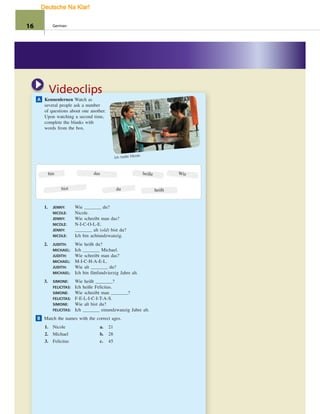
Ich heiße Nicole.
bin
heißtdu
das
bist
heiße Wie
1. JENNY: Wie du?
NICOLE: Nicole.
JENNY: Wie schreibt man das?
NICOLE: N-I-C-O-L-E.
JENNY: alt (old) bist du?
NICOLE: Ich bin achtundzwanzig.
2. JUDITH: Wie heißt du?
MICHAEL: Ich Michael.
JUDITH: Wie schreibt man das?
MICHAEL: M-I-C-H-A-E-L.
JUDITH: Wie alt du?
MICHAEL: Ich bin fünfundvierzig Jahre alt.
3. SIMONE: Wie heißt ?
FELICITAS: Ich heiße Felicitas.
SIMONE: Wie schreibt man ?
FELICITAS: F-E-L-I-C-I-T-A-S.
SIMONE: Wie alt bist du?
FELICITAS: Ich einundzwanzig Jahre alt.
B Match the names with the correct ages.
1. Nicole
2. Michael
3. Felicitas
a. 21
b. 28
c. 45
16 German
Deutsche Na Klar!
Videoclips 17
C Which other phrase could the interviewer use to ask for the other person’s
name?
1. Woher kommst du?
2. Wie ist dein Name?
3. Wie geht’s?
D Which one of these phrases does not have to do with one’s name?
1. Ich heiße Michael.
2. Ich bin neunzehn Jahre alt.
3. Wie heißt du?
4. Ich bin Felicitas.
E Now walk around your classroom, introduce yourself to several classmates, and
ask the other student to spell his or her name each time.
BEISPIEL: S1: Wie ist dein Name?
oder: Wie heißt du?
S2: Ich heiße Jacob.
S1: Wie schreibt man das?
S2: J-A-C-O-B.
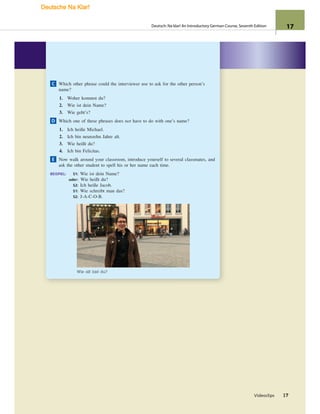
Wie alt bist du?
17
Deutsch: Na klar! An Introductory German Course, Seventh Edition 17
Deutsche Na Klar!
Zur Begrüßung Greetings
grüß dich hello, hi (among friends
and family)
guten Abend good evening
(guten) Morgen good morning
(guten) Tag hello, good day
hallo hello (among friends
and family)
herzlich willkommen welcome
hi hi
Beim Abschied Saying Good-bye
(auf) Wiedersehen good-bye
gute Nacht good night
mach’s gut take care, so long
(informal)
tschüss so long, ‘bye (informal)
Bekannt werden Getting Acquainted
Frau; die Frau Mrs., Ms.; woman
Herr; der Herr Mr.; gentleman
der Lehrer / die Lehrerin teacher
Das ist … This is . . .
Wie heißt du? What’s your name? (informal)
Wie ist dein Name? What’s your name? (informal)
Wie heißen Sie? What’s your name? (formal)
Wie ist Ihr Name? What’s your name? (formal)
Woher kommst du? Where are you from? (informal)
Woher kommen Sie? Where are you from? (formal)
Ich bin … I’m . . .
Ich heiße … My name is . . .
Ich komme aus … I’m from . . .
Mein Name ist … My name is . . .
bitte please; you’re welcome
danke thanks
danke schön thank you very much
Freut mich. Pleased to meet you.
auch also, too
und and
Auskunft erfragen Asking for Information
ja yes
na klar absolutely, of course
nein no
Wie heißt … What is the name of . . .
die Stadt? the town; the city?
die Straße? the street?
Wie ist … What is . . .
deine/Ihre
Telefonnummer?
your (informal/formal)
telephone number?
die Adresse? the address?
die Hausnummer? the street address?
die Postleitzahl? the postal code?
Nach dem
Befinden fragen
Asking About
Someone’s Well-being
Geht’s gut? Are you doing well? (informal)
Na, wie geht’s? How are you? (casual)
Wie geht’s? How are you? (informal)
Wie geht’s dir? How are you? (informal)
Wie geht es Ihnen? How are you? (formal)
ausgezeichnet excellent
danke, gut fine, thanks
ganz gut pretty good/well
nicht besonders gut not particularly well
schlecht bad(ly), poor(ly)
sehr gut very well; fine; good
Im Deutschunterricht In German Class
Alles klar. I get it.
Das weiß ich nicht. I don’t know.
Ich habe eine Frage. I have a question.
Ich verstehe das nicht. I don’t understand.
Langsamer, bitte. Slower, please.
Was bedeutet ? What does mean?
Wie bitte? Excuse me? What did you say?
Wie sagt man auf
Deutsch?
How do you say in
German?
Wie schreibt man ? How do you write ?
Zahlen (Numbers)
0 null 17 siebzehn
1 eins 18 achtzehn
2 zwei 19 neunzehn
3 drei 20 zwanzig
4 vier 30 dreißig
5 fünf 40 vierzig
6 sechs 50 fünfzig
7 sieben 60 sechzig
8 acht 70 siebzig
9 neun 80 achtzig
10 zehn 90 neunzig
11 elf 100 (ein)hundert
12 zwölf 200 zweihundert
13 dreizehn 300 dreihundert
14 vierzehn 1 000 (ein)tausend
15 fünfzehn 2 000 zweitausend
16 sechzehn 3 000 dreitausend
Wortschatz
18 Einführung
18 German
Deutsche Na Klar!
Deutschsprachige
Länder und ihre
Nachbarn
German-speaking
Countries and Their
Neighbors
Belgien Belgium
Dänemark Denmark
Deutschland Germany
Frankreich France
Italien Italy
Liechtenstein Liechtenstein
Luxemburg Luxembourg
die Niederlande (pl.) the Netherlands
Österreich Austria
Polen Poland
die Schweiz Switzerland
die Slowakei Slovakia
Slowenien Slovenia
Tschechien the Czech Republic
Ungarn Hungary
Das kann ich nun!
Now that you have completed the Einführung,
do the following in German to check what you
have learned.
1. Formulate appropriate expressions to:
a. Introduce yourself to a stranger.
b. Introduce someone to another person.
c. Greet a friend.
d. Greet a stranger.
e. Say good-bye to a friend.
2. Say the alphabet and spell your full name.
3. Ask a friend how he/she is doing and tell
him/her how you are doing.
4. a. Give your phone number.
b. Count from 1 to 100.
5. Formulate an appropriate statement or
question for when . . .
a. you don’t understand something.
b. you didn’t hear what someone said.
c. you want to know what something
means.
d. you want to know how to say some-
thing in German.
6. State five countries where German
is spoken and give their official
abbreviations.
Wortschatz 19
Deutsch: Na klar! An Introductory German Course, Seventh Edition 19
Deutsche Na Klar!

Deutsche naklar einfurung1

  • 1.
    —Grüß dich! Geht’sgut? —Na klar! www.connectgerman.com Wie heißt du? In diesem Kapitel Themen: Expressing greetings and farewells, getting acquainted, inquiring about someone’s well-being, spelling in German, numbers, useful classroom expressions, cognates Landeskunde: Forms of address, postal codes and country abbreviations, German-speaking countries and their neighbors, the German language Einführung VIDEOCLIPS Deutsch: Na klar! An Introductory German Course, Seventh Edition 1 Deutsche Na Klar!
  • 2.
    Internationale Studenten Hallo! GutenTag! Herzlich willkommen! Professor: Guten Tag!* Herzlich willkommen! Mein Name ist Pohle, Norbert Pohle. Und wie ist Ihr Name? Sabine: Sabine Zimmermann. Professor: Und Sie? Wie heißen Sie? Antonio: Ich heiße Antonio Coletti. Professor: Und woher kommen Sie? Antonio: Aus Italien. Safir: Und ich bin Safir Youssef. Ich komme aus Marokko. Auf einer Party Peter: Grüß dich. Ich heiße Peter Sedlmeier. Katarina: Hi! Mein Name ist Katarina Steinmetz. Peter: Woher kommst du? Katarina: Aus Dresden. Und du? Peter: Aus Rosenheim. Das ist in Bayern. Katarina: Freut mich! * New, active vocabulary is shown in bold print. 2 Einführung 2 German Deutsche Na Klar!
  • 3.
    Ein Treffen° inBerlin Herr Grote: Frau Kühne, das ist Herr Yamamoto aus Tokio. Frau Kühne: Freut mich. Herr Yamamoto: Freut mich auch. Herr Grote: Frau Kühne kommt aus Österreich. Aktivität 1 Sie oder du? Which form of address (Sie or du) … 1. would German children use with their teacher? 2. would a student use with an instructor? 3. is more appropriate among students? 4. would a child use with an aunt or uncle? 5. would a customer use with a salesperson? 6. should you use with any adult you do not know? 7. would a person use with a pet dog or cat? Aktivität 2 Wie ist der Name? Introduce yourself to several people in your class. S1: Mein Name ist . S2: Ich heiße . S1: Woher kommst du? S2: Aus . Und du? S1: Aus . Aktivität 3 Darf ich vorstellen?° Introduce a classmate to another. BEISPIEL: Gina: Paul, das ist Chris. Paul: Tag, Chris. Chris: Hallo, Paul. Hallo! Guten Tag! Herzlich willkommen! 3 meeting Sprach-Info German speakers address one another as Sie or du. The formal Sie (you) is used with strangers and even coworkers and acquaintances. Family members and friends address one another with du (you), as do children and, generally, students. Close personal friends address one another with du and first names. Most adults address one another as Herr or Frau and use Sie, although some might use first names with Sie. Children and students address adults who are not family or friends with Sie. Frau is the standard title for all women, regardless of marital status. May I introduce? Deutsch: Na klar! An Introductory German Course, Seventh Edition 3 Deutsche Na Klar!
  • 4.
    Wie schreibt mandas?° When you introduce yourself or give information about yourself, you may have to spell out words for clarification. In contrast to English, German follows fairly predict- able spelling and pronunciation rules. You will gradually learn these rules throughout the course. The German alphabet has the same twenty-six letters as the English alphabet, plus four other letters of its own. The four special German letters are written as fol- lows. Note that the letter ß has no capital; SS is used instead. Ä ä a-Umlaut: Bär, Käse Ö ö o-Umlaut: böse, hören Ü ü u-Umlaut: müde, Süden ß sz („ess tsett“): süß, Straße A pair of dots above a German vowel is called an “umlaut.” Although this book refers to these vowels as a-, o-, or u-Umlaut, they are actually distinct letters. When spelling words, speakers of German refer to them as they are pronounced. Listen carefully to these vowels on the Deutsch: Na klar! audio recordings and in your instructor’s pronunciation of them. The alphabet house (Buchstabenhaus) below shows how German schoolchildren learn to write the letters of the alphabet. In addition to displaying individual letters, the Buchstabenhaus also practices frequently used letter combinations. 4 Einführung How is that spelled? 4 German Deutsche Na Klar!
  • 5.
    Aktivität 4 DasABC Repeat the letters of the German alphabet after your instructor. Aktivität 5 B-E-R-L-I-N: So schreibt man das!° Listen as your instructor spells some common German words. Write the words as you hear them. Aktivität 6 Wie bitte?° Introduce yourself to another student and spell your name. BEISPIEL: S1: Mein Name ist . S2: Wie bitte? S1: (repeat your name; then spell it in German) S2: Ah, so! Aktivität 7 Buchstabieren Sie!° Think of three German words, names, products, or company names you already know or choose three items from the list below. Then close your book. Without saying the word, spell it in German (auf Deutsch) for a classmate, who writes it down and says the word back to you. Wie schreibt man das? 5 That is how you spell it! I beg your pardon? Spell! Deutsch: Na klar! An Introductory German Course, Seventh Edition 5 Deutsche Na Klar!
  • 6.
    GB IRL A I GR E P H B L F NL DK PL CZ CH FL SK RO RUS D Tschüss! Auf Wiedersehen! Hi! —Hallo! Aktivität8 Länder und Ländercodes When traveling in Europe, you will often see country codes (Ländercodes) on the license plates of cars from different countries, for example “D” for Germany (Deutschland) as shown in the photo. Repeat the country names (Länder) listed below after your instructor. Then work with a partner and use the map to provide the country codes. Finally, indicate which countries are neighbors of Germany. Deutschlands Land Ländercode Nachbarländer Belgien Dänemark Deutschland Frankreich Großbritannien Irland Italien die Niederlande Österreich Polen Portugal Russland die Schweiz Tschechien Hallo! – Mach’s gut!° How do people in German-speaking countries greet one another and say good-bye? Look at the following expressions and illustrations, and guess which ones are greet- ings and which ones are good-byes. 6 Einführung Take care! 6 German Deutsche Na Klar!
  • 7.
    German speakers usevarious formal and informal hellos and good-byes, depending on the situation and the person with whom they are speaking. Saying hello: Formal Casual Use guten Morgen Morgen until about 10:00 A.M. guten Tag Tag generally between 10:00 A.M. and early evening guten Abend ’n Abend* from about 5:00 P.M. on grüß Gott† grüß Gott southern German and Austrian for guten Tag grüß dich hallo hi greetings among young people any time Saying good-bye and good night: Formal Casual Use auf Wiedersehen Wiederseh’n any time mach’s gut tschüss among young people, friends, and family gute Nacht Nacht only at night Aktivität 9 Was sagt man?° What would people say in the following circumstances? For most circumstances there are many possible options. } } 1. your German instructor entering the classroom 2. two students saying good-bye 3. a person from Vienna greeting an acquaintance 4. two students meeting at a café 5. a mother as she turns off the lights in her child’s room at night 6. a student leaving a professor’s office 7. family members greeting one another in the morning a. Gute Nacht! b. Grüß dich! c. Tschüss! d. Mach’s gut! e. Guten Tag! f. (Auf) Wiedersehen! g. (Guten) Morgen! h. Grüß Gott! i. Hallo!/Hi! j. Guten Abend! Aktivität 10 Minidialoge Complete the following short dialogues with an appropriate greeting or leave-taking. 1. A: ! Ich heiße Stefan. Wie heißt du? B: Ich heiße Fusün. 2. C: . Mein Name ist Eva Schrittmeier. D: Und mein Name ist Georg Stillweg. Woher kommen Sie? E: Aus Stuttgart. 3. F: Wiederseh’n und gute , Jan. G: , Tarek, mach’s ! *The ’n before Abend is short for guten. † Lit. Greetings in the name of God. Hallo! – Mach’s gut! 7 What do you say? Deutsch: Na klar! An Introductory German Course, Seventh Edition 7 Deutsche Na Klar!
  • 8.
    Na, wie gehts? Ichfühl mich so kaputt!1 1 Ich … I feel so beat! sehr gut, ausgezeichnet danke, gut es geht, ganz gut nicht besonders gut (sehr) schlecht Na, wie geht’s? Na, wie geht’s?° German has several ways of asking How are you? Wie geht es dir? Wie geht’s? a family member or friend Wie geht es Ihnen, Herr Lindemann? an acquaintance You can respond in a number of different ways. Aktivität 11 Wie geht’s? Listen as three pairs of people greet each other and conduct brief conversations. Indicate whether the statements below match what you hear. Ja Nein Dialog 1 a. The conversation takes place in the morning. b. The greetings are informal. c. The man and the woman are both doing fine. Dialog 2 a. The two speakers must be from southern Germany or Austria. b. The speakers are close friends. c. Both of them are doing fine. Dialog 3 a. The two speakers know each other. b. The man is feeling great. c. They use a formal expression to say good-bye. Aktivität 12 Und wie geht es dir? Start a conversation chain by asking one classmate how he/she is. BEISPIEL: S1: Na, Jorge, wie geht’s? S2: Danke, gut. Und wie geht es dir, Caitlin? S3: Ausgezeichnet! Und wie geht’s dir, …? } Kulturspot German speakers will ask someone Na, wie geht’s?, Geht’s gut?, or Wie geht es Ihnen? only if they already know the person well. When you ask a native German speaker, be prepared for a detailed answer, particularly if the person is not feeling well. Hi or Hallo, wie geht’s? is sometimes used as a general greeting among young people. meone 8 Einführung So, how’s it going? 8 German Deutsche Na Klar!
  • 9.
    So zählt manauf Deutsch.° 0 null 9 neun 18 achtzehn 90 neunzig 1 eins 10 zehn 19 neunzehn 100 (ein)hundert 2 zwei 11 elf 20 zwanzig 200 zweihundert 3 drei 12 zwölf 30 dreißig 300 dreihundert 4 vier 13 dreizehn 40 vierzig 1 000 (ein)tausend 5 fünf 14 vierzehn 50 fünfzig 2 000 zweitausend 6 sechs 15 fünfzehn 60 sechzig 3 000 dreitausend 7 sieben 16 sechzehn 70 siebzig 8 acht 17 siebzehn 80 achtzig The numbers 21 through 99 are formed by combining the numbers 1–9 with 20–90. 21 einundzwanzig 22 zweiundzwanzig 23 dreiundzwanzig 24 vierundzwanzig 25 fünfundzwanzig 26 sechsundzwanzig 27 siebenundzwanzig 28 achtundzwanzig 29 neunundzwanzig The numbers one and seven are written as follows: German uses a period or a space where English uses a comma. In German-speaking countries, telephone numbers generally have a varying number of digits and may be spoken as follows: 0 24 36 71 null zwei vier, drei sechs, sieben eins [or] null, vierundzwanzig, sechsunddreißig, einundsiebzig This is how you count in German. So zählt man auf Deutsch. 9 Deutsch: Na klar! An Introductory German Course, Seventh Edition 9 Deutsche Na Klar!
  • 10.
    Important phone numbersAktivität13 Wichtige Telefonnummern° You will hear the telephone numbers for the following institutions. Write the numbers you hear in the appropriate spaces. Polizei Feuerwehr/Rettung Hotel Traube am Bodensee Information Baden-Baden Schwarzwald Musikfestival EINTRITT EINTRITT Theaterkarten in München Tourist-Information Weimar Staatsoper in Berlin Zeppelin Museum in Friedrichshafen Kulturhistorisches Museum Rostock Aktivität 14 Analyse: Adressen Look over the examples of addresses (Adressen) from German-speaking countries. How do they differ from the way addresses are written in your country? 1. Locate the name of the street (Straße) and the town (Stadt). 2. Where is the house number (Hausnummer) placed? Where is the postal code (Postleitzahl) placed? 3. Can you guess what the A before 9020 Klagenfurt and the CH before 8001 Zürich represent? 4. Now say each address out loud. Adresse: Kirchgasse 7, CH-8001 Zürich Telefon: ++41 (44) 261 57 50 E-Mail: eos@eosbooks.ch Buchantiquariat Benz 10 Einführung 10 German Deutsche Na Klar!
  • 11.
    1 1. Ich …I don’t know what a (ne= eine) Aktivität 15 Die Adresse und Telefonnummer, bitte! You will hear three brief requests for addresses and telephone numbers. As you listen, choose the correct street numbers and provide the missing postal codes and telephone numbers. 1. Professor Hausers Adresse ist … Gartenstraße 9 12 19 Ebenhausen/Isartal Die Telefonnummer ist . Back and forth 3. Die Adresse von Autohaus Becker ist … Landstuhler Straße 54 44 45 Zweibrücken-Ixheim Die Telefonnummer ist . Aktivität 16 Hin und her°: Was ist die Postleitzahl? This is the first of many activities in which you will exchange information with a partner. Here, one of you uses the chart below; the other turns to the corresponding chart in Appendix A. Take turns asking each other for the postal codes of the persons living in the cities below. BEISPIEL: S1: Was ist Saskias Postleitzahl in Hamburg? S2: D-22041. Was ist Peters Postleitzahl in Salzburg? Saskia Hamburg Susanne Wien Peter A-5020 Salzburg Felix D-10825 Berlin Mathias Zürich Marion Vaduz Kathrin D-01067 Dresden Michael D-99817 Eisenach Aktivität 17 Ein Interview Schritt 1: Jot down answers to the following questions. Schritt 2: Use the questions in Schritt 1 to interview a partner and fill in the information in the grid below. Name Stadt Straße und Hausnummer Postleitzahl Handynummer Schritt 3: Now tell the class about the person you interviewed. BEISPIEL: Das ist Ashley aus Chicago. Die Adresse ist 678 Maple Street. Die Postleitzahl ist 60076. Die Handynummer ist 555-4797. 2. Die Adresse von Margas Fitnessstudio ist … Bautzner Straße 5 15 14 Dresden Die Telefonnummer ist . So zählt man auf Deutsch. 11 Woher kommst du? Wie ist deine Handynummer? Was ist die Postleitzahl? Wie ist deine Adresse? Wie heißt du? Deutsch: Na klar! An Introductory German Course, Seventh Edition 11 Deutsche Na Klar!
  • 12.
    KULTURJOURNAL Die deutsche Sprache Germanand English: why do some words look identical or very similar in both languages? Even if you have never studied German before, you will soon see that you know or recognize more German than you thought. For example, look at the ad for the Kur- Café and pick out as many words as you can that you recognize or think you understand. Some words, for example Biergarten and Familie, are familiar and look similar to English words. German words like these that are com- mon in English, as well as others like Kindergarten and Delikatessen, are called cognates or international words. Since English and German are related—that is, they are both Germanic languages—they share many cognates. Here are some facts about the Ger- man language: Linguists classify German as a West Germanic language, like English and Dutch. Though descended from Germanic dialects, German has had many influences from Latin and Greek as well as from French and, more recently, English. Before modern German evolved, there was no standard German lan- guage, only many different dialects. Martin Luther’s Bible translation into German (completed in 1534) helped to unify the German language and establish modern German. The terms “High German” and “Low German” do not refer to the quality of the language but are geographic designations. Standard German or “High German” (Hochdeutsch) began to evolve in the moun- tainous areas of the south, while “Low German” (or Plattdeutsch) was spoken in the northern or lowland regions. Today, because of edu- cation and modern means of commu- nication, virtually everyone can speak standard German, sometimes along with a local regional dialect. Zur Diskussion 1. With a partner, make a list of five English words that have German cognates. (Don’t use any of the words in the ad on this page!) Then compare your list with the lists your classmates have made. How many total cognates did the class find? 2. Do a little research on the Internet and find out the names of three German dialects and where they are spoken. 3. Is German spoken by anyone in the area where you live or study? Report to the class. 12 Einführung 12 German Deutsche Na Klar!
  • 13.
    a. b. e. c. d. You alreadyknow some German!Sie können schon etwas Deutsch!° Aktivität 18 Wie viel Deutsch verstehen Sie? You have learned that you can use visual and verbal cues to understand a considerable amount of written German. Now you will hear some short radio announcements and news headlines. Listen for cognates and other verbal clues as you try to understand the gist of what is being said. As you hear each item, write its number in front of the topic(s) to which it corresponds. Not all the topics shown will be mentioned. Automobil Musik Sport Bank Politik Tanz Film Restaurant Theater Kinder Aktivität 19 Informationen finden An important first step in reading is identifying the type of text you have in front of you. Look for verbal as well as visual clues. Look at the texts below. Write the letter of each text in front of the appropriate category in the list below (some categories will remain empty). 1. ticket for an event 2. short news item about crime 3. concert announcement 4. newspaper headline 5. recipe 6. section from a TV guide 7. ad for a restaurant Sie können schon etwas Deutsch! 13 Deutsch: Na klar! An Introductory German Course, Seventh Edition 13 Deutsche Na Klar!
  • 14.
    KULTURJOURNAL Wo spricht manDeutsch?° Worldwide, there are some 100 mil- lion people who speak German as their native language. About 87 million of them live in Europe. It is the official language of Germany (Deutschland), Austria (Österreich), and Liechten- stein. It is one of four official lan- guages of Switzerland (die Schweiz) and one of three official languages of Luxembourg and Belgium. German is also spoken in regions of France, Denmark, Italy, the Czech Republic, Poland, Romania, Bosnia and Her- zegovina, Hungary, Latvia, Lithu- ania, Estonia, Russia, Slovakia, and Ukraine. German is also spoken by many people as a first language in other countries such as Brazil, Argentina, Canada, and the United States (Penn- sylvania Dutch). In Namibia, German is spoken by a sizable minority. According to U.S. census fig- ures from 2012, over 40 million U.S. citizens claim German descent. In Canada, the figure is approximately 3 million. Zur Diskussion 1. In which areas of your country is German spoken? 2. Are there any German tradi- tions, customs, or monuments in your area? If so, describe them. Blumenau, eine Stadt im Süden Brasiliens von deutschen Einwanderern gegründet (founded). Die Amischen sprechen Pennsylvania Dutch, einen alten deutschen Dialekt aus der Region Rheinland-Pfalz in Deutschland. 14 Einführung °Where is German spoken? 14 German Deutsche Na Klar!
  • 15.
    Nützliche Ausdrücke imSprachkurs° Ihr Deutschlehrer / Ihre Deutschlehrerin sagt: Bitte … Please . . . Hören Sie zu. Listen. Schreiben Sie. Write. Machen Sie die Bücher auf Seite auf. Open your books to page . Lesen Sie. Read. Machen Sie die Bücher zu. Close your books. Wiederholen Sie. Repeat. Haben Sie Fragen? Do you have any questions? [Ist] Alles klar? Is everything clear? Noch einmal, bitte! Once more, please. / Could you say that again, please? Sie sagen: Langsamer, bitte! Slower, please. Wie bitte? Excuse me? What did you say? Wie schreibt man ? How do you write ? Ich habe eine Frage. I have a question. Wie sagt man auf Deutsch? How do you say in German? Was bedeutet ? What does mean? Das weiß ich nicht. I don’t know. Ich verstehe das nicht. I don’t understand. Alles klar. I get it. Ja. Yes. Nein. No. Danke [schön]. Thank you. Aktivität 20 Wie sagt man das auf Deutsch? Match the English expressions to their German equivalents. 1. I have a question. 2. I don’t understand. 3. Is everything clear? 4. How do you write ? 5. Open your books. 6. What does mean? 7. Pardon, what did you say? 8. Open your books to page . 9. Once more, please. / Could you say that again, please? Useful expressions for the language course a. Alles klar? b. Machen Sie die Bücher auf. c. Was bedeutet ? d. Machen Sie die Bücher auf Seite auf. e. Ich verstehe das nicht. f. Noch einmal, bitte. g. Wie schreibt man ? h. Wie bitte? i. Ich habe eine Frage. Nützliche Ausdrücke im Sprachkurs 15 Deutsch: Na klar! An Introductory German Course, Seventh Edition 15 Deutsche Na Klar!
  • 16.
    A Kennenlernen Watchas several people ask a number of questions about one another. Upon watching a second time, complete the blanks with words from the box. Videoclips Ich heiße Nicole. bin heißtdu das bist heiße Wie 1. JENNY: Wie du? NICOLE: Nicole. JENNY: Wie schreibt man das? NICOLE: N-I-C-O-L-E. JENNY: alt (old) bist du? NICOLE: Ich bin achtundzwanzig. 2. JUDITH: Wie heißt du? MICHAEL: Ich Michael. JUDITH: Wie schreibt man das? MICHAEL: M-I-C-H-A-E-L. JUDITH: Wie alt du? MICHAEL: Ich bin fünfundvierzig Jahre alt. 3. SIMONE: Wie heißt ? FELICITAS: Ich heiße Felicitas. SIMONE: Wie schreibt man ? FELICITAS: F-E-L-I-C-I-T-A-S. SIMONE: Wie alt bist du? FELICITAS: Ich einundzwanzig Jahre alt. B Match the names with the correct ages. 1. Nicole 2. Michael 3. Felicitas a. 21 b. 28 c. 45 16 German Deutsche Na Klar!
  • 17.
    Videoclips 17 C Whichother phrase could the interviewer use to ask for the other person’s name? 1. Woher kommst du? 2. Wie ist dein Name? 3. Wie geht’s? D Which one of these phrases does not have to do with one’s name? 1. Ich heiße Michael. 2. Ich bin neunzehn Jahre alt. 3. Wie heißt du? 4. Ich bin Felicitas. E Now walk around your classroom, introduce yourself to several classmates, and ask the other student to spell his or her name each time. BEISPIEL: S1: Wie ist dein Name? oder: Wie heißt du? S2: Ich heiße Jacob. S1: Wie schreibt man das? S2: J-A-C-O-B. Wie alt bist du? 17 Deutsch: Na klar! An Introductory German Course, Seventh Edition 17 Deutsche Na Klar!
  • 18.
    Zur Begrüßung Greetings grüßdich hello, hi (among friends and family) guten Abend good evening (guten) Morgen good morning (guten) Tag hello, good day hallo hello (among friends and family) herzlich willkommen welcome hi hi Beim Abschied Saying Good-bye (auf) Wiedersehen good-bye gute Nacht good night mach’s gut take care, so long (informal) tschüss so long, ‘bye (informal) Bekannt werden Getting Acquainted Frau; die Frau Mrs., Ms.; woman Herr; der Herr Mr.; gentleman der Lehrer / die Lehrerin teacher Das ist … This is . . . Wie heißt du? What’s your name? (informal) Wie ist dein Name? What’s your name? (informal) Wie heißen Sie? What’s your name? (formal) Wie ist Ihr Name? What’s your name? (formal) Woher kommst du? Where are you from? (informal) Woher kommen Sie? Where are you from? (formal) Ich bin … I’m . . . Ich heiße … My name is . . . Ich komme aus … I’m from . . . Mein Name ist … My name is . . . bitte please; you’re welcome danke thanks danke schön thank you very much Freut mich. Pleased to meet you. auch also, too und and Auskunft erfragen Asking for Information ja yes na klar absolutely, of course nein no Wie heißt … What is the name of . . . die Stadt? the town; the city? die Straße? the street? Wie ist … What is . . . deine/Ihre Telefonnummer? your (informal/formal) telephone number? die Adresse? the address? die Hausnummer? the street address? die Postleitzahl? the postal code? Nach dem Befinden fragen Asking About Someone’s Well-being Geht’s gut? Are you doing well? (informal) Na, wie geht’s? How are you? (casual) Wie geht’s? How are you? (informal) Wie geht’s dir? How are you? (informal) Wie geht es Ihnen? How are you? (formal) ausgezeichnet excellent danke, gut fine, thanks ganz gut pretty good/well nicht besonders gut not particularly well schlecht bad(ly), poor(ly) sehr gut very well; fine; good Im Deutschunterricht In German Class Alles klar. I get it. Das weiß ich nicht. I don’t know. Ich habe eine Frage. I have a question. Ich verstehe das nicht. I don’t understand. Langsamer, bitte. Slower, please. Was bedeutet ? What does mean? Wie bitte? Excuse me? What did you say? Wie sagt man auf Deutsch? How do you say in German? Wie schreibt man ? How do you write ? Zahlen (Numbers) 0 null 17 siebzehn 1 eins 18 achtzehn 2 zwei 19 neunzehn 3 drei 20 zwanzig 4 vier 30 dreißig 5 fünf 40 vierzig 6 sechs 50 fünfzig 7 sieben 60 sechzig 8 acht 70 siebzig 9 neun 80 achtzig 10 zehn 90 neunzig 11 elf 100 (ein)hundert 12 zwölf 200 zweihundert 13 dreizehn 300 dreihundert 14 vierzehn 1 000 (ein)tausend 15 fünfzehn 2 000 zweitausend 16 sechzehn 3 000 dreitausend Wortschatz 18 Einführung 18 German Deutsche Na Klar!
  • 19.
    Deutschsprachige Länder und ihre Nachbarn German-speaking Countriesand Their Neighbors Belgien Belgium Dänemark Denmark Deutschland Germany Frankreich France Italien Italy Liechtenstein Liechtenstein Luxemburg Luxembourg die Niederlande (pl.) the Netherlands Österreich Austria Polen Poland die Schweiz Switzerland die Slowakei Slovakia Slowenien Slovenia Tschechien the Czech Republic Ungarn Hungary Das kann ich nun! Now that you have completed the Einführung, do the following in German to check what you have learned. 1. Formulate appropriate expressions to: a. Introduce yourself to a stranger. b. Introduce someone to another person. c. Greet a friend. d. Greet a stranger. e. Say good-bye to a friend. 2. Say the alphabet and spell your full name. 3. Ask a friend how he/she is doing and tell him/her how you are doing. 4. a. Give your phone number. b. Count from 1 to 100. 5. Formulate an appropriate statement or question for when . . . a. you don’t understand something. b. you didn’t hear what someone said. c. you want to know what something means. d. you want to know how to say some- thing in German. 6. State five countries where German is spoken and give their official abbreviations. Wortschatz 19 Deutsch: Na klar! An Introductory German Course, Seventh Edition 19 Deutsche Na Klar!