Computer Networks (18EC71)
Sample Problems & Solutions for IAT2
A pure ALOHA network transmits 200-bit frames on a
shared channel of 200 kbps. What is the throughput if the
system (all stations together) produces
a. 1000 frames per second?
b. 500 frames per second?
c. 250 frames per second?
Example 12. 3
Solution
The frame transmission time is 200/200 kbps or 1 ms.
a. If the system creates 1000 frames per second, or 1 frame
per millisecond, then G = 1. In this case S = G × e−2G =
0.135 (13.5 percent). This means that the throughput is
1000 × 0.135 = 135 frames. Only 135 frames out of 1000
will probably survive.
12.2
b. If the system creates 500 frames per second, or 1/2 frames
per millisecond, then G = 1/2. In this case S = G × e−2G
= 0.184 (18.4 percent). This means that the throughput is
500 × 0.184 = 92 and that only 92 frames out of 500 will
probably survive. Note that this is the maximum
throughput case, percentage-wise.
c. If the system creates 250 frames per second, or 1/4
frames per millisecond, then G = 1/4. In this case S =
G × e−2G = 0.152 (15.2 percent). This means that the
throughput is 250 × 0.152 = 38. Only 38 frames out of
250 will probably survive
Example 12. 3 (continued)
12.3
• Example 12.4: A slotted ALOHA network transmits 200-bit frames
using a shared channel with a 200-kbps bandwidth. Find the
throughput if the system (all stations together) produces
• a. 1000 frames per second. b. 500 frames per second. c. 250 frames
per second.
• Solution: This situation is similar to the previous exercise except
that the network is using slotted ALOHA instead of pure ALOHA.
The frame transmission time is 200/200 kbps or 1 ms.
• a. In this case G is 1. So S = G × e−G = 0.368 (36.8 percent). This
means that the throughput is 1000 × 0.0368 = 368 frames. Only 368
out of 1000 frames will probably survive. Note that this is the
maximum throughput case, percentagewise.
• b. Here G is 1/2. In this case S = G × e−G = 0.303 (30.3 percent). This
means that the throughput is 500 × 0.0303 = 151. Only 151 frames
out of 500 will probably survive.
• c. Now G is 1/4. In this case S = G × e−G = 0.195 (19.5 percent). This
means that the throughput is 250 × 0.195 = 49. Only 49 frames out
of 250 will probably survive.
Dr.Ananth Kumar M.S., Assistant Professor, Department of
ECE, CMRIT.
4
Define the type of the following destination addresses:
a. 4A:30:10:21:10:1A
b. 47:20:1B:2E:08:EE
c. FF:FF:FF:FF:FF:FF
Example 13.2
Solution
To find the type of the address, we need to look at the
second hexadecimal digit from the left. If it is even, the
address is unicast. If it is odd, the address is multicast. If all
digits are Fs, the address is broadcast. Therefore, we have
the following:
13.5
Example 13.2 (continued)
a. This is a unicast address because A in binary is 1010
(even).
b. This is a multicast address because 7 in binary is 0111
(odd).
c. This is a broadcast address because all digits are Fs in
hexadecimal.
13.6
18.7
Figure 18.18: Occupation of the address space in classful addressing
19.8
Find the class of each address.
a. 00000001 00001011 00001011 11101111
b. 11000001 10000011 00011011 11111111
c. 14.23.120.8
d. 252.5.15.111
Example 19.4
19.9
Solution
a. The first bit is 0. This is a class A address.
b. The first 2 bits are 1; the third bit is 0. This is a class C
address.
c. The first byte is 14; the class is A.
d. The first byte is 252; the class is E.
An organization is granted a block of addresses with the
beginning address 14.24.74.0/24. The organization needs to
have 3 subblocks of addresses to use in its three subnets: one
subblock of 10 addresses, one subblock of 60 addresses, and
one subblock of 120 addresses. Design the subblocks.
Example 18.5
18.10
Example 18.5
Solution
There are 232– 24 = 256 addresses in this block. The first
address is 14.24.74.0/24; the last address is 14.24.74.255/24.
To satisfy the third requirement, we assign addresses to
subblocks, starting with the largest and ending with the
smallest one.
18.11
a. The number of addresses in the largest subblock, which
requires 120 addresses, is not a power of 2. We allocate 128
addresses. The subnet mask for this subnet can be found as
n1 = 32 − log2 128 = 25. The first address in this block is
14.24.74.0/25; the last address is 14.24.74.127/25.
b. The number of addresses in the second largest subblock,
which requires 60 addresses, is not a power of 2 either. We
allocate 64 addresses. The subnet mask for this subnet can
be found as n2 = 32 − log2 64 = 26. The first address in this
block is 14.24.74.128/26; the last address is
14.24.74.191/26.
Example 18.5 (continued)
18.12
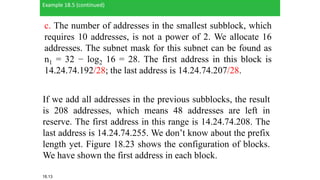
c. The number of addresses in the smallest subblock, which
requires 10 addresses, is not a power of 2. We allocate 16
addresses. The subnet mask for this subnet can be found as
n1 = 32 − log2 16 = 28. The first address in this block is
14.24.74.192/28; the last address is 14.24.74.207/28.
Example 18.5 (continued)
If we add all addresses in the previous subblocks, the result
is 208 addresses, which means 48 addresses are left in
reserve. The first address in this range is 14.24.74.208. The
last address is 14.24.74.255. We don’t know about the prefix
length yet. Figure 18.23 shows the configuration of blocks.
We have shown the first address in each block.
18.13
18.14
Figure 18.23: Solution to Example 4.5
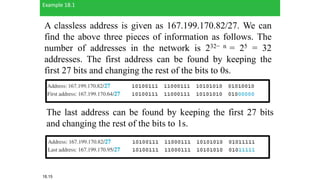
A classless address is given as 167.199.170.82/27. We can
find the above three pieces of information as follows. The
number of addresses in the network is 232− n = 25 = 32
addresses. The first address can be found by keeping the
first 27 bits and changing the rest of the bits to 0s.
Example 18.1
The last address can be found by keeping the first 27 bits
and changing the rest of the bits to 1s.
18.15

Sample Problems & Solutioooooooooons.pptx

  • 1.
    Computer Networks (18EC71) SampleProblems & Solutions for IAT2
  • 2.
    A pure ALOHAnetwork transmits 200-bit frames on a shared channel of 200 kbps. What is the throughput if the system (all stations together) produces a. 1000 frames per second? b. 500 frames per second? c. 250 frames per second? Example 12. 3 Solution The frame transmission time is 200/200 kbps or 1 ms. a. If the system creates 1000 frames per second, or 1 frame per millisecond, then G = 1. In this case S = G × e−2G = 0.135 (13.5 percent). This means that the throughput is 1000 × 0.135 = 135 frames. Only 135 frames out of 1000 will probably survive. 12.2
  • 3.
    b. If thesystem creates 500 frames per second, or 1/2 frames per millisecond, then G = 1/2. In this case S = G × e−2G = 0.184 (18.4 percent). This means that the throughput is 500 × 0.184 = 92 and that only 92 frames out of 500 will probably survive. Note that this is the maximum throughput case, percentage-wise. c. If the system creates 250 frames per second, or 1/4 frames per millisecond, then G = 1/4. In this case S = G × e−2G = 0.152 (15.2 percent). This means that the throughput is 250 × 0.152 = 38. Only 38 frames out of 250 will probably survive Example 12. 3 (continued) 12.3
  • 4.
    • Example 12.4:A slotted ALOHA network transmits 200-bit frames using a shared channel with a 200-kbps bandwidth. Find the throughput if the system (all stations together) produces • a. 1000 frames per second. b. 500 frames per second. c. 250 frames per second. • Solution: This situation is similar to the previous exercise except that the network is using slotted ALOHA instead of pure ALOHA. The frame transmission time is 200/200 kbps or 1 ms. • a. In this case G is 1. So S = G × e−G = 0.368 (36.8 percent). This means that the throughput is 1000 × 0.0368 = 368 frames. Only 368 out of 1000 frames will probably survive. Note that this is the maximum throughput case, percentagewise. • b. Here G is 1/2. In this case S = G × e−G = 0.303 (30.3 percent). This means that the throughput is 500 × 0.0303 = 151. Only 151 frames out of 500 will probably survive. • c. Now G is 1/4. In this case S = G × e−G = 0.195 (19.5 percent). This means that the throughput is 250 × 0.195 = 49. Only 49 frames out of 250 will probably survive. Dr.Ananth Kumar M.S., Assistant Professor, Department of ECE, CMRIT. 4
  • 5.
    Define the typeof the following destination addresses: a. 4A:30:10:21:10:1A b. 47:20:1B:2E:08:EE c. FF:FF:FF:FF:FF:FF Example 13.2 Solution To find the type of the address, we need to look at the second hexadecimal digit from the left. If it is even, the address is unicast. If it is odd, the address is multicast. If all digits are Fs, the address is broadcast. Therefore, we have the following: 13.5
  • 6.
    Example 13.2 (continued) a.This is a unicast address because A in binary is 1010 (even). b. This is a multicast address because 7 in binary is 0111 (odd). c. This is a broadcast address because all digits are Fs in hexadecimal. 13.6
  • 7.
    18.7 Figure 18.18: Occupationof the address space in classful addressing
  • 8.
    19.8 Find the classof each address. a. 00000001 00001011 00001011 11101111 b. 11000001 10000011 00011011 11111111 c. 14.23.120.8 d. 252.5.15.111 Example 19.4
  • 9.
    19.9 Solution a. The firstbit is 0. This is a class A address. b. The first 2 bits are 1; the third bit is 0. This is a class C address. c. The first byte is 14; the class is A. d. The first byte is 252; the class is E.
  • 10.
    An organization isgranted a block of addresses with the beginning address 14.24.74.0/24. The organization needs to have 3 subblocks of addresses to use in its three subnets: one subblock of 10 addresses, one subblock of 60 addresses, and one subblock of 120 addresses. Design the subblocks. Example 18.5 18.10
  • 11.
    Example 18.5 Solution There are232– 24 = 256 addresses in this block. The first address is 14.24.74.0/24; the last address is 14.24.74.255/24. To satisfy the third requirement, we assign addresses to subblocks, starting with the largest and ending with the smallest one. 18.11
  • 12.
    a. The numberof addresses in the largest subblock, which requires 120 addresses, is not a power of 2. We allocate 128 addresses. The subnet mask for this subnet can be found as n1 = 32 − log2 128 = 25. The first address in this block is 14.24.74.0/25; the last address is 14.24.74.127/25. b. The number of addresses in the second largest subblock, which requires 60 addresses, is not a power of 2 either. We allocate 64 addresses. The subnet mask for this subnet can be found as n2 = 32 − log2 64 = 26. The first address in this block is 14.24.74.128/26; the last address is 14.24.74.191/26. Example 18.5 (continued) 18.12
  • 13.
    c. The numberof addresses in the smallest subblock, which requires 10 addresses, is not a power of 2. We allocate 16 addresses. The subnet mask for this subnet can be found as n1 = 32 − log2 16 = 28. The first address in this block is 14.24.74.192/28; the last address is 14.24.74.207/28. Example 18.5 (continued) If we add all addresses in the previous subblocks, the result is 208 addresses, which means 48 addresses are left in reserve. The first address in this range is 14.24.74.208. The last address is 14.24.74.255. We don’t know about the prefix length yet. Figure 18.23 shows the configuration of blocks. We have shown the first address in each block. 18.13
  • 14.
  • 15.
    A classless addressis given as 167.199.170.82/27. We can find the above three pieces of information as follows. The number of addresses in the network is 232− n = 25 = 32 addresses. The first address can be found by keeping the first 27 bits and changing the rest of the bits to 0s. Example 18.1 The last address can be found by keeping the first 27 bits and changing the rest of the bits to 1s. 18.15