Detecting Anomalies in the Engine Coolant
Sensor using One-Class Classifiers
Eronides F. da Silva Neto, Allan R. S. Feitosa, George D. C.
Cavalcanti and Abel G. Silva-Filho
2019 IEEE 90th Vehicular Technology Conference
2
Agenda
- Introduction
-
- Proposed Anomaly Detection System
-
- Experiments
- Results
- Conclusion
-
3
Introduction
- New services and drive experience provided by the combination of
Information and Communication Technologies (ICTs).
- Some papers have evaluated the detection of anomalies in intra-vehicular
signals as a classification problem.
- The most recent contribution (Theisller, 2017) presents an approach to
detect known and unknown anomalies in the Engine Coolant Temperature
(ECT) sensor.
4
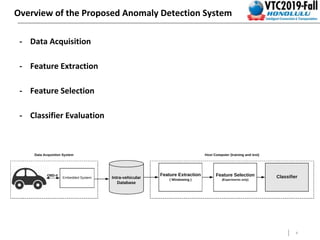
Overview of the Proposed Anomaly Detection System
- Data Acquisition
- Feature Extraction
- Feature Selection
- Classifier Evaluation
-
5
Feature Extraction and Selection
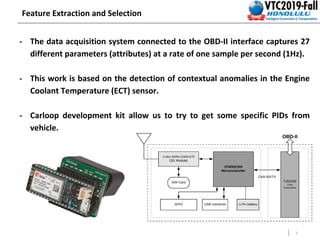
- The data acquisition system connected to the OBD-II interface captures 27
different parameters (attributes) at a rate of one sample per second (1Hz).
- This work is based on the detection of contextual anomalies in the Engine
Coolant Temperature (ECT) sensor.
- Carloop development kit allow us to try to get some specific PIDs from
vehicle.
-
6
Feature Extraction and Selection
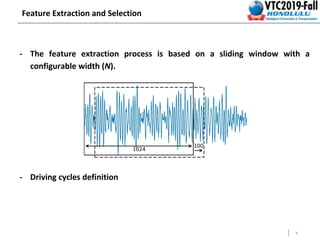
- The feature extraction process is based on a sliding window with a
configurable width (N).
- Driving cycles definition
-
7
Feature Selection
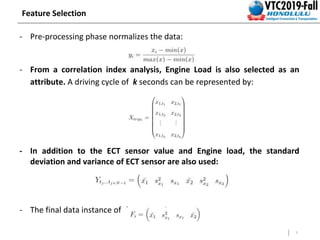
- Pre-processing phase normalizes the data:
- From a correlation index analysis, Engine Load is also selected as an
attribute. A driving cycle of k seconds can be represented by:
- In addition to the ECT sensor value and Engine load, the standard
deviation and variance of ECT sensor are also used:
- The final data instance of the system is:
8
One Class Classifier Evaluation
The different techniques evaluated separated by their category are:
- Instance-based techniques: k-NN;
- Statical Methods: Gaussian data description, Parzen and Naive Parzen
window density estimator and Extreme Value Analysis;
- Neural Networks: Self-organizing Map (SOM);
- Rule-based: Minimum Spanning Tree (MST) and Mahalanobis distance;
- Support Vector Machines: SVDD and OC-SVM.
-
9
Experiments
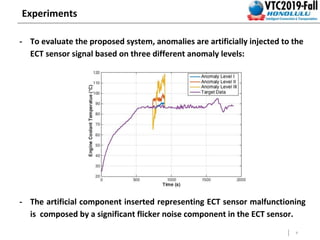
- To evaluate the proposed system, anomalies are artificially injected to the
ECT sensor signal based on three different anomaly levels:
- The artificial component inserted representing ECT sensor malfunctioning
is composed by a significant flicker noise component in the ECT sensor.
10
Experiments: intra-vehicular database
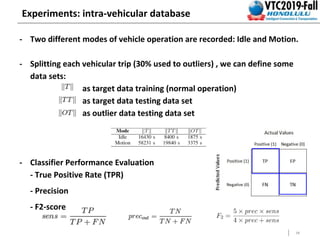
- Two different modes of vehicle operation are recorded: Idle and Motion.
-
- Splitting each vehicular trip (30% used to outliers) , we can define some
data sets:
as target data training (normal operation)
as target data testing data set
as outlier data testing data set
- Classifier Performance Evaluation
- True Positive Rate (TPR)
- Precision
- F2-score
11
Summary of the Results
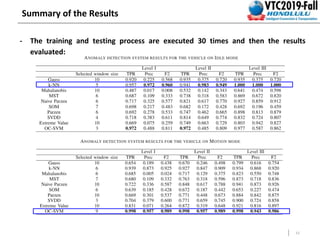
- The training and testing process are executed 30 times and then the results
evaluated:
12
Results
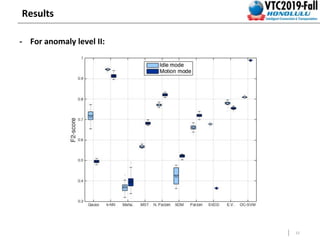
- For anomaly level II:
13
Results
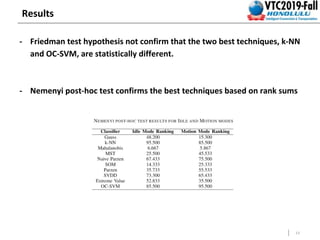
- Friedman test hypothesis not confirm that the two best techniques, k-NN
and OC-SVM, are statistically different.
- Nemenyi post-hoc test confirms the best techniques based on rank sums
14
Conclusions
- This work has shown the need to evaluate vehicular anomalies in different
malfunctioning or degeneration degrees.
- Experiments has shown k-NN and OC-SVM as the best techniques for the
respective idle and motion modes.
- The proposed approach of injecting anomalies can be applied in other
sensors analysis.
Mahalo!
(Thank You)

Detecting Anomalies in the Engine Coolant Sensor using One-Class Classifiers

  • 1.
    Detecting Anomalies inthe Engine Coolant Sensor using One-Class Classifiers Eronides F. da Silva Neto, Allan R. S. Feitosa, George D. C. Cavalcanti and Abel G. Silva-Filho 2019 IEEE 90th Vehicular Technology Conference
  • 2.
    2 Agenda - Introduction - - ProposedAnomaly Detection System - - Experiments - Results - Conclusion -
  • 3.
    3 Introduction - New servicesand drive experience provided by the combination of Information and Communication Technologies (ICTs). - Some papers have evaluated the detection of anomalies in intra-vehicular signals as a classification problem. - The most recent contribution (Theisller, 2017) presents an approach to detect known and unknown anomalies in the Engine Coolant Temperature (ECT) sensor.
  • 4.
    4 Overview of theProposed Anomaly Detection System - Data Acquisition - Feature Extraction - Feature Selection - Classifier Evaluation -
  • 5.
    5 Feature Extraction andSelection - The data acquisition system connected to the OBD-II interface captures 27 different parameters (attributes) at a rate of one sample per second (1Hz). - This work is based on the detection of contextual anomalies in the Engine Coolant Temperature (ECT) sensor. - Carloop development kit allow us to try to get some specific PIDs from vehicle. -
  • 6.
    6 Feature Extraction andSelection - The feature extraction process is based on a sliding window with a configurable width (N). - Driving cycles definition -
  • 7.
    7 Feature Selection - Pre-processingphase normalizes the data: - From a correlation index analysis, Engine Load is also selected as an attribute. A driving cycle of k seconds can be represented by: - In addition to the ECT sensor value and Engine load, the standard deviation and variance of ECT sensor are also used: - The final data instance of the system is:
  • 8.
    8 One Class ClassifierEvaluation The different techniques evaluated separated by their category are: - Instance-based techniques: k-NN; - Statical Methods: Gaussian data description, Parzen and Naive Parzen window density estimator and Extreme Value Analysis; - Neural Networks: Self-organizing Map (SOM); - Rule-based: Minimum Spanning Tree (MST) and Mahalanobis distance; - Support Vector Machines: SVDD and OC-SVM. -
  • 9.
    9 Experiments - To evaluatethe proposed system, anomalies are artificially injected to the ECT sensor signal based on three different anomaly levels: - The artificial component inserted representing ECT sensor malfunctioning is composed by a significant flicker noise component in the ECT sensor.
  • 10.
    10 Experiments: intra-vehicular database -Two different modes of vehicle operation are recorded: Idle and Motion. - - Splitting each vehicular trip (30% used to outliers) , we can define some data sets: as target data training (normal operation) as target data testing data set as outlier data testing data set - Classifier Performance Evaluation - True Positive Rate (TPR) - Precision - F2-score
  • 11.
    11 Summary of theResults - The training and testing process are executed 30 times and then the results evaluated:
  • 12.
  • 13.
    13 Results - Friedman testhypothesis not confirm that the two best techniques, k-NN and OC-SVM, are statistically different. - Nemenyi post-hoc test confirms the best techniques based on rank sums
  • 14.
    14 Conclusions - This workhas shown the need to evaluate vehicular anomalies in different malfunctioning or degeneration degrees. - Experiments has shown k-NN and OC-SVM as the best techniques for the respective idle and motion modes. - The proposed approach of injecting anomalies can be applied in other sensors analysis.
  • 15.