Detect If URL Opens in Browser or App_ Quick Guide.pdf
From using tools and code to leveraging handy tips, discover how to easily detect if a URL opens in a browser or app and take control of your digital navigation!
https://blog.herond.org/detect-if-url-opens-in-browser-or-app/
Detect If URL Opens in Browser or App_ Quick Guide.pdf
1.
Ever wondered whya link opens in an app instead of your browser, or vice versa?
Knowing how to detect if a URL opens in a browser or app is crucial for improving
user experience, streamlining app development, and analyzing data effectively.
Whether you’re a developer, marketer, or casual user, this quick guide offers simple,
practical methods to identify URL behavior. From using tools and code to leveraging
handy tips, discover how to easily detect if a URL opens in a browser or app and take
control of your digital navigation!
Introduction about URL opens in browser or app
Understanding whether a URL opens in a browser or an app is essential for
enhancing user experience and optimizing digital navigation. This introduction
explores why detecting URL behavior matters and previews quick, effective methods
to identify it.
What is URL?
A URL (Uniform Resource Locator) is the address used to locate a resource on the
internet, such as a webpage, image, or file. It typically consists of a protocol (e.g.,
https://), a domain name (e.g., www.companyabc.com), and a path to the specific
resource (e.g., /page), enabling browsers or apps to access and display content.
2.
What do weneed to know about URL?
To effectively navigate the internet, it’s essential to understand URLs (Uniform
Resource Locators), which serve as addresses for locating online resources like
webpages or files. Knowing a URL’s structure – protocol (e.g., https://), domain, and
path – helps users and developers ensure seamless access to content in browsers
or apps. URLs also play a key role in SEO, marketing, and security, enabling better
user experience, campaign tracking, and safe browsing practices.
Why Detect If a URL Opens in a Browser or App?
Knowing how to detect if a URL opens in a browser or an app is essential for
enhancing user experience and improving data analysis. Understanding URL
behavior ensures links function as intended, boosting efficiency across various
tasks.
Common Use Cases
3.
App Development: EnsuringURLs Trigger Apps (Deep
Linking)
Detecting if a URL opens in a browser or an app is critical for app developers to
ensure seamless deep linking, where URLs direct users to specific content within an
app, such as a song in Spotify or a post in a social media app. By verifying whether a
URL triggers the intended app (e.g., using schemes like “spotify://”) or falls back to a
browser, developers can test and refine app functionality. This process ensures a
smooth user experience and compatibility across platforms.
Digital Marketing: Tracking User Behavior Across Browsers or
Apps
In digital marketing, detecting if a URL opens in a browser or an app helps marketers
track user behavior and optimize campaigns. Understanding whether a promotional
link directs users to a mobile app (for higher engagement) or a website (for broader
reach) allows for better targeting and performance analysis. For instance, a
campaign link for an e-commerce app might be tested to ensure it opens the app for
logged-in users or a browser for new visitors. Tools like Google Analytics or
Branch.io can leverage this data to refine strategies.
Link Testing: Verifying URLs Function Correctly on Different
Platforms
Detecting if a URL opens in a browser or an app is vital for link testing to ensure
URLs work as intended across various platforms. SEO professionals, content
creators, or QA testers need to verify that links function correctly on iOS, Android, or
desktop environments. By detecting if a URL opens in a browser or an app, testers
can identify and fix broken links or misconfigured redirects, ensuring reliability and
user satisfaction.
4.
Benefits
Enhances User Experience
Detectingif a URL opens in a browser or an app significantly improves user
experience by ensuring links lead to the intended destination. For instance, a URL
designed to open the Spotify app should seamlessly launch the app for users who
have it installed, rather than redirecting to a browser, which can be frustrating. By
confirming URL behavior, you can prevent misdirects and provide a smooth, intuitive
navigation experience across devices, whether users are accessing content on iOS,
Android, or desktop. This clarity makes digital interactions more enjoyable and
efficient for everyone.
Optimizes Marketing Campaigns
For digital marketers, detecting if a URL opens in a browser or an app is key to
optimizing campaign performance. Understanding whether a promotional link
directs users to a mobile app (for higher engagement) or a website (for broader
reach) allows marketers to tailor strategies and track user behavior effectively. For
5.
example, a campaignfor an e-commerce app can be refined by ensuring links open
the app for logged-in users. Tools like Google Analytics rely on this data to measure
conversions, making it essential to detect if a URL opens in a browser or an app for
data-driven marketing success.
Supports Debugging in Web/App Development
Detecting if a URL opens in a browser or an app is crucial for developers debugging
web or app functionality. Misconfigured URLs, such as those failing to trigger deep
links or universal links, can disrupt app features or user flows. By verifying whether a
URL opens the intended app (e.g., a payment app like PayPal) or falls back to a
browser, developers can identify and fix issues like broken links or incorrect
redirects. This process ensures apps and websites work seamlessly across
platforms, saving time and enhancing reliability during development.
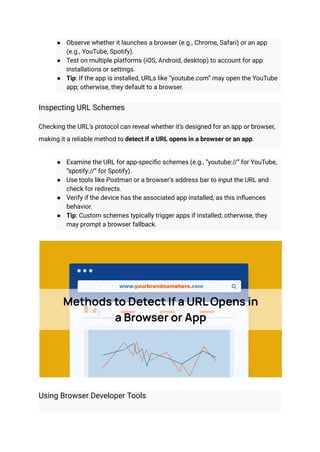
Methods to Detect If a URL Opens in a Browser or
App
Below are practical methods to identify whether a URL directs to a browser or an
app, ensuring seamless navigation and functionality across platforms.
Manual Testing
Manual Testing on Devices
Manual testing is a straightforward way to detect if a URL opens in a browser or an
app.
● Open the URL on a device (smartphone, tablet, or PC) using a browser or
messaging app.
6.
● Observe whetherit launches a browser (e.g., Chrome, Safari) or an app
(e.g., YouTube, Spotify).
● Test on multiple platforms (iOS, Android, desktop) to account for app
installations or settings.
● Tip: If the app is installed, URLs like “youtube.com” may open the YouTube
app; otherwise, they default to a browser.
Inspecting URL Schemes
Checking the URL’s protocol can reveal whether it’s designed for an app or browser,
making it a reliable method to detect if a URL opens in a browser or an app.
● Examine the URL for app-specific schemes (e.g., “youtube://” for YouTube,
“spotify://” for Spotify).
● Use tools like Postman or a browser’s address bar to input the URL and
check for redirects.
● Verify if the device has the associated app installed, as this influences
behavior.
● Tip: Custom schemes typically trigger apps if installed; otherwise, they
may prompt a browser fallback.
Using Browser Developer Tools
7.
Browser Developer Toolsoffer a technical approach to detect if a URL opens in a
browser or an app, perfect for developers needing detailed insights.
● Open the URL in a browser and access Developer Tools (press F12 or
right-click > Inspect).
● Check the “Network” tab for redirects or app-specific responses.
● Run navigator.userAgent in the console to identify the environment
(browser or app).
● Tip: Use extensions like “User-Agent Switcher” to simulate app
environments for testing.
Leveraging Analytics or SDKs
Analytics tools and SDKs provide automated ways to detect if a URL opens in a
browser or an app, ideal for marketers and developers tracking user flows.
● Integrate tools like Google Analytics or Mixpanel to monitor where users
land (browser or app).
● Use SDKs like Branch.io or Firebase Dynamic Links to track deep link
behavior.
● Check platform-specific configs, such as Apple’s Universal Links or
Android’s App Links.
● Tip: These tools log detailed data, helping confirm whether a URL triggers
an app or browser.
Using Online Tools or Extensions
Online tools and browser extensions simplify the process to detect if a URL opens in
a browser or an app, especially for non-technical users.
● Use tools like Redirect Checker or URL Profiler to analyze URL paths and
redirects.
● Install browser extensions like “User-Agent Switcher” to mimic app or
browser environments.
● Test the URL across different devices or emulators to verify behavior.
● Tip: Ensure tools are updated to support modern app protocols for
accurate results.
8.
Tips for OptimizingURL Detection
To effectively detect if a URL opens in a browser or an app, applying optimization
techniques ensures accuracy, efficiency, and a seamless process. These practical
tips help streamline URL behavior analysis for developers, marketers, and everyday
users, enhancing workflows and user experiences across platforms.
Test Across Multiple Platforms
URL behavior can vary depending on the device or operating system. So
cross-platform testing is crucial to detect if a URL opens in a browser or an app.
● Test URLs on iOS, Android, and desktop devices to observe differences.
● Check if apps like YouTube or Spotify are installed, as this affects whether
the URL opens in the app or browser.
● Use emulators or virtual devices to simulate environments without physical
hardware.
● Tip: Document results for each platform to identify patterns and ensure
consistent behavior.
Use Analytics Tools for Insights
Analytics tools provide valuable data to detect if a URL opens in a browser or an app,
especially for tracking user behavior in marketing or app development.
● Integrate Google Analytics or Mixpanel to monitor where users land after
clicking a URL.
● Set up event tracking to capture app launches versus browser redirects.
● Analyze reports to identify trends, such as higher app engagement on
mobile devices.
● Tip: Use UTM parameters in URLs to track specific campaigns and their
outcomes.
9.
Optimize Deep Linking
Deeplinking ensures URLs direct users to specific app content, and optimizing this
process helps accurately detect if a URL opens in a browser or an app.
● Configure Universal Links (iOS) or App Links (Android) correctly in app
settings.
● Test deep links with tools like Branch.io or Firebase Dynamic Links to
confirm app triggers.
● Verify fallback behavior to ensure URLs open in a browser if the app isn’t
installed.
● Tip: Regularly update app configurations to align with platform changes.
Ensure Security Checks
Security is critical when testing URLs to detect if a URL opens in a browser or an
app, as malicious links can harm devices or compromise data.
● Verify URLs come from trusted sources to avoid phishing or malware risks.
● Use URL scanners like VirusTotal to check for suspicious behavior before
testing.
10.
● Enable browsersecurity features or extensions like Herond Shield for safe
navigation.
● Tip: Avoid testing unverified URLs on personal devices; use a sandbox
environment instead.
Conclusion
Detecting if a URL opens in a browser or an app is a vital skill for enhancing user
experiences, optimizing marketing campaigns, and streamlining app development.
From manual testing and inspecting URL schemes to using browser tools, analytics,
and extensions, the methods outlined in this guide make it easy to identify URL
behavior accurately. Start applying these techniques today to ensure seamless
navigation across platforms!
About Herond
Herond Browser is a cutting-edge Web 3.0 browser designed to prioritize user
privacy and security. By blocking intrusive ads, harmful trackers, and profiling
cookies, Herond creates a safer and faster browsing experience while minimizing
data consumption.
To enhance user control over their digital presence, Herond offers two essential
tools:
● Herond Shield: A robust adblocker and privacy protection suite.
● Herond Wallet: A secure, multi-chain, non-custodial social wallet.
As a pioneering Web 2.5 solution, Herond is paving the way for mass Web 3.0
adoption by providing a seamless transition for users while upholding the core
principles of decentralization and user ownership.
Have any questions or suggestions? Contact us:
11.
● On Telegramhttps://t.me/herond_browser
● DM our official X @HerondBrowser
● Technical support topic on https://community.herond.org


![[@NaukriEngineering] Deferred deep linking in iOS](https://cdn.slidesharecdn.com/ss_thumbnails/deferreddeeplinkinginios-180322075651-thumbnail.jpg?width=640&height=640&fit=bounds)


